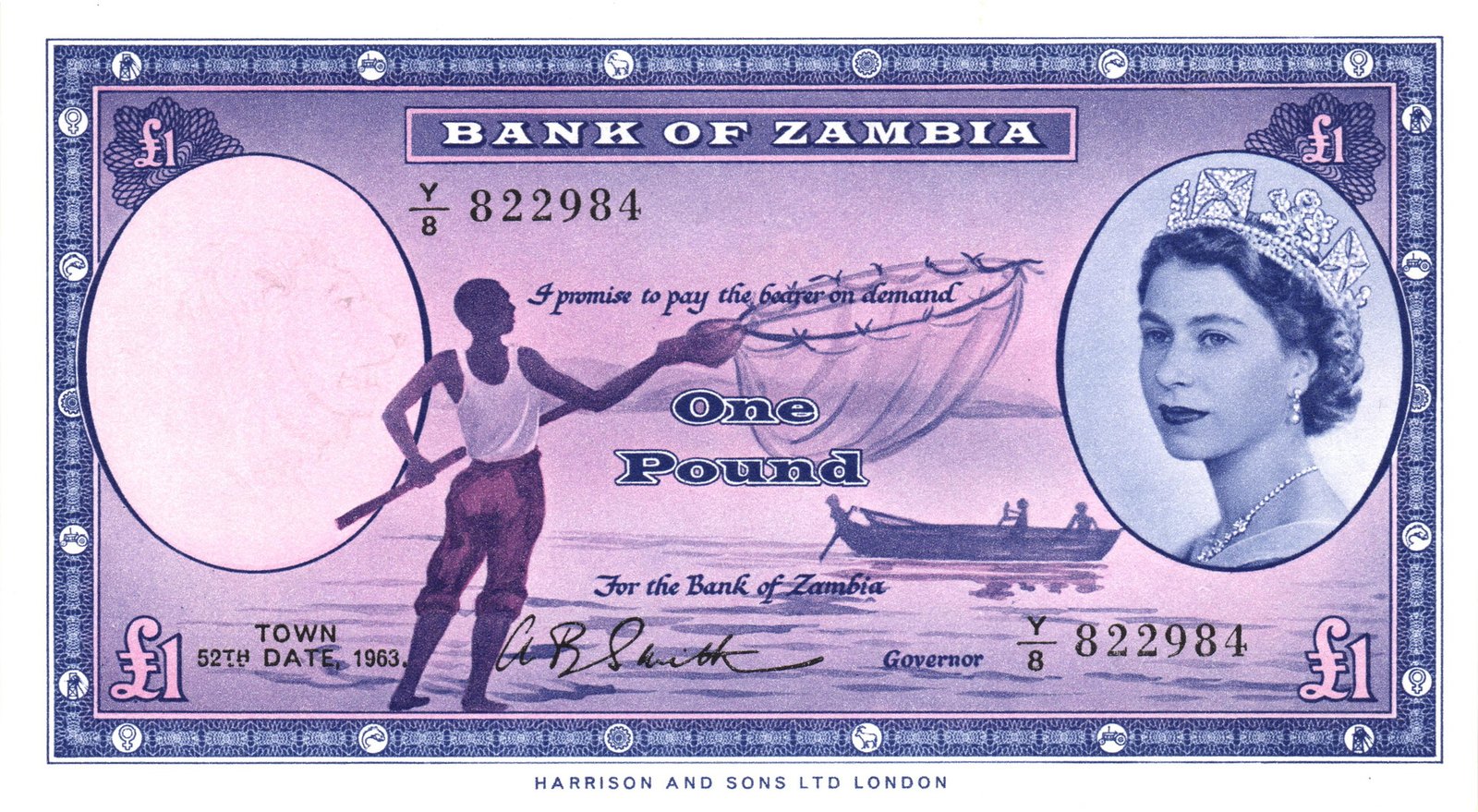
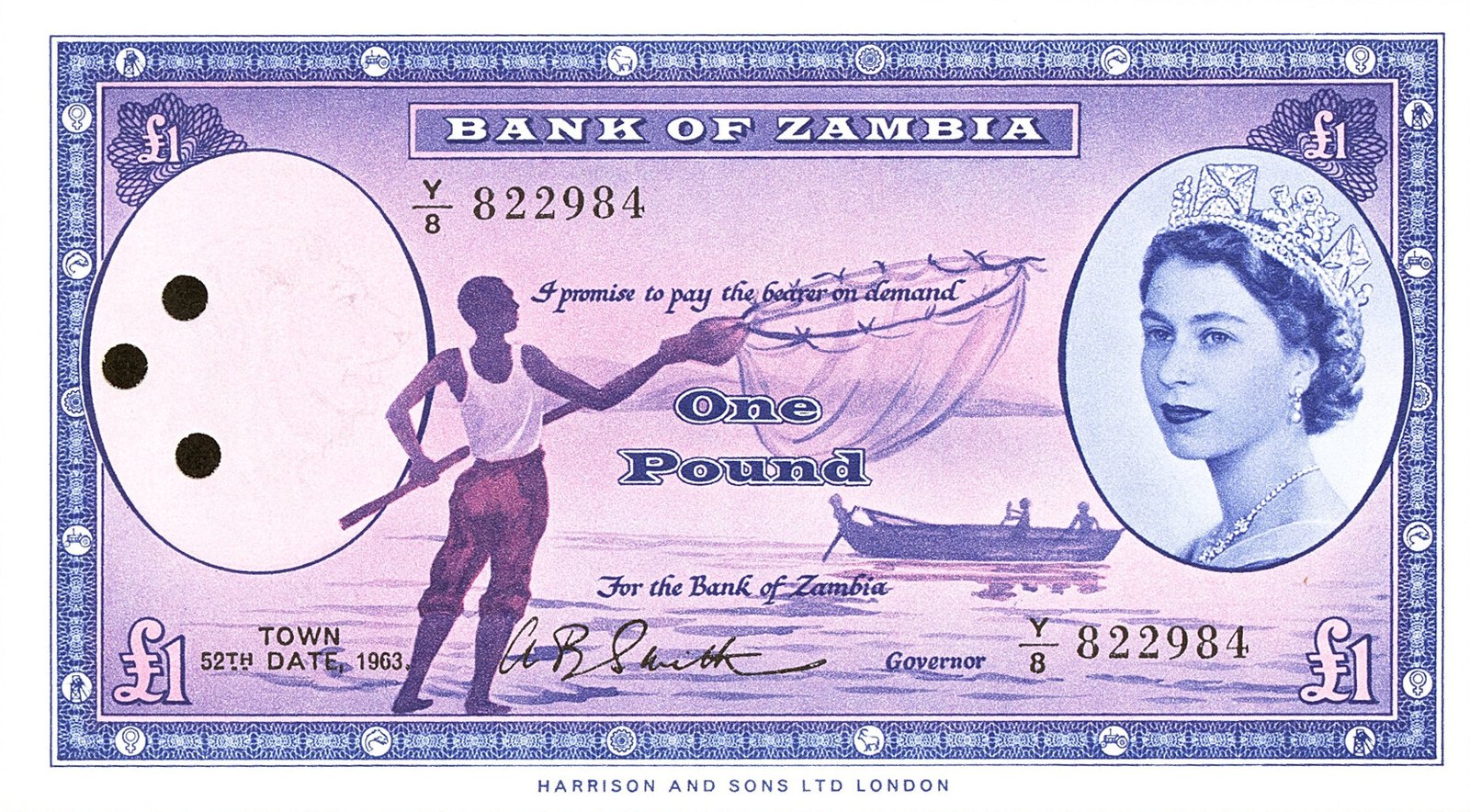
The one page of Zambia in this catalogue is not an issued note. It is the 1 pound trial of 1963 made by Harrison and Sons, with the portrait of Queen Elizabeth II. This article sets out what the printer itself said of the piece in a letter printed in the International Bank Note Society Journal in 1984, what the piece shows, and what the auction houses have claimed for it. It is one of the designs treated together in Notes that never were: unissued designs with Queen Elizabeth II.
The printer's own account, 1984
Michael McCarthy's article "Harrison & Sons: Banknote Printers" (International Bank Note Society Journal, volume 23, No. 2, 1984, page 39) starts from the catalogue listing of the piece as Pick A1. McCarthy knew Harrison and Sons as a printer of postage stamps, which the firm had been since 1910, when it won the contract for British stamps over Thomas De La Rue, and wrote to ask about the note.
The firm's reply, printed in the article, says that Harrison and Sons were not banknote printers. The piece was produced in photogravure, because intaglio printing was so expensive that the firm thought some territories might accept a photogravure note. It was made only as a trial. The firm's sales team used it to try to persuade the customer from the territory to take a note of this kind, and did not succeed.
The letter names one of the main difficulties: watermarked banknote paper has a fairly rough surface, which does not suit photogravure. It also explains the oval on the front. Making a special watermark for a trial would not have been practical, so the mark was printed to imitate the watermark a banknote would normally have.
McCarthy ends with the outcome: Zambia, formerly Northern Rhodesia, became independent in 1964, and Thomas De La Rue won the contract for the notes issued that year.
What is printed on it
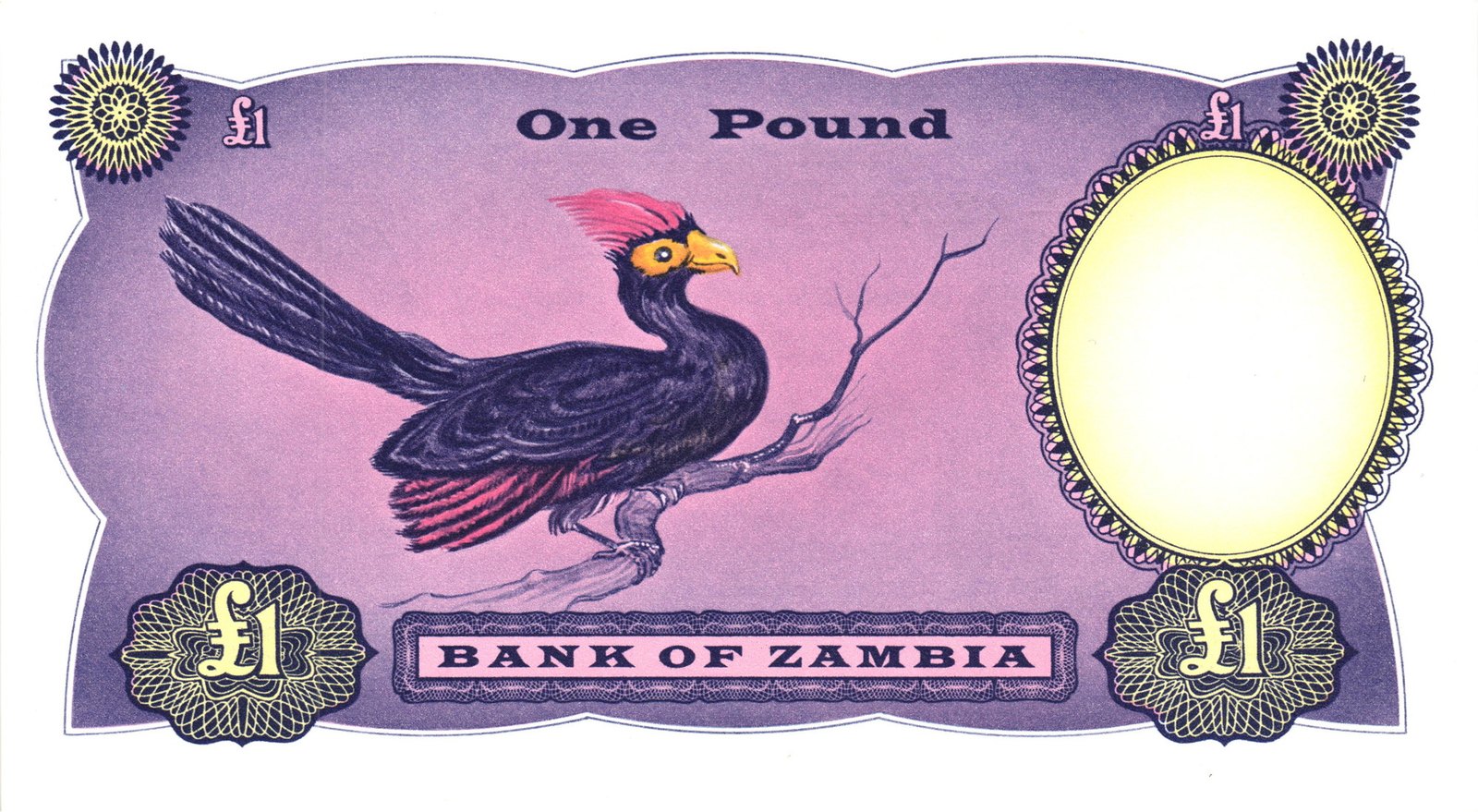
The trial dates from 1963, while the territory was still the British protectorate of Northern Rhodesia, which is why the Queen is on it. Spink's description of the piece in the Bruce Smart Collection of British Commonwealth, Part Two (lot 623) gives the design: the Queen at right, a man fishing with a net at left and two men in canoes, and on the back a Ross's Turaco. Noonans (27 November 2025, lot 1151) and Stack's Bowers (1 October 2026, lot 50368) name the bird in the same way.
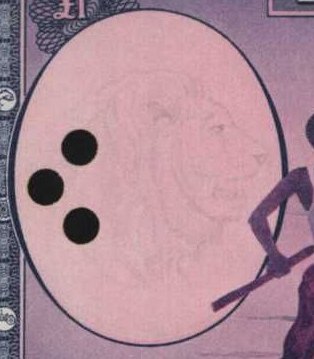
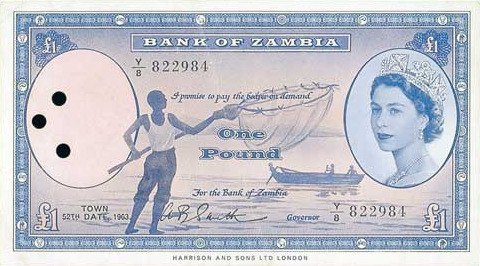
Nothing else on the piece is real. The place of issue is printed TOWN, and the date reads 52TH DATE, 1963. The signature over Governor is a sample hand reading A. B. Smith. The fully printed pieces carry one dummy serial number, Y/8 822984. The Pick page records three colour schemes (purple and pink, purple and blue, pale red-pink and purple), pieces with and without the dummy date, serial number and sample signature, and pieces with and without three punch holes.

There is no watermark. The oval on the front holds a faint lion's head printed on the paper, as the printer's letter says, and the matching oval on the back is blank.
What was issued instead
Independence came on 24 October 1964. The Pick page describes the notes the Bank of Zambia issued that year: they carried the national arms and Zambian wildlife, a Chaplin's barbet on the 10 shillings, a black-cheeked lovebird and a mining headframe on the 1 pound, a wildebeest and Victoria Falls on the 5 pounds. No Zambian note ever bore the Queen. Stack's Bowers (15 January 2021, lot 30353) and McCarthy both name De La Rue as the printer of the 1964 issue.
How many are known, as each house puts it
No source read gives the number Harrison and Sons made.
- Heritage (16 October 2025, lot 24498) says the firm printed a small quantity, all with the same serial number, signature and made-up date, and that it is unclear how many.
- Noonans (27 November 2025, lot 1151) says its piece is one of only 21 trial notes of the design ever discovered, and that only a handful are fully printed and uncancelled.
- Heritage (18 September 2020, lot 28651) says the trial is found with and without dates and with and without serial numbers, and that its piece is the one pictured in the Zambia chapter of The Banknote Book by Owen Linzmayer. Spink (sale 17035, lot 623) also calls the Bruce Smart piece The Banknote Book plate note.
Where the houses differ from the printer
Heritage (18 September 2020, lot 28651) says the piece was prepared for the newly formed Bank of Zambia. The printer's letter says it was the firm's own trial, shown by its sales team, and names no order from the customer. Spink's description of lot 2050 in its sale 9025 calls the piece a Harrison engraving. The printer's letter says it was printed by photogravure, and gives the cost of engraved work as the very reason for the trial.
The houses' colour words do not always match the rows of the Pick page. Spink (sale 17035, lot 623) and Stack's Bowers (15 January 2021, lot 30353) call purple and blue pieces that stand here on rows described as purple and pink, and Spink (sale 9025, lot 2050) calls purple and pink a piece on the row described as purple and blue. The Pick page keeps to its own three colour schemes.
Sources
- Michael McCarthy, "Harrison & Sons: Banknote Printers", International Bank Note Society Journal, volume 23, No. 2, 1984, page 39, with the letter of Harrison and Sons printed in it.
- House descriptions: Spink, sale 9025, lot 2050, and sale 17035, the Bruce Smart Collection of British Commonwealth, Part Two, lot 623; Heritage Auctions, 18 September 2020, lot 28651, and 16 October 2025, lot 24498; Stack's Bowers, 15 January 2021, lot 30353, and 1 October 2026, lot 50368; Noonans, 27 November 2025, lot 1151.
- The Pick page of the 1 pound trial.
Member comments
Log in or register to post a comment.