A printer offering a design to a colony liked to put an animal on it: a tiger for the Straits, an elephant for Ceylon, a toucan for British Guiana. Many of those animals never reached a note. The design archive of this catalogue holds what is left of them, and it lets a plain question be asked of each one: did the animal get onto an issued note later, or in another form, or not at all?
Everything here is taken from the pieces as the archive records them (what is drawn, printed and pencilled on them, and what was said when they were sold) and from the descriptions of the issued notes on the catalogue's own pages. Where a catalogue page ends before a later issue, that is said. Dates printed on a design are written as "1st March 1915"; days of events as "1 January 1968".
The Straits tiger: always on the note, seldom the one that was drawn
No animal in the archive was drawn more often than the tiger of the Straits Settlements, and it is the best example of an animal that made it while most of its versions did not.
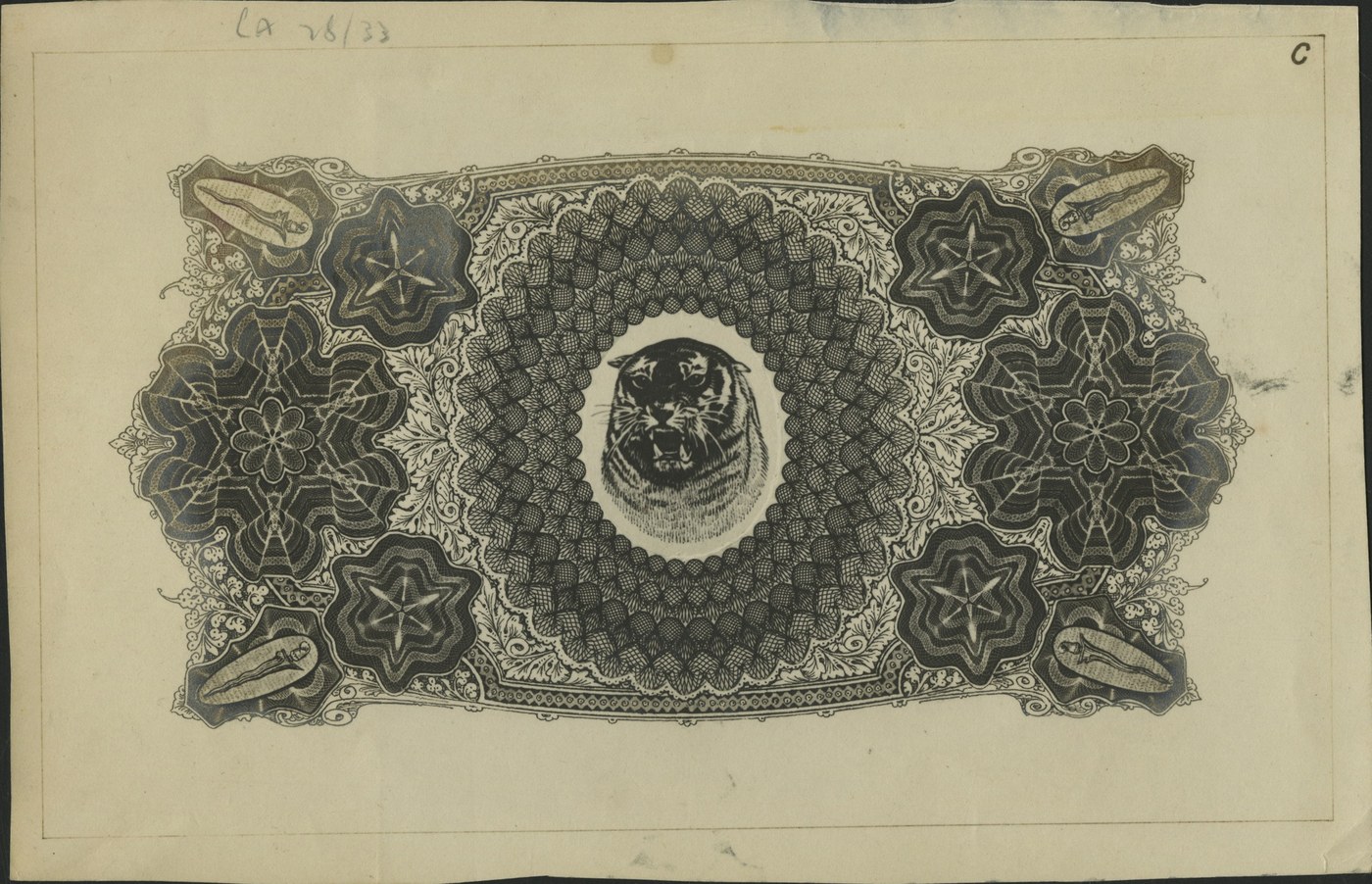
The oldest is a photograph of a proposed back, sold with two engine-turned designs that carry the pencilled date Aug 20th 95. A tiger's head looks straight out of an oval at the centre, ringed by lathe work, with kris daggers and star rosettes at the corners. The notes issued from 1898 chose another tiger: on the back of the 5 dollars and the values above it, a whole animal prowls in the jungle, with four elephants and kris around it. The facing head was not used.
In 1914 and 1915 a new set of designs was worked up as hand-coloured photographs, each dated June 8th 14 at the top, and every one of them has the tiger on the front. On a 1 dollar dated September 1915 it walks under the arms, with George V in an oval at the left. On a 5 dollars dated 1st September 1915 the King's head sits above it between two large figures 5. A 10 dollars dated 1st March 1915 has $10 at each side of it, and a 100 dollars of the same date puts a large $100 above it.
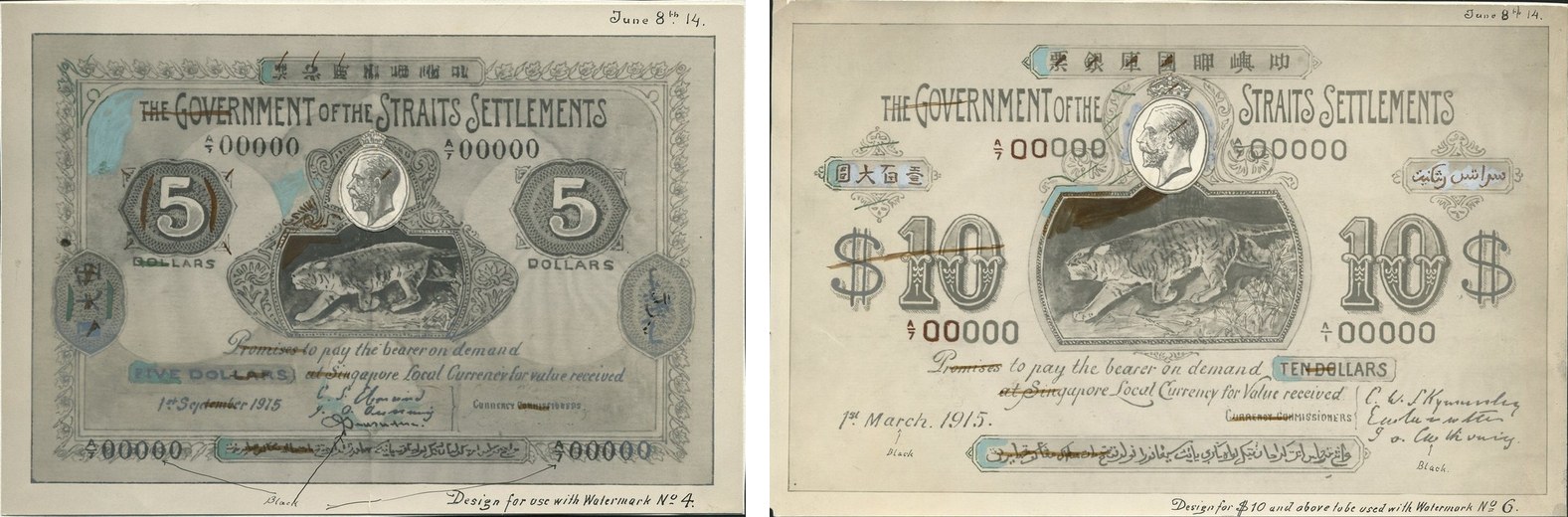
One of this family was adopted. The archive's record of another 10 dollars design of 1st March 1915 calls it the design that became the large 50 to 10,000 dollars of 1916, and those notes do carry the tiger prowling in the jungle under the crowned bust of the King (100 dollars). The 1 and 5 dollars with the King and the tiger on the front were not issued: the catalogue's 1 and 5 dollars kept the arms on the front and the tiger on the back until the dates of 1924.
For the issue of 1925 Bradbury Wilkinson competed with Thomas De La Rue and lost. Its photographs for a 10 dollars dated 15th August 1924 show three backs, one with a river scene between a kris and a tiger's head, one with a tiger at the centre and one with the value. De La Rue's notes were issued instead. Its 5 dollars has the tiger on the back; its 10 dollars has a bullock cart there, and keeps the tiger only as a head in the watermark.
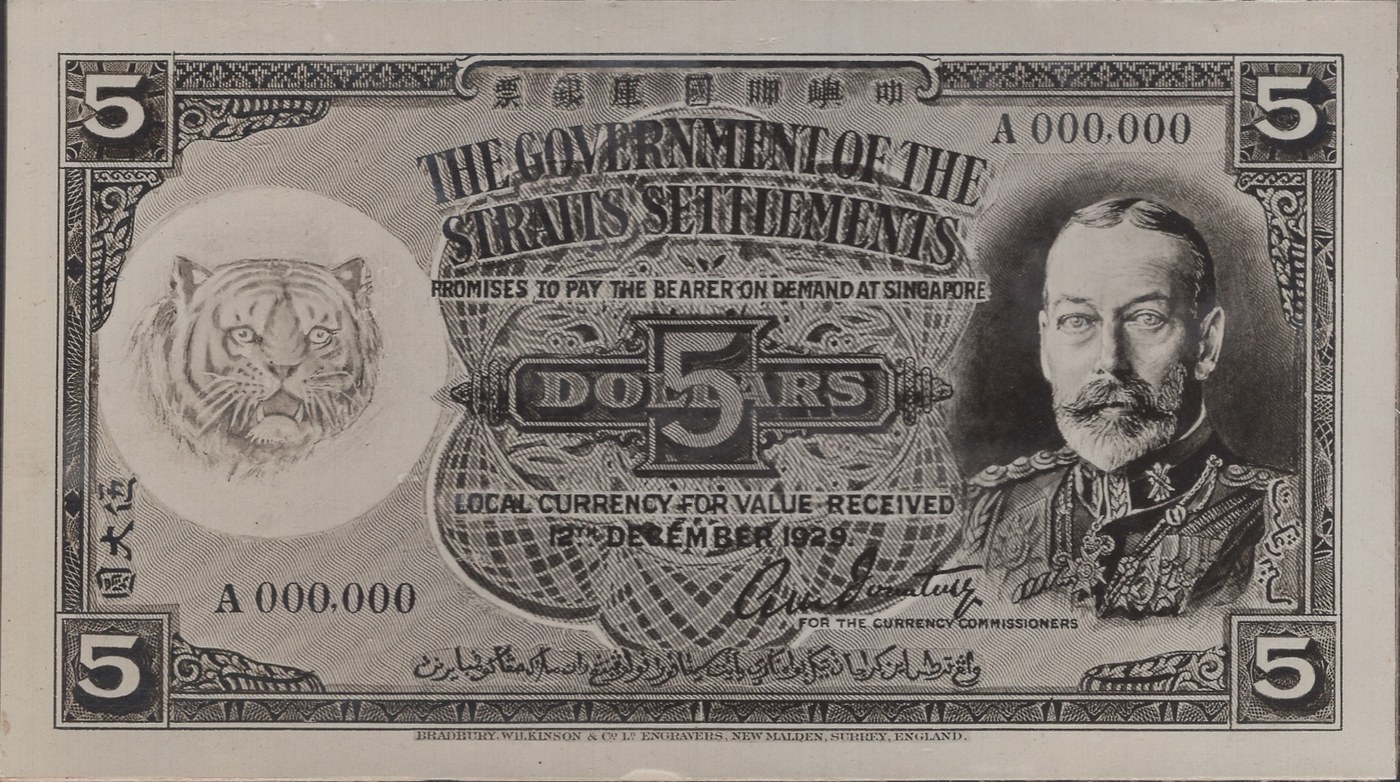
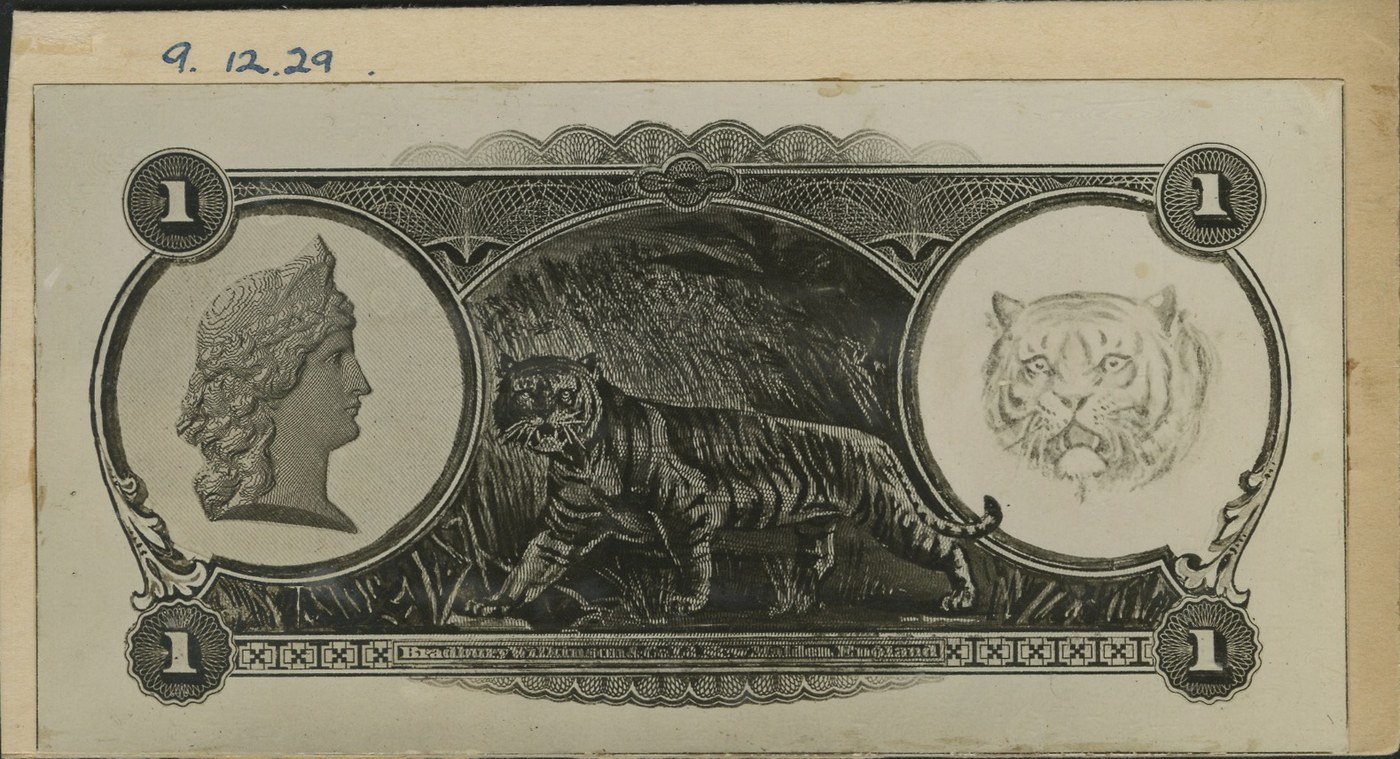
Bradbury Wilkinson came back in 1929 with photographs dated 12th December 1929, a date never used on a note. On each front a tiger's head is drawn in the circle left for the watermark: a 5 dollars which the archive calls the embryo of the 5 dollars issued from 1931, three versions of a 10 dollars, and two fronts and a back for a 1 dollar. This time the firm won, and here the animal made it in both forms: the notes of 1931 to 1935 have a tiger's head as the watermark and a tiger prowling in the jungle on the back, beside Britannia (1 dollar).
Two more tigers of these months were dropped. A 1 dollar dated 1st January 1930, hand-tinted in red-purple, has a back with a tiger in long grass. And a working sheet headed 12-1-1930 carries a green back for the 10 dollars with a tiger at the centre, marked Cancelled.
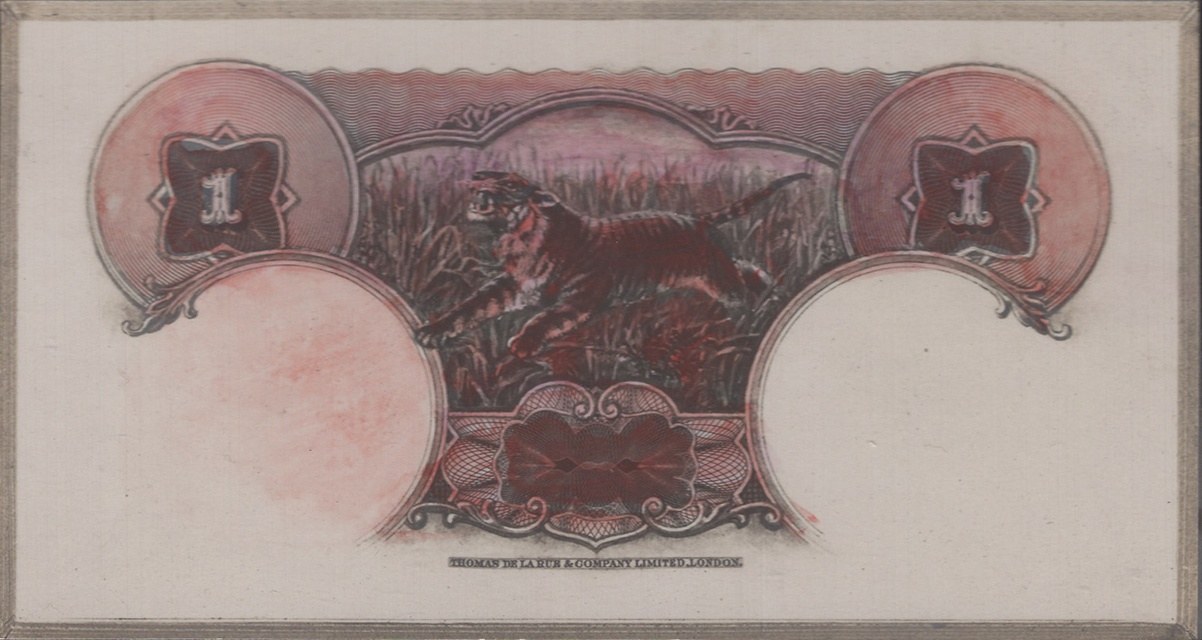
Malaya, 1937 to 1941: the tiger loses its place
For the notes of the Board of Commissioners of Currency, Malaya, De La Rue drew the tiger again. The archive has a hand-made back for a 5 dollars of about 1938, in brown and lilac, with a tiger standing in long grass, and the sale records of a 1 dollar and a 10 dollars essay say that each lot also held a back with a tiger at the centre, in blue and in green, which was not photographed.
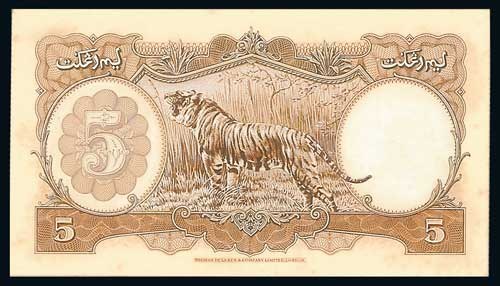
None of these backs was used. The catalogue's Malaya notes dated 1940 and 1941 have the arms of the Straits Settlements, the Malay States and Brunei on the back and a lion's head, not a tiger's, as the watermark (5 dollars dated 1941). The tiger shows once more on paper: the paste-up of the 10,000 dollars, dated 1st January 1941 and kept in the Crown Agents' archive at the British Library, has a tiger's head pencilled into the oval for the watermark.
Malaya and British Borneo, 1958: a whole series of wildlife
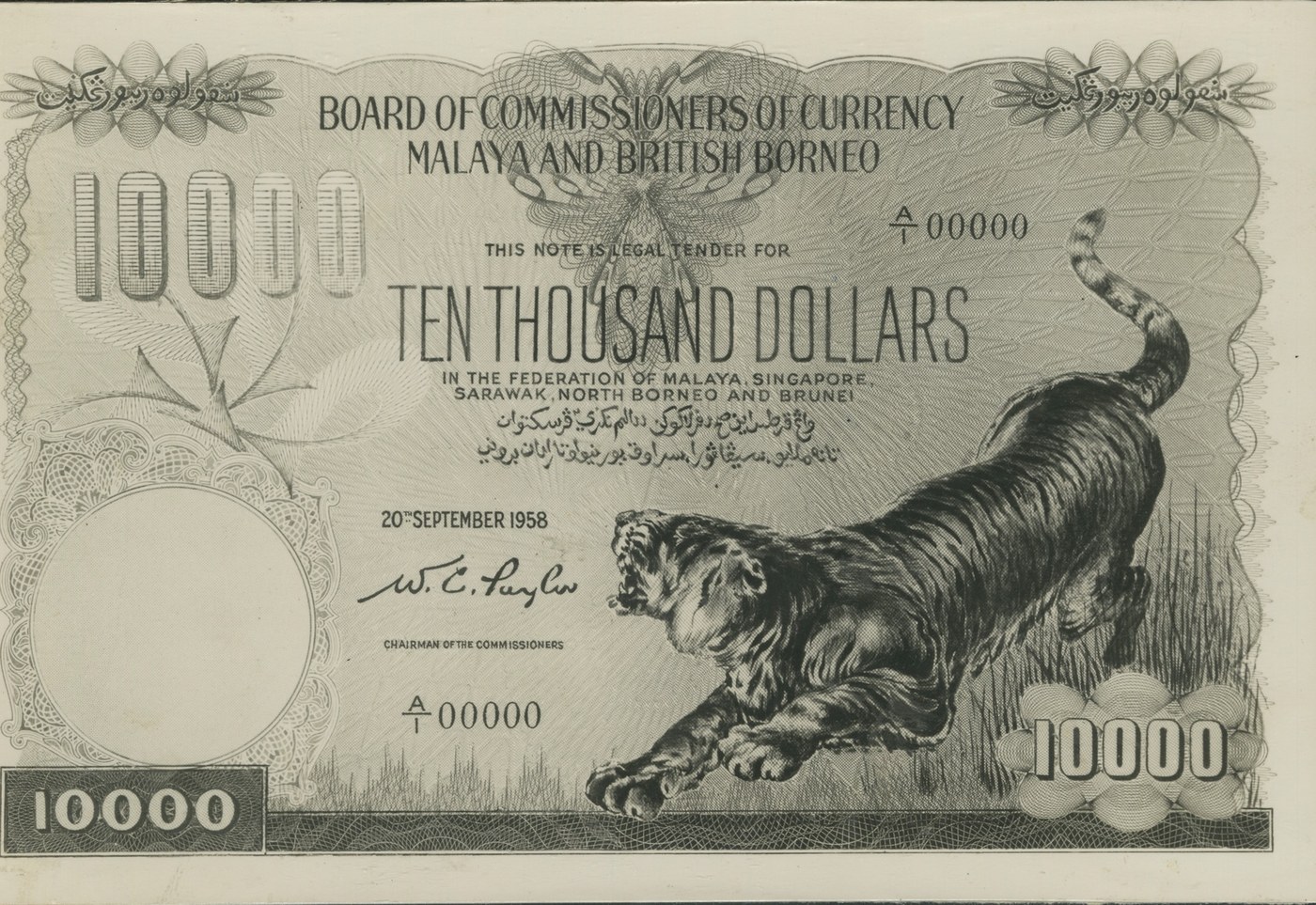
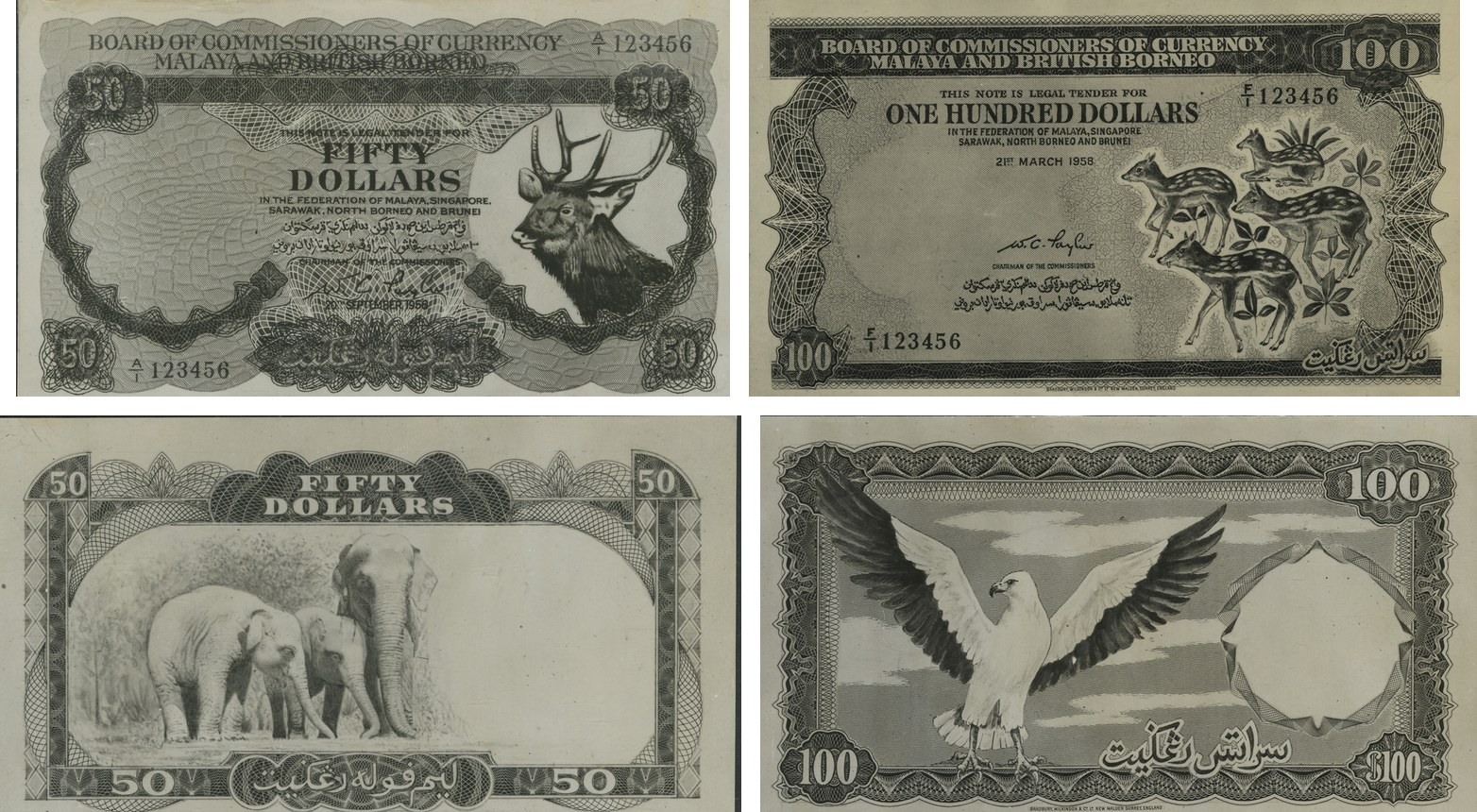
The largest group of animals that never made it is one series. In 1958 Bradbury Wilkinson prepared a second series for the Board of Commissioners of Currency, Malaya and British Borneo, and gave each value its own animal. The archive holds the firm's photographs, most of them dated 20th September 1958 and signed for W. C. Taylor:
| Value | Front | Back |
|---|---|---|
| 5 dollars | a snarling tiger's head | a tractor and a kampong among palms |
| 10 dollars (a model in colours) | the same tiger's head | not recorded |
| 50 dollars | a sambar stag | three elephants |
| 100 dollars, dated 21st March 1958 | four mouse deer | a white-bellied sea eagle with its wings spread |
| 1,000 dollars | water buffalo wading among lily pads, a gaur on a rock | an elephant among palms, with the arms of the five territories |
| 10,000 dollars | a prowling tiger | the arms of the five territories |
Two of the designs also survive as paintings: a 10,000 dollars of September 1958, front and back, with the tiger at the lower right in brown and violet, and the front of a 1,000 dollars with the water buffalo. A sketch for a 50 dollars dated 30th June 1958 tried a butterfly instead, and its notes ask for a "Duplex of Malayan butterfly".
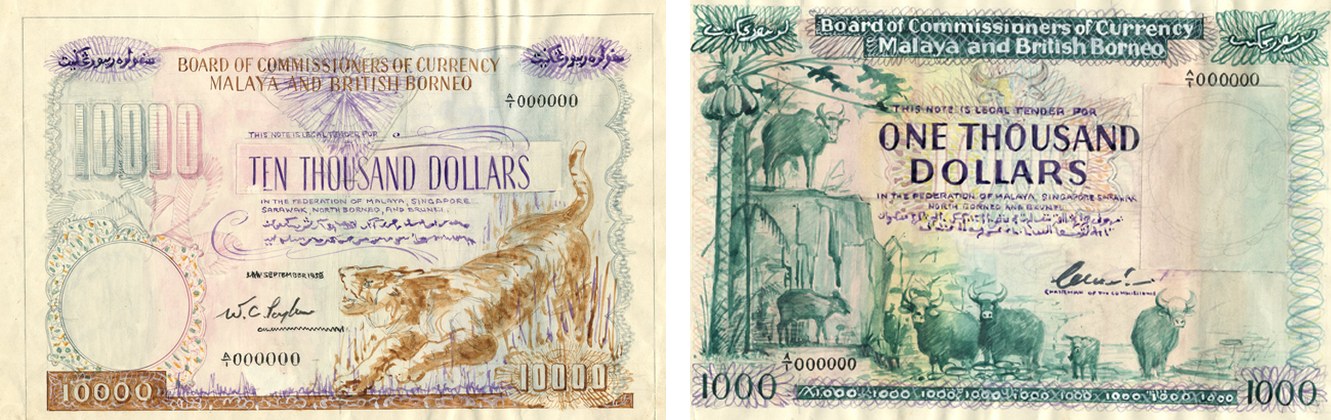
The series was not adopted. What the Board issued after it, on the catalogue's pages, was a 1 dollar of 1959 with a sailing boat and a 10 dollars of 1961 with a farmer ploughing behind a water buffalo. So one animal of the kind got through, in another form: a working buffalo in a field, not the wild herd of the 1,000 dollars. The catalogue shows that design on its way, too, as a Waterlow design dated 1st March 1959 of the note De La Rue printed. The tiger stayed where it had been since 1953, as a head in the watermark of every note of the Board. The stag, the mouse deer, the sea eagle, the gaur, the elephants and the butterfly are on no note in this catalogue.
One earlier bird belongs here. A De La Rue photograph of 1952 shows a back for the 10 dollars with a stylised bird sweeping across it. The back adopted in 1953 has arms and scrollwork.
Seychelles, 1965: the fish stayed behind
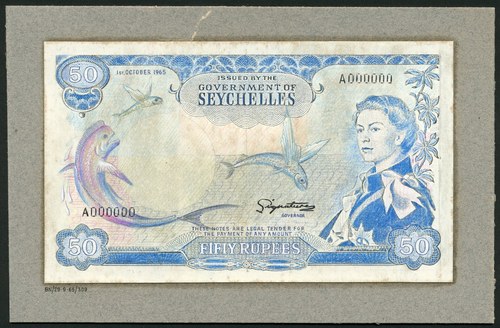
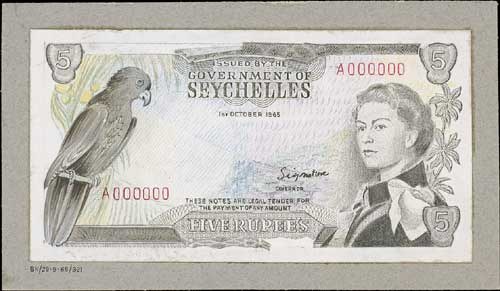
For Seychelles the archive has both halves of the story from one working session. Two hand-made designs dated 1st October 1965 carry sister job numbers pencilled on their mounts, BN/29.9.65/309 and BN/29.9.65/321. The first is a 50 rupees: a large pink and violet flying fish sweeps across the left and two blue-grey ones swim at the centre. The second is a 5 rupees with the Seychelles black parrot on a branch.
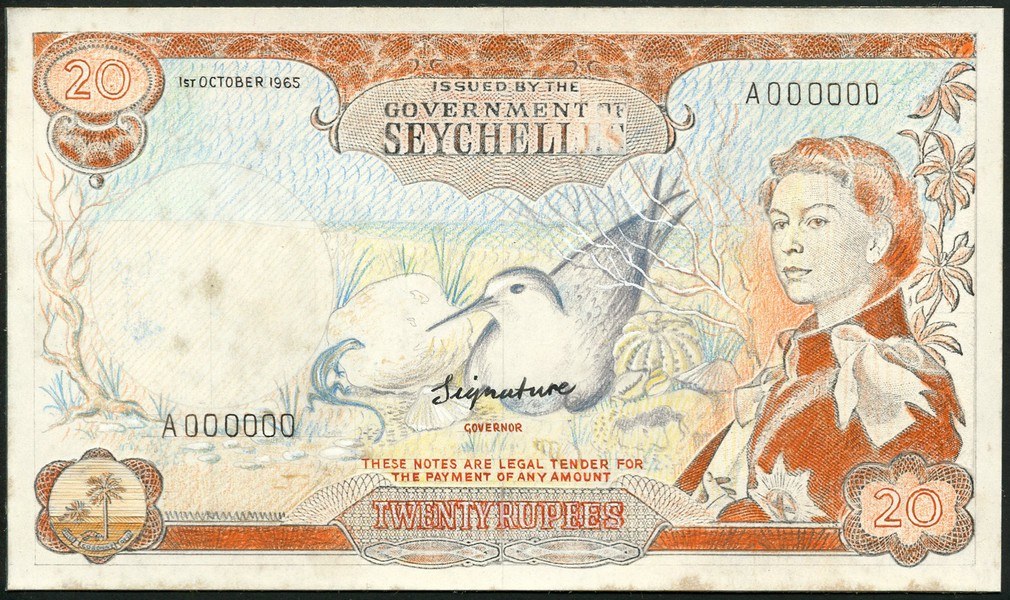
The parrot made it. The 5 rupees issued on 1 January 1968 kept the bird and the portrait and dropped the date of 1965, and a black parrot's head is the watermark of the whole series. The flying fish did not: the 50 rupees of 1968 carries a schooner. A third design of the session, a 20 rupees with a tern on the shore, a lizard and shells, reached the issued 20 rupees, whose front the catalogue describes with a sooty tern and a skink.
Two boards of fourteen wildlife vignettes and drawings, undated, show how much more was drawn than used: fairy terns, a turtle, a bird of prey and a rail on one, lionfish in three states, triggerfish and a bull's head on the other. The catalogue's Seychelles notes of 1968 have the parrot, a sea tortoise, the tern and skink and two giant tortoises. No lionfish or triggerfish is described on them.
Birds of the Caribbean
The scarlet ibis of Trinidad and Tobago
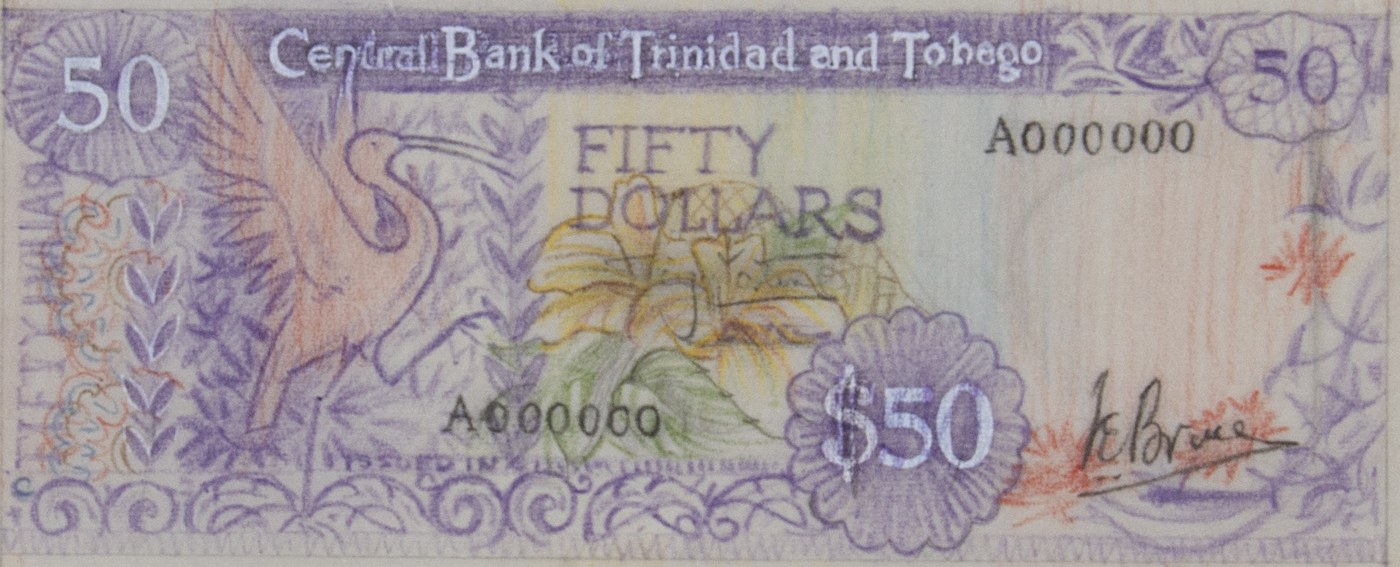
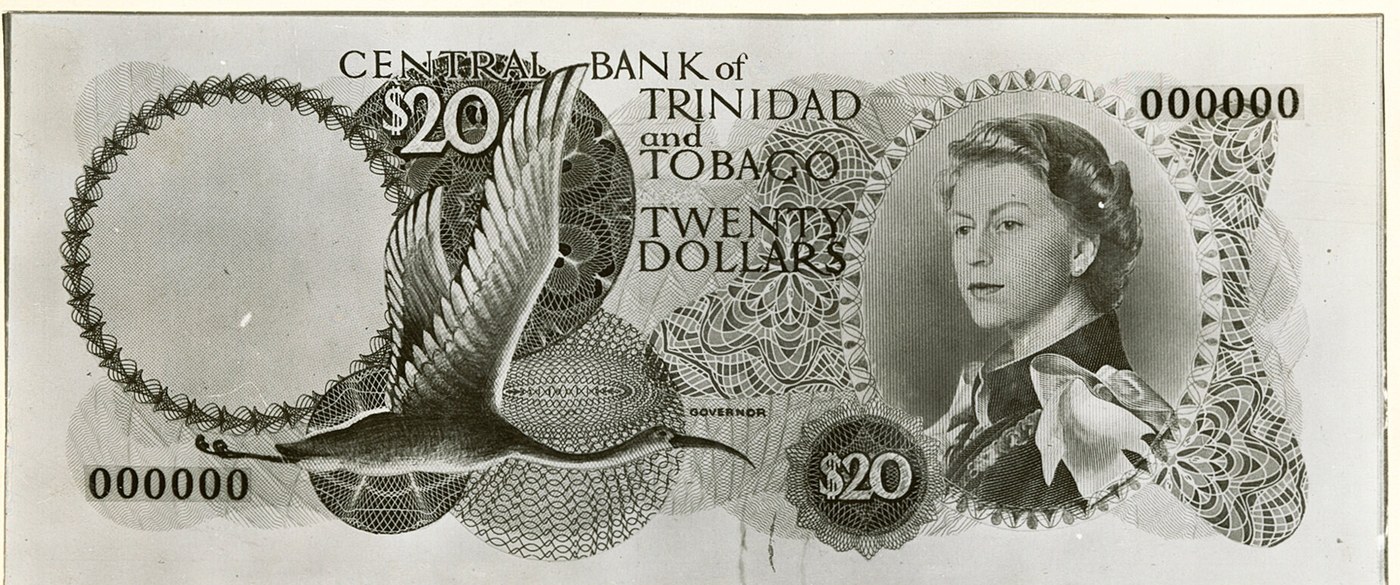
Bradbury Wilkinson's photographs for the Central Bank of Trinidad and Tobago show the scarlet ibis again and again between 1963 and 1970. A 20 dollars pencilled 8 1 63 has the bird in flight at the centre left. A 1 dollar marked 11.4.68 'B' sets it at the left of the arms and the Queen, and a later version of that note has a back of scarlet ibises in a swamp. An undated 50 dollars, in coloured pencil on tracing paper and most likely by the firm's designer Derek Friday, gives the ibis raised wings over a yellow hibiscus. Other birds were tried as well: two pelicans over a bay on a 5 dollars of 11.4.68, and a large bird among flowers on a 5 dollars pencilled 12/7/73.
On the notes this catalogue lists, the ibis is there only in heraldry. The notes issued under the Act of 1964 have the arms at the left, whose supporters include the scarlet ibis, and a bird of paradise as the watermark (1 dollar). The catalogue's pages for Trinidad and Tobago end with that series, so they do not show whether the bird was given a place of its own later; the archive says only that the next 5 dollars was a new design of 1977.
The toucan of British Guiana
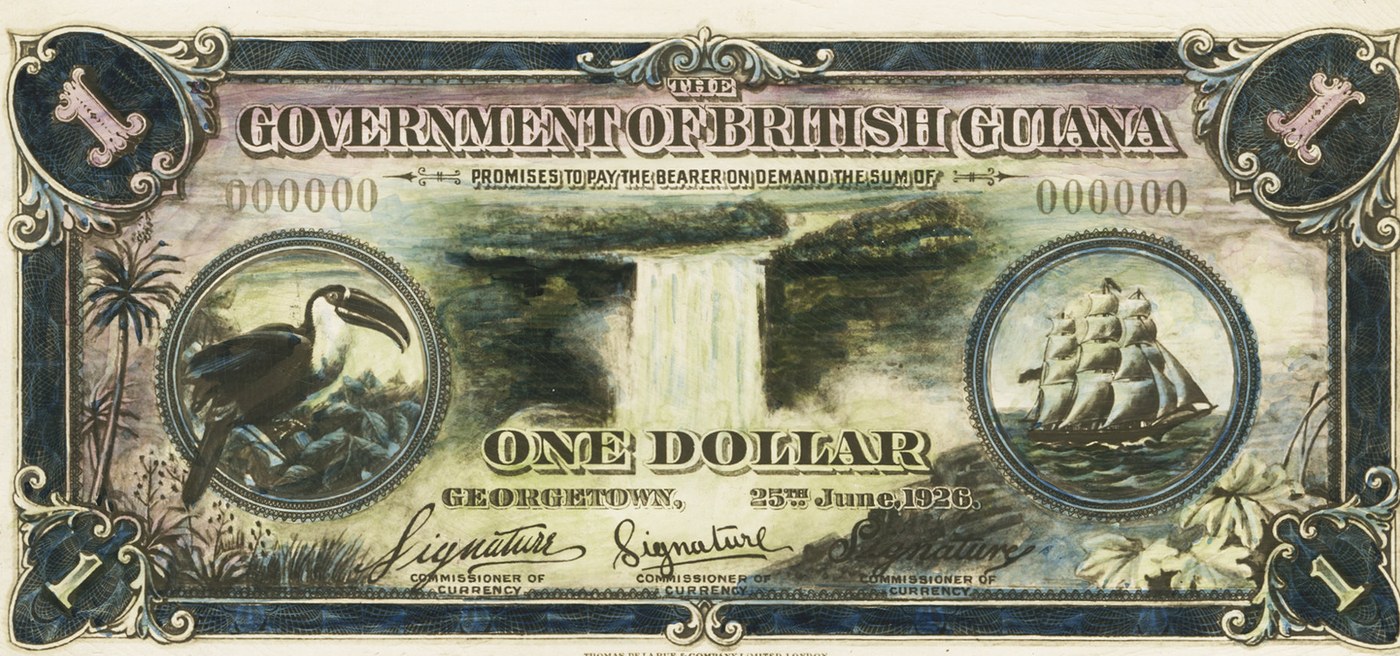
The toucan is the opposite case: a bird that outlived the design it was drawn for. De La Rue prepared a 1 dollar and a 2 dollars dated 25th June 1926 with a toucan at the left, the Kaieteur Falls at the centre and the colony's ship seal at the right. The archive has them in black and white and painted over in oils, in two sets of colours. The issue was never adopted. Bradbury Wilkinson then photographed a 1 dollar dated 1st October 1927 with the toucan and a lake scene, which was not adopted either.
The order went to Waterlow & Sons, whose pencil layouts mark a circle "British Guiana toucan bird in circle". The 1 dollar issued from 1929 has the toucan at the left, the falls at the centre and the ship at the right, and the bird stays on every later value the catalogue lists, to the 100 dollars of 1942. Two printers lost the contract; their bird did not.
The hummingbird of Jamaica
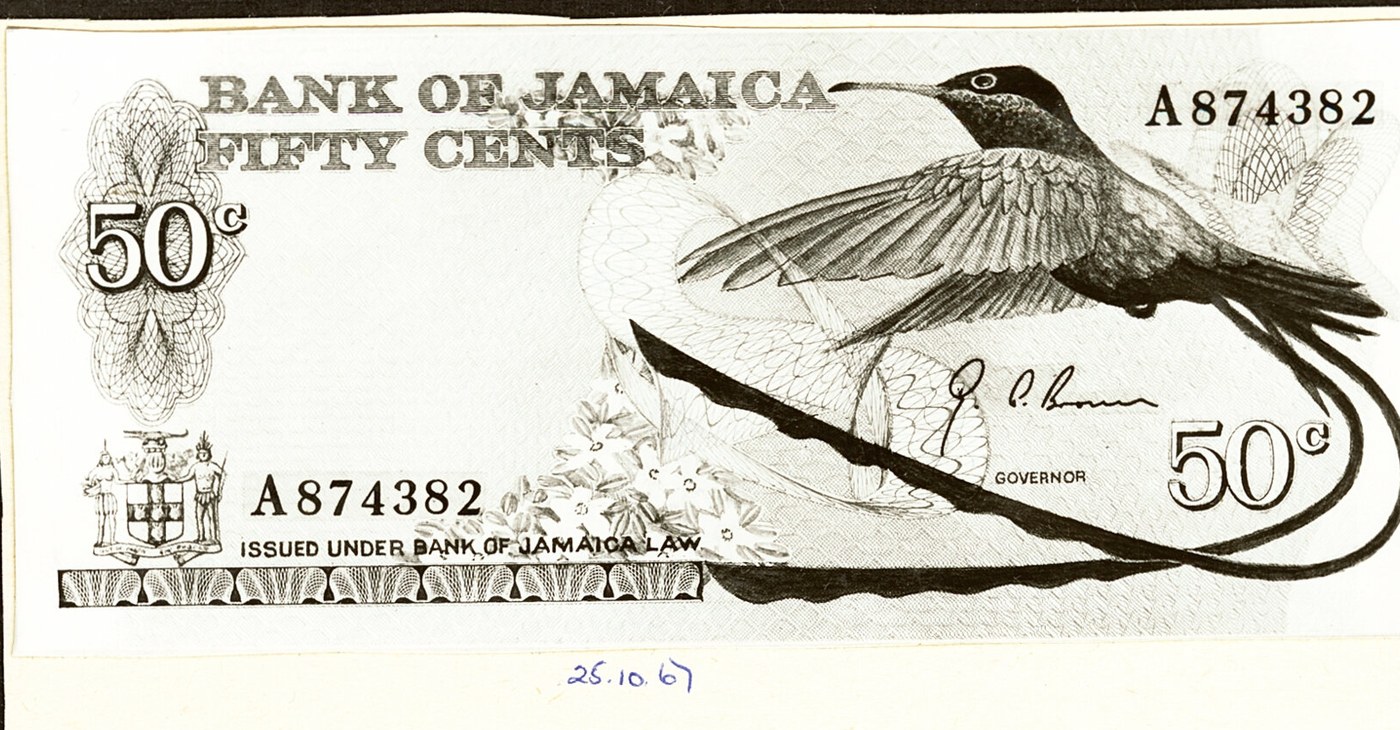
A fifty cents design for the Bank of Jamaica's decimal issue has a streamertail hummingbird across the whole front and Spanish Town Square on the back, with 25.10.67 written in ink between the two photographs. The archive's record says that the fifty cents issued in 1970 carries a portrait of Marcus Garvey instead of the bird. The catalogue's own Jamaica pages end with the pound notes of the early 1960s, none of which shows a bird, so this is as far as it can follow the hummingbird.
Marlin, flamingo and turtle
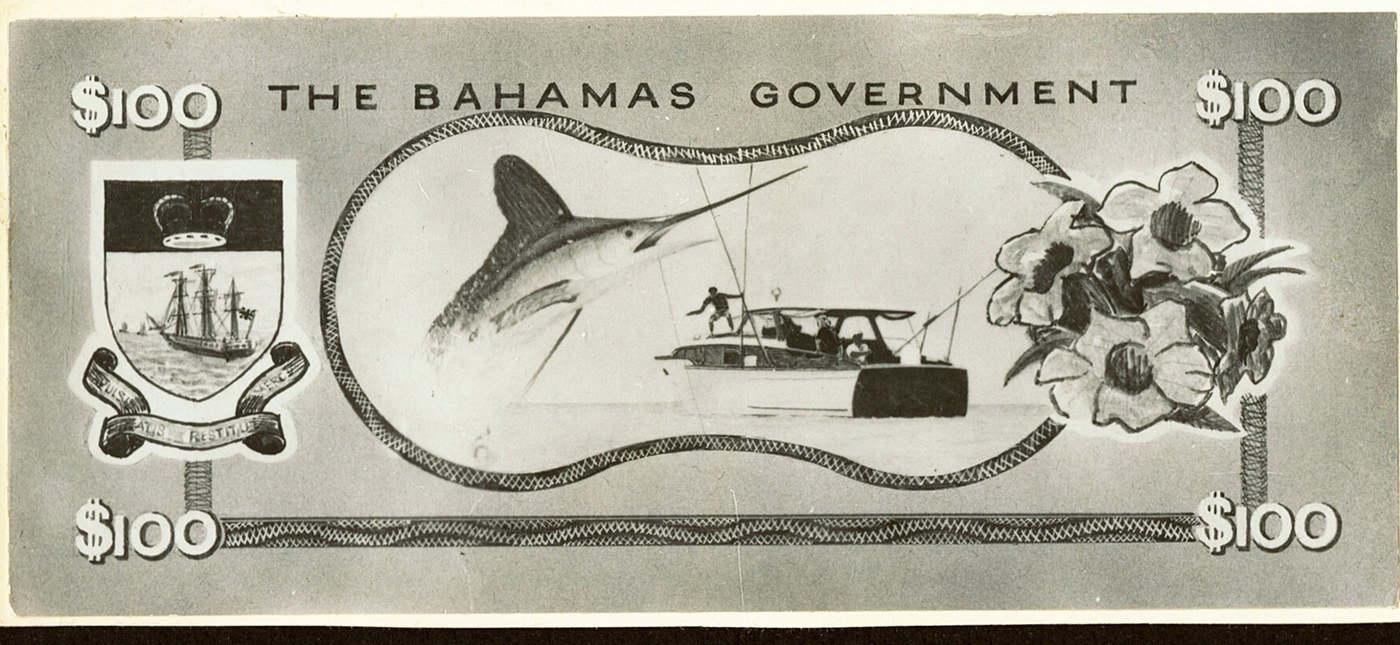
In the Bahamas the animals were kept and the designs changed around them. Photographs from the work on the decimal notes of 1965 show a 1 dollar front with a flamingo in flight and a 10 dollars back with reef fish, a 1 dollar back with fish and coral and two backs for a 100 dollars with a leaping marlin and a fishing boat. None was adopted as drawn. On the notes of 1965 in the catalogue the sea garden is on the back of the 1 dollar, flamingos are on the back of the 10 dollars and deep sea fishing is on the back of the 100 dollars: the flamingo moved from the front of one value to the back of another.
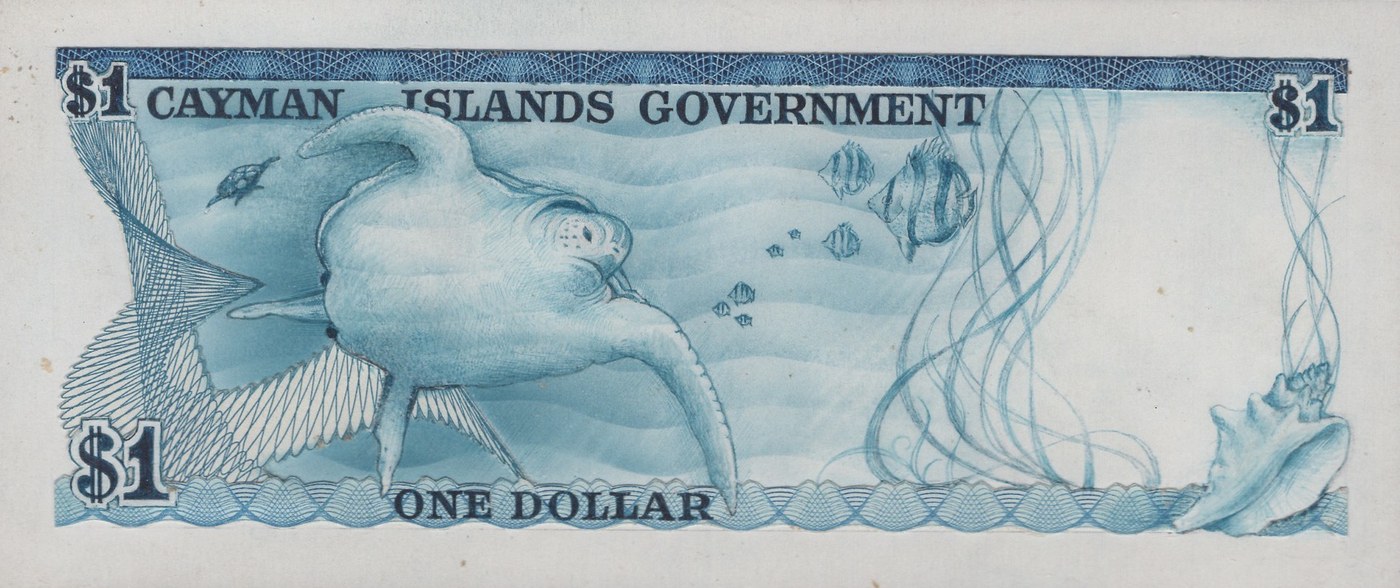
Two backs were drawn about 1970 for notes headed Cayman Islands Government, a heading no issued note carries: a 1 dollar with a sea turtle, reef fish and a conch and a 10 dollars with a leaping sailfish. The notes of the Currency Board that followed have a turtle in the watermark of every value and angelfish on the back of the 1 dollar. The sailfish is on none of them.
Bermuda's petrel, the cahow, had the same kind of luck. It flies at the left of an unadopted 10 dollars of about 1969 by Bradbury Wilkinson. The notes of 1970 were printed by De La Rue, and the catalogue has the cahow at the centre of the front of their 1 dollar and on the back of their 10 dollars.
Elephants
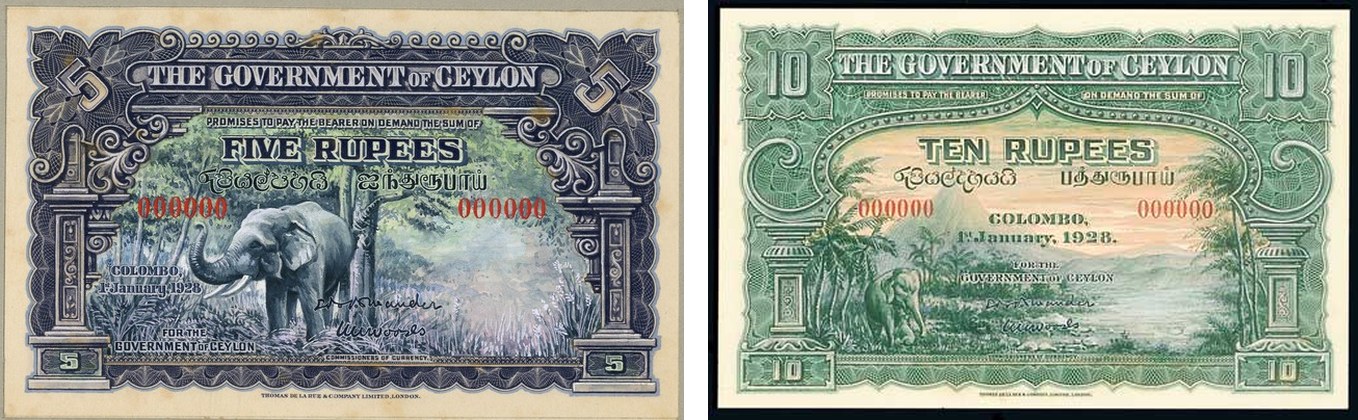
Ceylon already had an elephant: the catalogue's 2, 5 and 10 rupees of 1925 to 1939 have palm trees and an elephant as the vignette of the back, and an elephant in the watermark. In 1928 De La Rue proposed to bring it to the front. The archive has a 5 rupees dated 1st January 1928 with a tusker standing among the trees, a 10 rupees with an elephant and its young below a peak, and a group of seven bromides of the same proposal. A year before, Bradbury Wilkinson had photographed a 5 rupees with two men and their elephants at a river on the back. None was adopted, and the elephant stayed on the back. One back went the other way: an essay in green for a 500 rupees uses the elephant and palms, but the 500 rupees was issued printed on one side only, so on that value the elephant is in the watermark alone.
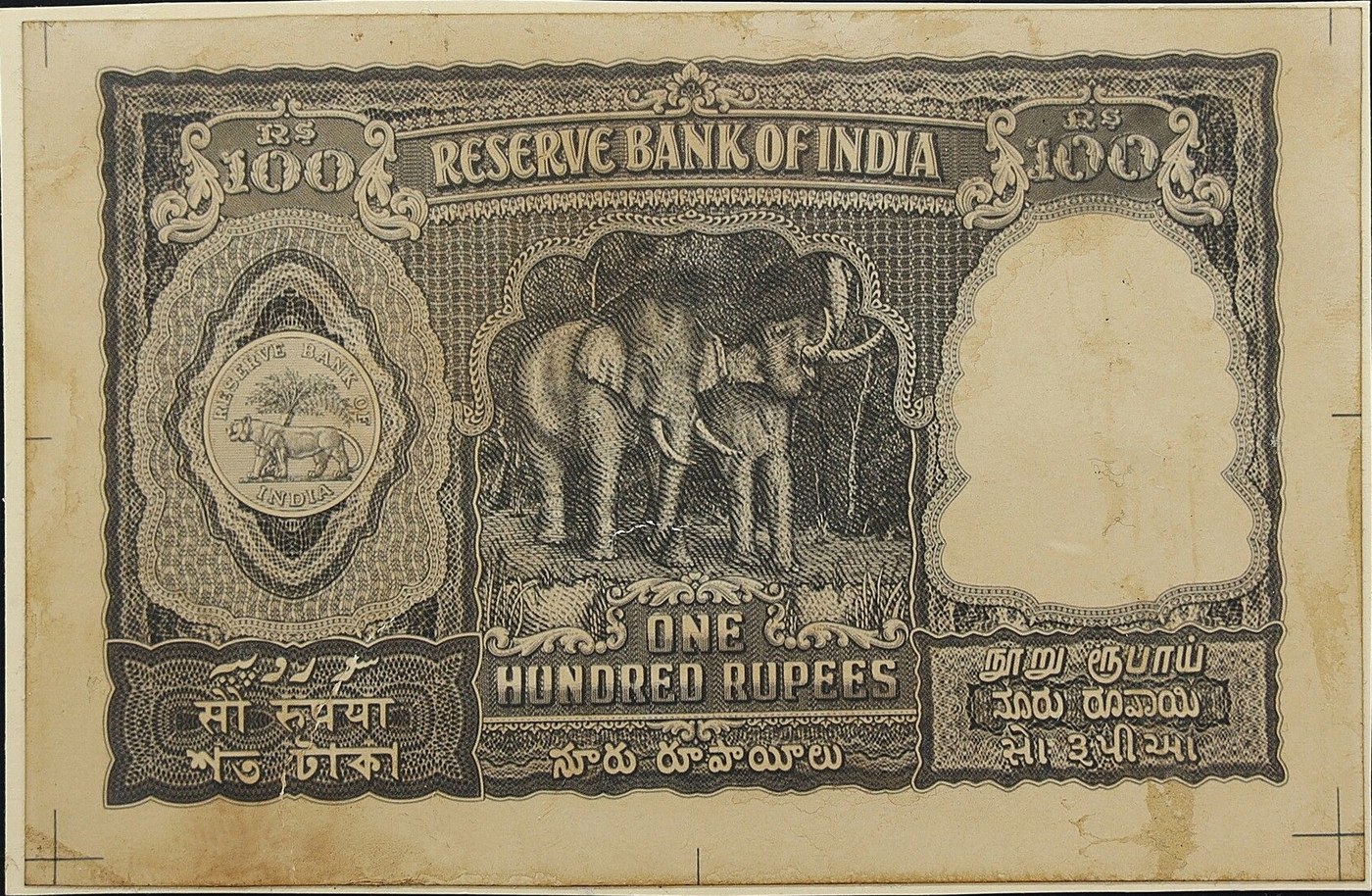
India's elephants had mixed fortunes. An essay for a 1 rupee 8 annas, a value never issued, sets George V between two elephants, and a 5 rupees of 1917 has an elephant with a howdah at the centre; neither became a note. Elephants did reach the back of the 10 rupees of the 1930s. Later a 100 rupees with the facing portrait of George VI was photographed with a pair of elephants on the back. It was not issued, and the back of the 100 rupees in the catalogue has a tiger.
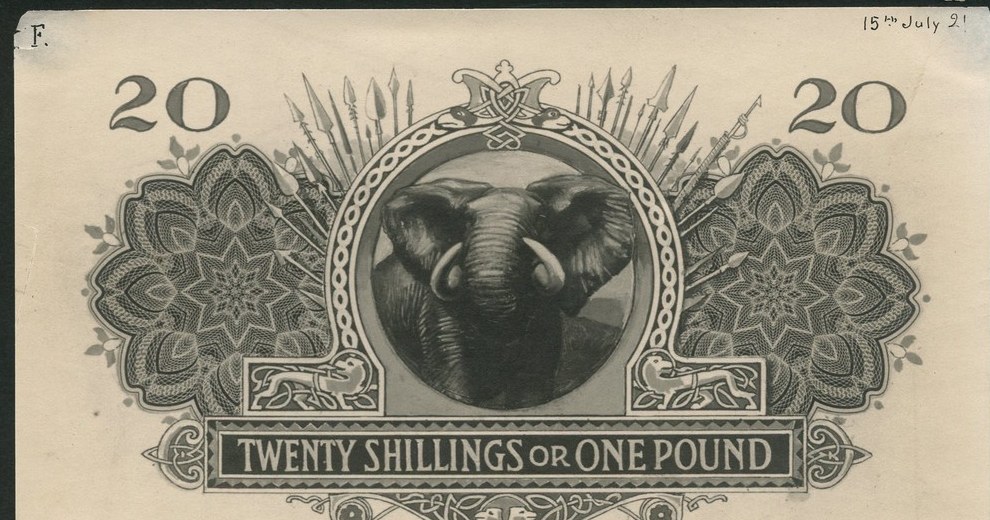
In East Africa the elephant lost to the lion. Among eight photographs of 1921 and 1922, worked over by hand, is a back for the 20 shillings with an elephant's head in the central oval, between spears and small walking lions. The note as issued has the lion before Mount Kenya. The archive's record of the hippopotamus vignettes of 1920 says the Board used only two animals: the hippopotamus on the back of the 1 rupee and 1 florin of 1920, and the lion on every later issue. A later back with a herdsman and cattle, in olive green, is on no issued note either.
Where the animal survived and the note did not
Sometimes it was the bank that never made it. Three hand-painted essays of about 1955 to 1956 are lettered Central Bank of Rhodesia and Nyasaland, a name no note was issued under: a 10 shillings with a fish eagle, a 1 pound with a leopard and a 5 pounds with a sable antelope. All three animals are on the same values of the notes that the Bank of Rhodesia and Nyasaland issued from 1956. A lion seated on a rock, engraved for a Southern Rhodesia 10 pounds of about 1940 to 1950, was not used; the 10 pounds issued from 1953 has a lion under a tree on the front and three elephants on the back.
And for one colony the animals never had a note to go on at all. De La Rue's designs of 1909 for the Government of Southern Nigeria were sold with seven backs which, by the sale's description, have a hippopotamus at the centre and small crocodiles in the border; the two fronts on record are dated 1st September 1909. No notes were issued for Southern Nigeria.
What the pieces show together
| Animal | Drawn for | Did it reach a note? |
|---|---|---|
| Tiger, facing head | Straits Settlements, about 1895 | No: the notes from 1898 have a tiger prowling in the jungle |
| Tiger under the King | Straits Settlements 1, 5 and 10 dollars, 1915 | Only on the large 50 to 10,000 dollars of 1916 |
| Tiger's head in the watermark circle | Straits Settlements, 1929 | Yes: watermark and back of the notes of 1931 to 1935 |
| Tiger in long grass | Malaya, about 1938 | No: arms on the back, a lion's head in the watermark |
| Tiger, stag, mouse deer, sea eagle, gaur, elephants | Malaya and British Borneo, 1958 | No: the tiger only as the watermark it already was |
| Water buffalo | Malaya and British Borneo 1,000 dollars, 1958 | In another form: ploughing, on the 10 dollars of 1961 |
| Flying fish | Seychelles 50 rupees, 1965 | No: a schooner in 1968 |
| Black parrot; tern and lizard | Seychelles 5 and 20 rupees, 1965 | Yes, in 1968 |
| Scarlet ibis | Trinidad and Tobago, 1963 to 1970 | Only as a supporter of the arms, on the notes the catalogue lists |
| Toucan | British Guiana, 1926 and 1927 | Yes: from 1929, by another printer |
| Hummingbird | Jamaica fifty cents, 1967 | No: the archive's record gives Marcus Garvey on the note of 1970 |
| Flamingo, reef fish, marlin | Bahamas, 1965 | Yes, on other values and other sides |
| Turtle; sailfish | Cayman Islands, about 1970 | The turtle as a watermark; the sailfish no |
| Elephant on the front | Ceylon, 1927 and 1928 | No: it stayed on the back |
| Elephant's head | East Africa 20 shillings, 1921 to 1922 | No: the lion |
| Fish eagle, leopard, sable antelope | Rhodesia and Nyasaland, about 1955 to 1956 | Yes, from 1956, under another bank name |
The records give a reason in a few cases only: another printer won the order, a bank was not set up, a value was issued without a back. For most of these animals the archive holds the drawing and no word on why it was passed over, and none is guessed here.

Member comments
Log in or register to post a comment.