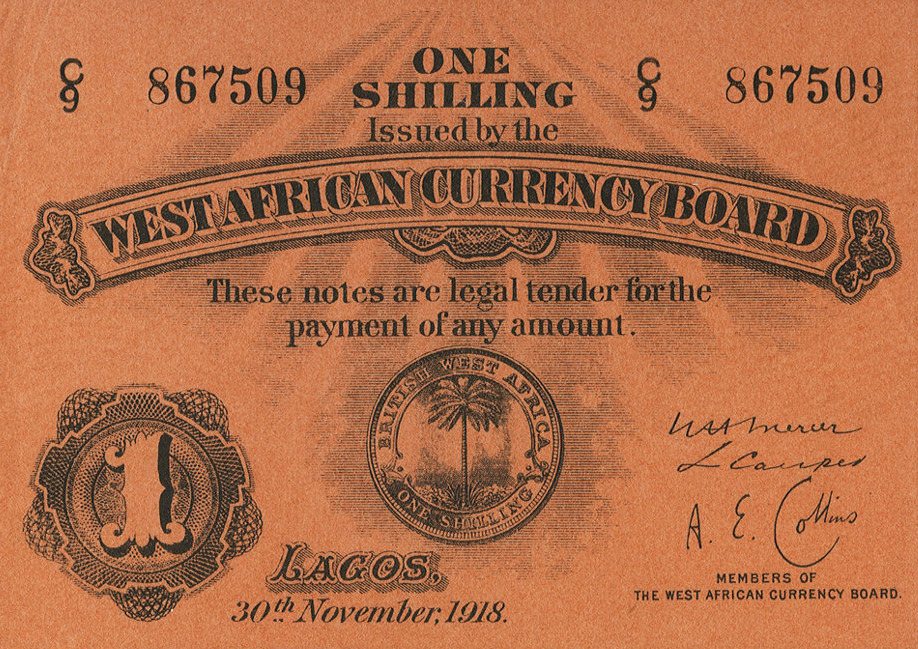
The West African Currency Board's first notes came out between 1916 and 1919 in five values: 1 shilling, 2 shillings, 10 shillings, 20 shillings and 5 pounds. How many of each were in people's hands is seldom told. The yearly reports of the four colonies tell part of it. One of them, the Gold Coast's for 1921, counts the notes value by value, and from its figures we can work out that more than a million 1 shilling notes were out in that one colony. This article sets the reports of 1921 to 1929 side by side, and says where their figures may not be pressed.
The source
The Colonial Reports - Annual are the printed reports each colony sent every year to the Secretary of State for the Colonies. H.M. Stationery Office published and sold them, each with a number of its own. We have read these eight, in the bound volumes scanned at the Internet Archive:
| Colony | Year | Report |
|---|---|---|
| Sierra Leone | 1921 | No. 1150 |
| Gold Coast | 1921 | No. 1154 |
| Gambia | 1922 | No. 1160 |
| Sierra Leone | 1922 | No. 1165 |
| Sierra Leone | 1928 | No. 1430 |
| Nigeria | 1928 | No. 1435 |
| Gambia | 1928 | No. 1444 |
| Nigeria | 1929 | No. 1493 |
Each has a short passage on currency. None names a member of the Board, and none pictures a note.
The Gold Coast, 31st March 1922
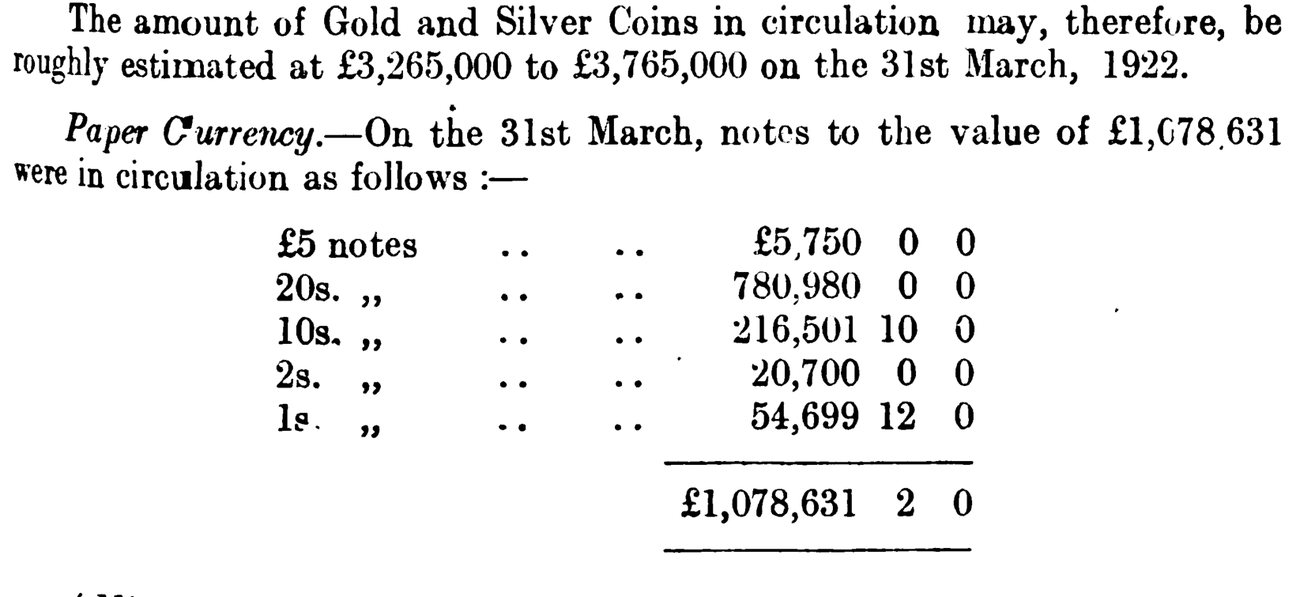
The Gold Coast report gives the paper currency in a small table. It says only "On the 31st March"; the lines above and below it are dated 31st March 1922, and we take that year. The five lines add up to the printed total. The numbers of notes in the third column are our arithmetic, not the report's.
| Note | In circulation, as printed | Number of notes (our arithmetic) |
|---|---|---|
| 5 pounds | 5,750 pounds | 1,150 |
| 20 shillings | 780,980 pounds | 780,980 |
| 10 shillings | 216,501 pounds 10 shillings | 433,003 |
| 2 shillings | 20,700 pounds | 207,000 |
| 1 shilling | 54,699 pounds 12 shillings | 1,093,992 |
| All | 1,078,631 pounds 2 shillings | 2,516,125 |
By value the 20 shillings carries the issue. By number the 1 shilling leads: 1,093,992 notes, more than four in every ten, for about a twentieth of the value. At the other end stand 1,150 notes of 5 pounds.
Sierra Leone: a stock account
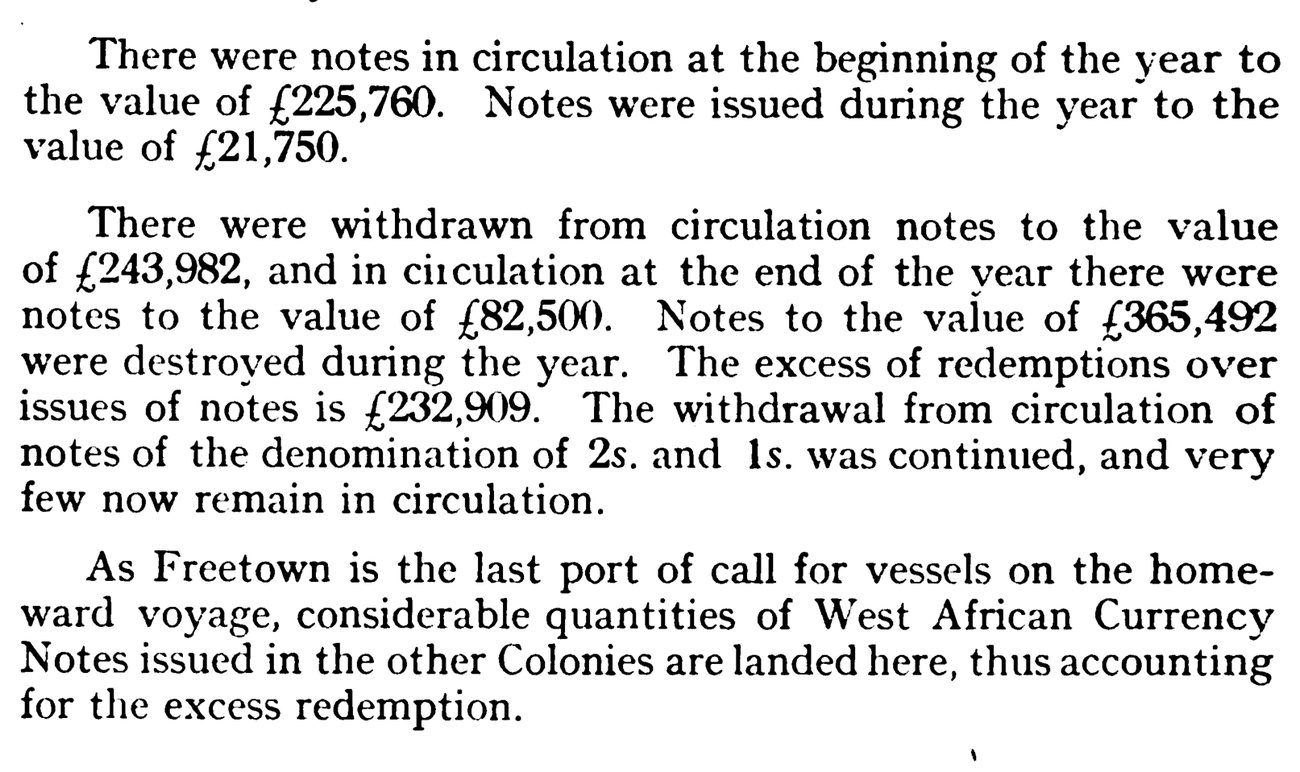
Sierra Leone's report for 1921 names all five values as current. Then it says that the withdrawal of the 2 and 1 shilling notes "was continued, and very few now remain in circulation". The word "continued" matters: the calling in had begun before 1921. That is a year earlier than the catalogue's other witness, Nigeria's Blue Book for 1922, which has the two notes "being withdrawn from circulation".
The figures beside that sentence need care. The report speaks of 225,760 pounds "in circulation" at the beginning of 1921, 21,750 pounds issued, 243,982 pounds withdrawn and 82,500 pounds at the end, with 365,492 pounds destroyed. As a circulation they do not balance: the first three leave 3,528 pounds, not 82,500. The report for 1922 settles what they are. It calls the same 82,500 pounds the notes "held at the beginning of the year". They are the stock at Freetown, not the notes with the public.
The 1922 account does balance: 82,500 pounds held, 50,000 received from the Board, 148,325 returned by the banks, 44,425 of those destroyed, 54,500 issued to the banks, 181,900 on hand at the close. Only then comes the one true figure of circulation: the notes "actually in circulation" at the end of 1922 are "estimated at £62,000".
Both reports give the reason Freetown took in so much more than it paid out. It was "the last port of call for vessels on the homeward voyage", and notes issued in the other colonies were landed and cashed there.
The Gambia
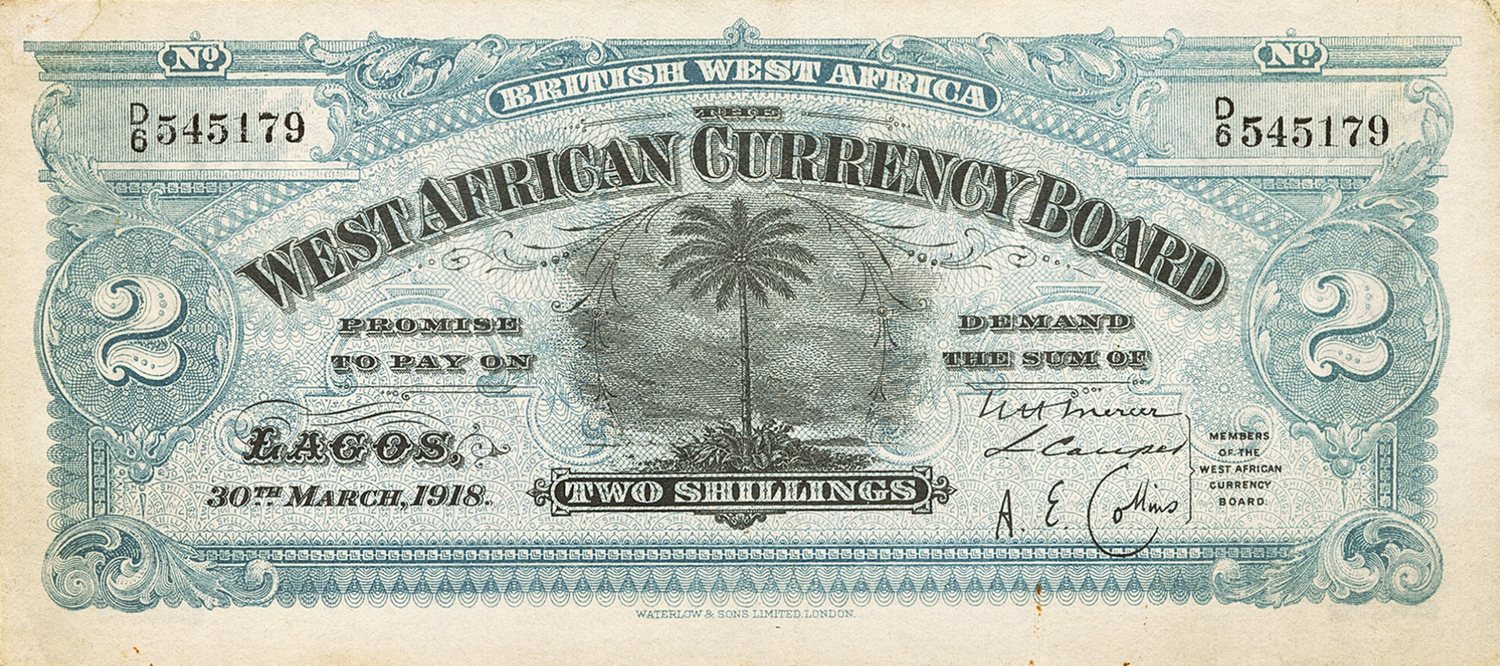
The Gambia's report for 1922 has one sentence: "Paper money to the amount of £100,000 has been issued in notes ranging from 1s. to £5." That is a round figure of issue, not a count on a day, but it shows every value of the series in use there. The report for 1928 gives notes "to the value of £191,000" in circulation during the year and names no values.
All West Africa, 1927 and 1928

Nigeria gives no figure of its own, and says why: "Owing to Inter-Colonial movements in currency notes it is not possible to give an approximate figure of the note circulation in Nigeria". It gives the whole of West Africa instead, and for two dates it gives the number of notes.
| Date | Value | Number of notes | A note on average (our arithmetic) |
|---|---|---|---|
| 30th June 1927 | 728,835 pounds | 1,098,152 | about 13 shillings 3 pence |
| 31st March 1928 | 791,313 pounds | not given | |
| 30th June 1928 | 764,672 pounds | 1,143,409 | about 13 shillings 4 pence |
The middle line is from the report for 1928, whose sentence is dated by the coin; we read the date as that of the notes too. An average a little over 13 shillings is what a mixture of 10 and 20 shilling notes gives. By 1928 the reports of Sierra Leone and Nigeria name only those two values as current. If every note counted on 30th June 1928 was one or the other, there were about 757,000 of 10 shillings and about 386,000 of 20 shillings. That is an inference of ours: no report says how the total was made up.
Set this beside the Gold Coast table. In 1922 one colony counted 2,516,125 notes. Six years later all four colonies together had 1,143,409, fewer than half that number.
1st July 1928
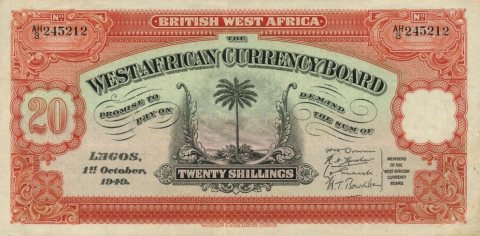
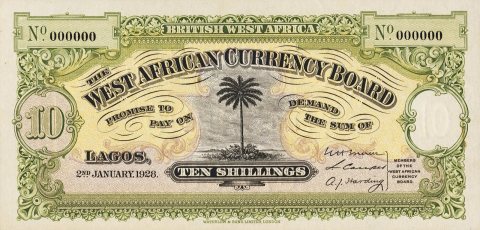
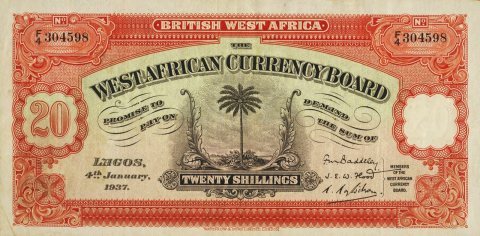
30th June 1928 was the last day on which the first series stood alone. Sierra Leone's report for 1928 says a new issue of 20 and 10 shilling notes "was placed in circulation as from 1st July": the 10 shillings and 20 shillings dated from 1928. The report adds that the new notes "differ only slightly in design from the old issue" and that the old notes kept their legal tender value and "still remain in circulation". So the notes of 1916 and 1918 were not called in when the new ones came, and the figures after 1928 count both together.
Why the figures cannot be added up
The colonies' figures look like parts of one whole. They are not. The Nigeria Handbook gives the Board's notes in all four colonies at the end of March 1922 as 1,201,718 pounds. The Gold Coast's figure for the same date, 1,078,631 pounds, is nine tenths of that. It would leave about 123,000 pounds for Nigeria, Sierra Leone and the Gambia together, yet the Gambia alone reports 100,000 pounds issued. Each colony counted notes by where they were issued or held, and the notes travelled: Freetown's account shows it, and Nigeria says so in 1929. The Gold Coast table is best read as the make-up of an issue, value by value, not as that colony's share of West Africa.
What the reports do not say
No report gives the day or the order that ended the 1 shilling, the 2 shillings or the 5 pounds. Sierra Leone still lists all five values in 1922 and only two in 1928; the catalogue's other records put the withdrawal in 1923. No report says how many notes of each value were printed or destroyed: Sierra Leone's "destroyed" is one sum for all values. The Gold Coast count is not repeated in the reports we read, so the fall of the 1 shilling cannot be followed year by year. Nigeria, the largest colony, gives no figure by value at all.
The Board's own yearly reports and accounts would settle most of this. The catalogue already draws on the one for the year ended 30th June 1918, which counts 55,500 notes of 2 shillings in circulation on that day. A run of those reports from 1919 to 1928 should give the notes issued, returned and destroyed, value by value and for all four colonies at once.
Member comments
Log in or register to post a comment.