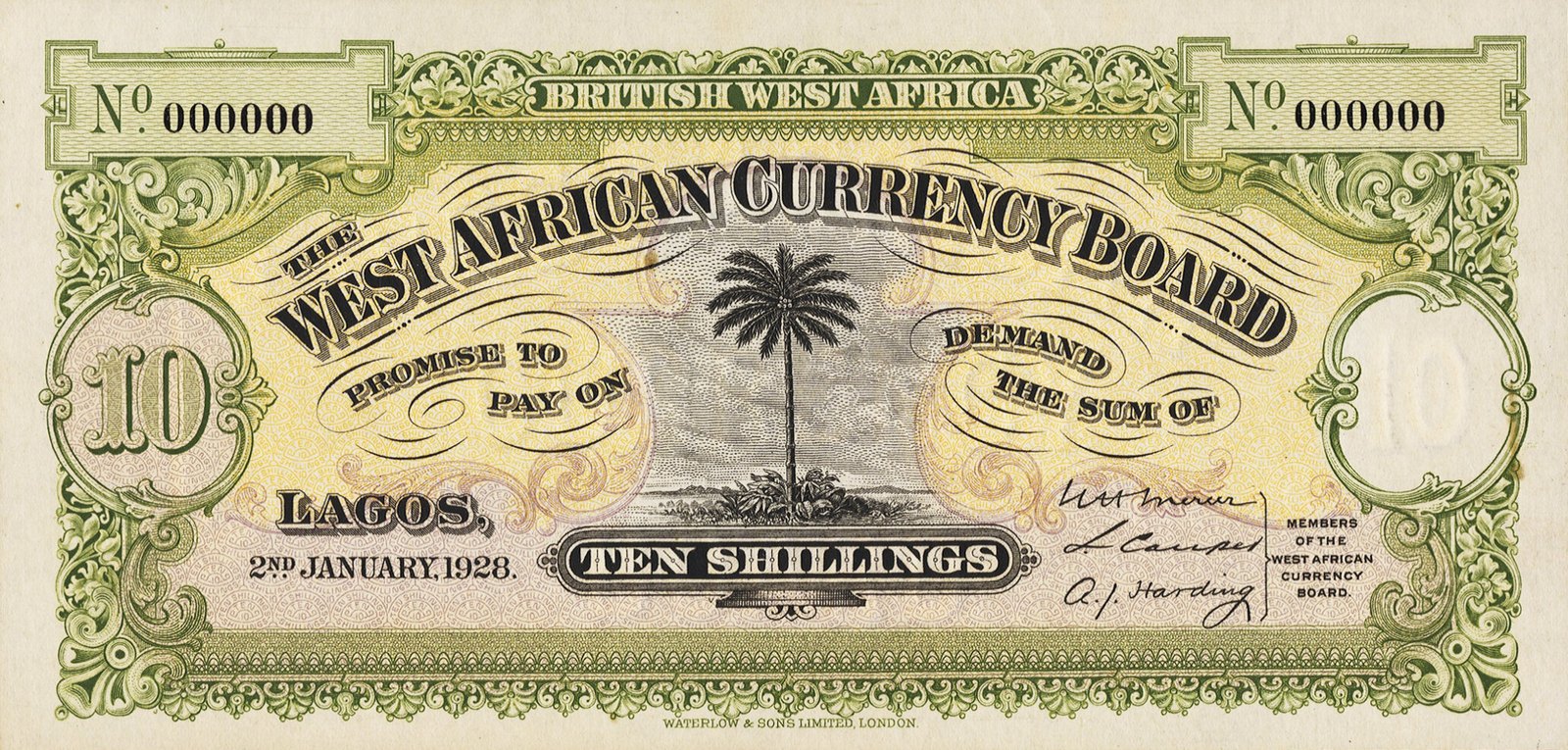
Many sentences on the catalogue's pages for British West Africa begin "Sources mention". Many of them go back to one article: Richard J. Ford, "British West African Currency Board Banknotes", in the Journal of the International Bank Note Society, vol. 10 no. 1, September 1970. Ford drew on the Board's own records and gave figures of printing and destruction that no official paper read for the catalogue gives. This article sets out what Ford wrote, page by page, and what the official papers say beside it, then what later writers in the IBNS Journal and Bank Note Reporter added, and the sale of the R. J. Ford Collection in 1975.
Ford's account, 1916 to 1928
Ford's article tells the story of each value from the Board's records:
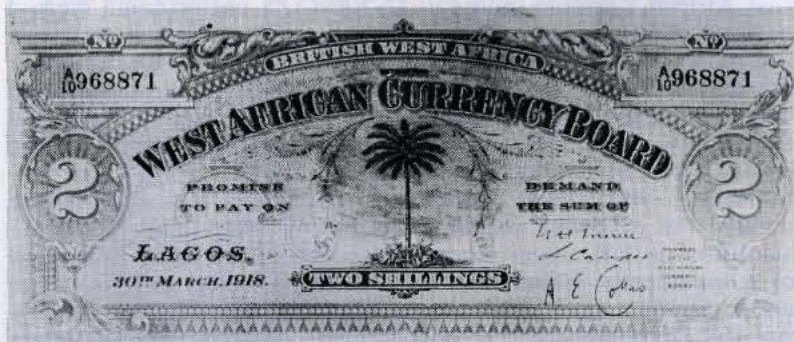
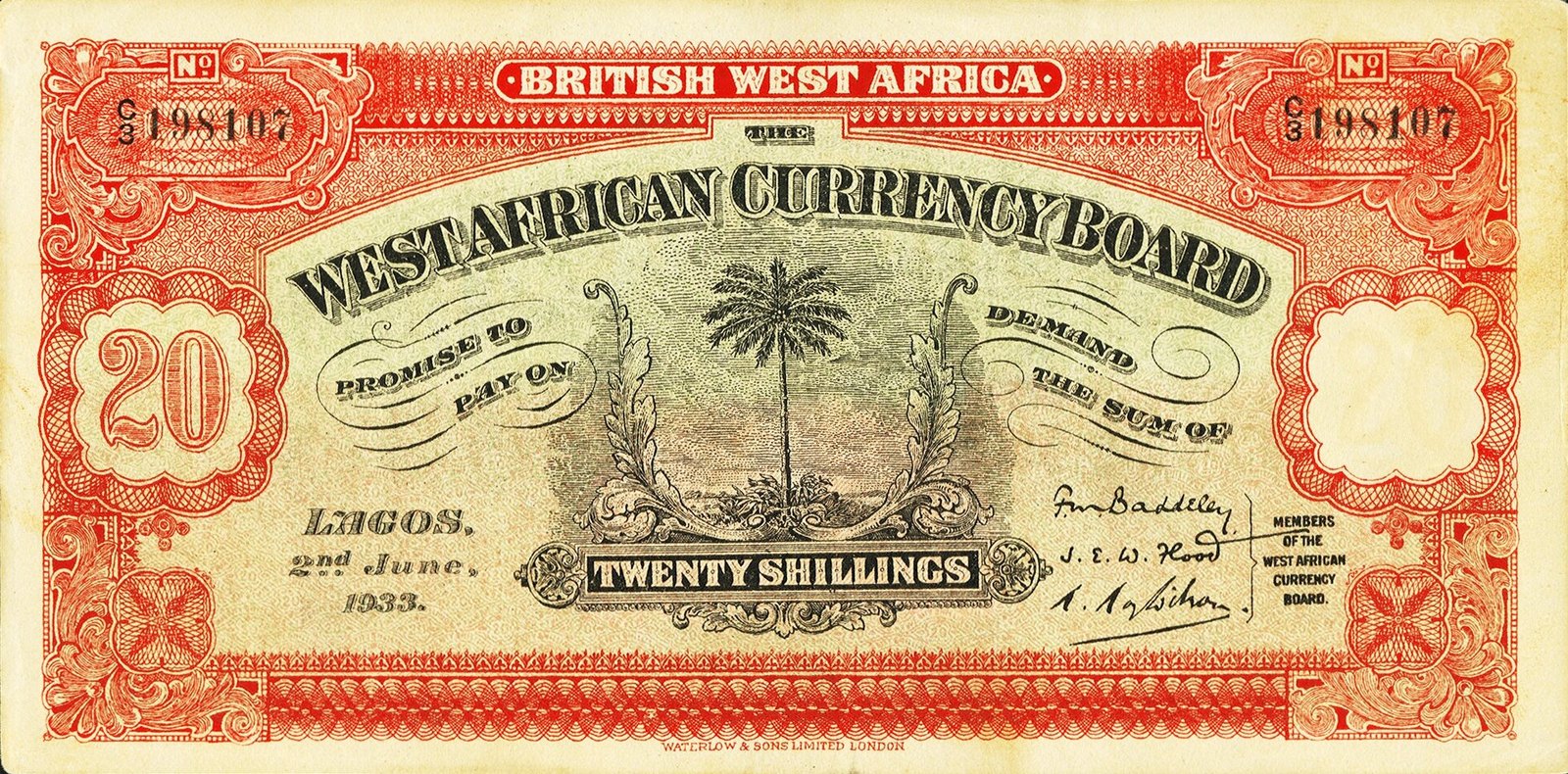
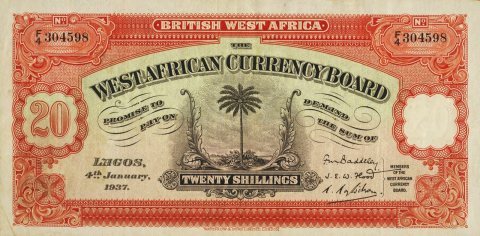
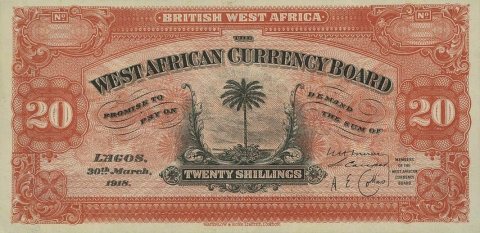
- The first notes (p. 7): Waterlow won the tender of 17th December 1915. The designs were approved on 2nd June 1916: the 2 shillings in blue, the 10 shillings in green, the 20 shillings in red. The first notes dated 31st March 1916 went to the Currency Officer at Lagos on 14th June 1916: 49,994 notes of 10 shillings, numbered A/1 000007 to A/1 050000, and 14,994 of 20 shillings, numbered A/1 000007 to A/1 015000. Numbers 1 to 6 of each value were sold at face value to members of the Board.
- The Hausa words (p. 9): the wording on the back in Arabic script was approved in December 1917, and in March 1918 it was also printed on stocks of notes dated before 1918. The printings of 1919 and 1920 kept the date 30th March 1918 and its signatures.
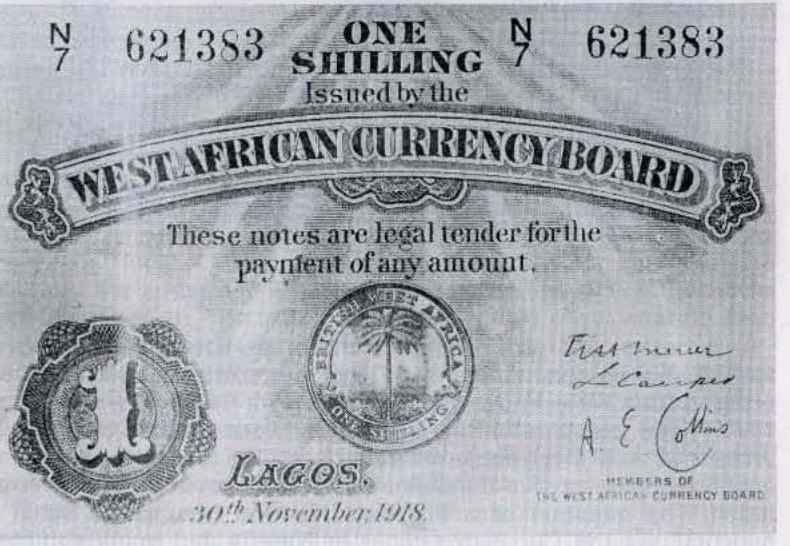
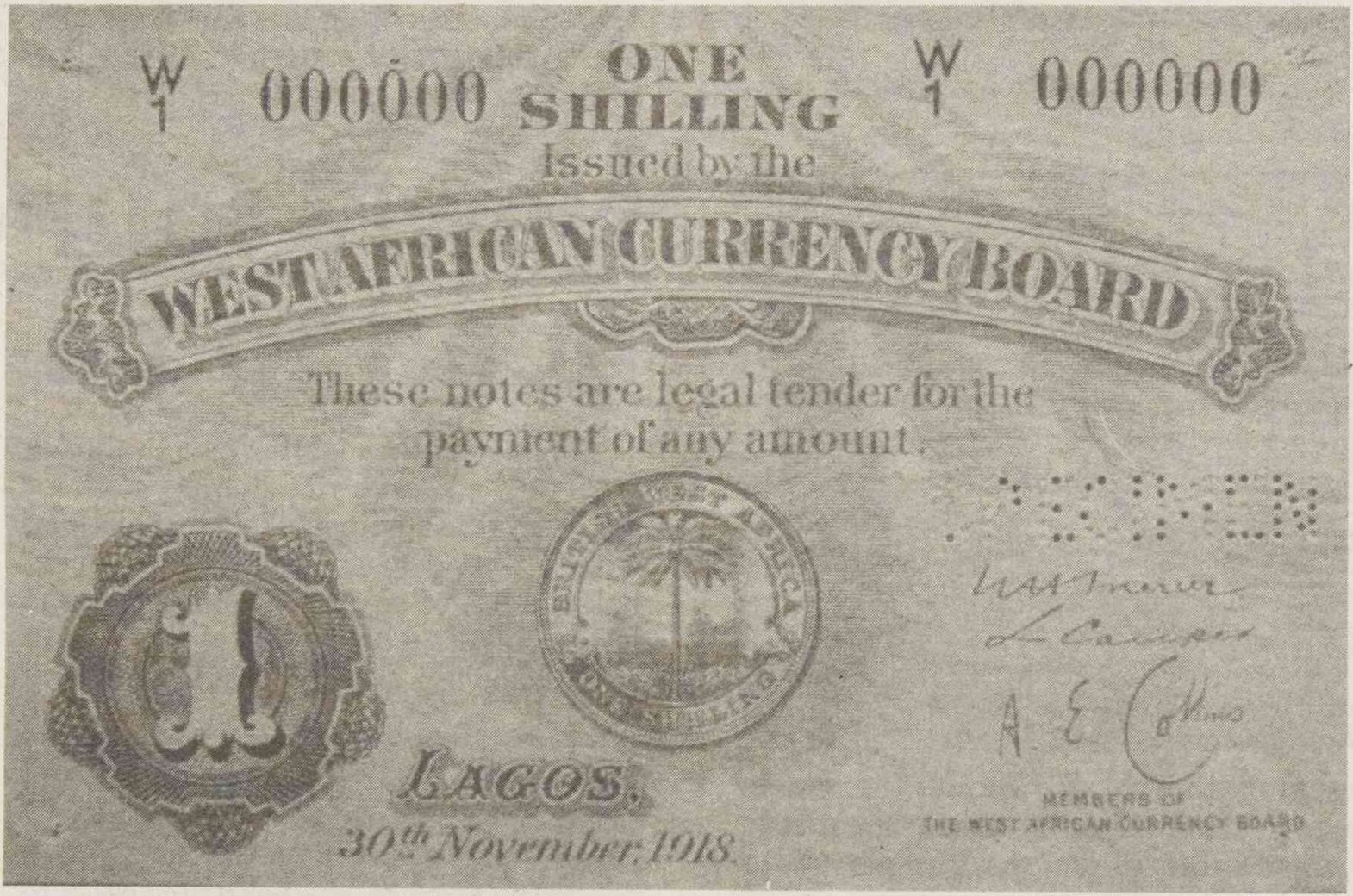
- The 1 shilling (p. 9): the Bank of England printed 21 million 1 shilling notes, all dated 30th November 1918, and 2,500,000 were ordered burned in 1922. The text layer of the scan reads 24 million for the burned figure.
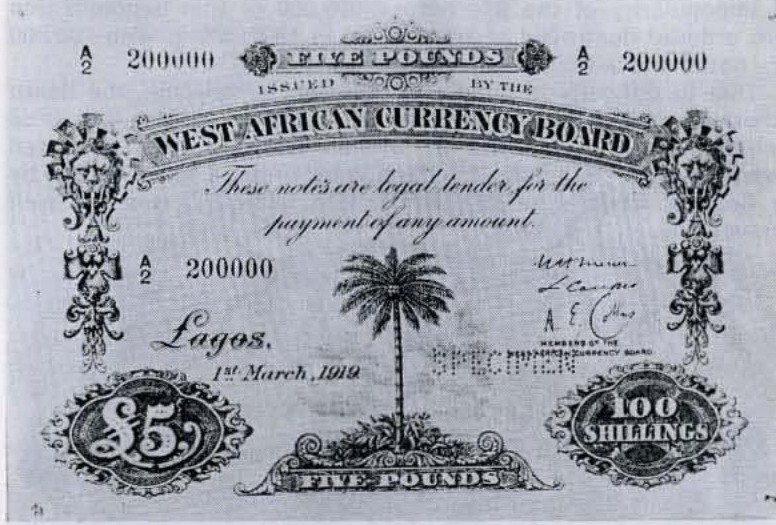
- The 5 pounds (pp. 9 and 10): 200,000 5 pound notes were ordered from the Bank of England in 1919 at a cost of 619 pounds 12 shillings and 5 pence, printed in black on India currency note paper with the India watermark less the word INDIA, all dated 1st March 1919.
- Destruction in 1922 (p. 9): Waterlow destroyed 2,500,000 notes of 2 shillings, 2,050,000 of 10 shillings and 700,000 of 20 shillings from the unissued stock.
- The booklets (p. 11): in October 1919 the Board ordered 5,000 booklets of twenty 1 shilling notes in plain red covers, on the model of the Indian rupee booklets: 2,000 for Nigeria, 2,000 for the Gold Coast, 500 for Sierra Leone and 500 for the Gambia.
- The 5 shillings (p. 10): the design was approved in December 1919, 500,000 notes dated 1st March 1920 were ordered from Waterlow in January 1920 and held there, and none was issued. Ford thought they were probably burned in the 1920s, and had seen one Waterlow specimen with its seal. The note is described as reddish brown, a little smaller than the 10 shillings. The catalogue's page for the 5 shillings records no note.
- Paper and records (p. 11): better paper was used from late 1919, because of damp and forgery, and the recording of cancelled serial numbers stopped on 16th July 1920.
- The end of the small values (p. 11): in March 1923 the Board formally discontinued the 1 and 2 shilling notes, decided not to issue the 5 shillings, and had the remaining stocks destroyed.
- The 5 pounds withdrawn (p. 10): the most in circulation was 56,000 notes, in December 1920; there were 1,526 in June 1921, 516 in June 1922 and 304 in June 1923, and about 28 were never accounted for. The Board's stock was destroyed in July 1924, and the rest, with the plates, in December 1934.
- Between 1920 and 1928 (p. 11): no notes were printed from late 1920 to 1928 except 250,000 twenty shillings of the old type in the J series, late in 1927, while the new notes were awaited.
- The notes of 1928 (p. 11): the new type was decided late in 1927 because of forgeries made with German machines. Waterlow printed directly from plates instead of by offset lithography, the colours changed slightly, a watermark window was added at the right, and the numbering began again at A/1 000001. The notes went into circulation early in July 1928.
Ford beside the official papers
Several of Ford's statements can be set against the official papers read for the catalogue.
| Ford, IBNS Journal 10:1 | The official papers |
|---|---|
| The 1928 notes reached circulation early in July 1928 (p. 11) | Sierra Leone's annual report for 1928: "as from 1st July" |
| The Board discontinued the 1 and 2 shillings in March 1923 (p. 11) | The Colonial Office List for 1923: the 2 and 1 shillings "now being withdrawn"; that for 1925: the 5 pounds, 2 and 1 shillings "having been withdrawn" |
| 516 notes of 5 pounds in circulation in June 1922 (p. 10) | The Gold Coast's annual report for 1921: 5,750 pounds in 5 pound notes in the Gold Coast alone on 31st March 1922 |
| The Hausa wording approved in December 1917 (p. 9) | The Board's report for the year ended 30th June 1918: arrangements made during that year to print the value in Hausa on new supplies |
| 21 million 1 shilling notes printed (p. 9) | The Gold Coast's annual report for 1921: 54,699 pounds 12 shillings in 1 shilling notes in the Gold Coast on 31st March 1922 |
The 5 pound figures do not sit easily together. The catalogue's pages read the Gold Coast's 5,750 pounds as 1,150 notes, more in that one colony at the end of March 1922 than Ford gives for the whole Board three months later. The two may count different things, notes issued in a colony and notes outstanding to the Board, and neither source explains its count.
Ford's dates and numbers, and three open points
Ford also lists, for each date of the 10 and 20 shillings and the later notes, the first and last numbers seen (pp. 13 and 14). These numbers are printed in the Journal. Three of Ford's statements still stand against the catalogue's pages:
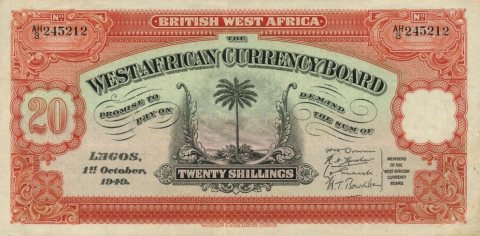
- The 20 shillings of 2nd June 1933. Ford writes that after July 1930 the date was not changed until 14th September 1934 (p. 13). The catalogue's page for the 20 shillings of 1928 to 1952 keeps a row dated 2nd June 1933 that holds no genuine note; the counterfeits of that page carry the date.
- AD/7. Ford gives AD/7 619935 as the last note seen of 28th January 1949 (p. 14). The same page says that sources also mention AD/7 on notes dated 24th December 1948.
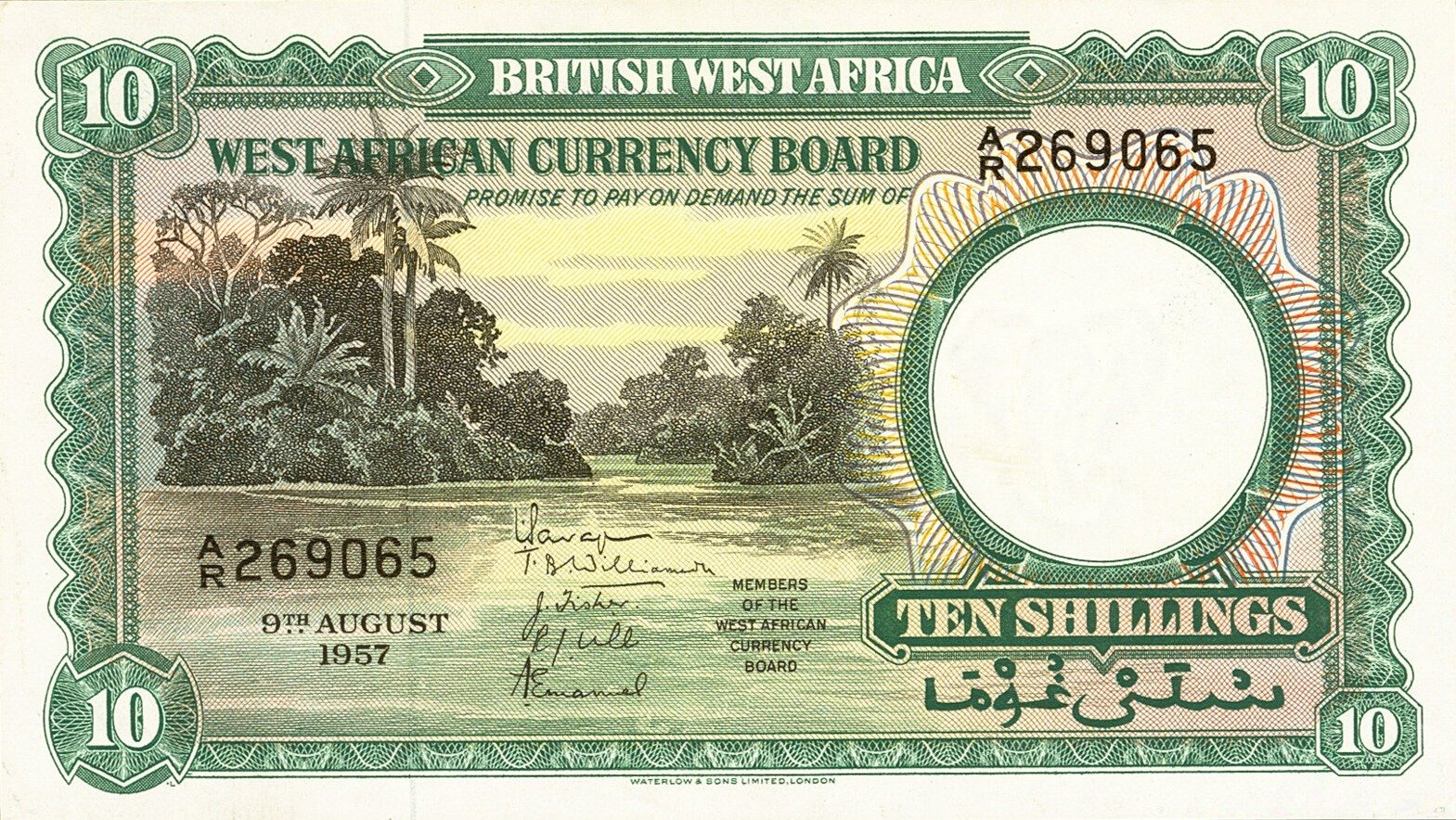
- The 10 shillings of 20th February 1957. Ford's list of 10 shilling dates has 1953, 1955, 9th August 1957 and 1958, and no 20th February 1957 (p. 13). The catalogue's page for the 10 shillings of 1953 to 1958 records one note of that date from a sale with no photograph: Glendining, 9th June 1975, lot 64, the R. J. Ford Collection (below).
For the 5 pounds of 1919 Ford's plate shows a specimen perforated SPECIMEN and numbered A/2 200000, which fits the 200,000 notes Ford gives.
Richard Kelly, 1977
Richard Kelly wrote twice in the IBNS Journal in 1977. "Early Paper Money in British West Africa" (vol. 16 no. 3, p. 151) puts the United Kingdom currency notes used in West Africa in 1915 and 1916 at about 257,000 pounds, mostly withdrawn by June 1916, and says the Southern Nigeria note plan of 1909 was cancelled in 1910. It also names the Bank of Nigeria's 10 shilling bearer notes and a Bank of British West Africa specimen of 1897; these are told in Before the Board's notes and beside them. "Blue Books and Bank Histories" (vol. 16 no. 4, p. 224) gives the Nigerian Blue Books' figures for Nigeria's own Government notes of 1918 still in circulation: 2,723 pounds 10 shillings in 1919, 1,476 pounds 10 shillings in 1920, 457 pounds 3 shillings in 1921, and 400 pounds, an estimate, for 1922 to 1925. The Nigeria Blue Book for 1923 (p. 197, read in the text only) gives 300 pounds for that year.
Sarangapani, 2017
Sarangapani's article on the Southern Nigeria essays (IBNS Journal, vol. 56 no. 4, 2017, pp. 43 to 47) is the source behind the catalogue's sentence on the plan of 1907 to 1910: Governor Egerton's proposal of November 1907, De La Rue's designs sent on 22nd April 1909 for notes of 10 shillings to 50 pounds dated 1st September 1909, and the Treasury's wish for a gold reserve and one board for all West Africa.
Bank Note Reporter
- Neil Shafer, October 1988 ("Carrying the torch", p. 10 of the scan), in a diary of the Amon Carter collection, pictures a 5 pounds of 1st March 1919 numbered A/2 199999, photographed at Fort Worth early in 1983, the picture by courtesy of John N. Rowe III and the Wedbrooke Collection. No perforation shows in the half-tone. The catalogue records the number A/2 199999 from a perforated specimen sold by Noble Numismatics; whether the two pictures show one note is not settled.
- Kerry Rodgers, November 2004 ("Early BWA issues appear at auction in Australia", printed p. 73), after David Vice (1983), gives the first shipment from Waterlow as arriving in June 1916, the notes put into circulation in Nigeria on 11th July 1916 and issued experimentally in the Gold Coast and Sierra Leone in September 1916. Ford's day of dispatch to Lagos, 14th June 1916, fits a June arrival. The same report pictures a specimen 1 shilling with the prefix W/1, an all-zero number and a perforated SPECIMEN, sold by Australian Numismatics at Ballarat in mid-October 2004; it is now a row of its own on the page for the 1 shilling.
- A caption of May 2011 calls J. B. Loynes the last chairman of the West African Currency Board and the first of the Gambia Currency Board. Every Colonial Office List held from 1957 to 1965 names Sir Alfred Savage as the Board's Chairman and Loynes as a member. The caption, like the Lists, prints the name without "de".
- Neil Shafer, August 2016 ("Coins on paper", pp. 72 and 73), pictures a 1 shilling of 30th November 1918.
The R. J. Ford Collection, Glendining, 9th June 1975
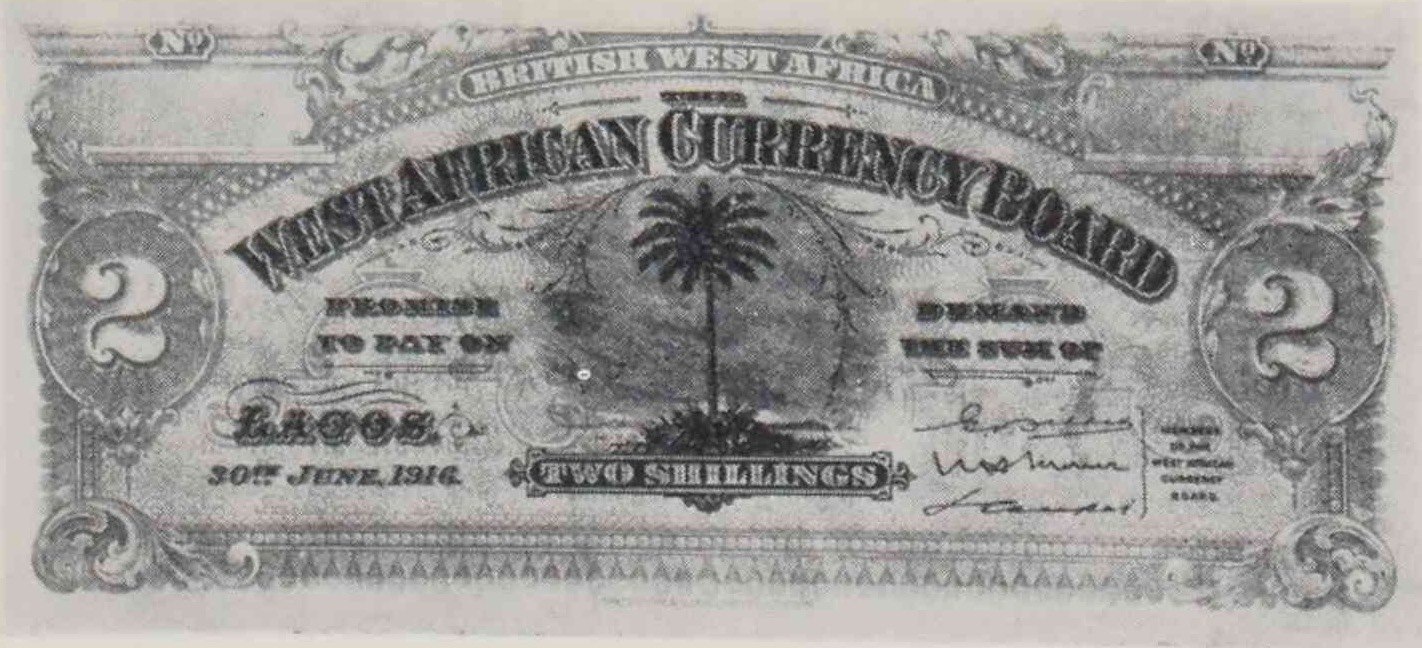
Glendining sold the R. J. Ford Collection in London on 9th June 1975, in a catalogue written by Spink and Son. The British West Africa notes were lots 44 to 90. They ran through every type: the 1 shilling and its specimen (lots 44 and 45); the 2 shillings of 1916 and 1918 (lots 46 and 48) and a specimen of 30th June 1916 on thick paper with no number, overprint or perforation (lot 47), from which the catalogue made a new row; colour trials of the 10 and 20 shillings of the first type (lots 49 and 66); the 10 shillings of 1928 to 1948 date by date (lots 50 to 61); the 20 shillings of 1928 to 1951 (lots 67 to 79), with a counterfeit dated 2nd June 1933 (lot 68); the notes of 1953 to 1962, issued and specimen (lots 62 to 65 and 80 to 86); and the 5 pounds of 1953 and 1954, issued and specimen (lots 87 to 90).
The records do not say that the R. J. Ford of the sale is the Richard J. Ford of the article of 1970, and the sale catalogue as read does not say so either.
Other records
The British Library's Portals specimen book (General Collection 2/12), which the Library describes as compiled by the paper makers Portals to show the quality and security features of their paper, holds a West African Currency Board 20 shillings of 1st March 1954, with no number given. Ruth Hill's handwritten inventory of about 1994 holds thirteen lines on British West Africa, among them a line for a letter of 1965 that the ledger calls a letter from the "BWA bank"; the notes of the inventory are on the catalogue's pages under the sales of the Ruth W. Hill Collection.
Sources
- Richard J. Ford, "British West African Currency Board Banknotes", IBNS Journal, vol. 10 no. 1, September 1970, pp. 7 to 14.
- Richard Kelly, "Early Paper Money in British West Africa", IBNS Journal, vol. 16 no. 3, 1977, p. 151; "Blue Books and Bank Histories", vol. 16 no. 4, 1977, p. 224.
- Sarangapani, IBNS Journal, vol. 56 no. 4, 2017, pp. 43 to 47.
- Neil Shafer, "Carrying the torch", Bank Note Reporter, October 1988, p. 10; "Coins on paper", Bank Note Reporter, August 2016, pp. 72 and 73.
- Kerry Rodgers, "Early BWA issues appear at auction in Australia", Bank Note Reporter, November 2004, printed p. 73; a caption in Bank Note Reporter, May 2011.
- Glendining, the R. J. Ford Collection, London, 9th June 1975, lots 44 to 90.
- Report of the West African Currency Board for the year ended 30th June 1918; the Colonial Office Lists for 1923, 1925 and 1957 to 1965; Gold Coast annual report for 1921; Sierra Leone annual report for 1928; Nigeria Blue Book for 1923.
- The British Library, Portals specimen book, General Collection 2/12.
- The Ruth Hill inventory, volume "Botswana to Burundi", p. 12.
Member comments
Log in or register to post a comment.