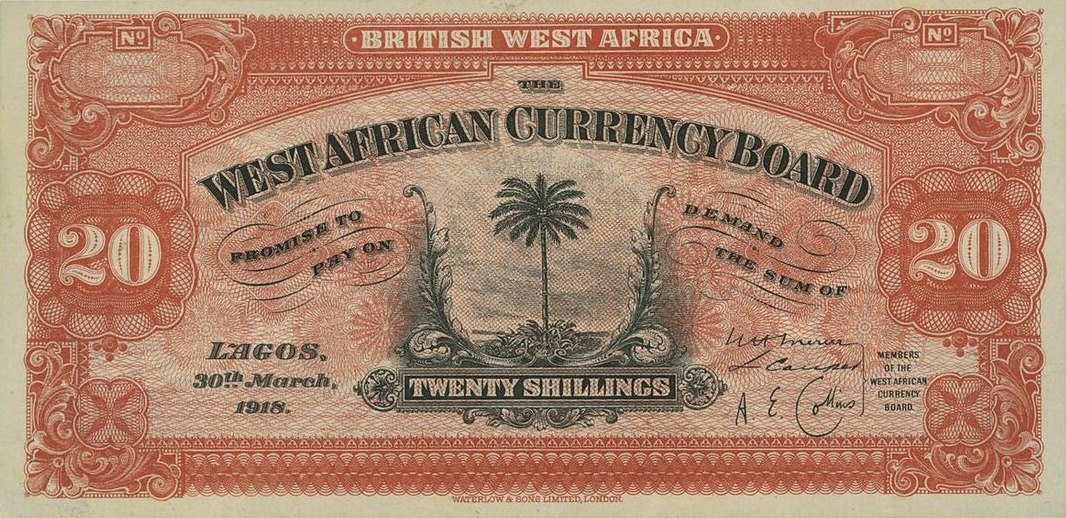
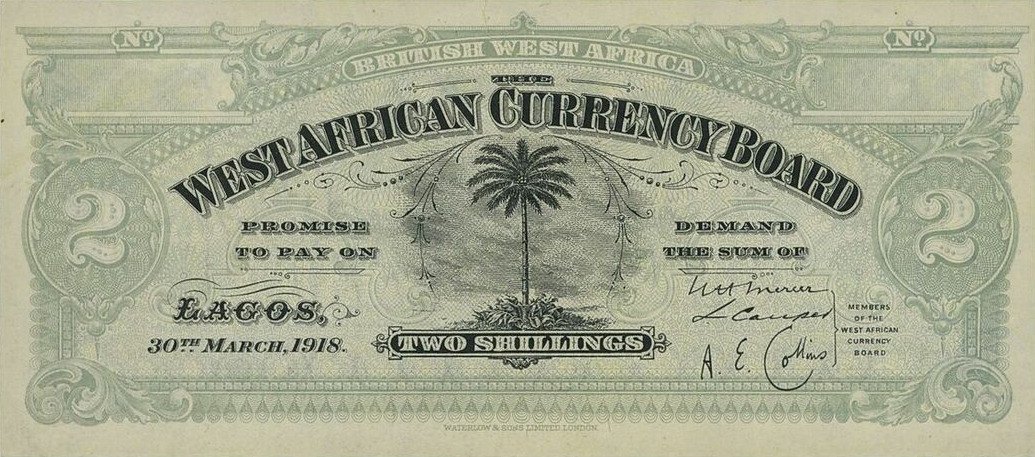
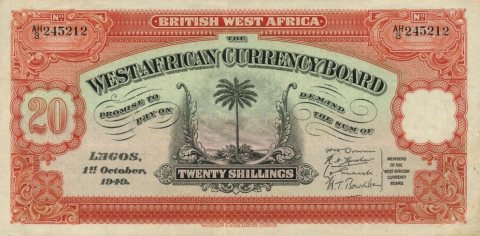
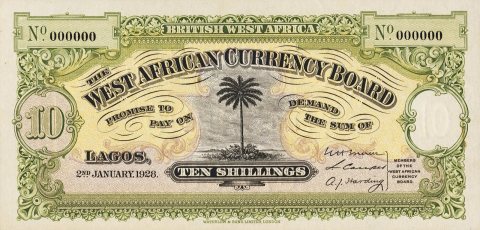
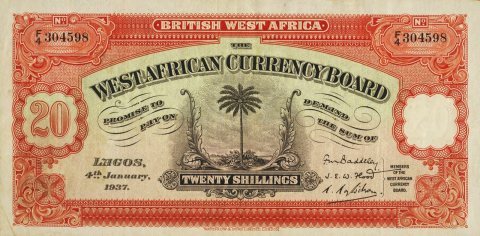
Of the West African Currency Board's own annual reports, one is among the sources read for the catalogue: the Report of the West African Currency Board for the year ended 30th June 1918. It is fourteen pages long. It is the Board's own account of the second full year of its notes, when only three values existed: the 2 shillings, the 10 shillings and the 20 shillings. This article goes through what it says of the notes. Its year-end totals are also set beside later figures in The West African Currency Board's notes in circulation, 1917 to 1961. All figures below were read on the page images of the report.
The report itself
The title page reads "Report of the West African Currency Board for the year ended 30th June, 1918", presented to Parliament in February 1919 as Command Paper No. 15. It refers back to the previous report, Cd. 8883 of December 1917. The members sign it on 25th January 1919: W. H. Mercer, L. Couper and A. E. Collins, the three whose signatures are on the notes dated 30th March 1918. The file of the report in the owner's sources was labelled as a report "of about 1915"; the title page shows it is the report for 1917-18.
What it says of the notes
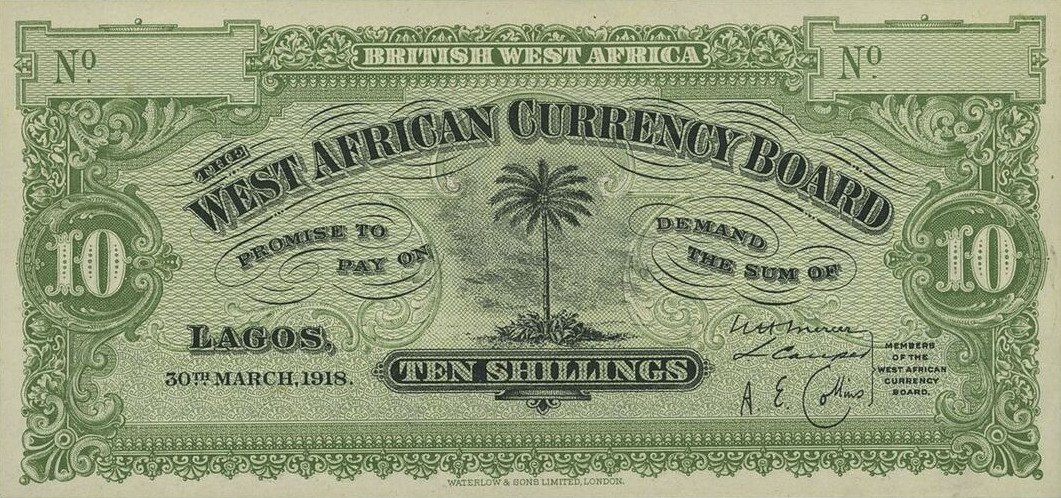
The report's paragraphs on the notes (16 to 21) are short. In order:
- The notes in circulation rose during the year from 79,246 pounds to 176,445 pounds, and from 135,996 notes on 30th June 1917 to 300,371 notes on 30th June 1918.
- "The 2s. note was issued in Sierra Leone in October, 1917, and notes of all three denominations (i.e. 20s., 10s. and 2s.) were introduced into the Gambia in March last."
- The 2 shillings "does not appear to have found very much favour so far in any of the Colonies".
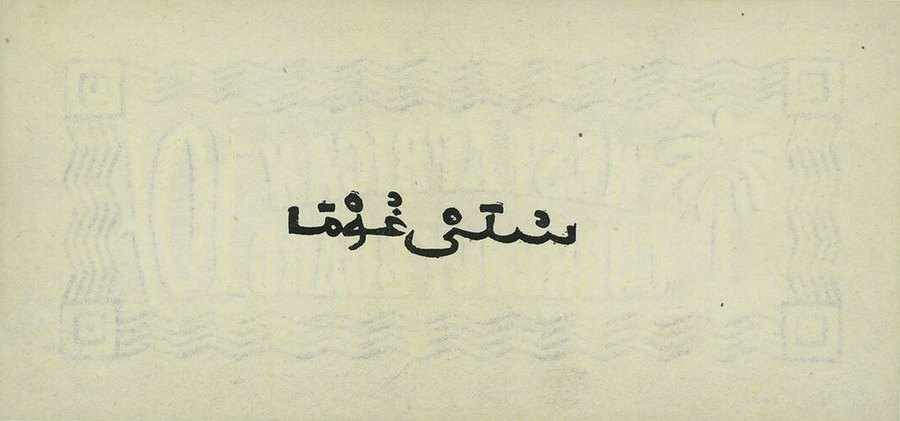
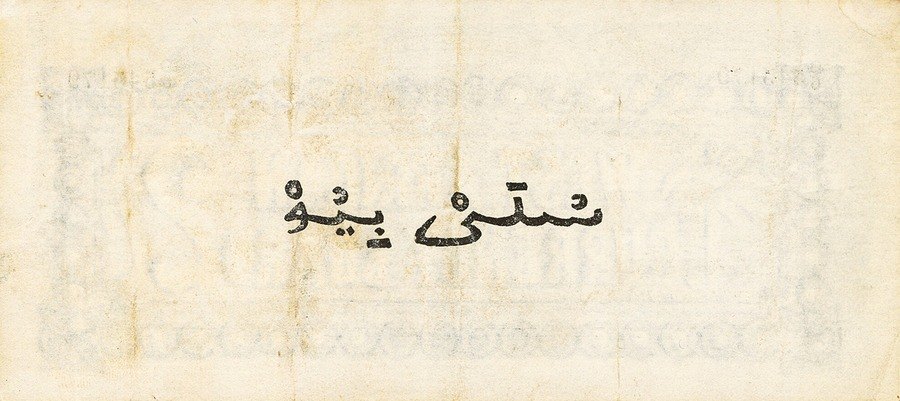
- To further the use of the notes, arrangements were made during the year to print their value in Hausa, in Arabic characters, on new supplies. The Pick pages describe two words of Arabic script on the backs of the notes dated 30th March 1918, and of the 1916-dated 2 shillings with prefixes A/3 to A/5, and say that sources mention the words are Hausa.
- A small number of notes were cancelled during the year as unfit for further use. It is the first mention of worn notes in the report.
- Early in the year the Board invested a small part of the coin held against the notes, and the Secretary of State approved investments of up to 50 per cent of the notes in circulation.
The notes at the end of every month
Appendix II B of the report (p. 8) counts the notes at the end of each month, by number and by value. The numbers of 20 shilling notes equal their value in pounds, so that column is given once.
| End of month | 20 shillings (number = pounds) | 10 shillings, number | 10 shillings, pounds | 2 shillings, number | 2 shillings, pounds | All notes, number | All notes, pounds |
|---|---|---|---|---|---|---|---|
| June 1917 | 48,496 | 55,000 | 27,500 | 32,500 | 3,250 | 135,996 | 79,246 |
| July 1917 | 49,496 | 56,500 | 28,250 | 33,000 | 3,300 | 138,996 | 81,046 |
| August 1917 | 56,496 | 66,500 | 33,250 | 33,000 | 3,300 | 155,996 | 93,046 |
| September 1917 | 56,420 | 66,452 | 33,226 | 33,000 | 3,300 | 155,872 | 92,946 |
| October 1917 | 58,420 | 70,952 | 35,476 | 33,000 | 3,300 | 162,372 | 97,196 |
| November 1917 | 65,419 | 72,952 | 36,476 | 27,000 | 2,700 | 165,371 | 104,595 |
| December 1917 | 66,919 | 83,952 | 41,976 | 28,500 | 2,850 | 179,371 | 111,745 |
| January 1918 | 71,919 | 87,452 | 43,726 | 27,500 | 2,750 | 186,871 | 118,395 |
| February 1918 | 74,919 | 98,452 | 49,226 | 28,500 | 2,850 | 201,871 | 126,995 |
| March 1918 | 78,019 | 112,452 | 56,226 | 32,500 | 3,250 | 222,971 | 137,495 |
| April 1918 | 83,419 | 123,952 | 61,976 | 33,500 | 3,350 | 240,871 | 148,745 |
| May 1918 | 89,419 | 136,952 | 68,476 | 45,500 | 4,550 | 271,871 | 162,445 |
| June 1918 | 96,919 | 147,952 | 73,976 | 55,500 | 5,550 | 300,371 | 176,445 |
The table bears out the report's remark on the 2 shillings. Its number in circulation stood at 33,000 from July to October 1917, fell to 27,000 in November, the month after it came out in Sierra Leone, and only passed 33,000 again in April 1918. The 10 and 20 shilling notes both fell slightly in September 1917, the only month in which either fell. In every month there were more 10 shilling notes than 20 shilling notes in circulation, while the 20 shilling notes always held more value.
The table gives the notes in circulation, not the notes printed or sent out. It does not show how many were held in the colonies' Currency Offices.
The four colonies on 30th June 1918
Appendix II A (p. 8) divides the notes of 30th June 1918 between the colonies and the values, and gives where the coin held against them lay.
| Colony | 20 shillings, pounds | 10 shillings, pounds | 2 shillings, pounds | All notes, pounds | Coin held against the notes, pounds, and where |
|---|---|---|---|---|---|
| Nigeria | 55,424 | 28,226 | 3,950 | 87,600 | 52,600, at Lagos |
| Gold Coast | 29,995 | 30,000 | 1,050 | 61,045 | 31,045, at Accra |
| Sierra Leone | 9,500 | 14,500 | 250 | 24,250 | 24,250, at Freetown |
| The Gambia | 2,000 | 1,250 | 300 | 3,550 | 3,550, at Bathurst |
| All four | 96,919 | 73,976 | 5,550 | 176,445 | 111,445 |
In the Gold Coast the 10 shillings and the 20 shillings were out in almost equal value. In the Gambia, three months after the notes came, there were 3,550 pounds in all.
The Note Guarantee Fund
The notes were covered by the Note Guarantee Fund, which had a coin portion and an investment portion. At 30th June 1918 the coin portion was 111,445 pounds, held in the four colonial capitals as the table above shows, and the investment portion was 65,000 pounds in 5 per cent National War Bonds. The report puts these at 63.16 per cent and 36.84 per cent of the total circulation. The appendix lists the War Bonds in four amounts: 15,000 pounds against the year 1922, 35,000 pounds against 1923, 7,500 pounds against 1924 and 7,500 pounds against 1927. Paragraph 25 says the year's investments were all in 5 per cent National War Bonds, "repayable between 1922 and 1927".
What the notes cost
The Currency Note Profit and Loss Account (p. 12) charges 260 pounds 16 shillings and 8 pence for the cost of manufacture of the notes in the year, and 250 pounds for agents' charges. The report does not say how many notes the manufacturing charge paid for.
The Board's Secretary
The report's last paragraph records the death in action, on 14th October 1918, of the Board's Secretary, Captain D. L. H. Baynes, M.C. (R.G.A.). W. A. F. Wickhart signs the accounts as Acting Secretary on 23rd October 1918 (p. 13) and the report as Secretary on 25th January 1919 (p. 5). The Colonial Office List for 1917 already names Wickhart as Acting Secretary. The Board's staff and its officers in the colonies have their own article, The Board's Secretaries, its Currency Officers and its agents.
What the report does not give
- No first day of issue for the notes in Nigeria or the Gold Coast. The report before this one (Cd. 8883, December 1917) and the reports before that would be the place to look; they are not among the owner's sources.
- No Currency Officer by name.
- No figure of notes printed, received from the printer or destroyed, and no serial numbers.
- No picture of a note.
The later reports of the Board are not among the sources read for the catalogue. Two later figures of the Board's money are in the records: the Gold Coast annual reports give the Board's profits shared out to the Gold Coast as 99,780 pounds for 1946-47 and 154,380 pounds for 1948, and Hansard for 20th July 1955 gives the Board's assets at 30th June 1955 as 99,902,000 pounds, with a surplus of 7,064,000 pounds.
Sources
- Report of the West African Currency Board for the year ended 30th June 1918 (Cmd. 15, February 1919): paragraphs 16 to 21, 25 and 27 (pp. 4 and 5); Appendix II A and II B (p. 8); the Currency Note Profit and Loss Account, p. 12; the Note Guarantee Fund account, p. 13.
- The Colonial Office List for 1917, p. 48.
- Gold Coast annual reports for 1947 (p. 43) and 1948 (p. 31).
- Hansard, House of Commons, 20th July 1955.
Member comments
Log in or register to post a comment.