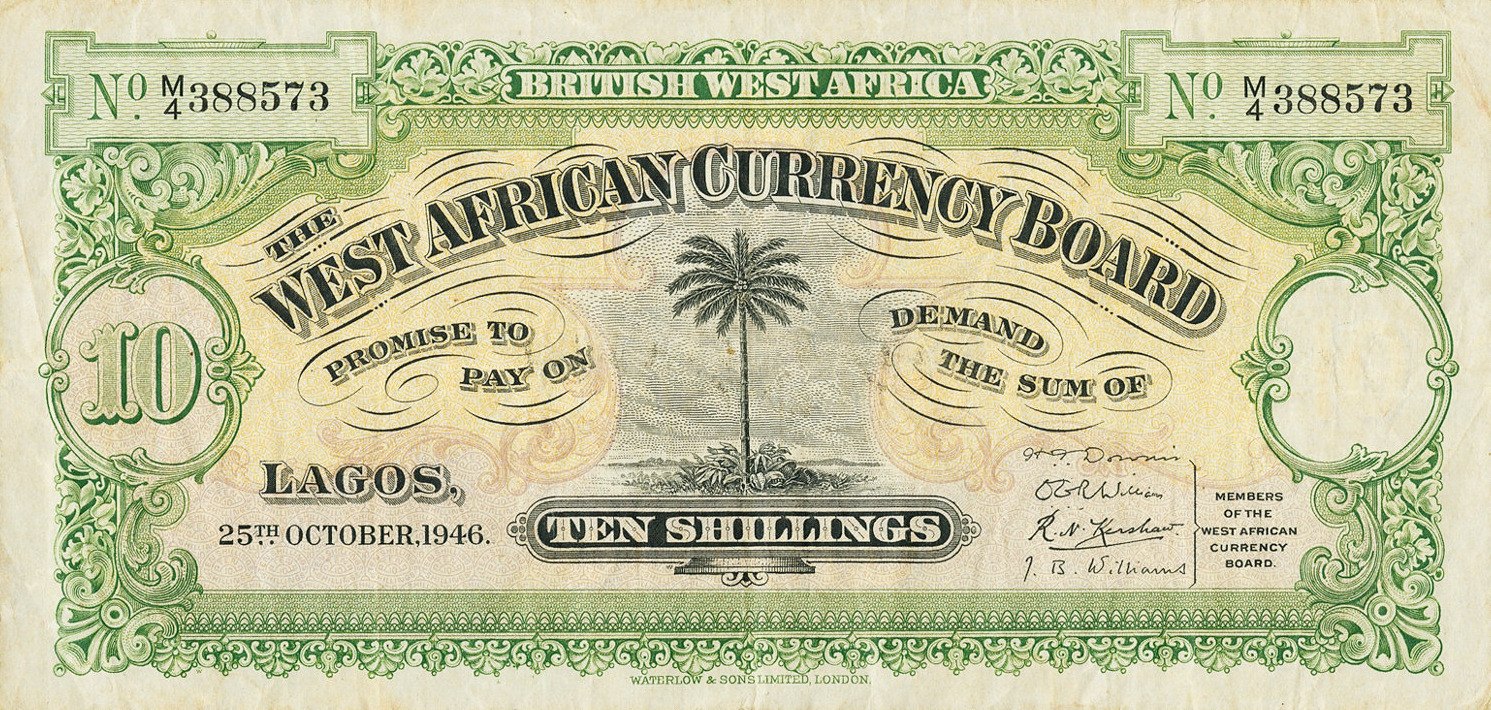
This article gathers the figures of notes in circulation that the official papers give for British West Africa: the report of the West African Currency Board for the year ended 30th June 1918, the Nigeria Handbooks of 1919 and 1922, the Gold Coast Handbook of 1928, the annual reports and Blue Books of the four colonies, the Nigeria Year Book for 1952 and the Bank of England's Quarterly Bulletin for 1962. The figures are those the sources print. Nothing has been added up here, and where two reports differ both are given. The issues themselves are told in The notes of the West African Currency Board, 1916 to 1962.
The Board's own count, 1917 and 1918
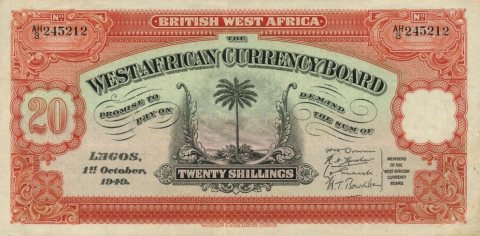
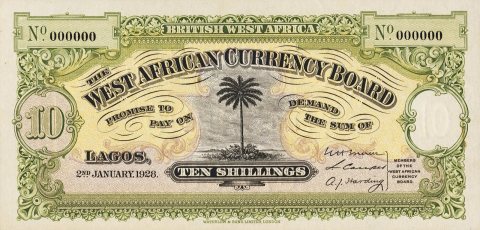
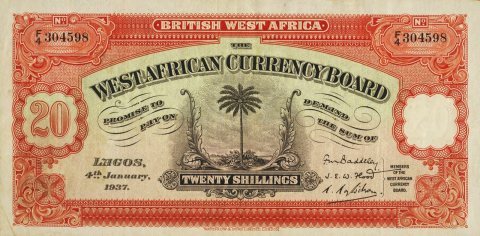
The Board's report for the year ended 30th June 1918 counts the notes by number as well as by value. It gives the notes in circulation as 135,996 notes worth 79,246 pounds on 30th June 1917 and 300,371 notes worth 176,445 pounds on 30th June 1918. On that second day the count by value of note was:
| Note | Number in circulation, 30th June 1918 | Face value in pounds |
|---|---|---|
| 20 shillings | 96,919 | 96,919 |
| 10 shillings | 147,952 | 73,976 |
| 2 shillings | 55,500 | 5,550 |
The report remarks that the 2 shillings had not found favour. Its appendix gives the figure for the end of every month from July 1917 to June 1918. The same appendix divides the 176,445 pounds between the colonies: 87,600 pounds in Nigeria, 61,045 pounds in the Gold Coast, 24,250 pounds in Sierra Leone and 3,550 pounds in the Gambia, where the notes had been introduced only in March 1918.
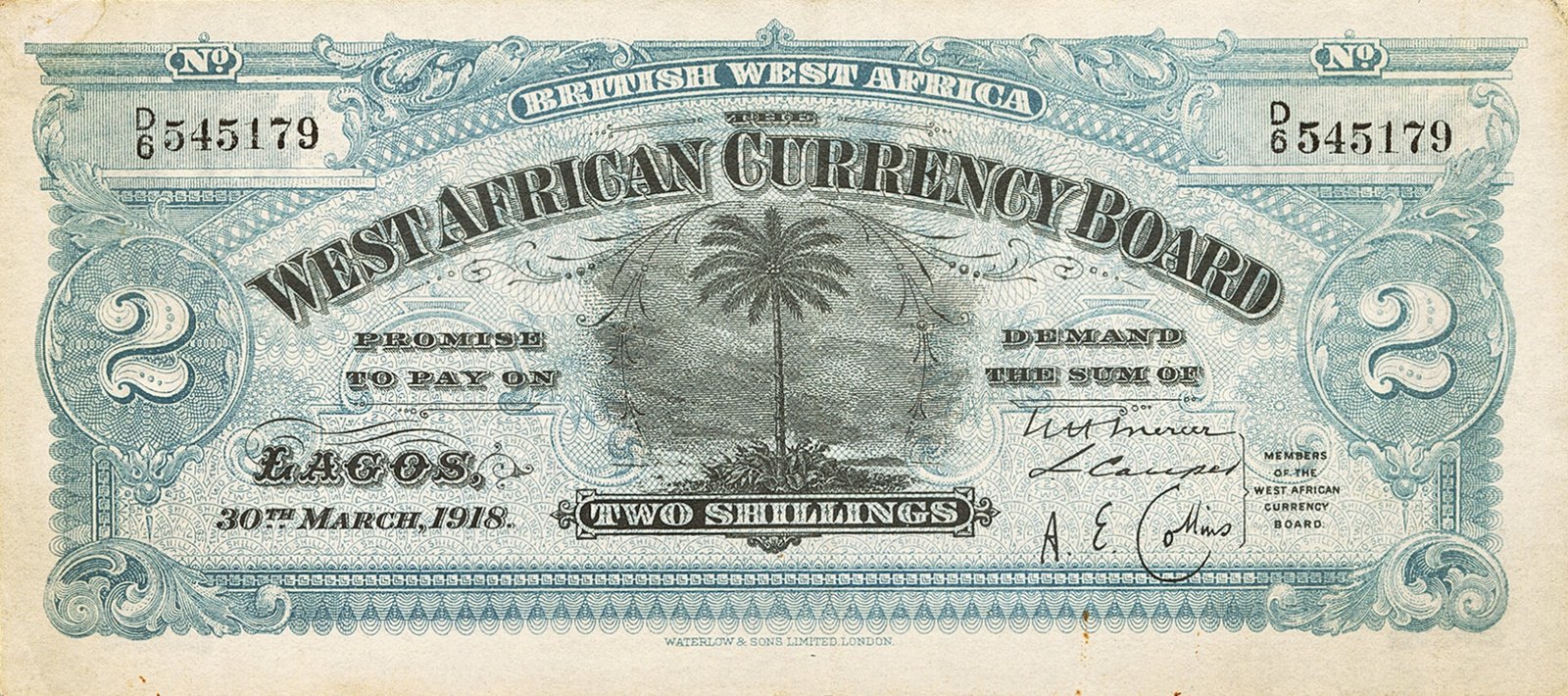
The jump of 1919 and the fall to 1922
The Nigeria Handbooks give the Board's notes in circulation at the end of March 1919 as 1,583,740 pounds in the four colonies, against 176,445 pounds on 30th June 1918, and 1,201,718 pounds at the end of March 1922.
| Colony | End of March 1919, in pounds | End of March 1922, in pounds |
|---|---|---|
| Nigeria | 658,395 | 295,446 |
| Gold Coast | 672,795 | not given |
| Sierra Leone | 144,250 | not given |
| The Gambia | 108,300 | not given |
| All four | 1,583,740 | 1,201,718 |
The figures for 1919 are from the Nigeria Handbook of 1919 and those for 1922 from the Nigeria Handbook of 1922. The Nigeria Handbook of 1919 names five values of note as then current: 5 pounds, 1 pound, 10 shillings, 2 shillings and 1 shilling. The 1 shilling is dated 30th November 1918 and the 5 pounds 1st March 1919.
The Gold Coast by value of note, 31st March 1922
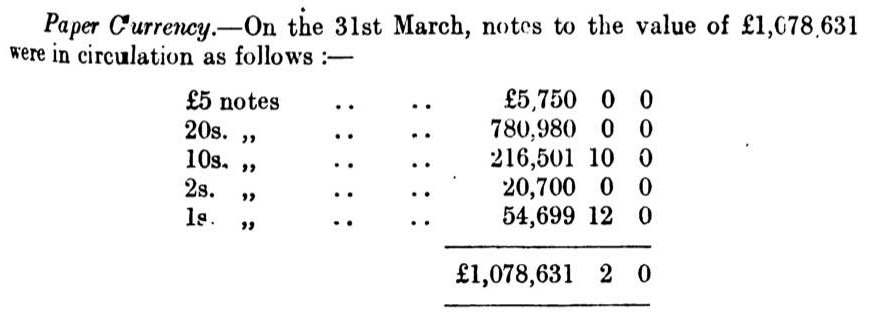
The Gold Coast's annual report for 1921 counts the notes in circulation in that colony on 31st March 1922 value by value.
| Note | Face value in circulation | Number of notes, as the catalogue's pages work it out |
|---|---|---|
| 5 pounds | 5,750 pounds | 1,150 |
| 20 shillings | 780,980 pounds | |
| 10 shillings | 216,501 pounds 10 shillings | |
| 2 shillings | 20,700 pounds | 207,000 |
| 1 shilling | 54,699 pounds 12 shillings | 1,093,992 |
| All values | 1,078,631 pounds 2 shillings |
For the same years the Gambia's report for 1922 says 100,000 pounds had been issued there in notes of every value from 1 shilling to 5 pounds, and Sierra Leone's estimates only 62,000 pounds actually in circulation there at the end of 1922. These reports are read closely, with the reasons the colonies' figures cannot be added together, in A million shilling notes: counting West Africa's first currency notes, 1921 to 1928.
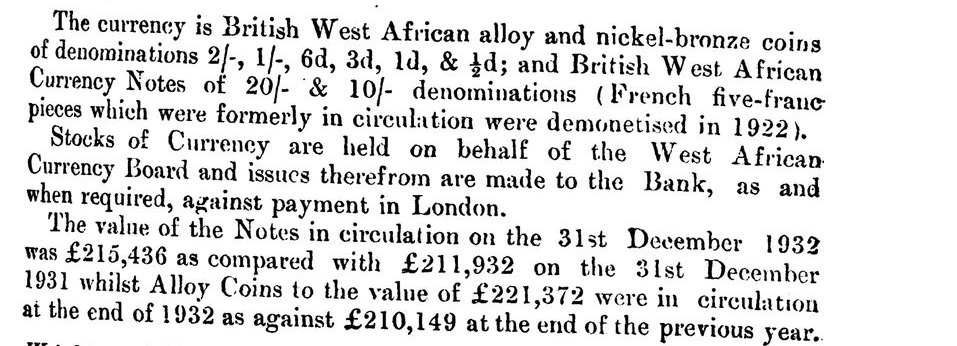
At 31st March 1925 the Board's notes issued in the Gold Coast and not returned came to 1,245,436 pounds, "almost entirely" in 20 and 10 shilling notes (Gold Coast annual report for 1924-25). The Gold Coast Handbook of 1928 gives 1,515,774 pounds on 31st March 1927.
All four colonies together, 1927 to 1937
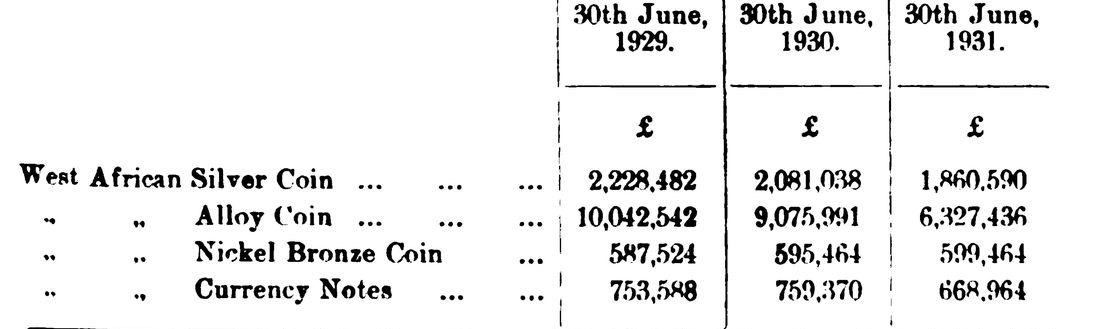
Nigeria's annual reports give the Board's notes in circulation in all British West Africa on 30th June of each year. For 1927 and 1928 they give the number of notes as well.
| 30th June | Notes in circulation, in pounds | Number of notes |
|---|---|---|
| 1927 | 728,835 | 1,098,152 |
| 1928 | 764,672 | 1,143,409 |
| 1929 | 753,588 | |
| 1930 | 759,370 | |
| 1931 | 668,964 | |
| 1932 | 628,122 | |
| 1933 | 705,140 | |
| 1934 | 697,024 | |
| 1935 | 717,295 | |
| 1936 | 976,247 | |
| 1937 | 2,374,909 |

The count of 30th June 1928 was taken the day before the engraved notes of 1928 came out in Sierra Leone: the 10 shillings of 1928 to 1950 and the 20 shillings of 1928 to 1952. The catalogue's pages set the figures of 1929 to 1931 beside more than 8,000,000 pounds in coin. Nigeria's annual reports of these years say that the notes in Nigeria alone could not be estimated, because currency moved between the colonies.
Nigeria, 1939 to 1957
From 1939 Nigeria's annual reports and the Nigeria Year Book for 1952 give the Board's notes in circulation in Nigeria on 31st March, and for some years the share of notes in all the currency.
| 31st March | Notes in circulation in Nigeria, in pounds | Notes as a share of all currency, per cent |
|---|---|---|
| 1939 | 250,000 | 4.3 |
| 1940 | 228,600 | |
| 1941 | 287,558 | 4.7 |
| 1942 | 529,773 | |
| 1943 | 1,440,851 | |
| 1944 | 1,606,364 | |
| 1945 | 2,276,198 | |
| 1946 | 3,213,927 | |
| 1947 | 4,696,430 | 20.0 |
| 1948 | 5,336,441 | |
| 1949 | 8,241,070 | 26.2 |
| 1950 | 8,935,237 | 28.3 |
| 1951 | 13,957,974 | 35.57 |
| 1952 | 19,121,911 | 38 |
| 1953 | 20,812,230 | 41 |
| 1954 | 22,951,435 | 43 |
| 1955 | 25,778,429 | 48 |
| 1957 | 37,741,502 | 59.7 |
The annual report for 1946 puts the small share of notes down to a general dislike of them, above all in the less developed parts of the country, because fire and termites destroyed them. On 31st March 1955 the notes in circulation in Nigeria, 25,778,429 pounds, passed the alloy coin, 25,355,733 pounds, for the first time (Nigeria annual report for 1955). The report for 1957 revises the figure for 1955 to 30,428,060 pounds, and gives 37,741,502 pounds for 31st March 1957, 59.7 per cent of all the currency in Nigeria. The reports for 1950 and 1951 say the 20 shillings was the note most in demand. No report gives the circulation in Nigeria by value of note.
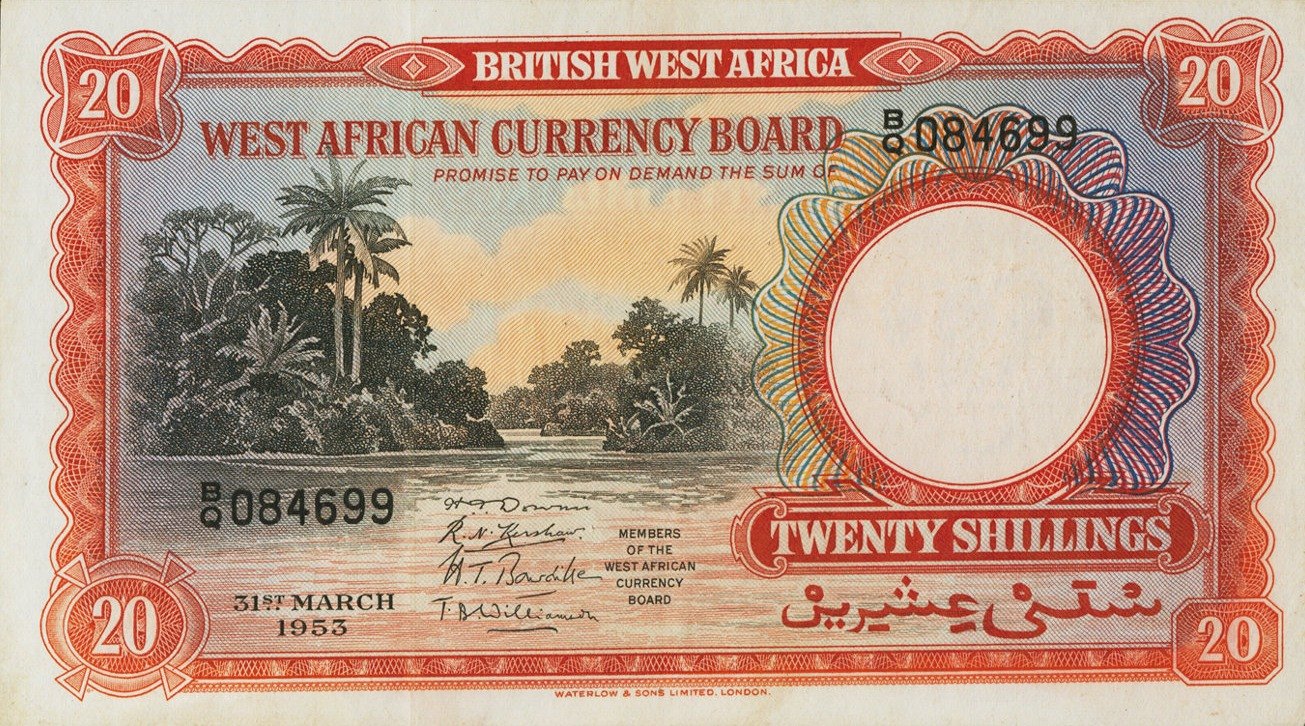
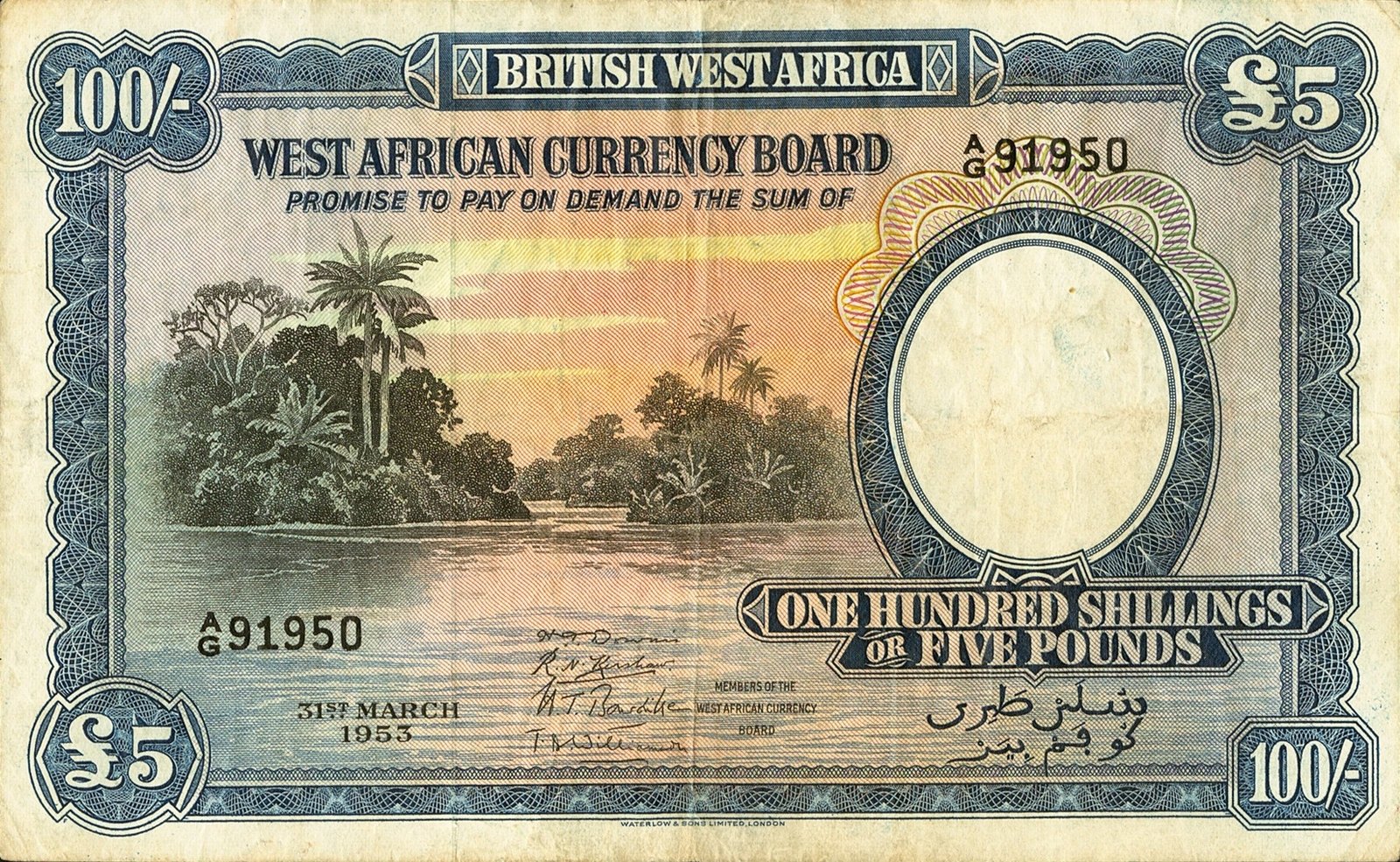
These are the years of the smaller notes of 1953: the 10 shillings, the 20 shillings and the 5 pounds.
The Gold Coast, 1934 to 1951
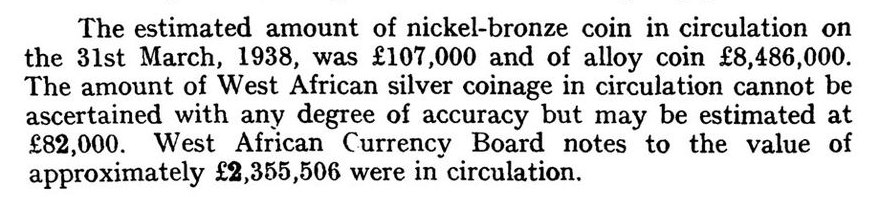
The Gold Coast annual reports put the Board's notes in circulation there at about 695,809 pounds in 1934, 843,089 pounds in 1935, 984,242 pounds in 1936, 2,355,506 pounds at 31st March 1938 and 1,802,506 pounds in 1939. From 1942 the reports give the two values apart, and they are the only reports read for the catalogue that do so for these notes.
| Date | 1 pound notes, in pounds | 10 shilling notes, in pounds |
|---|---|---|
| 31st March 1942 | 2,054,404 | 381,898 |
| 31st March 1943 | 2,751,023 | 570,464 |
| 31st March 1944 | 3,024,740 | 546,034 |
| 31st March 1945 | 3,420,930 | 519,459 |
| 31st March 1946 | 3,731,559 | 601,177 |
| 31st March 1947 | 5,407,950 | 987,877 |
| 31st December 1947 | 7,334,639 | 2,193,178 |
| 31st December 1948 | 17,525,284 | 2,973,178 |
| 31st December 1949 | 19,493,929 | 1,829,476 |
| 31st December 1950 | 21,780,685 | 2,689,726 |
| 31st December 1951 | 25,312,153 | 1,347,246 |
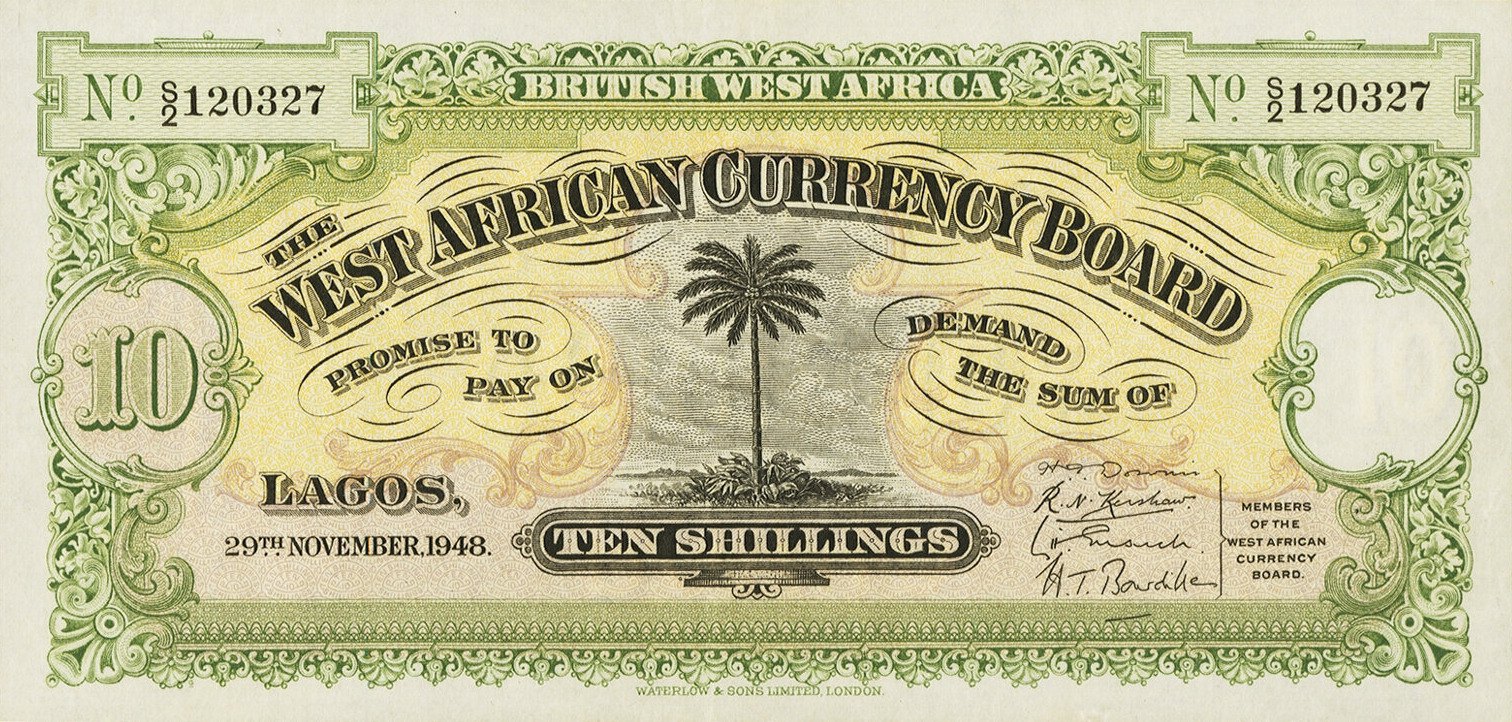
The 10 shilling notes reached their peak at the end of 1948. The report for 1950 prints the 1 pound figure for 31st December 1949 as 19,493,939 pounds, ten pounds more than the report for 1949.
Sierra Leone and the Gambia
Sierra Leone's Blue Books estimate only 32,000 pounds of the Board's notes in circulation at the end of 1934 and 50,000 pounds at the end of 1936. After the war the annual reports give 1,118,374 pounds 10 shillings at the end of 1945, falling to 550,369 pounds at the end of 1949, then 1,373,228 pounds at the end of 1953, 5,499,984 pounds at the end of 1954 and 9,232,512 pounds on 30th June 1958. The reports do not explain the rise of 1954.
In the Gambia only the 10 and 20 shillings circulated. The annual reports give about 191,000 pounds in circulation during 1928, 207,932 pounds at the end of 1930, 211,932 pounds in 1931, 215,436 pounds in 1932, 232,984 pounds in 1935 and 264,700 pounds in 1937.
After 1959
The Bank of England's Quarterly Bulletin for 1962 puts the Board's notes and coin in circulation at over 125 million pounds at their height and 28 million by 30th June 1961, after Ghana and Nigeria had left. That figure takes notes and coin together.
What the figures do not give
- No source to hand counts the notes printed. The catalogue's pages give printing figures for a few notes on the word of unnamed sources, and those are told in the article on the issues.
- No report read for the catalogue gives the circulation by value of note in Nigeria or Sierra Leone, and the catalogue's pages carry no figure for the Gambia after 1937.
- The Nigerian reports for 1938 to 1945, the Gold Coast reports for 1936-37 and 1939 to 1945 and the Sierra Leone reports for 1939 to 1945 have not been read. The figures for those years come from tables in later reports.
- The Nigerian figure for 31st March 1956 is not among those taken from the reports.
- A figure of notes in circulation is a figure of notes issued and not returned. It does not say how many notes survive today.
Sources
- Report of the West African Currency Board for the year ended 30th June 1918 (Cmd. 15, February 1919), paragraphs 16 to 18 and Appendix II.
- Nigeria Handbook of 1919, p. 41; Nigeria Handbook of 1922, p. 67.
- Nigeria annual reports to 1937, for 1946 to 1955 and for 1957; Nigeria Year Book for 1952, Table 6.
- Gold Coast annual reports for 1921, 1924-25, 1933-34 to 1935-36, 1937-38, 1938-39 and 1946 to 1951; Gold Coast Handbook of 1928.
- Sierra Leone annual report for 1922; Sierra Leone Blue Books for 1934 and 1936; Sierra Leone annual reports for 1946 to 1958.
- The Gambia annual report for 1922 and the annual reports for the years 1928 to 1937.
- The Bank of England's Quarterly Bulletin for 1962.
Member comments
Log in or register to post a comment.