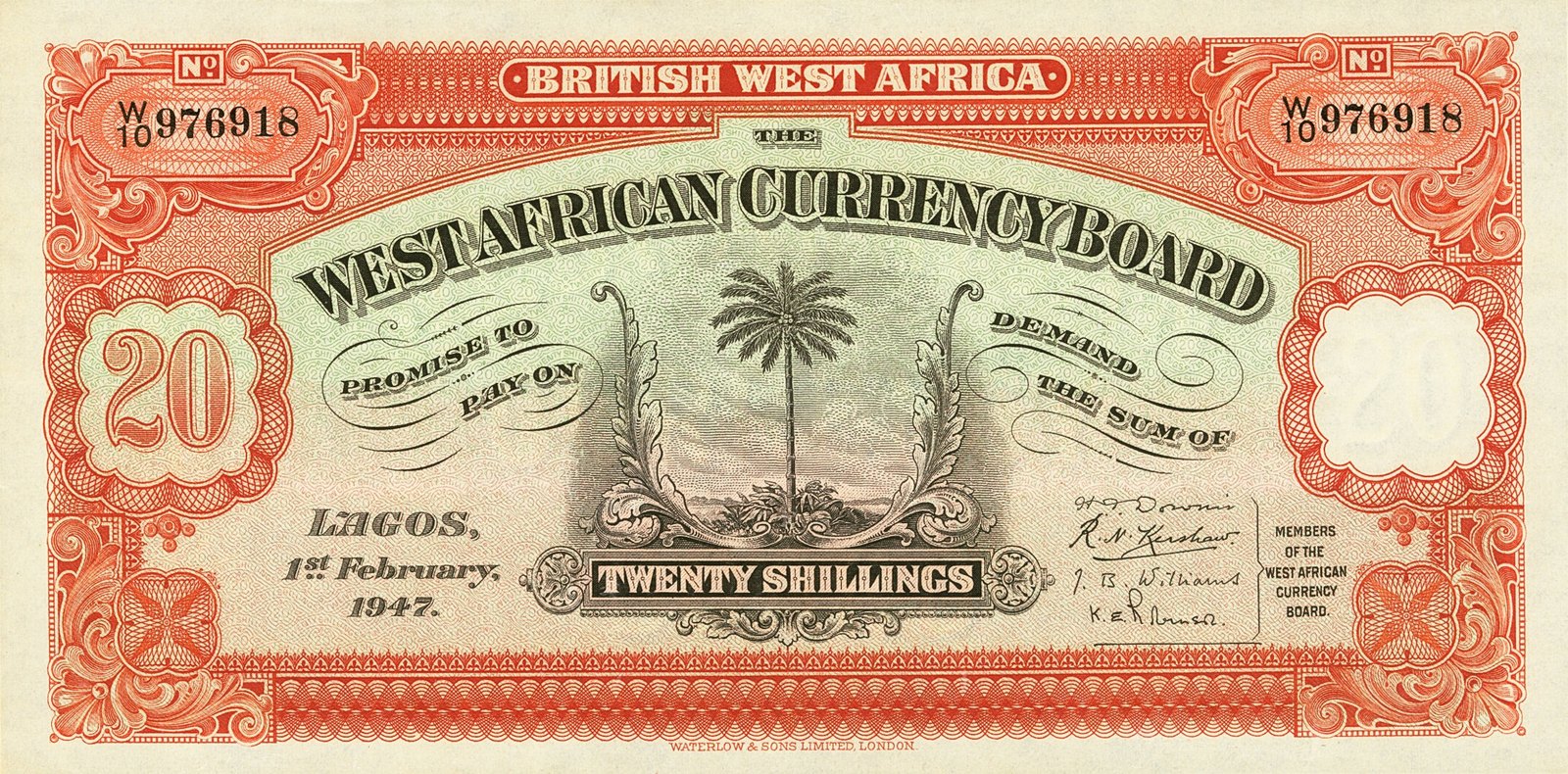
This article tells the story of the notes of the West African Currency Board in order of time, from the first notes dated 1916 to the last, dated 17th April 1962. It is drawn from the catalogue's pages for British West Africa, which name the reports, handbooks, Blue Books and Colonial Office Lists they rest on, from the Board's report for the year ended 30th June 1918 and the Nigeria Handbooks and annual reports, and from a few descriptions by auction houses, each given as that house's own statement. The members of the Board who signed the notes have their own article, The members of the West African Currency Board and the notes they signed, 1912 to 1965, and the figures of notes in circulation are set out in The West African Currency Board's notes in circulation, 1917 to 1961.
A plan for Southern Nigeria, and the Board of 1912
Sources mention that notes had first been planned for Southern Nigeria alone, De La Rue sending designs for 10 shillings to 50 pounds dated 1st September 1909, and that the plan was dropped when the Treasury asked for a gold reserve and one currency board for the whole of West Africa.
The West African Currency Board was set up in London in 1912. A note issue had been recommended from the start, but the Secretary of State for the Colonies told the House of Commons on 19th March 1913 that it would wait until the new West African coinage had proved itself. Late in 1915 a sharp rise in cocoa prices left the Board unable to meet the demand for coin. United Kingdom notes were issued as an emergency measure, and in November 1915 the Board's constitution was widened to let it issue notes. The Colonial Office List for 1918 says that in the Gold Coast the United Kingdom 10 and 20 shilling notes had been made legal tender by Ordinance No. 27 of 15th December 1915.
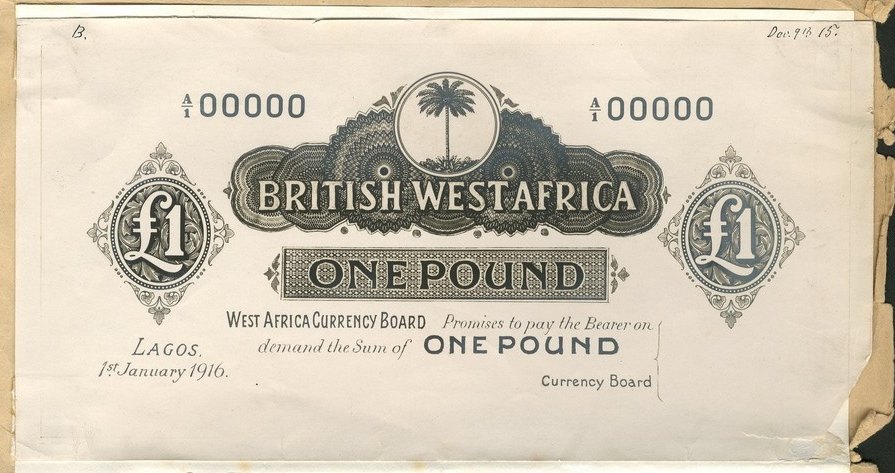
One trace of the design work has passed through the saleroom. Spink's description of lot 183 in its sale of 30th September 2014 tells of photographs of designs for a 10 shillings and a 1 pound dated 1st January 1916, with a piece of watermarked paper and a letter from De La Rue to W. H. Mercer that sets out the cost of the intended printing. Spink calls the designs forerunners of the notes that were issued. The notes that came out were printed by Waterlow.
The first notes, 1916
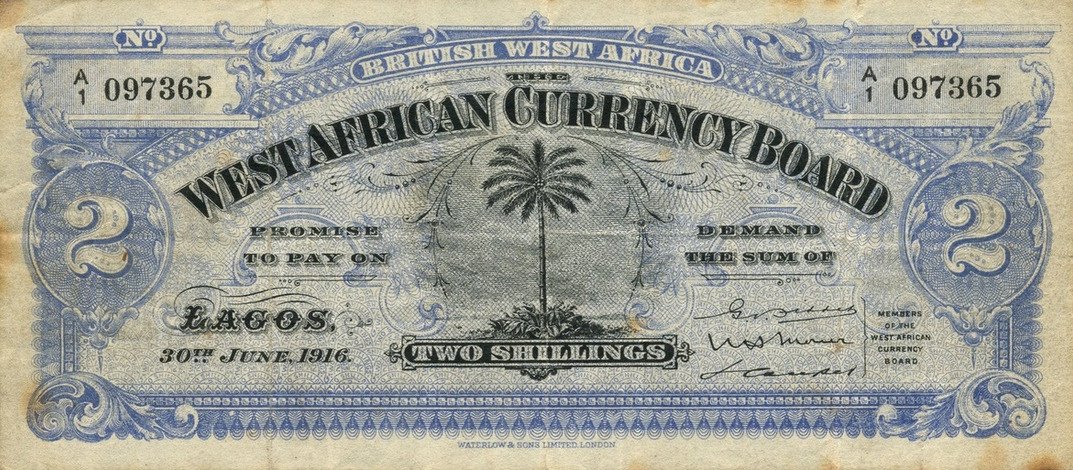
Three values were made: the 2 shillings of 1916 to 1918, dated 30th June 1916, and the 10 shillings and 20 shillings, both dated 31st March 1916. Kerry Rodgers, writing in Bank Note Reporter in November 2004 after David Vice, says that the first shipment of the notes arrived from the printers, Waterlow, in June 1916, that they were put into circulation in Nigeria on 11th July 1916, and that they were issued on trial in the Gold Coast and Sierra Leone in September 1916. The Board's report for the year ended 30th June 1918 says the 2 shillings was issued in Sierra Leone in October 1917, and that the notes of all three values were introduced into the Gambia in March 1918. The same report remarks that the 2 shillings had not found favour.
The law differed from colony to colony.
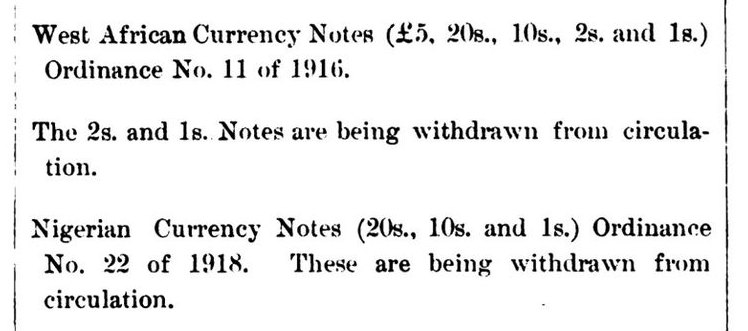
- Nigeria. The notes were authorised by the Currency Notes Ordinance of 3rd April 1916 (No. 11 of 1916) and could be changed for coin at the Bank of British West Africa in Lagos. In 1919, with silver short, that right was suspended for a time (Ordinance No. 6 of 1919).
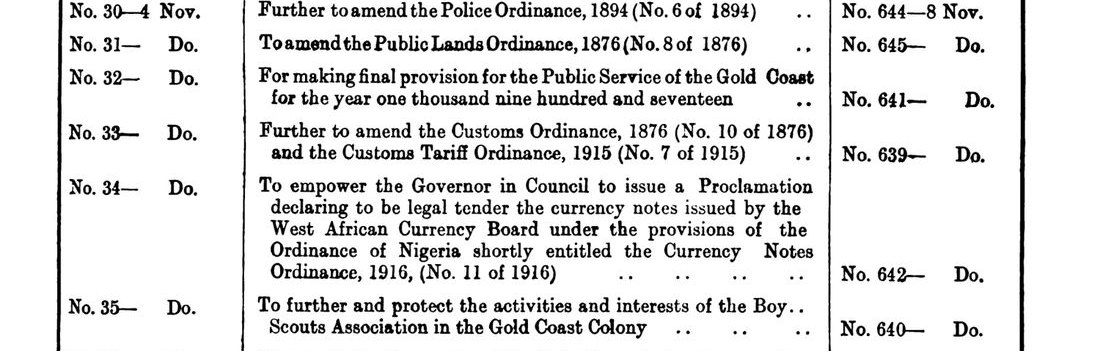
- Gold Coast. The Colonial Office List for 1918 says the notes had been introduced "experimentally" in 1916 and were not yet legal tender there. Ordinance No. 34 of 4th November 1918 empowered the Governor to proclaim the Board's notes legal tender (Gold Coast Blue Books for 1918 and 1921).
- Sierra Leone. An Ordinance of 23rd November 1918 made the notes legal tender (Sierra Leone Blue Book for 1918).
Elsewhere the notes were in use before they were legal tender. In each colony the Treasurer acted as the Board's Currency Officer and the Bank of British West Africa as its agent. In Nigeria the Accountant-General had taken over as Currency Officer by 1950.
The Nigeria Handbook of 1922 says the notes were very unpopular, because change was hard to get during the war and the notes tore easily.
The Hausa words and the notes of 30th March 1918
The notes dated 1916 were printed with a blank back. The notes dated 30th March 1918 carry two words of Arabic script printed in black in the middle of the back. Sources mention that the two words are Hausa, approved in December 1917, and that in March 1918 they were also printed onto the notes dated 1916 that were still in stock, which is how the 2 shillings dated 1916 with the two words came about. The Board's report for the year ended 30th June 1918 says that arrangements were made during that year to print the value in Hausa, in Arabic characters, on new supplies of the notes, to further their use.
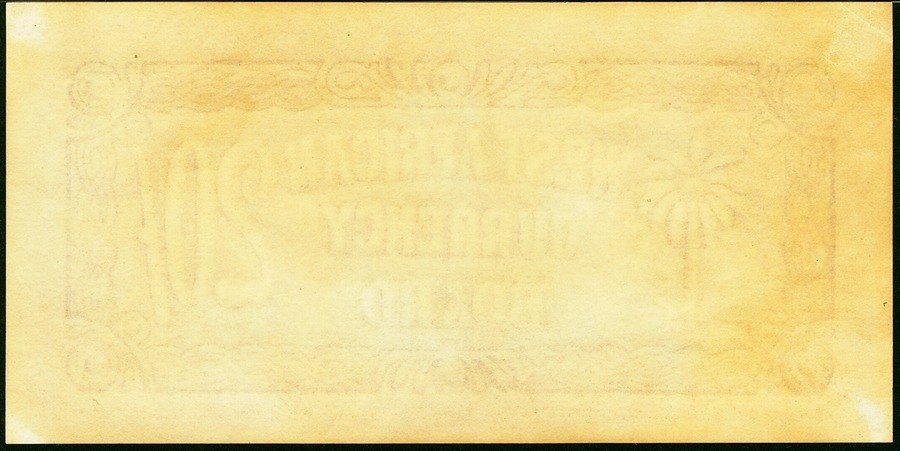
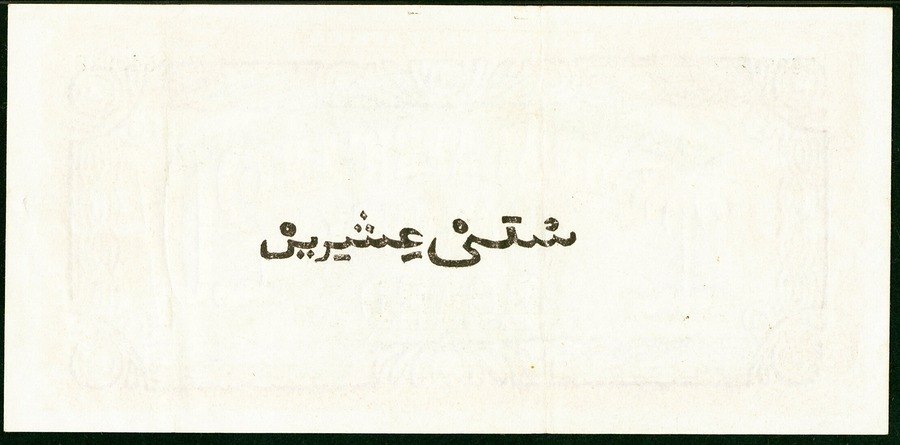
Sources mention that the large printings of 1919 and 1920 kept the date 30th March 1918 and its signatures, so no later date exists for these notes. Sources also mention a final printing of 250,000 twenty shillings of this type in the J series late in 1927, made while the notes of 1928 were awaited.
The 1 shilling, the 5 pounds and the 5 shillings, 1918 to 1920
Two values were added after the First World War, when trade boomed and the Board's area grew with the former German colonies in West Africa. Both were printed at the Bank of England.
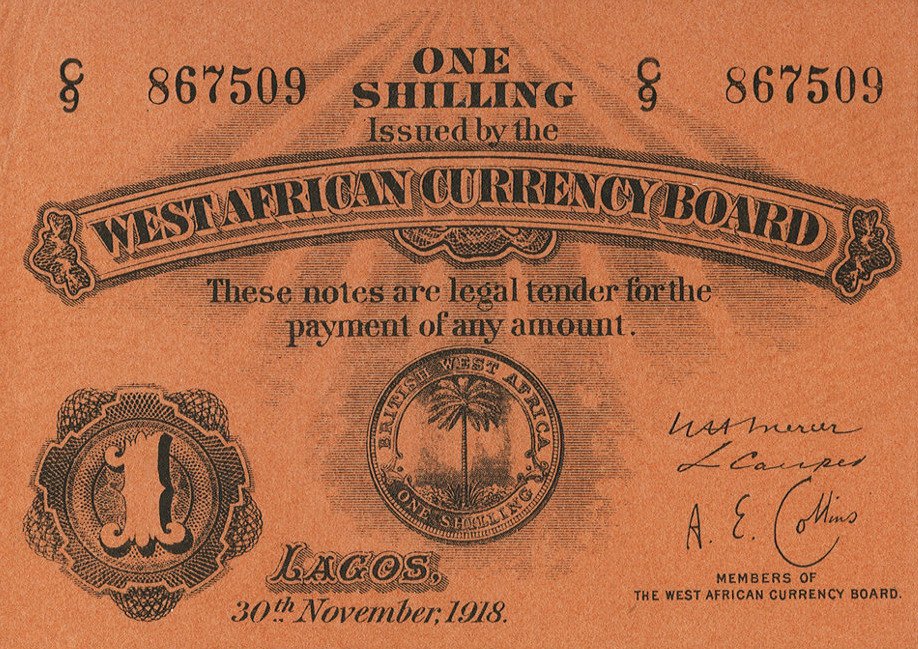
The 1 shilling is dated 30th November 1918. Sources mention that 21 million were printed and that 2,500,000 of them were burned at the Bank of England in 1922. Sources mention too that in October 1919 the Board ordered 5,000 booklets from the Bank of England in plain red covers, each holding 20 one shilling notes: 2,000 for Nigeria, 2,000 for the Gold Coast and 500 each for Sierra Leone and the Gambia. Stack's Bowers, describing lot 50037 in its sale of 1st October 2026, says the note is believed to have been first issued late in 1919 in booklets of 20. Heritage, describing lot 26071 in its sale of 24th April 2020, says the value was issued to help with small change at a time when silver coin was being hoarded.
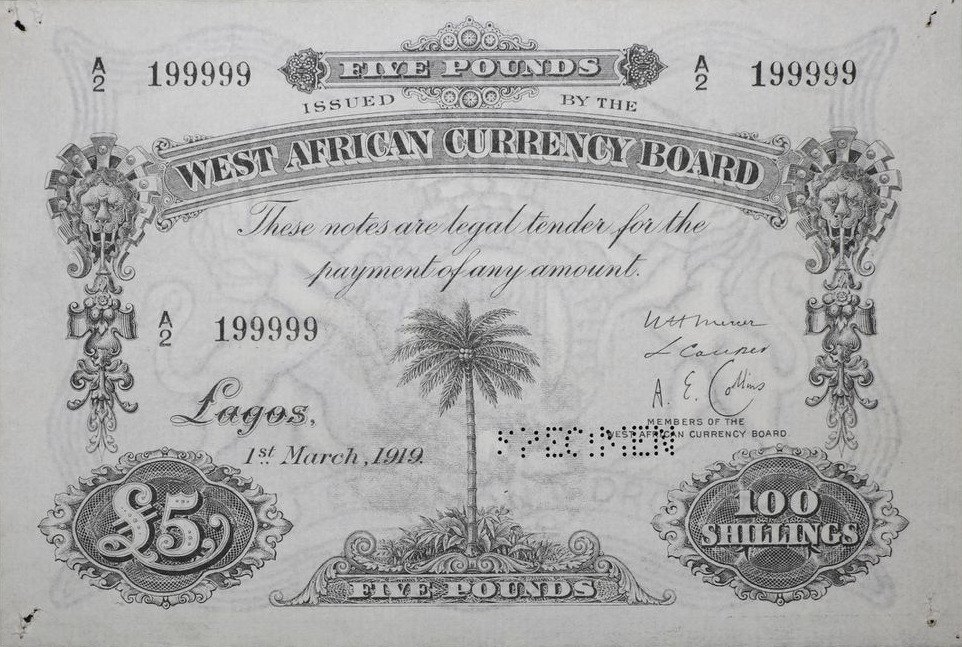
The 5 pounds of 1919 is dated 1st March 1919. Sources mention that 200,000 notes were made, printed in black on Indian currency note paper with its watermark but without the word INDIA.
A 5 shillings was prepared for 1st March 1920 but never issued. Sources mention that 500,000 were ordered from Waterlow in January 1920 and held by the printer, and describe a reddish-brown note a little smaller than the 10 shillings and of the same style. The signatures are not known.
The small values and the 5 pounds are withdrawn
Neither the 1 shilling nor the 5 pounds was popular, and the 5 pounds was too large for everyday use. The catalogue's pages give 1923 as the year both were withdrawn. The official papers show a withdrawal spread over years:
- Sierra Leone's annual report for 1921 says the withdrawal of the 2 and 1 shilling notes "was continued, and very few now remain in circulation".
- Nigeria's Blue Book for 1922 says the 2 and 1 shilling notes were "being withdrawn from circulation".
- The Colonial Office List for 1923 still names the 5 pounds as current.
- The Colonial Office List for 1925 says the 5 pounds, 2 shillings and 1 shilling had all been withdrawn, leaving the 20 and 10 shillings as the only values in circulation.
- The Gold Coast Handbook of 1928 says all three had been withdrawn from circulation.
- Nigeria's annual reports of 1932 to 1937 still list a few as outstanding and "in process of withdrawal".
What the Gold Coast, Sierra Leone and the Gambia counted in these years is told in A million shilling notes: counting West Africa's first currency notes, 1921 to 1928.
The engraved notes of 1928
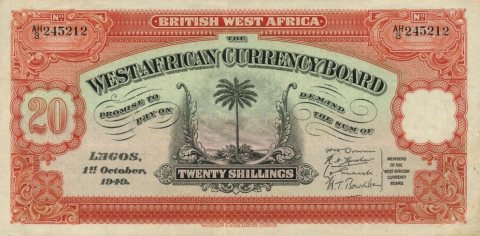
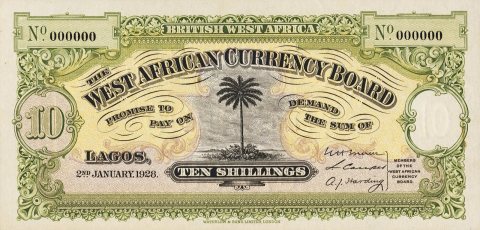
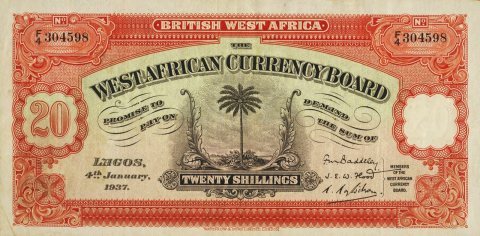
Two values went on: the 10 shillings of 1928 to 1950 and the 20 shillings of 1928 to 1952, the first of them dated 2nd January 1928. Sources mention that the 1928 notes were printed from engraved plates instead of by offset lithography, in slightly changed colours and with a watermark window at the right, to defeat forgery, and that they reached circulation early in July 1928. Sierra Leone's annual report for 1928 gives the day there as 1st July 1928, and says the old notes kept their legal tender value and stayed in circulation beside the new. In the Gambia only the 10 and 20 shillings circulated.
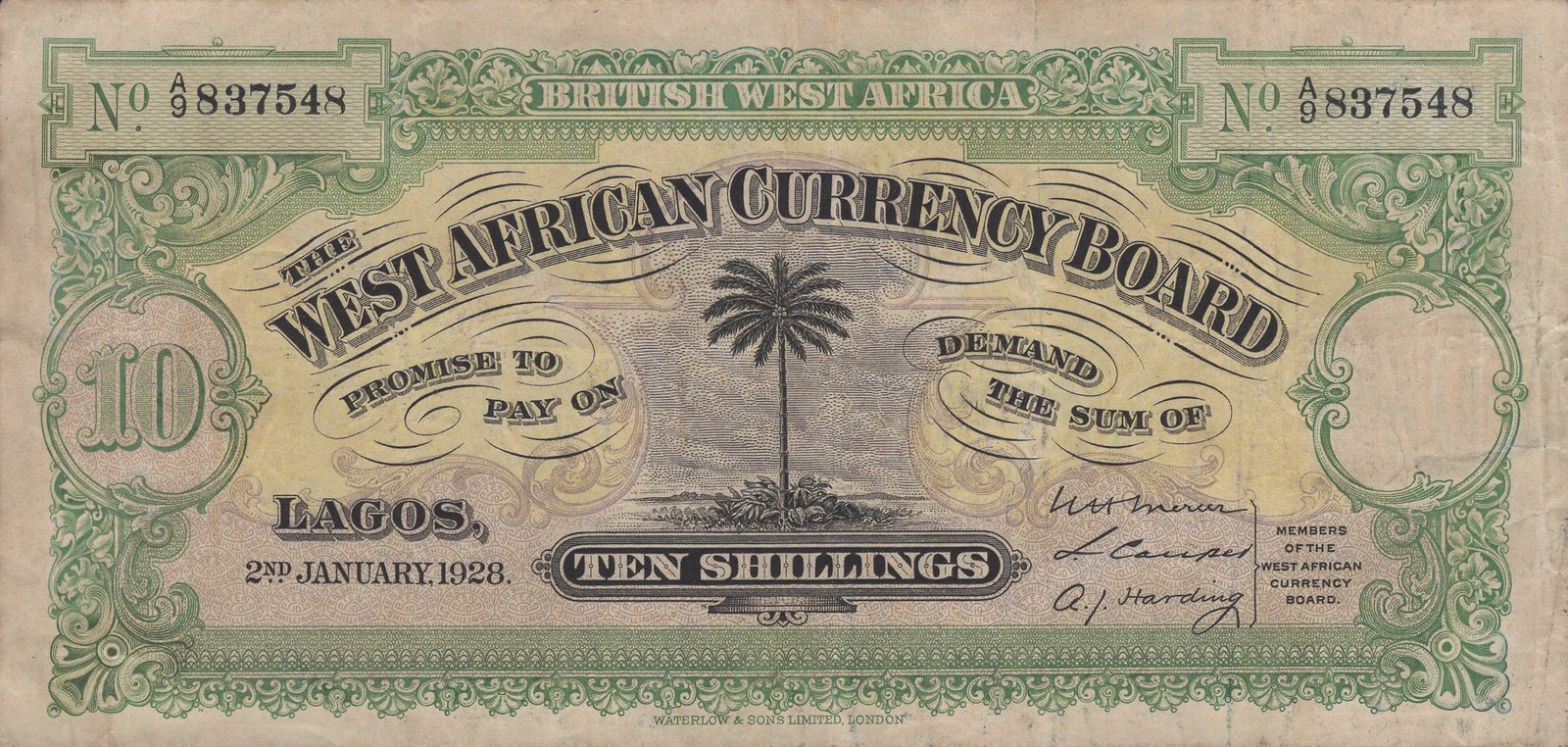
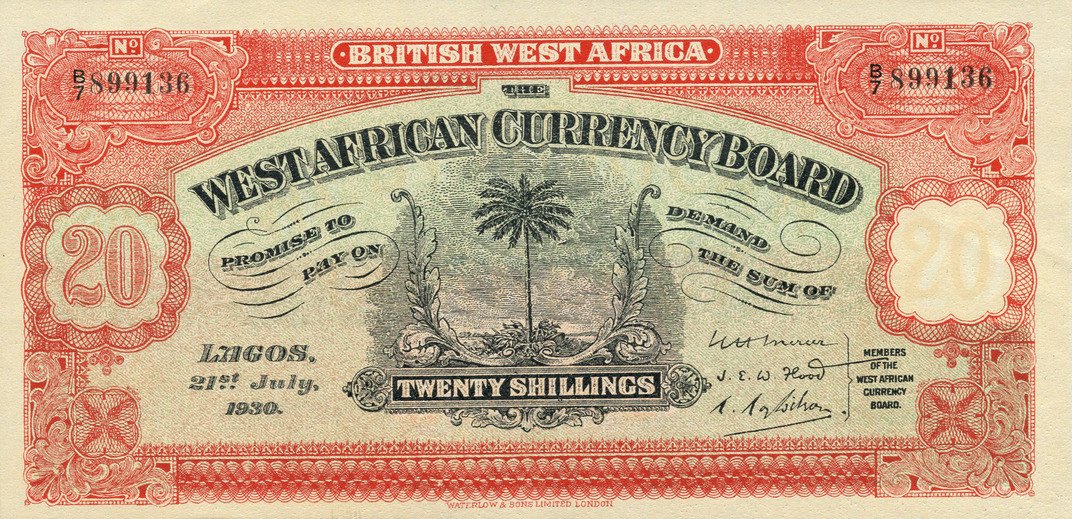
The dates on the 10 shillings run from 2nd January 1928 to 28th July 1950, and those on the 20 shillings from 2nd January 1928 to 1st April 1952. No issued note of 1st April 1952 has been recorded. Three or four members of the Board sign each note, and the panel changes with the date.
Forgeries of the 20 shillings
Many contemporary counterfeits of the 20 shillings exist. Nigeria's annual report for 1935 says forgers had been writing to printers abroad to have notes printed, which a new law made an offence. Nigeria's annual report for 1949 tells of an epidemic of counterfeit 20 shilling notes, made mainly by photographers in the Eastern Provinces and reported from 34 places from Sokoto to Lagos. The Nigeria annual report for 1953 calls counterfeiting far too prevalent and gives it as the reason for the new notes of that year.
The counterfeits recorded in the catalogue copy the dates 2nd January 1928, 21st July 1930, 2nd June 1933 and 14th September 1934. Whether any of them is the work of the photographers of 1949 is not known. One, sold by Spink on 17th April 2019 in lot 259, has two lines drawn across the front and is endorsed on the back "counterfeit for comparison only".
Heritage, describing a counterfeit of 14th September 1934 in lot 26873 of its sale of 8th September 2014, from the Ruth W. Hill Collection, says it has a plain back and that its watermark seems to have been put on with a pigment, where other examples used oil. The same description says the authorities only began to issue engraved designs in the 1950s. That disagrees with the sources behind the catalogue's pages, which put the change to engraved plates in 1928.
The notes of 1953 and the 5 pounds of 1954
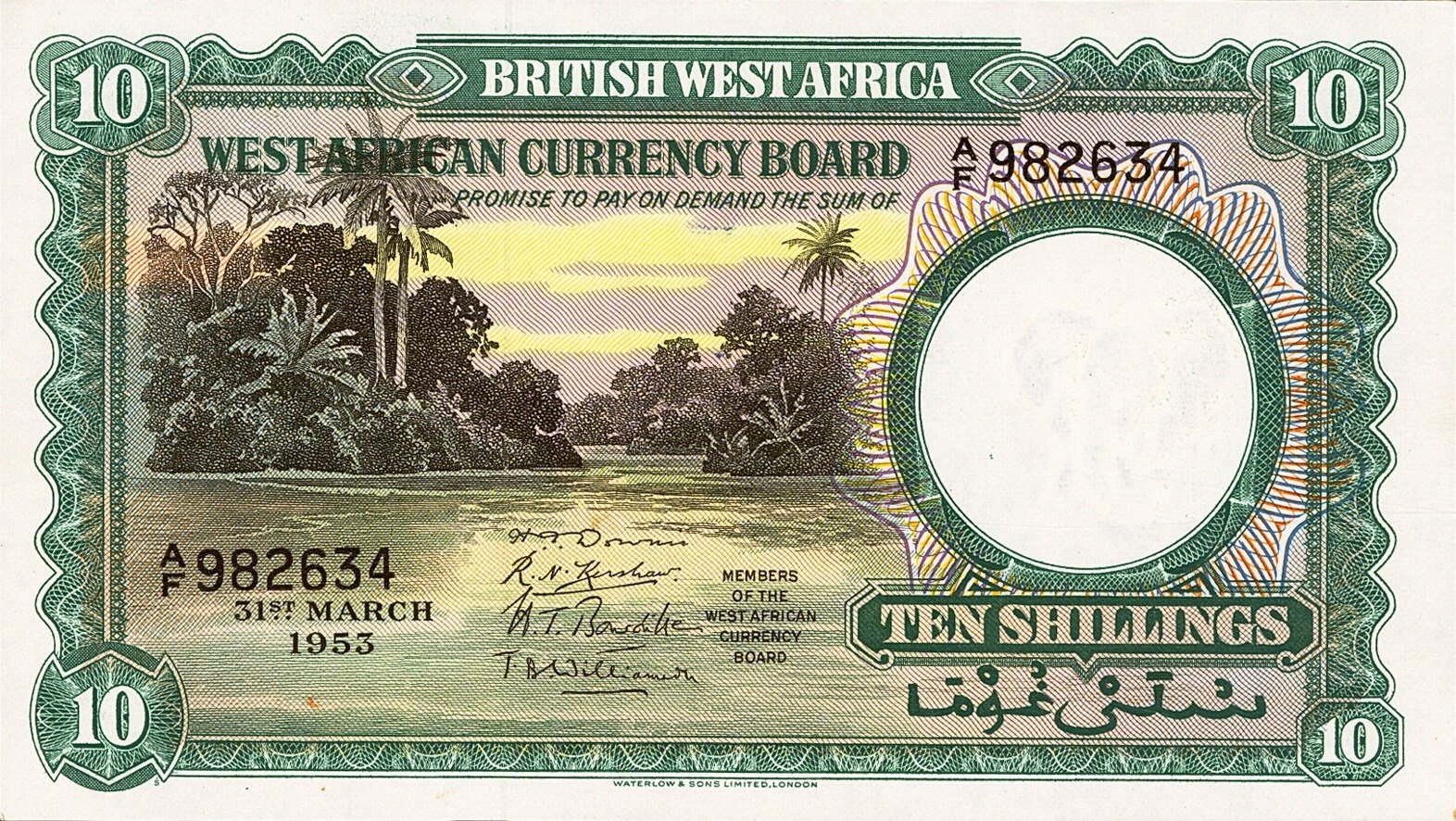
A new and smaller set of notes is dated 31st March 1953: the 10 shillings of 1953 to 1958, the 20 shillings of 1953 to 1957 and the 100 shillings or 5 pounds of 1953 and 1954, all printed by Waterlow. The Nigeria annual report for 1953 says the 10 and 20 shillings were first issued in Nigeria on 1st October 1953, smaller than the notes they replaced and on better paper, to make forgery harder. The paper carries a security thread, a fine vertical line left of centre on the front.
The 100 shillings was first issued in Nigeria on 5th April 1954 (Nigeria annual report for 1954), three weeks before the date on its second printing, 26th April 1954. The Gold Coast's annual report for 1953 already lists a 5 pounds among the notes current there, and Sierra Leone's reports first list it in 1954.
A 1,000 pounds dated 26th April 1954 is known only as a specimen. Stack's Bowers, describing lot 51065 in its sale of 7th May 2026, says the note was meant only for payments between banks and that it is not known whether any was issued.
The De La Rue note of 1962 and the end of the Board's notes
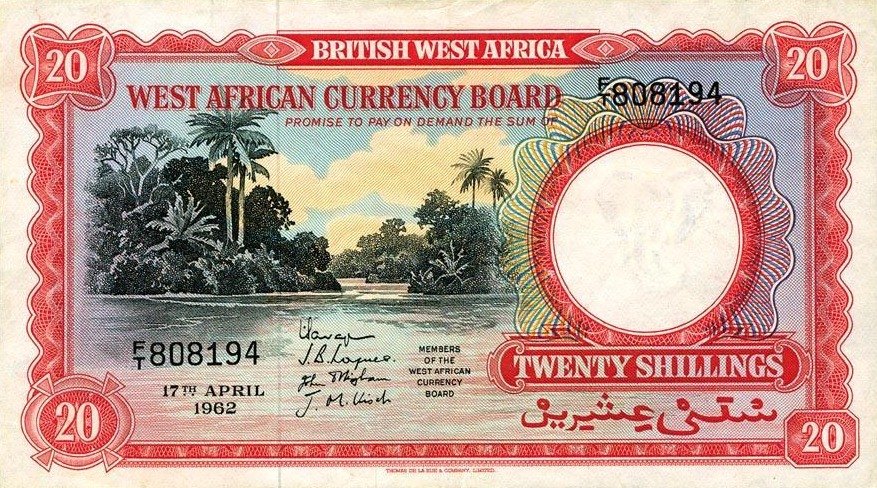
The last note is the 20 shillings of 17th April 1962. It keeps the design of the 20 shillings of 1953 but was printed by De La Rue, a change that followed De La Rue's purchase of Waterlow's banknote business in 1961.
The catalogue's pages give the steps of the withdrawal, without naming a source for the dates. The Board's notes were withdrawn as each territory took its own currency. In Ghana they were accepted at par until 1 July 1959 and then progressively demonetised. In Nigeria the Central Bank exchanged them at par from 1 July 1959; they stayed legal tender there until 1 July 1962 and could be redeemed in Lagos without commission until 30 September 1962. Sierra Leone changed to its own decimal currency on 4 August 1964, and The Gambia to the notes of The Gambia Currency Board in October 1964. The Bank of England's Quarterly Bulletin for 1962 puts the Board's notes and coin in circulation at over 125 million pounds at their height and 28 million by 30th June 1961, after Ghana and Nigeria had left.
What the sources do not give
- The first day of issue of the 1916 notes in Nigeria and the Gold Coast is not in the handbooks or annual reports read for the catalogue. The dates above are those of Kerry Rodgers in Bank Note Reporter.
- No source to hand says who would have signed the 5 shillings of 1920.
- The year 1923 for the withdrawal of the 1 shilling and the 5 pounds stands on the catalogue's pages without a named source, and the official papers above show the withdrawal running from 1921 into the 1930s.
- It is not known whether a 1,000 pounds note was ever issued.
- No day is given for the end of legal tender in Ghana, Sierra Leone or The Gambia.
Sources
- The catalogue's pages for the notes of the West African Currency Board, linked above.
- Report of the West African Currency Board for the year ended 30th June 1918 (Cmd. 15, February 1919).
- Nigeria: Currency Notes Ordinance, No. 11 of 1916; Ordinance No. 6 of 1919; Nigeria Handbooks of 1919 and 1922; Blue Book for 1922; annual reports for 1932 to 1937, 1949, 1953 and 1954.
- Gold Coast: Ordinance No. 27 of 15th December 1915; Ordinance No. 34 of 4th November 1918; Blue Books for 1918 and 1921; Gold Coast Handbook of 1928; annual report for 1953.
- Sierra Leone: Ordinance of 23rd November 1918; Blue Book for 1918; annual reports for 1921 and 1928.
- The Colonial Office Lists for 1918, 1923 and 1925.
- Statement of the Secretary of State for the Colonies in the House of Commons, 19th March 1913.
- Kerry Rodgers, after David Vice, in Bank Note Reporter, November 2004.
- The Bank of England's Quarterly Bulletin for 1962.
- Spink, 30th September 2014, lot 183; Spink, 17th April 2019, lot 259.
- Heritage, 8th September 2014, lot 26873; Heritage, 24th April 2020, lot 26071.
- Stack's Bowers, 1st October 2026, lot 50037; Stack's Bowers, 7th May 2026, lot 51065.
Member comments
Log in or register to post a comment.