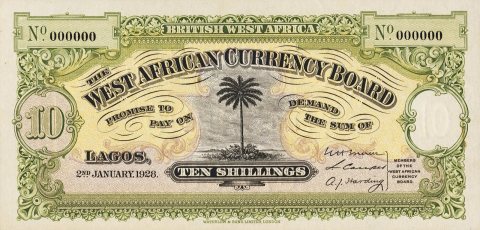
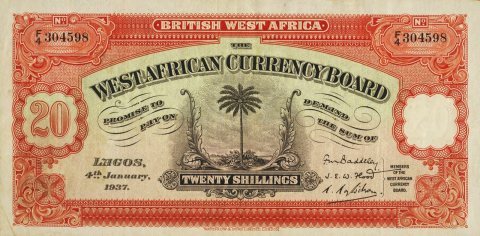
The notes of the West African Currency Board were not the first paper money seen in West Africa, and for years they were not the only paper money that was legal tender there. This article gathers what the owner's filed research records say about the years before 1916 and about the other notes that passed beside the Board's: the colonial annual reports, the Blue Books and Colonial Office Lists, Hansard, and three collectors' articles in the Journal of the International Bank Note Society. The Board's own issues are told in The notes of the West African Currency Board, 1916 to 1962.
What the annual reports saw before 1912
The colonial annual reports of the years before the Board name very little paper money.
- Southern Nigeria, 1908 (Colonial Reports, Annual, No. 630): the Bank of British West Africa and the Bank of Nigeria are named only as bankers. Nothing is said of notes.
- The Gambia, 1909 and 1910 (Nos. 641 and 679, read on the page image): Bank of England notes were not legal tender, but they were accepted at the Bank of British West Africa, then the only bank in Bathurst. The report adds that the circulation was small.
- Sierra Leone, 1909 (No. 648, read in the text): coin only, with coin in circulation put at 50,000 to 60,000 pounds. No paper money is named.
- Ashanti and the Northern Territories, 1909 (Nos. 640 and 639): in Ashanti silver coin and gold only, in the Northern Territories cowries, silver and copper coin. No paper money.
- The Gold Coast, 1913 (annual report for 1913, read in the text): no bank note of any kind circulated.
The banks' own notes
Richard Kelly, writing on early paper money in British West Africa in the IBNS Journal (vol. 16 no. 3, 1977, p. 151), names two bank issues. The Bank of Nigeria, Kelly says, issued 10 shilling bearer notes in Southern Nigeria for a few years before 1912, and none is known to survive. Kelly also writes of a specimen 5 pounds of the Bank of British West Africa dated 1897 and printed by Bradbury Wilkinson, which Kelly had seen. The article gives no photograph and no number.
The IBNS Journal (vol. 33 no. 4, p. 32, plate A4) pictures a 1 pound promissory note of Free Town, Sierra Leone, of the early nineteenth century, with no number filled in.
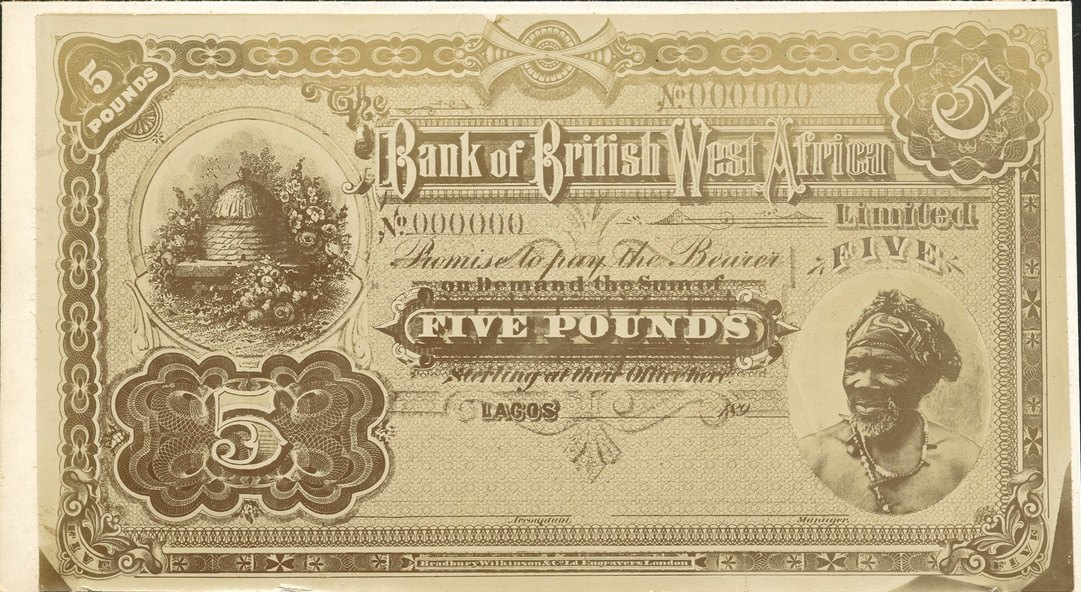
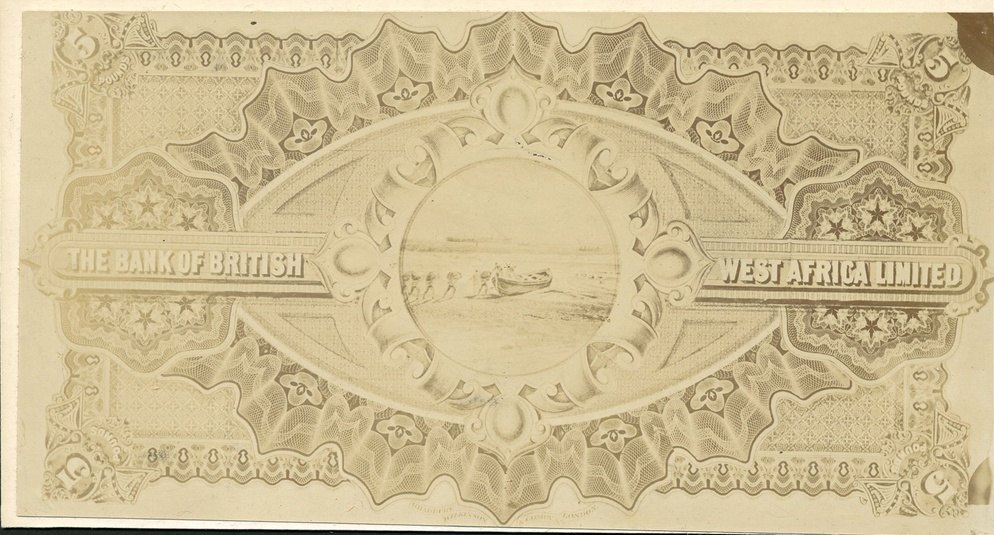
The catalogue has no Pick page for any of these; its Pick pages for British West Africa begin with the Board's notes of 1916. Its archive does hold Spink's archival photographs of the face and back of a 5 pounds of the Bank of British West Africa, payable at Lagos and dated 189-, shown here.
A plan for Southern Nigeria, 1907 to 1910
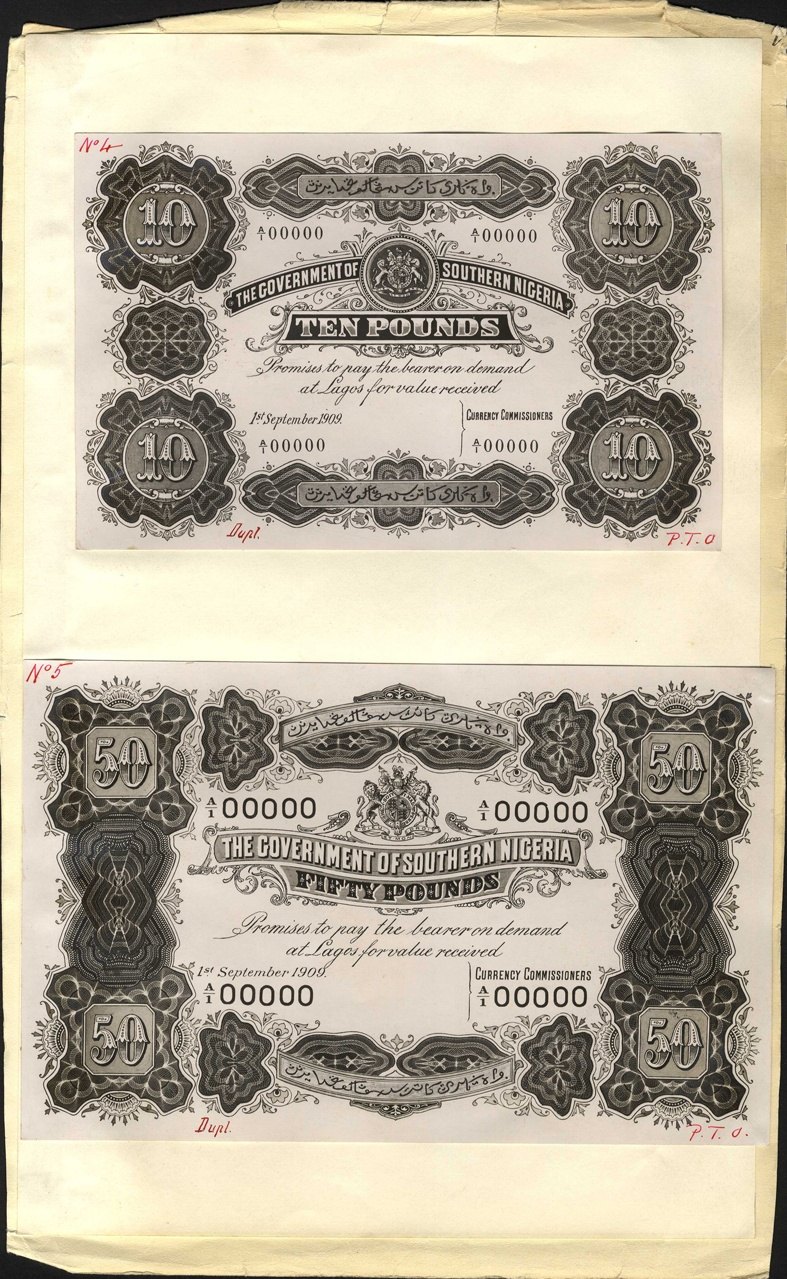
Sarangapani, in the IBNS Journal (vol. 56 no. 4, 2017, pp. 43 to 47), tells the story of a note issue planned for Southern Nigeria alone. Governor Egerton proposed it in November 1907. De La Rue sent designs on 22nd April 1909, for notes of 10 shillings, 1 pound, 5 pounds, 10 pounds and 50 pounds dated 1st September 1909 and payable at Lagos. The plan was dropped because the Treasury wanted a gold reserve and one currency board for the whole of West Africa. Kelly (vol. 16 no. 3, p. 151) says the plan was cancelled in 1910.
Two details in Sarangapani's article tie the designs to East Africa. The white watermarked paper De La Rue offered for Southern Nigeria was that of the Mombasa rupee notes of 1905 (p. 47). The hippopotamus De La Rue engraved in 1909 for the Southern Nigeria notes was used, as a mirror image, on the back of the East African 1 rupee and 1 florin of 1920 (p. 44). The second point is the author's comparison of two engravings and is given here as such.
A Board for coin, 1912 to 1915
The West African Currency Board was set up in London in 1912. Its first constitution, printed as Appendix I of the Board's report to 30th June 1914, covered coin only and said nothing of notes. Sierra Leone's annual report for 1912 (No. 759, read in the text) said a new silver coinage for the whole of British West Africa had been approved, and that "a corresponding local note issue is also in contemplation".
The note issue was put off. On 19th March 1913 Lewis Harcourt, Secretary of State for the Colonies, told the House of Commons that the Committee's recommendations had been accepted and that a Currency Board had been constituted and had met several times, but that the note issue the Committee recommended had been postponed until the new coinage had had time to prove itself (Hansard, House of Commons, vol. 50, cc. 1021 and 1022). The next mention in Hansard, on 8th February 1915, is only the laying of the Board's report to 30th June 1914.
United Kingdom notes, 1915 and after
When coin ran short late in 1915, United Kingdom currency notes were sent out as an emergency measure. The records give the laws that made them legal tender:
- The Gold Coast: the Colonial Office List for 1918 (p. 469, read in the text) says the United Kingdom 20 and 10 shilling notes were made legal tender by Ordinance No. 27 of 15th December 1915 as a temporary measure. The Gold Coast Blue Book for 1921 still lists them, as "Imperial Treasury Notes" of 20 and 10 shillings, legal tender to any amount under Ordinance No. 27 of 1915 (read on the page image).
- Nigeria: the Nigeria Handbook of 1919 (pp. 40 and 41) says United Kingdom currency notes had been made legal tender by Ordinance No. 27 of 1915 but hardly circulated.
- Sierra Leone: the Blue Book for 1915 lists an Ordinance of that year on the currency notes issued under the Currency and Bank Notes Act, 1914. Its number and day cannot be read in the text of the scan.

The Gold Coast and Nigeria laws carry the same number in these sources. The records do not say whether each colony passed its own Ordinance No. 27 or whether one of the two sources has the number of the other colony's law.
Kelly (vol. 16 no. 3, p. 151) puts the United Kingdom notes used in West Africa in 1915 and 1916 at about 257,000 pounds, and says most had been withdrawn by June 1916.
The United Kingdom notes stayed on the colonies' lists for years after that:
- Nigeria's annual report for 1928 says "United Kingdom notes are legal tender; and West African notes of one pound and ten shillings are also current". The report for 1929 drops the words on United Kingdom notes, and names no law and no day. When they ceased to be legal tender in Nigeria is not in the records.
- The Gold Coast annual report for 1932-33 still names British currency notes as legal tender there. The reports stop naming them between those for 1933-34 and 1934-35, and the report for 1935-36 no longer names them. Whether the Gold Coast's Currency Order, 1935 (Order in Council B1 of 25th June 1935) was the cause is an open question: the Blue Book gives only the title of that Order.
- Sierra Leone passed a Currency Notes (Repeal) Ordinance on 7th December 1934 (Blue Book for 1934, p. 75). The Blue Book does not say what it repealed. It may have been the Ordinance of 1915 on United Kingdom notes, but no source read says so.
French money in the Gambia
The Gambia's report for 1922 (No. 1160, read on the page image) says the French five-franc piece ceased to be legal tender at the end of January 1922 and was replaced by the Board's alloy coin, not by a note, and that French five-franc notes from Senegal passed in the Protectorate. The Colonial Office List for 1922 (p. 463) also has the five-franc pieces demonetised at the beginning of 1922. In 1949 the Economic Survey of the Colonial Territories (1951, vol. III, p. 22, read in the text) still says that notes of the French Banque de l'Afrique Occidentale circulated in the Gambia Protectorate beside the Board's notes.
To the east, the reports on the mandated territories (the volume filed as of 1920, p. 952, read in the text) say the Board's notes of 20, 10, 2 and 1 shillings were the currency of British Togoland in the mid-1920s.
What the records do not give
- No note of the Bank of Nigeria is pictured in any record. Of the Bank of British West Africa, the catalogue's archive holds only Spink's archival photographs of a 5 pounds design of Lagos, dated 189-, with no number.
- No law of the Gambia on United Kingdom notes or on the Board's notes appears in the records.
- The day United Kingdom notes ceased to be legal tender in any of the four colonies is not in the records.
- What the Sierra Leone Repeal Ordinance of 1934 repealed is not known.
Sources
- Colonial Reports, Annual: Southern Nigeria 1908 (No. 630); Northern Territories of the Gold Coast 1909 (No. 639); Ashanti 1909 (No. 640); The Gambia 1909 (No. 641), 1910 (No. 679) and 1922 (No. 1160); Sierra Leone 1909 (No. 648) and 1912 (No. 759); Gold Coast 1913, 1932-33, 1934-35 and 1935-36; Nigeria 1928 and 1929.
- Report of the West African Currency Board to 30th June 1914, Appendix I.
- Hansard, House of Commons, 19th March 1913 (vol. 50, cc. 1021 and 1022) and 8th February 1915.
- The Colonial Office Lists for 1918 (p. 469) and 1922 (p. 463).
- Gold Coast Blue Book for 1921; Sierra Leone Blue Books for 1915 and 1934; Nigeria Handbook of 1919, pp. 40 and 41.
- Economic Survey of the Colonial Territories, 1951, vol. III, p. 22.
- Reports on the mandated territories, the volume filed as of 1920, p. 952.
- Richard Kelly, "Early Paper Money in British West Africa", IBNS Journal, vol. 16 no. 3, 1977, p. 151.
- IBNS Journal, vol. 33 no. 4, p. 32, plate A4.
- Sarangapani, on the Southern Nigeria essays, IBNS Journal, vol. 56 no. 4, 2017, pp. 43 to 47.
Member comments
Log in or register to post a comment.