The Central Bank of The Bahamas prints, in the notes to its yearly accounts, the value of every denomination of note in circulation, and its chapter on currency operations reports each new note, reprint and forgery. This article reads the fourteen annual reports for 2011 to 2024 for the notes of the Bahamas, and adds what The Tribune of Nassau and the I.B.N.S. Journal say of the same years. Some of the figures are quoted in The dollar notes of the Bahamas, 1965 to 2019; here is every year. The reports before 2011 were not read: they are not online.
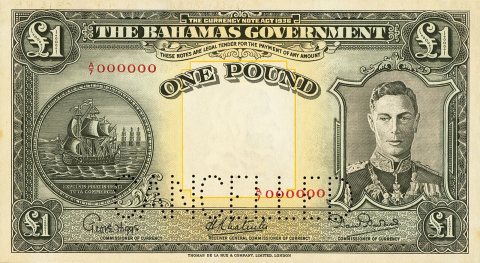
Notes in circulation by value, 2010 to 2024
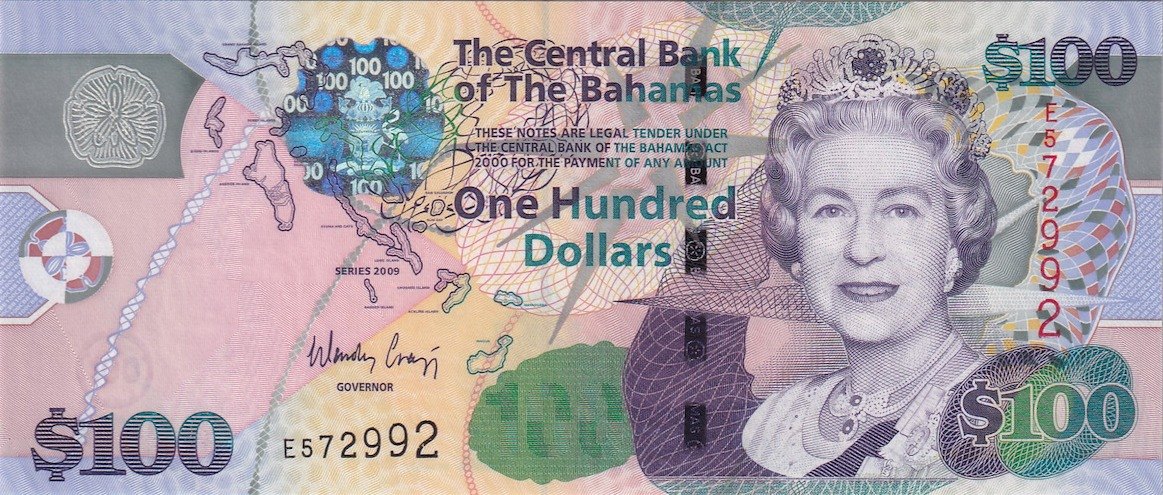
The figures are in Bahamian dollars at 31st December. They count every series of a value together, so the 100 dollars column holds the 100 dollars of 2009 with the Queen beside older and newer notes.
| 31st December | 1/2 dollar | 1 dollar | 3 dollars | 5 dollars | 10 dollars | 20 dollars | 50 dollars | 100 dollars | Other bank notes | All notes |
|---|---|---|---|---|---|---|---|---|---|---|
| 2010 | 636,204 | 19,635,544 | 1,826,199 | 9,452,500 | 13,394,830 | 46,138,940 | 81,997,900 | 116,602,400 | 82,039 | 289,766,556 |
| 2011 | 642,186 | 20,023,349 | 1,862,907 | 9,720,605 | 14,593,160 | 49,018,100 | 86,798,550 | 122,806,400 | 79,835 | 305,545,092 |
| 2012 | 653,043 | 20,656,956 | 1,874,841 | 10,018,630 | 15,218,100 | 51,997,040 | 93,668,750 | 130,727,700 | 79,835 | 324,894,895 |
| 2013 | 668,148 | 21,279,807 | 1,903,731 | 10,451,290 | 15,196,250 | 54,189,060 | 96,746,200 | 132,180,800 | 79,835 | 332,695,121 |
| 2014 | 669,736 | 22,114,045 | 1,921,257 | 10,730,945 | 15,794,890 | 57,060,500 | 102,993,900 | 142,783,600 | 79,835 | 354,148,708 |
| 2015 | 676,676 | 22,702,973 | 1,943,823 | 11,036,815 | 15,997,260 | 57,299,060 | 108,690,150 | 147,495,000 | 79,835 | 365,921,592 |
| 2016 | 737,313 | 23,509,536 | 1,972,440 | 11,503,120 | 17,753,390 | 59,900,280 | 116,723,650 | 167,895,600 | 79,832 | 400,075,161 |
| 2017 | 767,305 | 24,285,623 | 2,016,801 | 11,917,775 | 18,510,170 | 61,348,800 | 123,722,200 | 168,470,000 | 82,032 | 411,120,706 |
| 2018 | 772,514 | 24,666,843 | 2,026,296 | 11,978,945 | 18,872,740 | 54,215,500 | 141,702,200 | 176,571,800 | 82,017 | 430,888,855 |
| 2019 | 870,732 | 25,231,607 | 2,119,143 | 12,164,215 | 19,358,620 | 54,402,280 | 159,239,650 | 184,755,700 | 82,018 | 458,223,964 |
| 2020 | 873,079 | 25,953,612 | 2,139,801 | 12,979,945 | 20,437,240 | 57,279,320 | 163,661,950 | 232,807,400 | 82,018 | 516,214,365 |
| 2021 | 927,615 | 26,376,610 | 2,179,058 | 13,104,330 | 20,856,510 | 56,619,120 | 120,396,500 | 293,027,000 | 82,018 | 533,568,761 |
| 2022 | 929,635 | 27,137,759 | 2,176,200 | 13,468,985 | 21,992,390 | 59,202,940 | 124,090,000 | 326,909,600 | 82,018 | 575,989,527 |
| 2023 | 940,232 | 27,975,615 | 2,227,497 | 13,729,285 | 22,823,040 | 58,708,300 | 123,737,000 | 332,207,000 | 82,018 | 582,429,987 |
| 2024 | 950,529 | 28,565,569 | 2,231,202 | 13,946,605 | 23,150,290 | 58,707,780 | 127,801,450 | 361,720,300 | 82,018 | 617,155,743 |
Each row is taken from the report of its own year; the row for 2010 is the comparative column of the report for 2011. The table is note 16 to the accounts in the reports for 2011 to 2014, 2018 and 2019, note 15 in those for 2015 to 2017, note 18 in 2020 and 2021 and note 19 from 2022.
- The 1/2 dollar at the end of 2019. The report for 2019 prints 870,732 dollars. The report for 2020 gives the same year end as 870,731 dollars in its comparative column. Both were read on the page.
- The 20 dollars in 2018 and the 50 dollars in 2021. The 20 dollars falls from 61,348,800 dollars at the end of 2017 to 54,215,500 at the end of 2018 while every other value rises. The 50 dollars falls from 163,661,950 dollars at the end of 2020 to 120,396,500 at the end of 2021 while the 100 dollars rises from 232,807,400 to 293,027,000. The figures are as printed; the reports give no reason.
- "Other bank notes". The line stands at 82,039 dollars in 2010, at 79,835 dollars from 2011 to 2015, at 79,832 dollars in 2016 and between 82,017 and 82,032 dollars from 2017 on. The reports never say what it covers.
What the reports say of the mix
| Report | What it says |
|---|---|
| 2011 | eight values of note circulate, from 1/2 dollar to 100 dollars; the 100 dollars is 40.2 per cent of currency by value; the Bank's currency liabilities rose by 5.2 per cent to 323.9 million dollars |
| 2013 | the 100 dollars accounts for the highest value in circulation, "at just over $132 million" |
| 2014 | currency in circulation 375.4 million dollars, of which notes 354.1 million, 94 per cent; the 100 dollars and the 50 dollars are 40 and 29 per cent |
| 2019 | the 1 dollar is 63.0 per cent of the notes by number; the 100 and 50 dollars are about 75.0 per cent by value |
| 2020 | 41.5 million notes worth 516.2 million dollars at the end of the year |
| 2021 | 41.8 million notes worth 533.5 million dollars |
| 2022 | about 43 million notes worth 576.0 million dollars |
| 2023 | about 44.4 million notes worth 582.4 million dollars |
The text of the report for 2015, read in the text layer only, gives the currency in active circulation as 1,126.8 million dollars and the notes as 737.7 million, where the accounts of the same report put the notes at 365,921,592 dollars; its figures for the 100 and 50 dollars, 147.5 and 108.7 million, do match the accounts.
The older CRISP notes and their reprints
The reports date three notes of the first CRISP family that the catalogue has no pages for: the 50 dollars "previously released in 2006", the 5 dollars in 2007 and the 1 dollar "initially released in 2008". The catalogue's pages for this family are the 10 dollars of 2005 and the 100 dollars of 2009, the two that show the Queen.
- 2011: the Bank called for tenders for reprints of the CRISP 50 and 5 dollars, "with no design changes", to be issued in late 2012 and in 2013.
- 2012: the first reprint of the CRISP 50 dollars was issued, and the tender for the first reprint of the CRISP 1 dollar was awarded.
- 2013: a contract was awarded for the reprint of the CRISP 1 dollar, and the Bank began to plan its next family of notes.
The report for 2020 states the policy behind this: a redesign about every ten years and a reprint every five.
The CRISP Evolution family, 2016 to 2021
The report for 2014 names the new family CRISP Evolution, the successor to CRISP. The report for 2016 sets out its four tiers: the 100 and 50 dollars "Value Storage", the 20 and 10 dollars "Transactional", the 5 and 1 dollars "Low Value" and the 3 and 1/2 dollars "Novelty".
| Note | Released | What the reports say |
|---|---|---|
| 10 dollars | 28th September 2016 | the first of the family, after three years of design and production; portrait of Sir Stafford L. Sands |
| 1 dollar | 27th September 2017 | unveiled at the Sir Lynden O. Pindling International Airport; the first Bahamian note not printed on cotton paper, on the Hybrid substrate of Giesecke and Devrient; portrait of Sir Lynden O. Pindling; on the back the Royal Bahamas Police Force Marching Band |
| 20 dollars | 27th September 2018 | the third release; portrait of Sir Milo B. Butler |
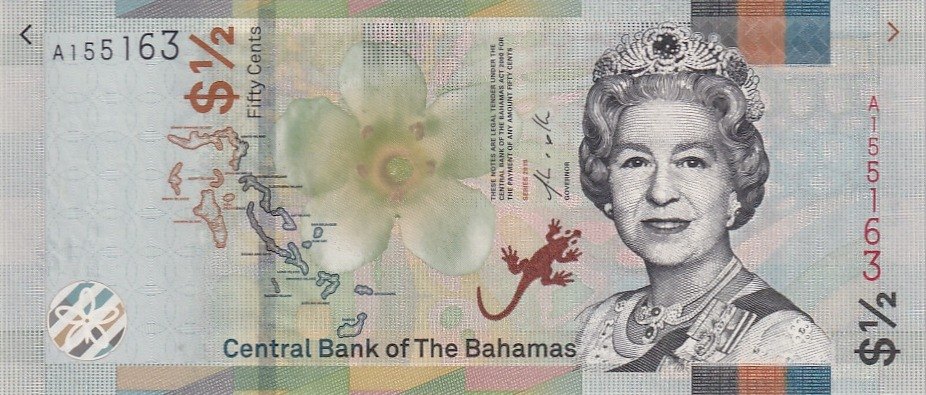
| 1/2 dollar and 3 dollars | the first quarter of 2019 | the report for 2017 says the 1/2 dollar was last redesigned in 2001 and the 3 dollars in 1984 |
| 50 dollars | October 2019 | made by several note producers together; Durasafe substrate; portrait of Sir Roland T. Symonette |
| 5 dollars | 23rd September 2020 | the seventh note of the series, on the Hybrid substrate; portrait of Sir Cecil Wallace-Whitfield |
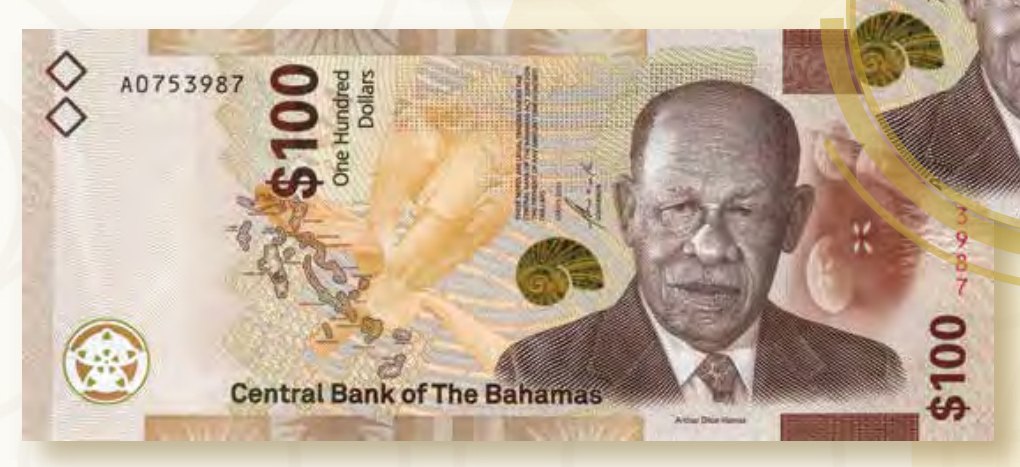
| 100 dollars | October 2021 | the eighth and last; a Durasafe substrate with a Motion Surface stripe, made with Canadian Bank Note Company, Landqart of Switzerland and Crane Currency of the United States; portrait of Arthur Dion Hanna |
The catalogue has pages for the 1/2 dollar and the 3 dollars alone, the two notes of the family that show the Queen, and gives their days of introduction as 24 January and 28 March 2019. The reports give the quarter only. The report for 2021 shows the front of the new 100 dollars with the number A0753987 and the signature of John A. Rolle.
Two later printings are reported:
- The 10 dollars reprint. In June 2020 the Bank awarded Crane Currency the contract to reprint the CRISP Evolution 10 dollars, with a new security thread, the Durasafe substrate and changes of colour "to reduce the similarity in appearance" to the 1 dollar of 2017. It was released in December 2022.
- The "Hybrid Green" 1 dollar. The report for 2023 announces a 1 dollar made "slightly greener". The report for 2024 says its production was completed that year on the Hybrid Addvance substrate, with a wider security thread, for release in the first quarter of 2025.
The reports give no exact day for the 1/2, 3, 50 and 100 dollars or for the reprint of the 10 dollars.
No note called in
No report from 2011 to 2024 speaks of the withdrawal or demonetisation of any series of notes. The only withdrawal in these years is of a coin: the 1 cent, demonetised on 31st December 2020. The report for 2018 says that the number of 1 dollar notes issued fell by 45 per cent, which it puts down to the longer life of the note of 2017.
Forgeries
The reports measure forgery in pieces per million genuine notes.
| Year | Rate as the report gives it |
|---|---|
| 2010 to 2014 | fewer than 3.5 per million over the five years |
| 2016 | below 1.0 per million; the report says the rate had fallen gradually since 2006, "just after the introduction of the CRISP family" |
| 2018 | "less than 1.0" per million |
| 2019 | 2.135 per million |
| 2020 | 1.59 per million |
| 2021 | 2.2 per million |
| 2022 | an estimated 1.4 per million |
| 2023 | an estimated 2.4 per million |
The chart on page 10 of the report for 2018 appears to show about 2 per million for 2017 and 2018, which does not agree with the words of the same report; the charts print no values. No report gives the number of forged notes by value. Four remarks name a note:
- early in 2017 the Bank saw more forgeries of the new 10 dollars, "of noticeably poor quality";
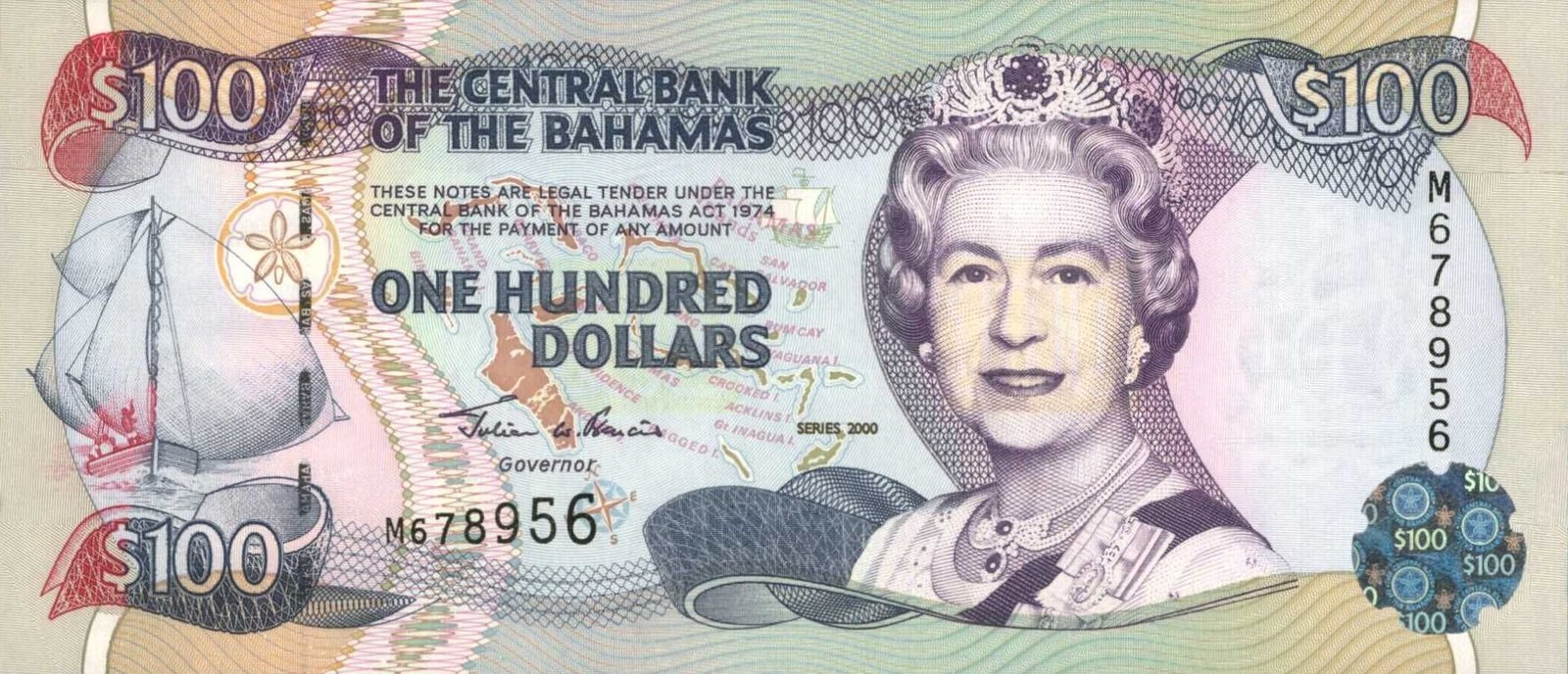
- forgeries of the 100 dollars of the series of 2000 were noticed late in 2017;
- in 2023 there was a rise in forged 20 dollar notes;
- in 2024 the 20 dollars was the largest share of the forgeries found in the deposits of the commercial banks, followed by the 100 and the 50 dollars, while those seized by the police were more often 100 dollars.
Commitments for the printing of currency
From 2014 the notes to the accounts state the Bank's commitments for the printing of currency at the year end. The figures cover coins as well as notes, and the reports give neither the size nor the cost of any single order.
| Year end | Not later than one year | Later than one year, not later than five | Report |
|---|---|---|---|
| 2013 | 1,225,000 dollars | 1,023,627 dollars | 2014, page 71 |
| 2014 | 2,407,982 dollars | 506,686 dollars | 2014, page 71 |
| 2015 | 5,050,812 dollars | 3,459,736 dollars | 2015, page 74 |
| 2016 | 2,787,878 dollars | 2,716,000 dollars | 2016, page 78 |
| 2017 | 53,470 dollars | 3,565,556 dollars | 2018, page 89 |
| 2018 | 2,933,500 dollars | 2,894,980 dollars | 2018, page 89 |
| 2019 | 1,038,880 dollars | 1,856,100 dollars | 2019, page 86 |
| 2020 | 1,856,100 dollars | 1,127,880 dollars | 2020, page 96 |
| 2021 | 1,127,880 dollars | a dash | 2021, page 93 |
| 2022 | a dash | line not printed | 2022, page 104 |
| 2023 | 3,960,000 dollars | line not printed | 2023, page 99 |
| 2023, as restated | 25,520,000 dollars | line not printed | 2024, page 106 |
| 2024 | 2,986,390 dollars | line not printed | 2024, page 106 |
The report for 2024 restates the commitment at the end of 2023 as 25,520,000 dollars, against 3,960,000 dollars in the report for 2023 itself. Both were read on the page.
The Governors and the law
The report for 2015 names Wendy M. Craigg as the "Immediate Past Governor ... who demitted office on December 31, 2015"; John A. Rolle signs that report's letter of 2nd May 2016 as Governor. The reports do not give the day on which Rolle took office. The report for 2017 says that Timothy B. Donaldson was the founding Governor from 1974 to 1980 and died in February 2013. Paul D. Walters, in "Sir Stafford Sands: Racist?", I.B.N.S. Journal, volume 46, number 1 (2007), page 53, says that Julian W. Francis retired on 31st May 2005 and that Wendy M. Craigg was Governor from 1st June 2005, before the 10 dollars signed by Francis came out on 3rd August 2005.
The Central Bank of The Bahamas Act, 2020 came into force on 1st September 2020 and replaced the Act of 2000 that the notes name in their legal tender clause. The report for 2020 has the 5 dollars of that year on its covers; the note is marked SERIES 2020 and its clause still names the Act of 2000.
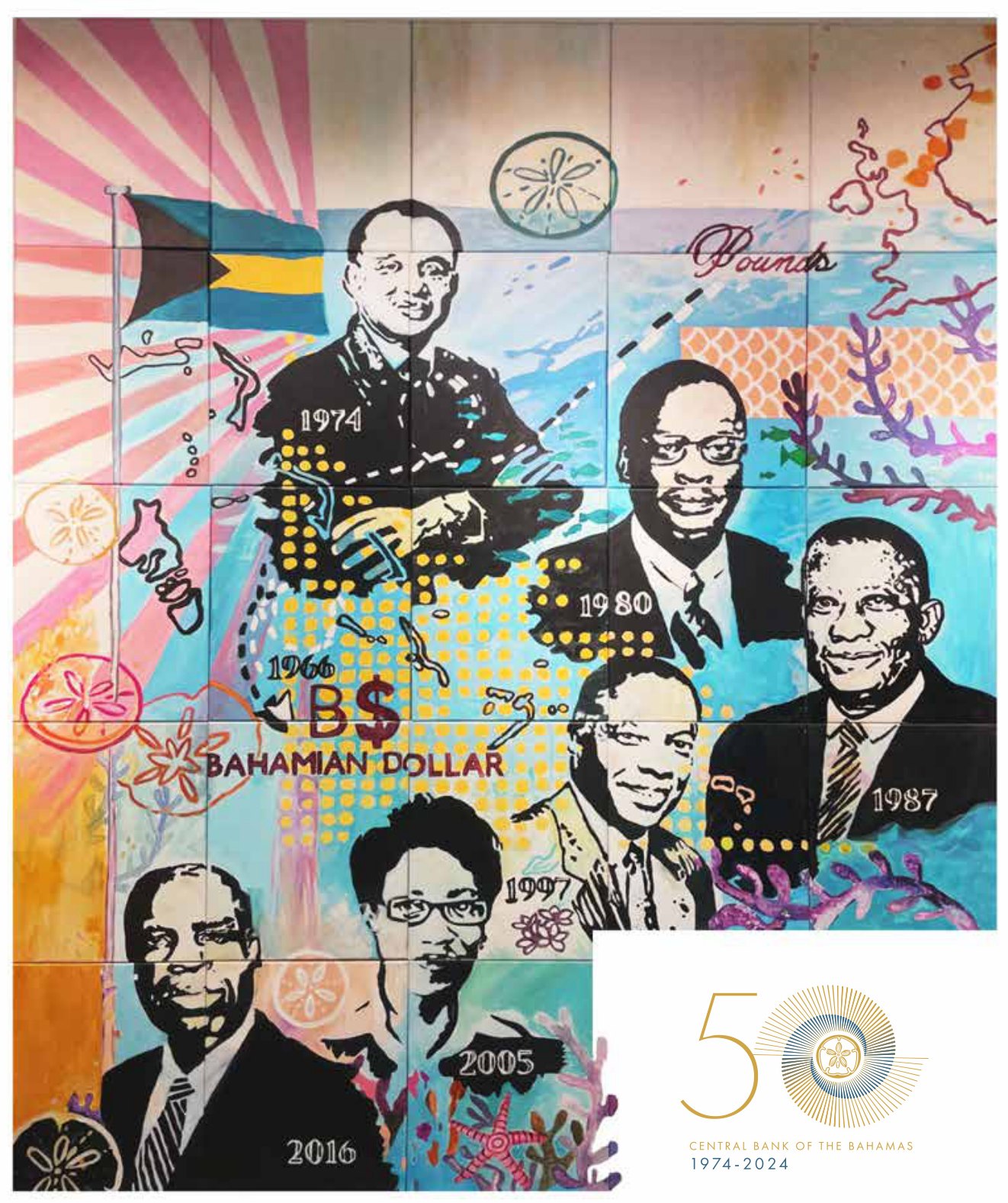
For its fortieth year, in 2014, the Bank showed panels of its notes in Rawson Square, from the pound sterling notes to the family of 1984; for its fiftieth, in 2024, it held a public exhibition on Bahamian notes and coins.
What The Tribune and the I.B.N.S. Journal add
These are newspaper reports and collectors' accounts, not statements of the Bank. The Tribune items were read in the text of the paper only, except that of 2nd September 2006, which was read on the page image.
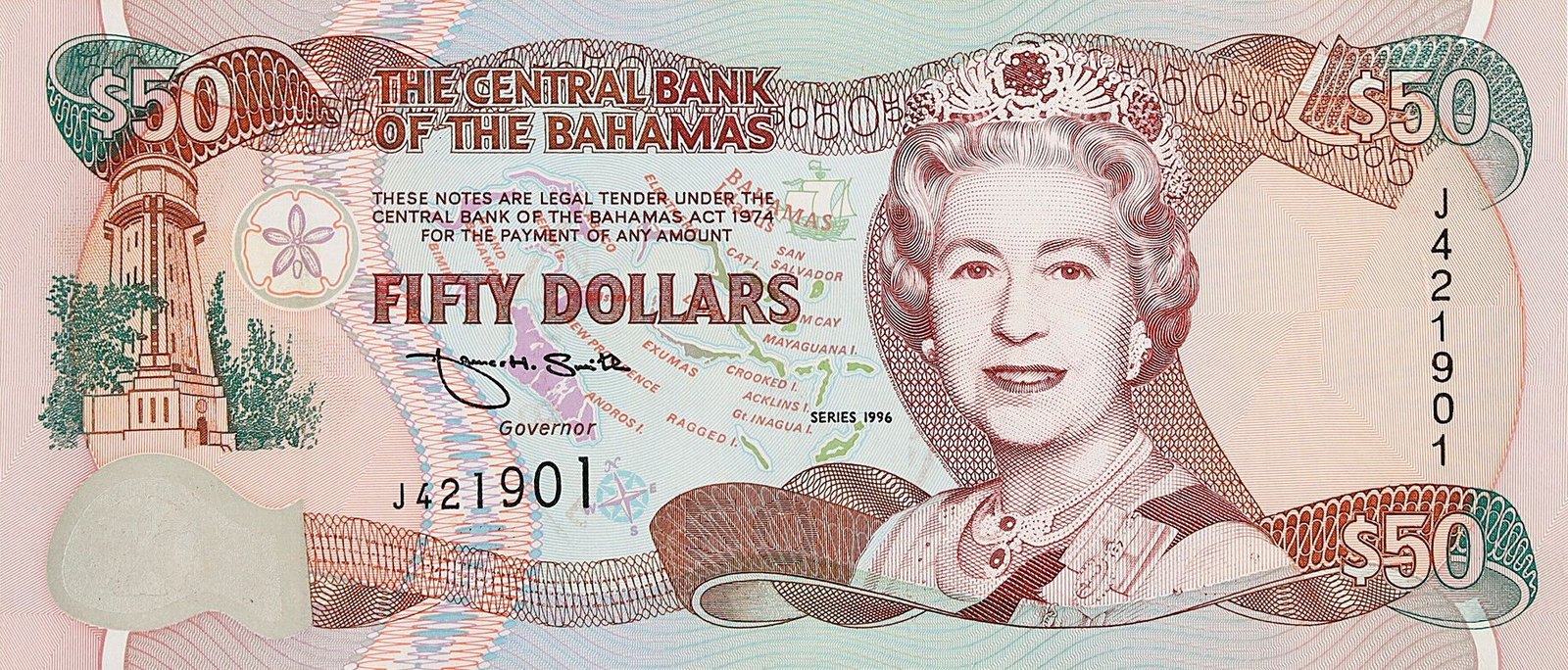
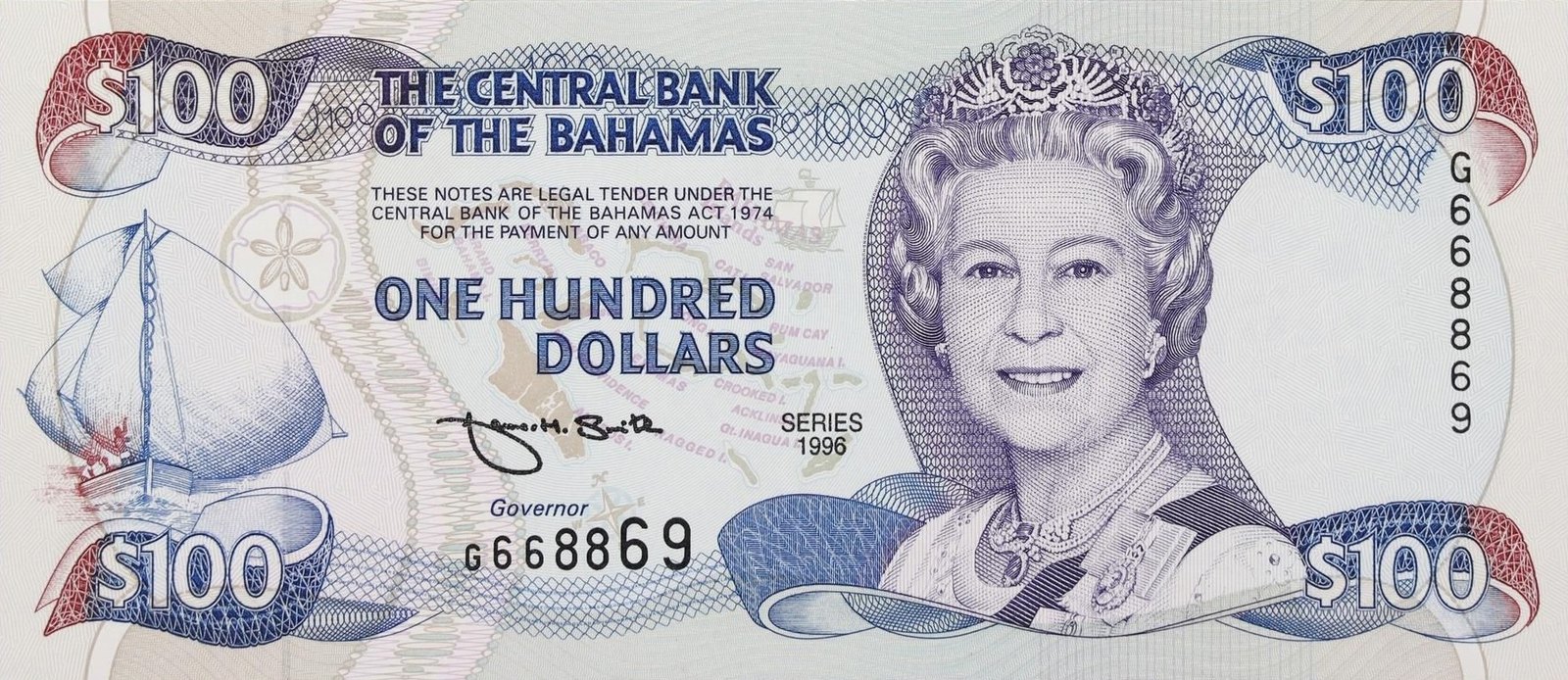
- Forgeries of 1996 notes. The Tribune of 10th March 2005 (page 15) reports a police warning of forged 50 and 100 dollar notes on Grand Bahama, "of the 1996 series", with a poor thread and ink that ran when wet. The notes copied are the 50 dollars and 100 dollars dated 1996.
- The 10 dollars of 2005. A Tribune editorial of 3rd August 2005 quotes the Central Bank's announcement that the first CRISP 10 dollars would circulate with the existing 10 dollar notes until those were phased out. Walters's article of 2007 (page 52) says that the 10 dollars of 2000 with Sir Stafford Sands had replaced the Queen's note of 1996 and that the note of 3rd August 2005 put the Queen back; it knows of no later Sands note.
- When Sands returned. A Tribune editorial of 3rd May 2010 says that the return of Sir Stafford Sands to the 10 dollars had been announced at the end of April 2010, now that the series of 2005 "had expired". The catalogue's page for the 10 dollars of 2005 says the note with Sands was issued in 2009. The editorial gives no day of issue.
- The CRISP 20 dollars. The Tribune of 2nd September 2006 (page 9) reports the Bank's announcement that a CRISP 20 dollars would circulate from 6th September 2006, with a watermark of Sir Milo Butler in place of the Spanish galleon, beside the existing notes.
- A collector at the counters, 2001 to 2004. Paul D. Walters, in "I Told You it was Better in the Bahamas", I.B.N.S. Journal, volume 44, number 4 (2005), reports what bank staff in Nassau said: in 2001 and 2002, that the 3 dollars was being phased out, the notes paid out being the 3 dollars of 1984; and by April 2004, that the 1 dollar of 2001 with Sir Lynden Pindling was withdrawn because the Bank lacked permission for the portrait. By Walters's account the 1/2 dollar of 2001 had not reached the Nassau banks late in 2001 and was to be had in bundles in April 2003.
- The 1 dollar of 2002. A letter from Herbert Stein in the I.B.N.S. Journal, volume 46, number 1 (2007), page 5, calls the 1 dollar marked SERIES 2002 an emergency reprint by De La Rue during a shortage of 2002 and 2003.
What the reports do not give
- Serial prefixes, replacement notes, uncut sheets or collectors' sets of notes. The Bank's numismatic programme, in being since 1973, is described as one of coins.
- The number of notes printed or destroyed.
- The printer of most notes. The catalogue's pages for the 1/2 dollar and the 3 dollars of 2019 name Oberthur Fiduciaire; the reports do not.
Sources
- Central Bank of The Bahamas, Annual Report and Statement of Accounts for each year from 2011 to 2024: the chapter on currency operations, the notes to the accounts on notes in circulation and on commitments for the printing of currency, the lists of directors and senior officials.
- The Tribune, Nassau: 10th March 2005, page 15; 3rd August 2005, page 4; 2nd September 2006, page 9; 3rd May 2010, page 4.
- I.B.N.S. Journal, volume 44, number 4 (2005): Paul D. Walters, "I Told You it was Better in the Bahamas"; volume 46, number 1 (2007): Herbert Stein's letter, page 5, and Paul D. Walters, "Sir Stafford Sands: Racist?", pages 52 and 53.
Member comments
Log in or register to post a comment.