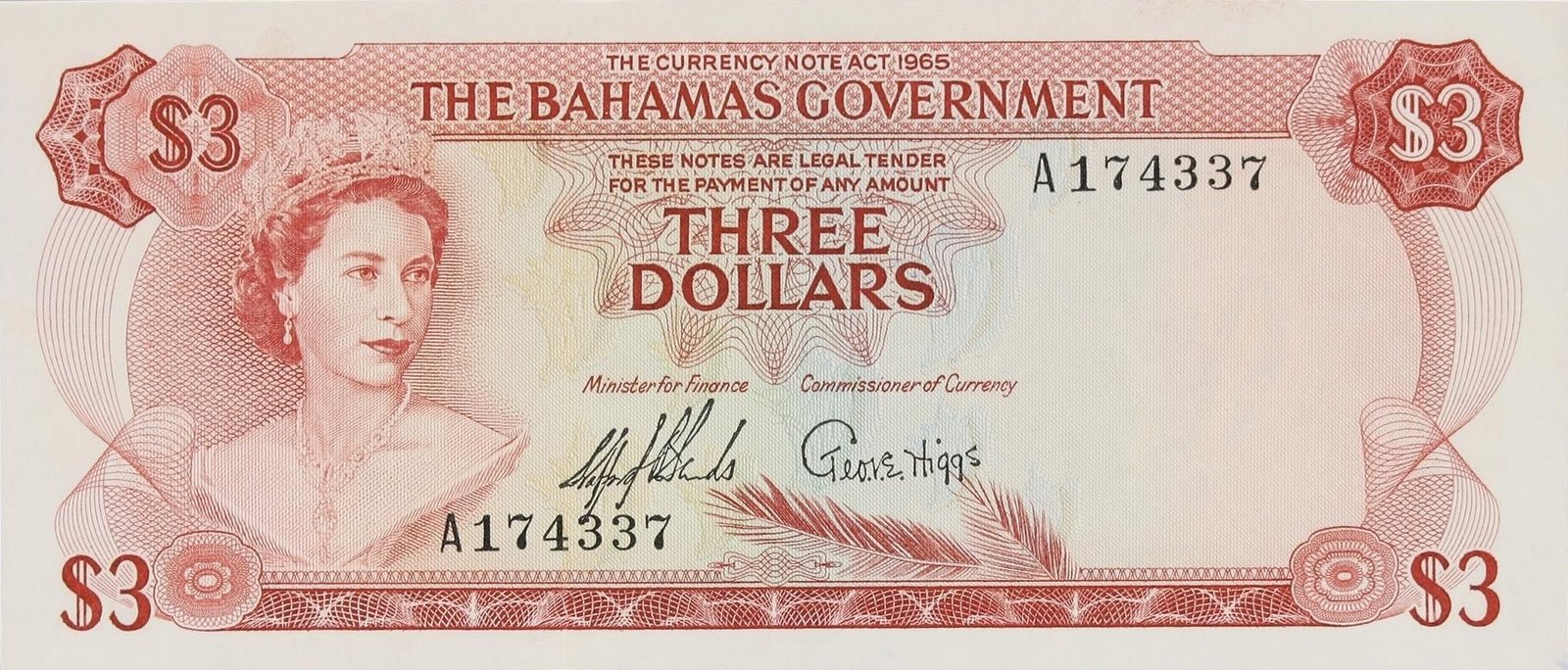
This article follows the dollar notes of the Bahamas from the first decimal issue under the Currency Note Act 1965 to the half dollar and 3 dollars of 2019. It is drawn from the catalogue's note pages, which rest on the notes themselves, the Central Bank's annual reports and accounts and a number of unnamed sources, with the history page of the Central Bank of The Bahamas and statements of auction houses, each named where it is used. It covers the notes that have a page in the catalogue. The sterling notes before them are in The Bahamas Government's sterling notes, 1919 to 1966.
The Government's issue under the Currency Note Act 1965
The first decimal dollar notes were issued by the Bahamas Government under the Currency Note Act 1965. There are eight values: 1/2 dollar, 1 dollar, 3 dollars, 5 dollars, 10 dollars, 20 dollars, 50 dollars and 100 dollars. All were printed by Thomas de la Rue and Company. The portrait of Queen Elizabeth II, sources mention, follows a 1954 photograph by Dorothy Wilding. Sources mention that the series was designed at De La Rue by John White, with the coloured scenes on the back printed by lithography or offset beside engraved work.
The notes were issued in 1966, and the pound and dollar notes circulated side by side for six months. Heritage (5 September 2019, lot 28221) says that the highest sterling note, the 5 pounds, could be exchanged for about 15 dollars. Heritage (9 November 2023, lot 24022) adds that the 20, 50 and 100 dollars were therefore higher values than the public was used to.
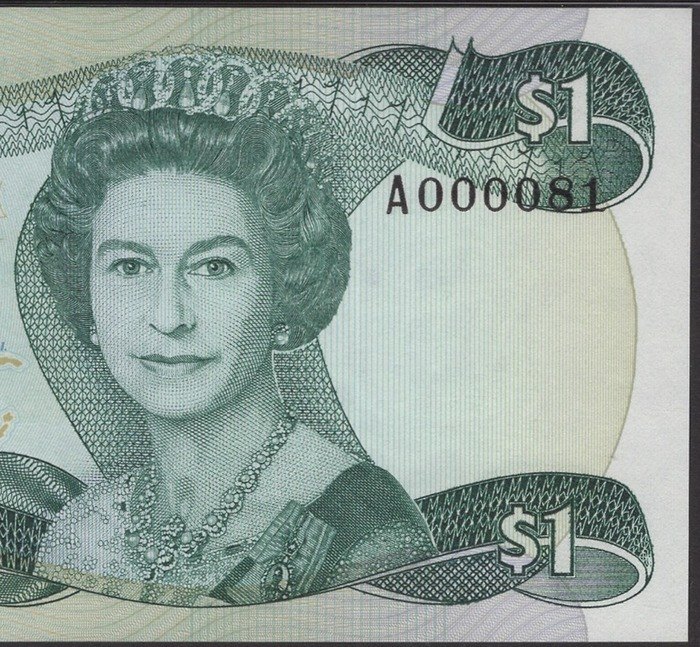
The first notes are signed Sands and Higgs, under the titles Minister for Finance and Commissioner of Currency. Matched sets with the same low serial number on every denomination of the issue are recorded: A 000081 is found on all eight Sands and Higgs notes from the 1/2 dollar to the 100 dollars. Heritage offered a 50 dollars numbered 81, which the house says is from a matched set, on 9 May 2023 (lot 28018), and a 1/2 dollar, a 1 dollar and a 100 dollars with the matching number 81 on 27 March 2025 (lot 24026).
The first 5 dollars, signed by Sands and Higgs, is green. Sources mention that it was soon withdrawn because it was mistaken for the 1 dollar. Its place was taken by an orange 5 dollars signed by Francis.
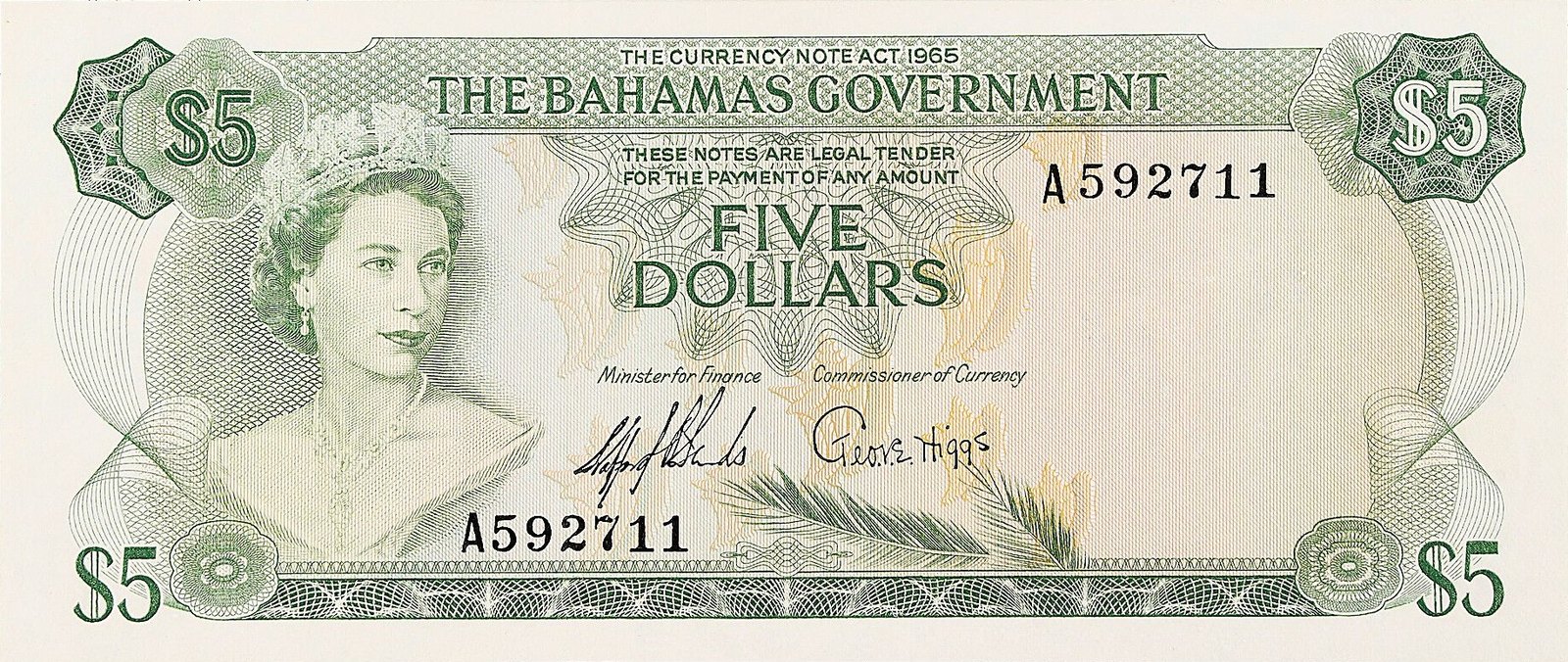
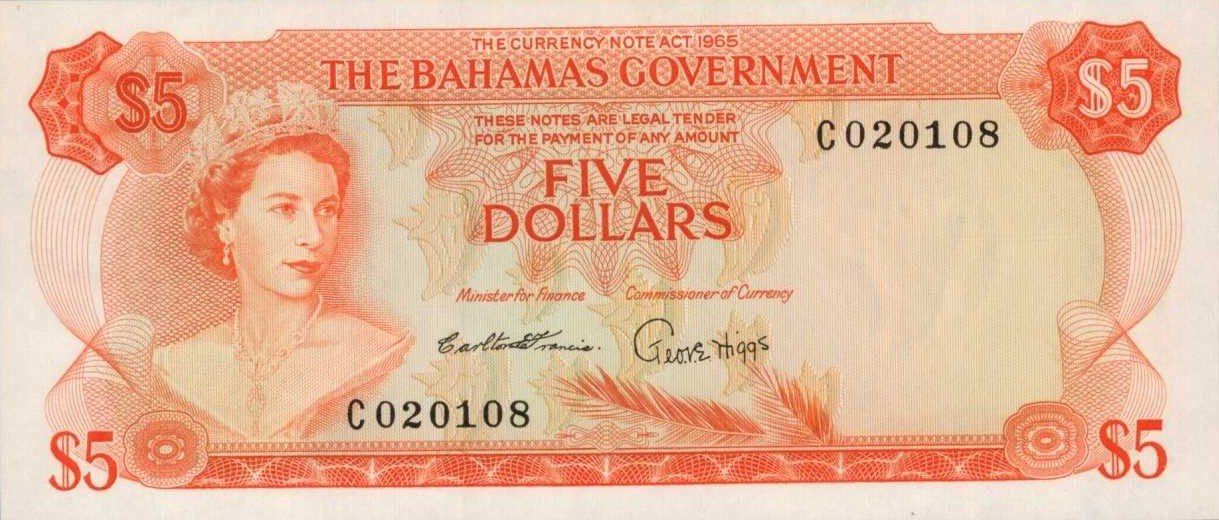
Francis followed Sands as the signer over Minister for Finance. Francis and Higgs sign the second row of the 3 dollars and the first row of the orange 5 dollars. A third form carries three signatures: Francis at left, with Higgs and Smiley-Butler one above the other at right, under the plural title Commissioners of Currency. It is found on the 1, 5, 10, 20, 50 and 100 dollars. These notes have an article of their own: The three-signature notes of the Bahamas Government's 1965 dollar issue.
One design, three issuers
The design of 1965 served three issuers in turn. The heading at the top of the front tells them apart: THE BAHAMAS GOVERNMENT under THE CURRENCY NOTE ACT 1965; BAHAMAS MONETARY AUTHORITY, ESTABLISHED BY THE BAHAMAS GOVERNMENT 1968; THE CENTRAL BANK OF THE BAHAMAS, with the act of 1974 in the legal tender clause. The signature titles follow the issuer: Minister for Finance and Commissioner of Currency in 1965 (Commissioners of Currency on the three-signature notes), Chairman and Manager in 1968, Governor in 1974.
| Value | Government, 1965 | Monetary Authority, 1968 | Central Bank, 1974 |
|---|---|---|---|
| 1/2 dollar | P-17 | P-26 | none |
| 1 dollar | P-18 | P-27 | P-35 |
| 3 dollars | P-19 | P-28 | none |
| 5 dollars | P-20, green, and P-21, orange | P-29 | P-37 |
| 10 dollars | P-22 | P-30 | P-38 |
| 20 dollars | P-23 | P-31 | P-39 |
| 50 dollars | P-24 | P-32 | P-40 |
| 100 dollars | P-25 | P-33 | P-41 |



Spink (17 April 2019, lot 94) offered a print of the portrait used on these notes and identifies it as Portrait Number 8a in Peter Symes's article "The Portraits of Queen Elizabeth II", used on the notes of the Bahamas from P-17 to P-41.
The Bahamas Monetary Authority, 1968
The Central Bank of The Bahamas, on the history page of its website, says that the Currency Board set up in 1919 gave way to the Bahamas Monetary Authority in 1968. The same page says that after the devaluation of the pound sterling in 1967, to which the local currency was linked, the Government cut the link and put the currency on par with the United States dollar. Stack's Bowers gives two accounts of the rate. Its description of 12 August 2024 (lot 30020) says the Bahamian dollar was tied one to one to the United States dollar from its introduction in 1966. Its description of 2 October 2025 (lot 50011) says the dollar was linked to sterling and worth 0.98 United States dollars until the devaluation of 18 November 1967. The Central Bank's page agrees with the second account in that it has the currency linked to sterling until 1967.
The Authority's notes name the Monetary Authority Act 1968 and are signed by the Chairman and the Manager. Replacement notes with the prefix Z are recorded for the 1, 10 and 20 dollars.
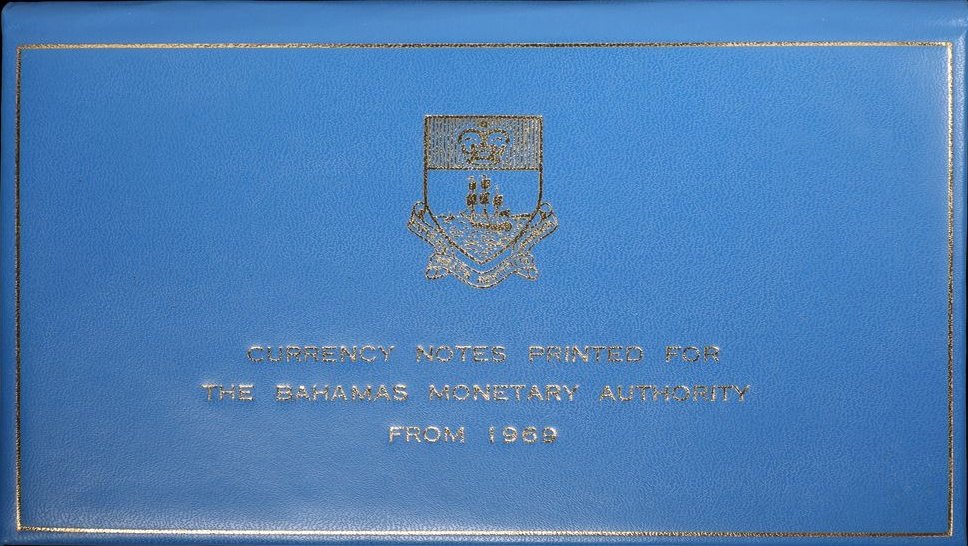
The Authority also sold Collector Series sets of specimens, with all-zero serial numbers, a diagonal red SPECIMEN overprint and two punch holes. Heritage offered such a set of eight in its blue album twice (21 October 2015, lot 18023, from the Eric P. Newman Numismatic Education Society, and 7 December 2023, lot 24007). The gilt title on the cover reads CURRENCY NOTES PRINTED FOR THE BAHAMAS MONETARY AUTHORITY FROM 1969, and Heritage dates the set 1969. The note pages give no day on which the Authority's notes were first issued.
The Central Bank of the Bahamas, 1974
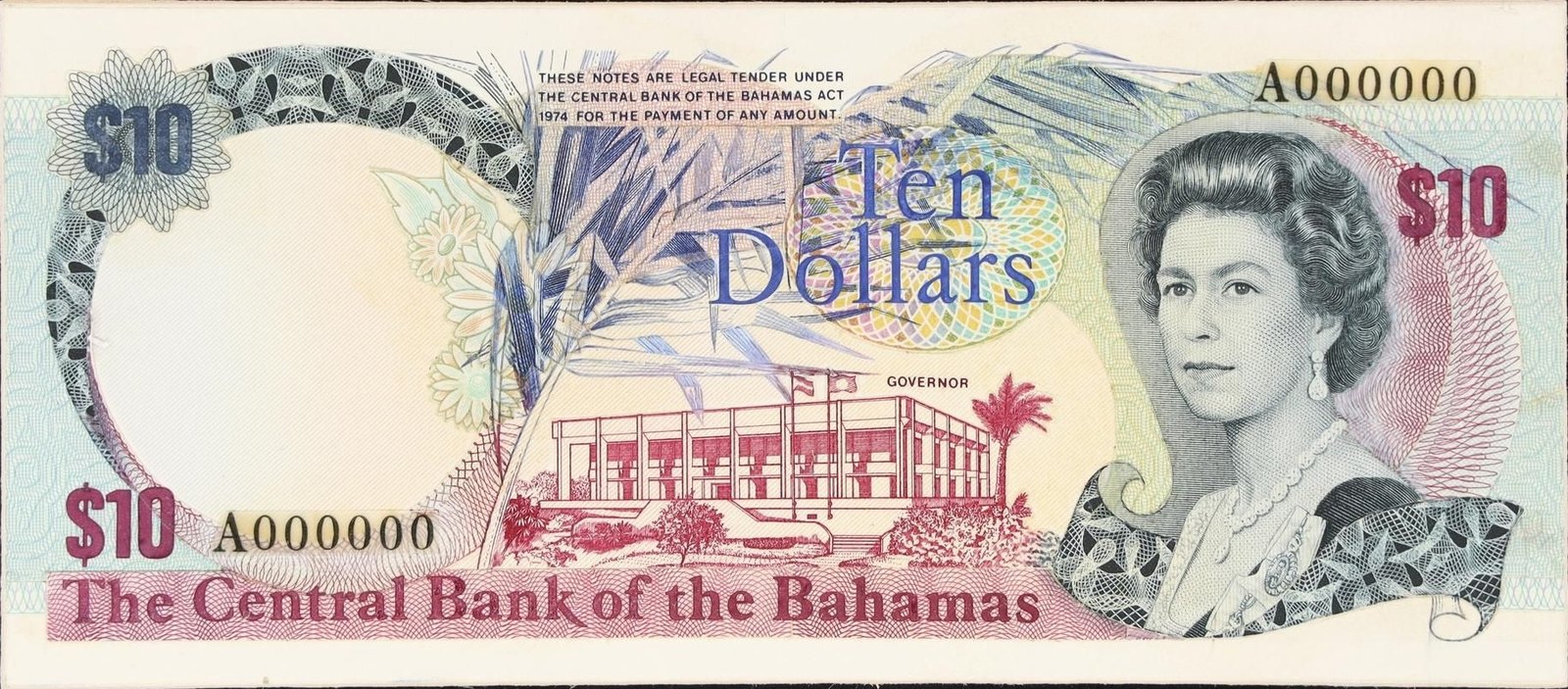
The Central Bank of The Bahamas was established on 1st June 1974, by the Bank's own history page. Its first notes keep the design of 1965 and name the Central Bank Act 1974. There are six values, from 1 dollar to 100 dollars, signed by the Governor. Two Governors sign: Donaldson, then Allen. The serial prefixes pass from one to the other, and on most values one block holds both signatures, so a note of that block is placed by its signature.
| Value | Donaldson | Allen | Block with both signatures |
|---|---|---|---|
| 1 dollar | S to Y and A/1 to M/1 | M/1 to Y/1 | M/1 |
| 5 dollars | F to J | J to M | J |
| 10 dollars | D to J | J to L | J |
| 20 dollars | D to K | K to N | K |
| 50 dollars | A | B and C | none |
| 100 dollars | A | A and B | A |
Replacement notes of the 1, 5, 10 and 20 dollars carry the prefix Z. Stack's Bowers (16 January 2026, lot 30016) points out that De La Rue's own specimens of this issue have red seals in the corners on both sides, which the Collector Series specimens lack.
The series of 1984 and 1992
The next design still names only the Act of 1974. Sources mention that the series began on 20th January 1984 with the 3 dollars and the 100 dollars, and that the other values followed over the next three years: 1/2 dollar, 1 dollar, 5 dollars, 10 dollars, 20 dollars and 50 dollars. Sources mention that the series was designed at De La Rue by Brian White, with an older and larger portrait of the Queen, facing forward with the shoulders turned left; that the portrait was engraved by Stanley Doubtfire of De La Rue; and that it follows Peter Grugeon's 1977 Silver Jubilee photograph.
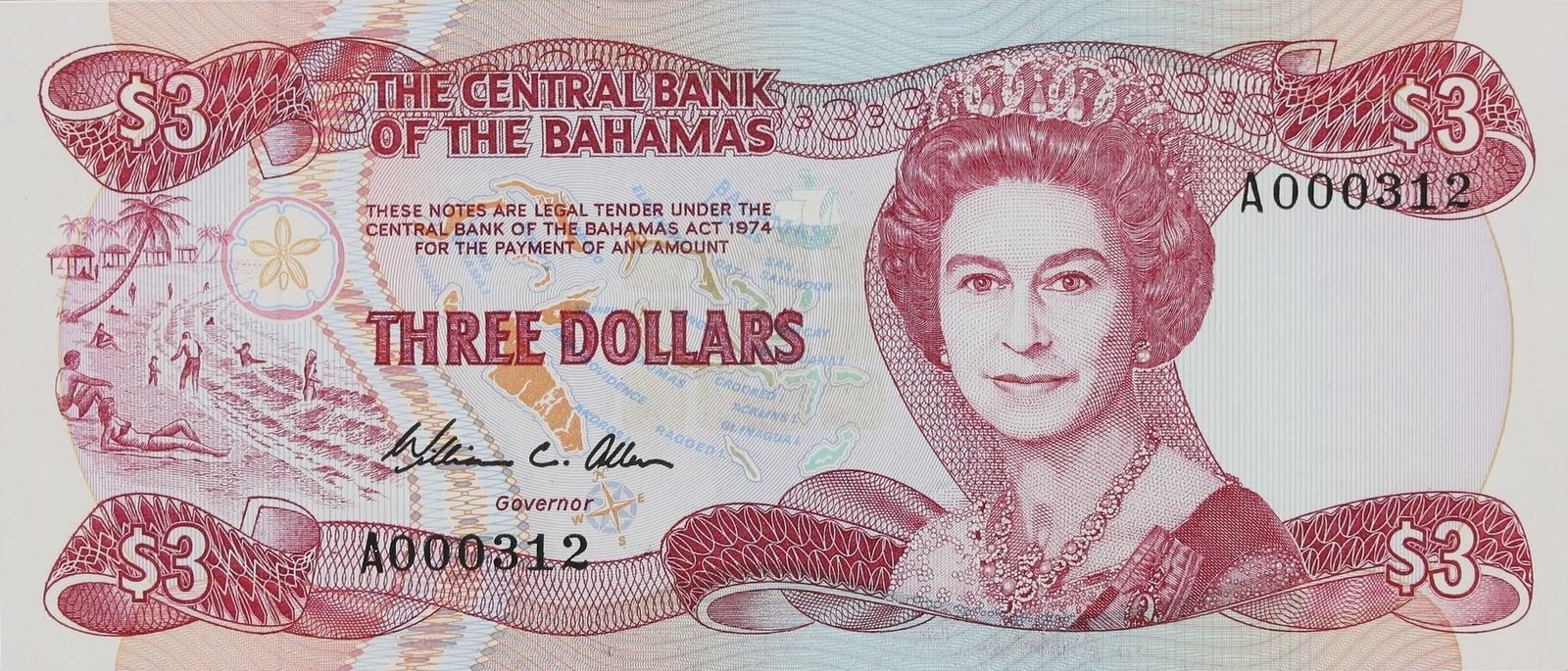
| Value | Allen | Smith |
|---|---|---|
| 1/2 dollar | A | none |
| 1 dollar | A to V, solid security thread | W to Y and AA to AJ, thread printed BAHAMAS |
| 3 dollars | A | none |
| 5 dollars | A to C | D to M |
| 10 dollars | A to D | E to H |
| 20 dollars | A to F, solid security thread | G to P, thread printed BAHAMAS |
| 50 dollars | A | B |
| 100 dollars | A and B | none |
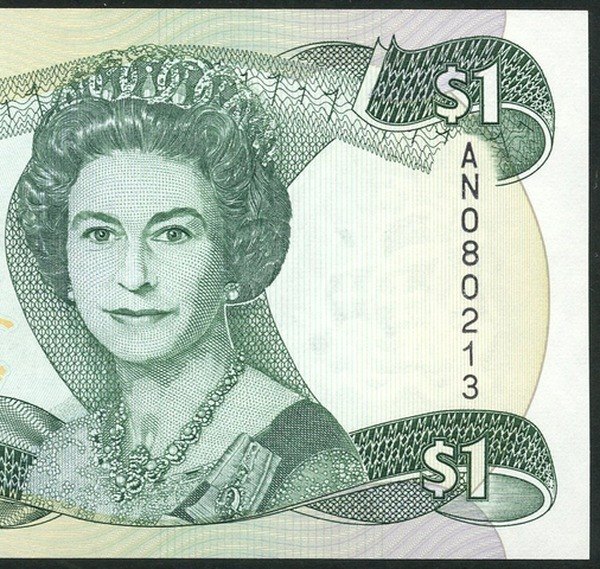
In 1992 four values were issued again in the same design: 1 dollar, 10 dollars, 50 dollars and 100 dollars. Both issues name only the Act of 1974. The second serial number, to the right of the portrait, tells them apart: it is set horizontally on the notes of 1984 and vertically, reading downward along the right-hand side, on the notes of 1992. All the notes of 1992 are signed Smith: the 1 dollar has the prefixes AK to AZ, the 10 dollars J to N, the 50 dollars C to E and the 100 dollars B to E. The catalogue gives the British American Bank Note Company of Canada as the printer of the 1 dollar and the 10 dollars of 1992 and De La Rue as the printer of the 50 and 100 dollars.
The dated series of 1996 to 2002
The notes dated 1996 are signed Smith. The 1 dollar has a new portrait of the Queen, smiling, with a diadem, a double necklace and the jewel of an order on a sash. Sources mention that it follows a photograph by Terry O'Neill taken in April 1992, in the British American Bank Note Company's engraving. The prefixes are BA to CF on the 1 dollar, P to V on the 10 dollars, F to J on the 50 dollars and E to J on the 100 dollars.
Part of the printing of the 50 dollars and of the 100 dollars of 1996 was stolen before it reached the Central Bank. The Bank published the serial ranges and declared them non-redeemable:
- 50 dollars: G 100001 to G 103000, G 104001 to G 105000 and G 108001 to G 109000;
- 100 dollars: G 541001 to G 548000.
A note in one of these ranges is a stolen note that the Bank will not honour.
The 100 dollars dated 2000 is of the dated 2000 series under the Central Bank Act 1974. The Central Bank's report for 2017 says forgeries of this note were noticed late in that year. The 1/2 dollar dated 2001 is issued under the Central Bank of the Bahamas Act 2000 and has serial numbers of seven digits.
In 2002 the Central Bank reused the 1 dollar design of 1984, with the Queen in the Vladimir tiara, for a 1 dollar marked SERIES 2002. It was printed by De La Rue with a windowed security thread reading BAHAMAS and the Spanish galleon watermark, and its legal tender clause names the Act of 2000. It came only a year after the 2001 1 dollar with the portrait of Sir Lynden Pindling. No official reason was given. Sources mention that the Bank lacked permission to use Pindling's portrait and went back to the earlier design to meet an urgent demand for notes. A design with Pindling drawn for 1973 is treated in From the monarch to national figures.
The CRISP notes, 2005 to 2019
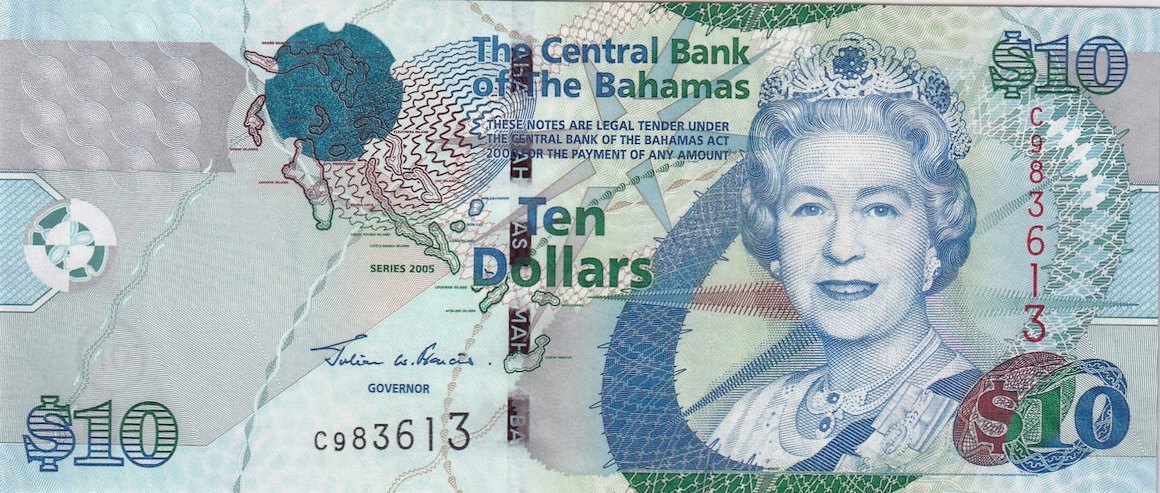
CRISP stands for Counterfeit Resistant Integrated Security Product. The notes carry features that differ from value to value. The first was the 10 dollars, introduced on 3 August 2005, with a blue foil patch, a solid thread and a 3-mm windowed thread reading BAHAMAS, on paper with a new sizing agent. Sources mention that Francis, whose signature the note carries, retired as Governor on 31 May 2005, so the note came out after Francis had left office. The 10 dollars of the same design issued in 2009 shows Stafford Sands in place of the Queen and has no page in the catalogue.
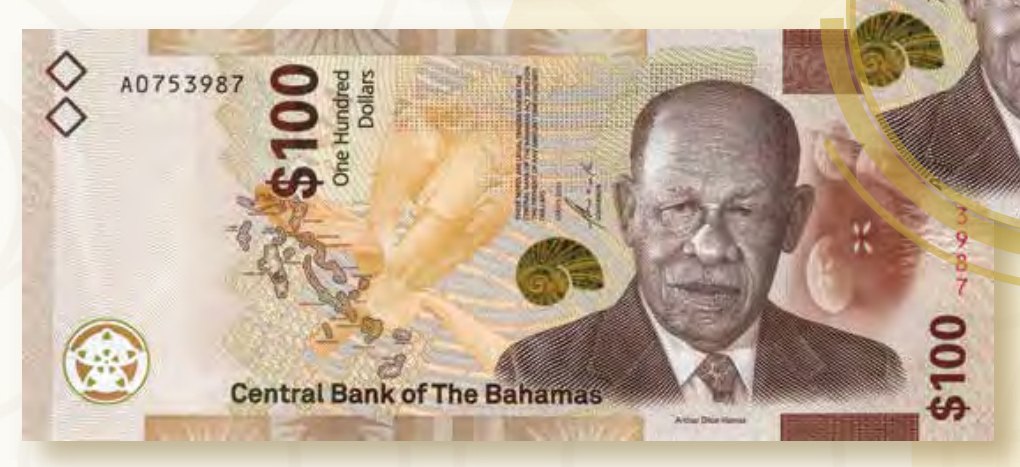
The CRISP 100 dollars was introduced on 16 December 2009, with a depth-image hologram, a solid thread and a 3-mm windowed thread reading BAHAMAS with a sand dollar. It carries the signature of Wendy M. Craigg, Governor from 2005 until 31st December 2015 by the Central Bank's annual report for 2015. Its place was taken in October 2021 by the 100 dollars of the CRISP Evolution family, without the Queen's portrait, by the annual report for 2021. The Bank's reports to 2024 mention no calling-in of the older note.
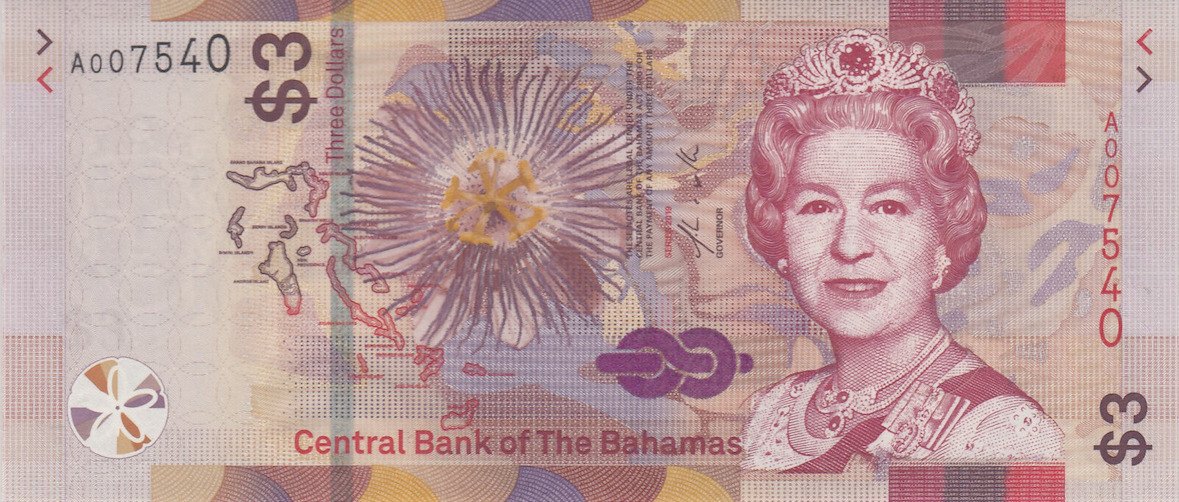
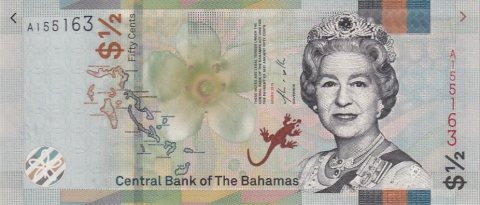
Two notes of 2019 still show the Queen. The 1/2 dollar was introduced on 24 January 2019, on paper, and the 3 dollars on 28 March 2019, on a composite (Hybrid) substrate. Both were printed by Oberthur Fiduciaire with a vertical back and a windowed security thread reading BAHAMAS with a sand dollar. The Central Bank's reports count them in the "novelty" tier of the CRISP Evolution family, whose other notes, from 1 to 100 dollars, were released from 2016 to 2021 and do not show the Queen. Both are signed by John A. Rolle, who became Governor in 2016. The Act of 2000 named on the notes was replaced by the Central Bank of The Bahamas Act, 2020, in force from 1st September 2020. Sources number the half dollar P-WA77 and the 3 dollars P-W78; the catalogue numbers the second P-WA78 to sit beside the first.
The Governors who sign
| Governor | What the pages give | Notes signed |
|---|---|---|
| Donaldson | the first rows of 1974 | |
| Allen | the second rows of 1974; the first rows of 1984 | |
| Smith | the second rows of 1984; the notes of 1992 and of 1996 | |
| Francis | retired on 31 May 2005 (sources mention) | the 10 dollars of 2005 |
| Wendy M. Craigg | Governor from 2005 until 31st December 2015 (Central Bank annual report for 2015) | the 100 dollars of 2009 |
| John A. Rolle | Governor from 2016 | the 1/2 dollar and 3 dollars of 2019 |
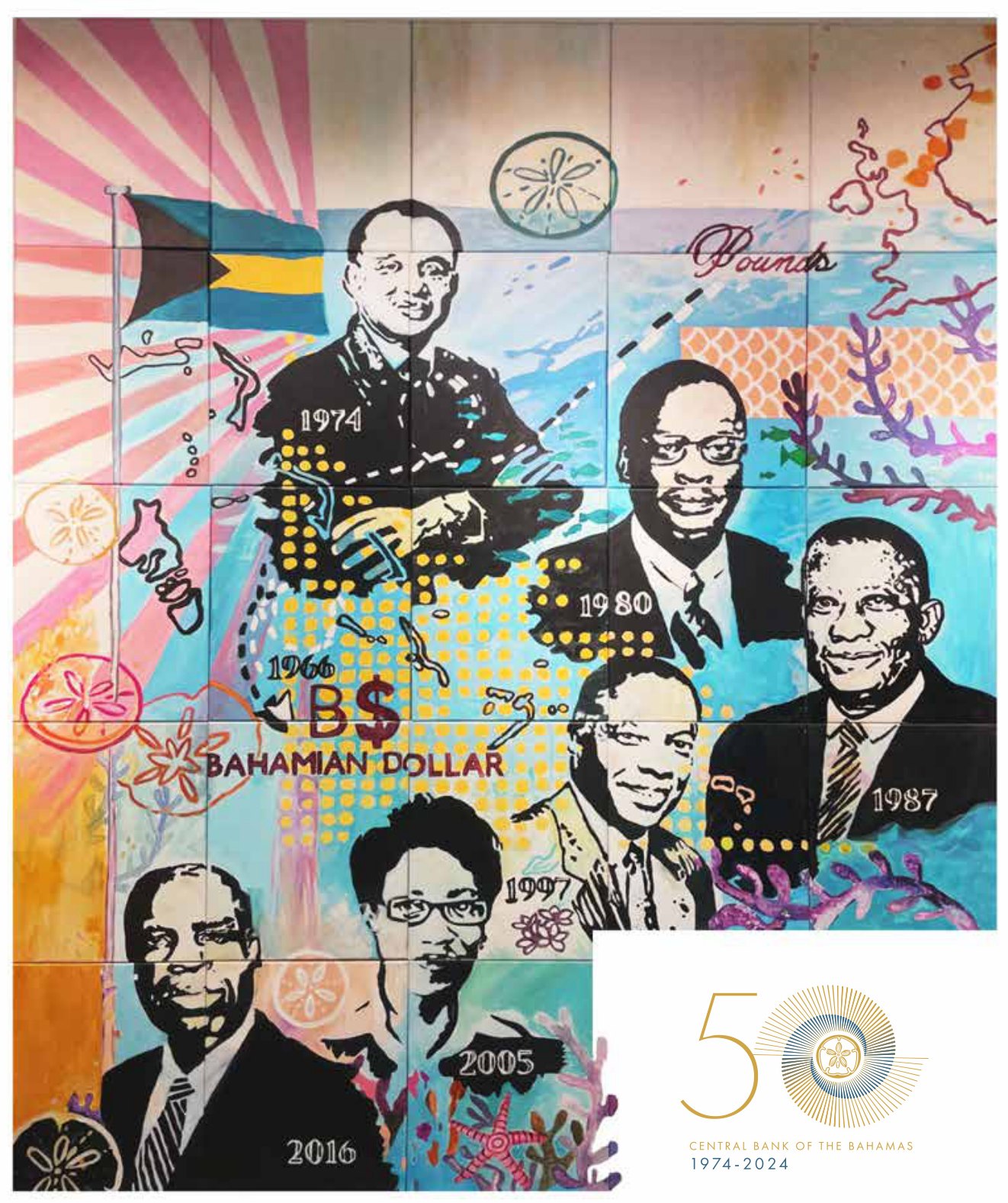
The note pages give surnames only for the first four. Heritage's descriptions name them as Timothy Baswell Donaldson (8 December 2023, lot 22029), William C. Allen (27 March 2025, lot 24034) and James H. Smith (27 March 2025, lot 24033). The pages do not say whether the Francis who signs as Minister for Finance on the notes of 1965 and the Francis who signs as Governor in 2005 are one person; Stack's Bowers (2 October 2025, lot 50011) names the first as Charlton E. Francis.
Notes in circulation, 2010 to 2024
The Central Bank's accounts give the notes in circulation by value, all series together.
| Value | End of 2010 | End of 2015 | End of 2019 | End of 2024 |
|---|---|---|---|---|
| 1/2 dollar | 870,731 dollars | 950,529 dollars | ||
| 3 dollars | 2,119,143 dollars | 2,231,202 dollars | ||
| 10 dollars | 13.4 million dollars | 23.2 million dollars | ||
| 100 dollars | 116.6 million dollars | 147.5 million dollars | 361.7 million dollars |
The 50 and 100 dollars in the houses' descriptions
The 50 dollars has the prefix A alone under the Government in 1965 and under Donaldson in 1974. Heritage says the prefix A was used by all three issuers and reads it as a sign of how few 50 dollars were printed and issued (5 September 2019, lot 28221, and 8 December 2023, lot 22029). Heritage also says that the Monetary Authority's 100 dollars was printed in a few hundred thousand notes, all with the prefix A (27 March 2025, lot 24029), and that only a few hundred thousand 100 dollars were issued with the Donaldson signature, all in the prefix A (27 March 2025, lot 24030). The pages agree on the prefixes: the 100 dollars signed Donaldson is found only in the A block.
The houses explain in the same way why few notes of these values were kept. Stack's Bowers (16 January 2026, lot 30018) says that visitors mostly used United States dollars, which passed at par, and that the high face value kept collectors from putting notes aside. Its description of 12 August 2024 (lot 30020) likewise says that the buying power of the 50 and 100 dollars meant few were put aside. Stack's Bowers (2 October 2025, lot 50012) adds that small quantities of 100 dollars went to the banks on the several islands and were enough for local trade.
The houses give these counts from the PMG population report, each as it stood on the day of the description:
- 100 dollars of 1965 with two signatures: 19 notes graded (Stack's Bowers, 2 October 2025, lot 50012);
- 100 dollars of the Monetary Authority: seven issued notes (Heritage, 27 March 2025, lot 24029), then eight (Stack's Bowers, 16 January 2026, lot 30015);
- 100 dollars of 1984: 11 notes (Stack's Bowers, 14 August 2019, lot 30018), and six specimens (Heritage, 27 March 2025, lot 24034);
- 50 dollars of 1984 signed Smith: 12 notes (Heritage, 27 March 2025, lot 24033).
Heritage (5 September 2019, lot 28221) says the 50 dollars it sold that day is the note pictured in the Bahamas chapter of The Banknote Book.
How long the design of 1965 stayed in use is given differently. Stack's Bowers (2 October 2025, lot 50010) says it lasted in circulation until the early 1980s; Stack's Bowers (16 January 2026, lot 30020) says it was replaced in the middle 1980s. The pages give 20th January 1984 for the first notes of the new design and three more years for the rest.
Designs that were not used
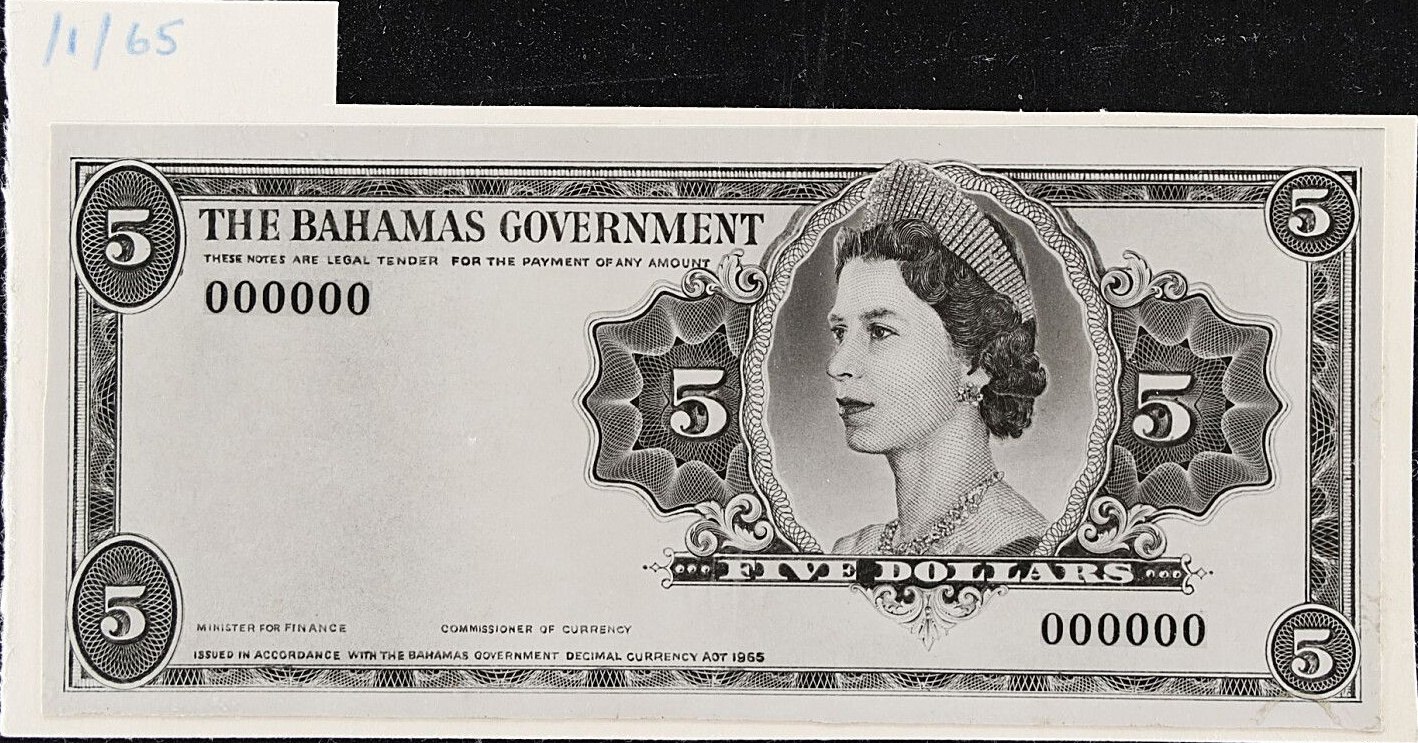
Three unadopted designs for these issues have been sold. Stack's Bowers (14 August 2023, lot 40038) offered photographic proofs of the front and back of a 5 dollars of about 1965, with a portrait of the Queen facing left that the house says is on no other note. Stack's Bowers (12 August 2024, lot 30021) offered a printer's model of the front of a 10 dollars of the Central Bank, with a portrait that the house traces to a photograph taken about 1966 by Anthony Buckley and that is on no issued note of the Bahamas. Stack's Bowers (2 October 2024, lot 20050) offered front and back models of a 20 dollars of the Central Bank; PMG dates them about 1974, and the house thinks the 1980s more likely.
Sources
- The notes of the three issuers: headings, legal tender clauses, signatures, titles and serial prefixes, as recorded on the catalogue's note pages.
- The Central Bank of The Bahamas: annual reports for 2015, 2017 and 2021, reports to 2024, and the accounts for 2010, 2015, 2019 and 2024; the published serial ranges of the stolen notes of 1996.
- Central Bank of The Bahamas, Our History.
- Unnamed sources of the note pages ("sources mention"): the designers John White and Brian White, the engraver Stanley Doubtfire, the photographs of Dorothy Wilding, Peter Grugeon and Terry O'Neill, the first day of the 1984 series, the green 5 dollars, the reissue of 2002 and the retirement of Francis.
- Heritage Auctions: 21 October 2015, lot 18023; 5 September 2019, lot 28221; 9 May 2023, lot 28018; 9 November 2023, lot 24022; 7 December 2023, lot 24007; 8 December 2023, lot 22029; 27 March 2025, lots 24026, 24029, 24030, 24033 and 24034.
- Stack's Bowers: 14 August 2019, lot 30018; 14 August 2023, lot 40038; 12 August 2024, lots 30020 and 30021; 2 October 2024, lot 20050; 2 October 2025, lots 50010, 50011 and 50012; 16 January 2026, lots 30015, 30016, 30018 and 30020.
- Spink: 17 April 2019, lot 94.
Member comments
Log in or register to post a comment.