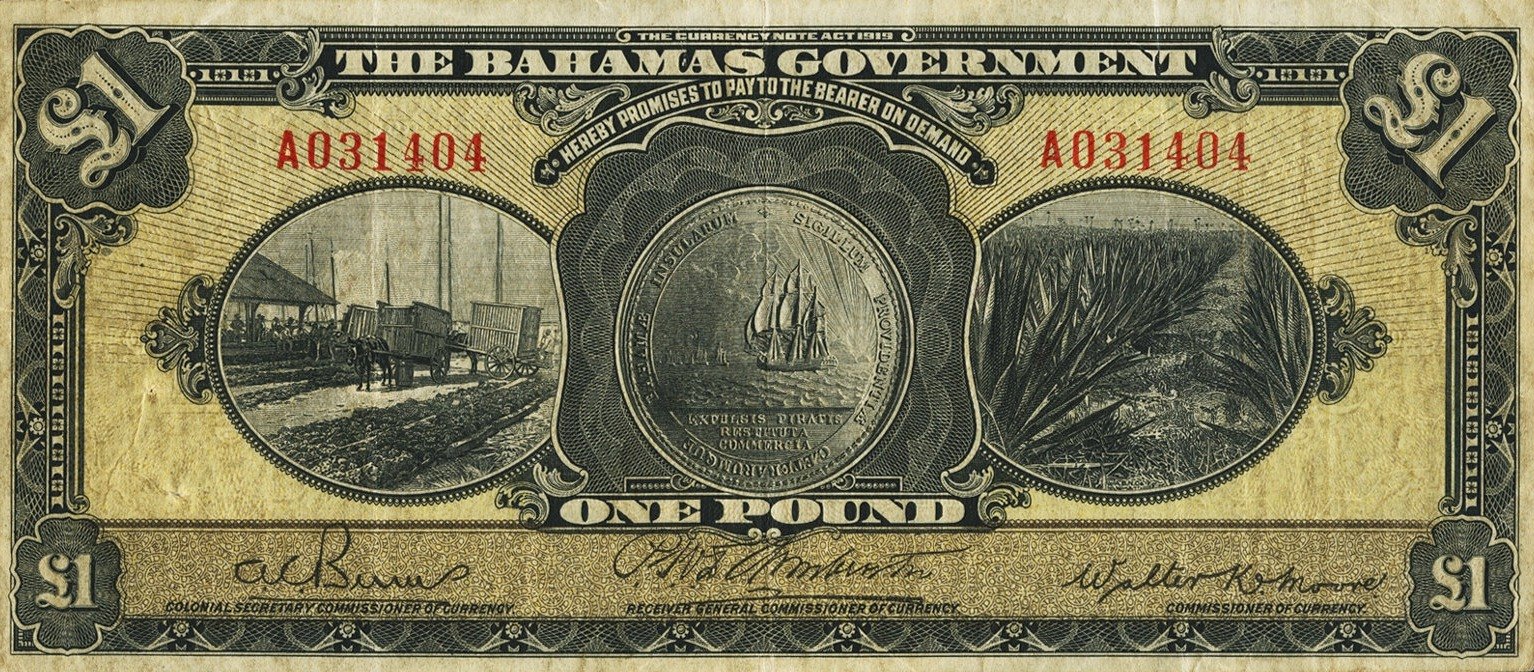
This article sets out the sterling paper money of the Government of the Bahamas in order of time, from the Currency Note Act of 1919 to the change to dollars in 1966. It is drawn from the catalogue's sixteen note pages for these issues, which rest on the Act, the Nassau Guardian, the annual reports on the Bahamas, the Colonial Office Lists, the Official Gazette and the Crown Agents' archive at the British Library. A few statements of auction houses and one page of the Central Bank of The Bahamas are added, each named where it is used.
The Currency Note Act 1919 and the local printing of 1920
The Currency Note Act 1919 is Chapter 21 of 18th December 1919. It allowed notes of 4 shillings, 10 shillings and 1 pound only, up to 10,000 pounds in all. The notes were to be issued by three Commissioners of Currency: the Colonial Secretary, the Receiver General and one unofficial member named by the Governor. The Act came into operation on 12th February 1920, by a Proclamation of 31st January 1920. The Central Bank of The Bahamas, on the history page of its website, speaks of a Currency Board set up in 1919 that "was restricted mainly to issuing currency".
Before the Government had notes of its own, other paper passed in the colony. That is the subject of another article, Whose paper passed? Other people's notes in the colonies, 1909 to 1929.
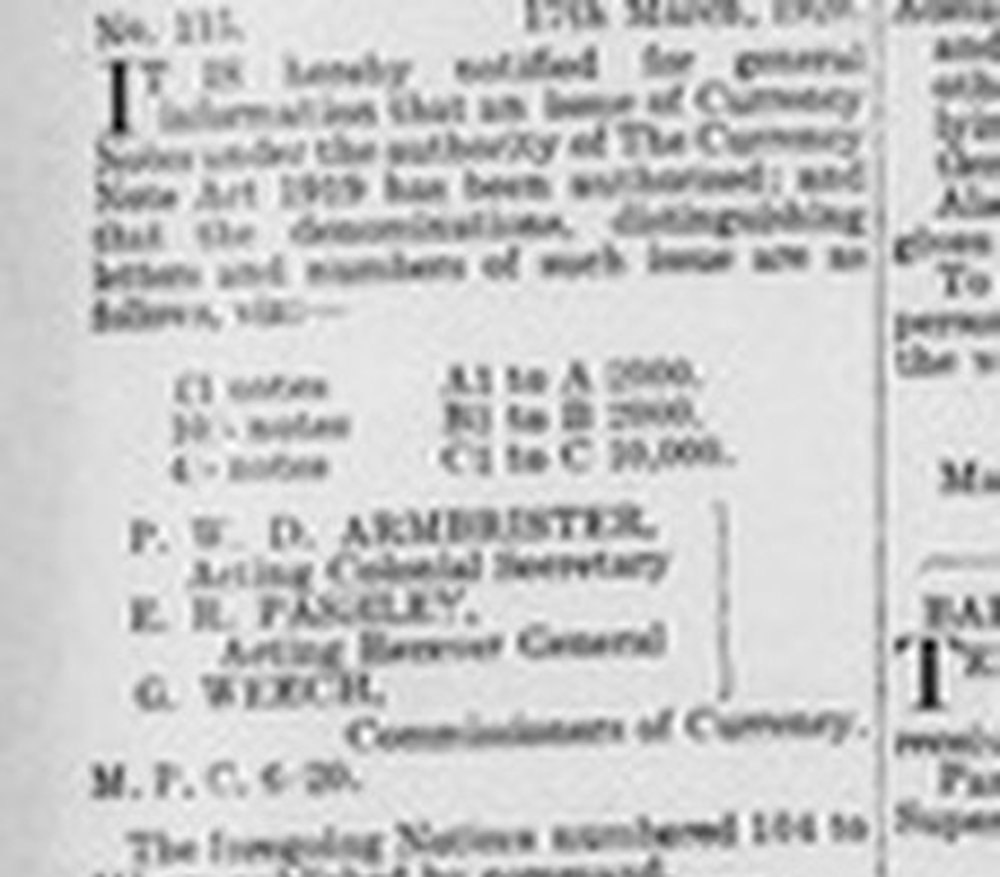
The first notes put out under the Act were printed locally. Government Notice No. 115, printed in the Nassau Guardian of 17th March 1920, announced this first issue as 1 pound notes A 1 to A 2000, 10 shillings notes B 1 to B 2000 and 4 shillings notes C 1 to C 10,000. Each value had its own prefix letter. At face value that is 2,000 pounds, 1,000 pounds and 2,000 pounds: 5,000 pounds, half of the limit of the Act. The notice went out over the names of Armbrister as Acting Colonial Secretary, Pashley as Acting Receiver General and Weech.
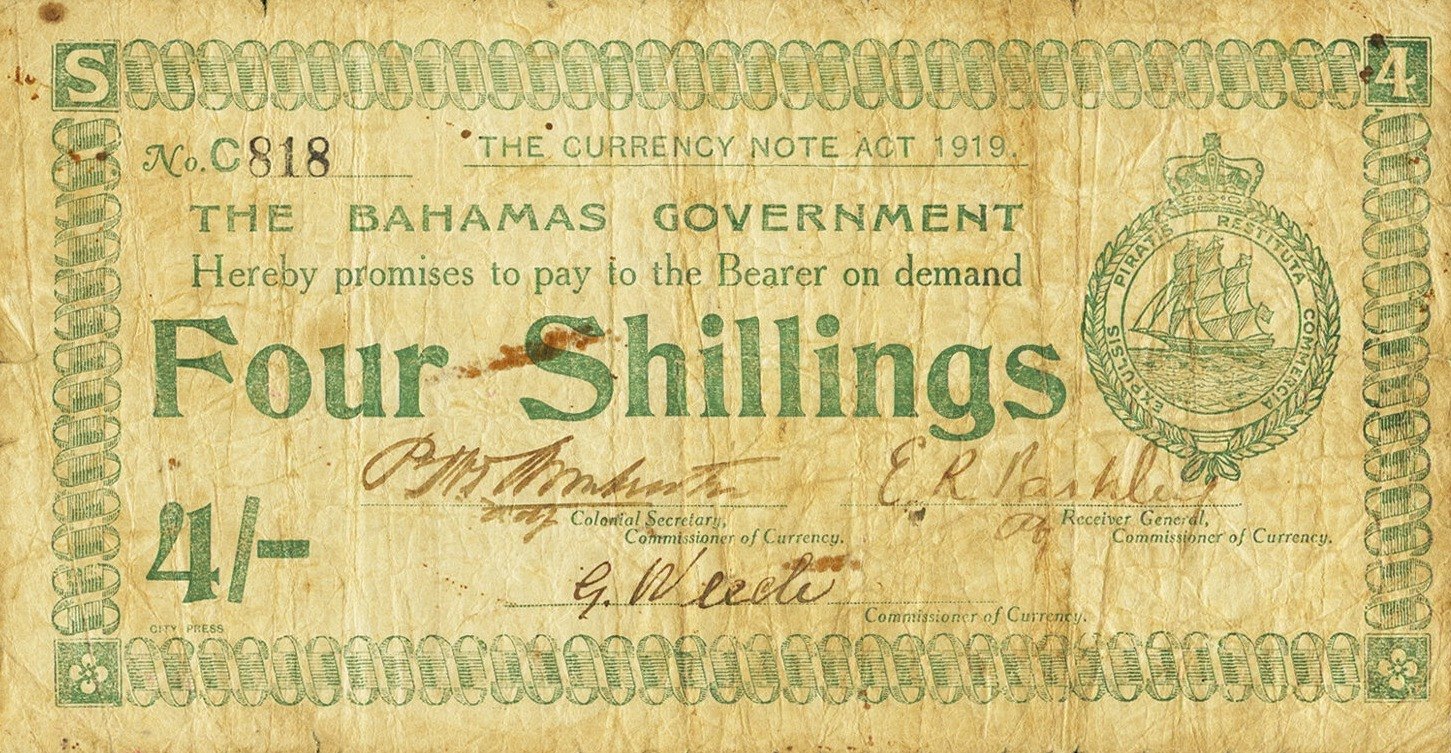
Only the 4 shillings with the imprint CITY PRESS has been recorded. No 10 shillings or 1 pound of the local printing is known to the catalogue. The three signatures on the 4 shillings are written by hand, and the Colonial Secretary and the Receiver General sign as acting officers, with Actg written in before the printed titles. The Colonial Office List gives Pashley, the Comptroller of Customs, three spells as acting Receiver General: 7th to 16th February 1919, 19th September to 12th November 1919 and 15th March to 8th April 1920. Only the last of them falls after the Act came into force.
The notes printed in Ottawa
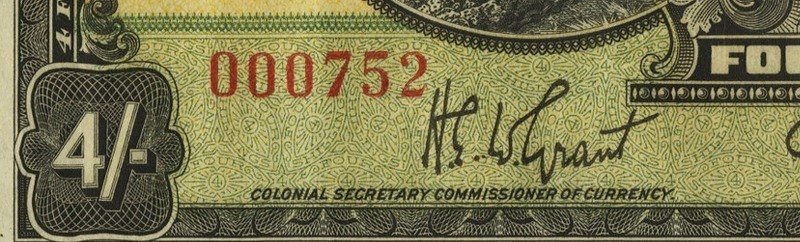
The local printing was followed by engraved notes of 4 shillings, 10 shillings and 1 pound. They carry no imprint. The catalogue follows the sources that name the American Bank Note Company, Ottawa. Heritage (21 April 2022, lot 25296) names the Canadian Bank Note Company, which the house says belonged to the American Bank Note Company until 1923, and the PMG holder of that proof also reads CBNC. Stack's Bowers (16 August 2021, lot 30023) likewise describes a 1 pound as printed by CBNC. The point is not settled.
The front proofs on card carry the signatures of Grant, Armbrister and Weech. They were approved and signed on the card by P. W. D. Armbrister as Acting Colonial Secretary on 9 June 1922. Stack's Bowers, describing one of these proofs of the 1 pound (12 August 2024, lot 30009), points out that Armbrister's printed signature on the same proof stands over the title of Receiver General, and thinks it very likely that the card is the one on which the design was approved before printing began. An unissued design for the Bahamas of 1919 is among those treated in Notes that never were: unissued designs with George V and George VI.
Each value has two rows. The first is signed Grant at left and Weech at right, and its serial number has no prefix letter. The second is signed Burns at left and Moore at right, and its number begins with the prefix A. Armbrister signs in the centre on both. The Colonial Office Lists give Grant as Colonial Secretary from March 1918 and Armbrister as Receiver General from 1916. Stack's Bowers (16 August 2021, lot 30023) gives the year 1924 for a Burns 1 pound; the note pages give no year for the change.
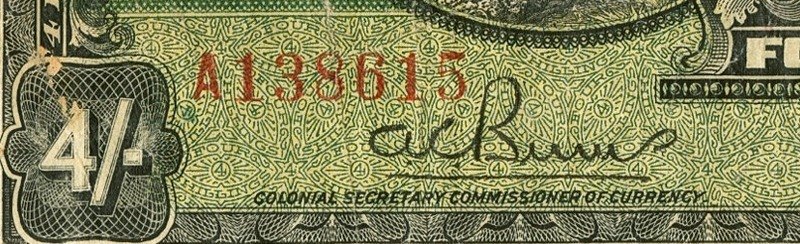
The issue soon passed the first limit of 10,000 pounds. The annual reports put the notes in circulation at 60,000 pounds in 1924 and 1925 and at 110,000 pounds in 1927, a figure they repeat to 1930 as the total value issued. They do not name the Act that raised the limit. The reports for 1928 and 1929 add that a large amount of United States currency and some British currency notes circulated beside the Government's notes.
The George V notes of Waterlow, 1930 and 1935
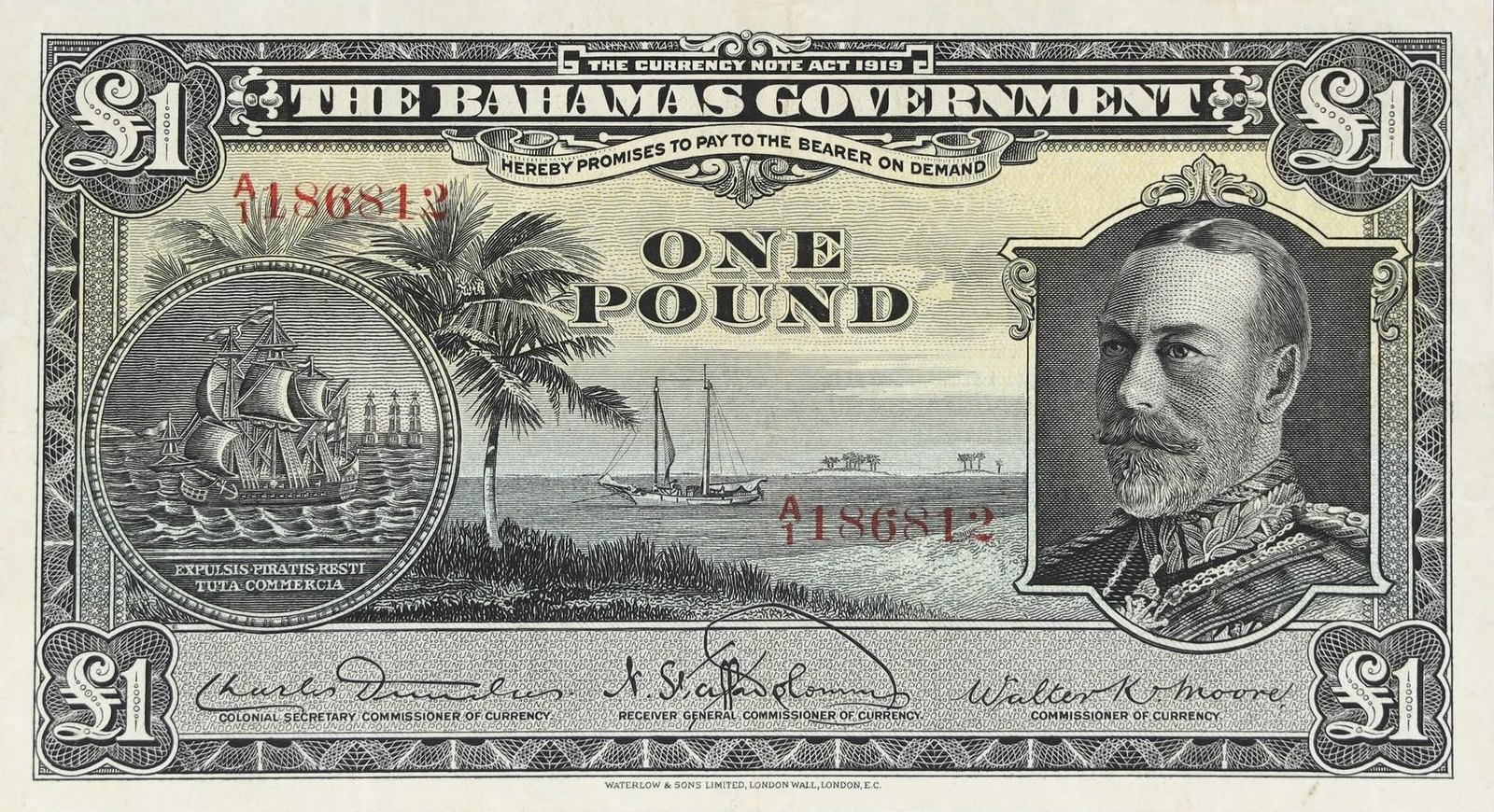
In 1930 the Crown Agents ordered new notes with the portrait of George V from Waterlow and Sons, still under the Act of 1919. The 10 shillings and the 1 pound were ordered under requisition 1103 of 1930. The proof of the 1 pound was approved on 19th September 1930. The colour proof of the 10 shillings, with the back in the same red as the front, was approved on 1st October 1930. The approved proofs are in the Crown Agents archive at the British Library.
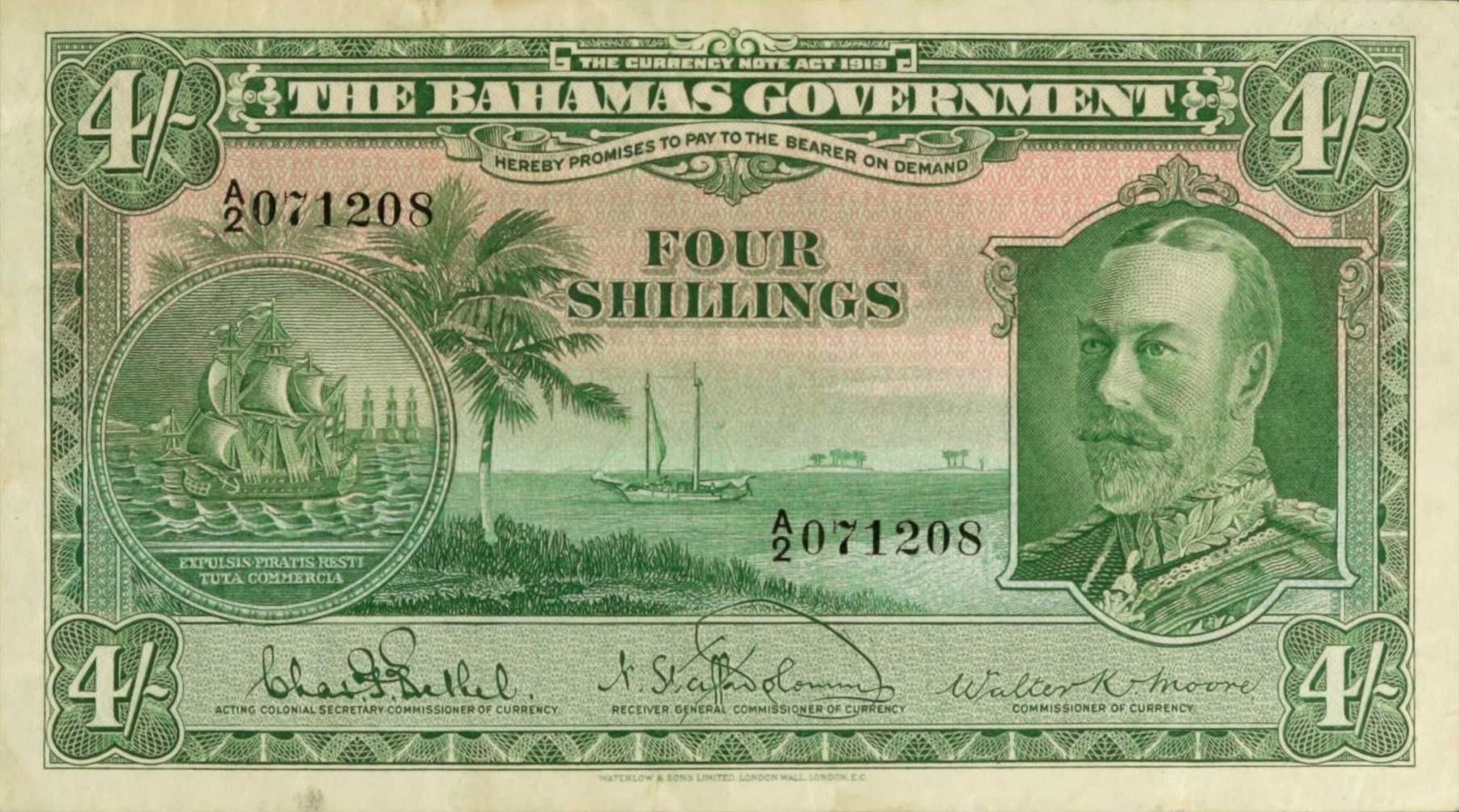
The 4 shillings followed in 1935. The Crown Agents ordered it from Waterlow that year under requisition 1347 of 1935, signed by Bethel as Acting Colonial Secretary. The specimen the Crown Agents kept has the prefix A/2 and SPECIMEN overprinted twice in red, and is also in the archive at the British Library. The Colonial Office Lists give Solomon as Receiver General from 1928 and Dundas as Colonial Secretary from April 1929. Bethel was Assistant Colonial Secretary from July 1928.
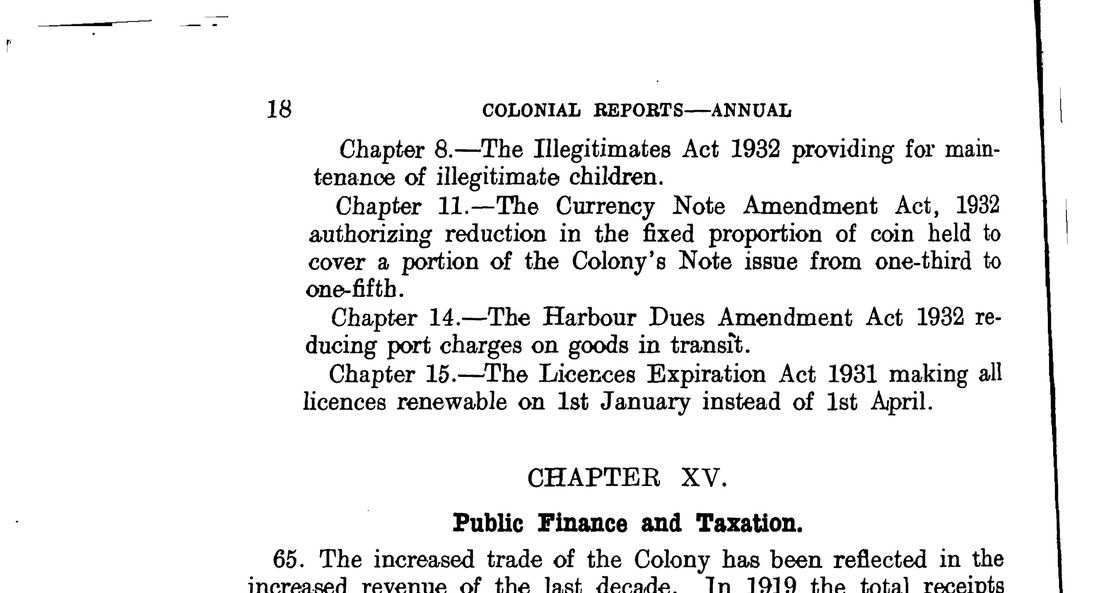
The annual report for 1932 records the Currency Note Amendment Act, 1932 (Chapter 11 of 1932). It lowered the fixed share of coin held to cover part of the note issue from one third to one fifth.
A 5 pounds of this issue has the Pick number P-8, but no issued example is confirmed. The Act of 1919 as passed allowed 4 shillings, 10 shillings and 1 pound only, and the annual reports from 1924 to 1938 name only those three values. The first report to name a 5 pounds is that for 1946, which belongs to the notes of the 1936 Act.
The 1936 Act and the George VI notes of De La Rue
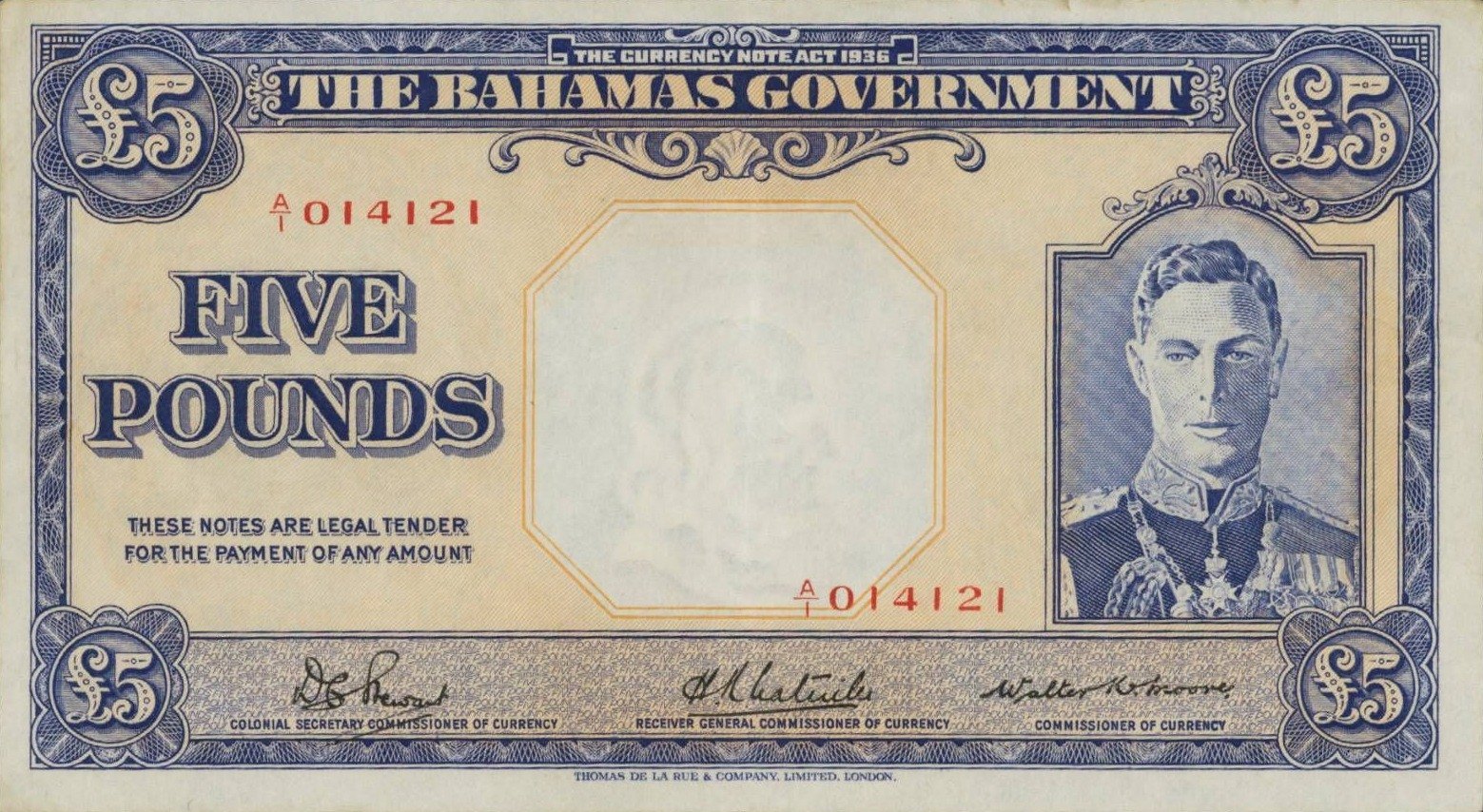
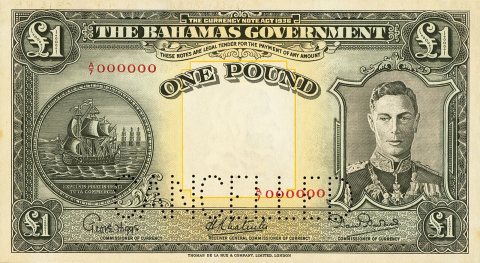
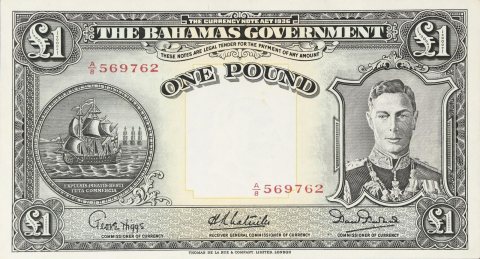
The 1936 Currency Note Act is Chapter 27 of 1st November 1936. Like the Act of 1919, it made the Colonial Secretary, the Receiver General and one unofficial member named by the Governor the Commissioners of Currency. The notes under it were printed by Thomas de la Rue and Company with the portrait of George VI: 4 shillings, 10 shillings, 1 pound and 5 pounds.
On the earlier rows the title under the left-hand signature reads COLONIAL SECRETARY COMMISSIONER OF CURRENCY. On the last row of each value Higgs signs over COMMISSIONER OF CURRENCY alone. The Crown Agents' proofs date the change to the order of 1947-48, when the Colonial Secretary's title was taken off. The Colonial Office Lists give Jarrett as Colonial Secretary from August 1935 and Heape from 1940 to 1944; Latreille is Receiver General in the List for 1946. On the 4 shillings Stewart and Latreille sign together on the prefixes A/5 and A/6, with Moore (A/5) and then Burnside (A/6) as the third signer at right.
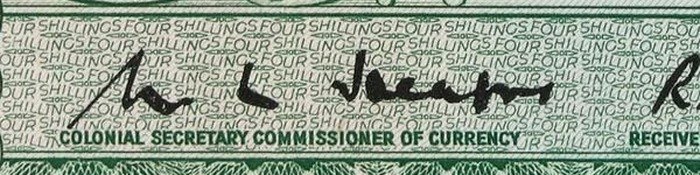
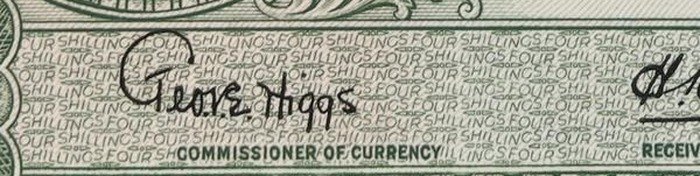
Heritage (9 January 2013, lot 15010) offered a 1 pound of the first row with a pen signature that the house reads as that of Edward, Duke of Windsor, and thinks was written while the Duke was Governor of the Bahamas. PMG records the writing on its holder as an annotation.
The Crown Agents' printing orders
The Crown Agents kept an approved proof of each order, now in their archive at the British Library. The proofs give the order behind each prefix.
| Value | Prefix | Year of the order | Requisition |
|---|---|---|---|
| 10 shillings and 1 pound, George V | A/1 on the issued notes | 1930 | 1103 of 1930 |
| 4 shillings, George V | A/2 on the specimen | 1935 | 1347 of 1935 |
| 4 shillings, 10 shillings and 1 pound, George VI | A/3 | 1939 | 1661, the new design |
| 4 shillings | A/4 | 1941 | 2207 |
| 4 shillings | A/5 | 1945 | 2557 |
| 4 shillings | A/6 | 1946-47 | 2853 |
| 4 shillings | A/7 | 1947-48 | 2982, the Colonial Secretary's title taken off |
| 10 shillings | A/4 | 1941, with a further order marked as a replacement in 1942 | 2207 |
| 10 shillings | A/5 | 1945 | 2557 |
| 10 shillings | A/6 | 1947-48, repeated without change in 1949 | 2982, then 3180 |
| 1 pound | A/4 | 1941, with further orders in 1942 and 1943 | 2207 |
| 1 pound | A/5 | 1945 and 1946 | 2557 and 2713 |
| 1 pound | A/6 | 1946-47 | 2853 |
| 1 pound | A/7 | 1947-48, repeated without change in 1949 | 2982, then 3109 and 3180 |
The 10 shillings went a different way from the other two values. Its A/6 block was ordered in 1947-48 and is signed by Higgs, and the Crown Agents' proof for that block is marked as having two new signatures. No 10 shillings with the Stewart, Latreille and Burnside signatures is recorded, and the proof shows that none was ordered. On the 4 shillings and the 1 pound the A/6 block was ordered in 1946-47 and carries those three signatures.
The note pages give no printing orders for the 5 pounds. Its first two rows share the prefix A/1 and the Stewart signature, and only the right-hand signature separates them: Moore, then Burnside. On the notes recorded so far, Moore runs to A/1 021367 and Burnside from A/1 028281. The third row, signed Higgs, has the prefixes A/1 and A/2.
Sources mention 4 shillings, 10 shillings and 1 pound notes of the George VI design printed by De La Rue and rejected on 14 May 1953. The catalogue lists an unissued 1 pound of this kind on the page of the 1 pound.
The Elizabeth II notes of 1953 and the end of the sterling issue
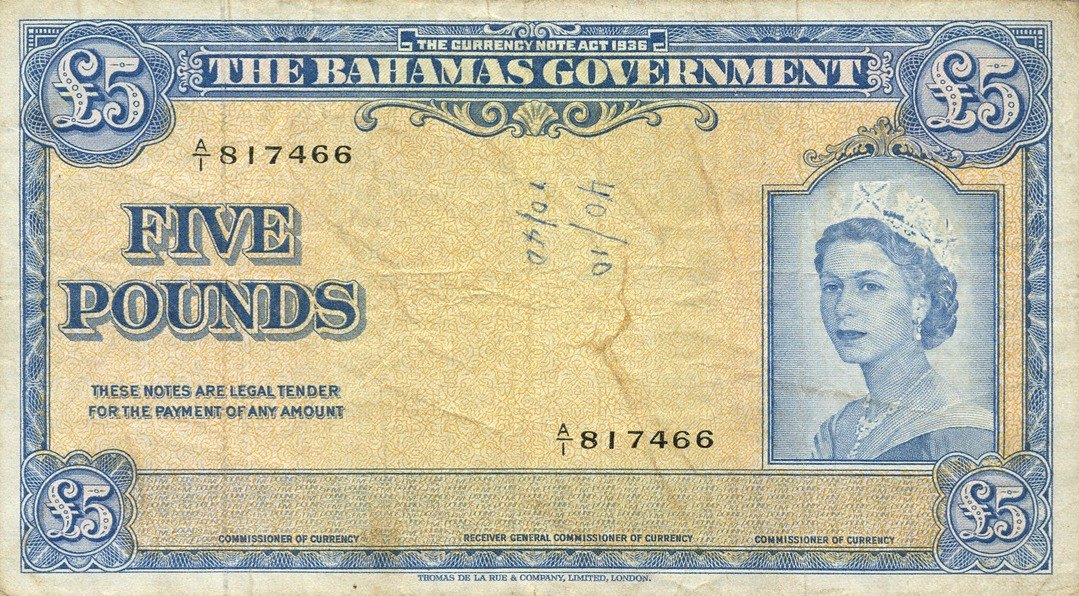
The last sterling notes carry the portrait of Queen Elizabeth II and were again printed by De La Rue under the Act of 1936: 4 shillings, 10 shillings, 1 pound and 5 pounds. Sources mention that the portrait follows a 1952 photograph by Dorothy Wilding, in De La Rue's engraving.
Higgs signs at left on every note as Commissioner of Currency. The pair of signatures at right changes three times, and that gives each value four rows: Latreille and Burnside, Sweeting and Burnside, Sweeting and Bethel, Sweeting and Roberts. The middle signer is titled RECEIVER GENERAL COMMISSIONER OF CURRENCY. The serial numbers run on across the changes. The Commissioners' statements in the Official Gazette date them: Sweeting signs in place of Latreille from the second half of 1954, Bethel in place of Burnside from late 1959, and Roberts was appointed in Bethel's place on 22nd December 1962. The Colonial Office List records that Sweeting, Assistant Treasurer from 1946, was named Receiver General and Treasurer (designate) in 1955.
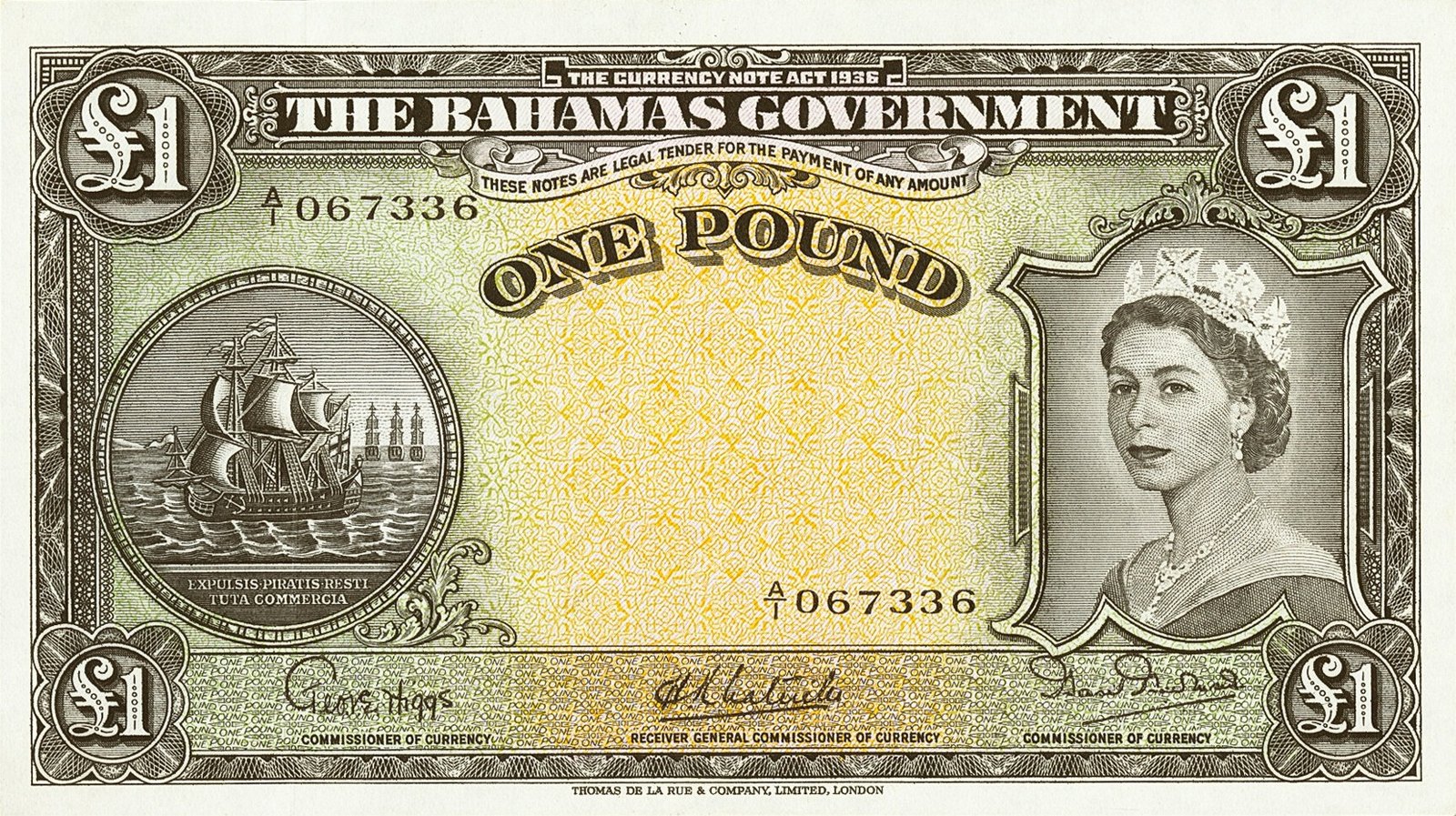
The houses agree with these dates where they speak of them. Heritage (8 December 2023, lot 22005) says the first row, with Latreille, circulated for about a year before the signatures changed. Stack's Bowers (16 January 2026, lot 30012) gives the signers of that first row as H. R. Latreille at centre and Basil Burnside at right. Spink (12 January 2024, lot 23) says a 1 pound signed Higgs, Sweeting and Roberts was introduced in 1963. Heritage (8 December 2023, lot 22009) says that PMG had then graded three examples of the 5 pounds with Latreille and Burnside.
The 5 pounds is also recorded printed without signatures, with numbers from A/1 685466 to A/1 828463, which fall among the Sweeting and Bethel numbers.
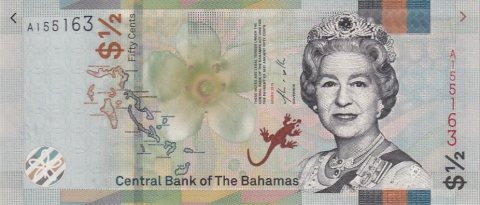
When the decimal dollar notes of the 1965 Currency Note Act were issued in 1966, the pound and dollar notes circulated side by side for six months. About £29,000 of the old sterling notes were never redeemed. The dollar notes are the subject of The dollar notes of the Bahamas, 1965 to 2019.
The Commissioners who signed
The table gathers what the note pages say of the signers and their offices. A blank means the pages do not say.
| Signer | Office, as the source gives it | Signs |
|---|---|---|
| Armbrister | Receiver General from 1916 (Colonial Office Lists); Acting Colonial Secretary on Government Notice No. 115 of 1920 and on the proofs of 9 June 1922 | the local 4 shillings of 1920 as Acting Colonial Secretary; the centre of the Ottawa notes |
| Pashley | Comptroller of Customs; acting Receiver General for three spells in 1919 and 1920 (Colonial Office List) | the local 4 shillings of 1920 |
| Weech | the local 4 shillings of 1920; the right of the Ottawa notes signed Grant | |
| Grant | Colonial Secretary from March 1918 (Colonial Office Lists) | the left of the first Ottawa row |
| Burns | the left of the second Ottawa row, prefix A | |
| Moore | the right of the Ottawa notes signed Burns; the right of the George VI 4 shillings with prefix A/5 and of the first row of the 5 pounds | |
| Dundas | Colonial Secretary from April 1929 (Colonial Office Lists) | named on the pages of the Waterlow notes |
| Solomon | Receiver General from 1928 (Colonial Office Lists) | named on the pages of the Waterlow notes |
| Bethel | Assistant Colonial Secretary from July 1928 (Colonial Office Lists) | the Waterlow 4 shillings of 1935 as Acting Colonial Secretary |
| Jarrett | Colonial Secretary from August 1935 (Colonial Office Lists) | the left of the first row of the George VI 1 pound |
| Heape | Colonial Secretary from 1940 to 1944 (Colonial Office Lists) | |
| Stewart | signs over the title COLONIAL SECRETARY COMMISSIONER OF CURRENCY on the 5 pounds | the George VI 4 shillings with prefixes A/5 and A/6; the left of the first two rows of the 5 pounds |
| Latreille | Receiver General in the Colonial Office List for 1946 | the George VI 4 shillings with prefixes A/5 and A/6; the centre of the first Elizabeth II row |
| Burnside | the right of the George VI 4 shillings with prefix A/6 and of the second row of the 5 pounds; the right of the first two Elizabeth II rows | |
| Higgs | Commissioner of Currency | the left of the last George VI row and of every Elizabeth II note |
| Sweeting | Assistant Treasurer from 1946; Receiver General and Treasurer (designate) in 1955 (Colonial Office List) | the centre of the Elizabeth II notes from the second half of 1954 |
| Bethel | the right of the Elizabeth II notes from late 1959 | |
| Roberts | appointed in Bethel's place on 22nd December 1962 (Official Gazette) | the right of the last Elizabeth II row |
The pages do not say whether the Bethel of 1935 and the Bethel of 1959 are one person, nor whether the Moore of the Ottawa notes is the Moore of the George VI notes.
Notes in circulation, 1920 to 1946
| Date | Government notes in circulation | Source |
|---|---|---|
| 10th August 1920 | 3,200 pounds | the Commissioners' monthly abstract in the Nassau Guardian |
| October 1920 to the end of 1922 | 3,800 pounds | the Commissioners' monthly abstracts in the Nassau Guardian |
| 1924 and 1925 | 60,000 pounds | the annual reports |
| 1927, repeated to 1930 as the total value issued | 110,000 pounds | the annual reports |
| End of 1933 | 110,000 pounds | the annual reports |
| 1935 | 73,400 pounds | the annual reports |
| End of 1936 | 73,400 pounds | the annual reports |
| End of 1938 | 79,400 pounds | the annual reports |
| 1946 | 482,800 pounds | the annual report for 1946, the first to name a 5 pounds |
To the end of 1938 the reports count notes of 4 shillings, 10 shillings and 1 pound only.
What the sources leave open
- The printer of the first engraved notes: the American Bank Note Company, Ottawa, or the Canadian Bank Note Company.
- The Act that raised the limit of 10,000 pounds. The annual reports do not name it.
- The year in which Burns and Moore took the place of Grant and Weech on the Ottawa notes. Only a house's date of 1924 is to hand.
- Whether a 10 shillings and a 1 pound of the local printing of 1920 survive. The notice announced 2,000 of each.
- Whether any George VI notes were ordered before 1939, and the orders for the 5 pounds. The Act is of 1936, the first proof of the new design in the Crown Agents' archive is of 1939, and the row of the 1 pound begins with the prefix A/2.
- The offices of Weech, Burns, Moore, Burnside, Higgs and Roberts. The pages name the unofficial member only as a seat on the board, not by person.
Sources
- The Currency Note Act 1919 (Chapter 21 of 18th December 1919) and the Proclamation of 31st January 1920.
- Government Notice No. 115, Nassau Guardian, 17th March 1920, and the Commissioners' monthly abstracts in the Nassau Guardian, 1920 to 1922.
- The annual reports on the Bahamas for 1924 to 1938 and for 1946, with the Currency Note Amendment Act, 1932 (Chapter 11 of 1932).
- The 1936 Currency Note Act (Chapter 27 of 1st November 1936).
- The Colonial Office Lists, to that for 1946, and the entry of 1955 for Sweeting.
- The Commissioners' statements in the Official Gazette, 1954 to 1962.
- The Crown Agents' archive at the British Library: approved proofs and specimens, requisitions 1103 of 1930, 1347 of 1935, 1661, 2207, 2557, 2713, 2853, 2982, 3109 and 3180.
- Heritage Auctions: 9 January 2013, lot 15010; 21 April 2022, lot 25296; 8 December 2023, lots 22005 and 22009.
- Stack's Bowers: 16 August 2021, lot 30023; 12 August 2024, lot 30009; 16 January 2026, lot 30012.
- Spink: 12 January 2024, lot 23.
- Central Bank of The Bahamas, Our History.
Member comments
Log in or register to post a comment.