Between 1915 and 1936 the Bermuda Government put out four notes and prepared a fifth that is known only as a specimen. This article gathers what the catalogue pages hold on the laws that allowed them, the orders placed with the printers and the amounts the annual reports counted. Its sources are the Colonial Office annual reports, the Blue Books, the Colonial Office List and, where they add something, the descriptions of the auction houses.
The Act of 1915 and the pound of 1914
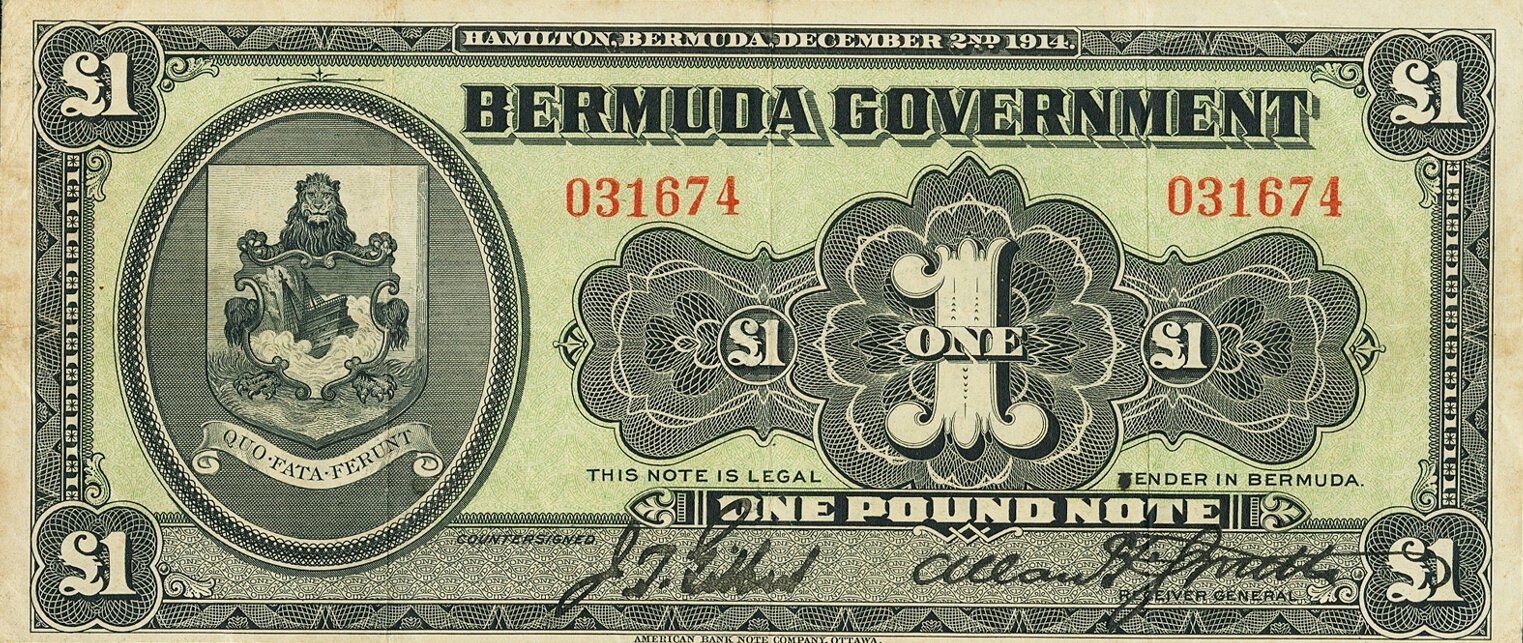
The 1 pound of 1914 is the first banknote of the Bermuda Government, an emergency issue of the First World War. The notes are dated 2nd December 1914, but the Government Notes Act that allowed them is of 19th February 1915, and sources mention that they were first paid out on 1st March 1915. The Blue Books for 1918, 1920 and 1921 give the notes as issued under Act No. 5 of 1915.
The Act allowed 20,000 pounds of these notes. The limit was raised to 30,000 pounds in August 1915 and to 40,000 pounds in 1917. Part of the issue did not go to the public: 10,000 pounds of the notes went to the British Treasury Chest Officer in 1915 and another 10,000 pounds in 1917.
The American Bank Note Company in Ottawa printed the note; London Coins (3 June 2019, lot 862) calls it the only Bermuda note from that firm. Heritage (18 September 2020, lot 28068) says 50,000 notes were printed and that they were issued up to 1927. At one pound each that is more than the 40,000 pounds the law allowed; the pages do not say how many of the 50,000 were put out. The notes carry a six-digit serial number with no prefix.
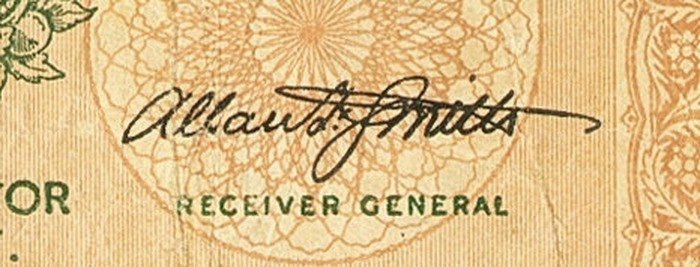
The Colonial Office List for 1921 gives Smith as Receiver General and Gilbert as Treasury Clerk. Heritage's descriptions of 23 April 2020 (lot 28219) and 20 October 2022 (lot 25015) say the note has a printed signature of Smith and a signature of Gilbert written by hand, and Heritage (18 September 2020, lot 28068) describes a note that has Smith's signature alone, adding that only some notes are countersigned.
What the reports counted, 1918 to 1927
The annual reports call the wartime notes "inconvertible". They count 28,000 pounds outstanding in every year recorded from 1918 to 1924, and 38,000 pounds at the end of 1926 and of 1927, out of the 40,000 pounds the law allowed. At the end of 1922 an investment fund of 38,995 pounds nominal value was held as surety for the issue, as the annual report for 1922 has it.
| End of year | Amount | What the reports counted |
|---|---|---|
| 1918 to 1924, every year recorded | 28,000 pounds | the wartime notes outstanding |
| 1926 | 38,000 pounds | the wartime notes outstanding |
| 1927 | 38,000 pounds | the wartime notes outstanding |
| 1929 | 83,000 pounds | the note issue |
| 1930 | 131,223 pounds | the note issue |
| 1931 | 221,289 pounds | the note issue |
The pages hold no figure for 1925 or for 1928.
The small notes of 1920
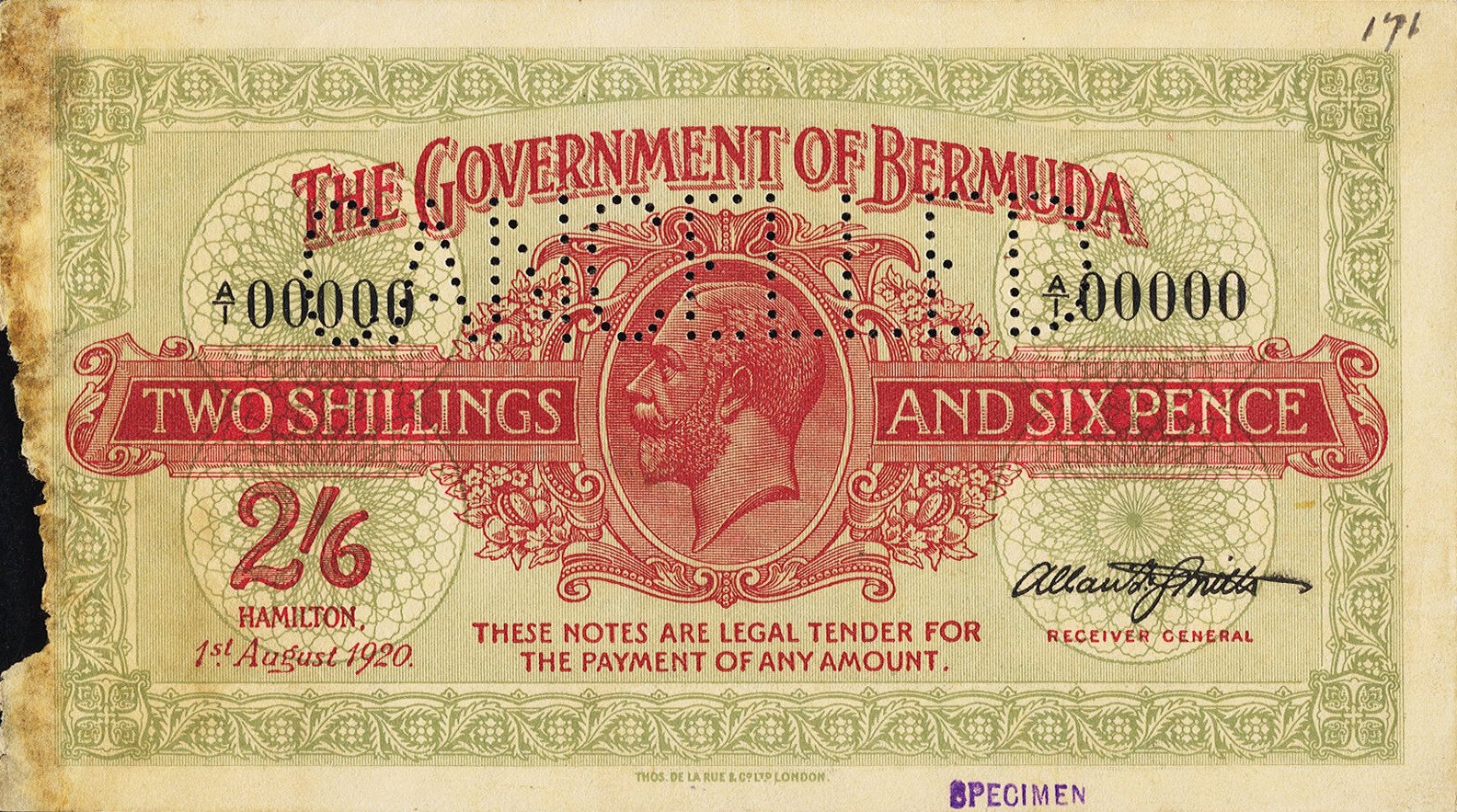
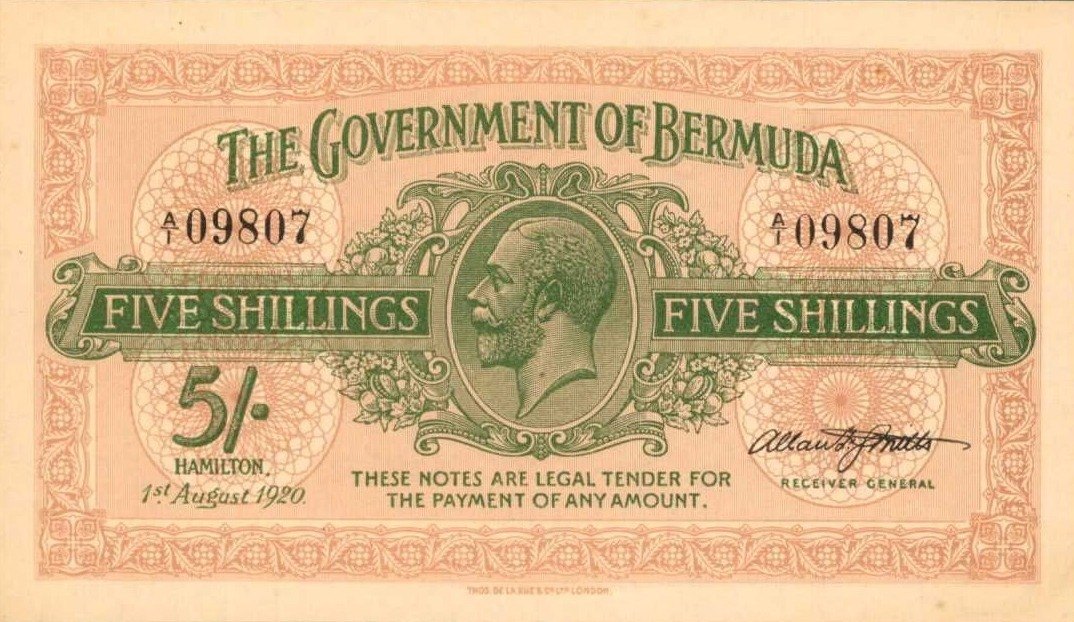
In 1920 a shortage of silver coin threatened. The Government Notes Act of 18th June 1920 (Act No. 16 of 1920) authorised notes of 2 shillings 6 pence and 5 shillings, up to 10,000 pounds of the two values together. Thomas de la Rue printed both, dated 1st August 1920.
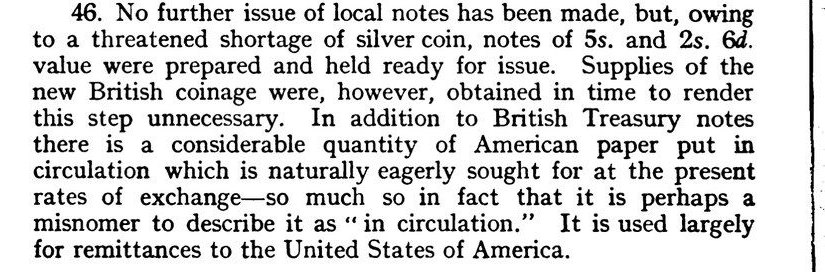
The Colonial Office reports for 1920 and 1921 say the two notes were "prepared and held ready for issue" when the shortage threatened, were not needed once new British coin arrived, and were "still held in reserve" at the end of 1921. The reports do not say where the notes were kept.
Of the 2 shillings 6 pence sources mention that 40,000 notes were printed and sent from the printers at the end of December 1920 but never reached Bermuda. Heritage (9 May 2023, lot 28029) names letters from Thomas de la Rue to the Bermuda Government as the source of the 40,000, but says the notes were shipped to Bermuda and that it is not known whether any were issued, the paper being too thin for a tropical climate. Whether the notes arrived is not settled. The note is known only as a specimen with the prefix A/1. Nelson P. Aspen, writing in Bank Note Reporter in January 1987, found two specimens in colour, with a pale green border and a raspberry-coloured banner bearing the value, on two following pages of the Crown Agents' records, which Aspen examined at the British Library in October 1986.
Of the 5 shillings sources mention that 24,000 notes dated 1st August 1920 were printed, A/1 00001 to A/1 24000, and that they were held back and released only in 1935. The reports agree with this: those for 1932 and 1934 name only 1 pound and 10 shillings notes, and the report for 1935 is the first to name the 5 shillings.
Taken at face value, 24,000 notes of 5 shillings are 6,000 pounds and 40,000 notes of 2 shillings 6 pence are 5,000 pounds. Together that is 11,000 pounds, above the 10,000 pounds of the Act. The pages do not explain the difference.
The Act of 1927 and the Waterlow notes
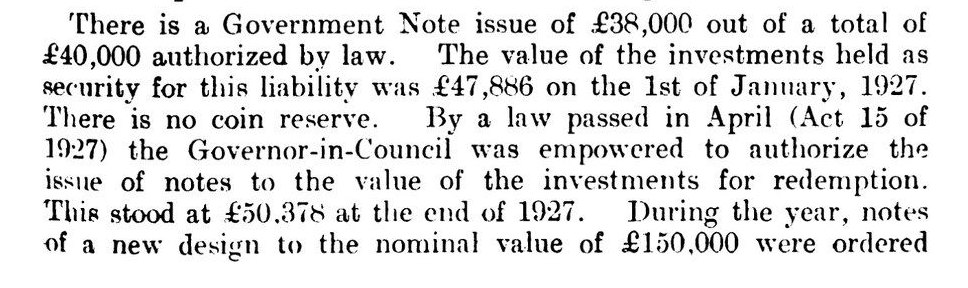
The Government Notes Act of 8th April 1927 allowed notes of a new design. The annual report for 1927 gives it as Act No. 15 of 1927, which let the Governor in Council issue notes up to the value of the investments held to redeem them. The same report says notes of the new design worth 150,000 pounds were ordered in London that year, to replace the wartime stock and to exchange old and defaced notes.
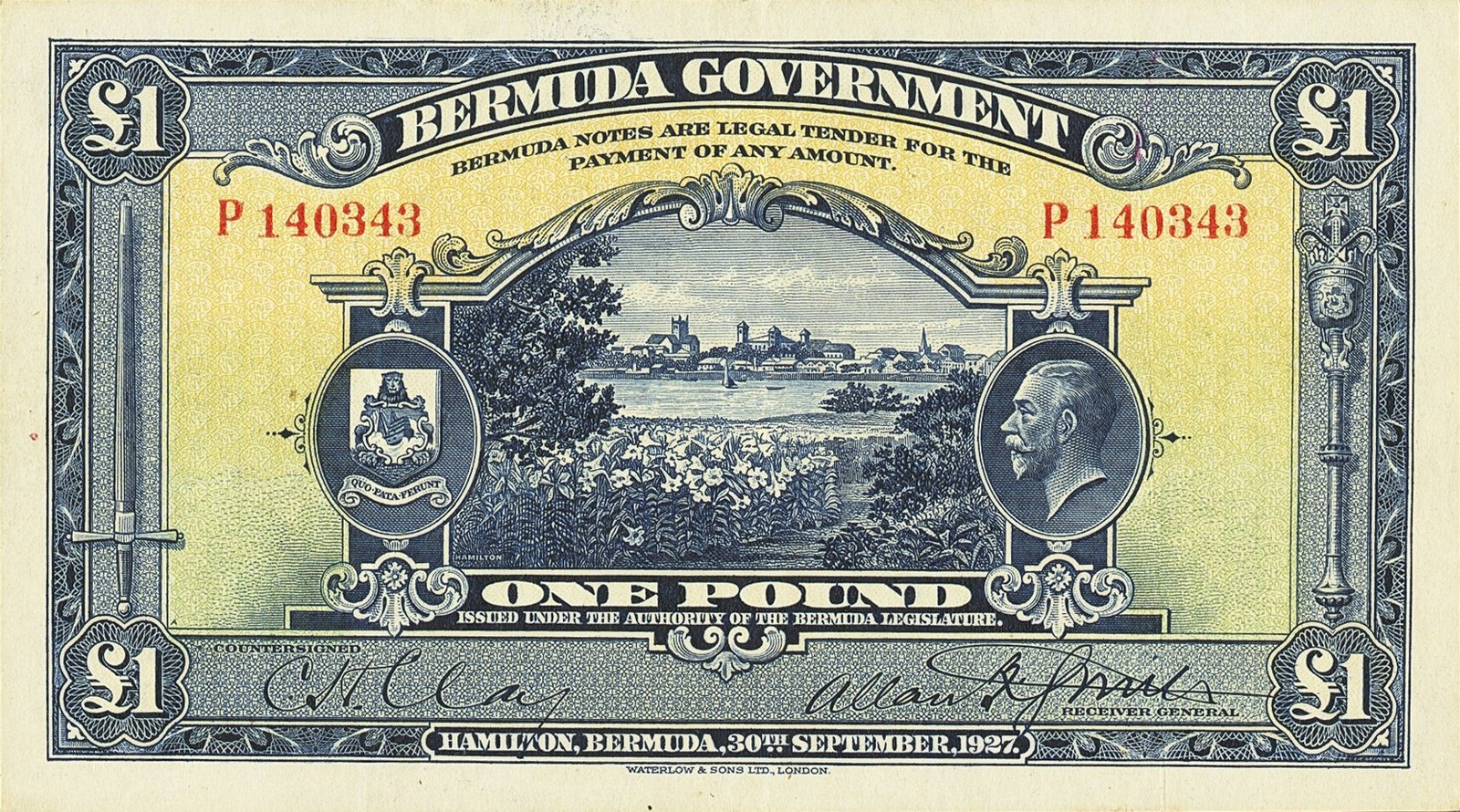
The new notes, the 10 shillings and the 1 pound, are dated 30th September 1927 and were printed by Waterlow and Sons. Clay, who countersigns, is Assistant Treasury Clerk in the Colonial Office List for 1921. Spink's description of lot 12 in its sale of 4 October 2013 gives the signers as C. H. Clay and the Receiver General Allan F. Smith. Heritage (23 April 2020, lot 28222) says the Government had been unhappy with the paper of the 5 shillings and for that reason gave the 1927 notes to Waterlow.
The reports name only 1 pound notes to the end of 1928. The report for 1929 is the first to name the 10 shillings: 43,000 pounds of 1 pound and 10 shillings notes were put out during that year, and the note issue stood at 83,000 pounds at its end. It reached 131,223 pounds at the end of 1930 and 221,289 pounds at the end of 1931.
How many were printed
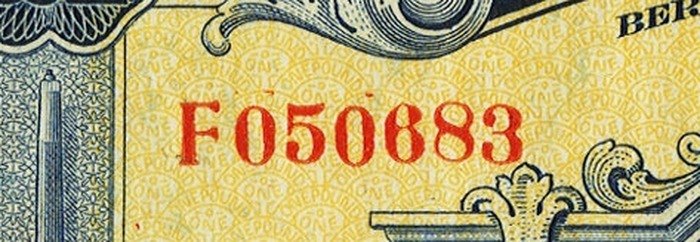
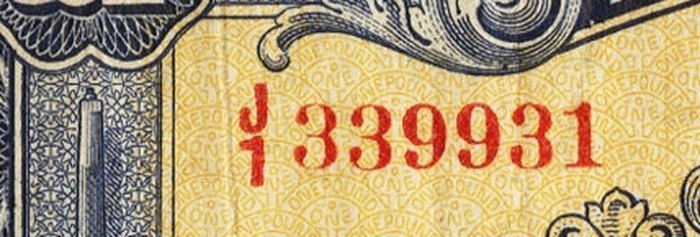
The serial numbers of both values run on from letter to letter, 10,000 numbers to each prefix letter, with no I. Heritage (23 April 2020, lot 28221) says 200,000 notes of the 10 shillings were printed and issued, which is twenty letters, A to U without I, and Heritage (18 September 2020, lot 28070) calls U the final prefix.
For the 1 pound Heritage (27 April 2020, lot 29026) gives 250,000 notes with a single letter, which is the 25 letters A to Z without I. The page of the note has the fractional prefixes starting at A/1 250000 and reaching O/1. Heritage (23 April 2020, lot 28222) says the pound was issued for ten years and came to 450,000 notes in all. Fourteen fractional prefixes of 10,000, A/1 to O/1 without I, would end near 390,000, so the house's total and the prefixes on the page do not agree.
The Currency Commissioners and the 5 shillings of 1935
From 1930 the notes were issued by three Bermuda Currency Commissioners, one of them the Colonial Treasurer, under the Bermuda Currency Notes Act of 23rd July 1930. Each new value now needed an Act of its own. The Act of 8th November 1935 approved the 5 shillings, and 1935 is the year given in brackets for the second 5 shillings, which carries no date.
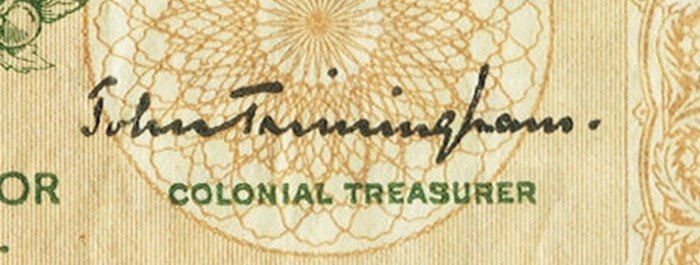
Sources mention that 40,000 notes numbered from B/1 24000 to B/1 64000 were then ordered, first to be dated 5th February 1936. In March 1936 the date was dropped, the notes were printed from 1st April 1936 and they were issued after May 1936. The title under the signature changed with them: RECEIVER GENERAL under Smith's signature on the notes of 1920, COLONIAL TREASURER under Trimingham's on the notes without a date. Trimingham is Colonial Treasurer and Registrar of Shipping in the Colonial Office List for 1937.
The first number of the B/1 notes is not settled. Heritage (18 September 2020, lot 28069), citing Bradbury Wilkinson records, gives 24001 to 64000, which makes exactly 40,000 notes and follows on from the last 1920 number. The same description names Bradbury Wilkinson's records for a note that the catalogue gives to Thomas de la Rue, and Heritage's description of 23 April 2020 (lot 28220) names Thomas De La Rue as the printer. Which firm's records hold the order is not known here.
Sources
- Colonial Office annual reports on Bermuda for 1918 to 1924, 1926, 1927, 1929, 1930, 1931, 1932, 1934 and 1935, as the catalogue pages cite them.
- Blue Books of Bermuda for 1918, 1920 and 1921.
- The Colonial Office List for 1921 and for 1937.
- Nelson P. Aspen in Bank Note Reporter, January 1987.
- Heritage, 23 April 2020, lots 28219, 28220, 28221 and 28222; 27 April 2020, lot 29026; 18 September 2020, lots 28068, 28069 and 28070; 20 October 2022, lot 25015; 9 May 2023, lot 28029.
- Spink, 4 October 2013, lot 12.
- London Coins, 3 June 2019, lot 862.


Member comments
Log in or register to post a comment.