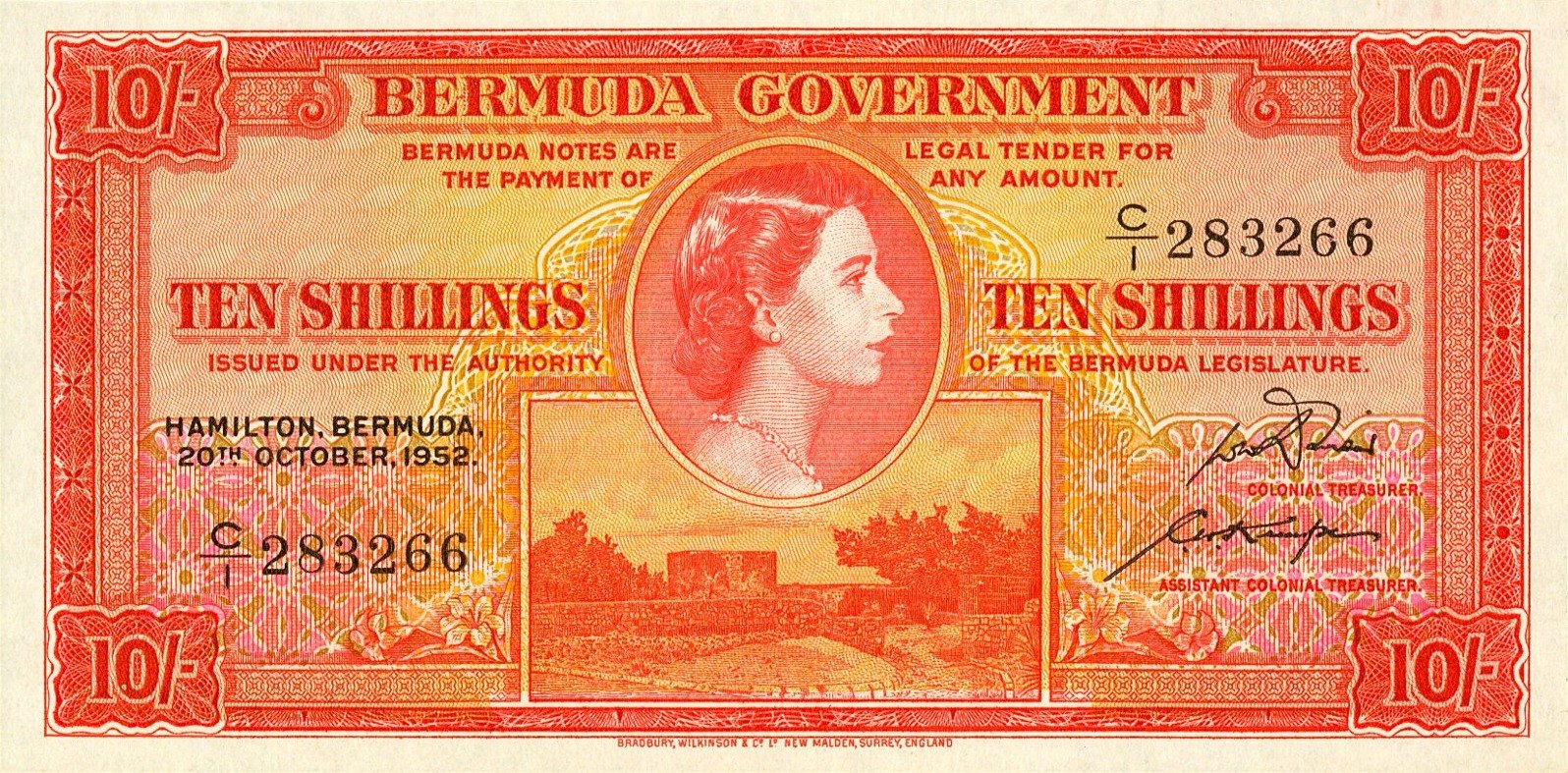
The pages of the Bermuda notes name the signers of each date. This article sets out who those officers were and when they held office, as the Colonial Office Lists, the Bermuda staff lists and the Bermuda Blue Books record it, and adds what collectors who knew some of them wrote down. Every List was read in machine text only; the Blue Book entries read on the image of the printed page are said to be so.
The offices
Until 1930 the notes were the business of the Receiver General, the head of the Treasury, with a Treasury Clerk and an Assistant Treasury Clerk under that office. The Government Notes Acts of 1915 and 1920 name the Receiver General as the officer who issues the notes, as The law behind Bermuda's notes, 1915 to 1969 sets out.
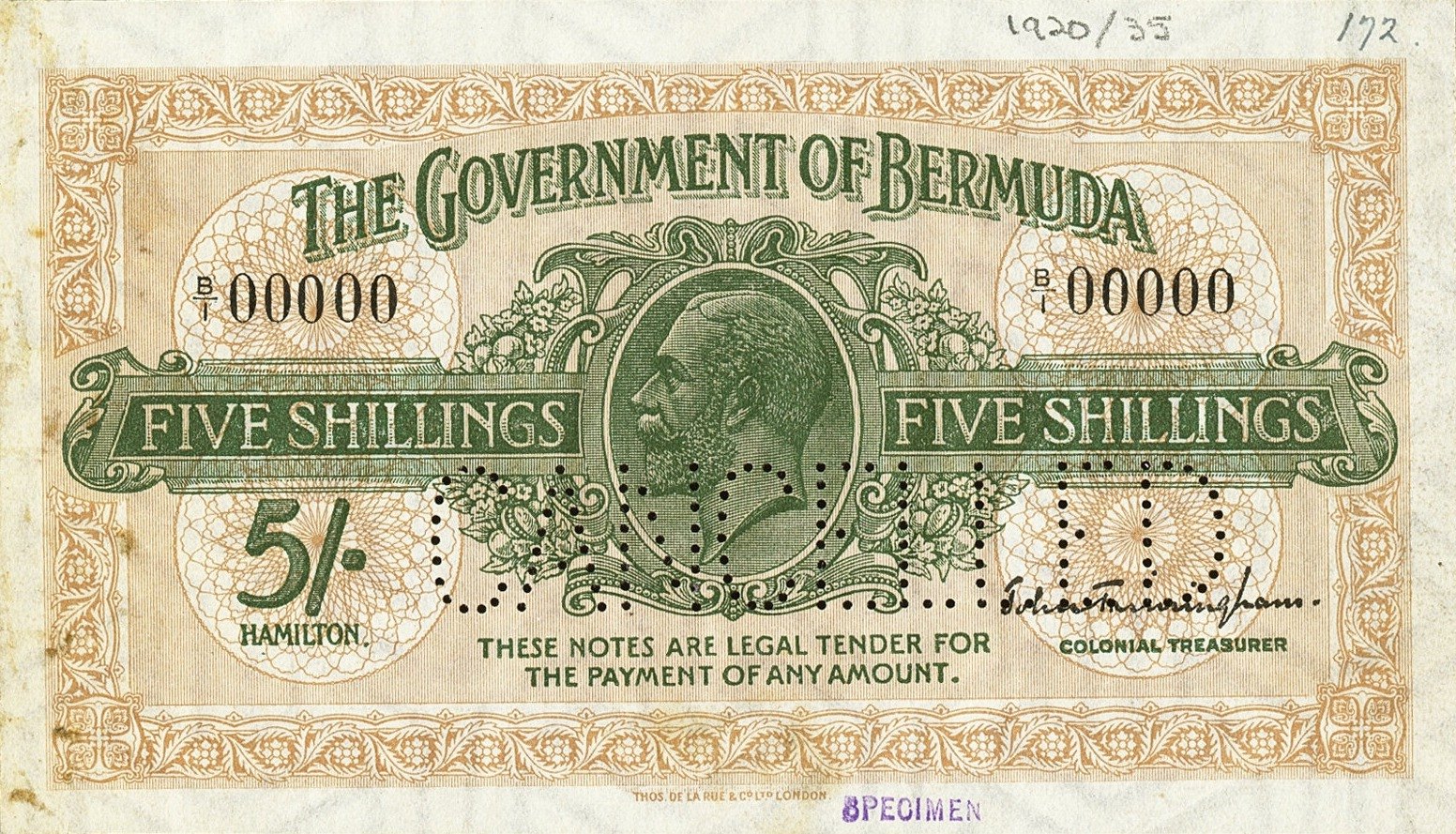
The title changed in 1930 and 1931. The Colonial Office List for 1930 gives John T. Trimingham as "Receiver General and Registrar of Shipping"; every List from 1931 to 1940 gives the same officer as "Colonial Treasurer and Registrar of Shipping". The notes follow the change. The 5 shillings dated 1st August 1920 carries RECEIVER GENERAL under the signature of Smith, and the undated 5 shillings of 1935 carries COLONIAL TREASURER under the signature of Trimingham. From then on every sterling note is signed by the Colonial Treasurer and the Assistant Colonial Treasurer, and on the notes of 1966 by the Deputy Colonial Treasurer.
The signers in the records
| Officer | Office on the notes | Term of office as the records give it | Notes signed |
|---|---|---|---|
| Allan Frith Smith | Receiver General | Receiver General from 1908; earlier a clerk in the Post Office from 1879, assistant colonial secretary 1895, colonial postmaster 1896, and acting Colonial Secretary July to August 1899 and May 1900 to July 1901 (Record of Services, Colonial Office Lists for 1923 and 1927). The List for 1928 shows the post vacant. | the 1 pound of 1914, the 5 shillings of 1920, the 10 shillings and 1 pound of 1927 |
| J. T. Gilbert | Treasury Clerk | Treasury Clerk in the Bermuda staff lists of 1915 to 1921, marked "On Active Service" in 1918 | countersigns the 1 pound of 1914 |
| Charles Herbert Lyndon Clay | Assistant Treasury Clerk | Assistant Treasury Clerk in the staff lists of 1915 to 1920; 1st Clerk, Revenue Department, in 1928; Clerk of the Executive Council in 1933 | countersigns the 10 shillings and 1 pound of 1927 |
| John T. Trimingham | Colonial Treasurer | Clerk of the Executive Council in the Lists of 1925 and 1928; Receiver General and Registrar of Shipping in 1930; Colonial Treasurer and Registrar of Shipping in every List from 1931 to 1940 | the 5 shillings of 1935, the notes of 1937 and the 5 pounds of 1941 |
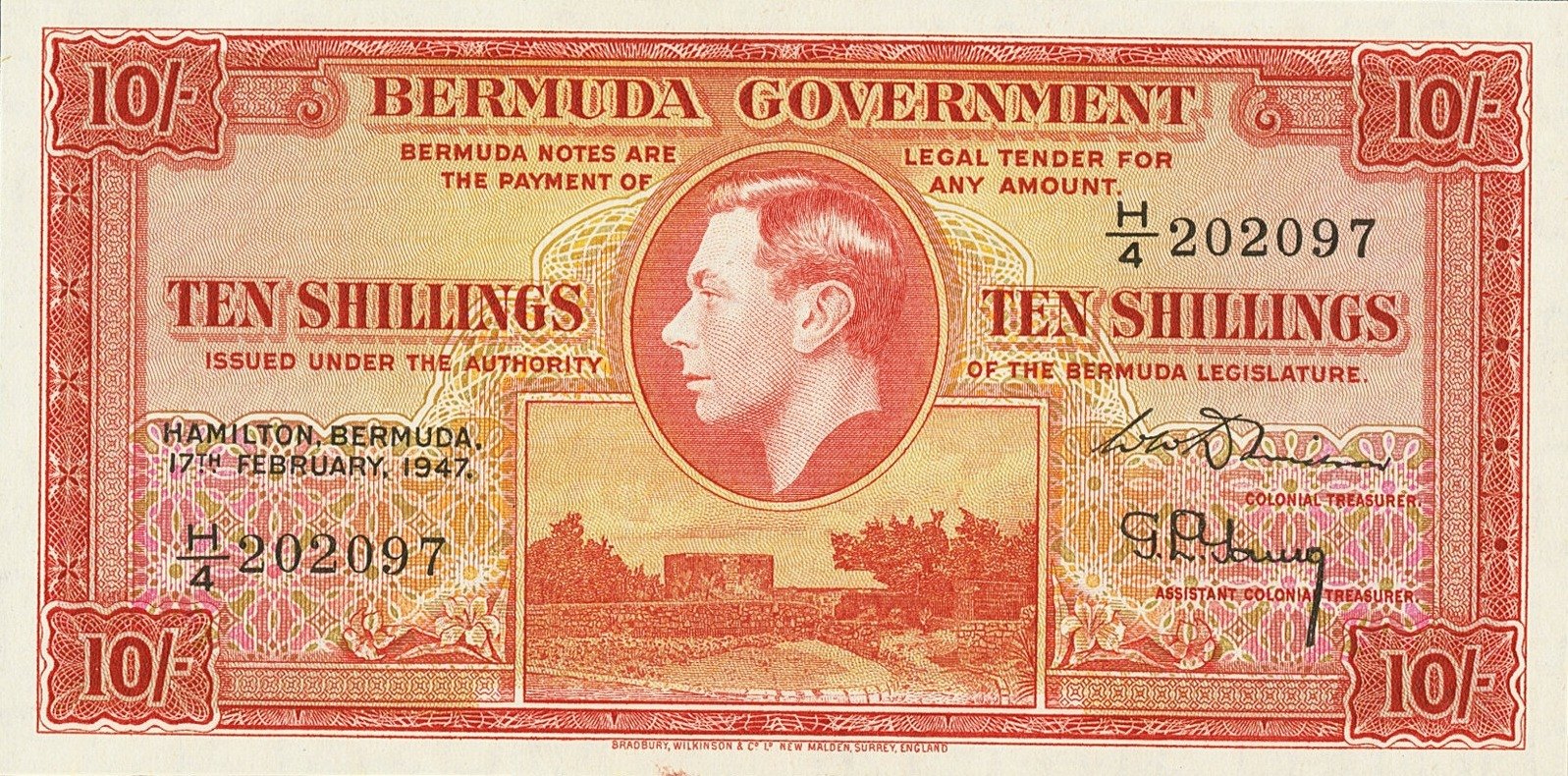
| Gerald LeRoy Young | Assistant Colonial Treasurer | present appointment 16th April 1930 (Blue Book for 1946, read on the page image), first appointment 1st January 1922 (the same Blue Book, text only); acting Treasurer 25th November 1943 to 24th February 1944 (Blue Book for 1944); clerk 1917, Assistant Colonial Treasurer 1930, Auditor 1952 (Record of Services, List for 1956) | the notes of 1937, 1941 and 1947, and the specimens of 1943 |
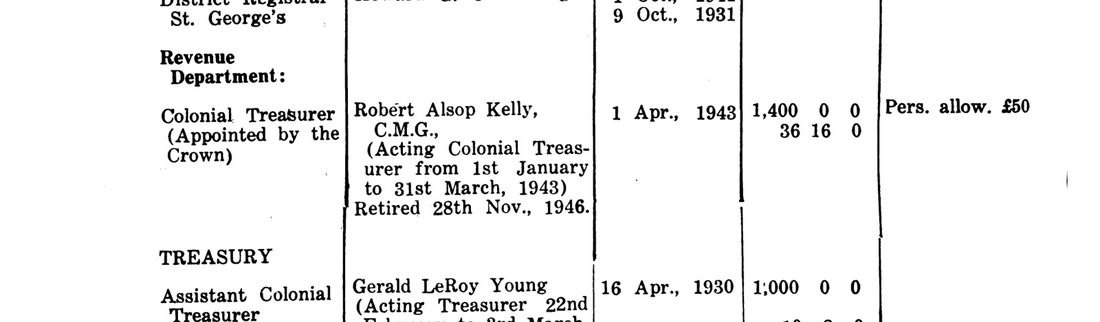
| Robert Alsop Kelly, C.M.G. | Colonial Treasurer | acting Colonial Treasurer 1st January to 31st March 1943; Colonial Treasurer from 1st April 1943, appointed by the Crown; retired 28th November 1946 (Blue Book for 1946, read on the page image; Blue Book for 1944); Colonial Treasurer in the List for 1946 | the specimens dated 1st April 1943 only |
| William West Davidson | Colonial Treasurer | revenue officer 1935, assistant colonial secretary 1941, Colonial Treasurer 1947 (Record of Services, List for 1965); Colonial Treasurer in every List from 1948 to 1965 | the notes of 1947, 1952, 1957, 1964 and 1966 |
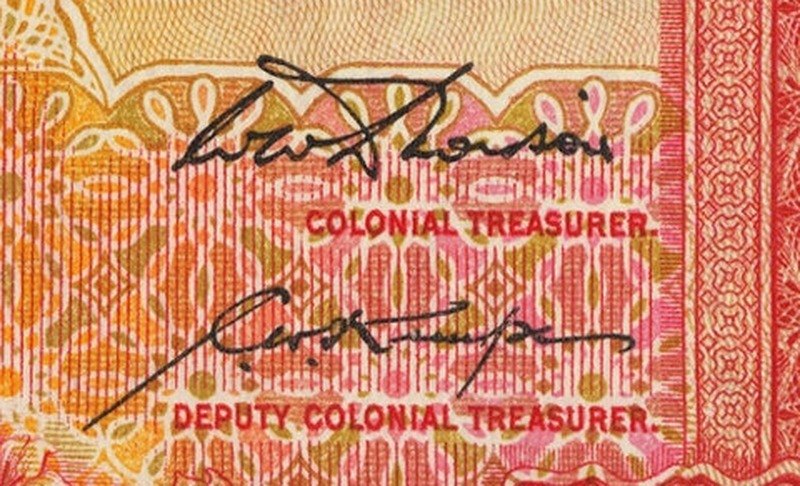
| Charles Winston Kempe | Assistant, then Deputy Colonial Treasurer | collector of customs 1951, Assistant Colonial Treasurer 1952, Colonial Auditor 1957 (Record of Services, List for 1965) | the notes of 1952 and 1966 |
| Ernest Frederick E. Lumsden | Assistant Colonial Treasurer | Assistant Colonial Treasurer in the staff lists of 1958 to 1960 | the notes of 1957 and the 10 pounds of 1964 |
The notes these officers signed are, by date: the 1 pound of 1914; the 5 shillings of 1920 and 1935; the 10 shillings and 1 pound of 1927; the 1937 issue, among them the 5 shillings and 1 pound; the 5 pounds of 1941; the 1947 issue, among them the 5 shillings and 1 pound; and the Elizabeth II issue, the 5 shillings, 10 shillings, 1 pound, 5 pounds and 10 pounds.
Two things in the table touch the notes. Smith's name is on the notes dated 30th September 1927, and the List for 1928 already shows the post of Receiver General vacant. And Gilbert, who countersigns the 1 pound of 1914, is marked "On Active Service" in the staff list of 1918; Heritage's descriptions of the note (23 April 2020, lot 28219; 18 September 2020, lot 28068) say that Smith's signature is printed and Gilbert's written by hand, and that only some notes are countersigned.

Before the notes
The office of Receiver General is older than the notes. The Colonial Office List for 1913 gives Francis William Major as Receiver General of Bermuda from June 1899, and by then as Chief of Customs of the East Africa Protectorate, from 9th April 1908 as the Protectorate's Blue Book for 1913-14 has it, and a Currency Commissioner there in 1912. Major's name stands on no Bermuda note: the annual report for 1912 knows no local notes, only some Bank of England notes and, in winter, United States notes.
The case of R. A. Kelly, 1943
Bradbury Wilkinson printed a 10 shillings and a 1 pound dated 1st April 1943 and signed by Kelly as Colonial Treasurer and Young as Assistant Colonial Treasurer. They are known only as specimens. Bermuda's notes in the war years, 1939 to 1943 gives the accounts of the auction houses. The records add the following.
The Blue Book for 1946 sets out the appointment in its return of the Revenue Department: Robert Alsop Kelly, C.M.G., Colonial Treasurer, appointed by the Crown on 1st April 1943, acting Colonial Treasurer from 1st January to 31st March 1943, "Retired 28th Nov., 1946". The entry was read on the image of the page. The date on the specimens is the first day of the substantive appointment.
Nelson Page Aspen told the story of the notes in the IBNS Journal in 2000 (vol. 39 no. 2, "The Thrill of Discovery", pp. 39 and 40), from the memory of C. W. Kemp, who had served in the Treasury. As Aspen gives it, the Bermuda Government brought Kelly from London on secondment as Colonial Treasurer instead of promoting Young; Kelly stayed about three years and went back to England, and no circulating note carried the signature. Aspen adds that the notes were ordered from Bradbury Wilkinson but never delivered, "and probably never printed", apart from a few specimens, and that with no range specimen known the size of the order cannot be told. Aspen's three years agree with the Blue Books; the story that Kelly died before taking up the post, which Spink's description of lot 149 in its sale of 17th April 2019 tells, does not.
The same article prints a short career of Kelly, as Aspen had it: born 8th March 1881; C.M.G. 1935; Deputy Treasurer of Northern Rhodesia 1911 to 1929; Treasurer and Currency Officer of the Gold Coast 1929 to 1936; retired in 1936; recalled in the war as Treasurer of Grenada in 1940; acting Colonial Secretary from May 1940 to 1941. None of this was checked against a Colonial Office List for this article.
Why the notes were not issued, when the officer whose name they carry held the post from 1st April 1943 to 28th November 1946, is still not known. Aspen's article suggests a reason for the order rather than for its fate: more 10 shillings notes were wanted in the war, "apparently" to take in United States dollars from servicemen and tourists.
What the records leave open
Young's later years. Aspen's article of 2000 says that Young died before the next issue of 1952 and never became Colonial Treasurer, and that Kemp became Assistant Colonial Treasurer after Young's death. The Record of Services in the Colonial Office List for 1956 gives Young as Auditor in 1952. The two cannot both stand as they are read; the List was read in machine text only.
Young's first appointment. The Blue Book for 1946 gives 1st January 1922; the List for 1956 gives Young as a clerk in 1917. The two may count different posts.
Kempe's title in 1966. The Lists give Kempe as Colonial Auditor from 1957, yet the notes of 1st October 1966 print DEPUTY COLONIAL TREASURER under the signature. The List for 1966 was not read. Aspen spells the name Kemp; the notes and the catalogue spell it Kempe.
The other Commissioners. The Bermuda Currency Notes Act of 1930 put the issue in the hands of three Bermuda Currency Commissioners, one of them the Colonial Treasurer. An Economic Survey of the Colonial Territories, 1951, says the notes "are issued by the Bermuda Currency Commissioners". No record read names the other two Commissioners, and the notes carry only the two Treasury signatures.
After 1970: the Authority's officers
The Bermuda Monetary Authority Act of 1969 made the Financial Secretary Chairman of the Authority's Board, with the Controller of Foreign Exchange, the Managing Director and three others. The first dollar notes of 6th February 1970 are signed by the Member of Executive Council for Finance and the Chairman of the Authority. Aspen's pieces in Bank Note Reporter and the IBNS Journal name several of the people behind the later signatures:
| Year | Officer, as Aspen names them | Source |
|---|---|---|
| 1979 | Dudley St George Butterfield, Chairman; Alan J. Humphryes, Managing Director, "from the Bank of England" | IBNS Journal 41:1 (2002), "Love Affair", p. 46 |
| late 1980 | Fred Yearwood becomes Chairman; Merlyn Trued Managing Director | the same |
| 1985 | J. David Gibbons, Chairman, knighted in the New Year's list; Stephen J. Flett, acting Managing Director; Lucelle Cooke to take the post of Manager; Adrian Bernard leaving the post of managing director, accounting, and Robert Pires in Bernard's place | Bank Note Reporter, August 1985, "New names, new positions appear on Bermuda notes" |
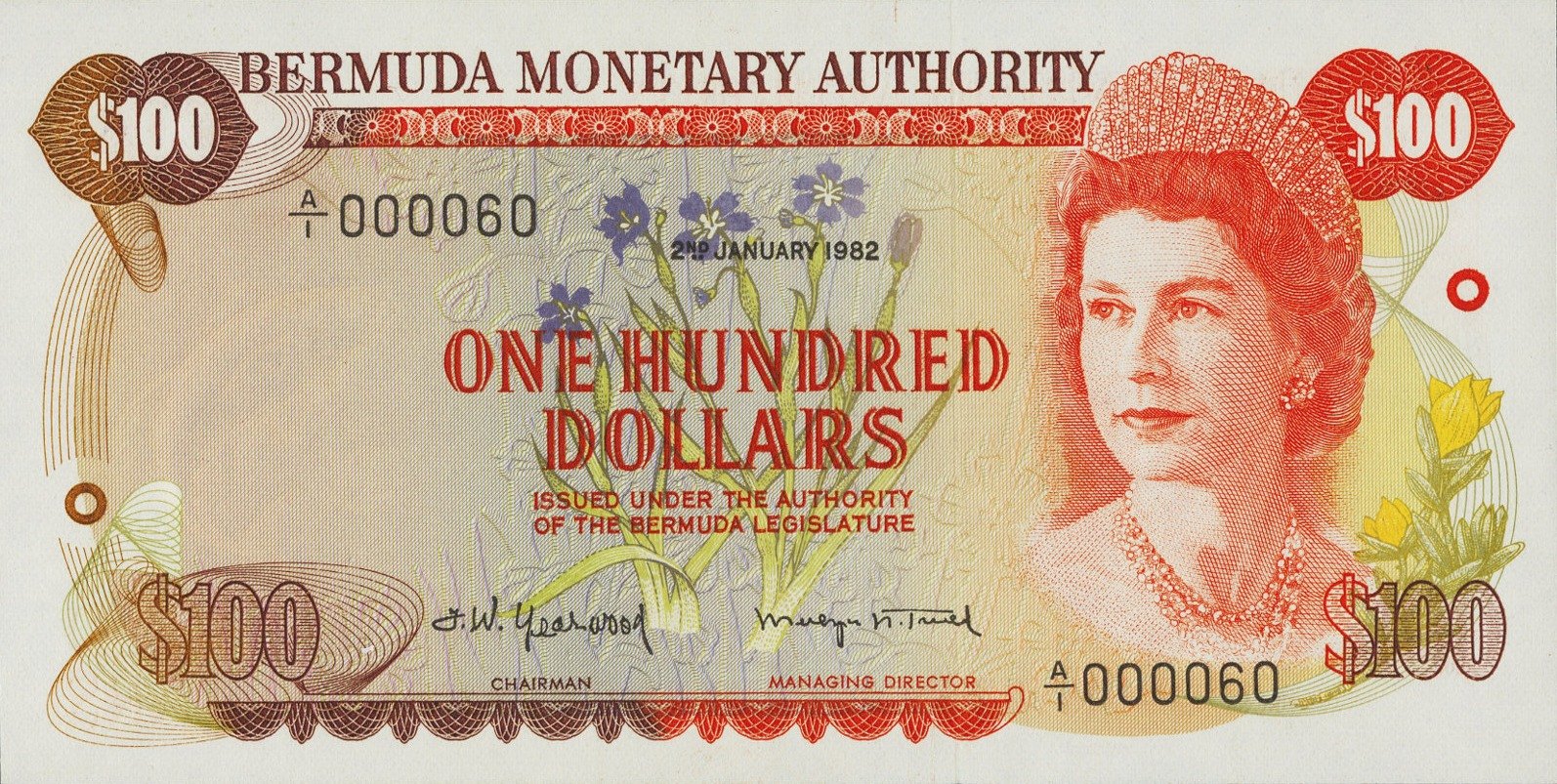
These names meet the notes. The 1 dollar page lists J. David Gibbons as Chairman, once with the signature in initials, and Stephen J. Flett beside Gibbons on the notes of 1st May 1984; the 100 dollars of 1982 pictured in Bank Note Reporter in December 2001 is signed by Yearwood and Trued; and the same 100 dollars dated 14th November 1984 carries the signature of Cooke under the new title. The first wave's The Bermuda Monetary Authority and its notes, 1969 to 1989 gives the titles on each date.
In October 1985, writing of a tour of the Authority for members of the American Numismatic Association, Aspen introduced a member of the Authority's staff as a great-grandchild of the Receiver General who had signed most of the early notes.
Sources
- Colonial Office Lists: Bermuda staff lists of 1915 to 1965, and the Records of Services in the Lists for 1913, 1923, 1927, 1956 and 1965; the List for 1946.
- Blue Book of the East Africa Protectorate for 1913-14.
- Colonial Reports, Annual: Bermuda for 1912.
- Bermuda Blue Books for 1944 and 1946, Civil Establishment and Revenue Department.
- An Economic Survey of the Colonial Territories, 1951, vol. IV, p. 51.
- Nelson Page Aspen, "The Thrill of Discovery", IBNS Journal, vol. 39 no. 2 (2000), pp. 39 and 40.
- Nelson P. Aspen, "Love Affair", IBNS Journal, vol. 41 no. 1 (2002), p. 46.
- Nelson Page Aspen, "New names, new positions appear on Bermuda notes", Bank Note Reporter, August 1985; "Numismatic fun in Bermuda's sun", Bank Note Reporter, October 1985, p. 29.
- Joel Shafer in Bank Note Reporter, December 2001, p. 82.
- Heritage, 23 April 2020, lot 28219; 18 September 2020, lot 28068. Spink, 17 April 2019, lot 149.
- The Bermuda Currency Notes Act, 1930, and the Bermuda Monetary Authority Act, 1969, as held in the Johns Hopkins archive of currency boards.


Member comments
Log in or register to post a comment.