Between 1939 and 1943 Bradbury Wilkinson printed three groups of notes for Bermuda that did not last or never came out at all. This article sets out what the catalogue pages, the Blue Books and the auction houses say about each of them, and where those sources disagree.
The small notes of 1939
The 1 shilling and the 2 shillings 6 pence were proposed to relieve a wartime shortage of coin and were approved by the Bermuda Currency Notes Act of 24th August 1939. Both are printed on the front only, with a blank back, and the 2 shillings 6 pence carries no signature. Heritage (9 May 2023, lot 28032) adds that the notes have no printer's imprint either.
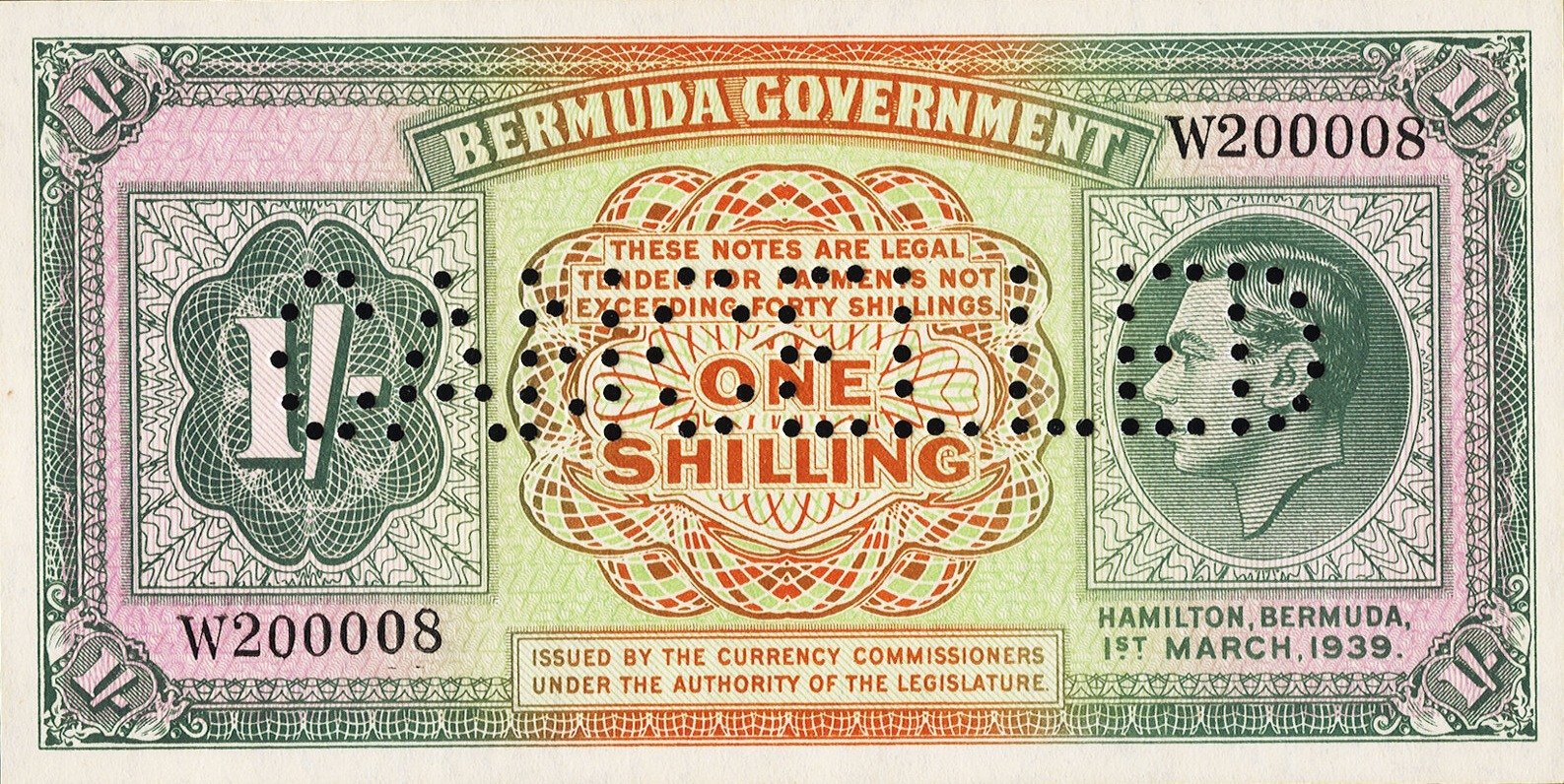
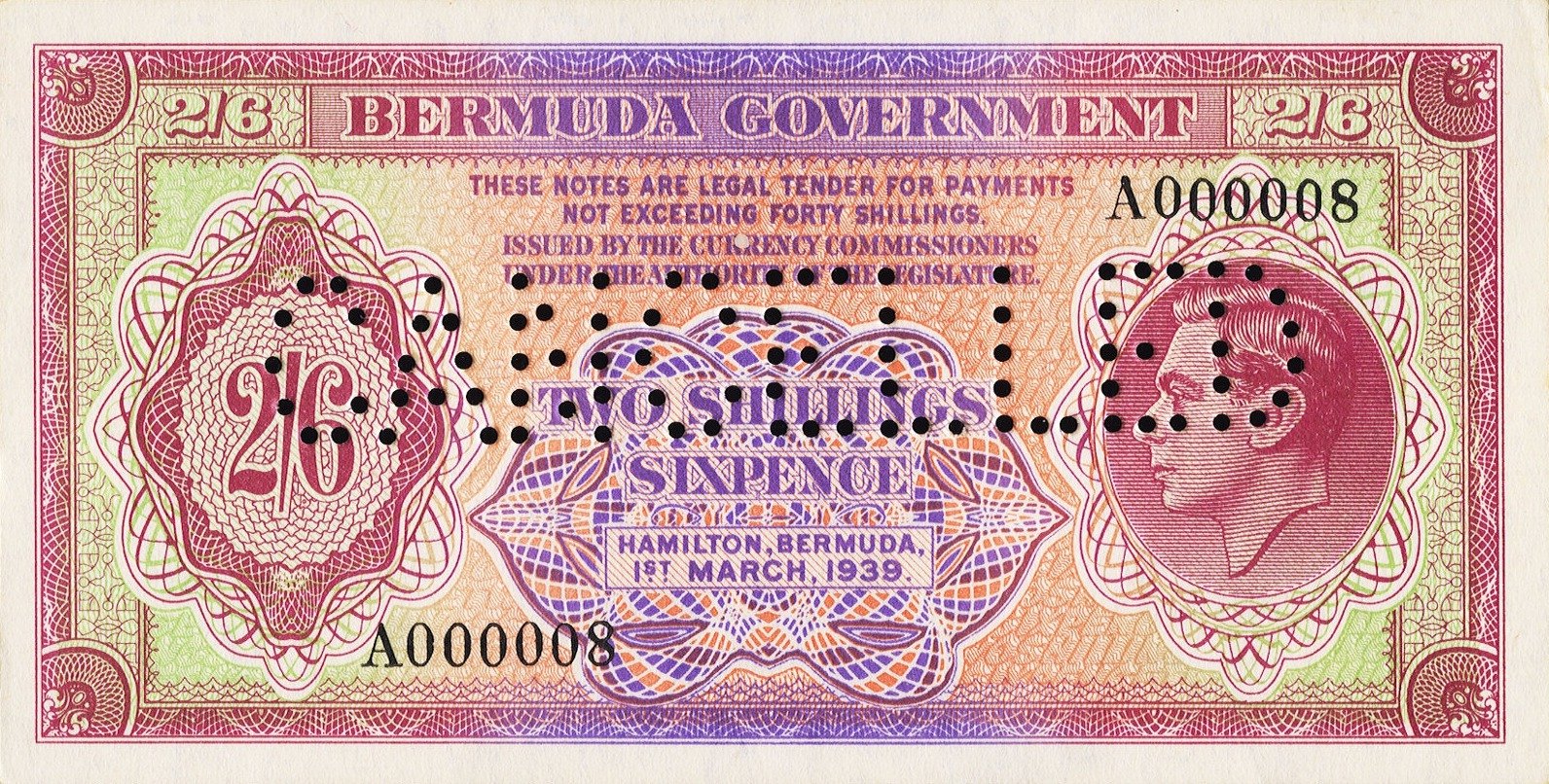
The notes were delivered in 1939, but the expected shortage never came. None of the 300,000 one shilling and 240,000 two shillings and sixpence notes was issued, and the whole stock was later destroyed, except for 11 sets. Heritage (9 May 2023, lot 28033) gives the same two printings and says the Bermuda Legislature had authorised the notes as a precaution.
The date on the notes, 1st March 1939, is nearly six months earlier than the Act. The pages do not explain this. The printer's archival photographs of both values, listed with the varieties, are dated June 1939.
What survives are specimens and proofs:
- of the 1 shilling, a specimen marked with the serial number range A 000001 to F/1 300000, and others with the normal serial numbers W 200001, W 200004 and W 200008;
- of the 2 shillings 6 pence, specimens with a low serial number and a 15-mm tall CANCELLED perforation (A 000004, A 000007, A 000008), and the printer's range specimen A 000001 to Z 240000 with a 5-mm tall CANCELLED perforation;
- of the 2 shillings 6 pence, a front intaglio proof and a front underprint proof on watermarked paper, and an uncut vertical pair of partial front proofs.
The two ranges fit the numbering of the 1937 notes, ten thousand to a prefix with I and O left out: 24 single letters make the 240,000 of the higher value, and six fractional prefixes more, A/1 to F/1, make the 300,000 of the 1 shilling.
Green to red: the 10 shillings of 1937
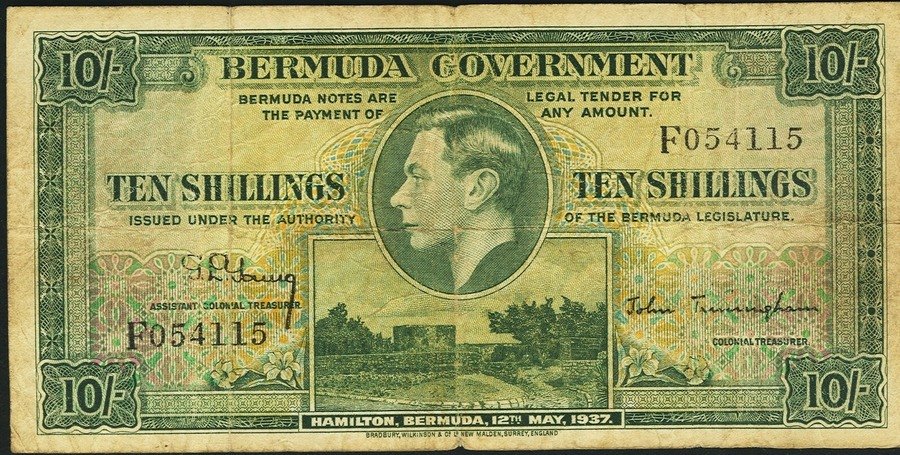
The notes dated 12th May 1937 went on being printed in these years, and one of them changed colour. The 10 shillings was first printed in green (P-9) and then in red (P-10). Sources mention that the green was changed to red because the note was hard to tell from others. The printer's range specimen A 000001 to K 100000 covers the whole green printing, and the red range specimens continue from L 100001. A die proof of the 10 shillings carries the typed date 12.7.38 in its top margin.
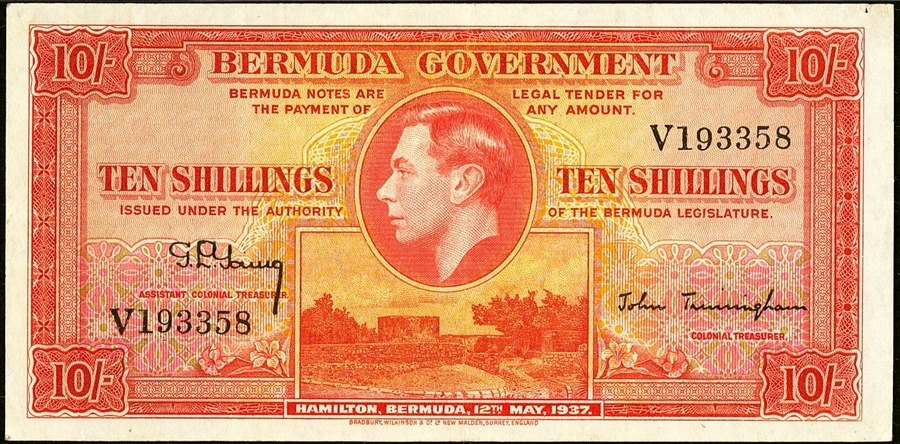
The printer's range specimens of the 5 shillings give the order of the printings; the last of them, W/4 160001 to F/5 260000, was approved in 1943.
The brown five pounds of 1941
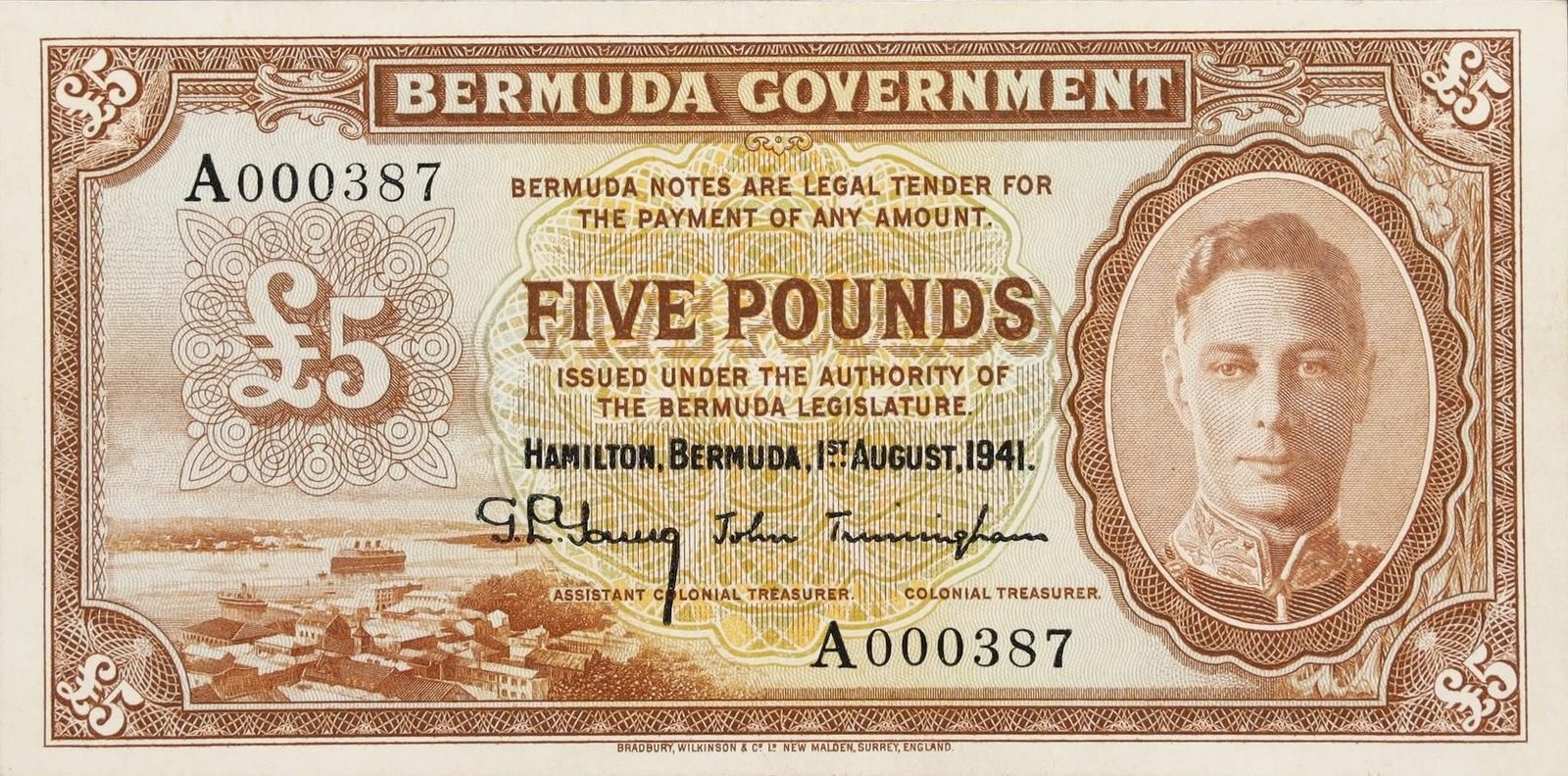
The 5 pounds was approved by the Bermuda Currency Notes Act of 18th June 1941 and is dated 1st August 1941. It was printed first in brown (P-12) and then in orange (P-13), with the same design, date and signatures. The change comes inside the E prefix: the printer's specimens run A 000001 to E 045000 in brown, then E 045001 to N 125000 and N 125001 to Q 145000 in orange.
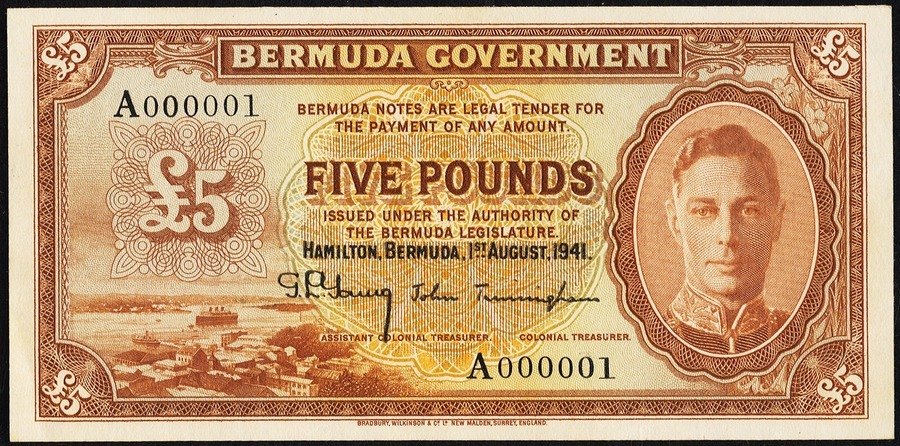
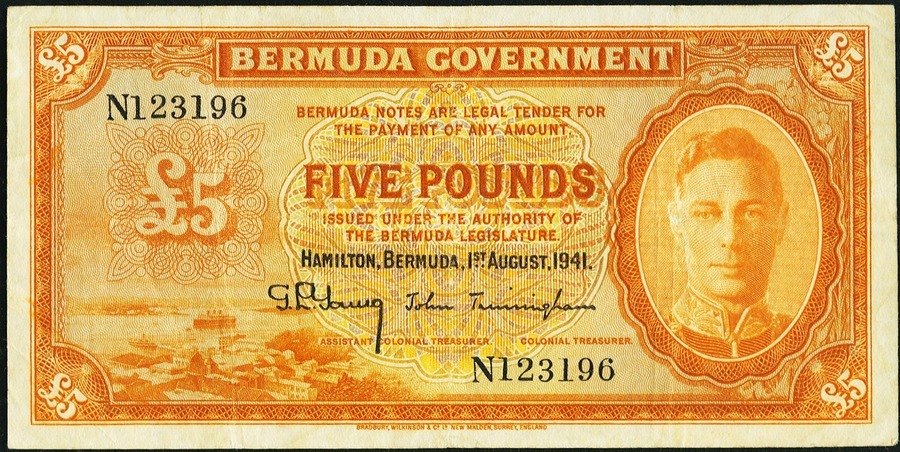
Each house tells the story a little differently.
- Spink (4 October 2013, lot 37) says the brown note was called the "Brownie" and was not a success because it was too easily mistaken for a smaller note, also brown. 45,000 were printed and withdrawn, and the orange five pounds, the "Canary", replaced it. The specimen in that lot has the ink note "approved 10/11/41".
- Heritage (9 May 2023, lot 28035) gives 45,000 as the number issued and adds that the orange notes were delivered in 1943 after complaints from the public.
- Stack's Bowers (8 May 2025, lot 50040), citing page 76 of Nelson Page Aspen's book on Bermuda's paper money, says the brown note first went into circulation in 1942 and that a delivery of orange notes reached Bermuda in February 1943. The house repeats Aspen's account of shoppers who showed the brown five pounds while buying and then handed over the brown 5 shillings, taking change for the larger note.
- Heritage (23 April 2020, lot 28225) says 100,000 orange notes were issued with the 1941 date.
The figures agree with the printer's specimens: A 000001 to E 045000 is 45,000 notes, and E 045001 to Q 145000 is 100,000.
The houses do not agree on which smaller note caused the trouble. Spink names the 10 shillings; Heritage and Stack's Bowers, both following Aspen, name the 5 shillings. The photographs on the catalogue pages settle it for the 5 shillings: the 1937 5 shillings is brown, while the 10 shillings is green or red.
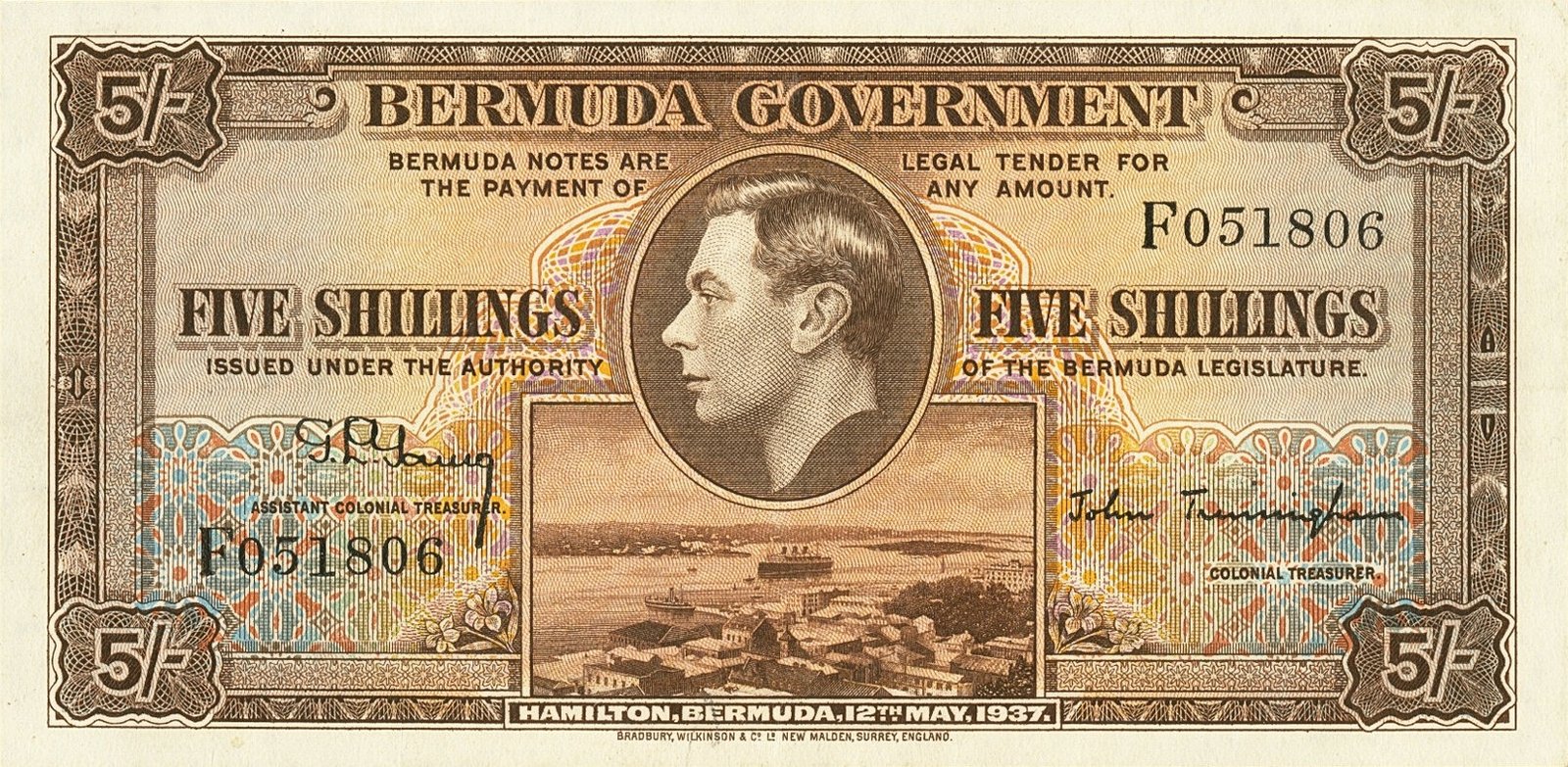
The signers of the 1937 and 1941 notes are named from two lists. Trimingham is Colonial Treasurer and Registrar of Shipping in the Colonial Office List for 1937, and the Blue Book for 1946 dates Young's appointment as Assistant Colonial Treasurer from 16th April 1930. Spink's description of lot 37 places the signature of the Assistant Colonial Treasurer G. L. Young at left and that of the Colonial Treasurer John Trimingham at right.
The Kelly notes of 1943
In 1943, when John Trimingham left the post of Colonial Treasurer, it was proposed to appoint Robert Alsop Kelly instead of Gerald Leroy Young, who had been expected to be promoted from Assistant Colonial Treasurer. Bradbury Wilkinson accordingly produced a 10 shillings and a 1 pound bearing Kelly's signature and the date 1st April 1943.
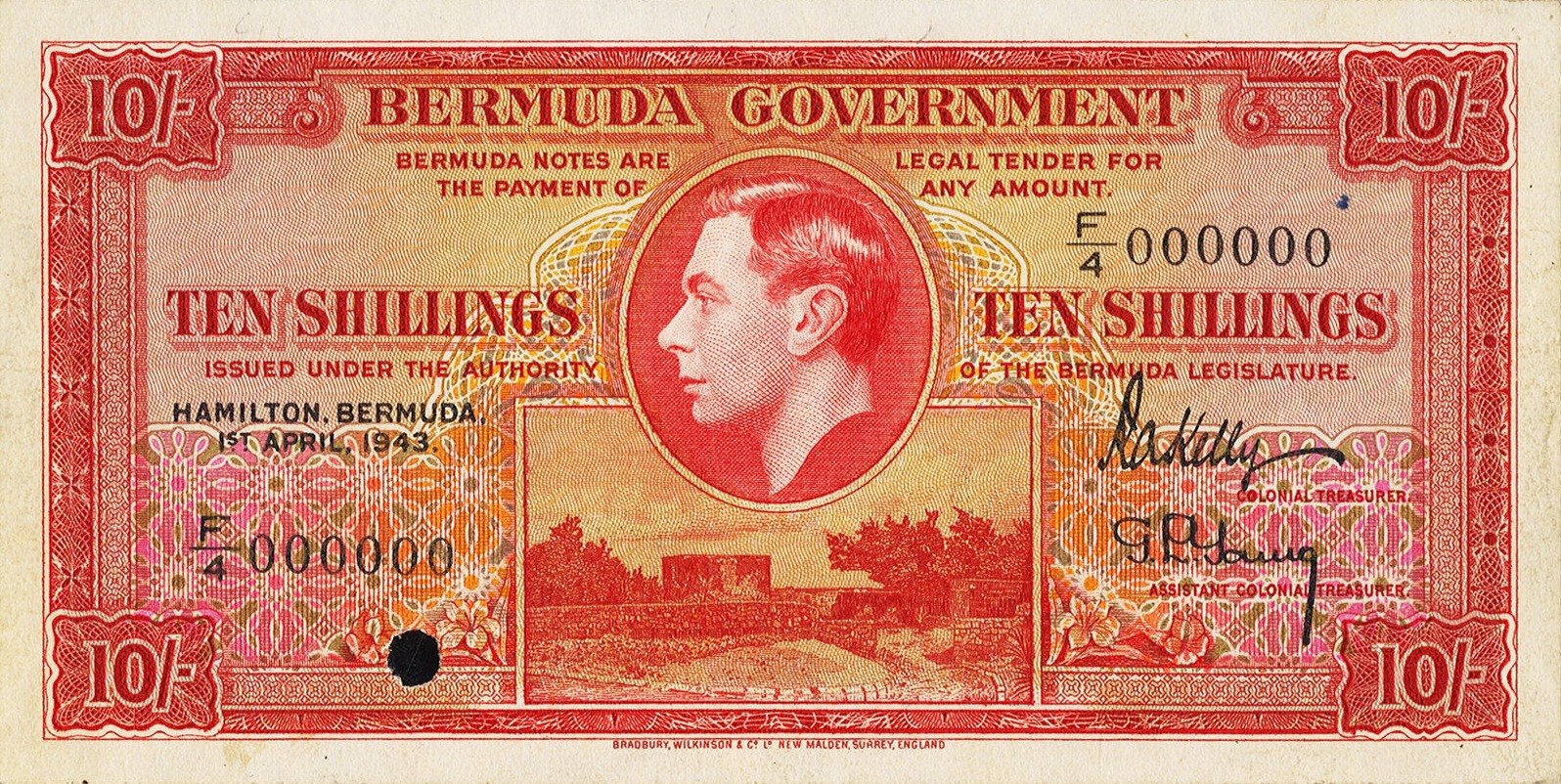
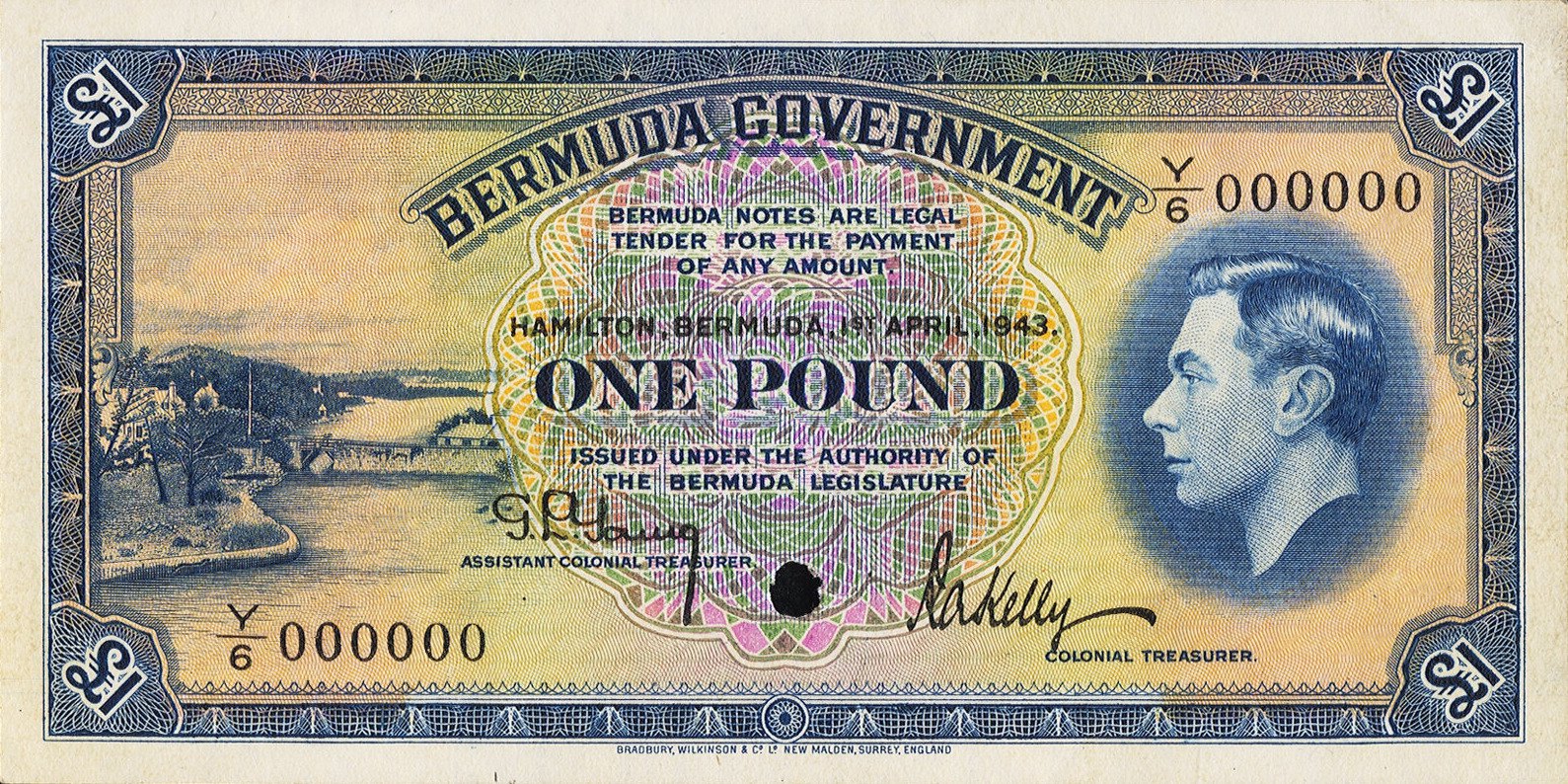
Kelly did take up the post. The Blue Books for 1944 and 1946 show Kelly as acting Colonial Treasurer from 1st January to 31st March 1943 and as Colonial Treasurer from 1st April 1943 until retirement on 28th November 1946. The date on the notes is the day the appointment began. Why the notes with this signature were never issued is not known.
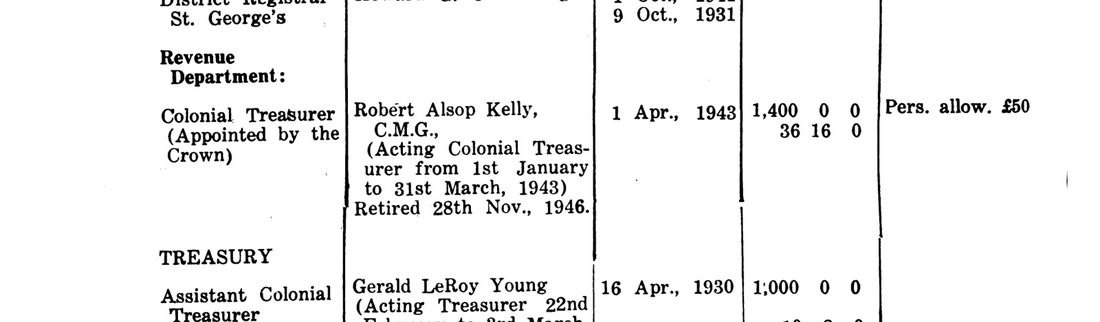
Spink's description of lot 149 in its sale of 17 April 2019 tells it otherwise. It says Kelly was based in London at the time, signed the notes for the printers, and died before taking up the post, after which the notes were scrapped. The Blue Books do not bear this out. Heritage (9 May 2023, lot 28037) offers a third reading, that the notes were prepared in case they were needed during the war. Heritage's descriptions of that day name the second signer as the Assistant Colonial Treasurer G. L. Young.
Both notes are known only as specimens with all-zero numbers: the 10 shillings F/4 000000 and the 1 pound Y/6 000000. F/4 and Y/6 are the prefixes at which the runs of the 1937 notes end. Spink (4 October 2013, lot 46, and 17 April 2019, lot 149) knows of no other example of the 10 shillings and calls the 1 pound possibly unique (4 October 2013, lot 47) and probably unique (17 April 2019, lot 150). Heritage sold the same two specimens again on 9 May 2023 (lots 28036 and 28037), from the David Saul and Ibrahim Salem collections. A 10 shillings specimen with the same number, sold by Spink at Christie's on 3 May 2000 (lot 65), has not been matched to it.
What is not known
- Why the small notes carry a date earlier than their Act.
- Where the 11 sets of the small notes that escaped destruction are now, and who kept them.
- Why the Kelly notes were not issued, although Kelly held the office for more than three years.
Sources
- The catalogue pages of the notes named above, with the printer's range specimens listed there.
- Blue Books of Bermuda for 1944 and 1946; the Colonial Office List for 1937.
- Spink, 4 October 2013 (the David J. Saul collection), lots 37, 46 and 47; Spink, 17 April 2019, lots 149 and 150; Spink at Christie's, 3 May 2000, lot 65.
- Heritage, 23 April 2020, lot 28225; Heritage, 9 May 2023, lots 28032, 28033, 28035, 28036 and 28037.
- Stack's Bowers, 8 May 2025, lot 50040, citing Nelson Page Aspen, A History of Bermuda and its Paper Money, page 76.


Member comments
Log in or register to post a comment.