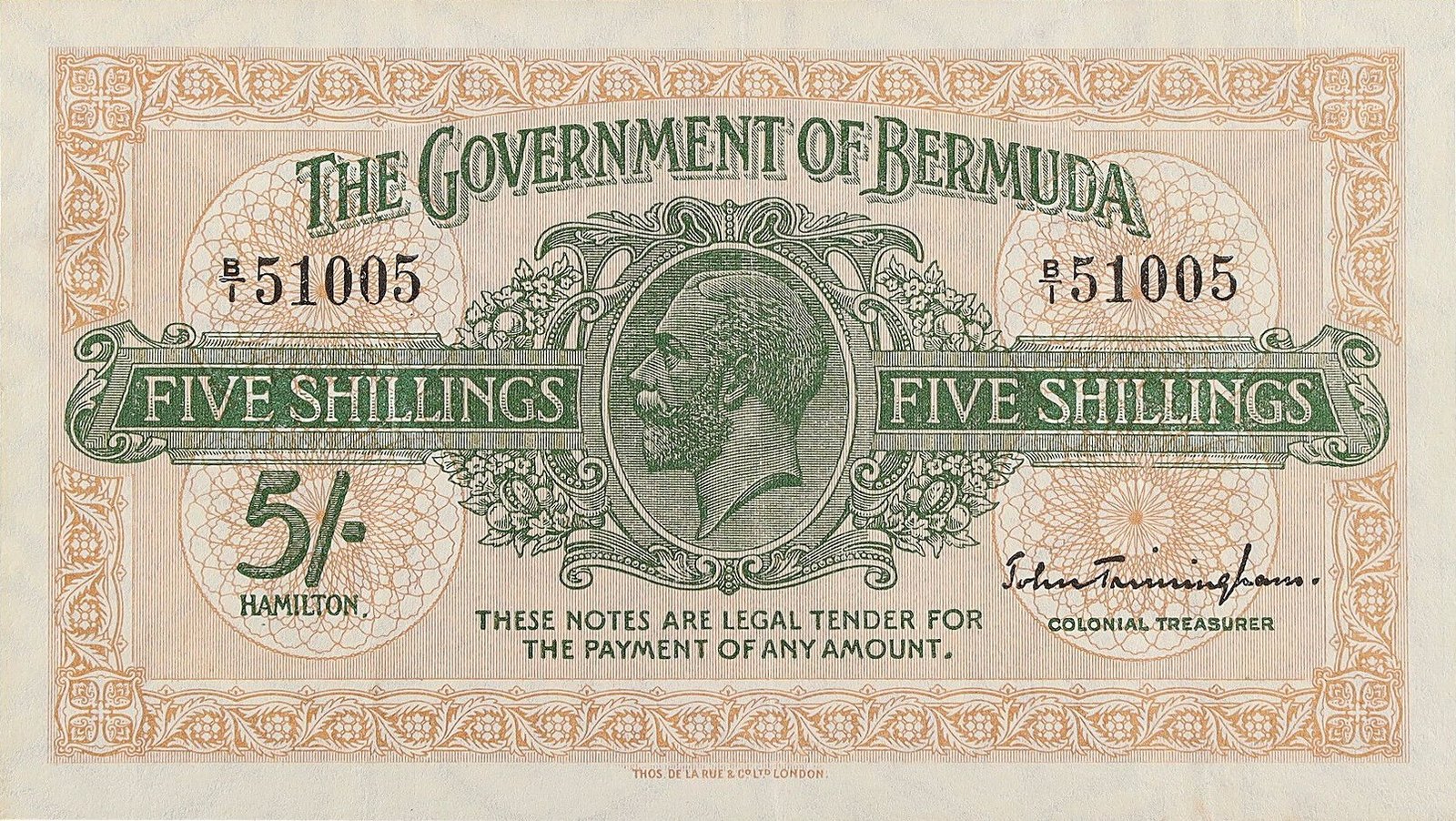
Nelson Page Aspen's A History of Bermuda and its Paper Money, first published in 1980, is in Aspen's own words of 2000 "the only definitive work" on the notes of Bermuda. The book itself was not read for this article. What follows comes from what Aspen wrote in Bank Note Reporter and the IBNS Journal between 1985 and 2002, from what other writers quoted from the book, and from the official records that can now be set beside it. Several passages were read in the machine text of the journals, as the record of their reading holds it; those are named as such.
The book
Aspen told the story of the book in the IBNS Journal in 2002 ("Love Affair", vol. 41 no. 1, pp. 46 and 47). In 1971, Aspen writes, a group of eleven founded the Currency Club of Chester County, and by then Aspen was deep in the study of Bermuda notes; there were, in Aspen's words, "fewer than a dozen serious collectors of Bermuda notes and no definitive work on the subject". The book was finished in 1979 and introduced in Bermuda in May 1980 at a reception at the Royal Yacht Club.
Jerry Remick reviewed the second edition in the IBNS Journal in 2000 (vol. 39 no. 2). It was published on 31st March 2000, 224 pages, hardbound, with the notes in colour, in 1,100 copies. The first edition had appeared in 1980. Remick lists among its chapters Acts of Parliament, Sterling Engraving and Printing Information, The Crown Agents and Specimen Notes, and says Aspen began collecting Bermuda notes in 1959. A letter of Aspen's in the same issue says the second edition was introduced at a ceremony on Bermuda Day at Burnaby House, the home of the Bermuda Monetary Authority. Aspen advertised the book in the Journal from 2000 to 2002, with a picture of a 1 pound of 1914 numbered 000002.
Aspen's pieces in the journals
| Date | Where | Title | Subject |
|---|---|---|---|
| February 1985 | Bank Note Reporter, p. 4 | "Enjoys holidays on Bermuda beach" (letter) | the order for the 100 dollars of 1982; the first woman to sign a Bermuda note |
| August 1985 | Bank Note Reporter | "New names, new positions appear on Bermuda notes" | new officers of the Authority; the rest of the 100 dollars order; a souvenir card |
| October 1985 | Bank Note Reporter, p. 29 | "Numismatic fun in Bermuda's sun" | a tour of Bermuda after the convention of the American Numismatic Association; Aspen as consultant to the Authority |
| October 1986 | Bank Note Reporter, p. 12 | "Bermuda bank robbery shocked island" | the Somerset branch robbery of May 1957 |
| January 1987 | Bank Note Reporter, pp. 18 to 20 | "England noted" | Christie's sale of 2nd October 1986; the Crown Agents' records |
| 1991 | IBNS Journal 30:4 | "Specimen Notes" | essays, proofs and range specimens |
| 1995 | IBNS Journal 34:2 | "The Odyssey of Bermuda's Undated Note" | the 5 shillings of 1935 and 1936 |
| 2000 | IBNS Journal 39:2 | "The Thrill of Discovery" | the 10 shillings of 1943 signed by Kelly |
| 2001 | IBNS Journal 40:4 | "The Series of Bermuda Notes for 2000", and a letter on the portraits | the notes of 2000 |
| 2002 | IBNS Journal 41:1 | "Love Affair" | the book and the Authority's collection |
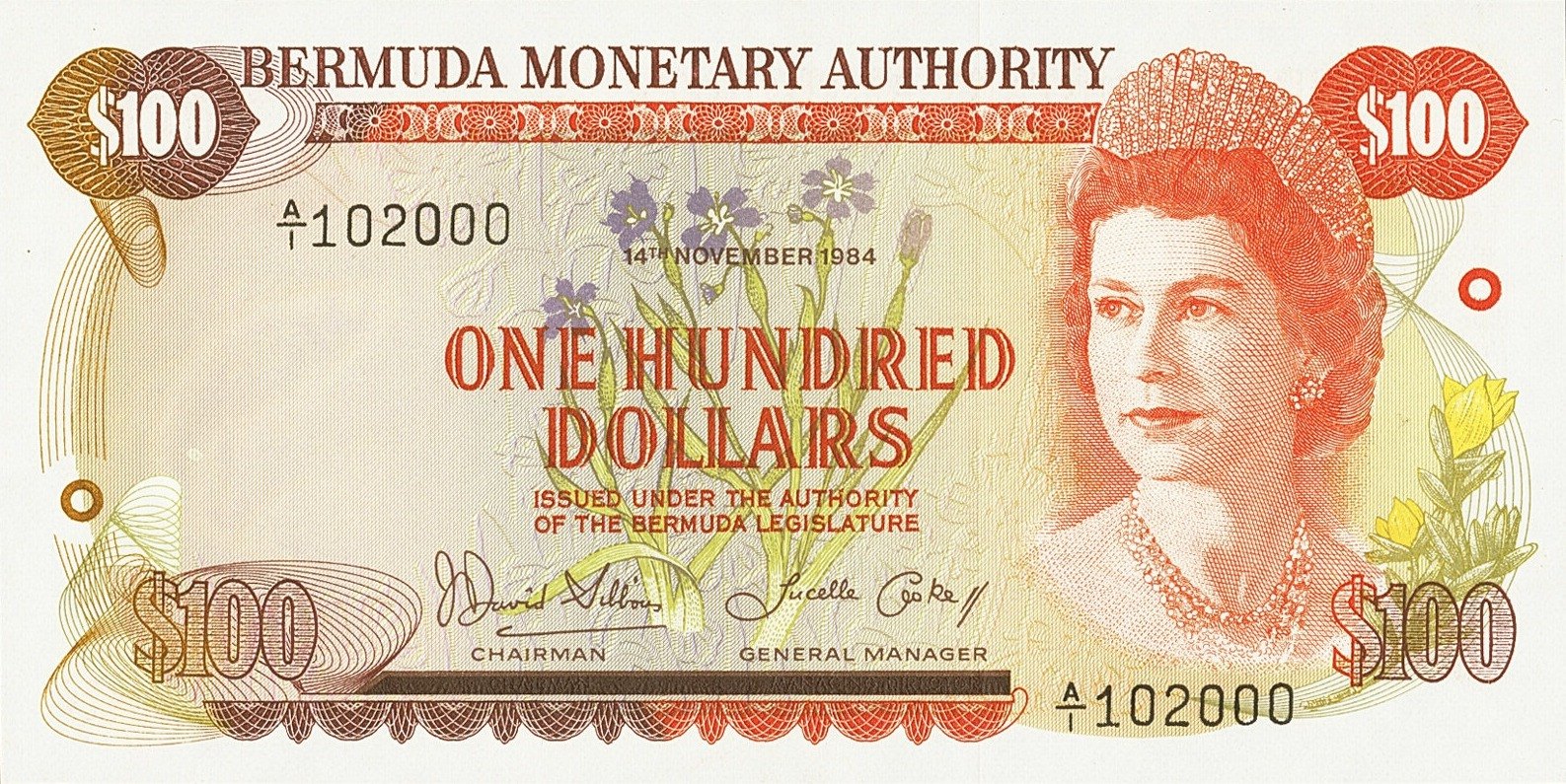
The robbery of 1957 and the 100 dollars of 1982 are told in the first wave's articles, The last sterling notes of Bermuda, 1952 to 1970 and The Bermuda Monetary Authority and its notes, 1969 to 1989. Two pieces add to them. The robbery article ends by saying that, after Decimal Day on 6th February 1970, Bermudians were given ten years to hand in their notes for replacement, and that none of the stolen numbers had turned up. The piece of August 1985, read in machine text, says the third printing pass of the 100 dollars, the one that adds the signatures, had been run on only 100,000 notes, and that the remaining 100,000 would be finished with the new date, the new title and the signature of Lucelle Cooke. That the notes of the new date are the 100,000 held back is Aspen's account. M. A. Munoz, in the IBNS Journal of 1991 (vol. 30 no. 1), wrote that the 100 dollars of 14th November 1984 started at A/1 100000 "according to information from the Bermuda Monetary Authority". The 100 dollars page gives that start as "sources mention" and does not say whether these are the notes held back; no later source read settles it.
In the archives: the Crown Agents and the printers
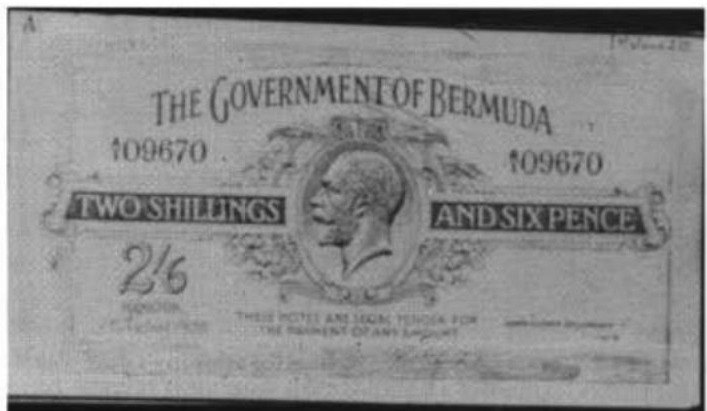
In October 1986 Aspen went through the records of the Crown Agents, then held by the British Library, and wrote of it in January 1987. Among them were two specimens of the 2 shillings 6 pence of 1920 in colour, with a pale green border and a raspberry-coloured banner bearing the value, on two following pages; Aspen thought them the only two. The same records held a grey colour trial specimen of an undated Elizabeth II 10 shillings with 1961 written in ink in the margin, and a green "commercial" specimen of the 10 pounds of 1964. No row was made from this mention of the grey 10 shillings, which has no picture.
"Specimen Notes" in the IBNS Journal of 1991 (vol. 30 no. 4) printed the printers' pieces themselves:
- for the 2 shillings 6 pence of 1920, an artist's essay of the front numbered 109670 and dated 1st June 1920 in the margin, an unadopted back with large rosettes, the printer's essay of the adopted back with a ship, and a back proof with corrections. The catalogue made rows for all four from Aspen's plates;
- a back proof of the 5 shillings of 1920 to 1935, a final front proof of the 5 dollars, and what Aspen called a "posthumous proof" of the 20 dollars, numbered A/1 000000 and made after the note was issued;
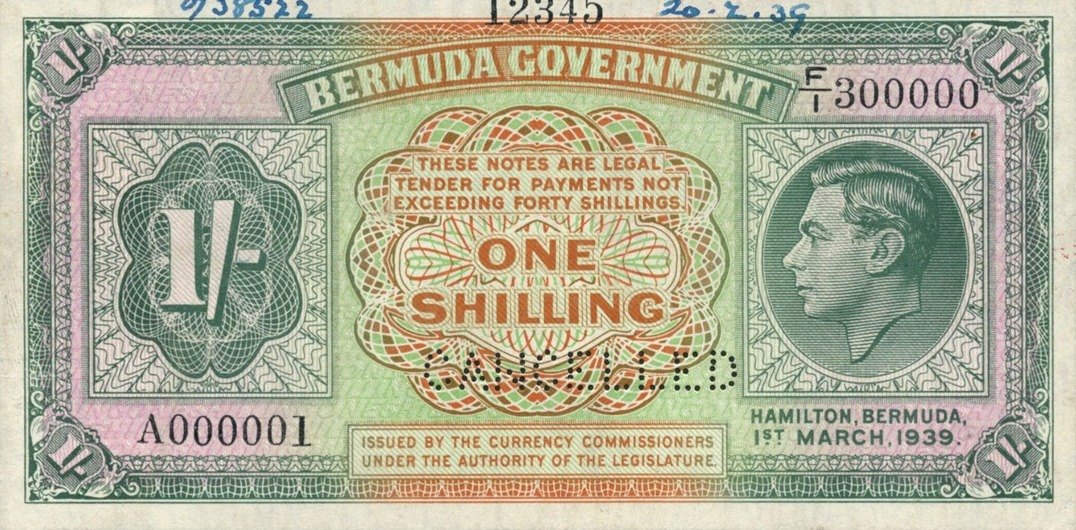
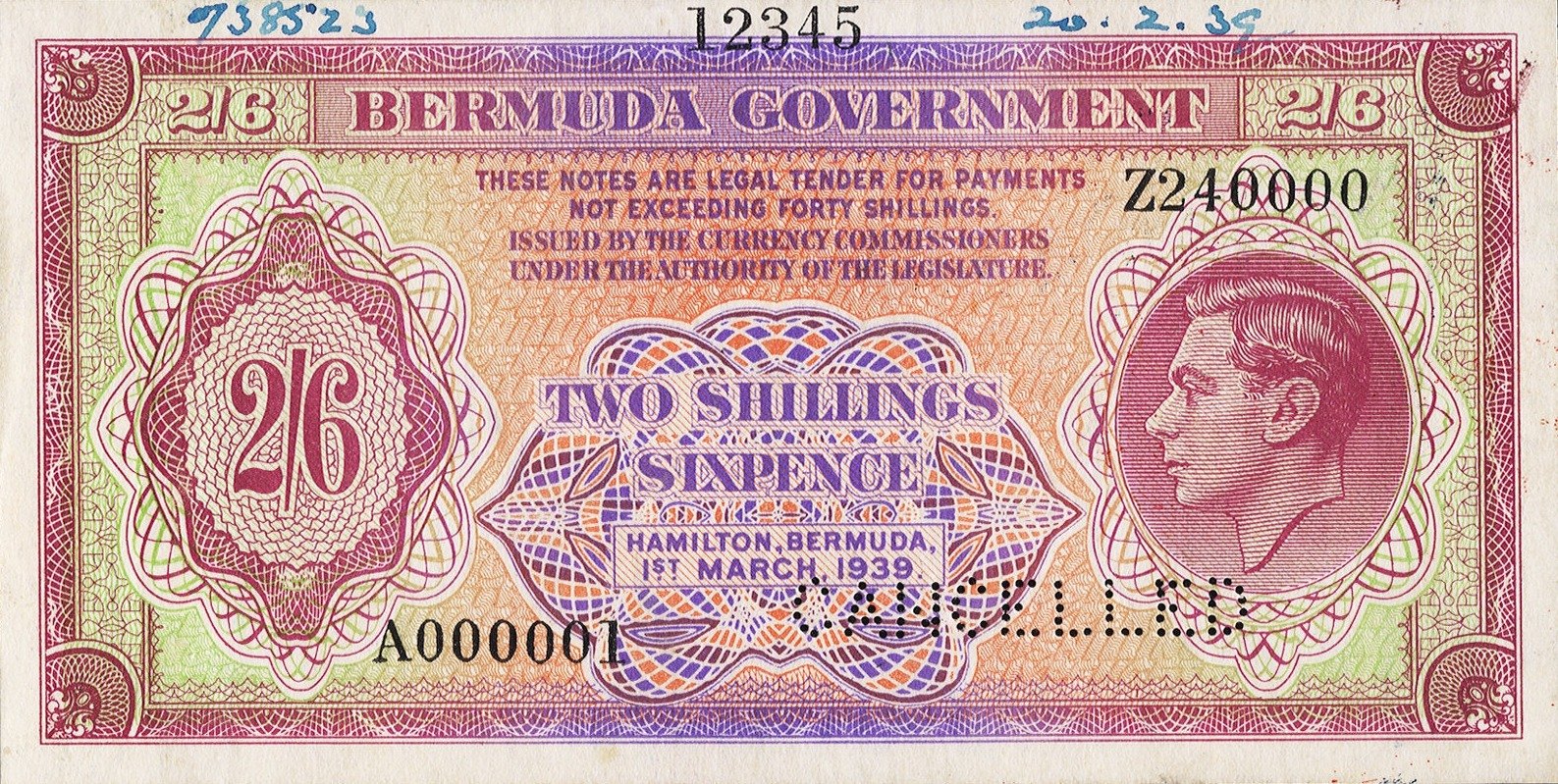
- the printer's range specimens of the 1 shilling and 2 shillings 6 pence of 1939, numbered A 000001 with F/1 300000 and A 000001 with Z 240000, with 12345 printed in the top margin. Aspen took the date written in ink at the top as the day the printing was approved for shipment; on the catalogue's photographs of the two pieces it reads 20.2.39, before the date printed on the notes.
The same article says the green 10 pounds was made in numbers to show the public the new value before it was issued, and that the usual hundred specimens were then made in the issued purple. The catalogue keeps the green piece as a colour trial specimen; Aspen cites no file for the account.
The undated 5 shillings
"The Odyssey of Bermuda's Undated Note" (IBNS Journal, vol. 34 no. 2, 1995, pp. 37 and 38) follows one order through the papers. After the Act of 8th November 1935, 40,000 notes of 5 shillings, B/1 24000 to B/1 64000, signed by Trimingham, were ordered to be dated 5th February 1936. On 23rd March 1936 the Crown Agents asked for any notes already printed to be destroyed and printed again without a date. The reprint began on 1st April 1936 on paper with an arabesque watermark, and the notes were released after May 1936. That is why the 5 shillings of the Colonial Treasurer carries no date. The page keeps the year in brackets as 1935, the year of the Act.
The same article says that 40,000 notes of the 2 shillings 6 pence of 1920 were printed and sent from the printers on 29th December 1920, never reached Bermuda, never circulated and were apparently destroyed, and that an early essay suggests the note was to carry the title Commissioner of Currency.
The Authority's collection
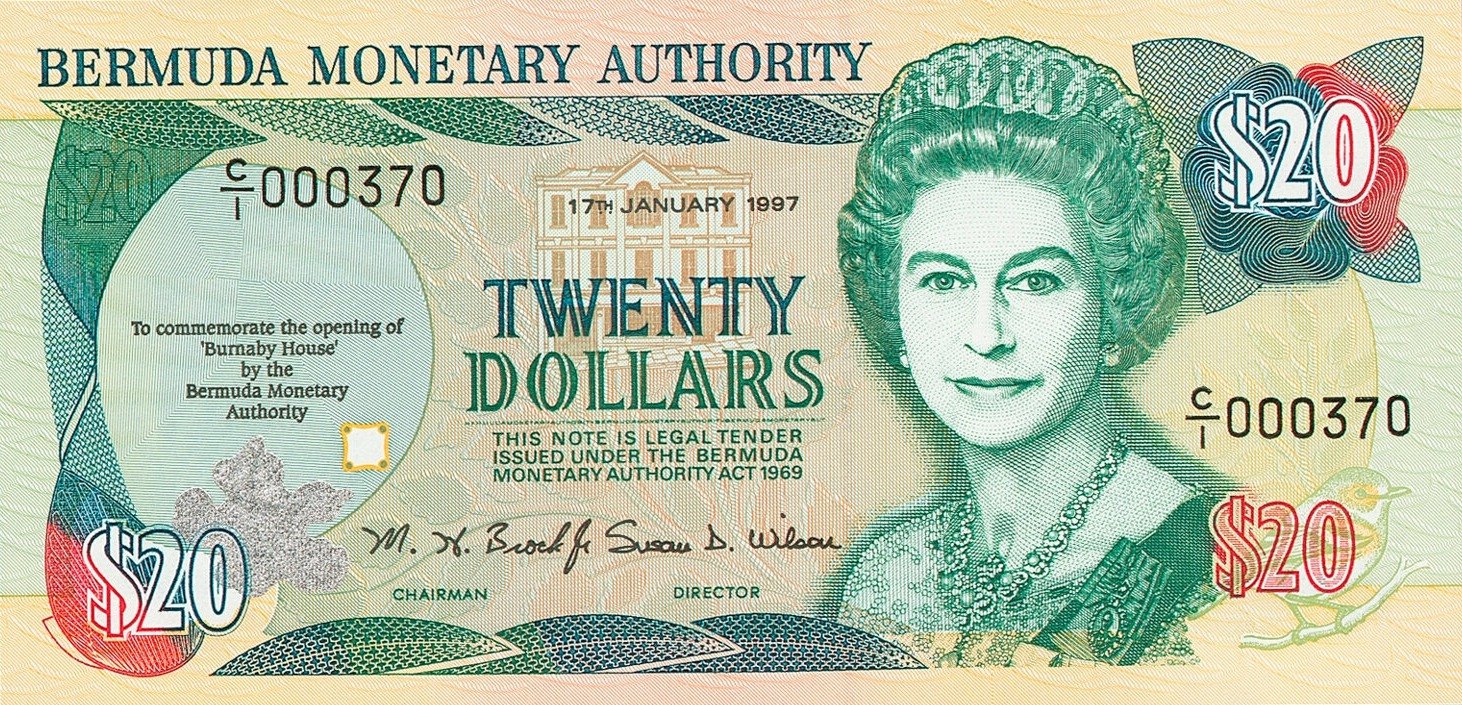
"Love Affair" tells how the Authority came to have a collection. When Aspen visited it about 1979, the Chairman, Dudley St George Butterfield, and the Managing Director, Alan J. Humphryes, said that the archives had been lost when the Government changed from the colonial system, which Aspen dates 1968, except for one sheet of the 1970 1 dollar notes. In late 1980 Fred Yearwood, the new Chairman, with the Managing Director Merlyn Trued, set out to build an archive and a public display, which opened in 1981. Aspen spent long weekends gathering the notes and coins for it. The collection later moved with the Authority to Church Street; in 1992 a permanent exhibit was placed in the Maritime Museum with the presentation of the 50 dollars of 1992; and a smaller one stands at Burnaby House, which was opened in 1997 and marked by the 20 dollars of that year.
Christie's, 2nd October 1986
In "England noted" Aspen reported the six Bermuda lots in Christie's sale of Bill Pheatt's British Commonwealth notes in London on 2nd October 1986:
| Lot | What it held |
|---|---|
| 24 | the 10 shillings of 1927 |
| 25 | the 5 shillings of 1937, the 5 shillings of 1947 and the green 10 shillings of 1937 |
| 26 | the red 10 shillings of 1937, the 1 pound of 1937 and the 1 pound of 1947 |
| 27 | the 5 pounds of 1941, the "canary" |
| 28 | the 5 pounds of 1947 |
| 29 | the 10 pounds of 1964, with a pin hole |
Three of the notes are pictured with their numbers. The 5 shillings of 1937 of lot 25, G/2 540115, came up again at Heritage on 23rd May 2017 (lot 84579), so it can be followed from one sale to the other. The 1 pound of 1937 of lot 26 is Y/1 462054. The 5 pounds of 1947 of lot 28, T422987, was pictured again in a dealer's advertisement in Bank Note Reporter of May 1999. The red 10 shillings of lot 26 could not be placed on either of the catalogue's two rows from what the paper shows.
What others took from the book
Fred Schwan, in Bank Note Reporter of April 1984 (p. 43), quoted the book on the small notes of 1939: dated 1st March 1939, authorised by an Act of "Aug. 2, 1939", and "The 300,000 1/- and 240,000 2/6 notes were then destroyed". M. A. Munoz, in the IBNS Journal of 1991 (vol. 30 no. 1), built a study of the Authority's replacement notes on the book's tables, set out in Bermuda in the collectors' journals, 1961 to 2025. Joel Shafer, in Bank Note Reporter of December 2001, quoted it for the 100,000 notes of the 100 dollars of 1982 delivered. Stack's Bowers, describing lot 50040 of its sale of 8th May 2025, cites page 76 for the brown 5 pounds of 1941, and its lot 50041 of the same day for the highest number of the 1947 5 shillings that Aspen recorded, K/5 530082.
What has held, and what has not
| Aspen's statement | Where | What the other records say | Standing, and whose judgement |
|---|---|---|---|
| Kelly stayed about three years as Colonial Treasurer | IBNS Journal 39:2 (2000) | the Blue Books for 1944 and 1946: 1st April 1943 to 28th November 1946 | the Blue Books' dates agree with it |
| 240,000 notes of the 2 shillings 6 pence of 1939 destroyed | the book, in Bank Note Reporter, April 1984 | the printer's range specimen ends at Z 240000; the page now gives 240,000 | the range specimen agrees; no official count read |
| the Act for the 1939 notes was of 2nd August 1939 | the same | the text of the Act in the Johns Hopkins archive is dated 24th August 1939 | the two dates differ; no source read explains it, and it is not settled here |
| 100,000 of the 1982 100 dollars signed, the rest held back for the new date | Bank Note Reporter, February and August 1985 | Munoz (IBNS Journal 30:1, 1991), from the Authority: the notes of 14th November 1984 start at A/1 100000 | no later source says whether the 1984 notes are the ones held back |
| the 2 shillings 6 pence of 1920 never reached Bermuda | IBNS Journal 34:2 (1995) | the annual report for 1921 says the notes were "still held in reserve"; Heritage (9 May 2023, lot 28029) says they were shipped to Bermuda | the report does not say where the reserve was held; the page leaves it "Not yet settled" |
| Young died before the issue of 1952 | IBNS Journal 39:2 (2000) | the Colonial Office List for 1956 gives Young as Auditor in 1952 | not settled: the List was read in machine text only |
| 930 ten pound notes not accounted for by destruction | Bank Note Reporter, January 1987 | the Bermuda Reports give the unredeemed pound notes of all values together | no source read gives a figure by value; Aspen names no source |
| twelve sets of the 1939 notes kept at the Authority | Bank Note Reporter, January 1987 | the pages say 11 sets escaped destruction | no first-hand count read decides it |
| the notes of 2000 came out in late October, not on 16th October 2000 | IBNS Journal 40:4 (2001) | the pages say they were introduced on 16th October 2000 | no later source read decides it |
Sources
- Nelson Page Aspen in Bank Note Reporter: February 1985, p. 4; August 1985; October 1985, p. 29; October 1986, p. 12; January 1987, pp. 18 to 20.
- Nelson Page Aspen in the IBNS Journal: "Specimen Notes", vol. 30 no. 4 (1991); "The Odyssey of Bermuda's Undated Note", vol. 34 no. 2 (1995), pp. 37 and 38; "The Thrill of Discovery" and a letter, vol. 39 no. 2 (2000); "The Series of Bermuda Notes for 2000" and a letter, vol. 40 no. 4 (2001); "Love Affair", vol. 41 no. 1 (2002), pp. 46 and 47.
- Jerry Remick, review of the second edition, IBNS Journal, vol. 39 no. 2 (2000).
- Fred Schwan in Bank Note Reporter, April 1984, p. 43; M. A. Munoz, "The Replacement Notes of Bermuda Monetary Authority", IBNS Journal, vol. 30 no. 1 (1991), pp. 19 to 21; Joel Shafer in Bank Note Reporter, December 2001, p. 82.
- Christie's, London, 2 October 1986, lots 24 to 29, as Aspen reports them; Heritage, 23 May 2017, lot 84579; Heritage, 9 May 2023, lot 28029; Stack's Bowers, 8 May 2025, lots 50040 and 50041.
- Bermuda Blue Books for 1944 and 1946; Colonial Reports, Annual: Bermuda for 1921; the Colonial Office List for 1956.


Member comments
Log in or register to post a comment.