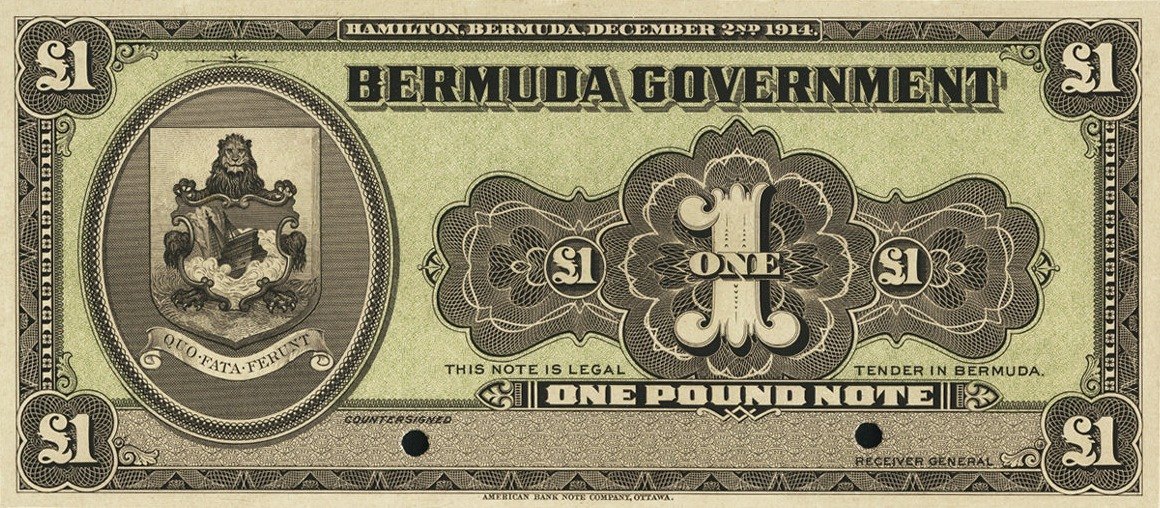
The pages of the Bermuda notes name the Act behind each issue by its date. This article puts all the Acts in one list and adds what else each said. It rests on the texts of the Bermuda Acts held in the Johns Hopkins archive of currency boards, on the list of legislation in John Stanton's working paper on Bermuda in the same archive (No. 50), on the Bermuda Blue Books and the Colonial Office annual reports, and on one wartime United States manual quoted in Bank Note Reporter. The issues themselves are told in The paper money of Bermuda, 1914 to 2007.
The list
| Date | Act or order | What it said | Source |
|---|---|---|---|
| 19th February 1915 | Government Notes Act, 1915 (No. 5) | The Governor may authorise the Receiver General to issue Bermuda Government 1 pound notes, of a form and design the Governor approves, up to 20,000 pounds. The notes are legal tender for all purposes and redeemable at face value. | the Act; the number from the Blue Books for 1918, 1920 and 1921 |
| 3rd August 1915 | Government Notes Redemption Act, 1915 | Raised the limit to 30,000 pounds and recorded that 10,000 pounds of the notes had been issued to the Treasury Chest Officer at the request of the Imperial Government, paid for through the Crown Agents. | the Act |
| 3rd August 1915 | Currency Act, 1915 (No. 21) | Made the Government's notes, and the British Treasury notes of 1 pound and 10 shillings, legal tender. | Stanton's list; the Blue Book for 1918 heads the British notes "(Act 21 of 1915.)" |
| 10th March 1917 | Government Notes Redemption Act, 1917 (No. 9) | A further 10,000 pounds of 1 pound notes for the Treasury Chest Officer, to buy War Loan. After an amendment of 1917 the limit stood at 40,000 pounds. | the Act; the consolidation of the Acts to 1930; the number from Stanton's list and the balance sheet in the annual report for 1928 |
| 1920 | Currency Act, 1920 | Let the Governor demonetise British currency notes. | the Act |
| 18th June 1920 | Government Notes Act, 1920 (No. 16) | The Receiver General may issue Bermuda Government Crown and Half Crown notes, in a proportion the Governor approves, up to 10,000 pounds. Legal tender. Regulations may be made for withdrawing and cancelling damaged notes. | the Act; the number also in the Blue Book for 1920 |
| 8th April 1927 | Government Notes Act, 1927 (No. 15) | Bermuda Government notes of a new design may be printed, in values, quantity, form and design approved by the Governor in Council. Legal tender for all purposes, redeemable at face value. | the Act; the number from the annual report for 1927 |
| 23rd July 1930 | Bermuda Currency Notes Act, 1930 | See below. | the consolidation of the Acts to 1930, sections 2 to 4, 12 and 13 |
| 1934 | Bermuda Currency Notes Act, 1930, Amendment Act, 1934 | Not known. Only the title is in the list of the Acts of the year, as No. 40. | annual report for 1934 (No. 1737) |
| 8th November 1935 | Bermuda Currency Notes Act, 1935 (No. 40) | Approved the issue of 5 shillings notes under section 3(2) of the Act of 1930. | the Act; the number from the annual report for 1935 and Stanton's list |
| 15th May 1939 | an amending Act (No. 20) | The Governor may demonetise notes by proclamation. Holders are paid by the Colonial Treasurer at any time afterwards. | the Act; Stanton's list |
| 24th August 1939 | Bermuda Currency Notes Act, 1939 | Approved the issue of half a crown and 1 shilling notes. | the Act |
| 14th September 1940 | Currency Act, 1940 | Made Bank of England notes legal tender in Bermuda. | the Act |
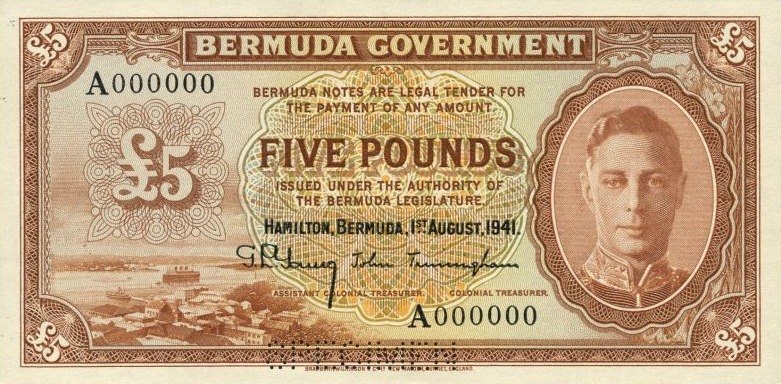
| 18th June 1941 | Bermuda Currency Notes Act, 1941 (No. 26) | Approved the issue of 5 pound notes. | the Act; Stanton's list |
| midnight of 1st November 1941 | an amendment of the Defence (Finance) Regulations, 1940 | Bermuda notes "the only legal currency for circulation in Bermuda". | United States War Department, Technical Manual 14-511 (March 1944), quoted in Bank Note Reporter, June 1994 |
| 16th December 1963 | Bermuda Currency Notes Act, 1963 (No. 191) | Approved the issue of 10 pound notes. | the Act; Stanton's list |
| 1965 | Currency (Bermuda Coin) Act, 1965 | Coins only. | the Act |
| 20th February 1969 | Bermuda Monetary Authority Act, 1969 (No. 57) | See below. | the Act |
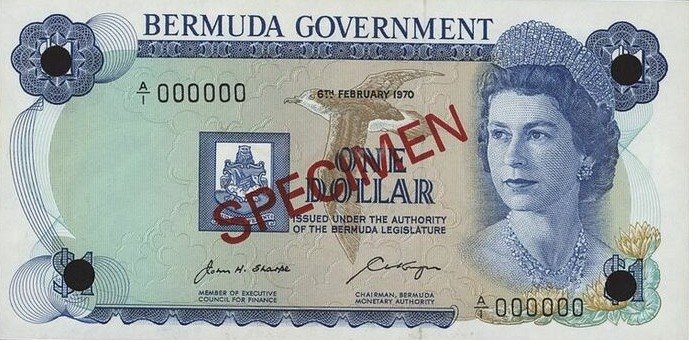
| 6th February 1970 | order of the Governor | The parity of the Bermuda dollar set at 2.40 dollars to the pound. | Bermuda Report for 1969 and 1970, p. 23 |
The wartime Acts, 1915 to 1917
The first Act was passed, Stanton's working paper says, because of a shortage of currency at the outbreak of war. The same paper adds two things that the pages do not have: forgery of the notes was made a felony punishable with up to five years, and the notes were issued from 1st March 1915. The date on the 1 pound of 1914, 2nd December 1914, is earlier than the Act, and a second working paper in the archive, by Krus and Schuler (No. 22, 2014), says in so many words that the first notes were backdated.
Part of the wartime issue did not go to the public of Bermuda at all. Two lots of 10,000 pounds went to the Treasury Chest Officer: the first in 1915 at the request of the Imperial Government, the second in 1917 to buy War Loan. The Blue Book for 1918 shows 10,000 pounds received from a note issue in 1917 and 10,000 pounds invested in the same year "towards redemption of Bermuda Government Notes".
The two Redemption Acts gave the investments their name. The annual report for 1923 lists stock held "under the authority of The Government Notes Redemption Act, 1915", and the balance sheet in the report for 1928 gives the notes as "issued under the authority of the Government Notes Redemption Act, 1917 (No. 9)". The balance sheet in the report for 1926 prints the same line with the year 1927, which does not fit an Act numbered 9 and passed in 1917.
1920 and 1927
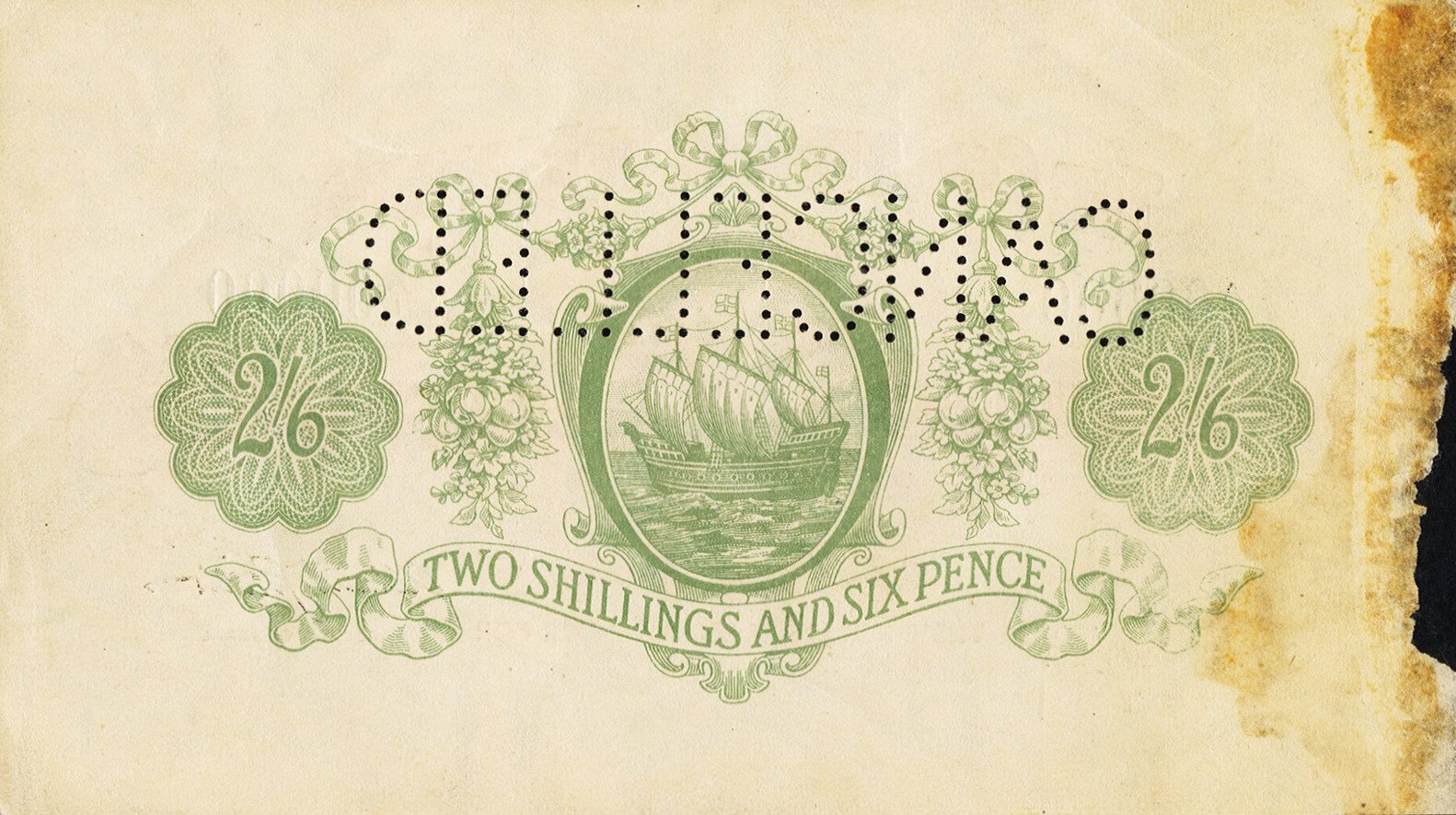
The Act of 1920 speaks of Crown and Half Crown notes, the names of the coins they were to stand in for: the 5 shillings and the 2 shillings 6 pence. It set one limit, 10,000 pounds, for the two together and left the proportion to the Governor. Stanton's list calls them emergency notes for a shortage of silver coin and says the 2 shillings 6 pence was not issued.
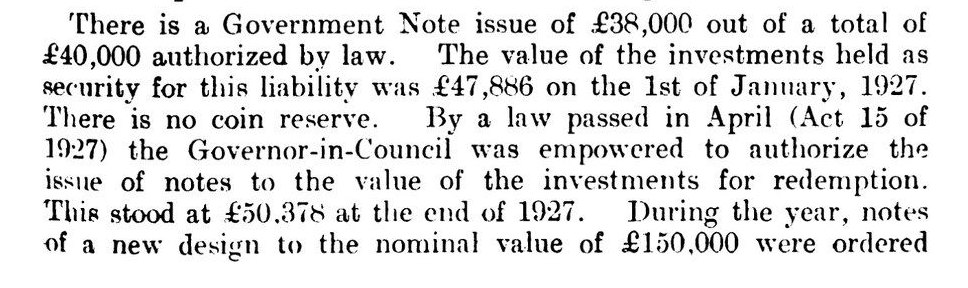
The Act of 1927 named no value and no amount. It left values, quantity, form and design to the Governor in Council. The annual report for 1927 describes its effect in one sentence: the Governor in Council "was empowered to authorize the issue of notes to the value of the investments for redemption". The fixed limit of 40,000 pounds was gone, and the issue could grow with the fund. The 10 shillings and 1 pound of 30th September 1927 were printed under it.
The Act of 1930
The Bermuda Currency Notes Act of 23rd July 1930 replaced this patchwork. As the consolidated text has it:
- Bermuda was put on a sterling exchange standard. Notes were issued at par against sterling lodged with the Crown Agents.
- The issue passed from the Receiver General to three Bermuda Currency Commissioners appointed by the Governor in Council, one of them the Colonial Treasurer.
- The values of the notes had to be approved by the Legislature. Their form, design, plates and paper were as the Governor in Council directed, with the approval of the Secretary of State.
- The notes were legal tender for any amount.
- The notes of the Acts of 1915, 1920 and 1927 could be called in and demonetised by regulation.
Because the Legislature had to approve each value, every new value after 1930 has a short Act of its own: the 5 shillings in 1935, the 1 shilling and 2 shillings 6 pence in 1939, the 5 pounds in 1941 and the 10 pounds in 1963.
The number of the Act is given two ways. The Blue Books for 1944 to 1948 head the notes "(Act 5 of 1915 and Act 32 of 1930)". Stanton's list gives the Act of 23rd July 1930 as No. 52. The Blue Books were read in machine text only, so the difference may lie in the reading.
The war, 1939 to 1941
Four measures fall between May 1939 and November 1941.
The Act of 15th May 1939 gave the Governor the power to demonetise notes by proclamation. The records hold no proclamation made under it.
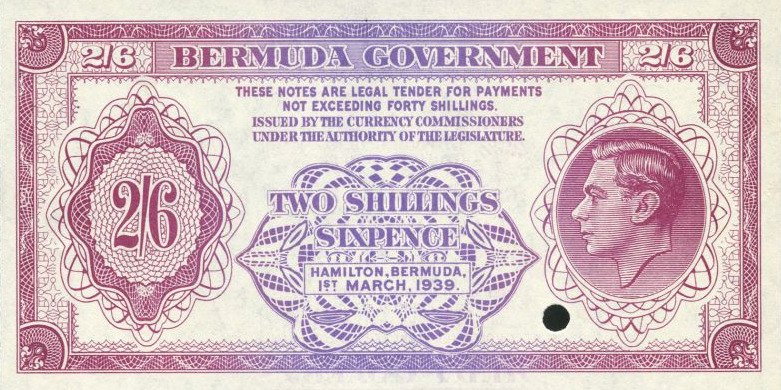
The Act of 24th August 1939 approved the 1 shilling and the 2 shillings 6 pence. The notes themselves are dated 1st March 1939, earlier than the Act, and were never issued. Fred Schwan, writing in Bank Note Reporter in April 1984 (p. 43) from Nelson Page Aspen's A History of Bermuda and its Paper Money, gives the authorising Act as of "Aug. 2, 1939". The text of the Act in the Johns Hopkins archive is dated 24th August 1939, and the catalogue pages follow it. No source read explains the difference, and this article does not settle it.
The Currency Act of 14th September 1940 made Bank of England notes legal tender in Bermuda. The United States War Department's Foreign Exchange Guide of March 1944 (Technical Manual 14-511), which Fred Schwan quoted in Bank Note Reporter in June 1994 (p. 51), told American paymasters: "Since midnight of 1 November 1941, Bermuda notes are the only legal currency for circulation in Bermuda. This was made effective by Amendment of Defense Finance Regulations 1940, of 29 October 1940." The manual gives the year of the amendment as 1940 and the day it took effect as 1st November 1941. The Bermuda regulation itself has not been read, so the dates stand as the manual prints them. The Colonial Office reports speak of the same kind of measure: from 1946 to 1957-58 they say that United Kingdom notes are not legal tender in Bermuda because of the wartime currency and exchange control regulations.
No catalogue page names the regulation. It falls in the same year as the first 5 pounds, approved on 18th June 1941 and dated 1st August 1941.
The Act of 1969
The Bermuda Monetary Authority Act, 1969 (No. 57), was assented to on 20th February 1969. The text in the archive provides:
- a Board made up of the Financial Secretary as Chairman by virtue of that office, the Controller of Foreign Exchange, the Managing Director and three others;
- a Bermuda dollar of 100 cents;
- that Part IV, on the currency, comes into force on a day set by notice in the Gazette, with a default parity of eight shillings sterling to the dollar;
- that the Authority alone issues notes, and arranges the printing and the custody and destruction of plates and paper;
- that the notes are legal tender for any sum and may be called in on one month's notice in the Gazette;
- that on commencement the Authority takes the place of the Bermuda Currency Commissioners, and all notes of the Acts of 1930 to 1963 stay legal tender, at the rate in force, until called in.
The parity was in the end set by order of the Governor, not by the Act's default: the Bermuda Report for 1969 and 1970 records 2.40 Bermuda dollars to the pound. The 1 dollar of 6th February 1970 and its fellows are signed by the Member of Executive Council for Finance and the Chairman of the Authority.
The end of the pound notes
The Act of 1969 only says that the old notes stay legal tender until called in. The day itself comes from other sources, and they use two different terms.
- The Bermuda Report for 1969 and 1970 says the old Bermuda pound notes "ceased to be legal tender on 30th June, 1970", and the report for 1971 repeats it.
- Stanton's working paper says the sterling notes were demonetised in June 1970, and the paper by Krus and Schuler says from 30th June 1970, both citing page 8 of the Bermuda Monetary Authority's annual report for 1994.
The notice that called the notes in has not been read. Nelson P. Aspen, writing in Bank Note Reporter in October 1986, says that Bermudians were given ten years to hand in their notes for replacement.
Not known
- What the Amendment Act of 1934 changed.
- Which is right for the Act of 1930, No. 32 or No. 52.
- The text and the true dates of the Defence (Finance) Regulations that shut out other notes.
- The notice that called in the pound notes in 1970, and whether the wartime pound, the notes of 1920 and the notes of 1927 were ever demonetised by regulation before that, as the Act of 1930 allowed.
Sources
- The Bermuda Acts in the Johns Hopkins archive of currency boards: Government Notes Act, 1915; Government Notes Redemption Acts, 1915 and 1917; Government Notes Acts, 1920 and 1927; the consolidation of the Acts to 1930 with the Bermuda Currency Notes Act, 1930; Bermuda Currency Notes Acts, 1935, 1939, 1941 and 1963; the amending Act of 15th May 1939; Currency Acts, 1920 and 1940; Currency (Bermuda Coin) Act, 1965; Bermuda Monetary Authority Act, 1969.
- John Stanton, working paper No. 50 on Bermuda in the same archive, pp. 3 and 4 and the list of legislation in its appendix, p. 16.
- Krus and Schuler, Currency Board Financial Statements, working paper No. 22 in the same archive (2014), section on Bermuda.
- Bermuda Blue Books for 1918, 1920, 1921 and 1944 to 1948.
- Colonial Reports, Annual: Bermuda for 1923, 1926, 1927, 1928, 1934 (No. 1737) and 1935; the Colonial Office annual reports on Bermuda for 1946 to 1957-58.
- Bermuda Report for 1969 and 1970, p. 23; Bermuda Report for 1971, p. 36.
- Fred Schwan in Bank Note Reporter, April 1984, p. 43.
- Fred Schwan, "War guide could prompt some re-evaluations", Bank Note Reporter, June 1994, p. 51, quoting United States War Department Technical Manual 14-511, Foreign Exchange Guide (March 1944).
- Nelson P. Aspen, "Bermuda bank robbery shocked island", Bank Note Reporter, October 1986.


Member comments
Log in or register to post a comment.