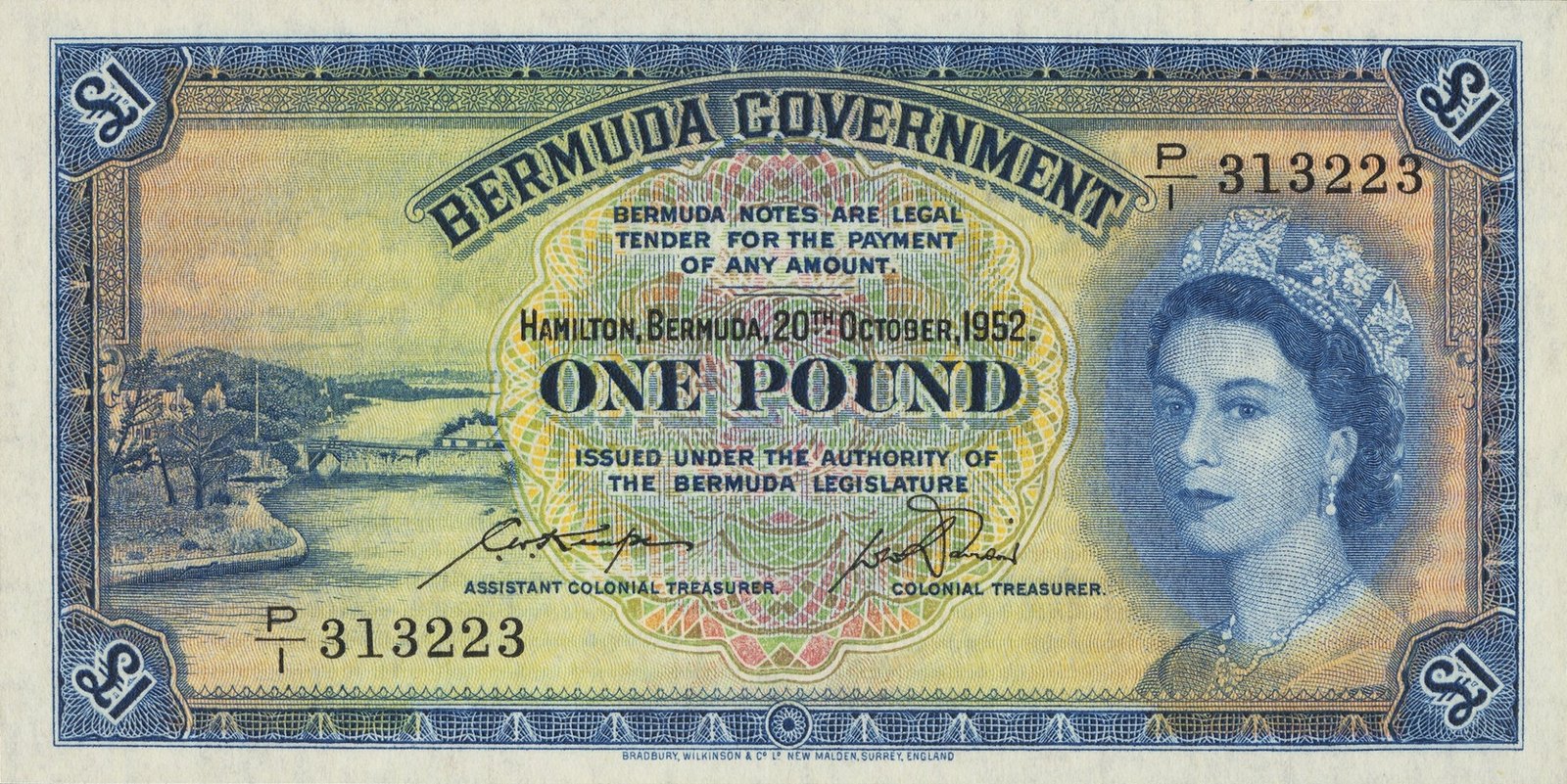
This article sets out the notes of Bermuda in order of time, from the first Government pound of 1914 to the last notes dated 2007. It is drawn from the catalogue pages of the notes, which name their own sources: the Colonial Office reports and Blue Books, the Colonial Office List, Bank Note Reporter and the descriptions of the auction houses. Four longer articles take up single periods and are linked where they belong.
Who issued the notes
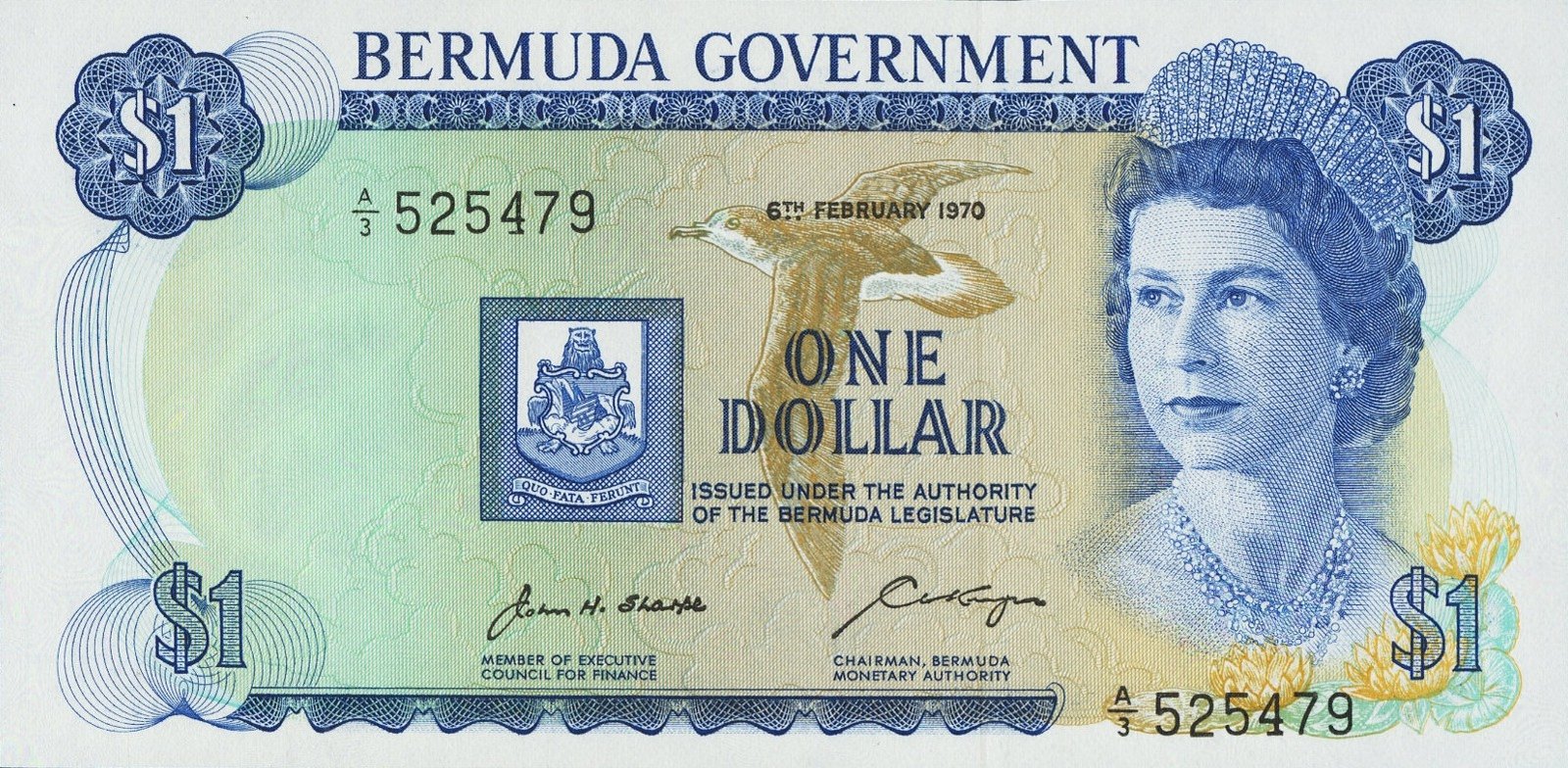
Three bodies stand behind the notes. From 1915 the Bermuda Government issued them under its Government Notes Acts. From 1930, as the page of the 5 shillings of 1920 to 1935 tells it, the notes were issued by three Bermuda Currency Commissioners, one of them the Colonial Treasurer, under the Bermuda Currency Notes Act of 23rd July 1930, and each new value needed an Act of its own. The Bermuda Monetary Authority Act, 1969 (No. 57 of 1969) then made the Authority the only issuer in place of the Commissioners. The consolidated text of that Act at Bermuda Laws Online records the assent on 20 February 1969 and says that its Part IV, on the currency, came into operation on 6 February 1970, the date printed on the first dollar notes.
| Issue | Values | Printer | Dates on the notes |
|---|---|---|---|
| 1914 | 1 pound | American Bank Note Company, Ottawa | 2nd December 1914 |
| 1920 to 1935 | 2 shillings 6 pence (not issued), 5 shillings | Thomas de la Rue | 1st August 1920; no date (1935) |
| 1927 | 10 shillings, 1 pound | Waterlow and Sons | 30th September 1927 |
| 1937 to 1943 | 5 and 10 shillings, 1 and 5 pounds | Bradbury Wilkinson | 12th May 1937; 1st August 1941 |
| 1939 | 1 shilling, 2 shillings 6 pence (not issued) | Bradbury Wilkinson | 1st March 1939 |
| 1947 | 5 and 10 shillings, 1 and 5 pounds | Bradbury Wilkinson | 17th February 1947 |
| 1952 to 1966 | 5 and 10 shillings, 1, 5 and 10 pounds | Bradbury Wilkinson | 20th October 1952; 1st May 1957; 28th July 1964; 1st October 1966 |
| 1970 | 1, 5, 10, 20 and 50 dollars | De La Rue | 6th February 1970 |
| 1974 to 1988 | 1 to 100 dollars | De La Rue | 1st April 1974 to 1st January 1988 |
| 1988 to 1989 | 2 to 100 dollars | De La Rue | 1st October 1988; 20th February 1989; 1st August 1989 |
| 1992 to 1999 | 2 to 100 dollars | De La Rue | 12th October 1992 to 31st May 1999 |
| 2000 to 2007 | 2 to 100 dollars | De La Rue | 24 May 2000; 2 June 2003; 7 May 2007 |
The Government notes of George V, 1914 to 1936
The 1 pound of 1914 was an emergency issue of the First World War, dated 2nd December 1914 and allowed by the Government Notes Act of 19th February 1915. In 1920 a shortage of silver coin brought a second Act and two small notes: the 2 shillings 6 pence, known only as a specimen, and the 5 shillings, which sources mention was held back until 1935. The Government Notes Act of 8th April 1927 allowed notes of a new design, the 10 shillings and the 1 pound dated 30th September 1927, the only Bermuda notes whose pages name Waterlow and Sons as the printer.
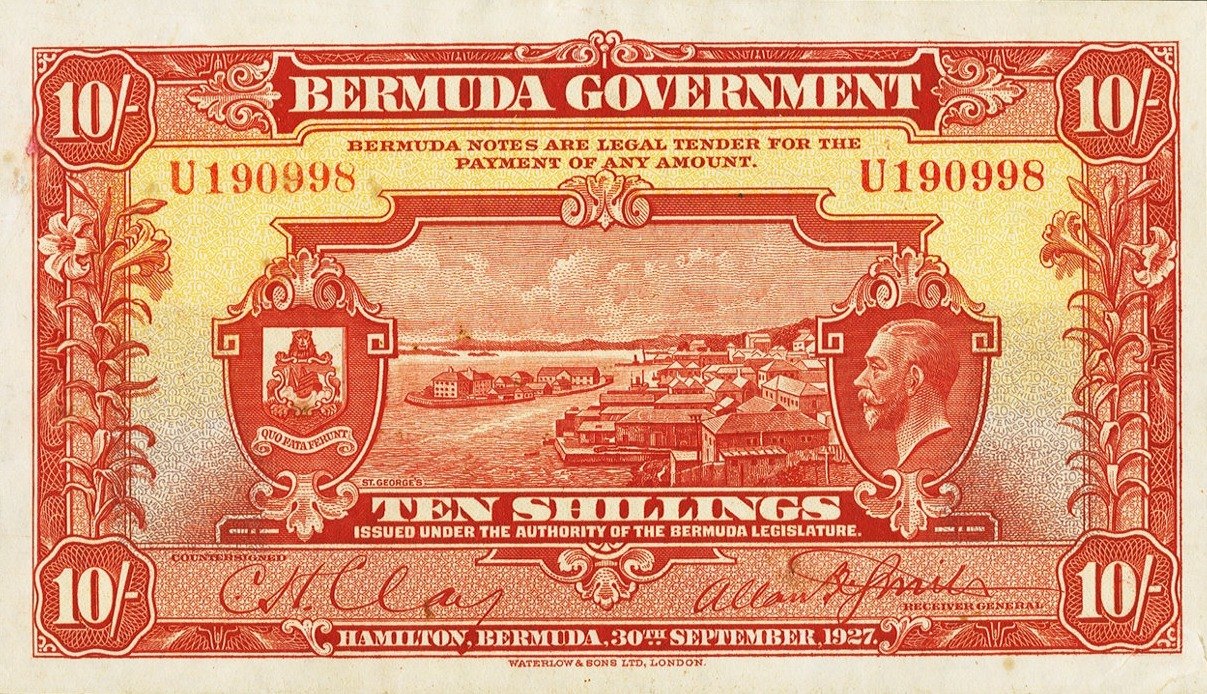
The laws, the printing orders and the figures of the annual reports for these years are set out in Bermuda's Government notes, 1914 to 1936.
George VI, 1937 to 1947
Bradbury Wilkinson printed every sterling note from 1937. The first George VI notes are dated 12th May 1937: the 5 shillings, the 10 shillings in green (P-9) and then in red (P-10), and the 1 pound. Their pages name the signers from the Colonial Office List for 1937 and the Blue Book for 1946: Trimingham, Colonial Treasurer, and Young, Assistant Colonial Treasurer. The 5 pounds, approved by the Bermuda Currency Notes Act of 18th June 1941 and dated 1st August 1941, came first in brown (P-12) and then in orange (P-13).
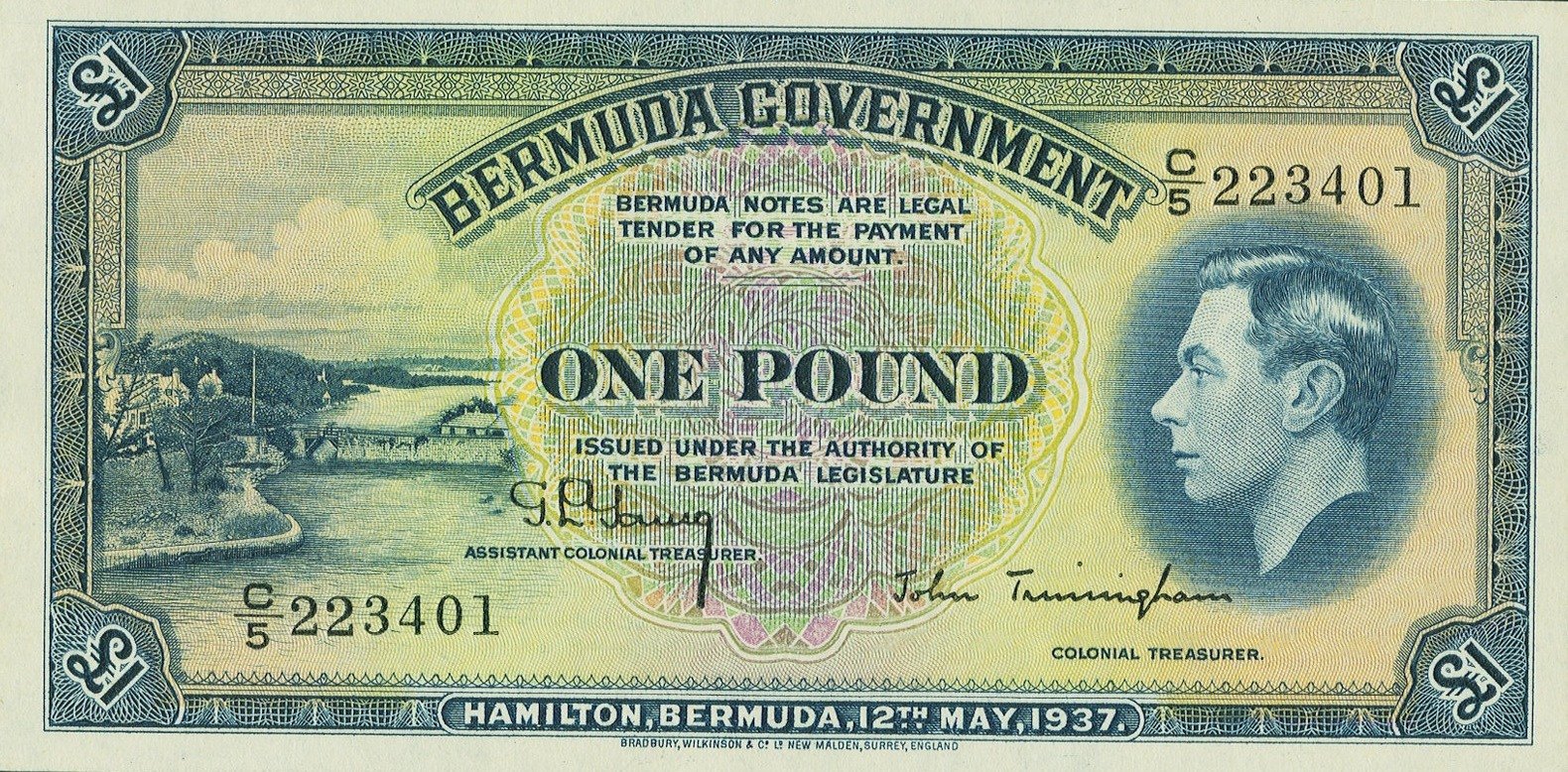
Two groups of notes of these years were printed and never issued: the 1 shilling and 2 shillings 6 pence dated 1st March 1939, and the 10 shillings and 1 pound dated 1st April 1943 with the signature of Kelly. They are told in Bermuda's notes in the war years, 1939 to 1943.
The serial numbers of the 1937 notes run on from one prefix to the next, ten thousand notes to a prefix with I and O left out, first through single letters and then through fractional prefixes, a letter over a figure. The notes dated 17th February 1947 carry the same runs on: the 5 shillings from G/5, the 10 shillings from F/4 014001, the 1 pound with Z/6 and the 5 pounds from Q 145001. The printed date separates a 1947 note from its forerunner. On the 1947 pound the page gives 100,000 numbers to a prefix, no longer 10,000. Davidson is Colonial Treasurer in the Colonial Office List for 1948.
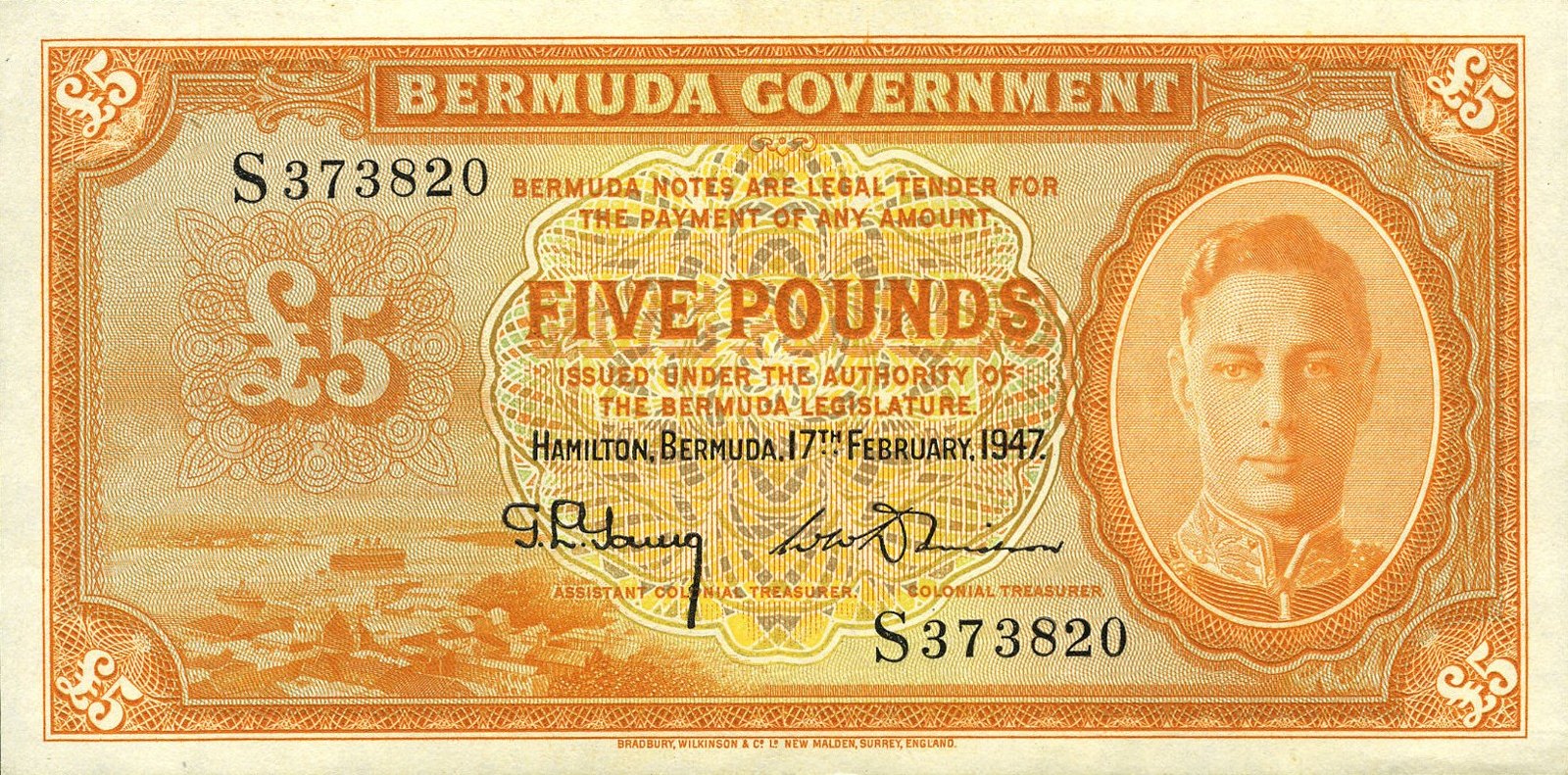
The houses give printings for three of the 1947 notes. Stack's Bowers (8 May 2025, lot 50041) says 400,000 of the 5 shillings were printed. Heritage (9 November 2023, lot 24077) says 800,000 of the 1 pound. Heritage (23 April 2020, lot 28227, and 9 November 2023, lot 24078) gives 350,000 of the 5 pounds, which agrees with the printer's range specimens, Q 145001 to T 495000. Heritage (18 September 2020, lot 28079) says the 1947 five pounds first arrived in Bermuda in the summer of 1947 and the last shipment in 1951.
Elizabeth II and the end of sterling, 1952 to 1970
The Elizabeth II notes, printed by Bradbury Wilkinson, are dated 20th October 1952, 1st May 1957 and 1st October 1966, and a 10 pounds was added with the one date 28th July 1964. The old pound notes ceased to be legal tender on 30th June 1970. The issue, the robbery of 1957, the ten pounds and the withdrawal are the subject of The last sterling notes of Bermuda, 1952 to 1970.
The dollar, 1970 to 1989
The first decimal notes are dated 6th February 1970. They still print BERMUDA GOVERNMENT at the top, and sources mention that notes headed with the name of the Bermuda Monetary Authority began in 1974. A 100 dollars was added with the date 2nd January 1982. In November 1988 a 1 dollar coin was announced to take the place of the 1 dollar note, and a 2 dollars came with it; the other values of the new series were unveiled on 20th February 1989. These years are told in The Bermuda Monetary Authority and its notes, 1969 to 1989.
The issue of 1992 to 1999
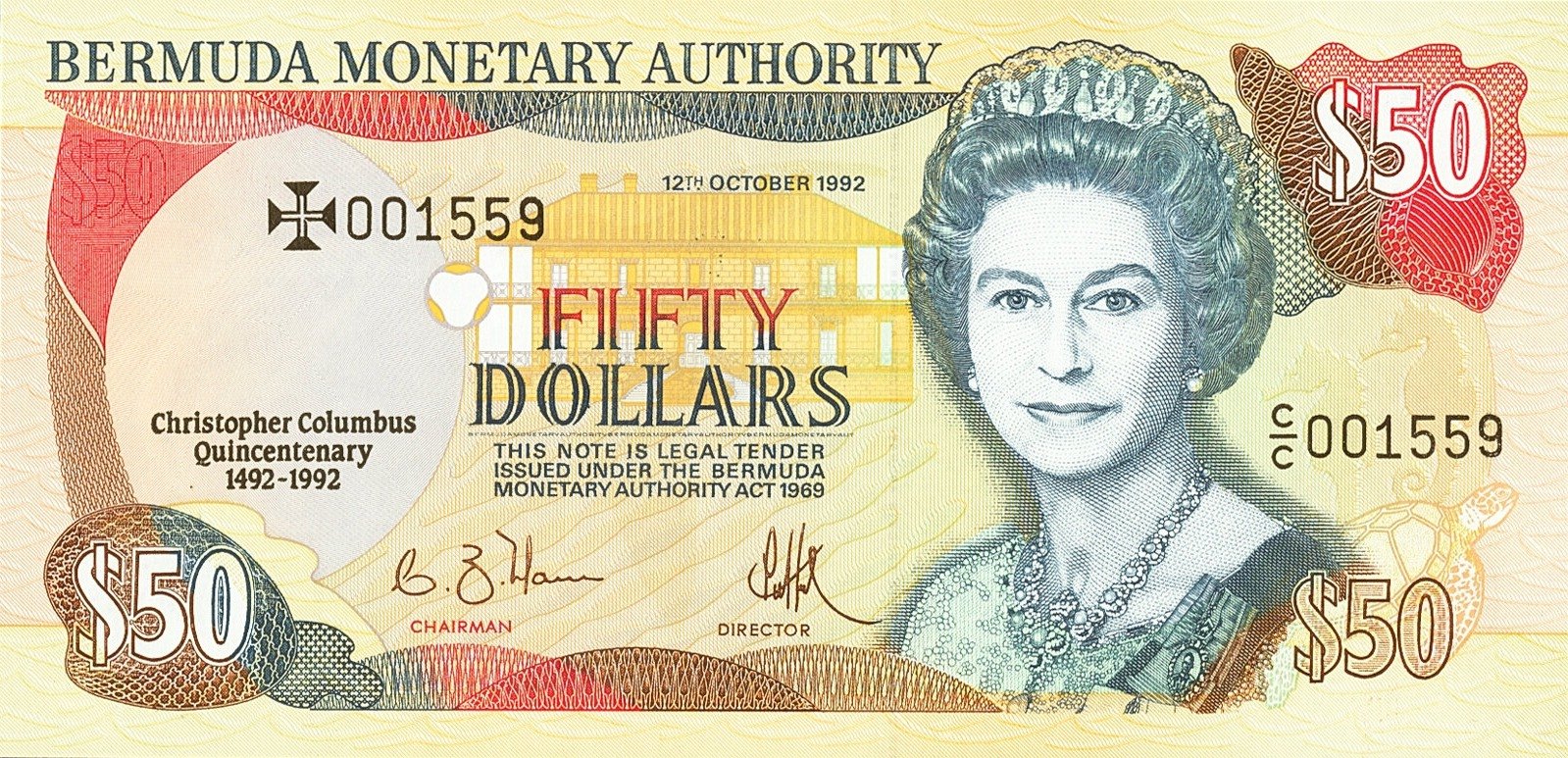
The notes of 1992 to 1999 carry the portrait of the 1988 to 1989 issue, which sources mention follows Peter Grugeon's 1977 Silver Jubilee photograph, engraved by De La Rue. The dates and the colour of the signatures tell the rows apart, as the pages of the 2 dollars, 5 dollars, 10 dollars, 20 dollars and 50 dollars explain. Later printings have a windowed security thread: the 10 dollars of 31st May 1999, the 20 dollars of 13th May 1999, the 50 dollars of 26th June 1997 and the 100 dollars of 30th June 1997, which followed the 100 dollars of 14th February 1996.
Three notes of these years are commemoratives:
- the 50 dollars of 12th October 1992 for the Quincentenary of Christopher Columbus, with a black overprint and the serial letters C/C, issued in a folder that calls it Bermuda's first commemorative note. Auction descriptions give an edition of 2,000, and the size of the issue is not yet settled;
- the 100 dollars of 20 February 1994 for the 25th anniversary of the Bermuda Monetary Authority;
- the 20 dollars of 17 January 1997 for the opening of Burnaby House.
The issue of 2000 to 2007
The series dated 24 May 2000 has a new portrait of the Queen from a photograph by Terry O'Neill; sources mention that it was taken in April 1992 and engraved by Alan Dow of De La Rue. The date is Bermuda Day, formerly Empire Day, and the notes of that date were introduced on 16 October 2000.
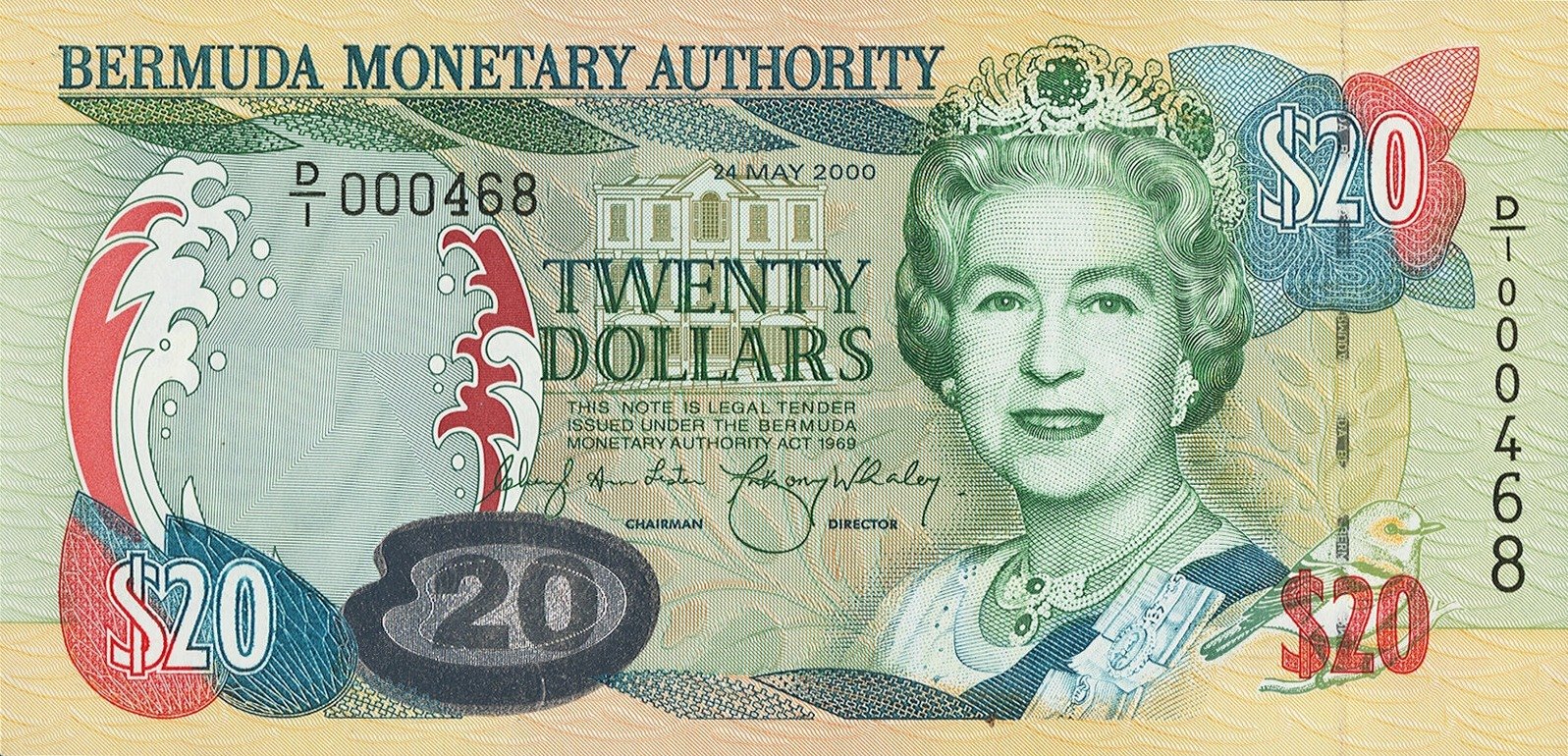
The Bermuda Monetary Authority's specification of the notes, printed in Bank Note Reporter in July 2000, gives every value a tuna fish watermark and a see-through feature. The 2, 5, 10 and 20 dollars have a 1.2-mm windowed Cleartext security thread that shows red under ultraviolet light, the 50 dollars a 1.2-mm FACET thread and the 100 dollars a 2-mm FACET thread. Each value has its own latent image or device: a shell on the 2 dollars, an angel fish on the 5, a Bermuda longtail on the 10, a foil shell on the 20, a hologram of a Bermudian dinghy on the 50 and a gold intaglio image of Burnaby House on the 100. The serial numbers are vertical, and magnetic from the 20 dollars up.
The first issue of the series is given value by value:
| Value | First issue | First prefix | Source as the page gives it |
|---|---|---|---|
| 2 dollars | 1.3 million | C/1 | sources mention |
| 5 dollars | 0.6 million | C/1 | sources mention |
| 10 dollars | 0.6 million | C/1 | sources mention |
| 20 dollars | 0.8 million | D/1 | sources mention |
| 50 dollars | 0.5 million | D/1 | sources mention |
| 100 dollars | 0.3 million | D/1 | Bank Note Reporter of July 2000 |
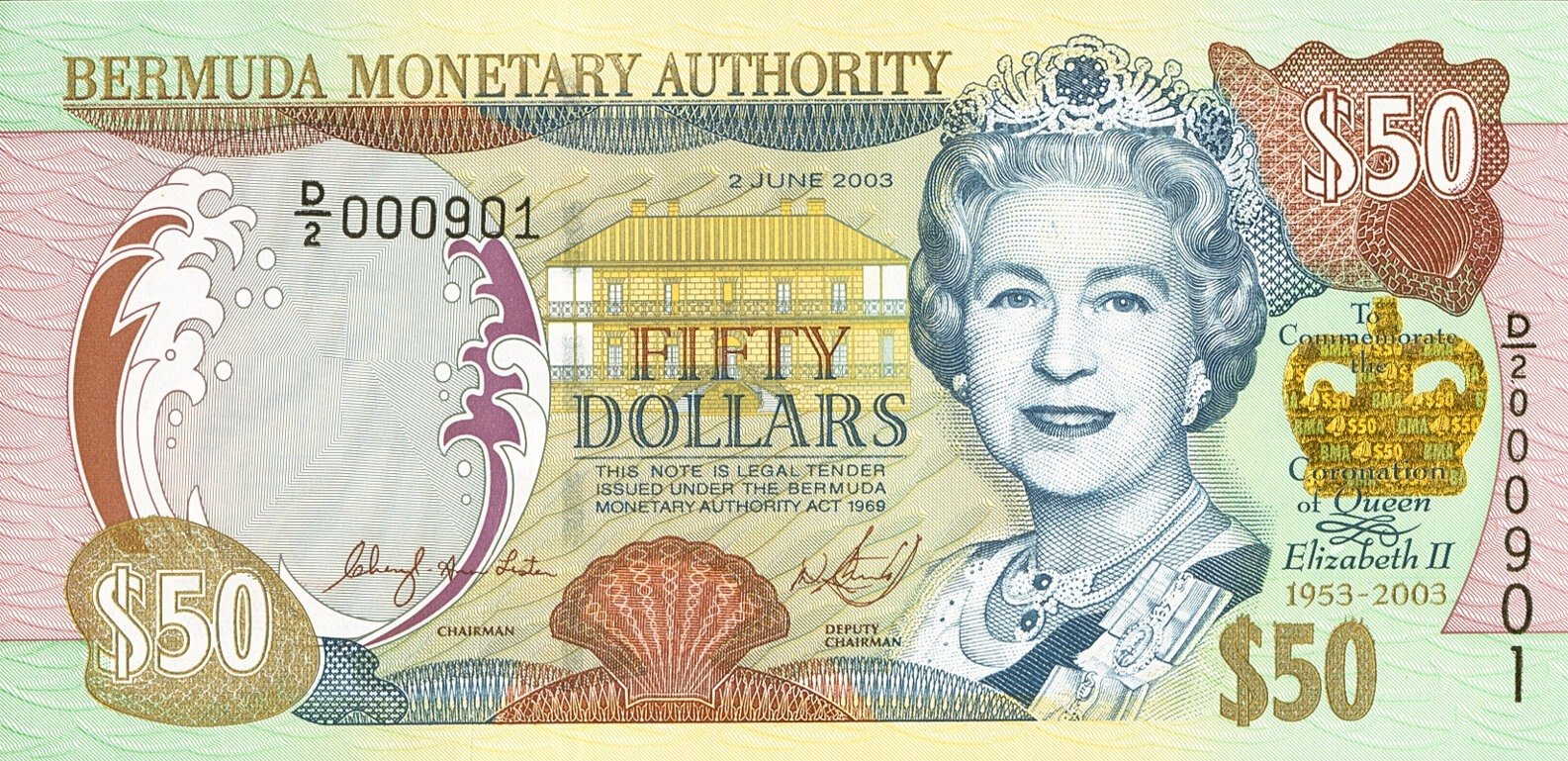
The 10, 20, 50 and 100 dollars of 2000 are signed by the Chairman Cheryl-Ann Lister, with the Directors Morris, Whaley, Darren Q. Johnston and Gregory D. Haycock in that order. The 2, 10 and 50 dollars were printed again with the date 7 May 2007; the 10 and 50 dollars of that date are signed by the Chairman R. Alan F. Richardson, with Morris and Robert Steinhoff. A 50 dollars dated 2 June 2003 marks the 50th anniversary of the coronation; its prefix D/2 lies between the D/1 of 2000 and the D/3 of 2007. A second printing of the 20 dollars keeps the date 24 May 2000 and is told from the first by its foil patch; sources mention December 2008 for its introduction, which is not confirmed.
Sources
- The catalogue pages of the notes of Bermuda, which name the Colonial Office reports and Blue Books, the Colonial Office List for 1921, 1937 and 1948, and Bank Note Reporter.
- Bank Note Reporter, July 2000: the Bermuda Monetary Authority's specification of the 2000 notes.
- Stack's Bowers, 8 May 2025, lot 50041; Heritage, 9 November 2023, lots 24077 and 24078; Heritage, 23 April 2020, lot 28227; Heritage, 18 September 2020, lot 28079.
- Bermuda Monetary Authority Act 1969 (1969 : 57), consolidated text at Bermuda Laws Online, for the assent on 20 February 1969 and the start of Part IV on 6 February 1970.


Member comments
Log in or register to post a comment.