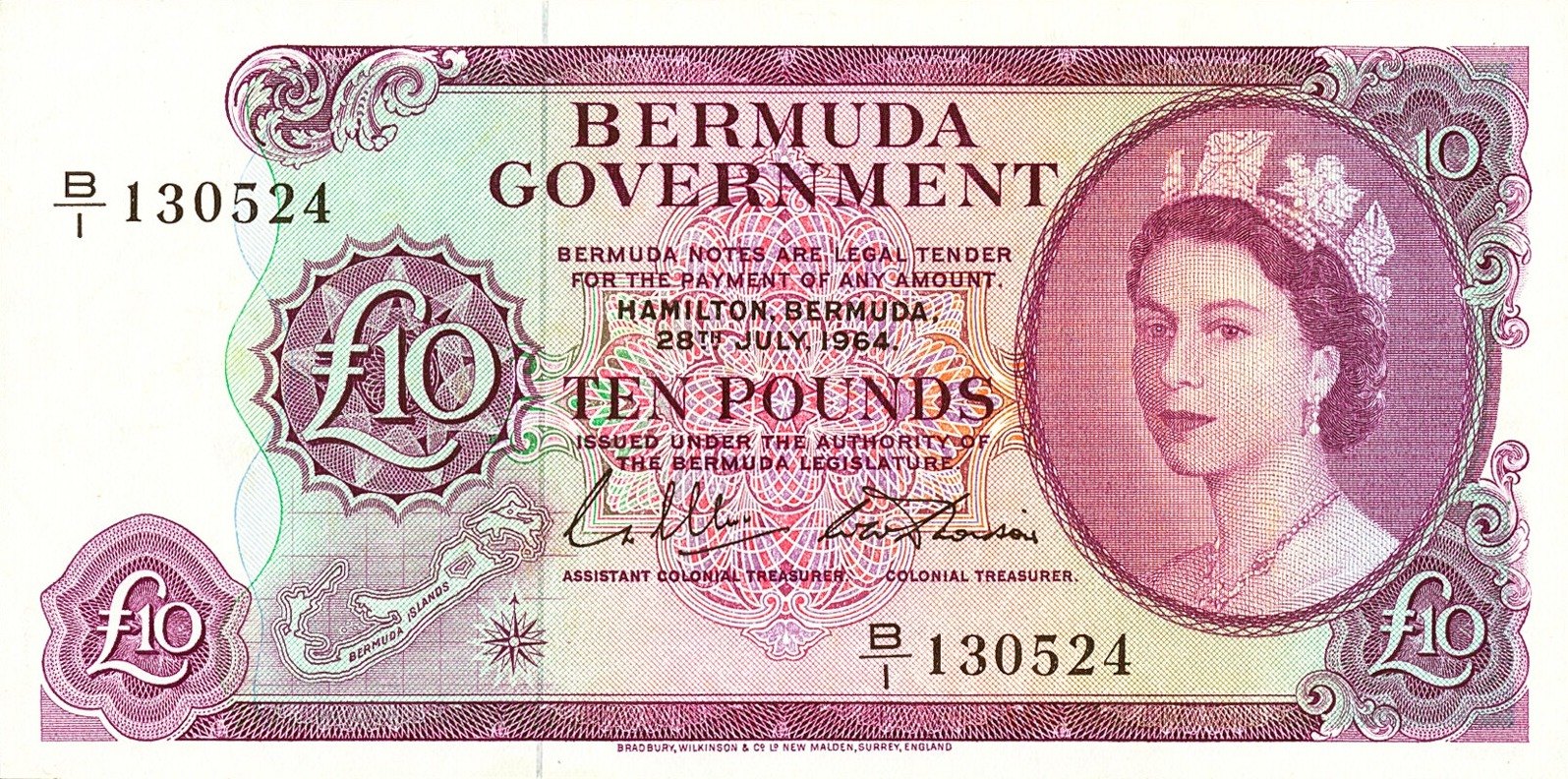
The last notes of Bermuda in pounds and shillings are the Elizabeth II issue of 1952 to 1966. This article sets out their dates and signers and then three matters the catalogue pages treat at length: a robbery in 1957, the short life of the ten pounds, and the withdrawal of 1970. The sources are the catalogue pages, two articles by Nelson P. Aspen in Bank Note Reporter, the Bermuda Reports for 1969 to 1971 and the descriptions of Spink, Heritage and Stack's Bowers.
The issue and its four dates
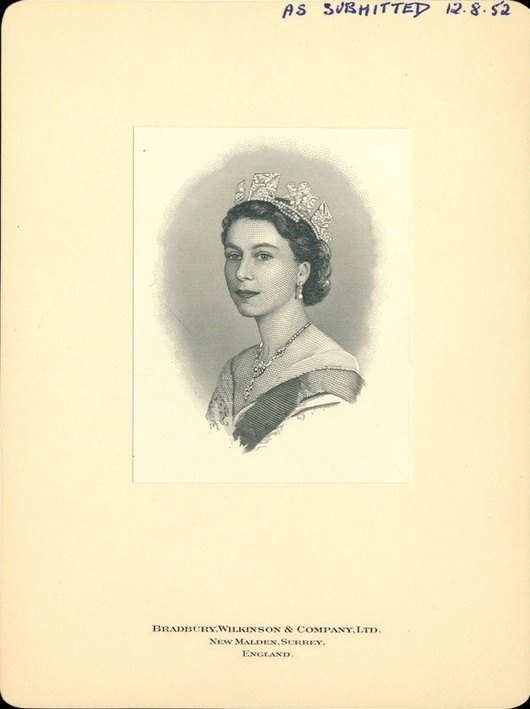
Bradbury Wilkinson printed the whole issue. Sources mention that the portrait of the Queen follows a 1952 photograph by Dorothy Wilding, engraved by Bradbury Wilkinson. Davidson, whom the pages name as the Colonial Treasurer on the notes of 1952, 1957 and 1966, holds that office in the Colonial Office List for 1948.
| Date on the notes | Values | Second signer and title |
|---|---|---|
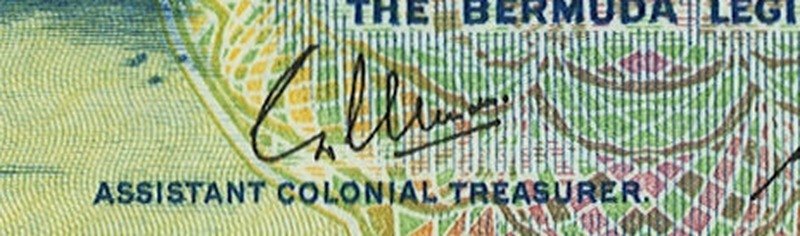
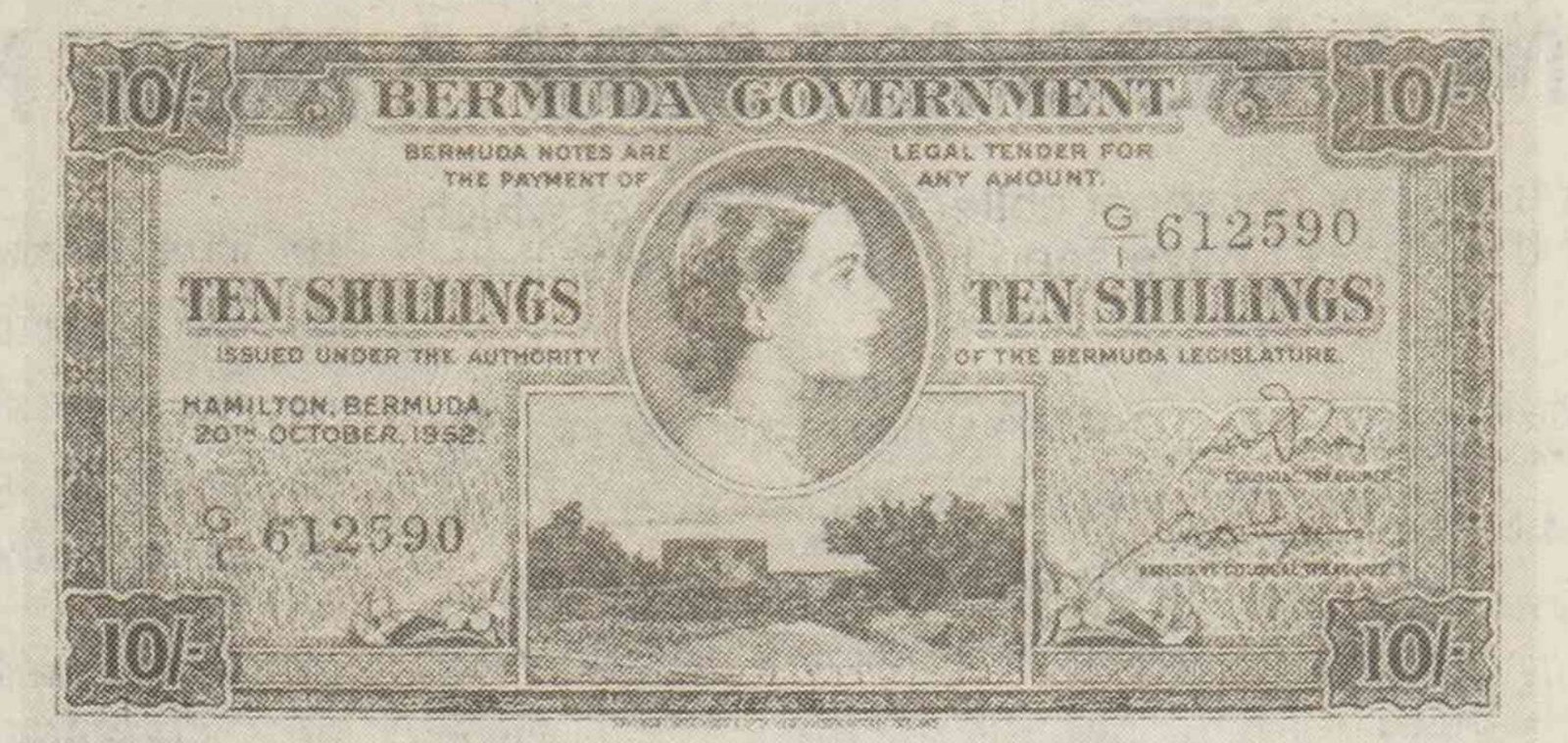
| 20th October 1952 | 5 and 10 shillings, 1 and 5 pounds | Kempe, Assistant Colonial Treasurer |
| 1st May 1957 | 5 and 10 shillings, 1 and 5 pounds | Lumsden, Assistant Colonial Treasurer |
| 28th July 1964 | 10 pounds | Assistant Colonial Treasurer |
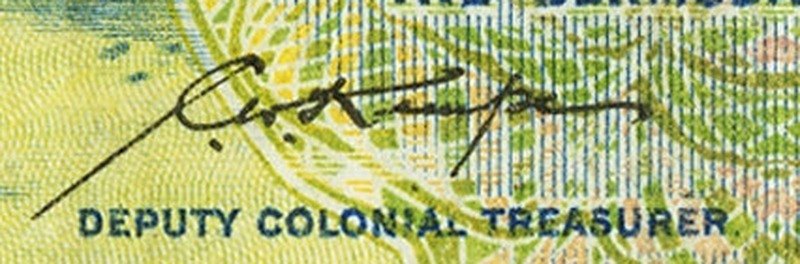
| 1st October 1966 | 10 shillings, 1 and 5 pounds | Kempe, Deputy Colonial Treasurer |
The 5 shillings was not printed again in 1966. On the 10 shillings, the 1 pound and the 5 pounds the title under the second signature separates the last two dates: ASSISTANT COLONIAL TREASURER in 1957, DEPUTY COLONIAL TREASURER in 1966.
The serial numbers run on from prefix to prefix through all the dates, 100,000 notes to a prefix, without the letters I and O, and start again from 000001 at every tenth prefix. The 5 pounds shows the plan: A/1 000001 to E/1 500000 in 1952, F/1 500001 to K/1 1000000 in 1957, then L/1 000001 onward. Heritage (8 December 2023, lot 22048) gives the same range for the 1952 five pounds.
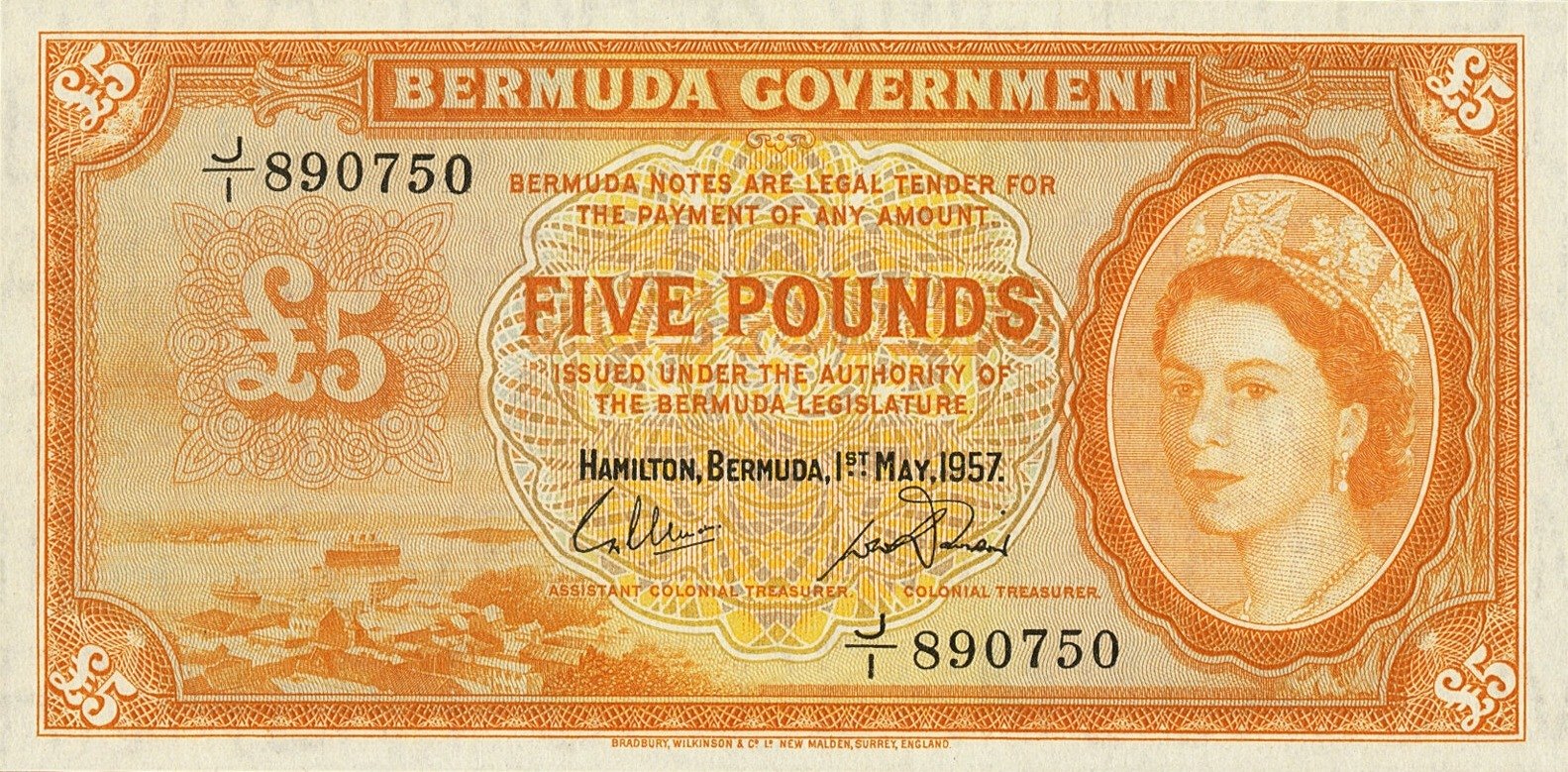
A security thread came in during the printing of the 1957 notes. The 1 pound and the 5 pounds of 1st May 1957 exist without it and with it, and the 5 pounds of 1966 has it. On the 5 pounds the notes with the thread begin a new run at L/1 000001.
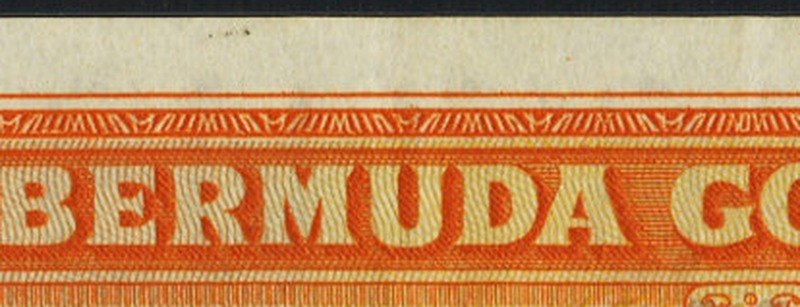
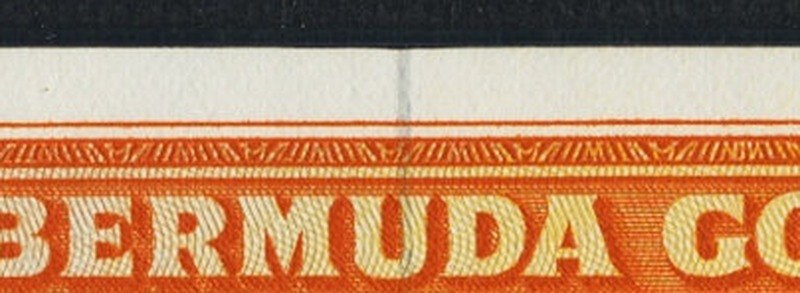
Two points are not settled. The Z/1 notes of 1957 on the 5 shillings and the 1 pound, and the Z/2 notes of 1966 on the 1 pound, are numbered in the ordinary run, so they may be ordinary prefixes and not replacements. A grading company's holder calls the Z/1 5 shillings a replacement, and the notes stand on the replacement rows until this is settled.
The robbery of May 1957
Nelson P. Aspen, writing in Bank Note Reporter in October 1986, tells how three armed men robbed the Somerset branch of the Bank of Bermuda of 10,110 pounds in mid-May 1957. Among the money taken were four bricks of 1,000 one pound notes each. Their numbers were:
- H/1 730001 to H/1 731000
- H/1 732001 to H/1 733000
- H/1 736001 to H/1 737000
- H/1 742001 to H/1 743000
The article prints two of these ranges with an extra figure. H/1 is a prefix of the 1 pound notes dated 20th October 1952.
Only one note from the robbery, a 10 shillings, was ever identified, and Aspen wrote that none of the stolen one pound numbers had been seen since. Three men were charged: one pleaded guilty and the other two were acquitted.
The ten pounds of 1964
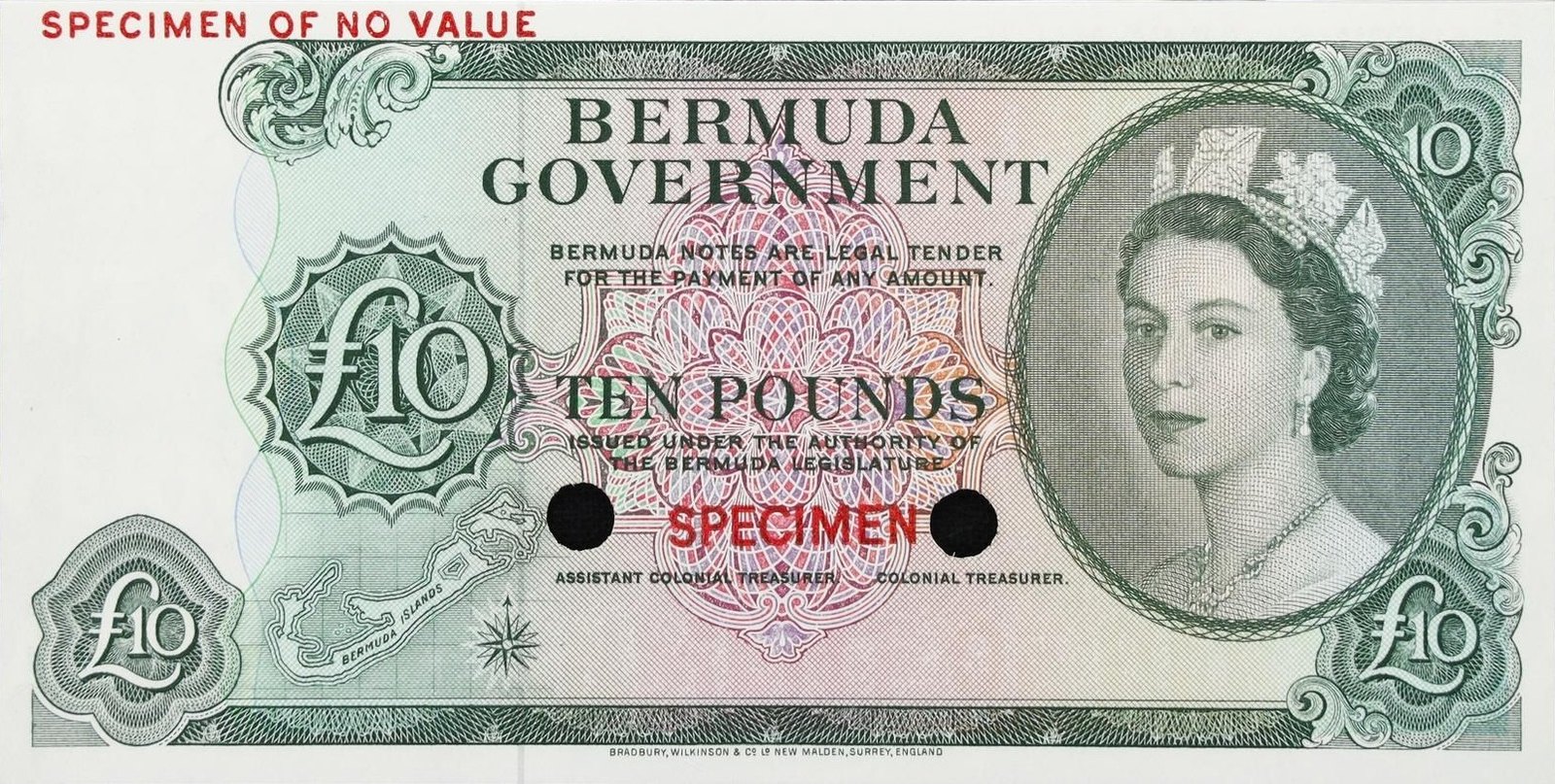
The 10 pounds was approved by the Bermuda Currency Notes Act of 16th December 1963 and issued with one date, 28th July 1964, on the prefixes A/1 to C/1.
How many were printed
Spink (8 October 2007, lot 147), Heritage (9 January 2020, lot 28022) and Heritage (24 April 2020, lot 26066) all give 300,000, which is the three prefixes at 100,000 each. Heritage (21 January 2021, lot 28032) names the printer's records as the source of the figure.
When it came out
Heritage (9 January 2020, lot 28022) says the note was conceived because of inflation and the fall of the pound against the United States dollar, that Bradbury Wilkinson printed it, and that the issue was held back a little by a fault with the security thread, coming out in November 1964. The same description says the value was little liked at first and found more use after sterling was devalued in 1967. Heritage (21 April 2022, lot 25052) says instead that the note was first issued in 1966. The two statements of the same house do not agree, and the pages hold no official date of issue.
How many were issued
This is not settled, and the houses give three answers.
- Spink (8 October 2007, lot 147) says the first 50,000 were not inventoried and the last 50,000 never placed in circulation.
- Heritage (23 April 2020, lot 28233, and 24 April 2020, lot 26066) says about 200,000 were issued.
- Heritage (9 January 2020, lot 28022, and 18 September 2020, lot 28093) says 250,000, numbers 000001 to 250000, the last 50,000 said to have been destroyed. Heritage (21 January 2021, lot 28032) also gives about 250,000.
The notes themselves speak against a clean cut at 250,000. The catalogue page records notes from A/1 000001 upward and notes numbered above C/1 250000, so some of the last 50,000 did get out. Heritage says as much of the note in its lot 28022, which has a number from the stock that was supposed not to have been issued.
Nelson P. Aspen, writing in Bank Note Reporter in January 1987, said that only 930 of the ten pound notes were not accounted for by destruction. Aspen gives no source for the figure. Heritage (9 November 2023, lot 24081) says most of the notes were redeemed from 1970, when Bermuda changed to a decimal currency.
Trials
Stack's Bowers (2 October 2024, lot 20076) describes a colour trial specimen of the 10 pounds printed in green, where the issued note is purple. The 10 pounds is also recorded as a progressive proof, a die proof and proofs, listed with its varieties.
The withdrawal of 1970
The dollar took the place of the pound on 6th February 1970. The Bermuda Monetary Authority Act 1969, in the consolidated text at Bermuda Laws Online, provides that from 6 February 1970 every contract, payment and dealing in money is deemed to be made in the currency of Bermuda, and that a reference to pounds, shillings or pence in any statutory provision is to be read as the equivalent sum in that currency.
The old pound notes ceased to be legal tender on 30th June 1970. The Bermuda Report for 1969 and 1970 counts 227,269 pounds 10 shillings of them, of all values, still unredeemed at the end of 1970, and the report for 1971 counts 205,400 pounds.
| End of year | Old pound notes of all values still unredeemed | Source |
|---|---|---|
| 1970 | 227,269 pounds 10 shillings | Bermuda Report for 1969 and 1970 |
| 1971 | 205,400 pounds | Bermuda Report for 1971 |
The reports do not divide the figure by value, so they cannot test Aspen's 930 ten pound notes. The pages hold no figure for the years after 1971.
Sources
- The catalogue pages of the five notes, with the printer's range specimens listed there.
- Nelson P. Aspen in Bank Note Reporter, October 1986 (the robbery) and January 1987 (the ten pounds).
- The Bermuda Report for 1969 and 1970, and the Bermuda Report for 1971.
- The Colonial Office List for 1948.
- Spink, 8 October 2007, lot 147.
- Heritage, 9 January 2020, lot 28022; 23 April 2020, lot 28233; 24 April 2020, lot 26066; 18 September 2020, lot 28093; 21 January 2021, lot 28032; 21 April 2022, lot 25052; 9 November 2023, lot 24081; 8 December 2023, lot 22048.
- Stack's Bowers, 2 October 2024, lot 20076.
- Bermuda Monetary Authority Act 1969 (1969 : 57), consolidated text at Bermuda Laws Online.


Member comments
Log in or register to post a comment.