The Bermuda Monetary Authority has issued every Bermuda note since 1970. This article follows its first twenty years, from the Act that created it to the new series of 1989. It rests on the catalogue pages, on reports and letters in Bank Note Reporter between 1983 and 2001, on the text of the Act and on the descriptions of the auction houses.
The Act of 1969
The Authority was created by the Bermuda Monetary Authority Act, 1969 (No. 57 of 1969), which made it the only issuer of notes in place of the Bermuda Currency Commissioners. The consolidated text of the Act at Bermuda Laws Online records the assent on 20 February 1969. Its Part IV sets up the currency of Bermuda, a dollar divided into one hundred cents, and provides that no person other than the Authority shall issue currency notes. That Part came into operation on 6 February 1970, the rest of the Act on 20 February 1969.
The first dollar notes, 6th February 1970
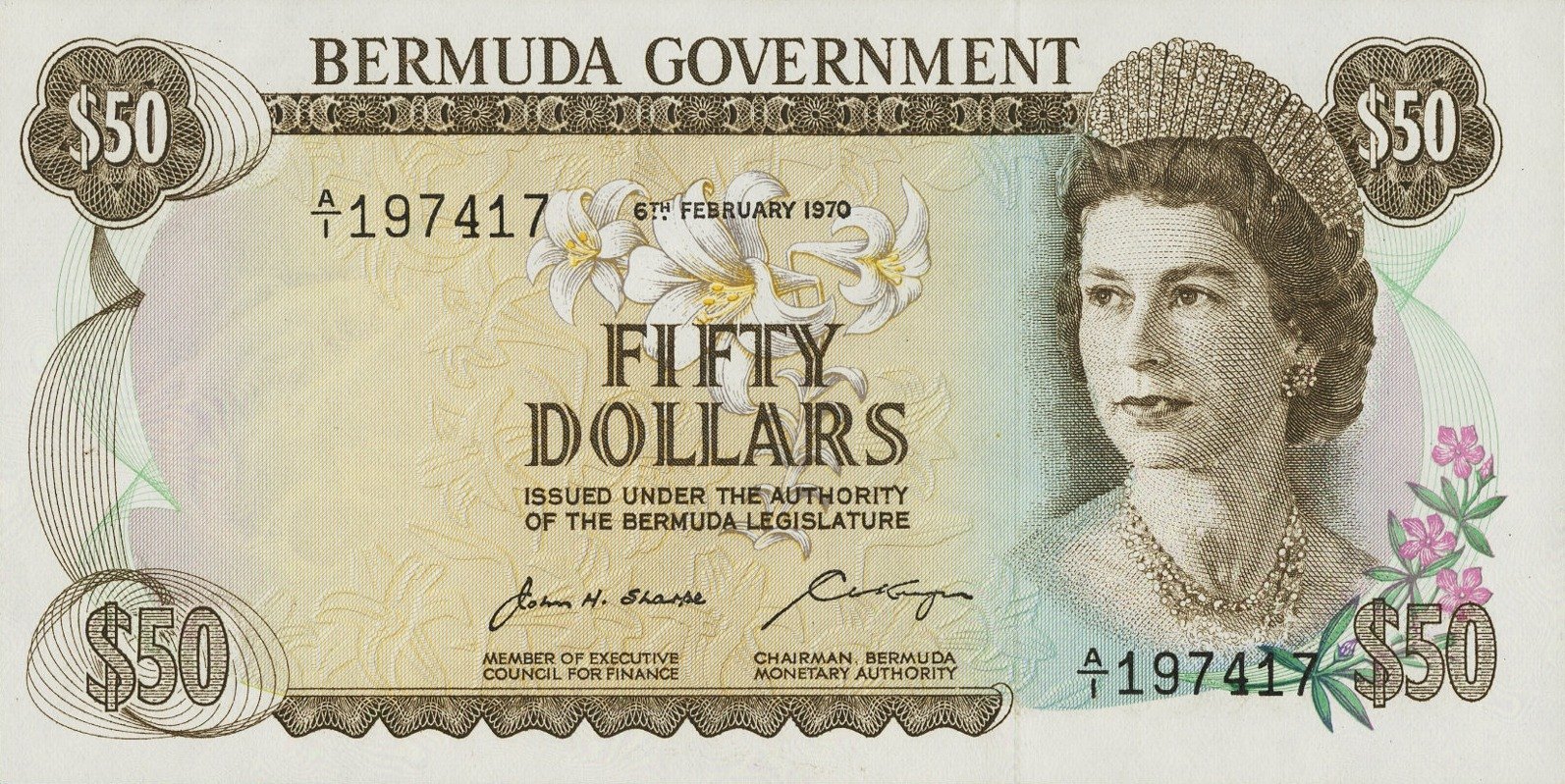
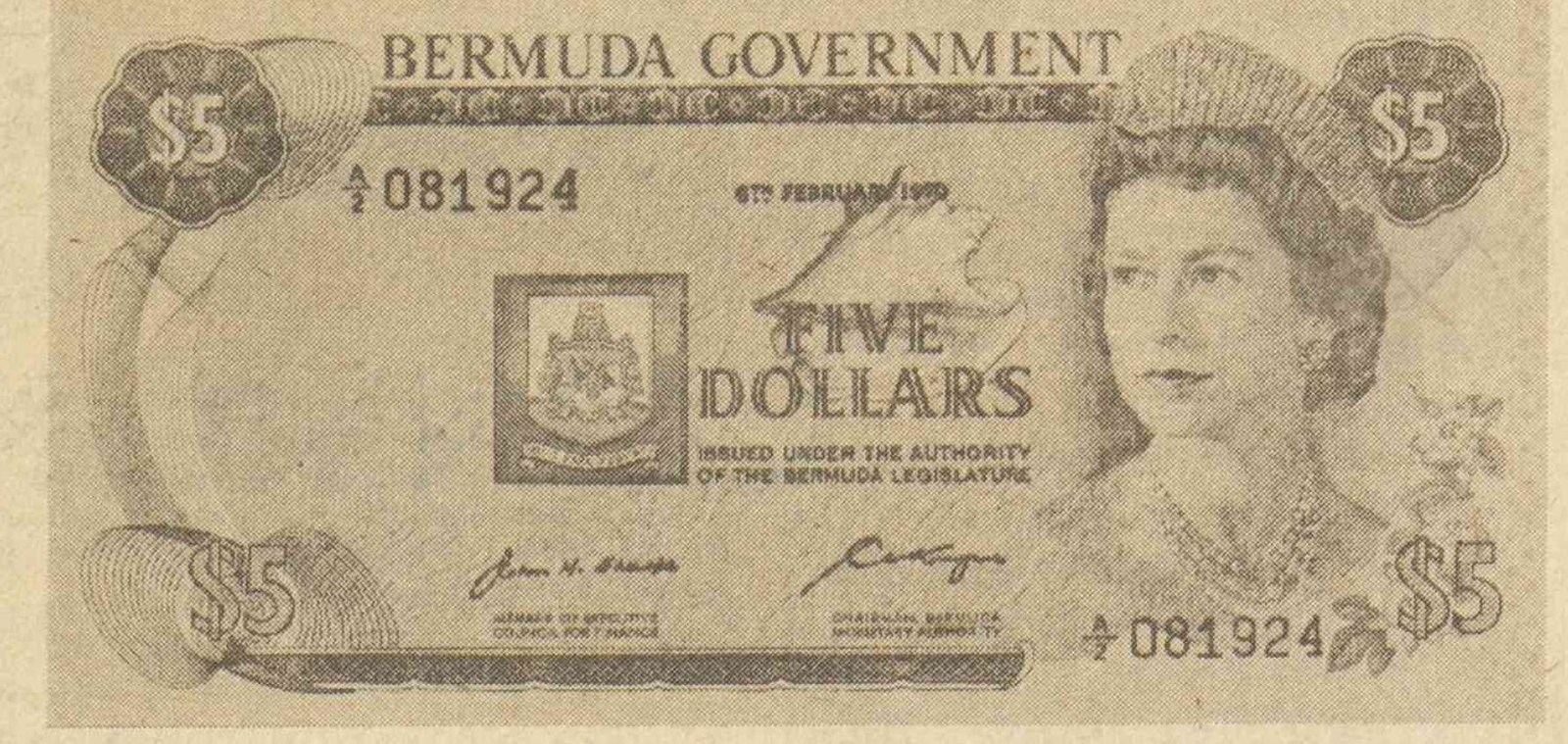
The first decimal notes carry the date on which Part IV began: 6th February 1970. There are five values, the 1 dollar, 5 dollars, 10 dollars, 20 dollars and 50 dollars, all printed by De La Rue. They still print BERMUDA GOVERNMENT at the top and are signed by the Member of Executive Council for Finance at left and the Chairman, Bermuda Monetary Authority at right. Sources mention that the portrait follows a photograph by Anthony Buckley taken in October 1960.
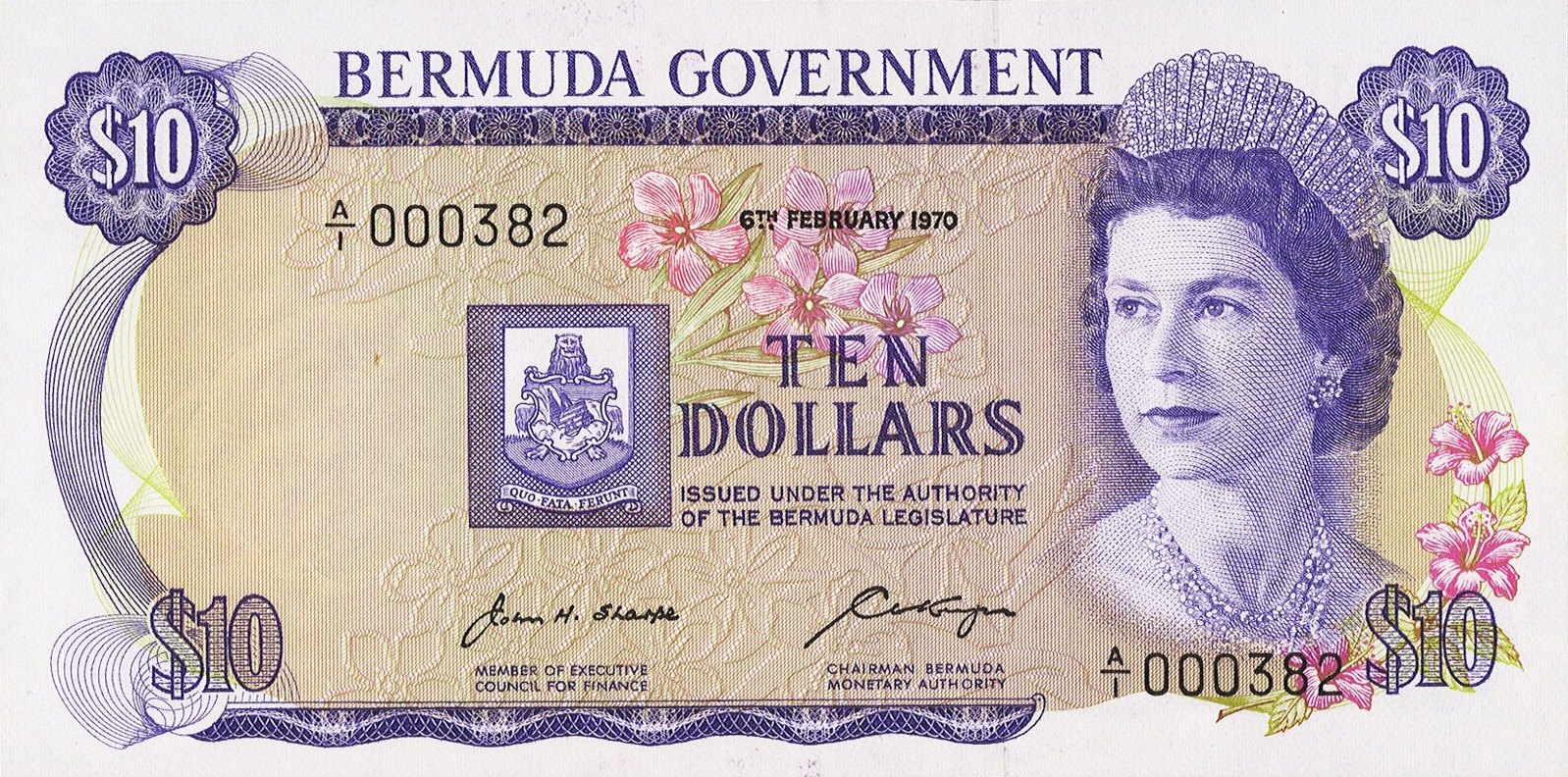
The 5 and 10 dollars have the prefixes A/1 and A/2, the 20 and 50 dollars A/1 only. Stack's Bowers (2 October 2025, lot 50049) says 200,000 of the 50 dollars were printed, the smallest printing of the series.
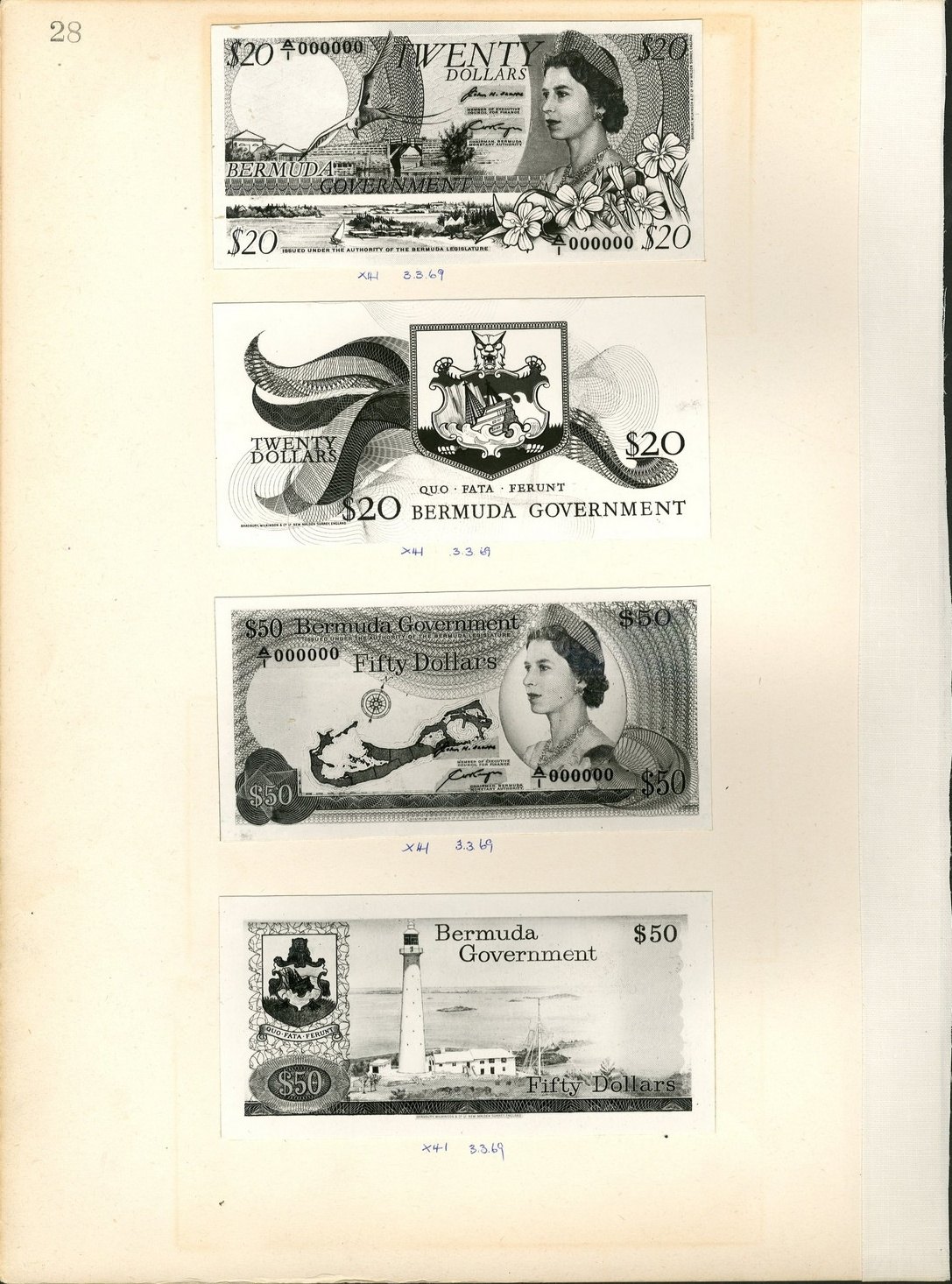
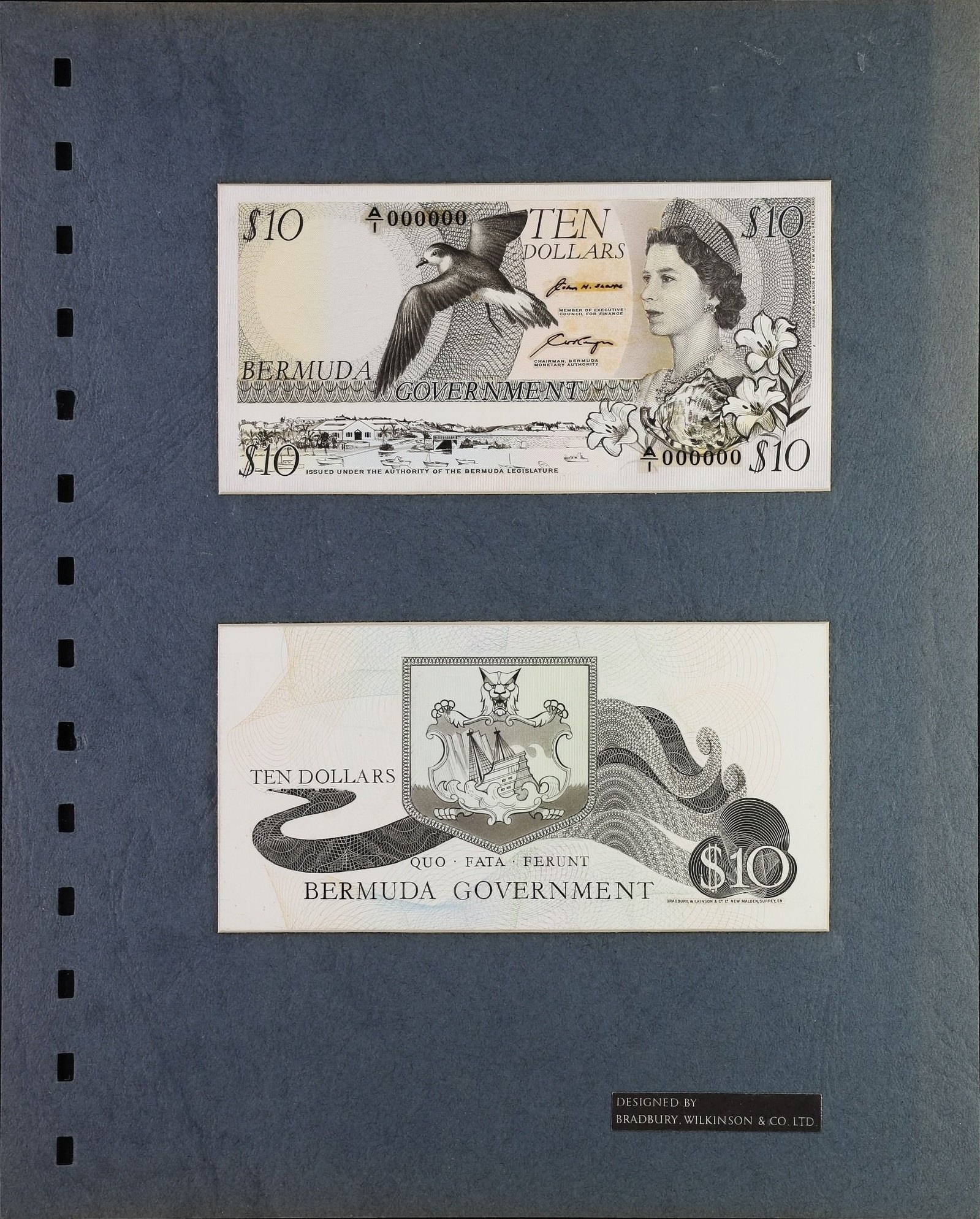
Two lots show designs that were tried before these notes. Spink's description of lot 460 in its sale of 15 July 2014 lists printer's archival photographs of a 5, 10, 20 and 50 dollars with the imprint of Bradbury Wilkinson, the firm that had printed the sterling notes, and a printer's annotation of 3.3.69; Spink points out that the issued notes of 1970 were printed by De La Rue. Stack's Bowers (5 September 2026, lot 30025) describes Bradbury Wilkinson printer's models for the front and back of a 10 dollars, pasted on a black archival sheet, in a design that was not issued.
Notes in the Authority's name, 1974 to 1988
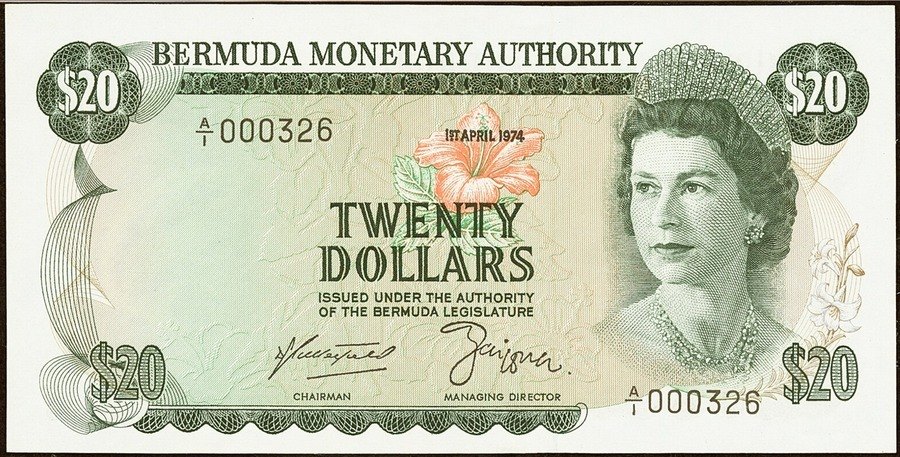
Sources mention that notes headed with the name of the Bermuda Monetary Authority began in 1974. The earliest dates on them are 1st April 1974 on the 20 dollars and 1st May 1974 on the 50 dollars, and Heritage (18 September 2020, lot 28097) calls those two values the first notes the Authority issued.
| Value | Dates on the notes |
|---|---|
| 1 dollar | 1st July 1975, 1st December 1976, 1st April 1978, 1st September 1979, 2nd January 1982, 1st May 1984, 1st January 1986, 1st January 1988 |
| 5 dollars | 1st April 1978, 2nd January 1981, 1st January 1986, 1st January 1988 |
| 10 dollars | 1st April 1978, 2nd January 1982 |
| 20 dollars | 1st April 1974, 1st March 1976, 2nd January 1981, 1st May 1984, 1st January 1986 |
| 50 dollars | 1st May 1974, 1st April 1978, 2nd January 1982 |
| 100 dollars | 2nd January 1982, 14th November 1984, 1st January 1986 |
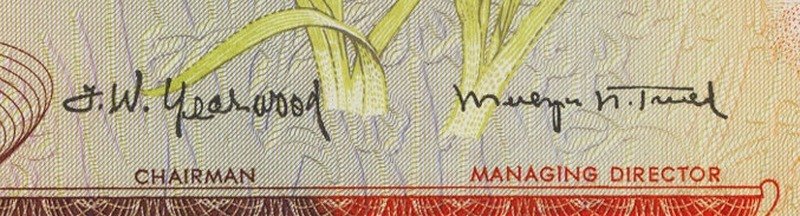
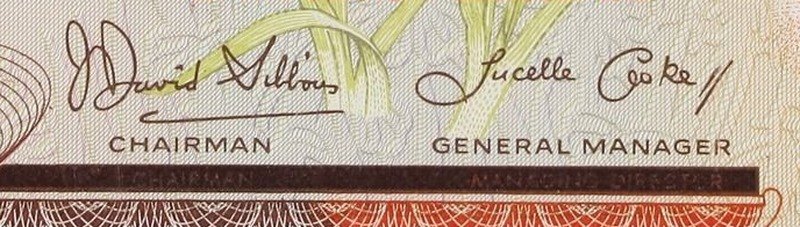
The titles under the signatures change with the years: Chairman and Managing Director to 1984, Chairman and General Manager on the notes of 1986 and on the 100 dollars of 14th November 1984, Chairman and Director in 1988. The Chairman Butterfield of 1975 to 1979 and the Director Butterfield of 1988 are two different people. Replacement notes carry the prefix Z/1, and their numbers run on from one date to the next.
Of the first 50 dollars Heritage (8 December 2023, lot 22057, and 9 November 2023, lot 24082) says 300,000 notes dated 1st May 1974 were printed, and Heritage (21 January 2021, lot 28037) that 300,000 were issued. Heritage (18 September 2020, lots 28096 and 28097) puts the next date, 1978, down to the inflation of the later 1970s.
The 100 dollars of 1982
The 100 dollars came out with the date 2nd January 1982. Joel Shafer, writing in Bank Note Reporter in December 2001, says the two raised circles at left and right on the front are there for the blind and honour the Year of the Disabled (1981 to 1982).
A letter of Nelson Page Aspen printed in Bank Note Reporter in February 1985, written after Aspen talked with Adrian Bernard of the Bermuda Monetary Authority, says that 200,000 notes were ordered for the issue of 2nd January 1982, but that only 100,000 of them were signed and numbered, from 1 to 100,000; the other 100,000 were printed without signatures. Shafer, quoting Aspen's book A History of Bermuda and its Paper Money in the same paper in December 2001, also gives 100,000 as the number delivered. Aspen's letter adds that early in 1985 about 26 per cent of the 1982 notes could not be accounted for and seemed to be held privately.
The notes of 14th November 1984 have a brown bar printed over the old titles CHAIRMAN and MANAGING DIRECTOR, with CHAIRMAN and GENERAL MANAGER printed above the bar, and sources mention that they start at A/1 100000. The page does not say whether these are the 100,000 notes that had been left without signatures. The notes of 1st January 1986 have the new titles and no bar. Aspen's letter says that Lucelle Cooke, who signs the notes of 1984 and 1986, was the first woman whose name appeared on a Bermuda note.
Sets for collectors, 1983 and 1985
Bank Note Reporter of April 1983 reported that the Authority was selling collectors two kinds of matched sets with serial numbers under 1,000:
- the notes of 6th February 1970, 1 to 50 dollars;
- the notes dated 2nd January 1981 and 1982, 1 to 100 dollars. On the catalogue pages those are the 1, 10, 50 and 100 dollars of 2nd January 1982 and the 5 and 20 dollars of 2nd January 1981.
A. M. Bernard, the Authority's Manager-Accounting, told the paper that the sets were available only because the first brick of 1,000 notes of each value had not been issued before. Bernard added that when the 100 dollars was introduced the Authority thought collectors would welcome the chance to obtain notes in uncirculated condition.
Bank Note Reporter of November 1985 reported that the Authority was also selling sets of five specimens, 1, 5, 10, 50 and 100 dollars. There were two kinds: earlier notes with all-zero serial numbers and four punch holes, and new sets with a serial number and two punch holes. Every note has a large red SPECIMEN on each side.
The coin for the dollar and the series of 1989
Bank Note Reporter of December 1988 reported that on 23rd November 1988 Bermuda announced a 1 dollar coin to take the place of the 1 dollar note and, with it, a 2 dollars, the first note of a new series that was to replace the 5 to 100 dollars by February 1989. A note in the consolidated text of the Act records that the 1 dollar note was called in and ceased to be legal tender after 30 April 1990. The 2 dollars is dated 1st October 1988 and again 1st August 1989. Sources mention that the portrait of the new series follows Peter Grugeon's 1977 Silver Jubilee photograph, engraved by De La Rue.
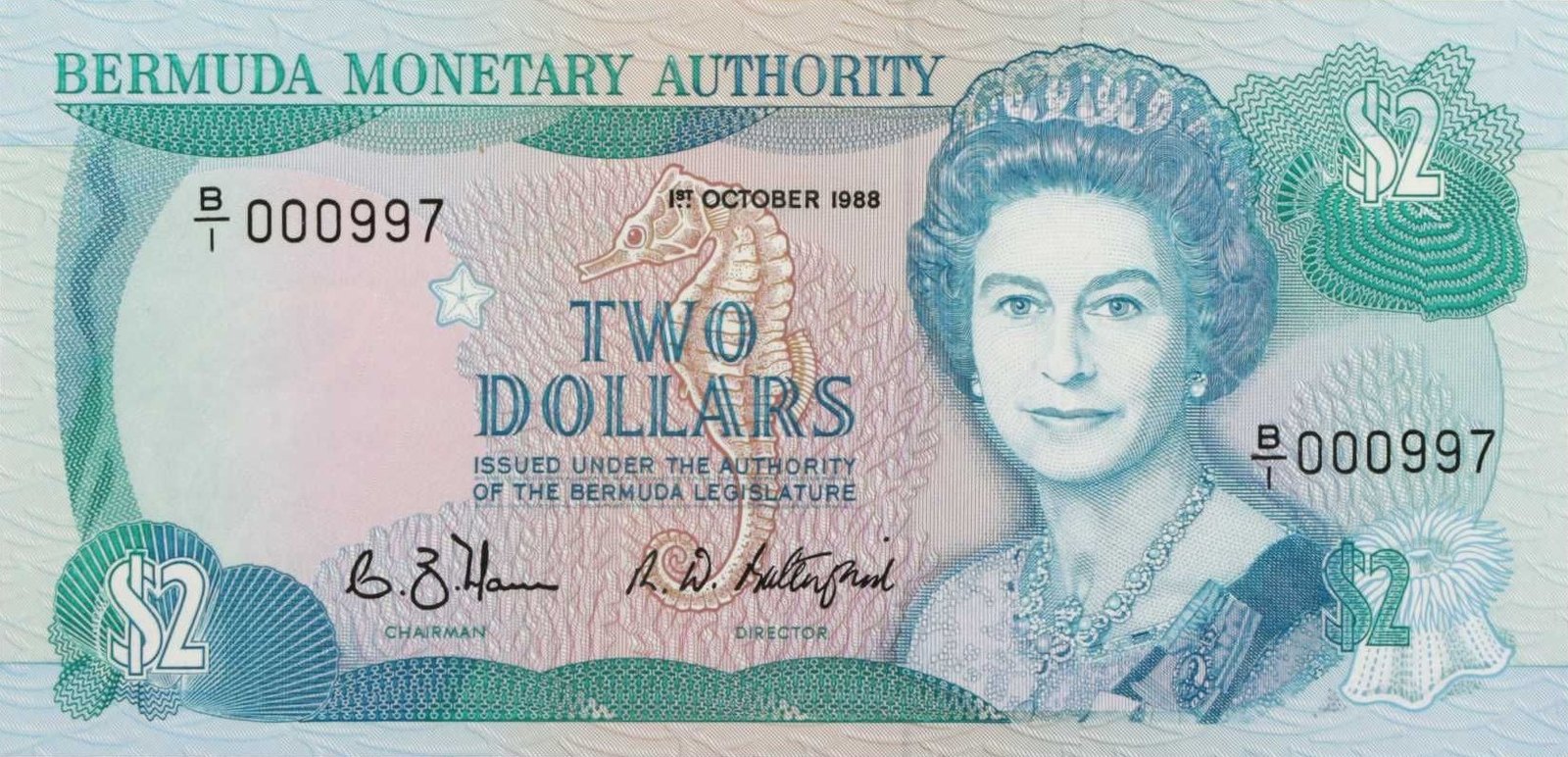
Bank Note Reporter of March 1989 reported that the 5 to 100 dollars were unveiled on 20th February 1989, the twentieth anniversary of the Authority, at a reception given by the printers De La Rue, and that full circulation of the new notes began the next morning. Each value is signed by a different director beside the Chairman, the security thread now carries the word Bermuda, and a silver motif was added to the back of the 50 dollars and the 100 dollars. The 10 dollars and the 20 dollars complete the series. All bear the date of the unveiling.
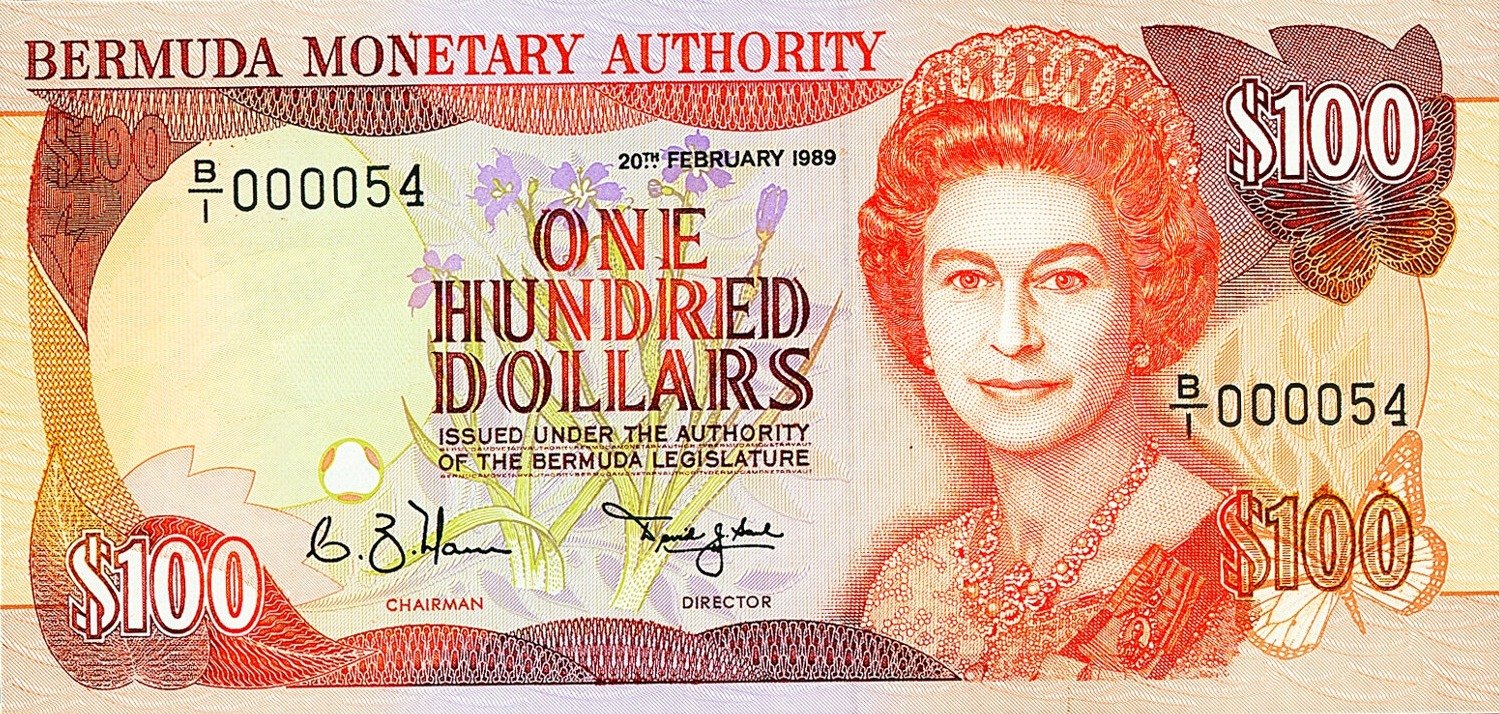
The same report says 100 sets with matching serial numbers were to be set aside. Spink's description of lot 197 in its sale of 17 April 2019 is of such a set, the 2 to 100 dollars all numbered B/1 000006, the five higher values signed by hand by the Chairman and the directors whose printed signatures they carry. It came from the collection of David Saul, who signs the 100 dollars as a Director.
The 5 dollars that lost its signer
Sources mention that the 5 dollars of 1989 was first printed with the signature of the board member Edgar Wilkinson. The day before the notes were introduced Wilkinson was caught trying to leave Bermuda with a large sum of undeclared cash and was forced to resign, so the notes were overprinted with a silver patch bearing the signature of Richard Butterfield instead. No note showing Wilkinson's signature is known.
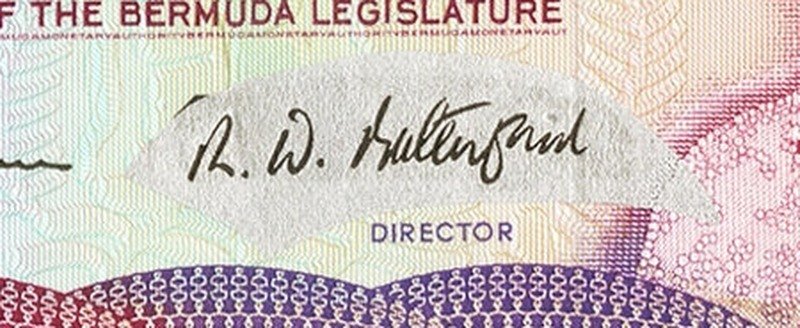
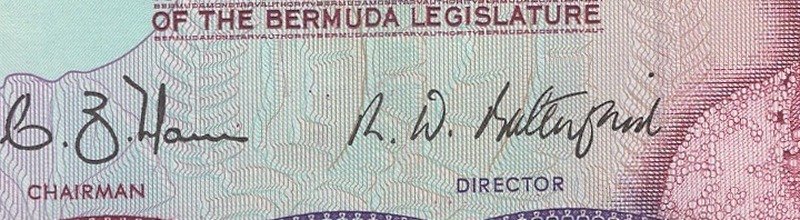
Bank Note Reporter adds two things. The table of directors it printed in March 1989, when the new series was unveiled, still gives Edgar Wilkinson as the signer of the 5 dollars, and its issue of May 1989 reported that the 5 dollars would not be issued until later that year. The catalogue also has a row of the 5 dollars on which the Director's signature stands on plain paper with no patch. Heritage (6 September 2016, lot 81389), citing the Mehilba reference, says 2,000 of the Z/2 replacement notes of the 5 dollars were printed.
Sources
- The catalogue pages of the notes named above.
- Bank Note Reporter: April 1983 (the matched sets); February 1985 (letter of Nelson Page Aspen); November 1985 (the specimen sets); December 1988 (the 1 dollar coin and the 2 dollars); March 1989 (the new series and its table of directors); May 1989 (the 5 dollars); December 2001 (Joel Shafer).
- Bermuda Monetary Authority Act 1969 (1969 : 57), consolidated text at Bermuda Laws Online.
- Spink, 15 July 2014, lot 460; Spink, 17 April 2019, lot 197.
- Heritage, 6 September 2016, lot 81389; 18 September 2020, lots 28096 and 28097; 21 January 2021, lot 28037; 9 November 2023, lot 24082; 8 December 2023, lot 22057.
- Stack's Bowers, 2 October 2025, lot 50049; Stack's Bowers, 5 September 2026, lot 30025.


Member comments
Log in or register to post a comment.