This article sets out the paper money of the British Caribbean Territories in order of time, from the setting up of the British Caribbean Currency Board in 1950 to the last calling in of its notes in 1968. It is drawn from the catalogue's twelve note pages, which rest on the Board's annual reports, the ordinances of the territories, the minutes of the British Guiana council, newspaper reports and the notes themselves. A few statements of the auction houses and one page of the Central Bank of Trinidad and Tobago are added, each named where it is used.
The Board and the laws of 1950
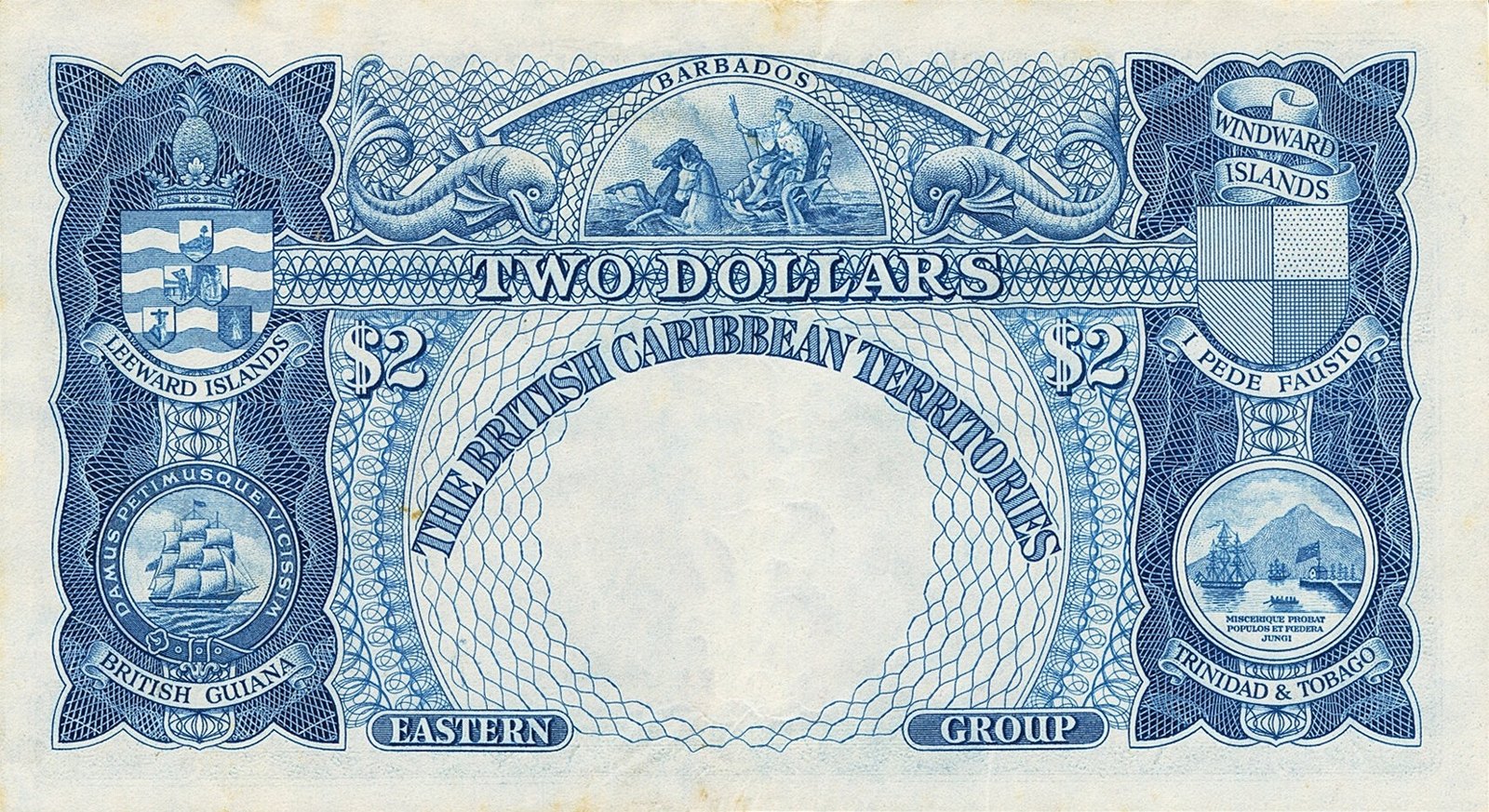
The British Caribbean Currency Board was set up in 1950 at Port of Spain to issue one currency, the British West Indies dollar of 100 cents, for five territories: Trinidad and Tobago, British Guiana, Barbados, the Leeward Islands and the Windward Islands. The badges of the five are on the back of every note.
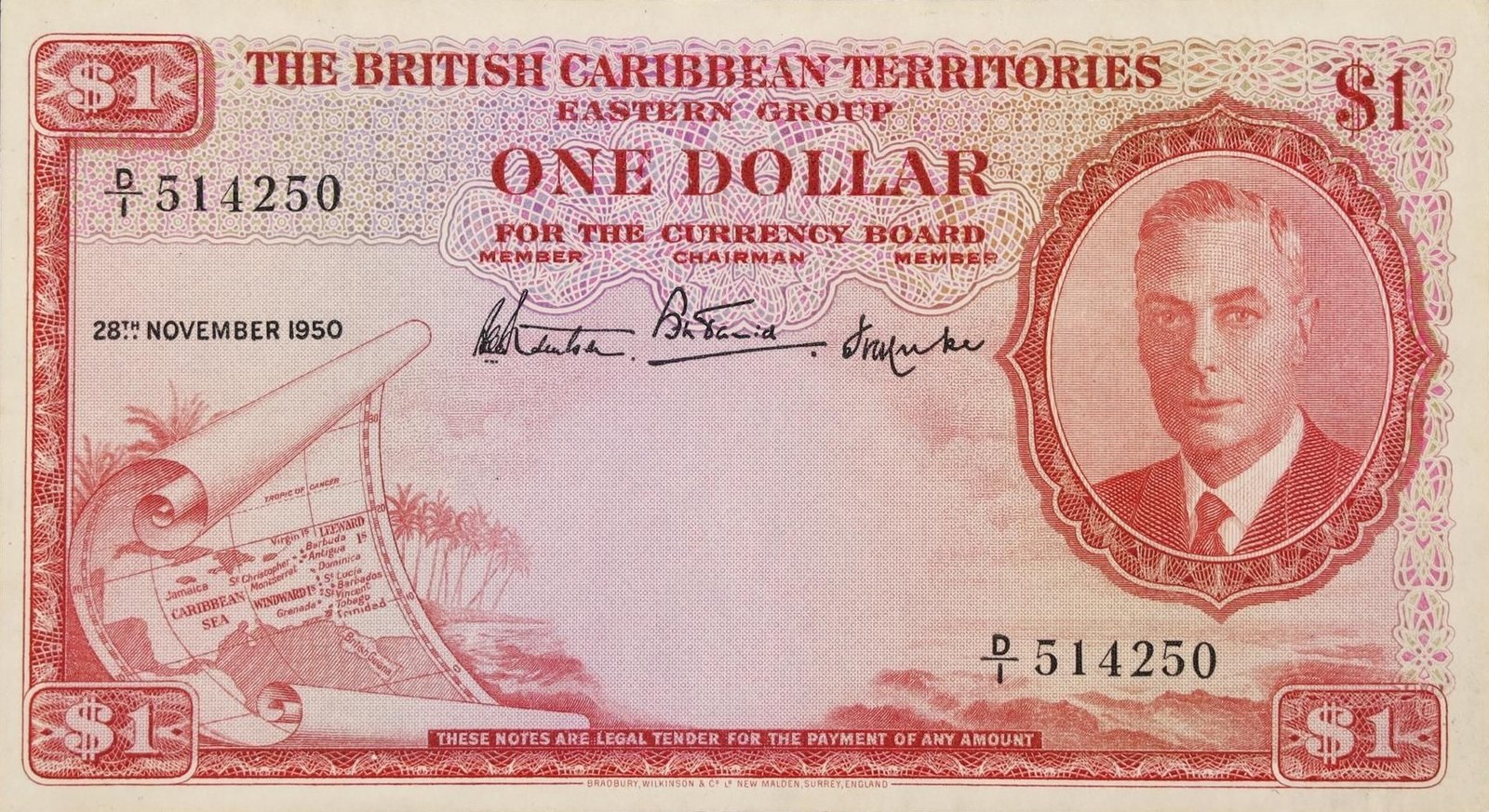
The Board was constituted on 28th November 1950, and that is the date its first notes carry. It had one member nominated for each of the five territories and an Executive Commissioner. The members chose their own Chairman.
Each territory passed its own Currency Ordinance in 1950 to give the agreement force. In British Guiana it was No. 20 of 1950, of 16th June 1950. In the Leeward Islands it was the Currency Act, No. 4 of 1950, of 20th July 1950. The pages do not give the numbers of the ordinances of Trinidad and Tobago, Barbados or the Windward Islands.
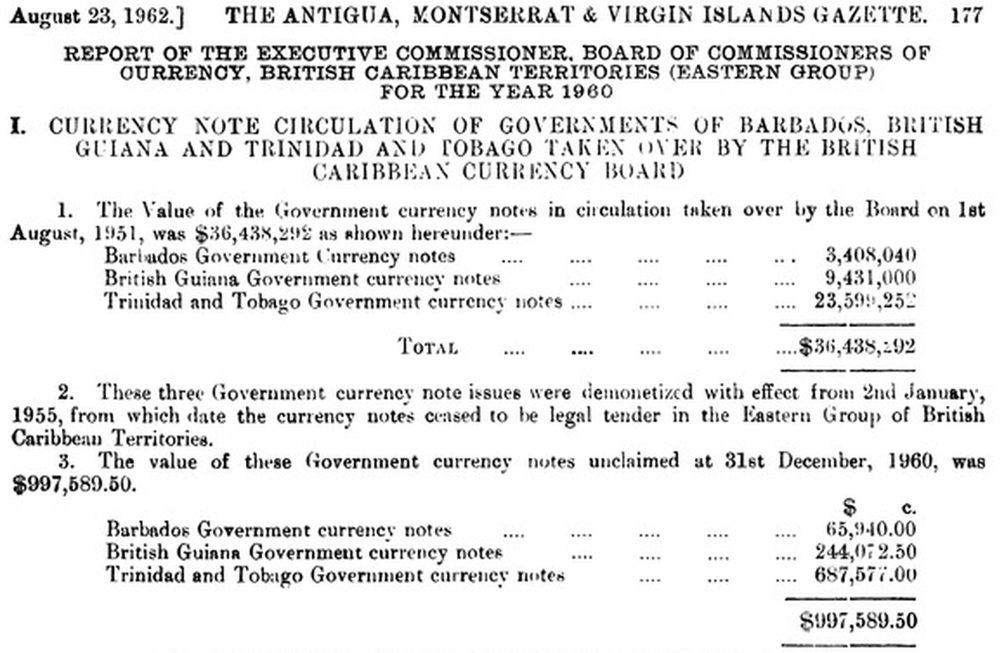
The part of the law that dealt with notes took effect on 1st August 1951. On that day the Board took over the Government notes of Trinidad and Tobago, British Guiana and Barbados then in circulation: 36,438,292 dollars in all, by the Board's own count. Those Government notes ceased to be legal tender on 2nd January 1955.
Two outside statements differ a little from this. The history page of the Central Bank of Trinidad and Tobago puts the introduction of the Board in 1951, where the note pages give 1950 for its setting up and 28th November 1950 for its constitution. Spink's description of lot 43 in its sale of 12 January 2024 names Barbados, British Guiana, British Honduras and the British Virgin Islands as the participating territories. The note pages, and the five badges on the notes, give the five territories listed above.
The designs and the printer
All the Board's notes were printed by Bradbury Wilkinson. Specimens of the six notes were shown to the public in each territory on 27th April 1951. The Barbados Advocate reported next day that Bradbury Wilkinson's designs had been chosen in preference to those of De La Rue and Waterlow.
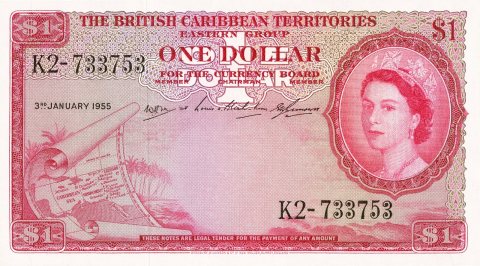
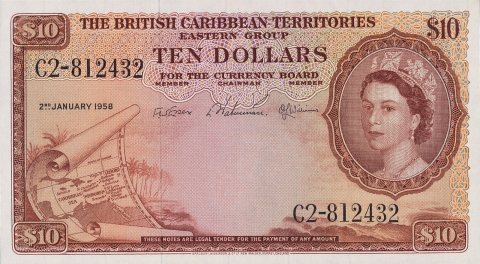
The six values share one design. The front has the portrait of the sovereign and a map of the Caribbean, the back the arms of the member territories. A drawing of 1948 for a note headed "British Caribbean Colonies", and the trials and specimens that the printer made, are treated in British Caribbean Territories: designs, specimens and colour trials, and the grading counts the auction houses gave.
The King George VI notes of 1950 and 1951
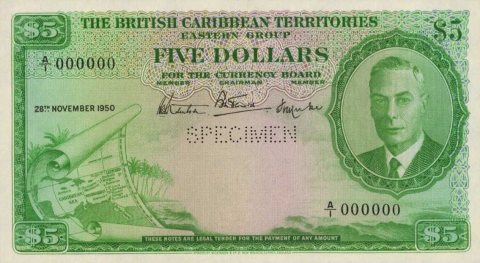
The first notes are dated 28th November 1950 and 1st September 1951. They carry King George VI. There are six values: the 1 dollar, the 2 dollars, the 5 dollars, the 10 dollars, the 20 dollars and the 100 dollars. The paper is watermarked with a sailing ship and has no security thread. The serial prefixes are fractional: A/1, B/1 and so on.
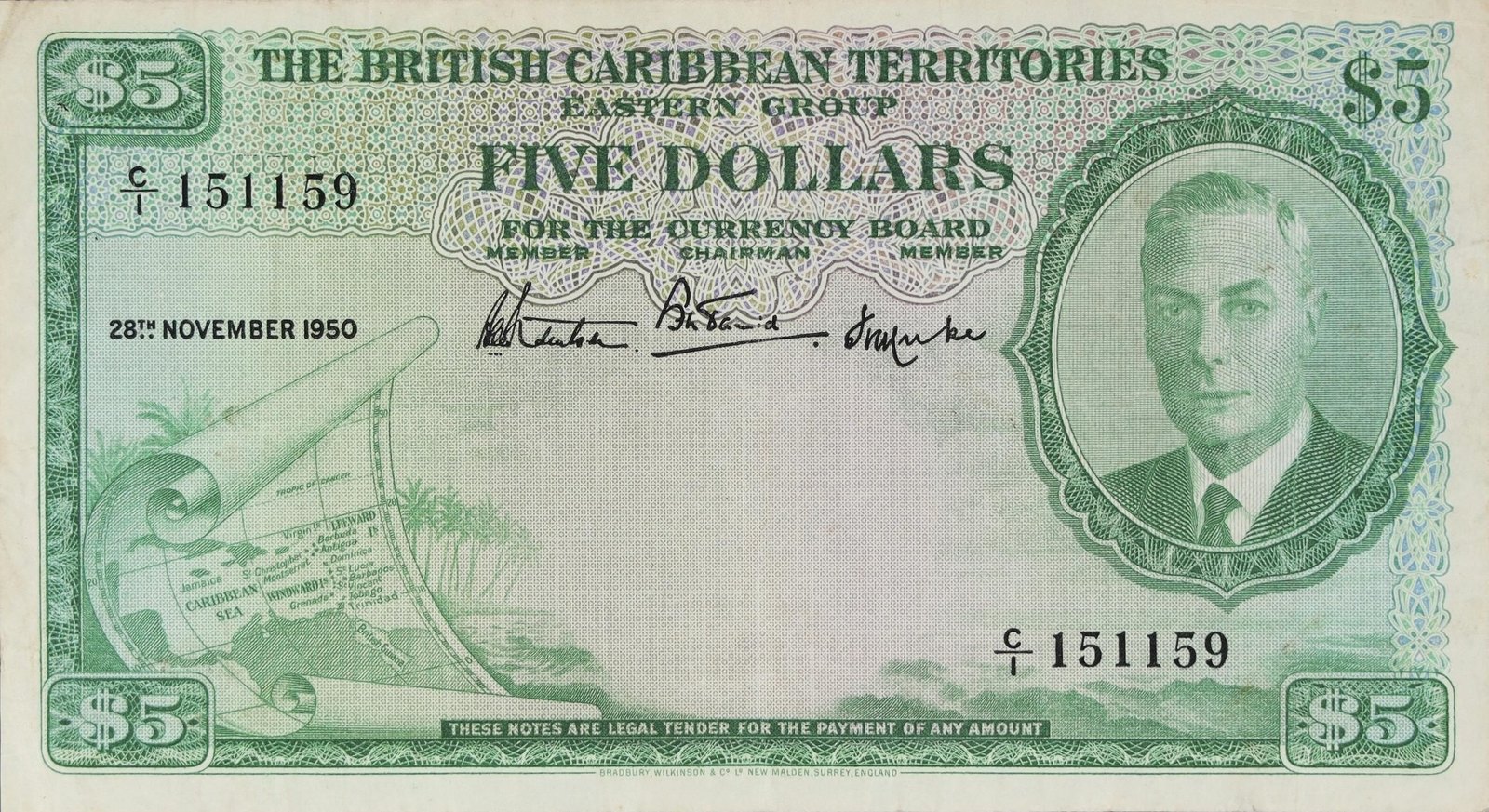
Each note is signed by two Members and the Chairman of the Board, with the Chairman in the centre. On the 1950 notes McDavid signs as Chairman and Robertson at the left. On the 1951 notes the two change places: Robertson signs as Chairman and McDavid at the left. Cuke signs at the right as a Member on both dates. The note pages give surnames only. Stack's Bowers, in its description of lot 20058 in its sale of 17 January 2025, writes the three names as Ronald W. Robertson, Edwin F. McDavid and Hampden A. Cuke.
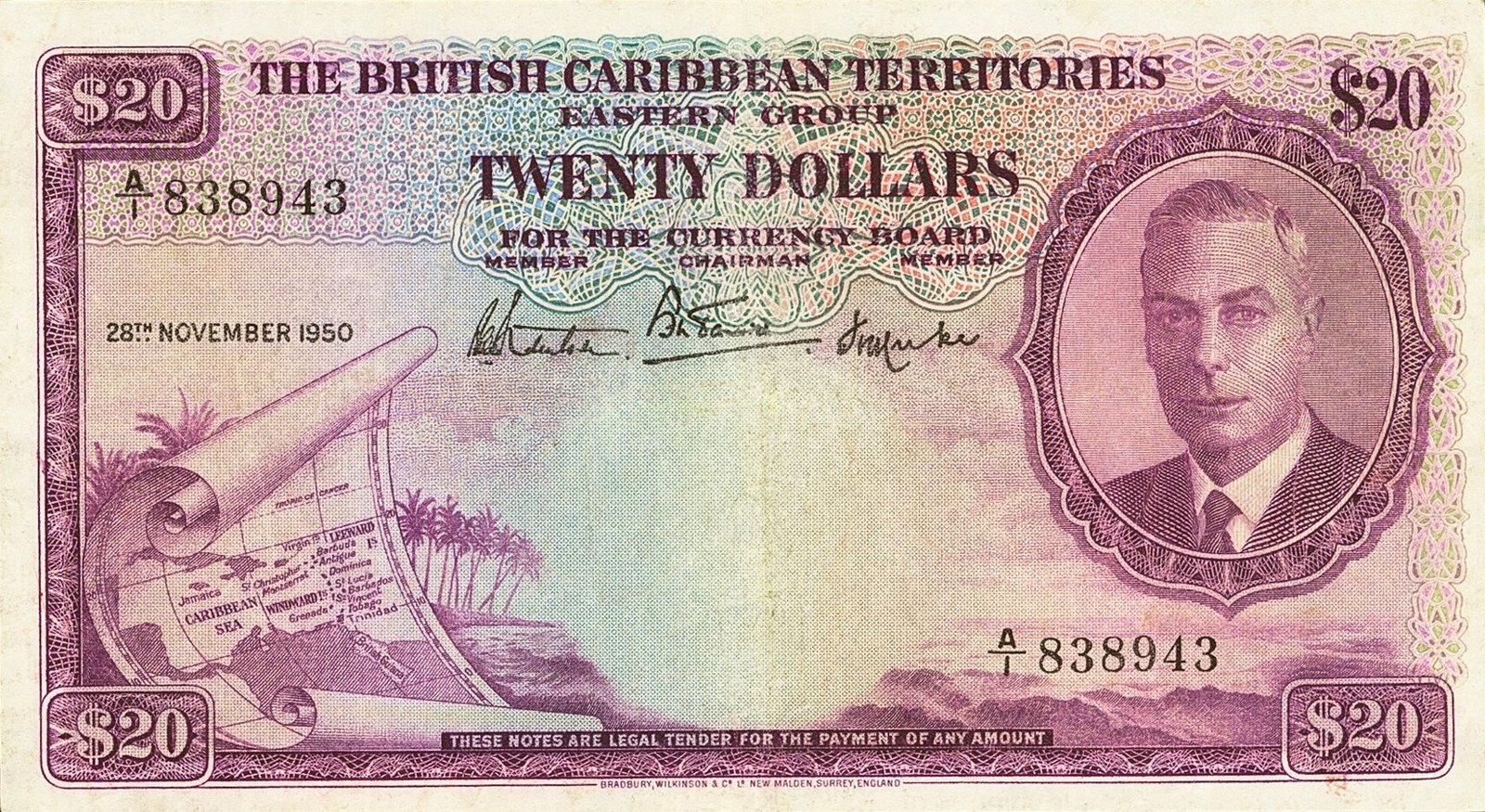
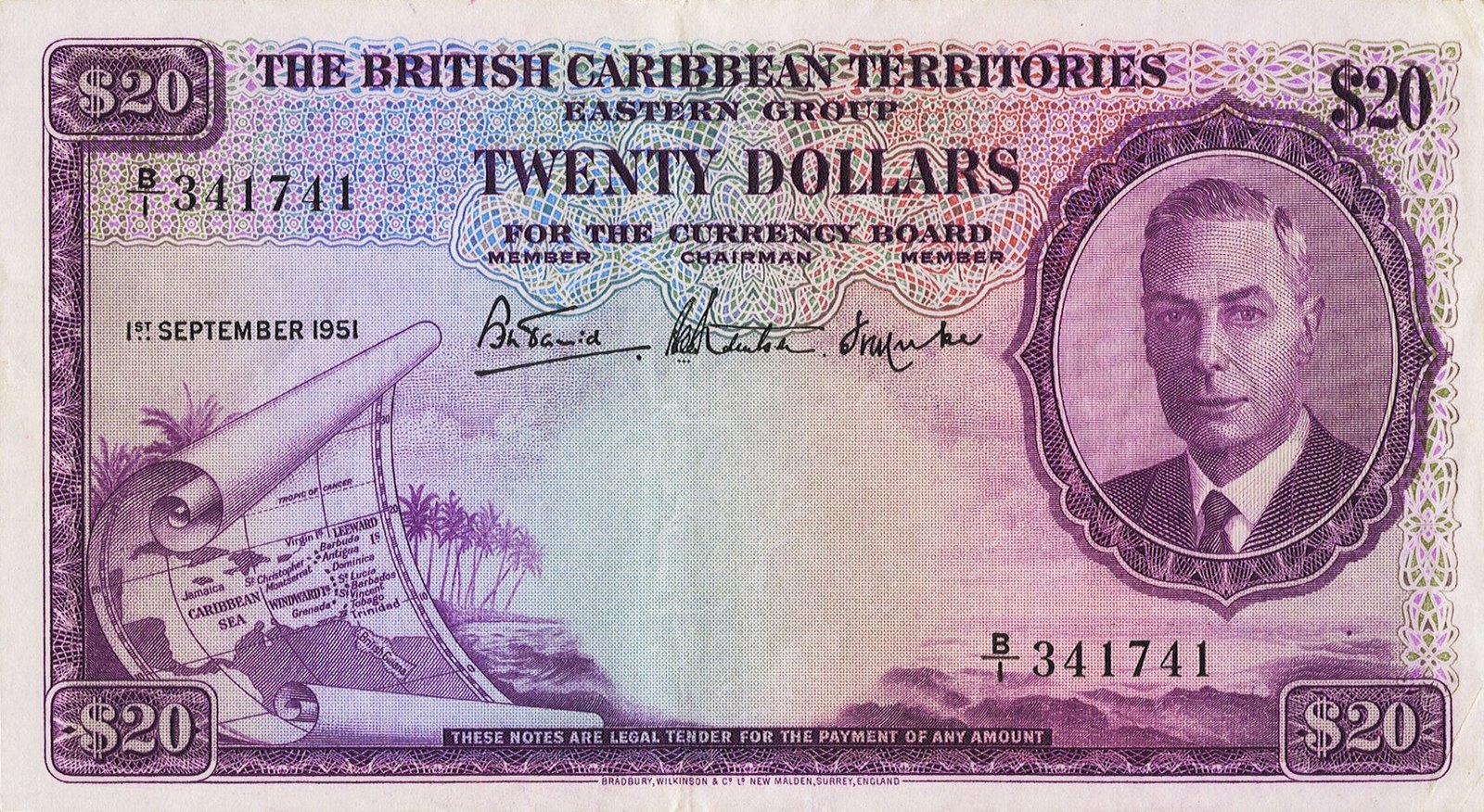
Sources mention that the Board first put notes into circulation on 15 August 1951, and that the currency regulations of 1951 required new notes to be issued, as far as possible, in the order of their serial numbers. The second date on the notes, 1st September 1951, is later than that day. The pages do not say when the notes of the second date were first paid out.
The printer's range specimens show where one date ends and the next begins within a prefix. Each note page gives those ranges for its own value. On the 100 dollars both dates carry the prefix A/1.
The Queen Elizabeth II notes, 1953 to 1964
From 5th January 1953 the notes carry Queen Elizabeth II in place of the King, and letter-and-number prefixes (A2, B2 and so on) in place of the fractional ones. Sources mention that the portrait follows a 1952 photograph by Dorothy Wilding, engraved by Bradbury Wilkinson.
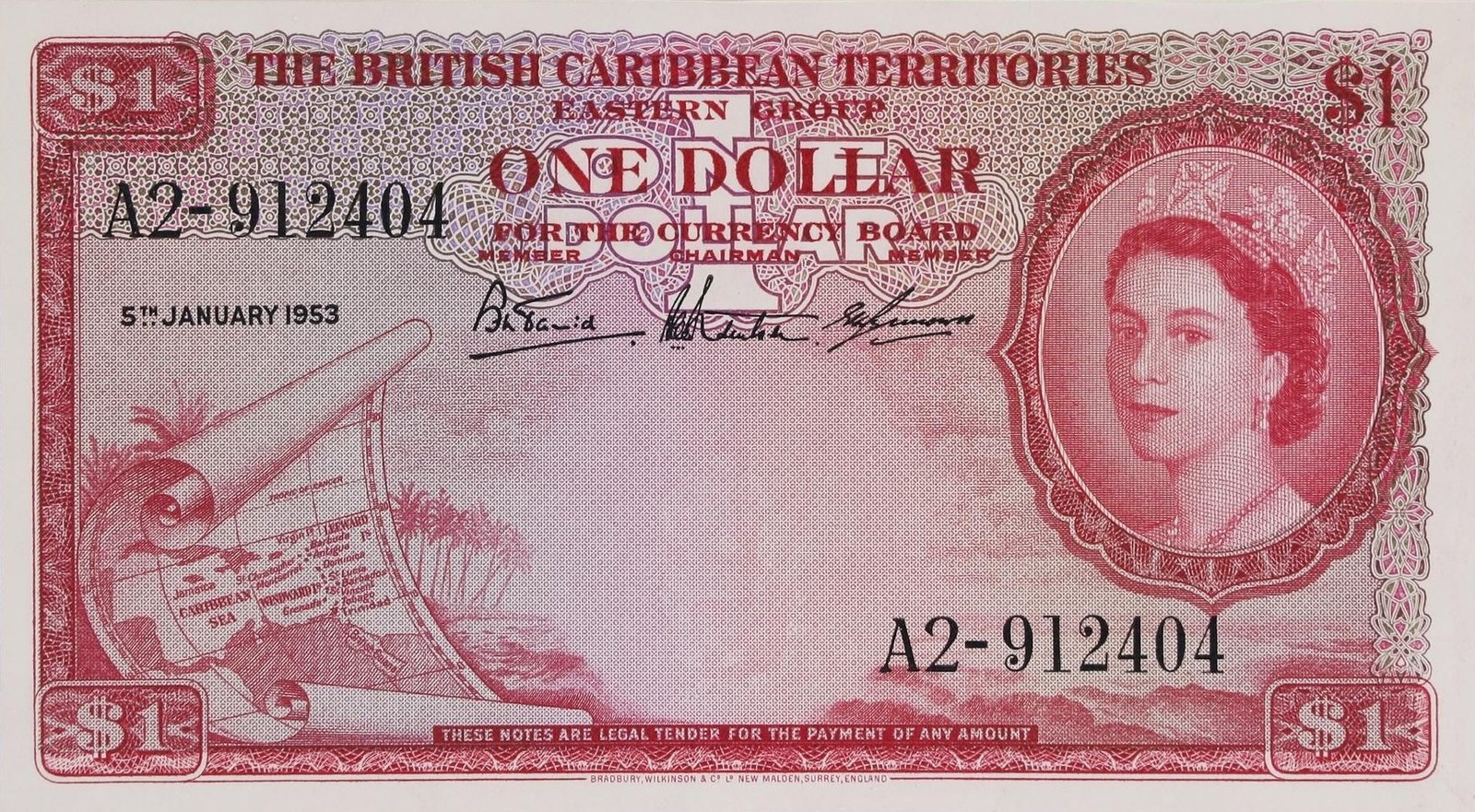
The 1953 printings keep the sailing-ship watermark and have no security thread. From the next printing the watermark is the Queen's head and a solid security thread runs through the paper. That next printing is dated 1954 on the 1, 2 and 100 dollars, and 1955 on the 5, 10 and 20 dollars.
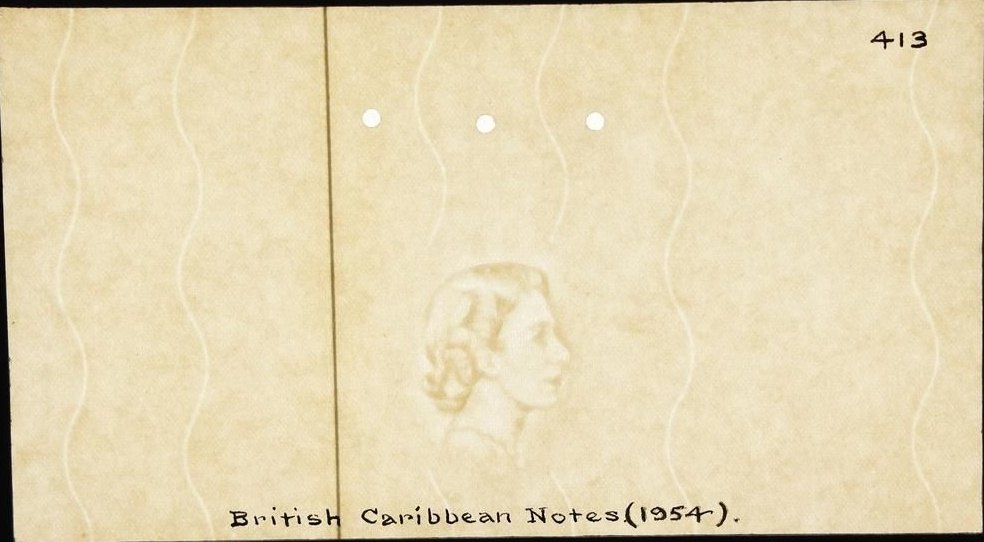
The series has twelve dates, and not every value was printed for each. The table is taken from the rows of the note pages.
| Date on the note | 1 dollar | 2 dollars | 5 dollars | 10 dollars | 20 dollars | 100 dollars |
|---|---|---|---|---|---|---|
| 5th January 1953 | yes | yes | yes | yes | yes | yes |
| 1st March 1954 | yes | yes | no | no | no | yes |
| 3rd January 1955 | yes | yes | yes | yes | yes | no |
| 3rd January 1956 | yes | yes | yes | yes | no | no |
| 2nd January 1957 | yes | yes | yes | yes | yes | yes |
| 2nd January 1958 | yes | yes | yes | yes | no | no |
| 2nd January 1959 | yes | yes | yes | yes | yes | no |
| 1st July 1960 | yes | yes | no | no | no | no |
| 2nd January 1961 | yes | yes | yes | yes | yes | no |
| 2nd January 1962 | yes | yes | yes | yes | yes | no |
| 2nd January 1963 | yes | yes | yes | yes | yes | yes |
| 2nd January 1964 | yes | yes | yes | yes | yes | no |
So the 1 dollar and the 2 dollars were printed for all twelve dates, the 5 dollars and the 10 dollars for ten, the 20 dollars for eight and the 100 dollars for four only. All four dates of the 100 dollars are on the one prefix, A2.
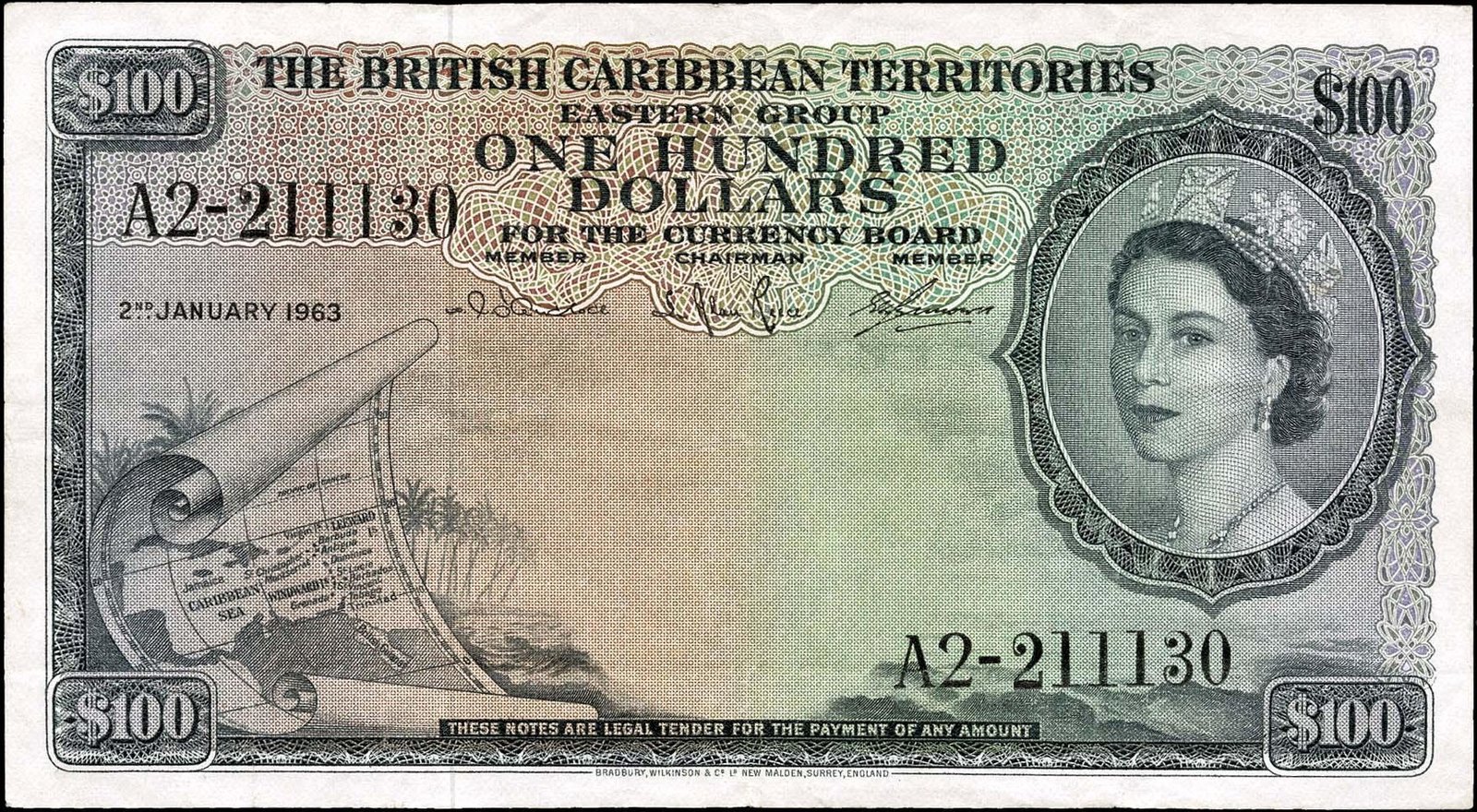
A printing often begins in the last prefix of the one before. The date, not the prefix, places a note.
Sources mention that the Queen Elizabeth II notes were first put into circulation on these days:
- 1 dollar: 22nd December 1954
- 2 dollars: 16th March 1955
- 5 dollars: 22nd March 1956
- 10 dollars: 11th October 1956
- 20 dollars and 100 dollars: 22nd March 1957
The history page of the Central Bank of Trinidad and Tobago says that the first British Caribbean notes were issued between 1954 and 1957 in the six values. Those years agree with the days above for the Queen's notes. They do not agree with the note pages for the Board's first notes, which, as the pages have it, went into circulation on 15 August 1951 with the King's portrait.
The boards of signers and their offices
Twenty boards signed the Queen Elizabeth II series between 1953 and 1964. The Chairman is always in the centre. On one date the board can differ from one value to the next.
The Board's annual reports and the British Guiana council minutes give the offices of three of the signers. Spence, who signs as a Member, was the Board's Executive Commissioner. Reece chaired the Board as Financial Adviser of Trinidad and Tobago. Essex sat for British Guiana as its Financial Secretary. The pages do not give the offices of the other signers.
Paying out the notes, and Jamaica's notes from 1955
The Board's annual reports show that it paid out its notes from the Treasury Building in Port of Spain and from currency centres at Bridgetown and Georgetown. In the smaller islands Barclays Bank was its agent.
From 1st October 1955 the Government notes of Jamaica were legal tender in the Board's territories, at 4 dollars 80 cents to the pound. The Board's notes were legal tender in Jamaica, at 4 shillings 2 pence to the dollar. In British Guiana the law for it was Ordinance 45 of 1954.
The notes in circulation at the end of 1962
The Board's report for 1962 counts its notes in circulation at the end of that year, value by value. Each figure takes both portraits together.
| Value | Notes in circulation at the end of 1962 |
|---|---|
| 1 dollar | 5,483,532 |
| 2 dollars | 2,467,134 |
| 5 dollars | 3,441,064 |
| 10 dollars | 1,716,117 |
| 20 dollars | 2,152,522 |
| 100 dollars | 117,045 |
The Board's reports also show how fast the lowest value wore out. About 6.4 million worn 1 dollar notes a year were withdrawn and destroyed in 1960 to 1962, more than were in circulation at any one time.
The pages give no such count for any other year, and no figure for the number printed of any value or date.
Forged and altered notes
The pages record three cases.
In August 1952 the Board warned of forged 10 dollars notes made from the red 1 dollar of the first issue. The word One was taken off and Ten put in its place, a nought was added to the figure 1 in the corners, and the note was coloured to look like the brown 10 dollars.
Forged 20 dollar notes were found in British Guiana. The Government Analyst there identified 17 in 1958 and 8 in 1959.
In 1962 the Board reported 118 genuine notes in British Guiana altered to pass for a higher value. They had been recoloured with crayon or water colour.
The end of the Board, 1964 to 1968
British Guiana and Trinidad and Tobago left the Board to found their own central banks. Under the British Caribbean Currency Agreement of 12th December 1964 the Board was to stop issuing notes by 1st January 1966 and to be dissolved on 30th June 1967. Its unredeemed notes were then to be paid by the new authorities. The agreement named only the 1 to 20 dollars for further issue, and the last date of the 100 dollars is 2nd January 1963.
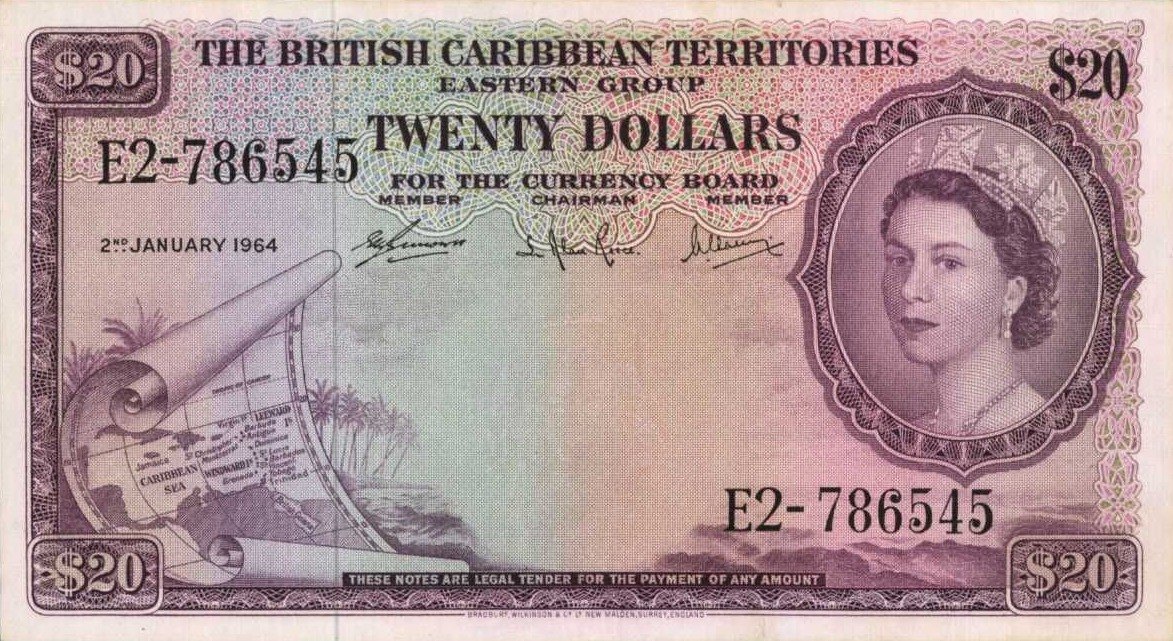
The history page of the Central Bank of Trinidad and Tobago says that the British Caribbean Currency Agreement was signed in 1964 and given effect by the Currency Act of 1965. Spink's description of lot 43 in its sale of 12 January 2024 puts the dissolution of the Board in 1965. The note pages give 30th June 1967 as the day set by the Agreement.
In March 1965 the East Caribbean Currency Authority took over the issue for the remaining territories. Its notes are on the pages of the East Caribbean States.
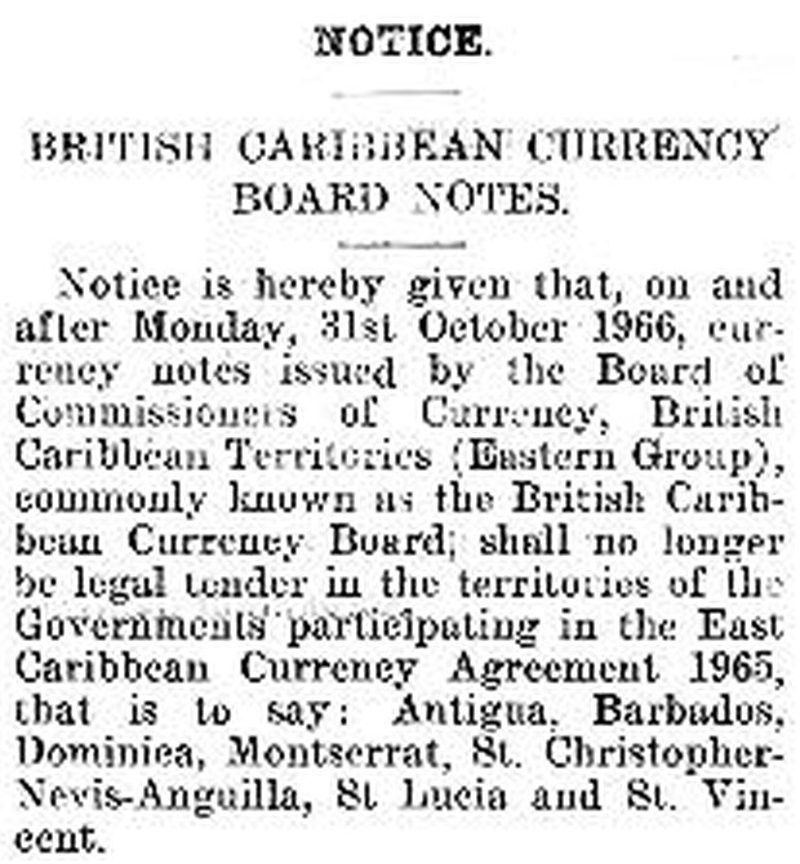
The Authority gave notice on 15th July 1966 that the Board's notes would no longer be legal tender on and after Monday 31st October 1966 in seven territories: Antigua, Barbados, Dominica, Montserrat, St Kitts-Nevis-Anguilla, St Lucia and St Vincent. Grenada came into the Authority later. There the public was asked from June 1968 to change the Board's notes before they ceased to be legal tender, and the pages of the first issue give 1968 as the year they did so.
For Trinidad and Tobago the note pages give no day. The Central Bank of Trinidad and Tobago says on its history page, a history of money in Trinidad and Tobago, that by July 1967 the Board's notes and coins had ceased to be legal tender; the sentence does not name the country. The pages give no day for British Guiana.
What the sources leave open
- The day in 1968 on which the Board's notes ceased to be legal tender in Grenada.
- The day on which they ceased to be legal tender in British Guiana.
- The number of notes printed of any value or date. An auction house's reading of the range on a specimen is that house's reckoning, not a figure from the Board.
- The names and offices of most of the signers of the twenty boards.
- Where the pages say only that sources mention a thing, as for the days of first issue and for the portrait, the source is not named on the page.
Sources
- The catalogue's twelve note pages for the British Caribbean Territories, and through them:
- The annual reports of the British Caribbean Currency Board, among them the report for 1962.
- British Guiana, Currency Ordinance, No. 20 of 1950, of 16th June 1950, and Ordinance 45 of 1954.
- Leeward Islands, Currency Act, No. 4 of 1950, of 20th July 1950.
- The currency regulations of 1951.
- The Barbados Advocate of 28th April 1951.
- The minutes of the British Guiana council.
- The Board's warning of August 1952 on forged 10 dollars notes.
- The findings of the Government Analyst of British Guiana for 1958 and 1959.
- The British Caribbean Currency Agreement of 12th December 1964.
- The notice of the East Caribbean Currency Authority of 15th July 1966.
- Stack's Bowers, 17 January 2025, lot 20058.
- Spink, 12 January 2024, lot 43.
- Central Bank of Trinidad and Tobago, "History of Money in Trinidad and Tobago", https://www.central-bank.org.tt/history/
Member comments
Log in or register to post a comment.