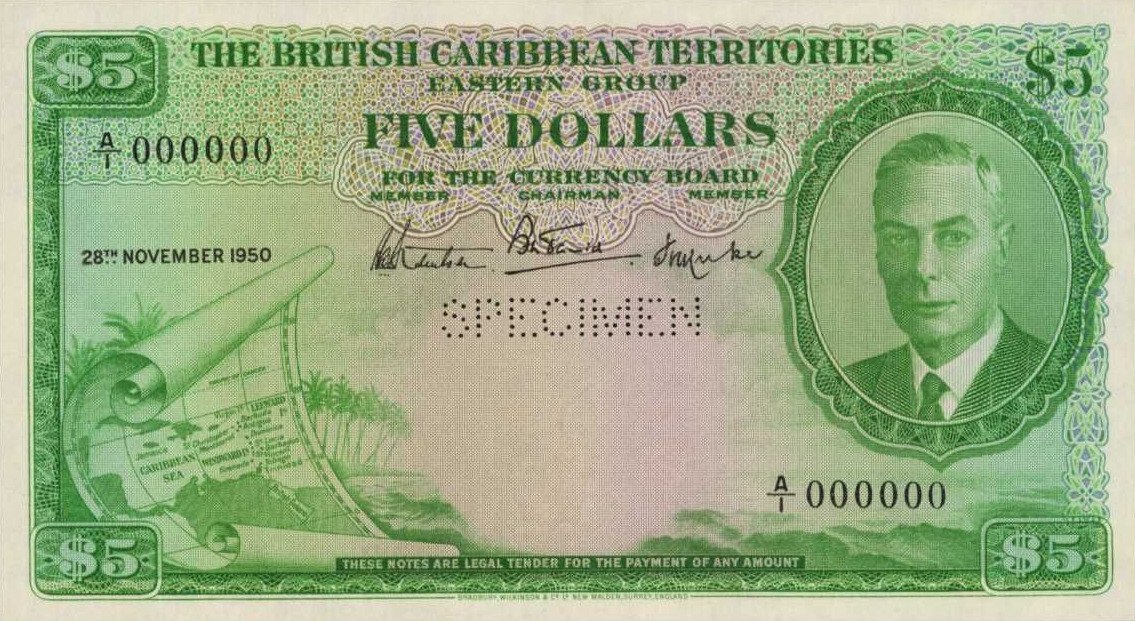
This article follows the law of the British Caribbean currency in order of time, from the first calls for one currency in 1944 to the notice of 1966 that ended the Board's notes as legal tender. It rests on the laws and notices as the gazettes of the territories printed them, and on the Board's own reports. The laws of the two territories that left the Board first are told more fully in The currency laws of British Guiana, 1836 to 1965 and The currency laws of Trinidad and Tobago, 1903 to 1964.
Before the Board, 1944 to 1950
The agenda of the Trinidad Legislative Council printed on the front page of the Trinidad Guardian of 17th May 1944 lists a resolution for a currency in a decimal relation to sterling, and a Currency Board in London to issue and redeem notes and coin for the Caribbean colonies. The page was read in the text only, and its columns run together. The preamble of British Guiana's Currency Ordinance, 1950 names the Currency Conference held at Barbados in May 1946.
The Barbados Advocate of 16th April 1950, read in the text only, reported that the Preparatory Committee of the Unified Currency Scheme had ended its meetings at Hastings House, Barbados, on 14th April 1950. It had agreed the draft Bills and chosen the tender and design of one of three security printers in the United Kingdom, and the Crown Agents were to arrange for the notes to be ready early in 1951. The Board's accounts for 1951 carry a line of 22,344.83 dollars, "Expenses of Preparatory Committee".
The territories' laws of 1950
Each government passed its own law to give the Agreement force. The laws found are these:
| Territory | Law | Date | Where read |
|---|---|---|---|
| British Guiana | Currency Ordinance, 1950, No. 20 of 1950 | assented 16th June 1950 | the Ordinance, Parliament of Guyana papers |
| Leeward Islands | Currency Act, No. 4 of 1950 | passed by the General Legislative Council 20th July 1950; assented 28th July 1950 by the Acting Governor, P. D. Macdonald | Leeward Islands Gazette, 3rd August 1950 (page image); annual report on the Leeward Islands for 1949 and 1950 |
| Barbados | Currency Act, 1950 (Act 1950-31) | 16th August 1950 | the Act, with the Agreement in its First Schedule |
| Trinidad and Tobago | Currency Ordinance, No. 39 of 1950 | Bill passed by the Legislature 12th June 1950 (annual report on Trinidad and Tobago for 1950, text only); in force 1st August 1951 | Revised Ordinances of Trinidad and Tobago, 1950, vol. V, pp. 594 to 606 (page image) |
| Saint Vincent | Currency Ordinance, No. 17 of 1950 | assented 17th November 1950 by Governor R. D. H. Arundell | Saint Vincent Government Gazette, Ordinances supplement, p. 121, printed with the gazette of 5th December 1950 (page image) |
| Dominica | Currency Ordinance, No. 18 of 1950 | passed 24th August 1950; assented 16th October 1950 by Governor R. D. H. Arundell | Official Gazette of Dominica, supplement of 30th October 1950, pp. G 1 and G 6 (page image) |
For Grenada no number was found; a Grenada newspaper of 1982 gives only the date 18th October 1950. For St. Lucia nothing was found.
What the Agreement said
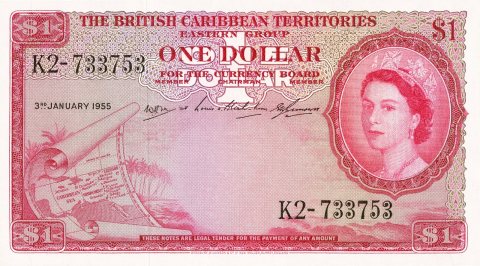
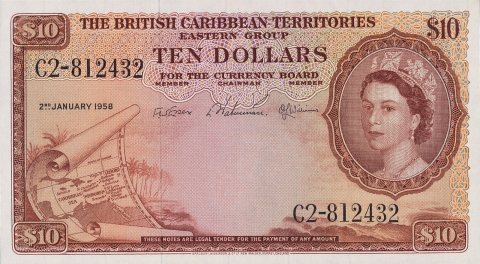
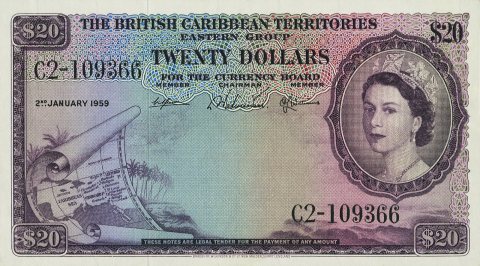
The Agreement printed with the Barbados Act set up the Board of Commissioners of Currency, British Caribbean Territories (Eastern Group), with its headquarters in Trinidad. The make-up of the Board is in The members, Executive Commissioners and currency officers of the Board. For the notes it said:
- The Board would issue notes of 1, 2, 5, 10, 20 and 100 dollars, and others with the approval of the Secretary of State. The dollar was 4 shillings 2 pence sterling.
- The notes were legal tender for any amount. A Governor might demonetise them by proclamation, but the holder could always claim their value from the Board.
- The Board took over the liability for the Government notes of Barbados, British Guiana and Trinidad and Tobago, which those Governments were to demonetise.
- The part of each law on notes would come into force on a day proclaimed by the Governor.
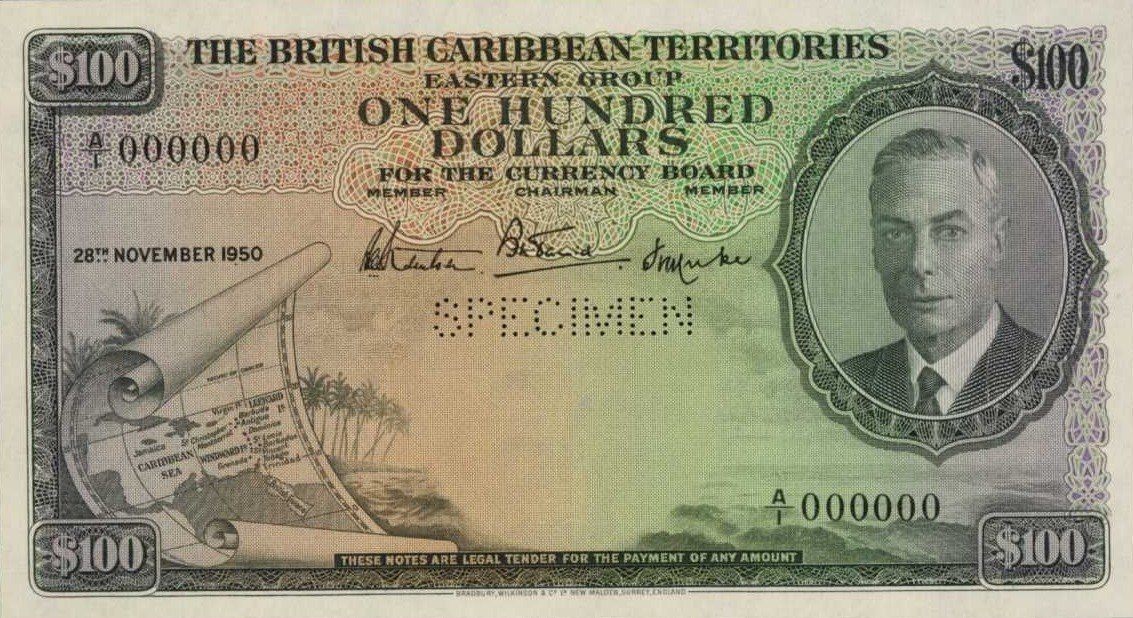
The Trinidad Ordinance adds what happened on that day. The Trinidad Commissioners of Currency ceased to issue, no banker could issue new notes, and the Government notes became liabilities of the new Board (section 4). Demonetised notes stayed payable at face value by the Board (section 9). Section 13 kept the note rights of Barclays Bank (Dominion, Colonial and Overseas), formerly the Colonial Bank. The preamble recalls that the Trinidad Government notes were already legal tender in the Leeward and Windward Islands. The Leeward Islands Act repealed, on the same day, the Trinidad Currency Notes Act, 1939 (No. 1 of 1939), which had made them so, and kept the same saving for Barclays.
1st August and 15th August 1951
The Barbados Advocate of 2nd August 1951 reported that the Currency Act, 1950 had been brought into effect by proclamation the day before, 1st August 1951, so far as it related to notes, and that the new notes would circulate from 15th August. A notice of the Colonial Secretary's Office at Antigua, of the same day, said the same for the Leeward Islands, with specimens on show at Barclays Bank and the Royal Bank of Canada in Antigua, St. Kitts-Nevis and Montserrat (Leeward Islands Gazette, 2nd August 1951, p. 169). In Dominica the notes began to circulate on 10th September 1951 (Official Gazette of Dominica, 3rd September 1951, p. 169). The British Guiana Gazette of 28th July 1951 printed the proclamation for that colony. The Board's report for 1960 adds that the part of the laws on coin came into force on 1st July 1955, and that the Board first issued coins on 15th November 1955.
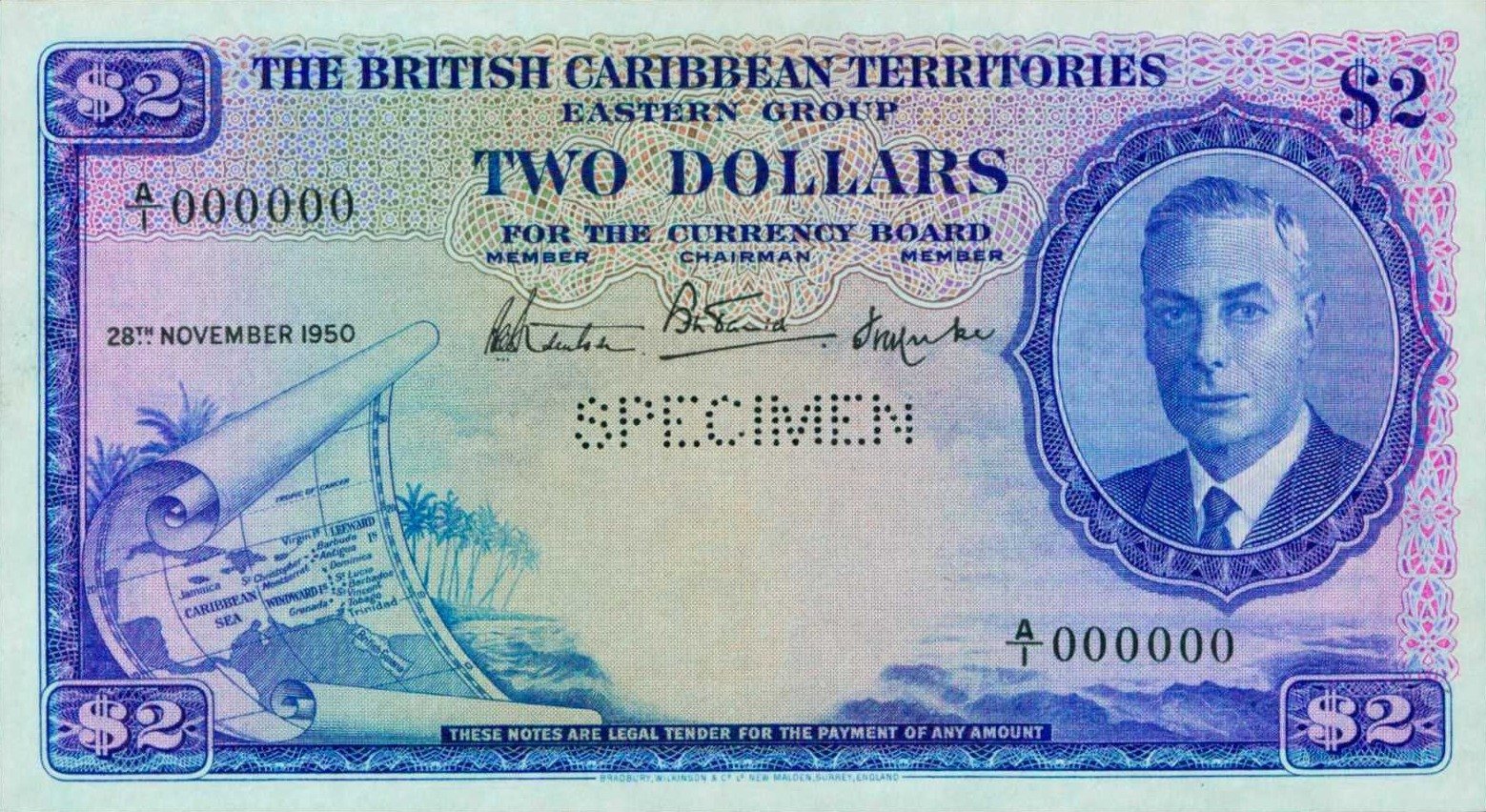
The Currency (Notes) Regulations: printing, issuing and the register of numbers
Each territory made the same regulations under its law after consulting the Board: in British Guiana No. 21 of 1951 (Official Gazette, 28th July 1951, pp. 187 and 188), in Dominica S.R.&O. No. 28 of 1951 (made 28th July 1951 and gazetted 30th July 1951, Official Gazette of Dominica, pp. A 40 to A 46, read on the page image), in the Leeward Islands S.R.&O. 1951 No. 21, and in Saint Vincent (Government Gazette, 7th August 1951, pp. A-211 to A-215, read in the text only). They provided that:
- the plates were prepared by a firm chosen by the Crown Agents and kept by them, and the notes printed under their supervision;
- in the Leeward and Windward Islands the stocks of notes were held in a vault of the Board's agent;
- new notes were issued, as far as possible, in the order of their serial numbers, and used notes fit for re-issue were paid out before new ones;
- the Board's register recorded the serial number of every note above 10 dollars, and for the lower values only the total issued from each prefix, each prefix divided into groups.
The rule on the register was read in the text only, in both the Dominica and the Saint Vincent copies. The Saint Vincent copy adds that worn notes were cancelled and destroyed in bundles of 100.
The register rule changed three times.
| Year | Change | Source |
|---|---|---|
| 1952 | serial numbers recorded only for notes above 20 dollars | Saint Vincent Government Gazette, 1952, p. A-101 (text only) |
| 1958 | serial numbers, with the day of issue or re-issue and the day of destruction, only for notes above 20 dollars; for the rest, the total issued from each prefix, the prefixes of the 1 and 2 dollars divided into groups of 100,000 and those of the other values into groups of 5,000 or 10,000 as the Board decided | Antigua, Montserrat and Virgin Islands Gazette, S.R.&O. supplement, February 1958, pp. G-1 and G-2 (Antigua S.R.&O. 1958 No. 8, made on 28th January 1958 by Alec Lovelace, Administrator, page image; the group sizes of the other values read in the text only); the Montserrat copy, made on 14th January 1958 by A. F. Dawkins, Administrator, read in the text only |
| 1964 | from 1st March 1964, serial numbers only for notes above 20 dollars; for the 1 to 20 dollars, only the number and value destroyed of each value | Montserrat S.R.&O. 1964 No. 8, Montserrat supplement, pp. C-1 and C-2 (page image); Antigua S.R.&O. 1964 No. 4, Antigua, Montserrat and Virgin Islands Gazette, 23rd April 1964, pp. 29 and 30 (text only, the page image would not open) |
Above 20 dollars there was only the 100 dollars. So from 1952 the regulations asked for a note-by-note record of that value alone, and from March 1964 they no longer asked for a record of which prefixes of the 1 dollar to the 20 dollars were issued. The Grenada gazette also names Currency Notes Regulations of that colony, S.R.&O. No. 32 of 1961, whose text was not read.
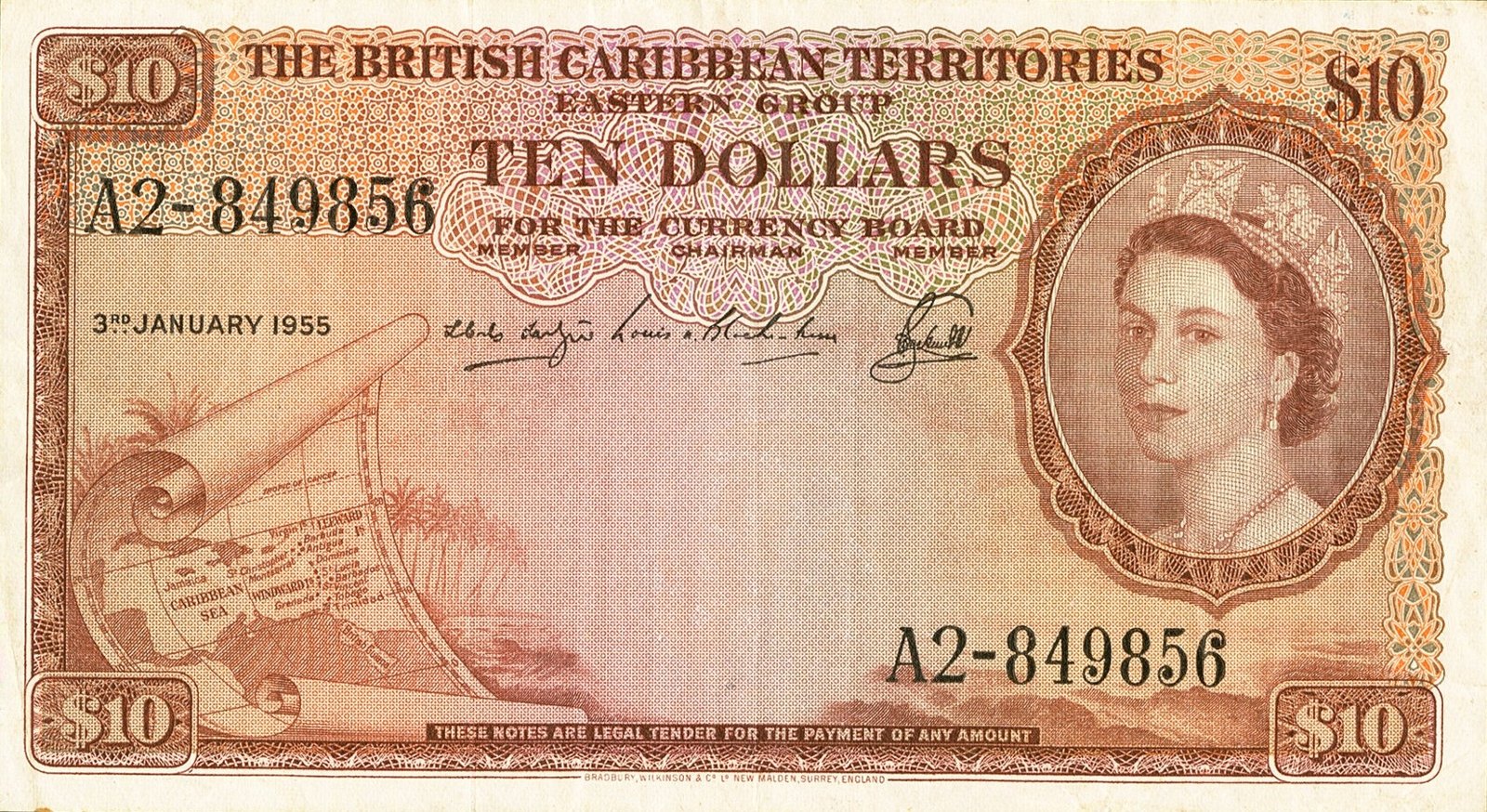
Commission, and the first call for the old notes
A notice under section 7 (1) (b) of the Currency Act, 1950, signed by L. Spence, Executive Commissioner, and printed in the Barbados Advocate of 2nd September 1951, set the Board's commission: seven-sixteenths per cent to issue notes against sterling, one half per cent to redeem them, and the cost of any telegrams. The same rates are in the Dominica gazette of 25th July 1952, the Trinidad Royal Gazette in a notice of 4th April 1955 and the Grenada gazette of 16th April 1955, all read in the text only.
In August 1952 the Board asked the public to change their Barbados, British Guiana and Trinidad and Tobago Government notes for Board notes "with as little delay as possible". The notice was signed by L. Spence on 7th August 1952 in Trinidad (Royal Gazette, 1952, p. 1440, text only) and by H. N. Armstrong, Senior Currency Officer, on 12th August 1952 in Barbados (Sunday Advocate, 17th August 1952). The banks named were Barclays Bank (D.C. & O.), the Royal Bank of Canada and the Canadian Bank of Commerce in Trinidad and Barbados, Barclays alone in Saint Vincent (Saint Vincent Government Gazette, notice of 7th August 1952, p. 271, text only), and Barclays and the Royal Bank of Canada in Dominica (notice of J. Bully, Currency Officer, 18th September 1952, Official Gazette of Dominica, p. 329).
The end of the old Government notes, 2nd January 1955
The end of the three Government issues was proclaimed territory by territory. The proclamations and notices found are these:
| Territory | Proclamation or notice | Source |
|---|---|---|
| Saint Vincent | S.R.&O. 1954 No. 72, of 18th December 1954, by O. R. Kelsick, Acting Administrator | Saint Vincent Government Gazette, 21st December 1954, p. B-185 (page image) |
| Leeward Islands | proclamation of 28th December 1954 by Governor K. W. Blackburne | Leeward Islands Gazette, 30th December 1954 (page image) |
| Grenada | S.R.&O. No. 66 of 1954 | Government Gazette of Grenada |
| Trinidad and Tobago | notice 1222 of the Board, 29th December 1954, signed W. V. Brown, Acting Executive Commissioner | Royal Gazette Extraordinary, 31st December 1954 (page image) |
The Saint Vincent proclamation says that from 2nd January 1955 the Government notes of Barbados, British Guiana and Trinidad and Tobago ceased to be current or legal tender in the colony. Until then they could be changed at Barclays Bank for Board notes of the same value, and afterwards their holders could claim the value at any time from the Executive Commissioner. The Leeward Islands proclamation names Barclays and the Royal Bank of Canada for the exchange, and the Currency Officers at the Treasury in Antigua and in St. Christopher-Nevis-Anguilla for later claims. The proclamations of Barbados and British Guiana are not among the pages read. What was never handed in is told in The Trinidad and Tobago Government notes after 1951.
Jamaica's notes and the Virgin Islands, 1954 to 1956
From 1st October 1955 the Government of Jamaica's notes were legal tender in the Board's territories at one pound to 4 dollars 80 cents, and the Board's notes in Jamaica at 4 shillings 2 pence to the dollar (the Board's report for 1960, which adds that notes taken to Jamaica were sent back when paid into a bank). Each territory needed its own law:
| Territory | Law | Source |
|---|---|---|
| British Guiana | Legal Tender (Jamaica Currency Notes) Ordinance, No. 45 of 1954, assented 23rd December 1954 | Parliament of Guyana papers |
| Grenada | Ordinance No. 55 of 1954 | Government Gazette of Grenada, 31st December 1954, p. 537 (page image) |
| Saint Vincent | Currency (Amendment) Ordinance, 1955, No. 3 of 1955, assented 22nd March 1955 by L. Cools-Lartigue as Deputy to the Acting Governor; and No. 16 of 1955, assented 24th October 1955 by Governor C. M. Deverell, deemed in force from 1st October 1955, which fixed the rate at 4 dollars 80 cents to the pound | Saint Vincent Ordinances, 1955, p. A-5 (page image); press release, Saint Vincent Government Gazette, 29th September 1955, p. 314 (text only) |
| Leeward Islands | Currency (Amendment) Act, 1955, No. 20 of 1955, passed 20th June and assented 23rd June 1955 by Governor K. W. Blackburne | Leeward Islands Gazette, 30th June 1955 (page image) |
| Trinidad and Tobago | Ordinance No. 31 of 1955 | annual report on Trinidad and Tobago for 1955 (text only) |
The Objects and Reasons of the Leeward Islands Bill say that the same law was to be passed in every colony of the Eastern Group and brought in on the same day as the matching law of Jamaica. The Saint Vincent press release names that law as the Currency, Coinage and Legal Tender (Amendment) Law, 1954 (No. 51 of 1954). The Director of Audit's report on the Board's accounts for 1955 says the Jamaica notes became legal tender from 1st October 1955 by proclamations made in Trinidad, British Guiana and Dominica, and that no proclamation for the other territories had been seen (Government Gazette of Grenada, 18th August 1956, p. 324).
A notice of the Board of 28th October 1955, signed by L. Spence, warned that the blue Jamaica 10 shillings had been demonetised by Jamaica on 1st July 1951, so only the purple 10 shillings were legal tender in Jamaica and the Eastern Group (Government Gazette of Grenada, 12th November 1955, p. 439; Leeward Islands Gazette, 17th November 1955, both on the page image).
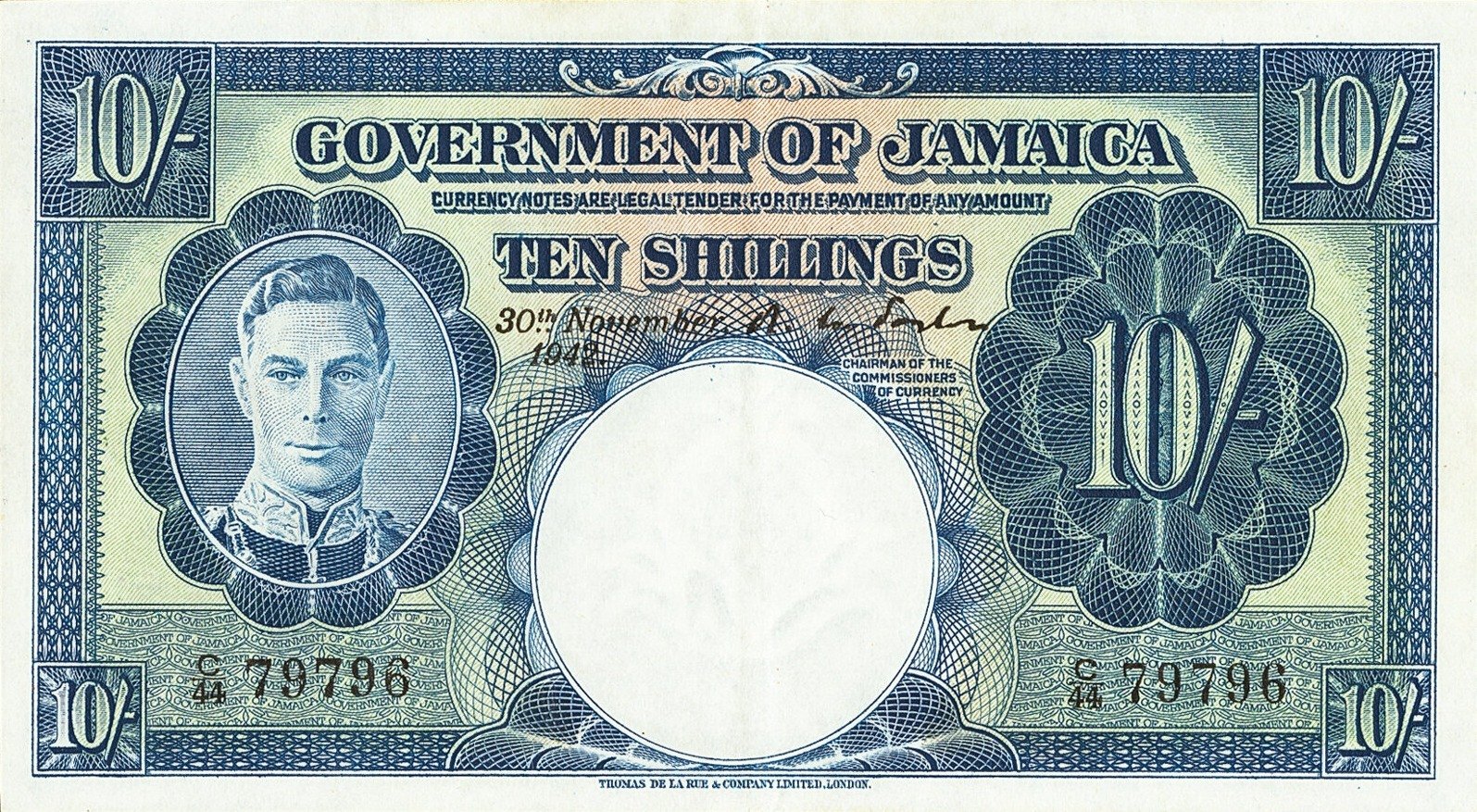
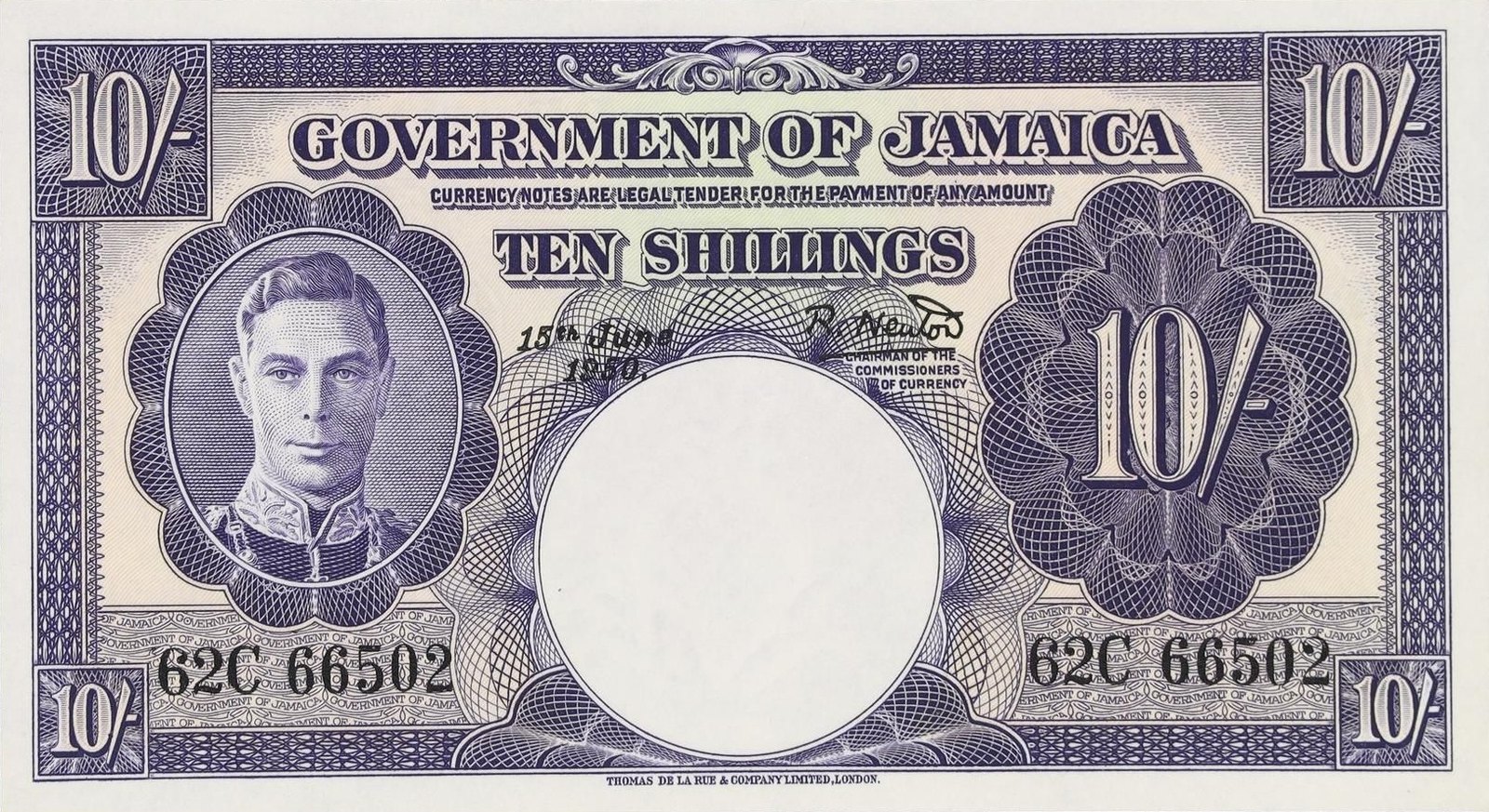
The British Virgin Islands were not one of the five members. The Board's notes, with Jamaica's at 4 dollars 80 cents to the pound, were made legal tender there by the Currency, Coinage and Legal Tender Ordinance, 1956 (No. 11 of 1956), assented on 5th June 1956 and brought into operation on 1st July 1956 by a proclamation of the Acting Commissioner, E. A. Evelyn, of 7th June 1956 (Leeward Islands Gazette, 14th June 1956, page image). From 9th March 1959 the Legal Tender (Adoption of United States Currency) Ordinance, 1959 (No. 3 of 1959) made United States notes legal tender there as well, at 2 dollars 80 cents United States to 4 dollars 80 cents of the West Indies; the Board's notes were not demonetised by it (Antigua, Montserrat and Virgin Islands Gazette, 5th March 1959, page image).
Barclays Bank gives up its notes
The laws of 1950 kept Barclays Bank's right, under its charter, to issue its own notes. The Board's papers for 1959 record that the Bank gave up that right of its own accord. The Board had undertaken to issue its notes to the Bank free of commission to the value of the Bank's notes withdrawn. At its fourteenth meeting, on 26th September 1959, it settled that undertaking by paying the Bank 75 dollars, the commission on 20,000 dollars. The Bank's notes still in circulation in August 1958 were worth 59,285 dollars (Antigua, Montserrat and Virgin Islands Gazette, 27th July 1961, p. 143; Saint Vincent Government Gazette, Supplement C, 3rd May 1960; Government Gazette of Grenada, 21st May 1960, p. 192). The bank notes of the region before 1951 are in The banks' notes beside the Government's in Trinidad.
1956 to 1962: securities, a second Agreement and exchange control
A Bill of Antigua printed in July 1956, to amend the Currency Act, let the Board issue notes against securities of the participating governments lodged at its headquarters. Its Objects and Reasons set the limit at two million five hundred thousand pounds, twenty per cent of the Currency Fund at 31st December 1954. British Guiana made the same change by Ordinance No. 28 of 1956.
A second Agreement between the Governors of the five territories, dated 28th January 1958, was given effect from 1st July 1956. Each territory enacted it by a new law in 1959:
| Territory | Law | Dates | Source |
|---|---|---|---|
| British Guiana | Currency Ordinance, No. 8 of 1959 | assented 8th May 1959 | Parliament of Guyana papers |
| Saint Vincent | Currency Ordinance, 1959, No. 5 of 1959 | assented 29th August 1959 by the Acting Governor, H. Lindo | Saint Vincent Ordinances, 1959, pp. A-57 to A-72 (page image) |
| Antigua | Currency Ordinance, 1959, No. 16 of 1959 | passed 29th October 1959; in force 1st April 1960 by proclamation of 15th March 1960 (S.R.&O. 1960 No. 15) | Antigua, Montserrat and Virgin Islands Gazette, November 1959, pp. J-2 to J-20, and 17th March 1960, p. F-1 (page image) |
| Montserrat | Currency Ordinance, No. 24 of 1959 | circulated May 1960 | Antigua, Montserrat and Virgin Islands Gazette (text only) |
| Barbados | Currency Act, 1959 (1959-22) | consent of the Governor-General of The West Indies, 25th February 1960 | West Indies Gazette, 26th February 1960 (page image) |
| Trinidad and Tobago | Currency Ordinance, No. 15 of 1959 | the same consent; in force 1st April 1960 | the same; Director of Audit's report for 1960 (Antigua, Montserrat and Virgin Islands Gazette, 23rd August 1962, p. 189), whose audit certificate on p. 187, read in the text only, calls it No. 16 of 1959 |
The new laws kept the six values at 4 shillings 2 pence to the dollar and the notes' legal tender for any amount, kept Jamaica's notes, and kept the Governor's power to demonetise, the holder always able to claim face value from the Board. The Antigua Ordinance set a fine of up to 24 dollars for defacing a note (section 15). The Saint Vincent Ordinance barred any banker from issuing notes, repealed Ordinances 17 of 1950, 3 of 1955, 16 of 1955 and 26 of 1956, and kept the members and Chairman in office.
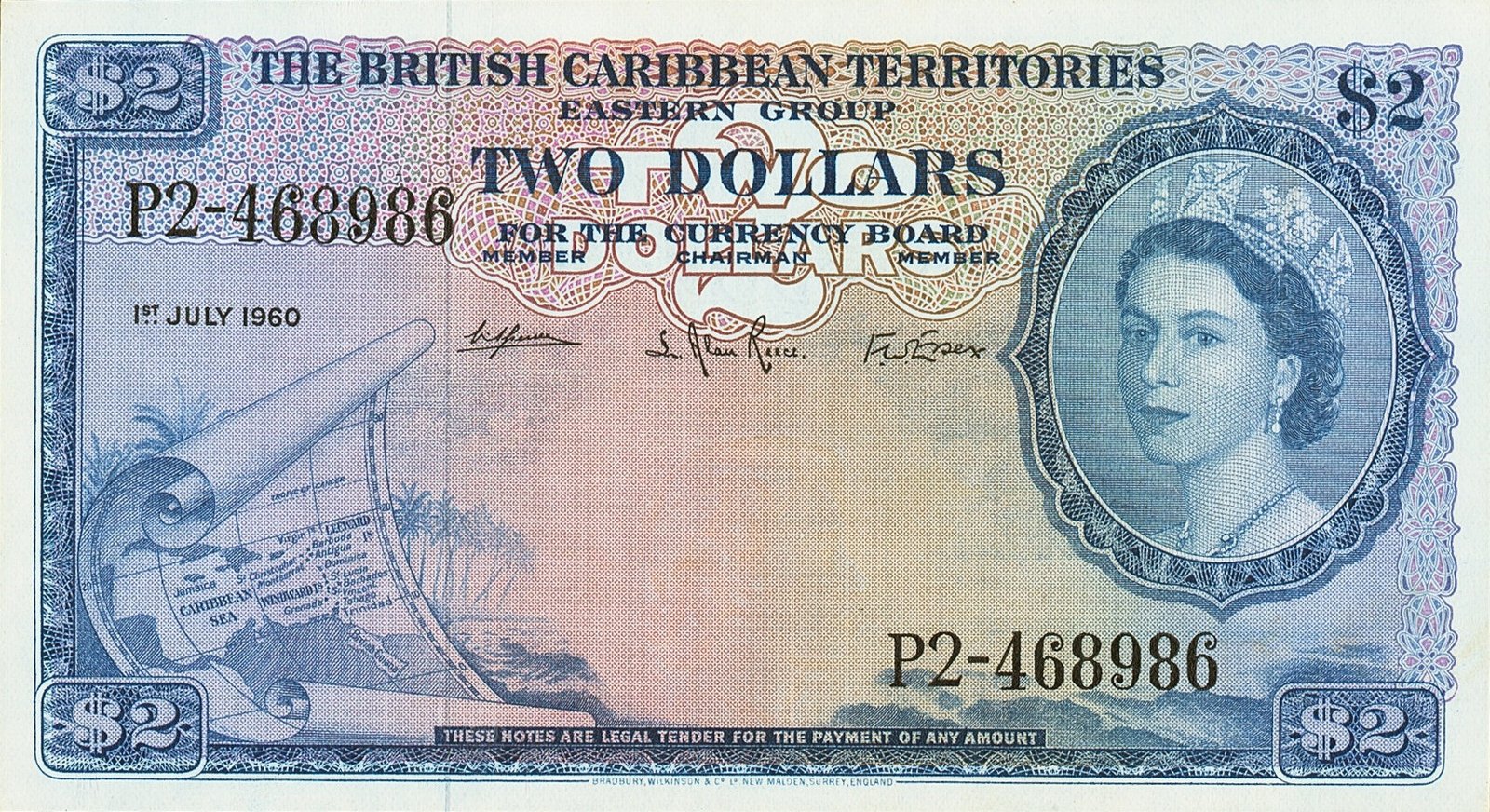
In British Guiana the Exchange Control (Amendment) Ordinance, 1962 required a permit from the Ministry of Finance before notes lodged with the Board there could be paid in sterling in London. The Board's report for 1962 says it was enacted on 17th October 1962. The Ordinance itself, No. 22 of 1962, as the Parliament of Guyana papers hold it, passed the Legislative Assembly on 16th October and the Senate on 22nd October 1962, and was assented to by the Acting Governor, O. A. Murphy, on 14th November 1962. The report for 1962 also says, in a paragraph read from its text layer, that a private person sued the Board over it, at a cost to the Board of 9,288.02 dollars.
Offences against the notes
The law protected the notes in three ways that the papers show at work.
Defacing. In March 1952 notices in British Guiana and Barbados warned against stamping or writing on notes. The British Guiana notice (Official Gazette, 8th March 1952, p. 524, notice 440) named section 204 of the Summary Jurisdiction (Offences) Ordinance. The Barbados notice, signed by H. N. Armstrong (Sunday Advocate, 9th March 1952), named section 12 (2) of the Government Currency Notes Act, 1937 (1937-1) as applied by section 14 of the Currency Act, 1950, with a fine of up to five pounds. In August and September 1963 the Currency Officer of Antigua, A. A. Caines, warned three weeks running that defacing or perforating the Board's notes carried a fine of up to 24 dollars under section 15 of the Currency Ordinance of 1959 (Antigua, Montserrat and Virgin Islands Gazette, 29th August 1963, p. 207).
The security thread. In August 1957 the Currency Officer of Saint Vincent, B. R. Thomas, and in October 1957 the Financial Secretary and Currency Officer of Grenada, G. E. C. Stanford, warned of a rumour that the banks were buying the security threads of the notes. People had pulled the threads out and taken them to the banks. Withdrawing the thread was an offence. Traders in Saint Vincent were asked to accept notes so damaged and take them to Barclays Bank (Saint Vincent Government Gazette, 27th August 1957, pp. 320 and 321; Government Gazette of Grenada, 19th October 1957, p. 504).
Forgery. The Board's warning of August 1952 on 10 dollar notes made from the 1 dollar is in The British Caribbean Currency Board and its notes. The Barbados Advocate of 5th September 1952 added that none had been reported in Barbados. The reports for 1960 to 1962, read in their text layer, list the offences by territory:
| Year | Offences reported to the Board |
|---|---|
| 1960 | British Guiana: one report of uttering forged notes, still under inquiry. Trinidad and Tobago: one person charged with having paper for forging notes, and convicted. Grenada: two reports of forged notes, no charge. St. Lucia: four reports, charges laid in two. Barbados, St. Vincent, Dominica, Antigua and St. Kitts: none. |
| 1961 | British Guiana: the case of 1960 closed without a charge; one charge of uttering forged notes, with a conviction. Trinidad and Tobago: four persons charged with forging notes, one discharged and three awaiting trial. St. Lucia: one report of a forged 1 dollar note, no charge. |
| 1962 | British Guiana: 118 genuine notes raised to higher values, no charge; four charges over forged notes. Trinidad and Tobago: one charge of having forged notes. Other territories: none. |
No denomination is given except for the St. Lucia note of 1961, and no serial number at all. The forgeries in British Guiana are told in Forged, altered and defaced notes in British Guiana.
1964 to 1966: the laws that ended the Board
The British Caribbean Currency Agreement was made at Port of Spain on 12th December 1964. As enacted in British Guiana's Currency Ordinance, 1965 (No. 8 of 1965, assented 5th June 1965), it provided that the Board would stop issuing notes in each territory when that territory's new currency authority began, and everywhere by 1st January 1966. The Board was to be dissolved on 30th June 1967. Its unredeemed notes would then be paid by the new authorities from a fund held by the Crown Agents, to be divided on 30th June 1977. Only the 1, 2, 5, 10 and 20 dollars were named for further issue.
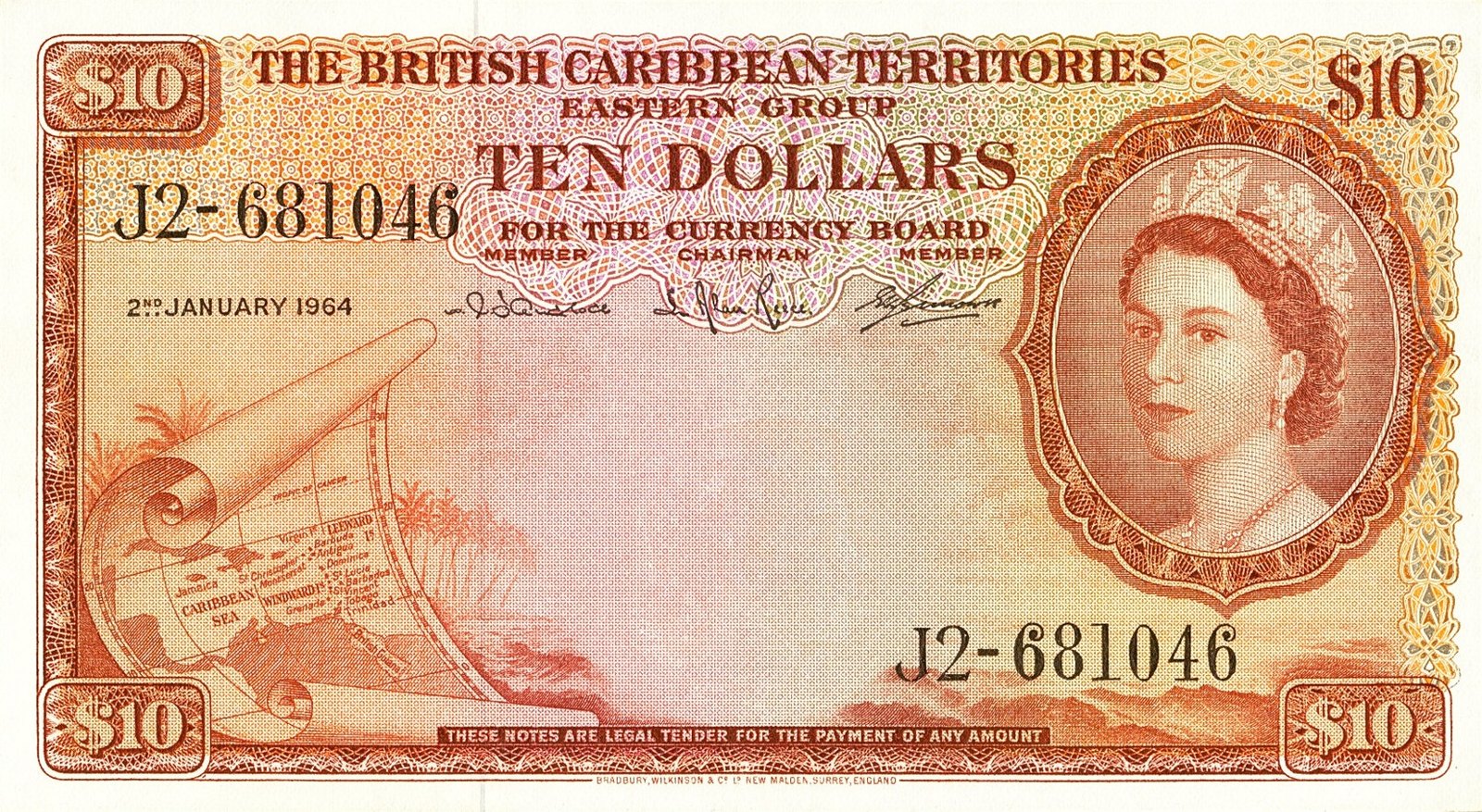
In Saint Vincent, Ordinance No. 1 of 1965 repealed the Currency Ordinance, 1959 and gave effect to the Agreement of 1964, and Ordinance No. 2 of 1965 gave effect to the East Caribbean Currency Agreement (Saint Vincent Government Gazette, 23rd March 1965, p. 70, text only). In British Guiana the Bank of Guyana Ordinance (No. 23 of 1965, of 15th October 1965) kept the Board's notes legal tender for a time to be set by the Minister, to be exchanged at par.
The notice of 15th July 1966, under Article 29 (2) of the East Caribbean Currency Agreement 1965, ended the Board's notes as legal tender in seven territories on and after 31st October 1966. That notice, Grenada's later change, and the Board's notes handed in after 1st July 1967 under Article 15 of the Agreement of 1964 are told in The East Caribbean notes in the gazettes and island newspapers, 1962 to 2004.
What the records do not hold
- The text of the Agreement of 1950 as a separate document, and any Schedule with a form of note: the laws leave the design to the Secretary of State.
- The ordinance numbers of Grenada and St. Lucia, and the proclamations of Barbados and British Guiana of 1954.
- The proclamations that brought the Jamaica laws and the Ordinances of 1965 into force, and those for the Ordinances of 1959 other than Antigua's.
- The text of the regulations of 1952 on the page image, and of Grenada's regulations of 1961.
Sources
- Trinidad Guardian, 17th May 1944, p. 1 (text only).
- Barbados Advocate, 16th April 1950, p. 7 (text only); 2nd August 1951, p. 5; 2nd September 1951, p. 14; 5th September 1952, p. 1. Sunday Advocate, 9th March 1952, p. 8, and 17th August 1952, p. 15.
- British Guiana: Currency Ordinance, No. 20 of 1950; Currency (Notes) Regulations, No. 21 of 1951 (Official Gazette, 28th July 1951); notice 440 (Official Gazette, 8th March 1952, p. 524); Ordinances No. 45 of 1954, No. 28 of 1956, No. 8 of 1959, No. 22 of 1962, No. 8 of 1965 and No. 23 of 1965; Parliament of Guyana papers.
- Leeward Islands: Currency Act, No. 4 of 1950 (Leeward Islands Gazette, 3rd August 1950); Annual Report on the Leeward Islands for 1949 and 1950; Leeward Islands Gazette, 2nd August 1951, p. 169, 30th December 1954 (proclamation of 28th December 1954), 30th June 1955 (Act No. 20 of 1955), 17th November 1955, and 14th June 1956 (Virgin Islands Ordinance No. 11 of 1956 and S.R.&O. 1956 No. 19).
- Barbados: Currency Act, 1950 (Act 1950-31), with the Agreement in its First Schedule.
- Trinidad and Tobago: Revised Ordinances, 1950, vol. V, pp. 594 to 606 (Ordinance No. 39 of 1950); Royal Gazette, 1952, p. 1440; Royal Gazette Extraordinary, 31st December 1954, notice 1222; annual reports for 1950 and 1955; West Indies Gazette, 26th February 1960.
- Official Gazette of Dominica: supplement of 30th October 1950, pp. G 1 and G 6 (Ordinance No. 18 of 1950); 3rd September 1951, p. 169; S.R.&O. No. 28 of 1951 (28th July 1951); 25th July 1952; notice of 18th September 1952, p. 329.
- Saint Vincent Government Gazette: Ordinances supplement, 1950, p. 121 (No. 17 of 1950); 7th August 1951, pp. A-211 to A-215; 1952, p. A-101; notice of 7th August 1952, p. 271; 21st December 1954, p. B-185 (S.R.&O. 1954 No. 72); 29th September 1955, p. 314; 27th August 1957, pp. 320 and 321; Supplement C, 3rd May 1960; 23rd March 1965, p. 70. Saint Vincent Ordinances, 1955, p. A-5 (No. 3 of 1955), and 1959, pp. A-57 to A-72 (No. 5 of 1959).
- Government Gazette of Grenada: 31st December 1954, p. 537; 16th April 1955; 18th August 1956, p. 324; 12th November 1955, p. 439; 19th October 1957, p. 504; 21st May 1960, p. 192.
- Antigua, Montserrat and Virgin Islands Gazette: Bill supplement, July 1956, pp. B-1 and B-4; S.R.&O. supplement, February 1958, pp. G-1 and G-2; 5th March 1959 (Virgin Islands Ordinance No. 3 of 1959); Ordinance supplement, November 1959, pp. J-2 to J-20 (Antigua No. 16 of 1959); 17th March 1960, p. F-1 (S.R.&O. 1960 No. 15); 27th July 1961, p. 143; 23rd August 1962, p. 189; 29th August 1963, p. 207; 23rd April 1964, pp. 29 and 30, and Montserrat supplement, pp. C-1 and C-2.
- West Indies Gazette, 26th February 1960.
- Reports of the Executive Commissioner for 1960, 1961 and 1962, as laid before the legislature of British Guiana.
Member comments
Log in or register to post a comment.