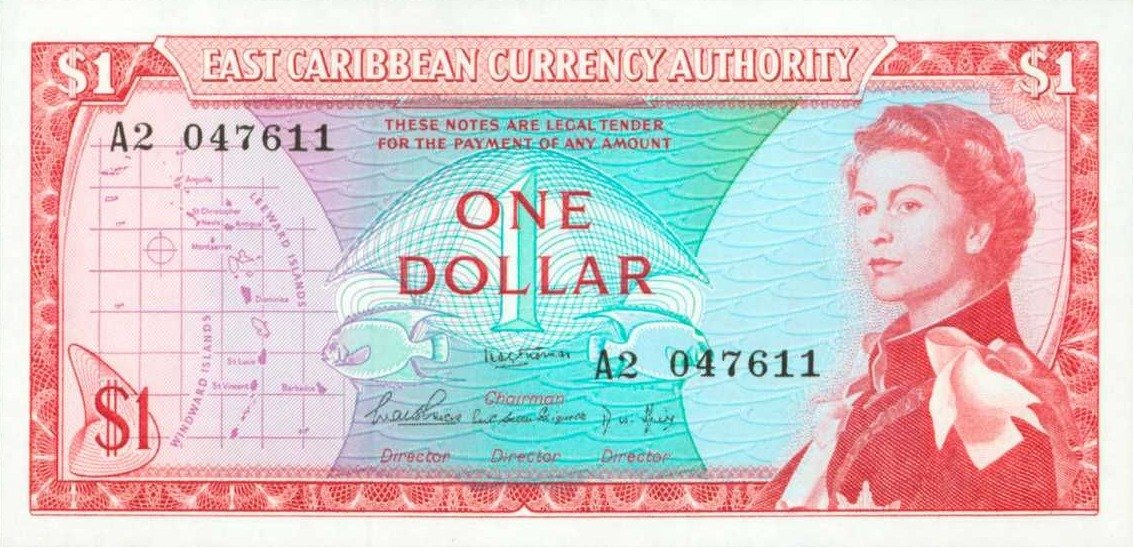
This article goes through what the official gazettes of the eastern Caribbean printed about the paper money of the East Caribbean Currency Authority and the Eastern Caribbean Central Bank, from the end of the British Caribbean Currency Board to the upgraded notes of 2004. The pages are those of the Saint Vincent, Grenada, Barbados and St Christopher and Nevis gazettes, with the Dominica Herald and the Grenada Newsletter where they report a notice, all held as page images in the Digital Library of the Caribbean. The issues themselves are set out in order in East Caribbean dollars, 1965 to 2026; here the notices speak for themselves.
A new board for the smaller islands, 1962 to 1965
The Dominica Herald of 3rd October 1962 reported a Regional Council of Ministers in Barbados at which British Guiana and Trinidad and Tobago had announced that they would leave the Currency Board. Trinidad offered its own new currency if the "Little Eight" took on its fiscal policy; the offer was rejected, and the group chose a Currency Board of its own, to sit in Barbados. (That page was read in its text only.)
On 18th April 1964 the same paper reported that the East Caribbean dollar would keep its fixed parity of four shillings and twopence, that the new Board would have four members and its headquarters in Barbados, and that the notes then in use would stay valid until the new notes were ready. The last of those points is on a part of the column read in the text only. On 24th December 1964, under the heading "New dollar bills soon", it reported that the Central Bank of Trinidad and Tobago had issued its own notes on 14th December, that the Regional Council would set up a new East Caribbean Currency Authority, and that D. W. Spiers, the Currency Adviser, would become the Authority's first Managing Director.
The Saint Vincent Government Gazette of 23rd March 1965 (p. 70, read in the text only) lists two Ordinances of that year: No. 1 of 1965 repealed the Currency Ordinance, 1959, and gave legal effect to the British Caribbean Currency Agreement, 1964; No. 2 of 1965 gave effect to the East Caribbean Currency Agreement. The text of neither Ordinance is among the pages.
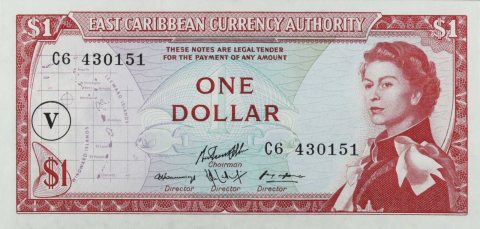
A press release printed in the Saint Vincent Government Gazette (No. 88, p. 84, read in the text only) reports the Authority's first meeting, held on 26th March 1965 at the headquarters of the Regional Council of Ministers at Sherbourne, St. Michael, Barbados. Its members were H. A. C. Thomas, nominated by Barbados; W. A. Kelsick, nominated by St. Kitts for Antigua, Montserrat and St. Kitts; Maurice Sales Miquelle, nominated by St. Lucia for St. Lucia, Dominica and St. Vincent; and D. W. Spiers of the Bank of England, appointed Managing Director by the Regional Council. Thomas was elected Chairman, and the printing and shipment of the new notes was on the agenda. These four are the first board on the catalogue's 1 dollar of 1965, where the name is spelt Salles-Miquelle and Spiers is called a Director.
The missing specimens, 1965 to 1967
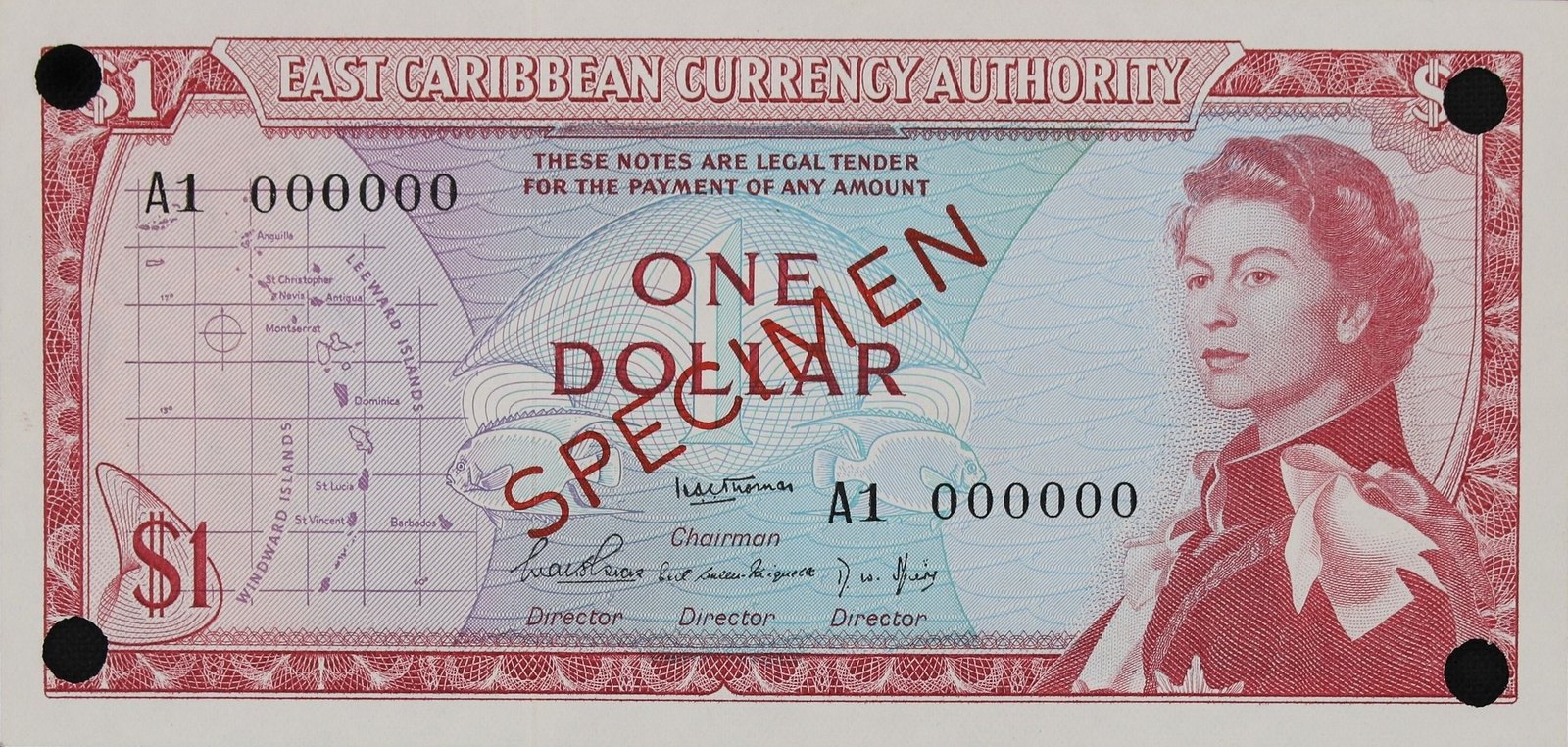
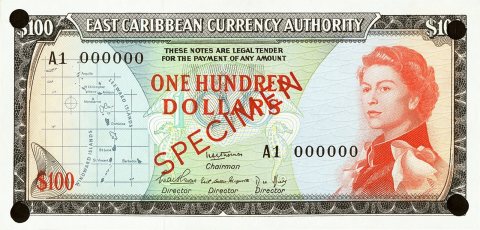
A Treasury notice in the Saint Vincent Government Gazette of 15th March 1967 (p. 112, repeated on pp. 124, 128, 134 and 139 until 18th April 1967), signed by E. R. Hannaway, Currency Officer, warned that some of the specimen notes put on display when the East Caribbean notes were issued "in September, 1965" had gone missing and entered circulation. They were of the 1, 5, 20 and 100 dollars, all bore the signature of D. W. Spiers, and were the same as issued notes except that every one was numbered A1 000 000 and overprinted SPECIMEN diagonally on both sides.
The notice says nothing of punch holes, which the catalogue's specimen row of the 1 dollar records, and it gives no count of the missing notes. The Colonial Office's annual report on Dominica, read in its text only, says the new notes came in "October 1965"; the Treasury notice says September. The day itself is in neither.
The end of the Currency Board's notes, 1966 to 1969
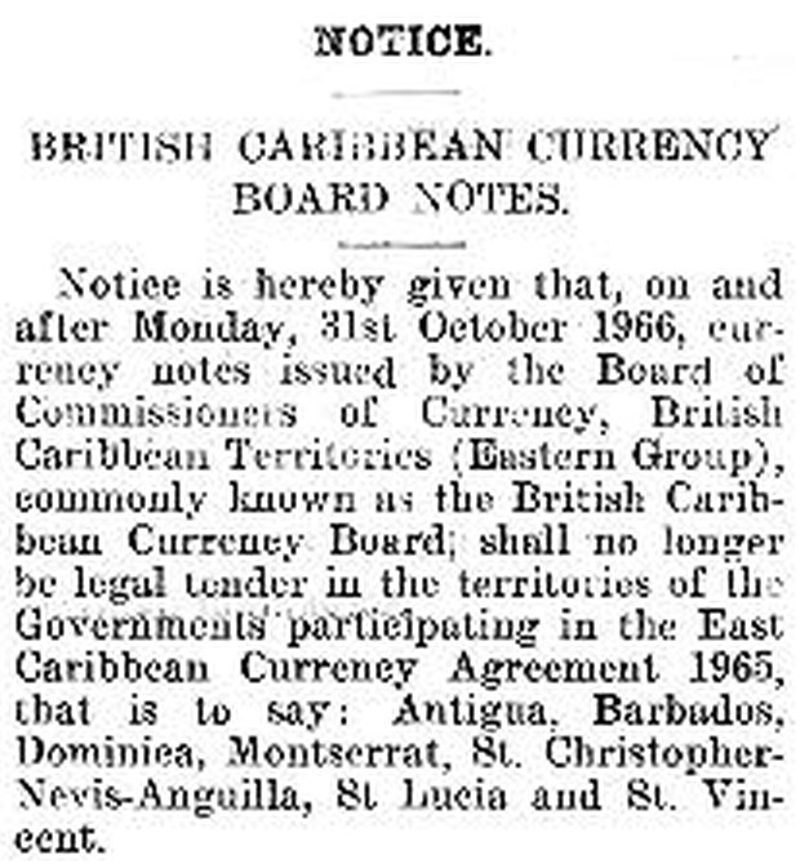
A notice of the Authority dated 15th July 1966 and signed by G. M. Lambert as Managing Director was printed in the Saint Vincent Government Gazette (p. 267, repeated on p. 275) and as Notice No. 597 in the Official Gazette of Barbados of 25th July 1966 (p. 798). On and after Monday 31st October 1966 the notes of the British Caribbean Currency Board would no longer be legal tender in the territories of the East Caribbean Currency Agreement 1965: Antigua, Barbados, Dominica, Montserrat, St. Christopher-Nevis-Anguilla, St Lucia and St. Vincent. The date was fixed under Article 29(2) of that Agreement. Grenada is not in the list.
Grenada came later. From 22nd June to 31st August 1968 the Grenada Government Gazette printed, eleven times, a notice of the Ministry of Finance, Trade and Production: the Board's notes and the Trinidad and Tobago notes "will shortly cease to be legal tender in Grenada", and the public should change them, free of charge, for Eastern Caribbean currency notes at Barclays Bank D.C.O., the Canadian Imperial Bank of Commerce, the Bank of Nova Scotia or the Royal Bank of Canada. The Board's coin stayed legal tender. No closing day is given in any of the eleven printings. The catalogue's pages date the second back, the first to name Grenada, from 1968.
The Board's monthly statements, printed in the Saint Vincent gazette, show the changeover. On the statement of 1st February 1966 several territories already stand at a minus figure, St. Vincent at minus 630,600 dollars, because more of the Board's notes had been withdrawn there than issued.
An account signed on 3rd April 1969 by N. L. Smith, Acting Managing Director, in the Official Gazette of Barbados of 21st April 1969 (pp. 372 to 374), gives the Board's notes handed in after 1st July 1967, claimed from the Crown Agents and destroyed. The page images are small and blurred, and the figures were read as far as they go and checked against the printed totals.
| Period from 1st July 1967 to | Central Bank of Trinidad and Tobago | Bank of Guyana | East Caribbean Currency Authority | Totals |
|---|---|---|---|---|
| 31st December 1968 | 410,402.00 | 134,904.50 | 558,877.50 | 1,104,184.00 |
| 31st January 1969 | 410,402.00 | 134,904.50 | 560,377.50 | 1,105,684.00 |
| 28th February 1969 | 410,402.00 | 134,904.50 | 573,115.50 | 1,118,422.00 |
These are the sums claimed from and paid by the Crown Agents. On 28th February 1969 the sums cancelled and destroyed were the same as the sums claimed, and notes of 6,756.00, 5,216.50 and nil dollars were in hand and not yet claimed by the three authorities, 11,972.50 in all. The story of the Board's own notes is told on the pages of the British Caribbean Territories.
Two sets of figures of 1977, through a newspaper
The Grenada Newsletter of Alister Hughes, for the week ending 5th November 1977 (pp. 4 and 5), copied from the Grenada Government Gazette of 28th October 1977 a breakdown of the Authority's currency in circulation by territory at 31st August 1977. The Newsletter says the Gazette headed the breakdown CONFIDENTIAL, and it found errors in it. The Gazette page itself is not among the pages held.
| Territory | Notes, EC$ | Coin, EC$ |
|---|---|---|
| Antigua | 19,004,412.00 | 824,350.00 |
| Dominica | 6,555,269.00 | 274,743.55 |
| Grenada | 26,233,701.00 | 597,640.75 |
| Montserrat | 3,561,283.00 | 97,740.00 |
| St. Kitts Nevis Anguilla | 135,461.00, in brackets (a minus figure) | 371,420.07 |
| St. Lucia | 21,677,607.00 | 628,710.28 |
| St. Vincent | 15,046,984.50 | 372,063.40 |
| Sub-total | 91,943,795.50 (the Newsletter: 92,214,717.50) | 3,166,668.05 |
| Less notes returned to the Authority from other currency areas | 34,448,897.00 | |
| After that deduction | 57,494,898.50 (the Newsletter: 57,765,820.50) | 4,475,876.05 |
The coin column goes on with Guyana, Trinidad and Tobago, Barbados and the proof sets, which are left out here. The Newsletter points out that St. Vincent shows cents where every other territory has whole dollars.
The same issue (p. 5) gives the Board's old notes redeemed to 31st August 1977, as the Gazette of 28th October published them:
| Territory | Board notes redeemed, WI$ |
|---|---|
| Antigua | 2,491,215.00 |
| Dominica | 2,474,881.00 |
| Grenada | 278,229.00 |
| Montserrat | 532,828.00 |
| St Kitts Nevis Anguilla | 3,059,501.00 |
| St Lucia | 3,412,272.00 |
| St. Vincent | 2,230,996.00 |
| Barbados | 13,075,253.50 |
| Total | 27,555,175.50 |
The Newsletter itself doubts the fifty cents in the Barbados figure.
1981: Trinidad and Tobago notes no longer bought
The Grenada Newsletter of 22nd August 1981 (p. 24) reported that the Central Bank of Trinidad and Tobago would no longer give the Authority value for Trinidad and Tobago notes, from 7th April 1981. The Authority had told the commercial banks that it would no longer buy those notes from them. The territories named are Grenada, St Vincent, St Lucia, Dominica, Antigua, Montserrat and St Kitts/Nevis. (The machine text of the page reads "April 2"; the page image reads April 7th.)
The Central Bank's notices of 1984 to 1993
The Bank's notice of its first note was printed in the Official Gazette of St Christopher and Nevis of 1st November 1984 (p. 5) and in the Government Gazette of Saint Vincent and the Grenadines of 6th November 1984 (No. 360, p. 327). The 10 dollars would be issued from 16th November 1984. It "bridges the gap" between the 5 and 20 dollars and is "the first Bank note to bear the title of the Eastern Caribbean Central Bank". The notice describes it point by point:
- the size is 145 x 69 millimetres, somewhat smaller than the existing notes;
- the engraved colours are blue and brown on the front, blue on the back;
- a new large portrait of the Queen;
- a map showing the territories;
- a stylised windsurfer, and a conch shell beneath the value in words;
- on the back, an island harbour scene, "typical, authentic, but intentionally unspecific", with the local flower, bird and fish in the borders;
- a security thread microprinted with the letters ECCB;
- one signature only, the Governor's.
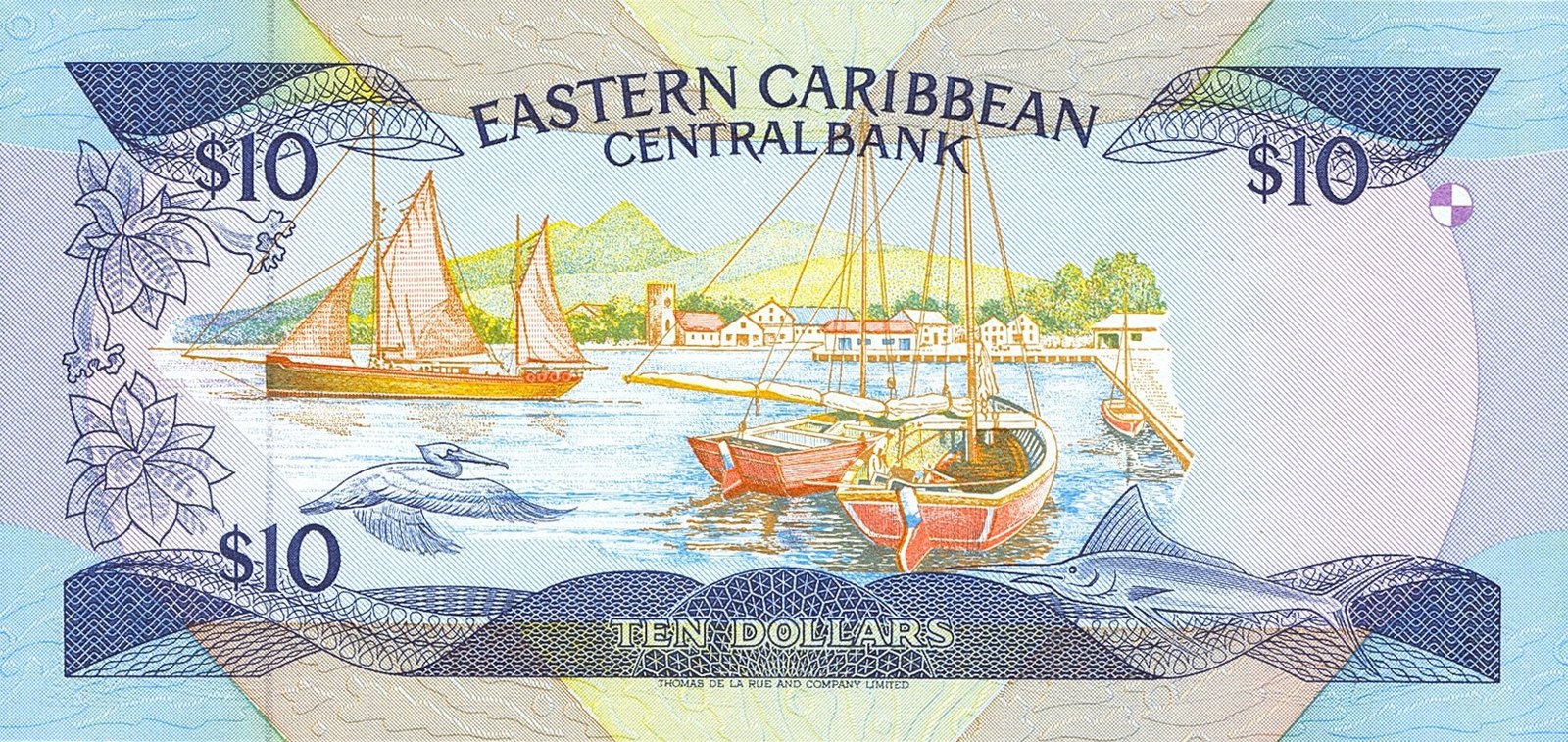
The Bank's own chronology, in its annual report for 2003-04, gives 15th November 1984 for the same note.
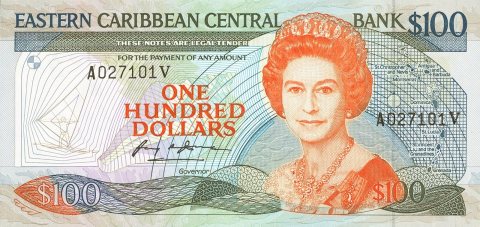
A press release of the Bank, in the Official Gazette of St Christopher and Nevis of 31st July 1986 (p. 2), announced a new design of the 1, 5, 20 and 100 dollars to replace the Authority's notes. The 1 dollar would go into circulation on 1st August 1986; the 5 dollars, 20 dollars and 100 dollars would follow as stocks of the old design ran out, and the Authority's notes would be withdrawn as they reached the commercial banks.
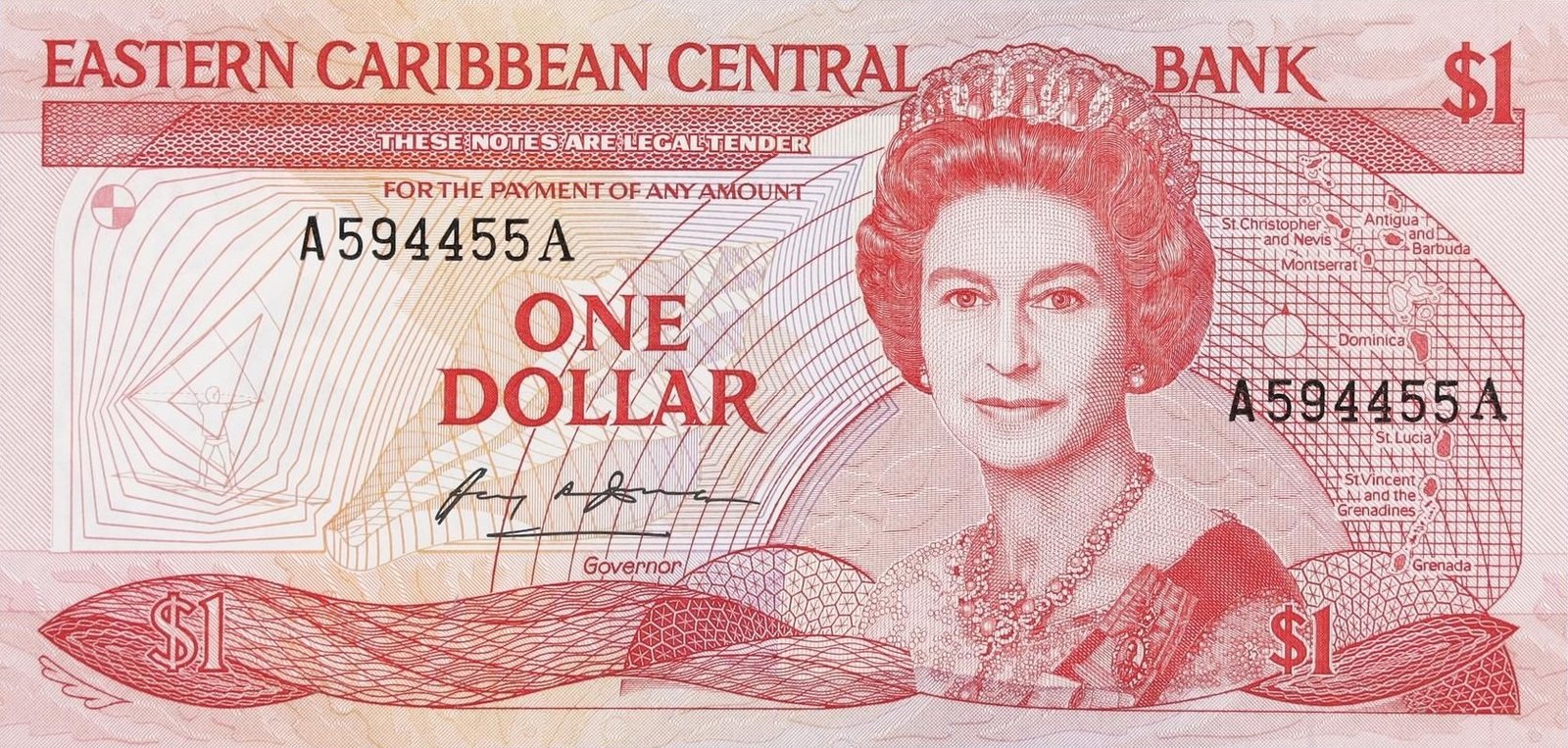
The Grenada Newsletter of 19th December 1987 (p. 11) reported the Bank's notice then appearing in the Gazette. From 1st January 1988 the Authority's 1, 5, 20 and 100 dollars "without the territorial codes" would cease to be legal currency. Holders could change them at par at the commercial banks until 31st March 1988, then only at the offices of the Bank's Currency Agents; after 1st January 1993 any payment would be at the sole discretion of the Bank. The Newsletter explains the "territorial code" as a letter, G for Grenada, printed on the face to show where a note was issued. The Gazette notice itself is not among the pages, and the notes with a letter in a circle are not named in the report.
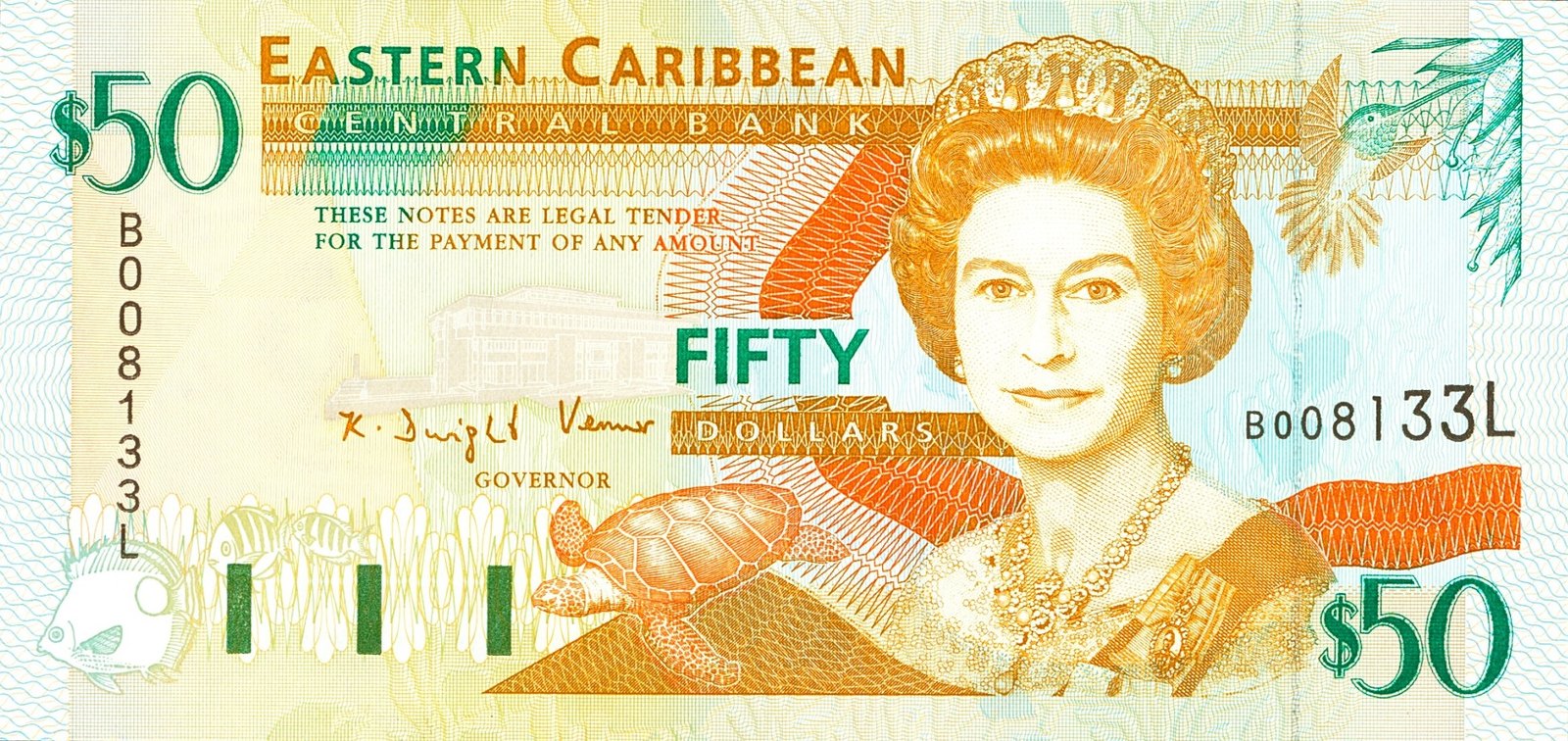
A press release of the Bank in the Grenada Government Gazette of 17th September 1993 (p. 403, repeated on 24th September and 1st October, p. 428, and in the Saint Vincent gazette) announced the new series for 4th October 1993, the tenth anniversary of the Bank. It would replace the existing notes over six months, though those would stay legal tender until further notice. The notes are of one size, 145 x 69 mm, printed by Thomas De La Rue and Company Limited. At the bottom left of each value is a series of dark green vertical bars, printed for security purposes, of which there may be between two and five. The release names the colours and the pictures of each value:
| Value | Colours | Subjects named |
|---|---|---|
| 5 dollars | mid green, navy blue and magenta | Admiral's House, Antigua and Barbuda; Trafalgar Falls, Dominica |
| 10 dollars | royal blue, charcoal grey and scarlet | Admiralty Bay, St. Vincent and the Grenadines; the Warspite, Anguilla |
| 20 dollars | burgundy, turquoise and orange | Government House, Montserrat; nutmeg, Grenada |
| 50 dollars | violet, olive green and red | Brimstone Hill, St. Kitts; Les Pitons, St. Lucia |
| 100 dollars | dark brown, dark green and ochre | Sir Arthur Lewis; the ECCB Central Bank building |
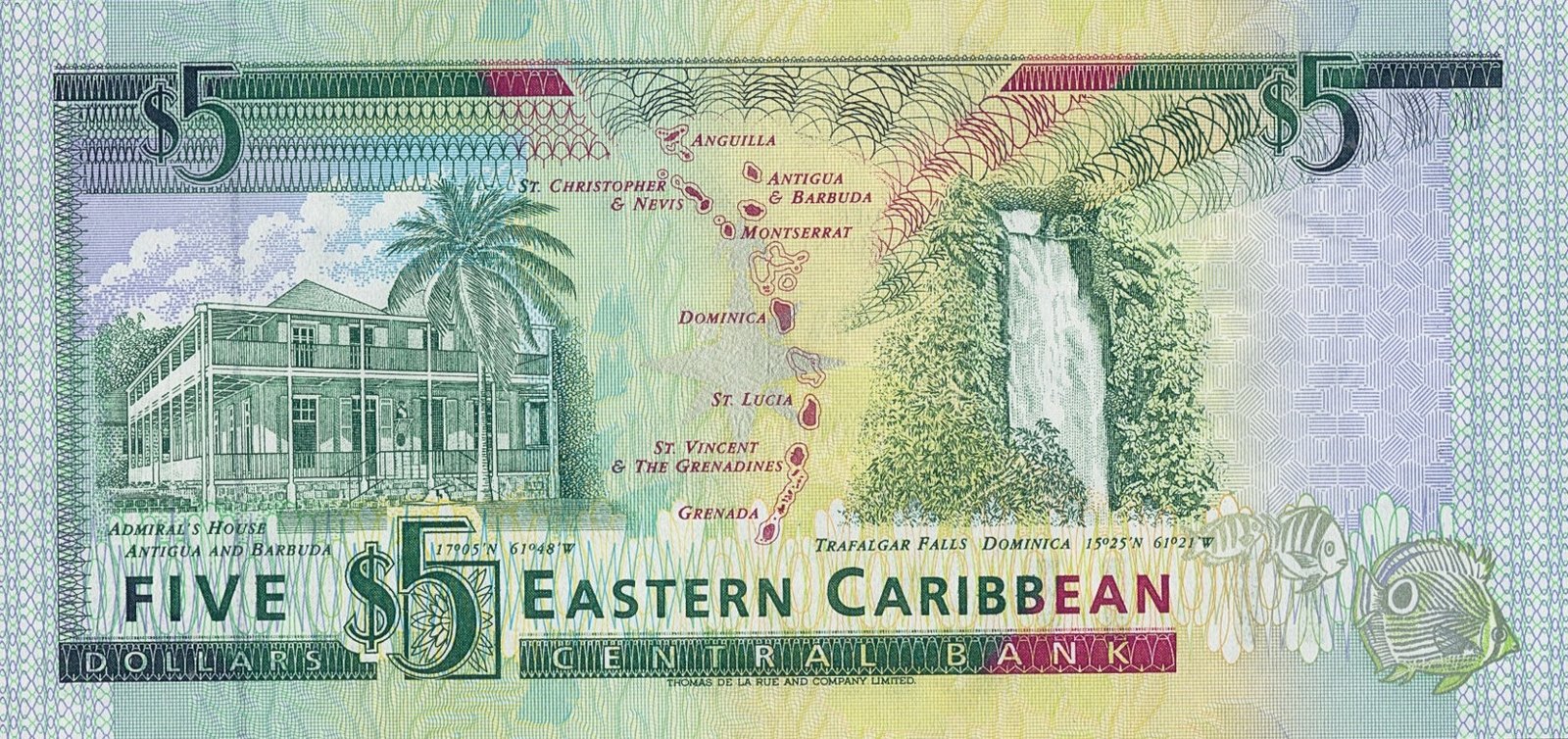
The catalogue's pages call the bars a machine-readable bar code of the island letter, which let the Bank measure the cash in circulation in each member country. The release calls them a security feature. The rest of the release, after the paragraph on the watermark, is on a page that is not held.
The stolen notes of 1998 and the upgrade of 2004
The Official Gazette of St Christopher and Nevis of 19th November 1998 (p. 8) carries a notice of the Bank under article 20 of the Eastern Caribbean Central Bank Agreement Act 1983. It called in, "effective immediately", all unissued notes that in May 1998 had been found to have been stolen from the vault of Barclays Bank in Plymouth, Montserrat. All bear the letter M, and the notice prints their numbers:
| Value | Numbers |
|---|---|
| Fives | A238001M to A247000M |
| Tens | A195001M to A205000M |
| Twenties | A371001M to A374000M |
| Fifties | A081001M to A087000M |
| Hundreds | A128001M to A131000M |
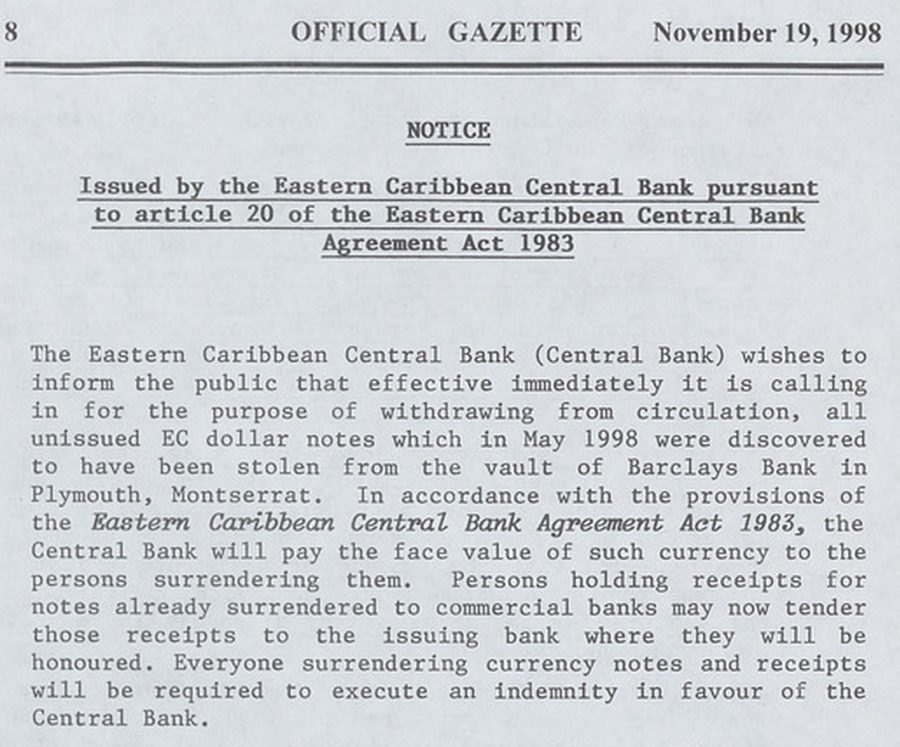
The Bank would pay face value to those who surrendered the notes. Payment through a commercial bank ended on 27th November 1998; after that every claim had to go to the Bank at its headquarters in St. Kitts. The notice does not say which printing the notes were. The catalogue puts the fifties on the 50 dollars of 1994 and the hundreds on the 100 dollars of 1994. For the other three runs no page is settled: the notice does not say, and no note from them has been seen. The pages of the 1994 5 dollars, 10 dollars and 20 dollars do not name them.
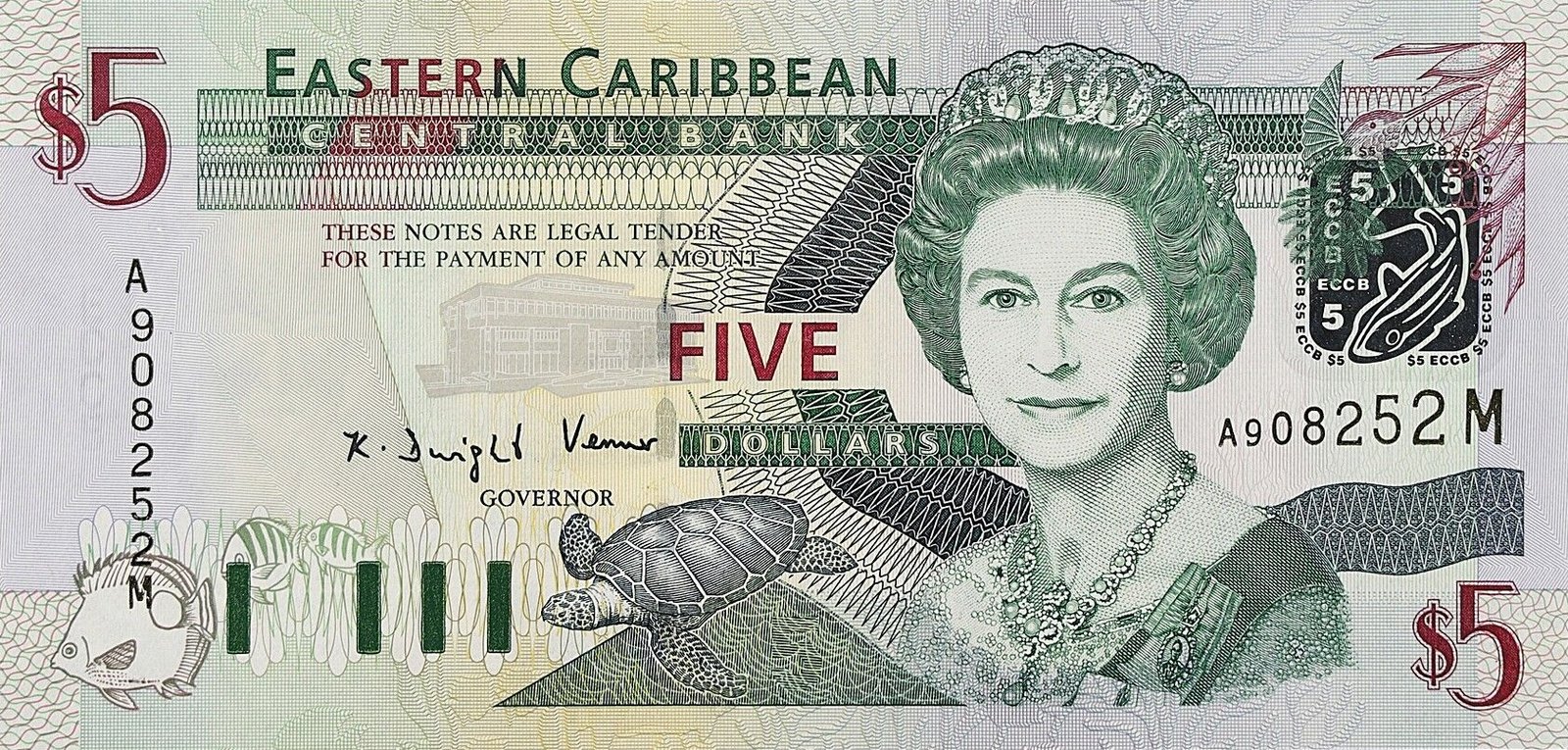
The same gazette of 15th July 2004 (p. 6) printed the Bank's notice of "Upgraded ECCB Banknotes". Two security features were changed. The security thread now fluoresces under ultraviolet light, showing the letters ECCB and the value in yellow against blue, and a second thread was added. The notes carry a highly reflective silver filigree foil, overprinted with intaglio. The upgraded notes were being brought into the member countries in phases, as stocks of the existing notes ran out. These are the notes of 2003 and 2004 on the catalogue, the 5 dollars with the silver fish among them.
What the pages do not hold
The day in September 1965 when the first notes were issued, and the day the Board's notes ceased to be legal tender in Grenada in 1968, are not in any notice held. Nothing among the pages speaks of the letters in a circle of 1983, or gives a day on which those notes ceased to be legal tender. No notice of a lost or stolen note of the Authority was found. The Authority's and the Bank's monthly statements, printed in the gazettes from 1966 to 1993, give one total for the notes in circulation and nothing by value or by island. Nothing after 2004 is among the pages.
Sources
- Dominica Herald, 3rd October 1962, 18th April 1964 (p. 1) and 24th December 1964 (p. 7).
- Saint Vincent Government Gazette, 23rd March 1965 (p. 70, the Ordinances); press release No. 88 on the Authority's first meeting (p. 84); the Authority's notice of 15th July 1966 (p. 267, repeated on p. 275); 15th March 1967 (p. 112) and the repeats to 18th April 1967; the Board's monthly statement of 1st February 1966.
- Official Gazette of Barbados, 25th July 1966 (Notice No. 597, p. 798) and 21st April 1969 (pp. 372 to 374).
- Grenada Government Gazette, 22nd June to 31st August 1968 (p. 206 and the repeats); 17th September 1993 (p. 403) and 1st October 1993 (p. 428).
- The Grenada Newsletter, week ending 5th November 1977 (pp. 4 and 5); 22nd August 1981 (p. 24); 19th December 1987 (p. 11).
- Official Gazette of St Christopher and Nevis, 1st November 1984 (p. 5), 31st July 1986 (p. 2), 19th November 1998 (p. 8) and 15th July 2004 (p. 6).
- Government Gazette of Saint Vincent and the Grenadines, 6th November 1984 (No. 360, p. 327).
- Colonial Office, annual report on Dominica (the year of the new notes).
- Eastern Caribbean Central Bank, annual report for 2003-04 (the chronology).
- The catalogue's note pages for the East Caribbean States.
Member comments
Log in or register to post a comment.