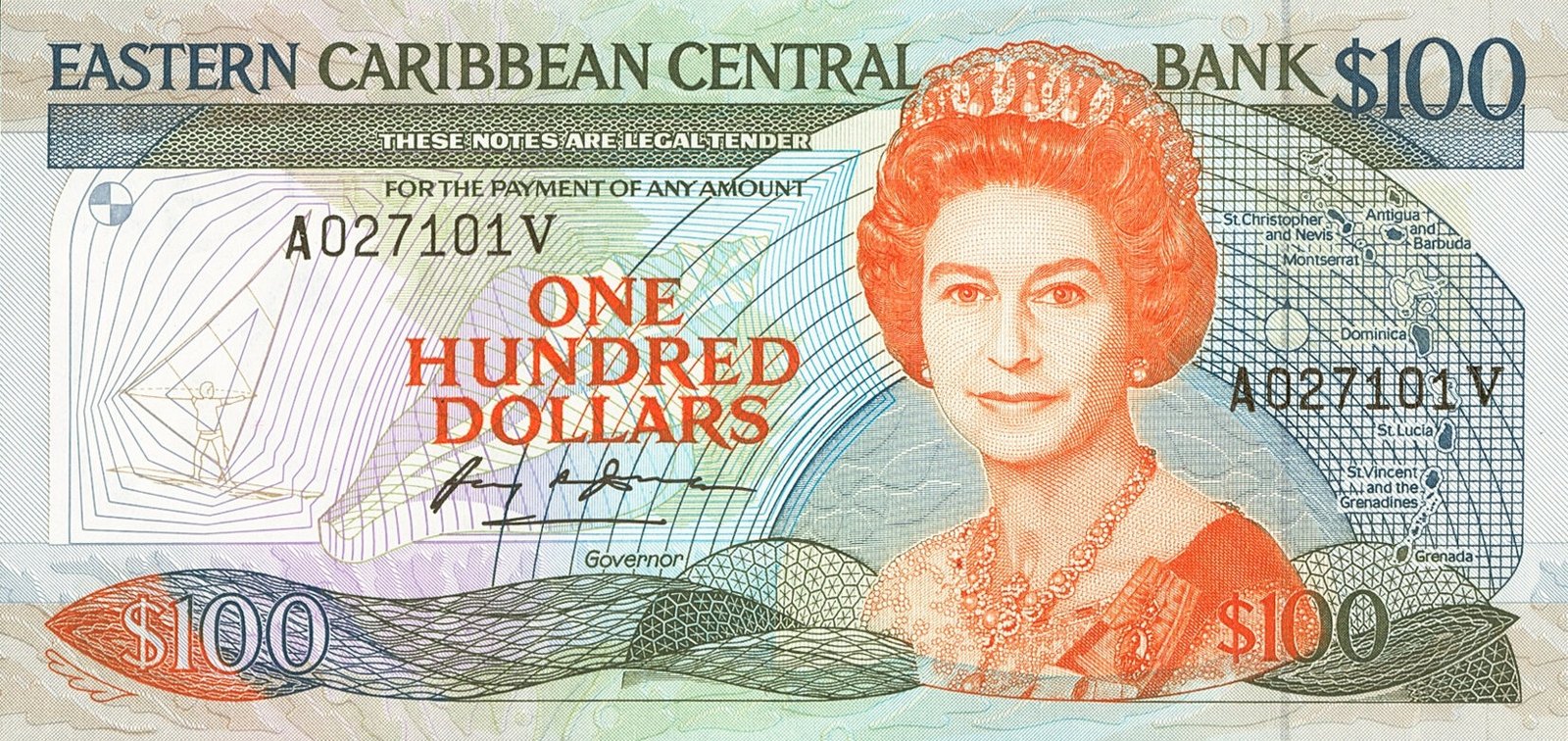
Three annual reports of the Eastern Caribbean Central Bank have been read for the catalogue: those for the years to 31st March 2004, 2025 and 2026. This article sets out what they say of the Bank's notes and of the people who ran its currency, figure by figure and page by page, and what they do not say. The days on which each issue came out, which the 2003-04 report also gives, are in East Caribbean dollars, 1965 to 2026; the notices the Bank printed in the gazettes are in The East Caribbean notes in the gazettes and island newspapers, 1962 to 2004. Page numbers below are those of the report files.
The Bank's chronology of its first ten years
The report for 2003-04 ends with a chronology of the Bank (pp. 34 to 36). These are its entries on the founding of the Bank and on its notes:
| Year | What the chronology says |
|---|---|
| 1983 | The Agreement establishing the Bank was signed on 5th July by the governments. The Bank came into being on 1st October as successor to the East Caribbean Currency Authority. Its Board first met on 5th October. |
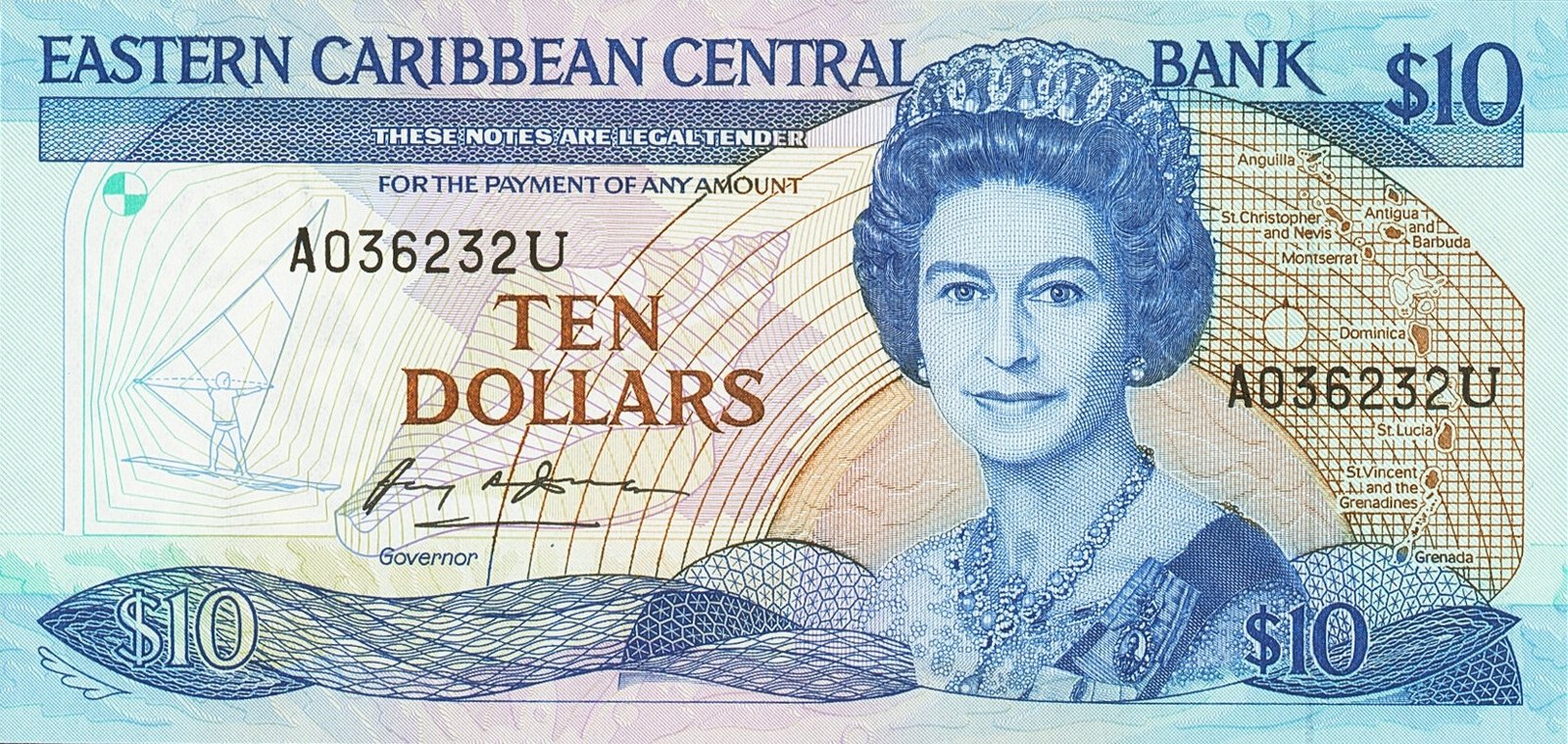
| 1984 | The Monetary Council first met on 20th January. The 10 dollars, "the first in a series of coded notes to replace the series issued under the ECCA", was introduced on 15th November, and country codes were assigned to the new series. |
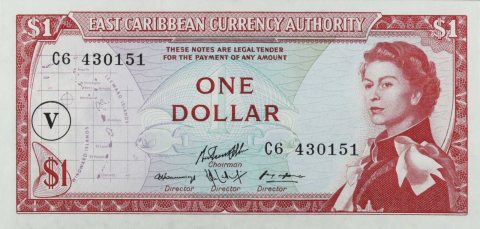
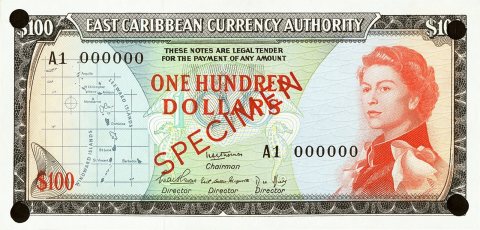
| 1986 | The coded 1 dollar was introduced on 1st August and the 100 dollars on 5th December. |
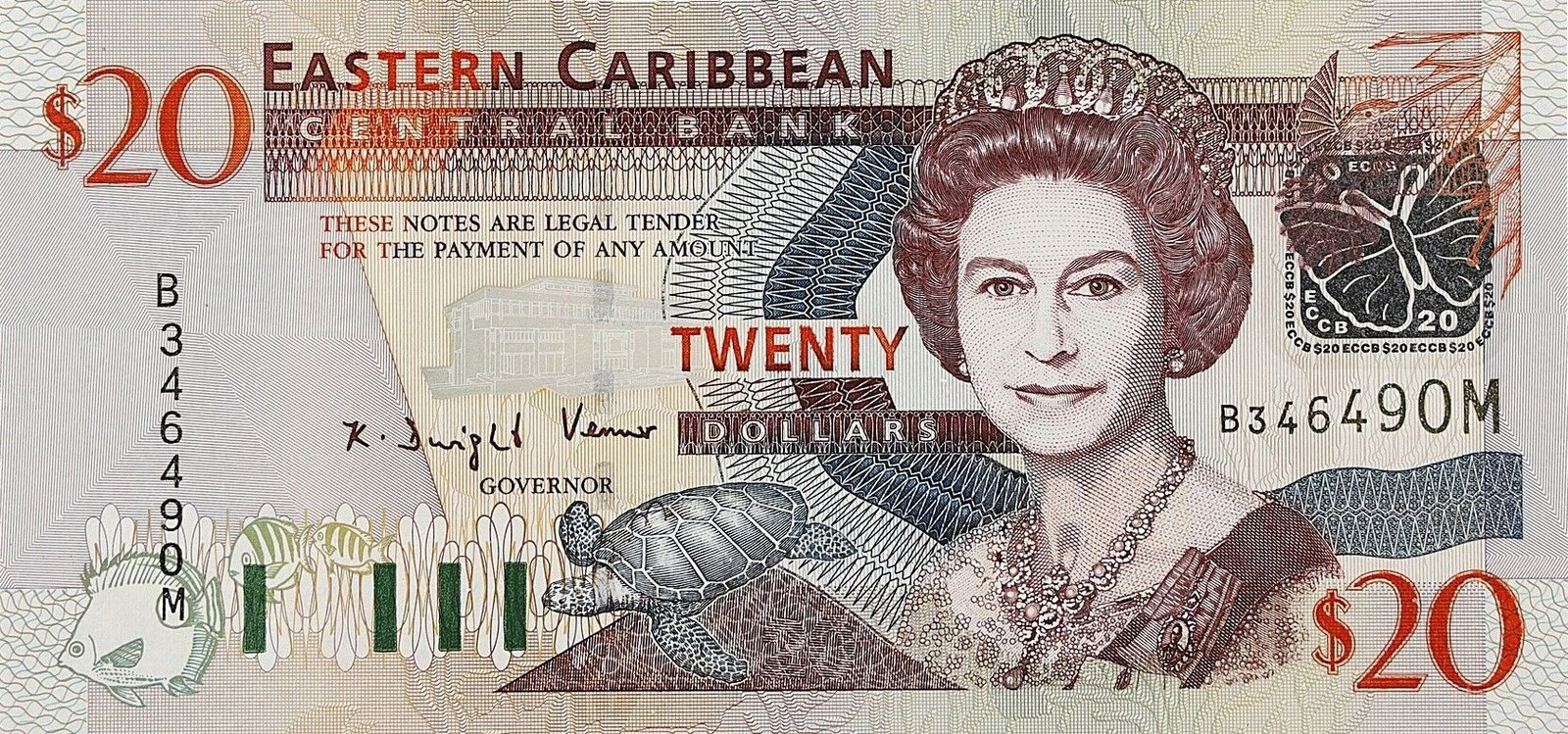
| 1987 | Anguilla became a full member of the Bank on 1st April. The coded 5 and 20 dollars were introduced on 8th April. |
| 1989 | The Bank ceased to issue the 1 dollar note, replaced by the 1 dollar coin. Cecil Jacobs retired in September, and K. Dwight Venner became Governor on 1st December. |
| 1992 | Ground was broken for the new headquarters on 21st November. |
| 1993 | A new series of notes was put into circulation in October, for the Bank's tenth anniversary. |
| 1994 | The headquarters opened on 29th October. |
The entries for 1983, 1984, 1986, 1987 and 1989 were read on the page images; the entry for 1993 and the dates of the headquarters were read in the text only.

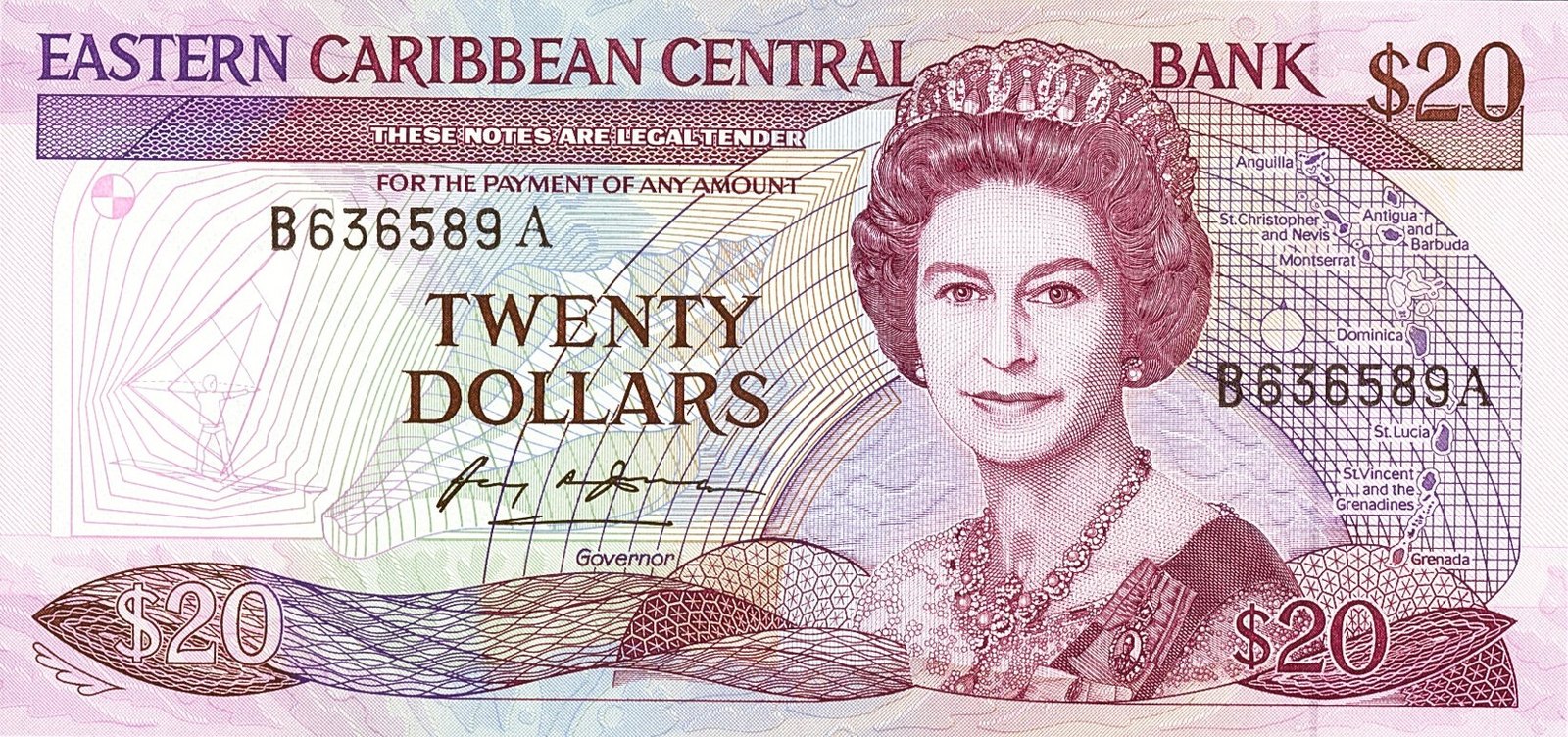
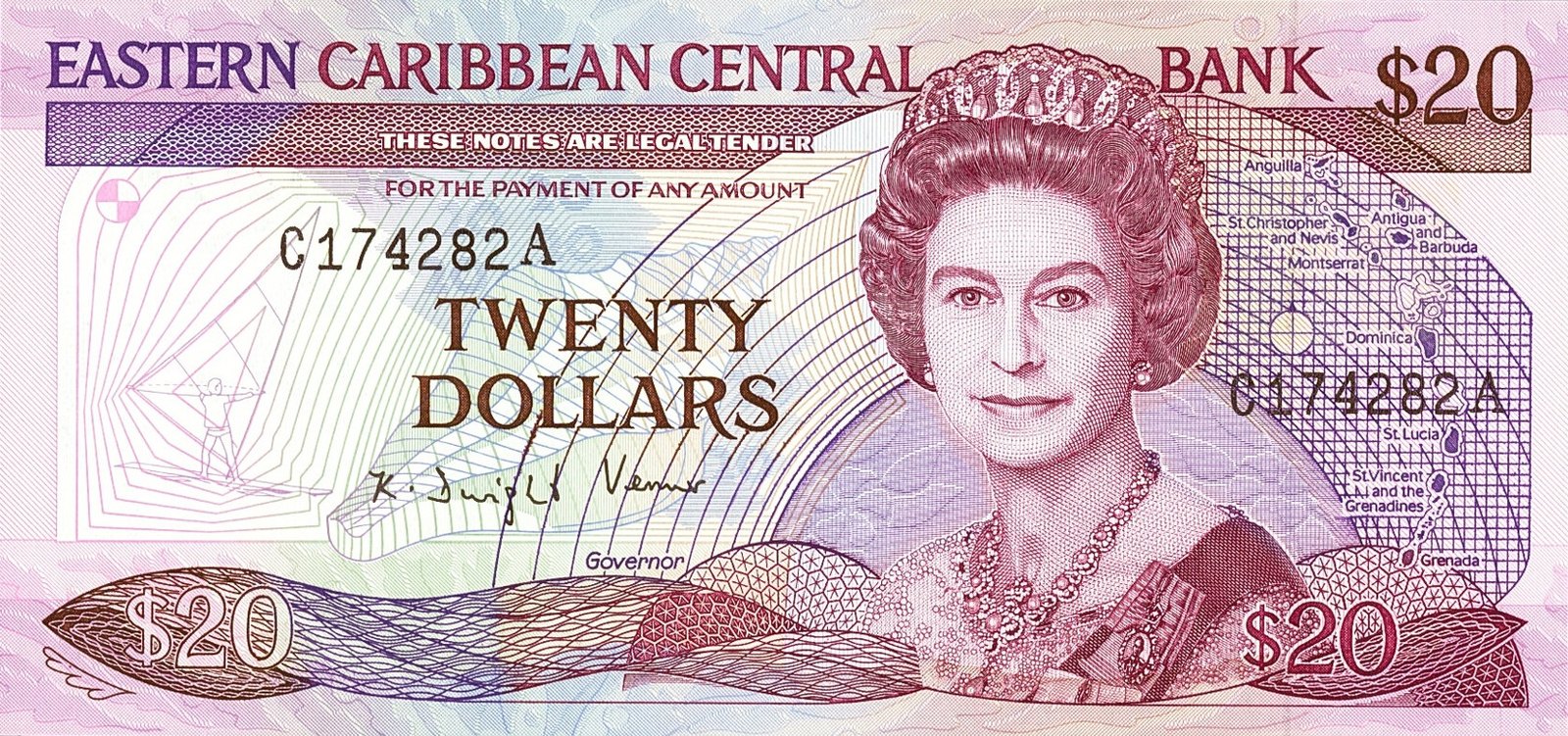
The pages for these notes are the 10 dollars, the 1 dollar, the 5 dollars, the 20 dollars and the 100 dollars of the map design. The chronology makes Anguilla a full member only on 1st April 1987, while the catalogue's page for the 10 dollars has a row with the Anguilla suffix U from the first notes, dated ND (1984). The report does not say when the letter U was first used, and the point is not settled.
The year to March 2004
The report for 2003-04 (p. 20, read on the page image) says that currency in circulation came to 532.9 million dollars on 31st March 2004, 11.2 per cent more than a year before. Of this, notes came to 479.6 million dollars, an increase of 50.6 million or 11.8 per cent. The notes to the accounts (note 14) give the currency in circulation as 532,925,052 dollars in 2004 and 478,898,885 dollars in 2003. The report gives no figure by value.
On the same page the Bank says it introduced upgraded notes, with "slight modifications to two (2) of the security features", phased into circulation as the current stock ran out, and that the earlier notes stayed legal tender. The report does not name the two features; the Bank's notice in the St Christopher and Nevis gazette of July 2004 does. The report also mentions "Know Your Money" seminars held with De La Rue Currency, which is named there only as the firm that ran the seminars, not as the printer. Its strategic plan (p. 31, read in the text only) sets the groundwork for a Currency Museum at the Bank's headquarters.
Notes in circulation, 2021 to 2026
The reports for 2024-25 and 2025-26 each give a chart of currency in circulation at 31st March over five years, in millions of dollars. Both are shown here, because the later report restates the year 2025.
| 31st March | Notes | Coins | Digital currency | Total | Report |
|---|---|---|---|---|---|
| 2021 | 1,169.53 | 118.57 | 0.40 | 1,288.50 | 2024-25 |
| 2022 | 1,281.84 | 123.03 | 2.27 | 1,407.14 | 2024-25 and 2025-26 |
| 2023 | 1,360.92 | 128.23 | 2.45 | 1,491.60 | 2024-25 and 2025-26 |
| 2024 | 1,437.67 | 134.77 | 0.77 | 1,573.21 | 2024-25 and 2025-26 |
| 2025 | 1,558.31 | 141.89 | 0.21 | 1,700.41 | 2024-25 |
| 2025, restated | 1,559.36 | 141.67 | not shown | 1,701.03 | 2025-26 |
| 2026 | 1,707.07 | 149.04 | not shown | 1,856.11 | 2025-26 |
The report for 2024-25 (p. 77) puts the notes at 91.64 per cent of all currency on 31st March 2025; the report for 2025-26 (p. 64) puts them at 91.97 per cent on 31st March 2026, when the total had risen by 155.08 million dollars, or 9.12 per cent, in the year. Neither report divides the notes by value or by island.
What the notes cost, and the stock in hand
The income statements give the Bank's currency expenses, and a note to the accounts gives the stock of new notes and coins it held, at cost. The report for 2024-25 says this cost covers "the production of notes and coins by printers/minters, freight and other related charges".
| Year to 31st March | Currency expenses, dollars | Notes and coins inventory, dollars |
|---|---|---|
| 2024 | 4,261,638 | 20,250,331 |
| 2025 | 4,780,621 | 18,300,957 |
| 2026 | 5,579,563 | 14,419,813 |
These are notes and coins together. The inventory figure for 2026 was read in the text only. No report names a printer.
Policy, forgeries and the new family
The report for 2024-25 (pp. 78 and 79) records a Banknote Policy that gave the commercial banks standards for fit, unfit and mutilated notes, and a course for forensic expert witnesses on counterfeits held on 13th and 14th March 2025, led by Rosbert Humphrey, Director of the Currency Management Department. It gives no count of forged notes. The page also carries small photographs of notes at the training.
The same report (p. 79) describes the 50 dollars for Grenada's fiftieth year of independence, a polymer note in the size of the current notes, legal tender in every member territory. On the front are Sir Eric Gairy, the words "50 Years Grenada's Independence", the lines "The difficult we do right away / The impossible we take a little longer", a map of Grenada, the arms of Grenada and the Maurice Bishop International Airport. On the back are Maurice Bishop, the words "Forward ever backward never", and dancers and drummers. The picture carries the number SX 000000 and the Governor's signature. SX is also the prefix with which the catalogue's 50 dollars on polymer begins. The report gives the year of issue, April 2024 to March 2025, and not the day.
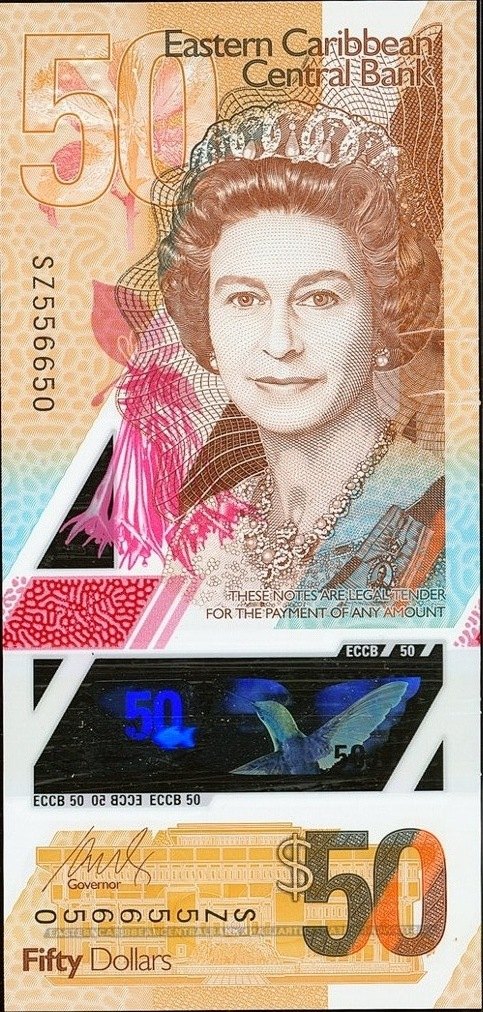
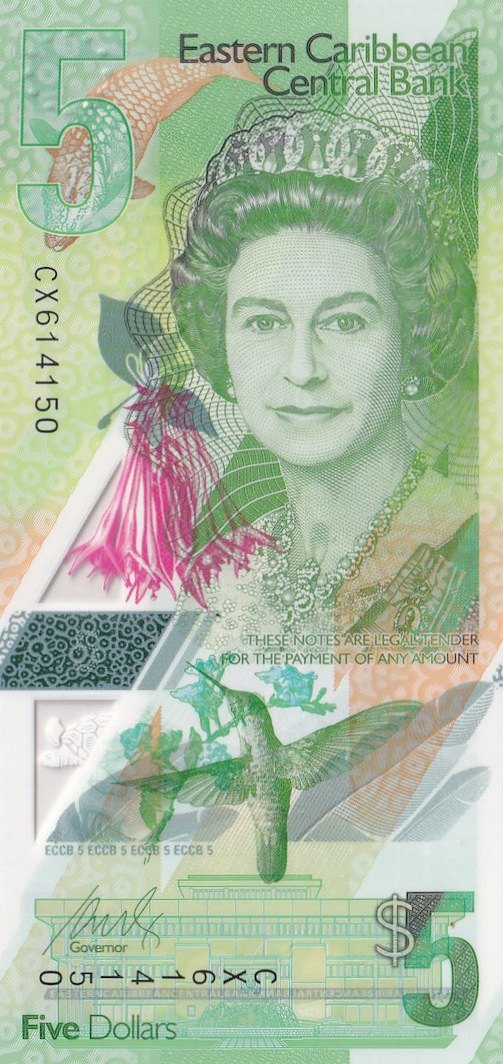
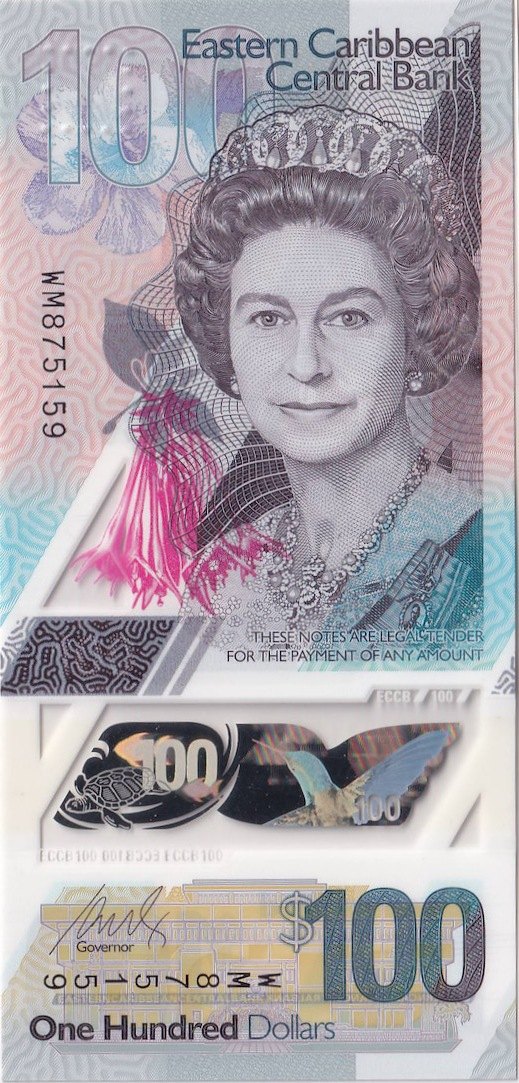
Among its plans for 2025-26 (p. 97, read in the text only), the report lists the final designs of notes and coins without the image of the British monarch, and ways of disposing of and recycling shredded polymer notes. The report for 2025-26 (p. 65) says the removal of the monarch's image had been approved, replacement images agreed and the designs of a new family of notes and coins finished, with a launch early in the second half of the year and issue "as early as 2026" beginning with the five cent coin. Its focus for 2026-27 (p. 86) is the introduction of the new currency. No note of the new family had been issued by 31st March 2026. The present notes with the Queen are the polymer 5 dollars, 10 dollars, 20 dollars, 50 dollars and 100 dollars.
The old Currency Board's money on the Bank's books
The British Caribbean Currency Board was to be dissolved on 30th June 1967, and its name was still in the Bank's accounts in 2004 and in 2025. The report for 2003-04 (note 16, p. 58) lists a "British Caribbean Currency Board Residual Fund" among the Bank's demand liabilities: 833,731 dollars in 2004 and 833,632 dollars in 2003. The report for 2024-25 (note 17) carries the Residual Fund at 833,626 dollars and a line "British Caribbean Currency Board Coins in Circulation" at 2,564,130 dollars, the same in both years. Neither report says what the fund is for, or whether it stands for any of the Board's notes not yet handed in. The Board's notes themselves are on the pages of the British Caribbean Territories.
The people the reports name
| Name | Office | When, and where the report says so |
|---|---|---|
| Cecil Jacobs | First Governor | Retired September 1989 (2003-04, p. 35) |
| K. Dwight Venner | Governor | From 1st December 1989 (2003-04, p. 35); in office on 31st March 2004 (p. 7) |
| Errol N. Allen | Deputy Governor | In office on 31st March 2004 (2003-04, p. 7) |
| Carl Harrigan, Whitfield Harris Jr, Ambrose Sylvester, Timothy Antoine, Vincent Placide, Wendell Lawrence, Trevor Brathwaite, Maurice Edwards | Directors for Anguilla, Antigua and Barbuda, Dominica, Grenada, Montserrat, St Kitts and Nevis, St Lucia, St Vincent and the Grenadines, in that order | On 31st March 2004 (2003-04, p. 7) |
| Anthony Boatswain, then Margaret Annie Dyer-Howe | Chairman of the Monetary Council, which passes each July | Handover in July 2003 (2003-04, p. 28) |
| Timothy N. J. Antoine | Governor and Chairman of the Board | In office in 2024-25 and on 31st March 2026 (2024-25, p. 18; 2025-26, p. 9) |
| Dr Valda Henry | Deputy Governor | The same (2024-25, p. 18; 2025-26, p. 9) |
| Hon. Dr Ellis Webster | Chairman of the Monetary Council | From the change of chairmanship on 19th July 2024 (2024-25, p. 38) |
| Kathleen Rogers, Kenya Lee, Rasona Davis-Crump, Hilary Hazel, Denise Edwards, Francis Fontenelle, Mike Sylvester, Edmond A. Jackson | Appointed Directors for Anguilla, Montserrat, Antigua and Barbuda, St Kitts and Nevis, Dominica, Saint Lucia, Grenada, St Vincent and the Grenadines, in that order | On 31st March 2026 (2025-26, p. 9) |
Jacobs and Venner are the two signatures of the notes of 1984 to 1993; the catalogue dates its Venner rows ND (1989), which agrees with the day the chronology gives. The reports give no day on which Venner left office or Antoine came in.
What the three reports do not give
None of the three reports gives the notes in circulation by value or by island, the notes destroyed or ordered, the number of forged notes, the printer of the notes, the day the Grenada 50 dollars came out, or any end of legal tender for the paper notes. The report for 2003-04 says nothing of the bar code or of the island letters being dropped. The reports for the years 2004-05 to 2023-24 have not been read for the catalogue; they would be the place to look for the days on which the notes of 2008, 2012, 2015, 2019 and 2021 were issued.
Sources
- Eastern Caribbean Central Bank, Annual Report 2003/2004: pp. 7, 20, 28, 31, 34 to 36 and 58 of the file (the Board, Currency Management, the Monetary Council, the strategic plan, the chronology, the notes to the accounts).
- Eastern Caribbean Central Bank, Annual Report 2024-2025: pp. 18, 38, 77 to 79, 97 and 105 of the file, and the notes to the accounts.
- Eastern Caribbean Central Bank, Annual Report 2025-2026: pp. 9, 64, 65, 86 and 97 of the file, and the notes to the accounts.
- Official Gazette of St Christopher and Nevis, 15th July 2004, p. 6 (the upgraded notes).
- The catalogue's note pages for the East Caribbean States.
Member comments
Log in or register to post a comment.