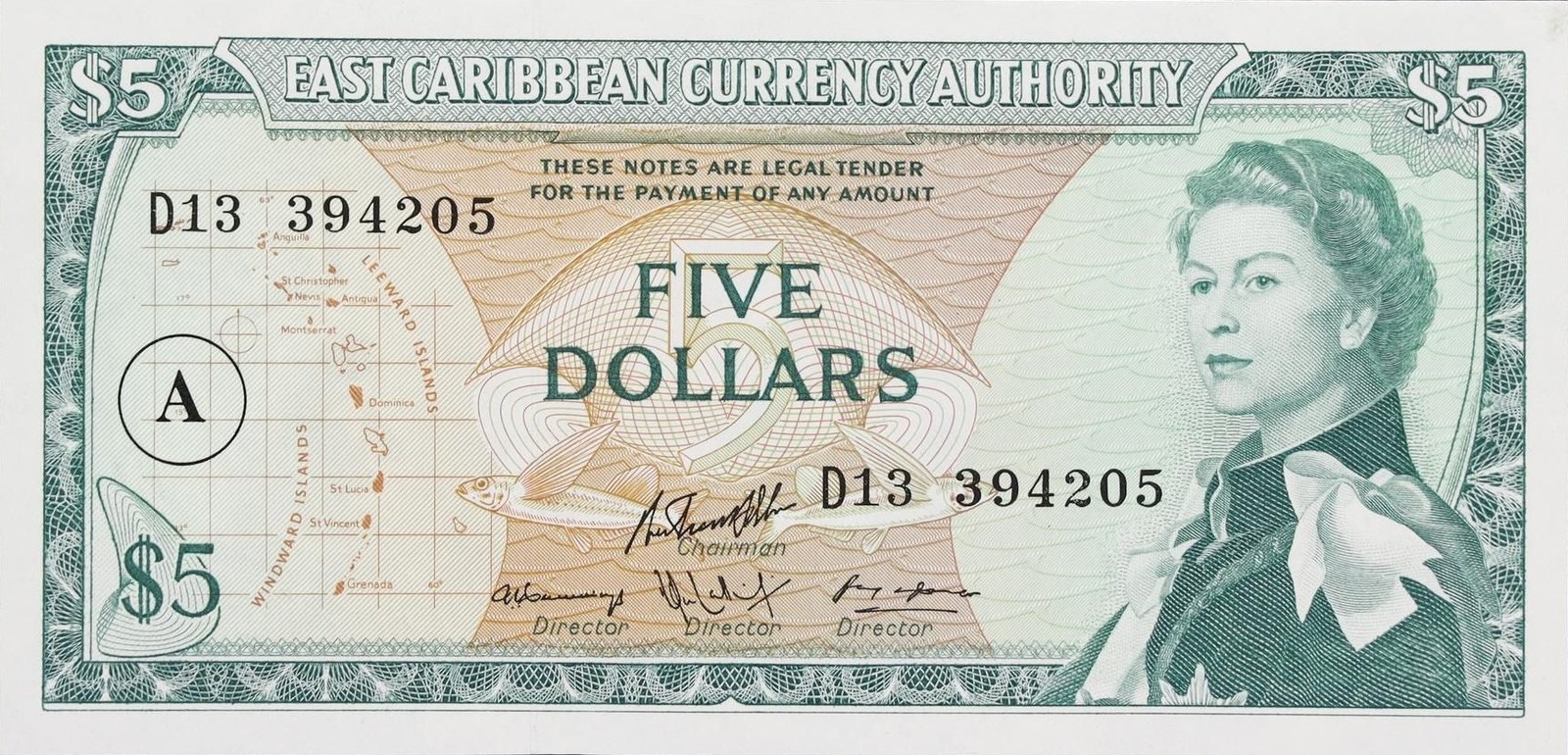
This article sets out the paper money of the East Caribbean States in order of time, from the first notes of the East Caribbean Currency Authority in September 1965 to the polymer notes of the Eastern Caribbean Central Bank. It is drawn from the catalogue's note pages, which rest on the Bank's annual reports, notices in the gazettes and the notes themselves, with some statements of the auction houses and one law text, each named where it is used.
The East Caribbean Currency Authority and its issue of 1965
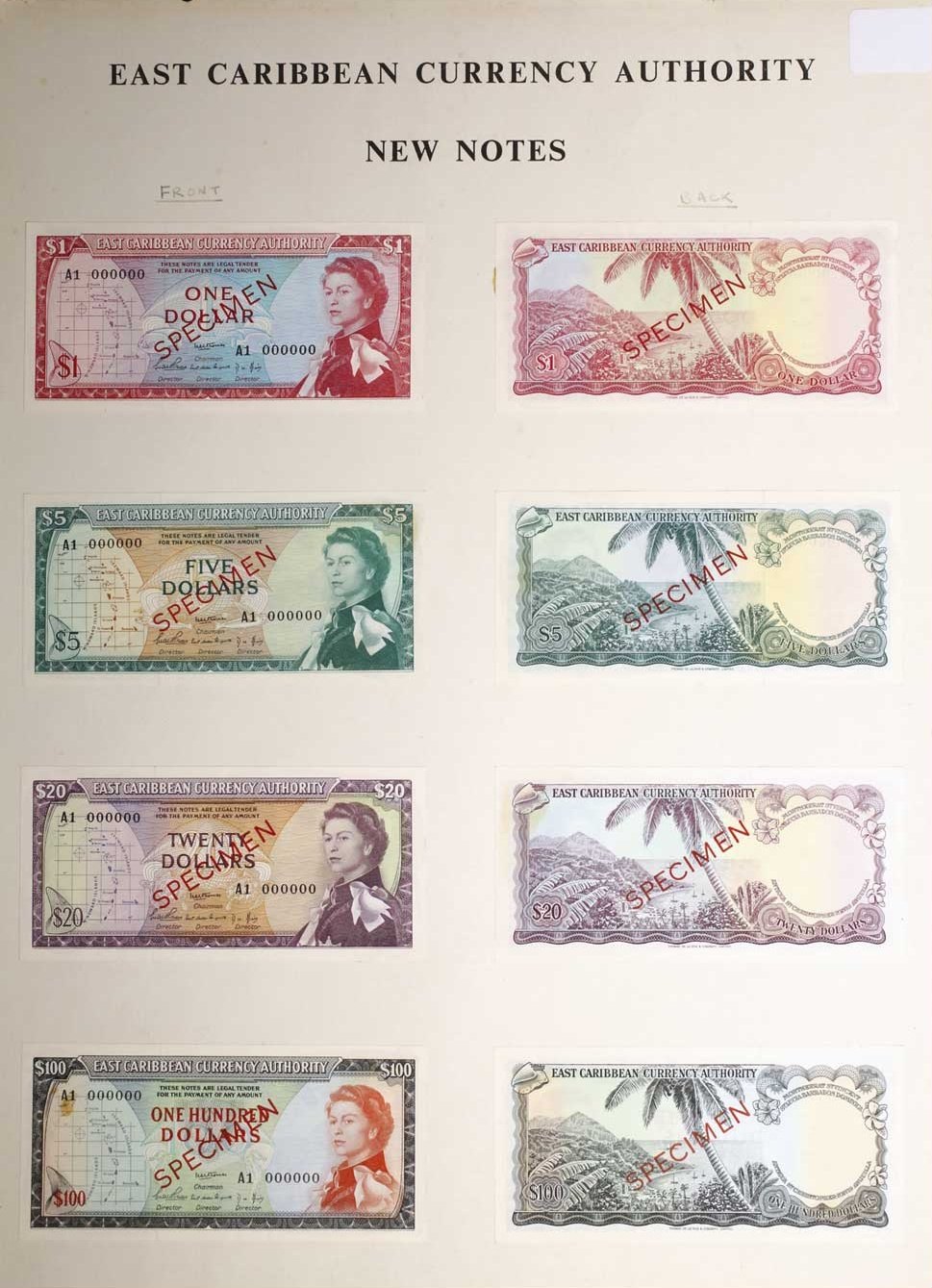
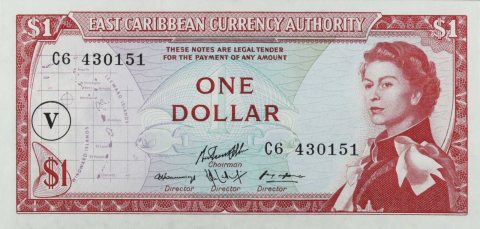
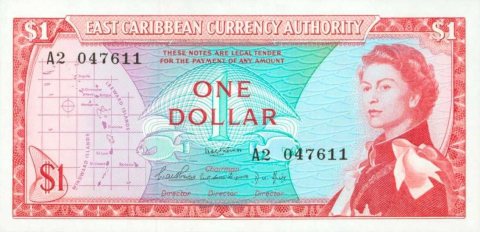
The Authority issued four values: the 1 dollar, the 5 dollars, the 20 dollars and the 100 dollars. All four were printed by Thomas de la Rue and carry no date. They were first issued in September 1965 and the design stayed in use until 1983.
Sources mention that the issue was designed at De La Rue by John White in 1962, with Annigoni's portrait of the Queen on the front and one bay with a palm tree on the back of every value, so that no single territory was favoured. The catalogue's pages name no source for this by title.
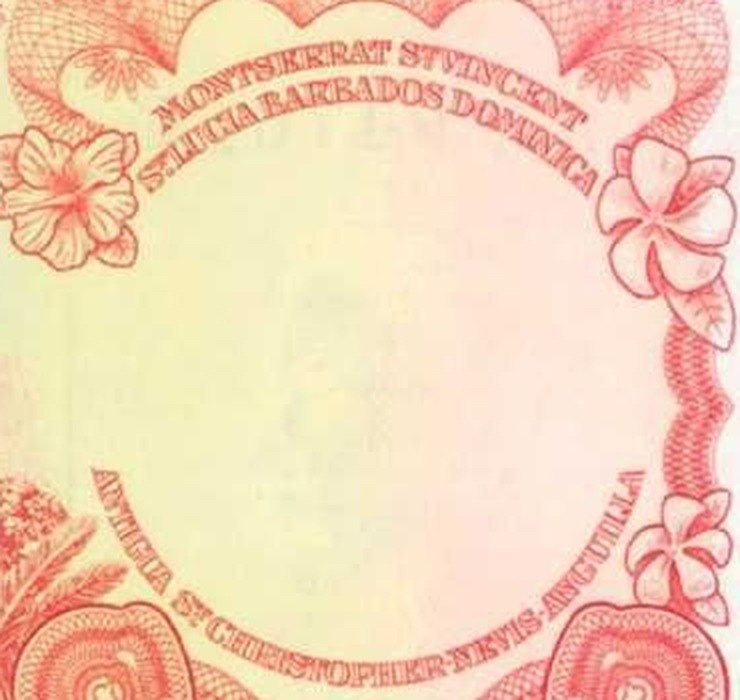
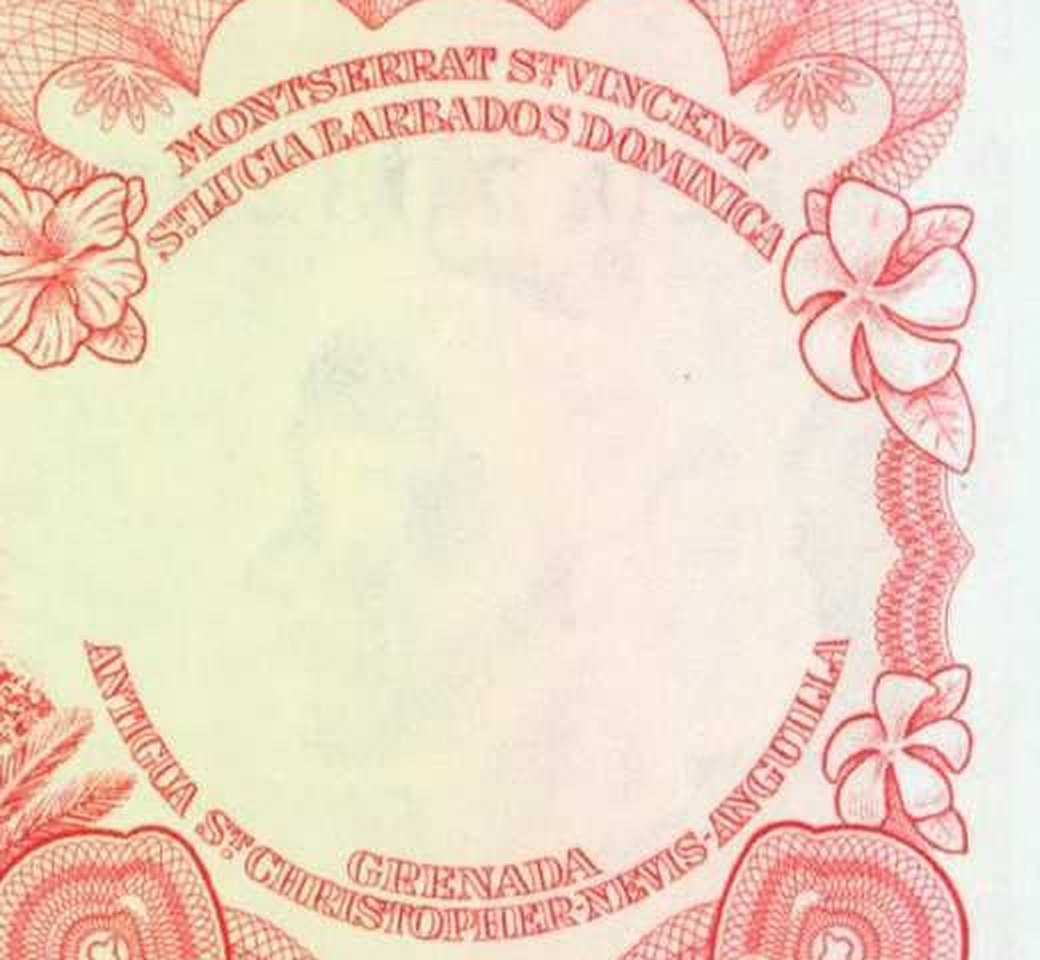
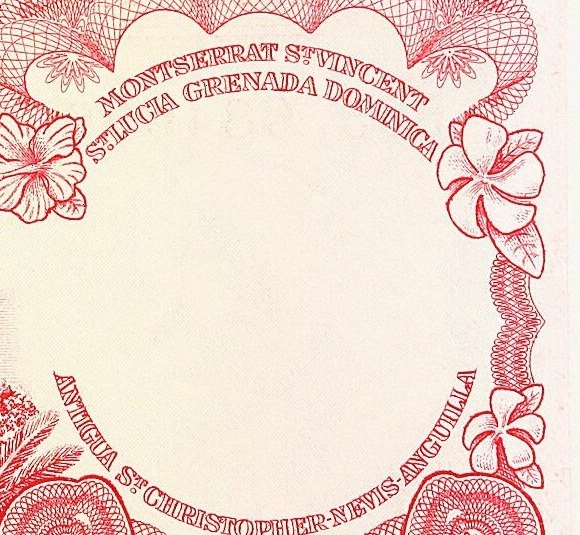
The list of territories on the back changed twice, which gives three backs:
| Back | From | Territories listed |
|---|---|---|
| Type A | 1965 | Barbados, but not Grenada |
| Type B | 1968 | Barbados and Grenada |
| Type C | 1974 | Grenada, but not Barbados |
Barbados left the currency union in 1973, and the type C back followed in 1974. On the 1 dollar the type C back changes from dark red to bright red under the last board.
Twelve boards of signers
Each note carries four signatures: a Chairman and three Directors. Twelve boards signed the series in turn. Ten of them are found on the 1 dollar. Ten are listed for the 5 dollars and ten for the 20 dollars, one of them unconfirmed on each value. All twelve are listed for the 100 dollars, five of them unconfirmed as issued notes. The pages do not name the members of the boards. Heritage's description of lot 22188 in its sale of 8 December 2023, a 20 dollars of the second board, says that board is known by the signature of Gerald M. Lambert at the right.
The prefixes run in board order, and the tables for dating a note from its prefix are in East Caribbean dollars of 1965 to 1983: how to date a note from its prefix. The 100 dollars is the exception: every board printed it on prefix A1 and only the last board ran on into A2. Heritage's description of lot 24131 in its sale of 17 October 2024 says that a note with the ninth group of signatures still carries A1, and the house takes this as evidence of how few 100 dollars notes were issued.
The specimens that went into circulation, 1965 to 1967
When the notes came out in September 1965, specimens were put on display in the territories. They were numbered A1 000000 and overprinted SPECIMEN diagonally on both sides. Some went missing and passed into circulation. A Treasury notice in the Saint Vincent Government Gazette of March 1967 warned of them. The pages do not say how many were lost or whether any was recovered.
1983: a letter in a circle, and the end of the Authority
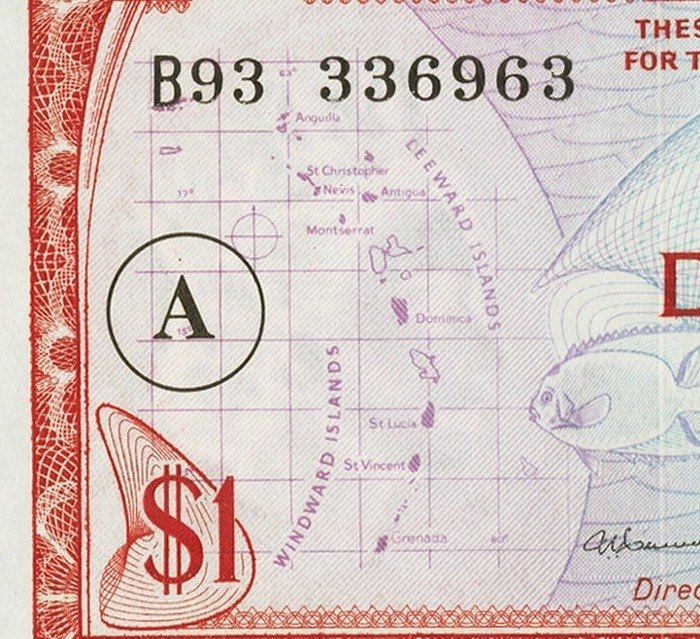
From 1983 the type C notes of the last board were overprinted in black with a territory letter in a circle, at the left centre of the front, over the map and below the serial number: A Antigua, D Dominica, G Grenada, K St. Kitts, L St. Lucia, M Montserrat, U Anguilla, V St. Vincent. Spink's description of lot 187 in its sale of 9 December 2014 gives a detail of how the overprint was prepared: a specimen 100 dollars with the V in a circle is annotated in ink "for style and position of o/p" and dated 1. 8. 83 in the margin.
The Authority gave way to the Eastern Caribbean Central Bank in the same year. The Eastern Caribbean Central Bank Agreement, as printed in the Revised Laws of Saint Lucia, was done at Port of Spain on 5th July 1983 for the governments of Antigua and Barbuda, Dominica, Grenada, Montserrat, St. Christopher and Nevis, Saint Lucia, and Saint Vincent and the Grenadines. Its Article 54 says that the Authority is deemed to cease to exist immediately upon the establishment of the Bank, and that the East Caribbean Currency Agreement 1965 ends then. Anguilla is not among the seven governments of that text, though the Authority's notes of 1983 have a letter for it.
The Authority's notes without a territory letter ceased to be legal currency on 1st January 1988, and banks changed them until 31st March 1988. The pages give no date for the end of the notes with a circle letter.
The Central Bank's first notes, 1984 to 1988
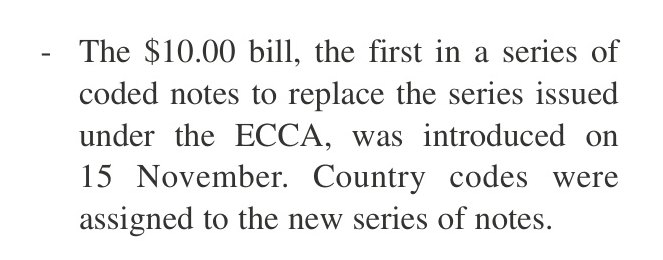
The Bank's first note was the 10 dollars. The Bank's own chronology, in its annual report for 2003-04, gives 15th November 1984 as the day it was introduced, the first of the notes with a letter for each island. The Bank's notice in the gazettes at the time gave 16th November 1984, and the size of the note as 145 x 69 mm. The two dates differ by a day and the pages leave both standing.
The other values followed, by the same chronology:
| Value | Day introduced |
|---|---|
| 10 dollars | 15th November 1984 (the gazette notice: 16th November 1984) |
| 1 dollar | 1st August 1986 |
| 100 dollars | 5th December 1986 |
| 5 dollars and 20 dollars | 8th April 1987 |
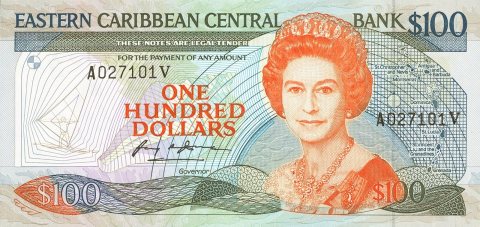
The notes show Queen Elizabeth II at the right over a map of the member states, and are signed by Jacobs as Governor. Sources mention that the portrait follows Peter Grugeon's 1977 Silver Jubilee photograph, engraved by De La Rue, and that the design was drawn at De La Rue by John White, the back combining a scene printed in several colours with engraved work.
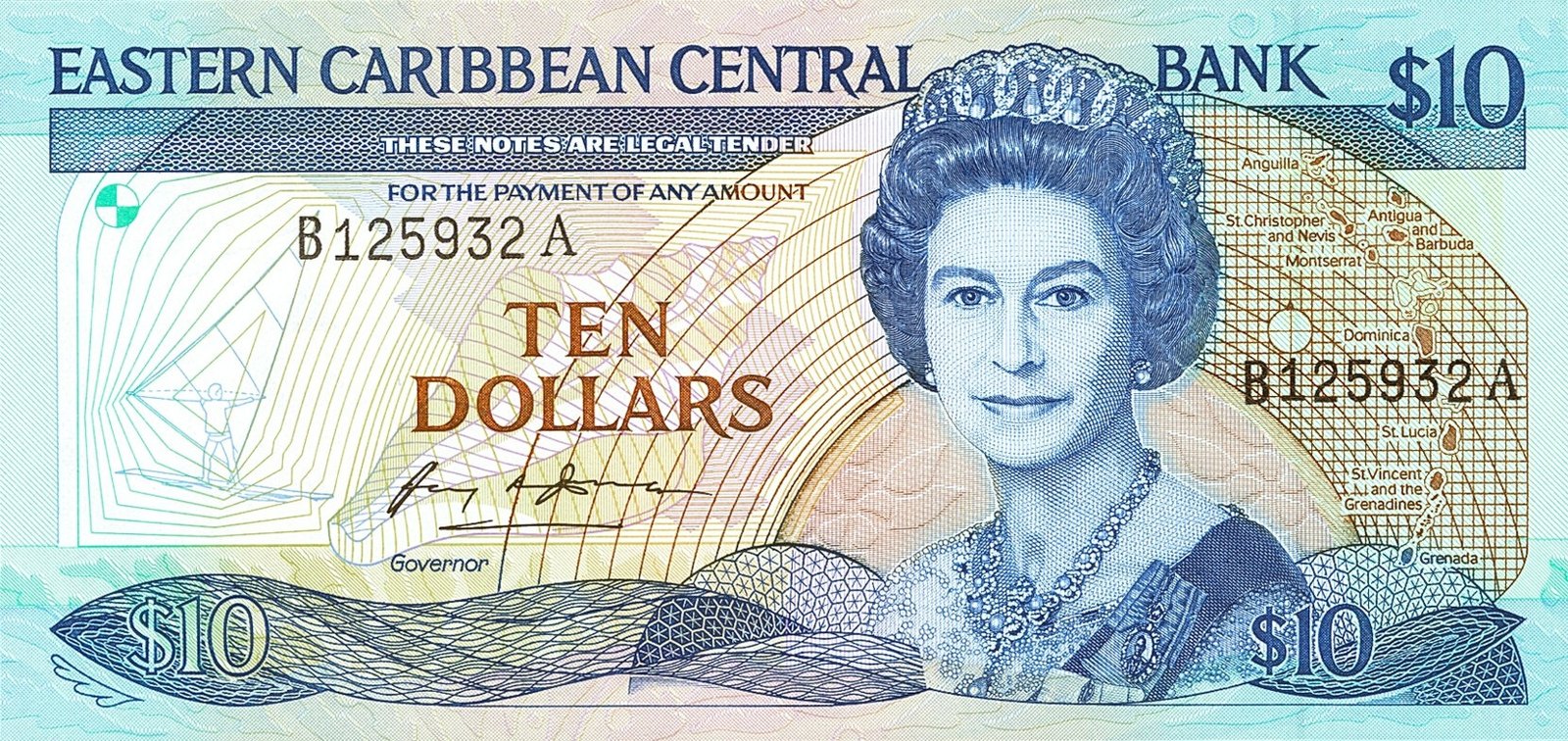
In place of the circle of 1983, the island letter is now the last letter of the serial number. On the 1, 5, 20 and 100 dollars of 1986 to 1988 Anguilla is not named on the map and has no letter of its own: its notes are St. Vincent notes, ending in V, overprinted with a U in a circle. The 10 dollars is different. It names Anguilla on the map and has the suffix U from its first notes, dated ND (1984) in the catalogue, and there is no earlier 10 dollars without Anguilla.
The second printing of 1988 and the Venner signature
From 1988 the 1, 5, 20 and 100 dollars were printed again with two changes: the word Anguilla beside the northernmost island of the map, and a printed suffix letter U for Anguilla. The catalogue heads these pages "Second printing of the 1985 design, 1988-93".
During this printing the signature changes from Jacobs, a scrawl with an underline, to Venner, written out legibly. The catalogue dates the Venner rows ND (1989). Heritage's description of lot 28152 in its sale of 23 October 2021 gives the names in full as Cecil Albert Jacobs and K. Dwight Venner and says the Venner notes were issued about 1989; its description of lot 22216 in its sale of 8 December 2023 names K. Dwight Venner as well. Sources mention Sir K. Dwight Venner as Governor of the Bank from December 1989 to November 2015.
The Bank stopped issuing 1 dollar notes in 1989, when the coin took their place (ECCB annual report for 2003-04).
The new design of 4th October 1993
A new family of notes was put into circulation on 4th October 1993, the tenth anniversary of the Bank: the 5 dollars, the 10 dollars, the 20 dollars, the 50 dollars and the 100 dollars. There is no 1 dollar, which the coin had replaced in 1989. Robert Obojski, writing in Bank Note Reporter in August 1995, called the 50 dollars the first note of that value the Bank had issued.
The map is gone. The Queen is at the right, a green sea turtle is at the lower centre, and the Bank's building stands in pale underprint behind the Governor's signature at the left. The building on the front is the Bank's new headquarters at Bird Rock, St Kitts, begun on 21 November 1992 and opened on 29 October 1994, so the notes showed it a year before it opened. Sources mention that the portrait follows Peter Grugeon's 1977 Silver Jubilee photograph, engraved by De La Rue. Heritage's description of lot 24193 in its sale of 7 March 2024, a 100 dollars of the 1994 reprint, says the back of that note shows Sir William Arthur Lewis and a map of the islands.
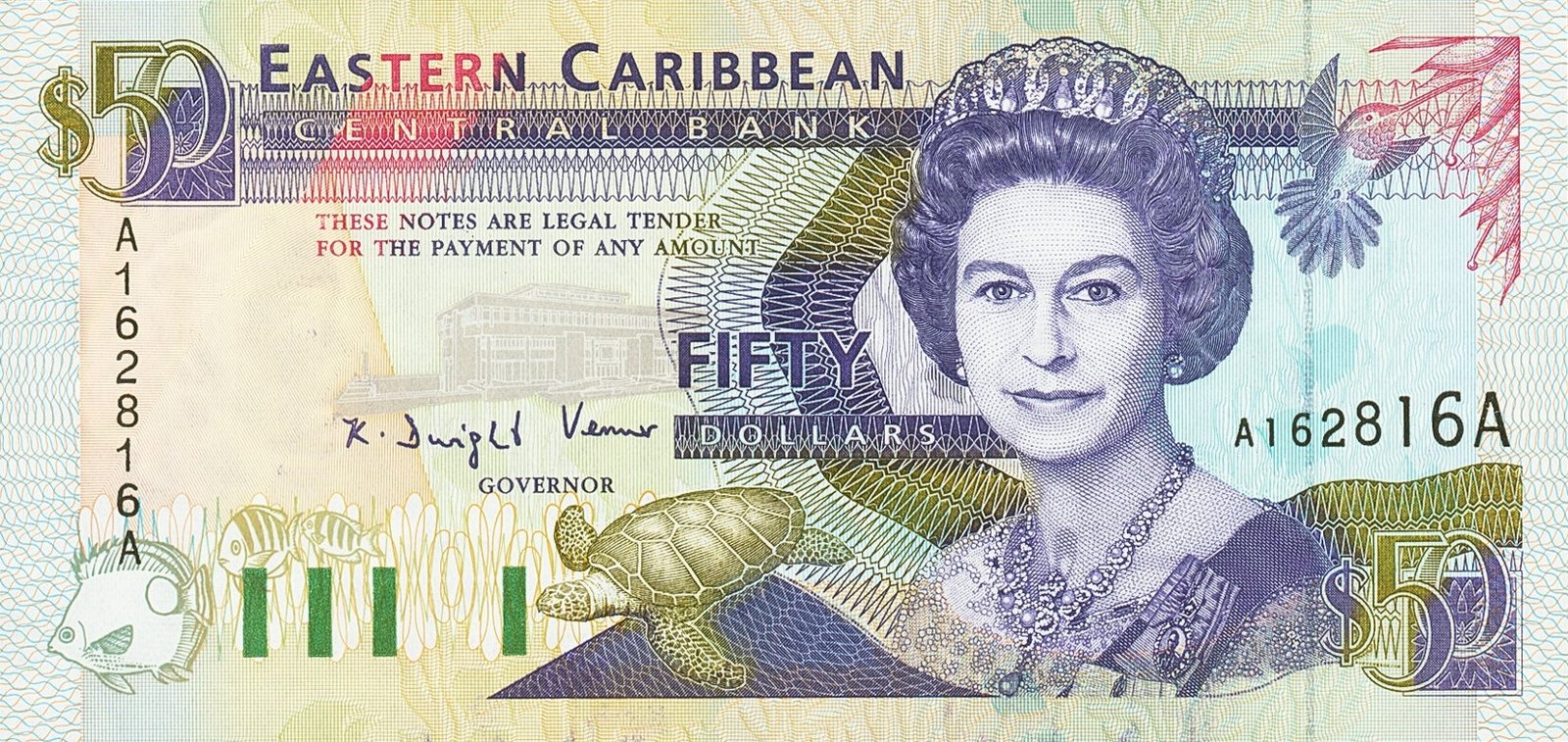
The island letter is also printed as a machine-readable bar code at the lower left of the front, which let the Bank measure the cash in circulation in each member country. Heritage's description of lot 24184 in its sale of 14 October 2026 says that on a St. Kitts note the code is one vertical bar followed by two vertical dashes.
Serial numbering started again with the new design, so a number of 1993 to 2003 can repeat one of the 1985 to 1993 notes.
The reprint of 1994 and the 100 dollars of 1998
On the 1993 notes the value at the upper left sits on a dark ornamental square. The reprint of 1994 drops the square. The pages give no reason. Stack's Bowers gives one in its descriptions of lot 70135 (3 September 2024) and lot 30239 (29 August 2025): the public found the value hard to read, complaints came in, and the issue was changed within a year. That is the house's account; no report of the Bank on the pages confirms it.
In 1998 the 100 dollars alone was printed with a gold foil flower at the upper right, brighter colours and foil segments over the security thread.
The notes stolen at Plymouth, Montserrat, 1998
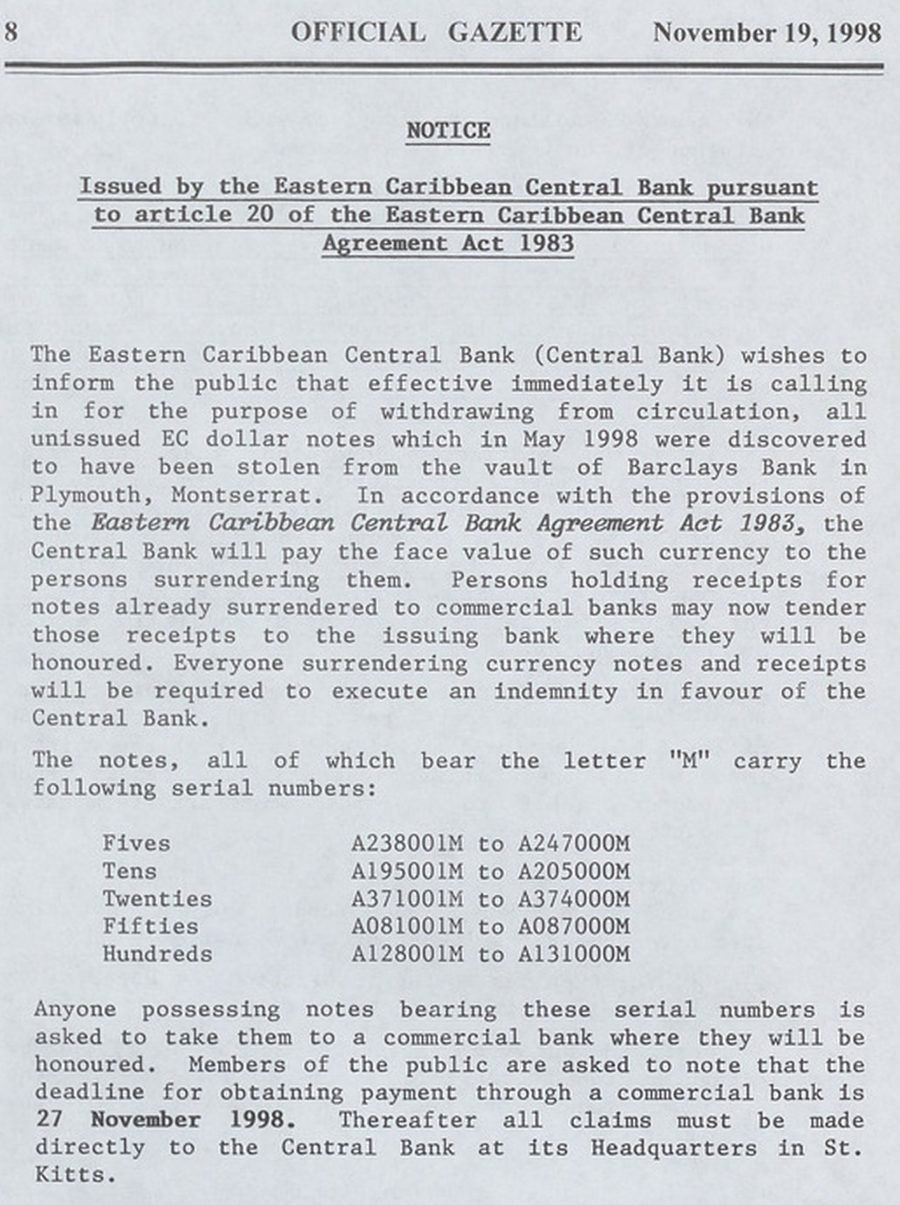
In May 1998 unissued notes were found to have been stolen from the vault of Barclays Bank in Plymouth, Montserrat. The Central Bank called them in by a notice of November 1998 and paid their face value to those who handed them in. Two runs of the 1994 notes are named: 50 dollars A 081001 M to A 087000 M, 6,000 notes, and 100 dollars A 128001 M to A 131000 M, 3,000 notes. A 50 dollars numbered A 167304 M, outside the stolen run, shows that Montserrat notes of that printing did circulate. Stack's Bowers, in its description of lot 20201 in its sale of 2 October 2024, recalls the volcanic eruptions of 1995 and 1997 that reshaped much of the island; the pages do not link the theft to them.
2001, 2003 and 2008
The series of 2001 adds a gold foil device to every value and redraws the Bank's building without the long wing at its left. Stack's Bowers, in the Dauer collection sale of 15 August 2023 (lot 41091), calls it the Millennium issue and dates it ND (2000), where the catalogue has ND (2001).
The series of 2003 has the same devices in silver and a wider thread. The Bank's report for its year to 31st March 2004 says the upgraded notes were phased in as the old stock ran out: by that date the 20 dollars had gone out in St Lucia, Grenada and St Kitts and Nevis, and the 5 dollars and 50 dollars in St Lucia only. Not every island had every value: the 50 dollars for Anguilla and the 100 dollars for Dominica and Anguilla were not issued.
The series of 2008 ends the island letters. The serial number takes a two-letter prefix instead, and the design otherwise follows the 2003 notes. Reprints of 2012 and 2015 add raised marks for the blind to the 10, 20, 50 and 100 dollars; there is no 5 dollars among them.
The polymer notes of 2019 to 2021 and what comes next
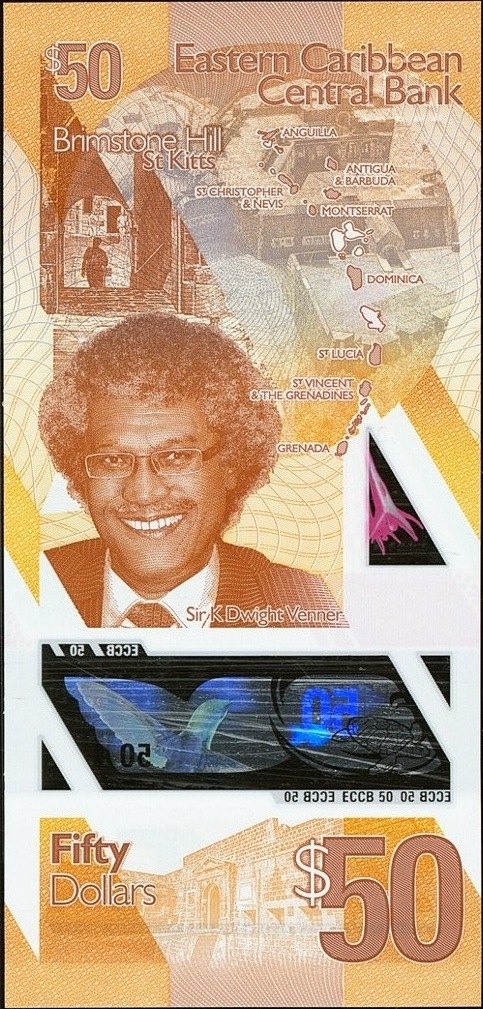
The polymer series, printed by De La Rue, is vertical on both sides, with the Queen at the top of the front. The catalogue dates the 10, 20, 50 and 100 dollars ND (2019) and the 5 dollars ND (2021). The back of the 50 dollars shows Sir K. Dwight Venner, named on the note.
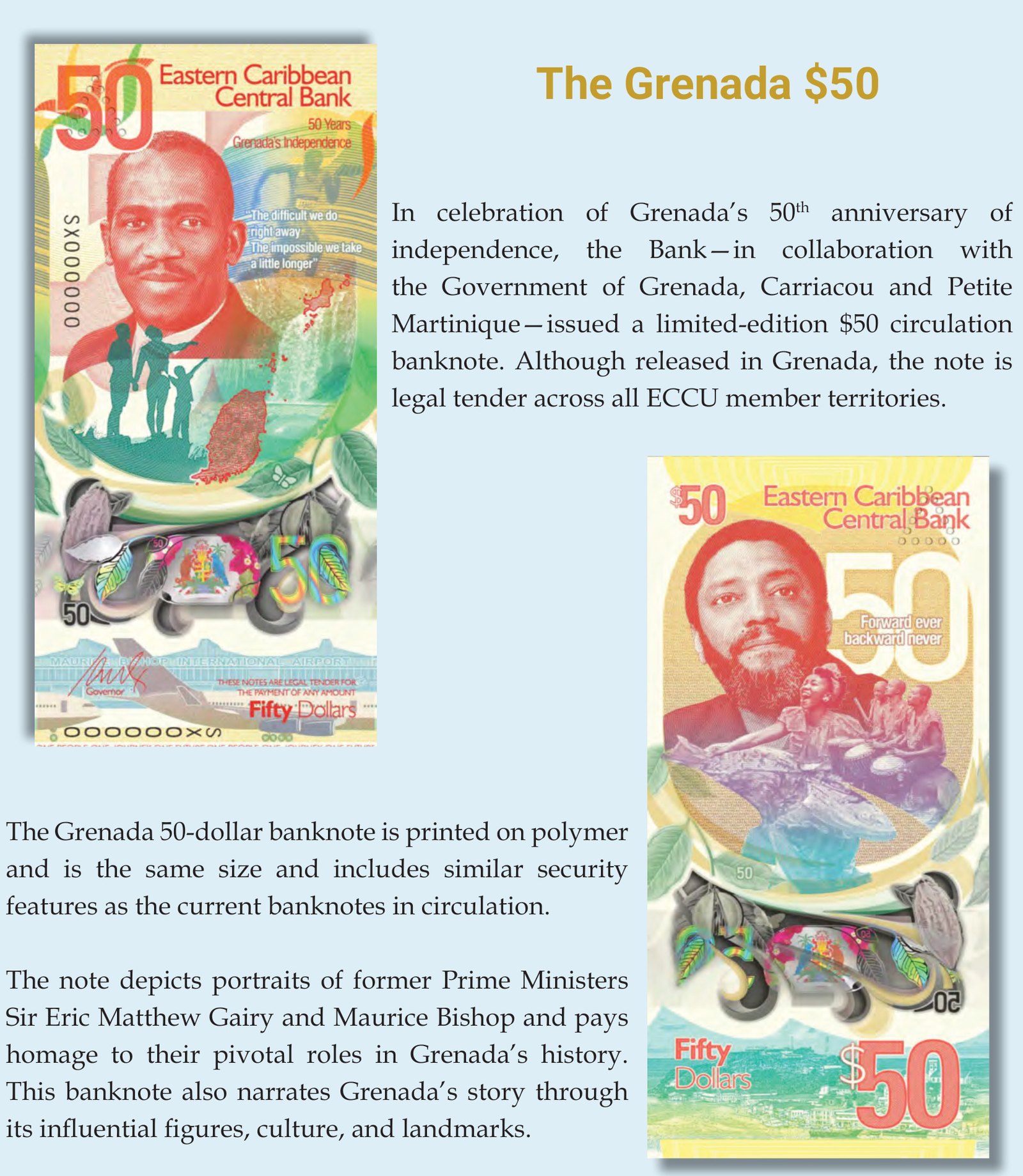
In its year to March 2025 the Bank also issued a limited 50 dollars on polymer for Grenada's fifty years of independence, with Sir Eric Gairy on the front and Maurice Bishop on the back and without the Queen's portrait. It was released in Grenada and is legal tender in all the Bank's territories (ECCB annual report for 2024-25).
The Bank's report for 2025-26 says the designs of a new family of notes without the monarch's portrait were finished, for launch in the second half of 2026. Its notes in circulation then stood at 1,707 million dollars.
The issues side by side
| Years | Issuer | Values | How the island is shown |
|---|---|---|---|
| 1965 to 1983 | East Caribbean Currency Authority | 1, 5, 20, 100 dollars | none |
| 1983 | East Caribbean Currency Authority | 1, 5, 20, 100 dollars | letter in a circle, overprinted |
| 1984 to 1988 | Eastern Caribbean Central Bank | 1, 5, 10, 20, 100 dollars | suffix letter; Anguilla a U in a circle on V notes, except on the 10 dollars |
| 1988 to 1993 | Eastern Caribbean Central Bank | 1, 5, 20, 100 dollars | suffix letter, U for Anguilla |
| 1993 to 2004 | Eastern Caribbean Central Bank | 5, 10, 20, 50, 100 dollars | suffix letter; on the 1993 design a bar code as well |
| 2008 to 2015 | Eastern Caribbean Central Bank | 5, 10, 20, 50, 100 dollars | none |
| 2019 to 2021 | Eastern Caribbean Central Bank | 5, 10, 20, 50, 100 dollars, polymer | none |
Sources
- The catalogue's note pages for the East Caribbean States, P-13 to P-60.
- Treasury notice in the Saint Vincent Government Gazette, March 1967 (the missing specimens).
- Eastern Caribbean Central Bank, annual report for 2003-04 (the chronology of the notes; the upgraded notes; the end of the 1 dollar note).
- The Bank's notice in the gazettes, November 1984 (the 10 dollars).
- The Bank's notice of November 1998 (the notes stolen at Plymouth, Montserrat).
- Eastern Caribbean Central Bank, annual reports for 2024-25 and 2025-26.
- Robert Obojski in Bank Note Reporter, August 1995.
- Revised Laws of Saint Lucia (2023), Eastern Caribbean Central Bank Agreement Act, Part XIV, Final Provisions: the text.
- Heritage Auctions, 23 October 2021, lot 28152; 8 December 2023, lots 22188 and 22216; 7 March 2024, lot 24193; 17 October 2024, lot 24131; 14 October 2026, lot 24184.
- Stack's Bowers, 15 August 2023, lot 41091; 3 September 2024, lot 70135; 2 October 2024, lot 20201; 29 August 2025, lot 30239.
- Spink, 9 December 2014, lot 187.
Member comments
Log in or register to post a comment.