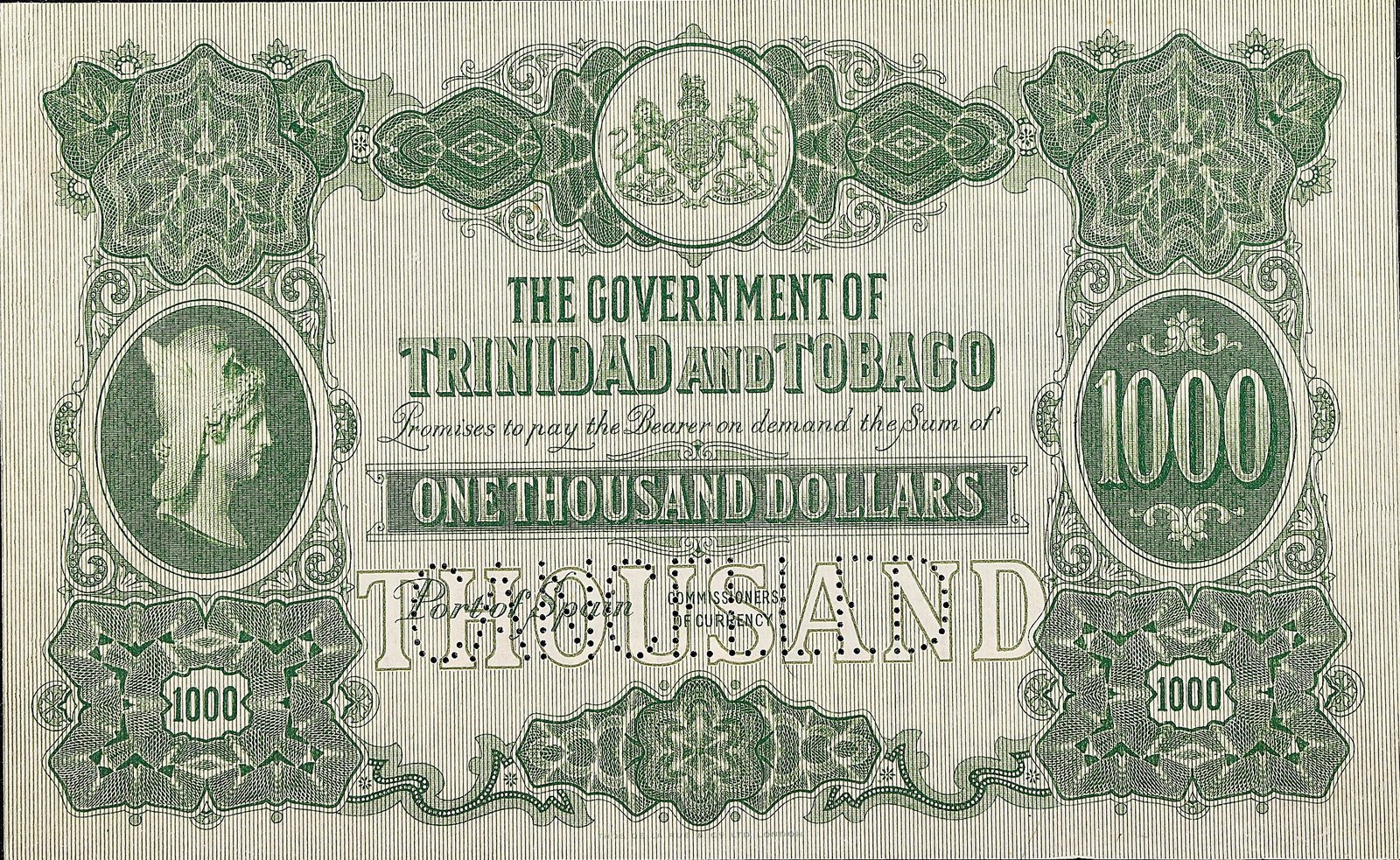
This article sets out, in order of time, the laws behind the paper money of Trinidad and Tobago: the ordinances that created and amended the Government note issue, the proclamations that ended its series, the laws on the banks' notes, and the laws that handed the issue first to the British Caribbean Currency Board and then to the Central Bank. It is drawn from the lists of legislation in the Blue Books, the revised Ordinances of 1950, the Royal Gazette, the Port of Spain Gazette, the annual reports and the currency board archive of Johns Hopkins University, as read for the catalogue. For many amending ordinances the sources give the number and the date but not what was changed; where that is so, the article says it.
The Ordinance of 1903 and its early amendments
| Law | Date | What it did | Source |
|---|---|---|---|
| Government Currency Notes Ordinance, No. 16 of 1903 (No. 244 in the revised Ordinances) | second reading reported 24th December 1903 | set up the Board of Commissioners of Currency (Colonial Secretary, Receiver-General, one member outside the salaried service) to issue notes of 1 and 2 dollars against gold and silver coin, in amounts the Commissioners fixed; coin held as the Note Guarantee Fund, part of it invested | revised Ordinances No. 244, s. 3 and 5 (page image); Port of Spain Gazette, 13th September and 24th December 1903 |
| Bank Notes Ordinance, No. 243 in the revised Ordinances | in force from 22nd February 1904 | the law under which the commercial banks issued their notes in Trinidad | Ordinance No. 26 of 1914 (page image) |
| Ordinance No. 4 of 1905 | 13th March 1905 | amended No. 16 of 1903; the contents are not given | Johns Hopkins archive, laws file |
| Government Currency Note Regulations | Royal Gazette, 22nd February 1906, p. 320 | the plates to be made by a person the Crown Agents chose and the notes printed under their supervision | Johns Hopkins archive |
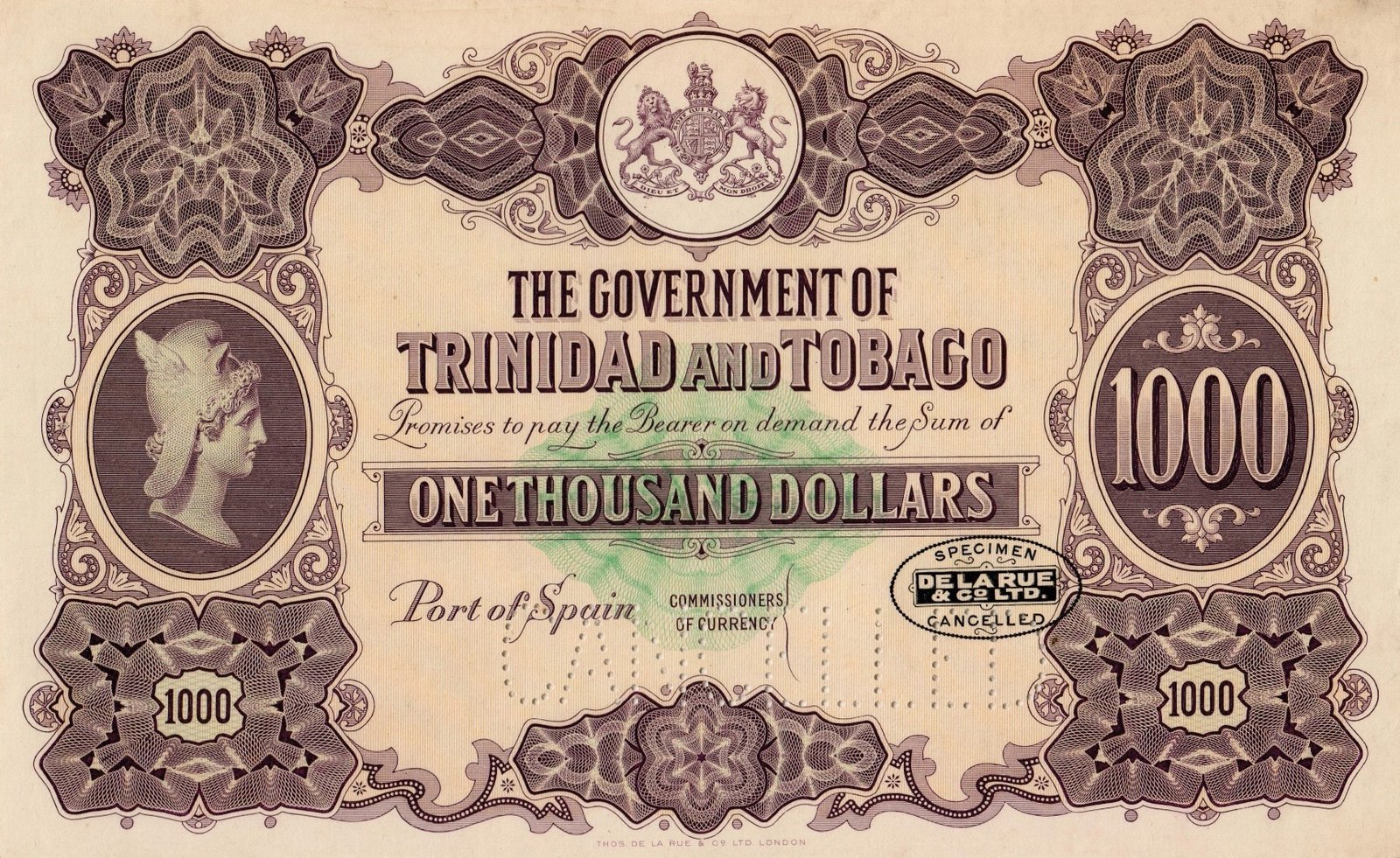
| Ordinance No. 21 of 1913 | Governor's assent 16th June 1913; sent to England 17th June; allowed by Proclamation No. 24 of August 1913 | amended No. 244; the Blue Book does not say how. The Port of Spain Gazette of 22nd May 1913 reports that an ordinance for Government notes of 1,000 dollars was passed in Council the day before, without giving its number; No. 21 is presumably that ordinance, but neither source names the other | Blue Book 1913 to 1914, Legislation K 1 (page image); Port of Spain Gazette, 22nd May 1913 (page image) |
| Bank Notes (validation), No. 26 of 1914 | passed 5th October 1914 | declared the Bank Notes Ordinance No. 243 in force from 22nd February 1904 and validated every bank note issue made under it | Ordinances of 1914 (page image) |
| Government Currency Notes (Amendment) Ordinance, No. 30 of 1914 | passed 30th October 1914; assent of Governor George R. Le Hunte 10th November 1914 | in section 10(6) of No. 244 put "the Governor" in place of "a Secretary of State" | Ordinances of 1914 (page image) |
| Ordinance No. 27 of 1916 | assent 21st November 1916; proclaimed by Proclamation No. 11 of 20th February 1917 | amended No. 244; the Blue Book does not say how. The Port of Spain Gazette of 4th November 1916 reports an amending ordinance passed in Council that, for the duration of the war, suspended the rule of section 10 that any fall in the market value of the Note Guarantee Fund's securities be made good from general revenue; No. 27 is presumably that ordinance, but neither source names the other | Blue Books 1916 and 1917 (page image); Port of Spain Gazette, 4th November 1916 (text) |
| Proclamation of 8th December 1919 | 8th December 1919 | forbade the export of bank notes of any value without the Governor's leave, beyond 100 dollars for a traveller | Port of Spain Gazette, 11th December 1919 (text) |
| Ordinance No. 4 of 1920 | passed 26th March 1920; proclaimed by Proclamation No. 34 of 8th June 1920 | amended No. 244; the contents are not given | Blue Book 1920 (page image) |
| Proclamation No. 26 of 1920 | 14th April 1920 | fixed the coin part of the Note Guarantee Fund at one-third | Blue Book 1920 (page image) |
| Ordinance No. 37 of 1925 | passed 15th May 1925; not disallowed, Proclamation No. 32 of 1st July 1925 | amended No. 244; the contents are not given | Blue Book 1925 (page image) |
The 1903 law appears in the sources under several numbers: No. 16 of 1903 as passed, No. 244 in the revised Ordinances, an edition that Ordinance No. 4 of 1905 speaks of as still to come into force (the Government's notice of the first issue in December 1905 already cites "Ordinance 244"), and Cap. 212 in the Revised Laws of 1925. The Blue Book of 1916 prints "No. 224", a slip for 244. The section of No. 244 changed in 1914 is not described on the page read. The newspaper's editorial of 21st June 1910 says the coin reserve could go down to its minimum of one half only by the Secretary of State's direction, and the debate of November 1916 shows that section 10 dealt with the Note Guarantee Fund; whether section 10(6) was that power, the page does not say.
The ordinance that allowed the 1,000 dollars, and the reasons given for it in 1913, are told in The first Government notes of Trinidad and Tobago, 1903 to 1936.
1932 to 1936: the banks licensed, a new Board, the old notes ended
| Law | Date | What it did | Source |
|---|---|---|---|
| Bankers Licences and Bank Notes Ordinance, No. 40 of 1932 | 1932 | licensed bankers and taxed the notes of note-issuing banks: 250 pounds a year and a duty of 1 pound for every 100 pounds of notes issued | Blue Book 1932, Legislation (text); Year Book 1937 (text) |
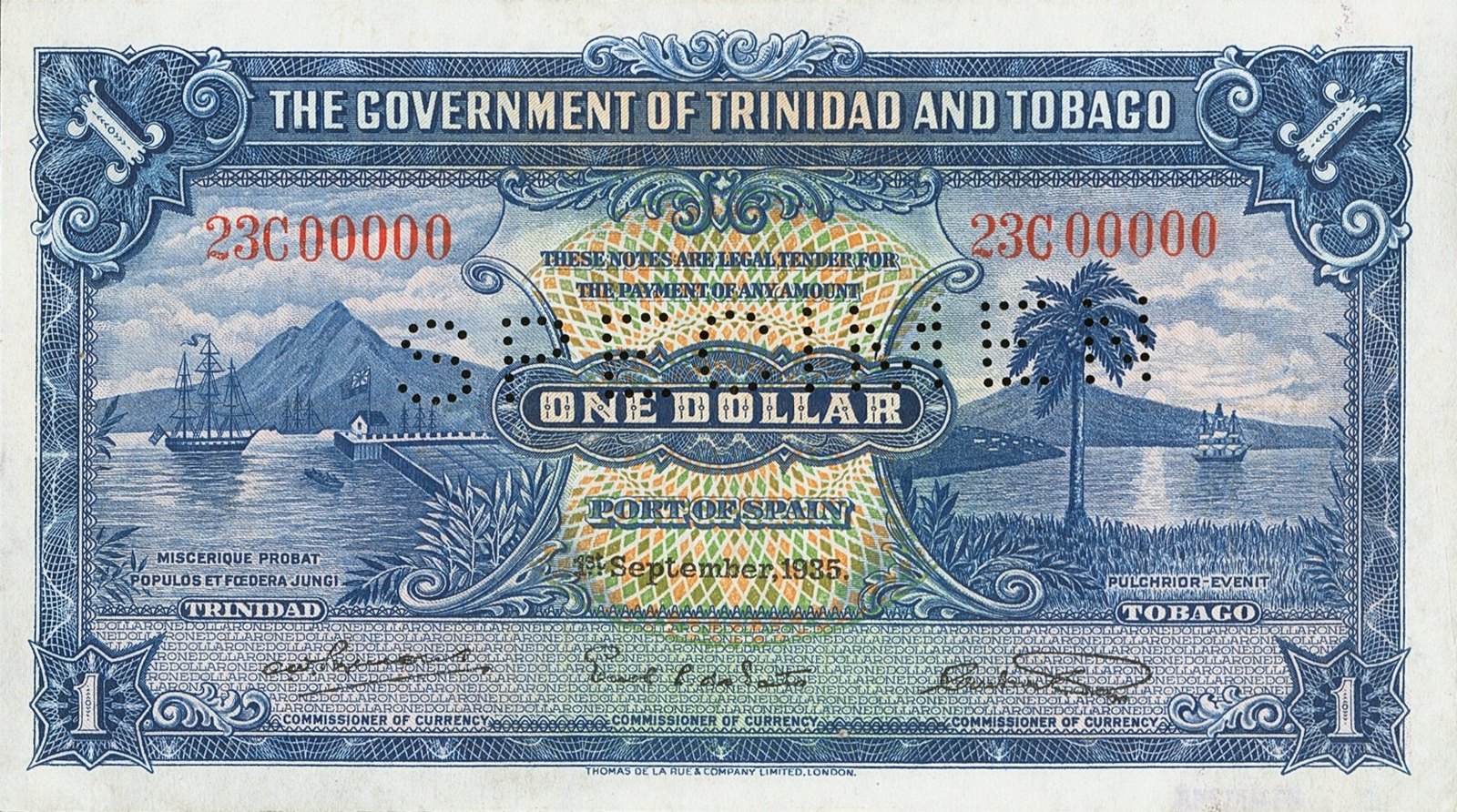
| Government Currency Notes Ordinance, 1934, No. 40 of 1934 | listed under 19th December 1934 in the Blue Book (text only); printed in the supplement to the Royal Gazette of 20th December 1934, p. 243; in force 20th December 1934 | repealed Cap. 212; a new Board of the Colonial Secretary, the Treasurer and one non-official member; placed the issue "upon a permanent basis"; half-yearly abstracts under section 14 | Blue Book 1934 (text); Johns Hopkins archive; revised Ordinances of 1950 (page image) |
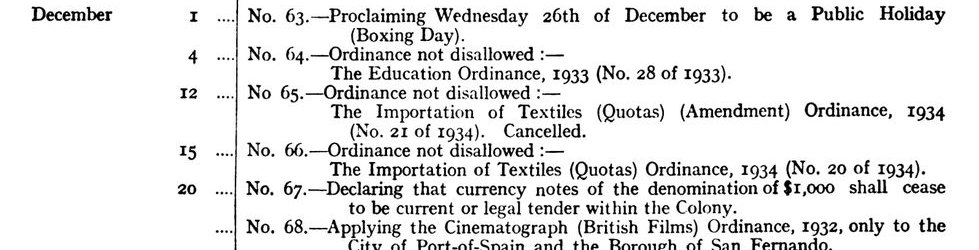
| Proclamation No. 67 of 1934 | 20th December 1934 | declared that notes of 1,000 dollars "shall cease to be current or legal tender within the Colony" | Blue Book 1934, list of Proclamations (page image) |
| Proclamation No. 75 of 1935 | Royal Gazette of 19th September 1935, as the notice below refers to it; the Treasurer's notice of 7th December 1935 in the Royal Gazette of 12th December 1935, p. 1312 | the 1 and 2 dollar notes of Series A and B ceased to be current and legal tender from 2nd January 1936, then redeemable only at the Treasury in exchange for Series C | Royal Gazette of 12th December 1935, p. 1312 (page image) |
| Grenada, Currency Notes (Trinidad) Ordinance, No. 22 of 1935 | in force 1st November 1935 | made Trinidad Government notes legal tender in Grenada | Grenada annual report for 1935 (page image) |
| St Lucia, Ordinance No. 4 of 1936 | in force 1st May 1936 | made the Trinidad 1 and 2 dollar notes legal tender in St Lucia | St Lucia annual report for 1936 (page image) |
| St Vincent, Ordinance No. 14 of 1936, Trinidad Currency Notes | 1936 | the Economic Survey for 1936 says the Trinidad 1 and 2 dollars were legal tender in St Vincent for any amount | St Vincent list of Ordinances (text); Economic Survey 1936 (page image) |
Two places are given for Proclamation No. 75. The page read is the Treasurer's notice in the Royal Gazette of 12th December 1935, signed by Errol L. dos Santos and read for the catalogue from the copy in the Johns Hopkins currency board archive; as read there, it gives the Proclamation as in the Royal Gazette of 19th September 1935. The Gazette of 19th September itself was not read. The first Government notes of Trinidad and Tobago, 1903 to 1936 says the Proclamation was "printed in the Royal Gazette of 12th December 1935". Which issue first printed it is not settled here.
The Ordinance of 1934 was the law behind the 1 dollar and 2 dollars of 1935 and every later Government note. No notice read for the catalogue names the law that first allowed the 5, 10 and 20 dollars; the abstracts cite only Ordinance No. 40 of 1934, and by the revised text of 1950 the denominations were those the Secretary of State approved.
1941 to 1950: the Ordinance as it stood at the end
The revised Ordinances of 1950 print the Government Currency Notes Ordinance as Chapter 35 No. 6 (in the 1940 revision it was Chapter 35 No. 2, the number the abstracts of 1942 to 1949 and notice 2064 of 1950 cite). The text, read on the page image for pages 643 and 649 and in the machine text for the rest, shows what the amendments of 1941 did:
- Ordinance No. 16 of 1941 made the Board the Financial Secretary, the Accountant General and one nominee of the Governor not holding a salaried office under the Crown.
- Ordinance No. 4 of 1941 added section 15: notes issued under the old Ordinance, Cap. 212 of 1925, were deemed issued under this one, so the 1905 to 1934 notes stayed a charge on the Fund.
- Demonetised notes were payable at any time by the Accountant General (section 8).
- The notes were legal tender for any amount; sterling was exchanged at 4 shillings 2 pence to the dollar, with a commission of up to 1 3/4 per cent; the Note Security Fund was held by the Crown Agents; abstracts were printed half-yearly in the Royal Gazette.
- Barbados and British Guiana currency notes were legal tender in Trinidad (section 17), and a colony where Trinidad notes were legal tender received a duty on the Trinidad notes circulating there (section 6).
The annual report of British Guiana for 1946 (text only) dates the reciprocal legal tender of Trinidad, Barbados and British Guiana notes from 1941.
| Law | Date | What it did | Source |
|---|---|---|---|
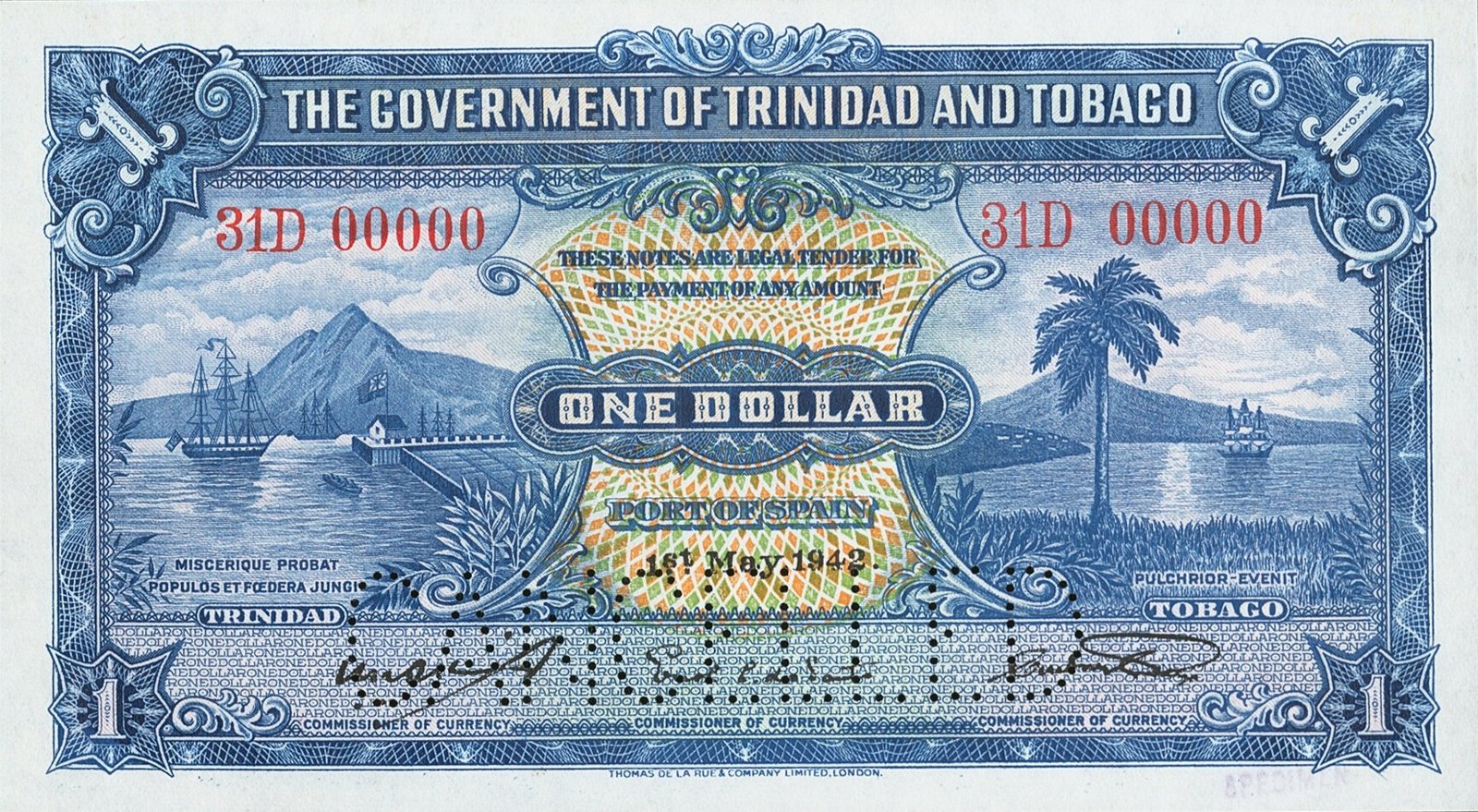
| Proclamation No. 25 of 1943, under the Customs Ordinance | 28th May 1943; Royal Gazette, 3rd June 1943, p. 608 | prohibited the import of the unissued 1 dollar notes 29D 55839 to 29D 55984 | Royal Gazette (page image) |
| Certain Bankers (Restriction of Note Issue) Order, under section 15 of the Bankers Licences and Bank Notes Ordinance | Royal Gazette, 29th June 1944 | capped the notes in circulation of the Royal Bank of Canada at 1,293,000 dollars from 1st July 1944, and of the Canadian Bank of Commerce at 271,000 dollars from 1st January 1945 | revised subsidiary legislation (page image) |
| Currency Ordinance, No. 39 of 1950 | passed 12th June 1950; in force 1st August 1951 | gave force to the agreement for one currency in the Eastern Group of the British Caribbean Territories; ended the Trinidad Board's issue and all new bank note issues; made the Government notes liabilities of the new Board | revised Ordinances of 1950, Chapter 35 No. 2 (page image for the number and commencement); annual report for 1950 (text) |
The prefix 29D of the block barred in 1943 is one the catalogue places among the 1 dollar notes dated 1st May 1942; the proclamation does not say why the notes were unissued.
1950 to 1964: the Board's years and the Central Bank
| Law or notice | Date | What it did | Source |
|---|---|---|---|
| Notice 2064 | 13th December 1950; Royal Gazette, 21st December 1950, p. 738 | named R. L. Gwatkin a member of the Board of Commissioners of Currency for a further year from 1st July 1950, under section 3(1) of Chapter 35 No. 2 | Royal Gazette (page image) |
| Notice 2065 | Royal Gazette, 21st December 1950, p. 738 | the British Caribbean Board constituted by the Secretary of State on 28th November 1950 | Royal Gazette (page image) |
| Notice 662 | Royal Gazette, 10th April 1952, p. 263 | the last number issued of each value of the Government notes | Royal Gazette (page image) |
| Notice 1222 | 29th December 1954; Royal Gazette Extraordinary, 31st December 1954 | the Government notes of Barbados, British Guiana and Trinidad and Tobago to cease to be legal tender from 2nd January 1955, their value still claimable from the Board | Royal Gazette (page image) |
| Ordinance No. 31 of 1955 | 1955 | made the Jamaica Government notes legal tender in Trinidad | annual report for 1955 (text) |
| Government Currency Notes (Repeal) Ordinance, No. 34 of 1955 | 1955 | repealed the Government Currency Notes Ordinance and wound up the Note Security Fund | annual report for 1955 (text) |
| Currency Ordinance, No. 15 of 1959 | consent of the Governor-General of The West Indies, 25th February 1960 | Trinidad and Tobago's part of the new currency ordinances of 1959; the contents are not on the page | West Indies Gazette, 26th February 1960 (page image) |
| Central Bank Act, No. 23 of 1964 | assent 11th December 1964 | created the Central Bank of Trinidad and Tobago | the Act (Johns Hopkins archive) |
| British Caribbean Currency Agreement, 1964 | made at Port of Spain, 12th December 1964, between the United Kingdom and Trinidad and Tobago, the other governments concurring | arranged the winding up of the Board; by Article 12 the liability for the Trinidad and Tobago Government notes taken over in 1951 was to go back to that Government, with sterling equal to the notes outstanding, on the day its new currency authority began to issue. The Board's statement for 1st February 1965 says the Central Bank assumed it at 14th December 1964 | the Agreement as printed with British Guiana's Currency Ordinance, 1965 (No. 8 of 1965), Parliament of Guyana papers; Saint Vincent Government Gazette, 23rd March 1965, p. 73 (page image) |
The day of notice 1222 and the proclamations under it, and what followed for the old notes, are in The Trinidad and Tobago Government notes after 1951. The Central Bank's first notes, the 1 dollar and its fellows, are in The first notes of the Central Bank of Trinidad and Tobago, 1964.
What the sources leave open
- What Ordinance No. 4 of 1905, No. 4 of 1920 and No. 37 of 1925 changed.
- The text of the Proclamation that brought the Ordinance of 1903 into force, and of the Trinidad proclamation of 2nd January 1955.
- The law, if any, that first named the 5, 10 and 20 dollars.
- What the Currency Ordinance of 1959 changed.
Sources
- Revised Ordinances of Trinidad and Tobago: No. 244 (the Ordinance of 1903 in the revised edition); the revised Ordinances of 1950, vol. V, Chapter 35 No. 2 and No. 6; the volume of subsidiary legislation (Order of 29th June 1944).
- Ordinances passed by the Legislative Council, 1914: No. 26 and No. 30.
- Blue Books of Trinidad and Tobago, 1913 to 1914, 1916, 1917, 1920, 1925, 1932 and 1934, Legislation.
- Year Book of Trinidad and Tobago for 1937.
- Royal Gazette: 22nd February 1906; 3rd June 1943; 19th September and 12th December 1935; supplement of 20th December 1934; 21st December 1950; 10th April 1952; Extraordinary of 31st December 1954.
- Port of Spain Gazette: 13th September and 24th December 1903; 22nd May 1913; 4th November 1916; 11th December 1919; 21st June 1910.
- Annual reports of Grenada for 1935 and St Lucia for 1936; St Vincent list of Ordinances, 1936; Economic Survey of the Colonial Empire, 1936; annual report of British Guiana for 1946; annual reports of Trinidad and Tobago for 1950 and 1955.
- West Indies Gazette, 26th February 1960.
- Central Bank Act, No. 23 of 1964; the currency board archive of Johns Hopkins University (laws file for Trinidad).
- Papers of the Parliament of Guyana: the Currency Ordinance, 1965 (No. 8 of 1965) of British Guiana, with the British Caribbean Currency Agreement, 1964; the British Caribbean Currency Board's statement for 1st February 1965 in the Saint Vincent Government Gazette of 23rd March 1965, p. 73.


Member comments
Log in or register to post a comment.