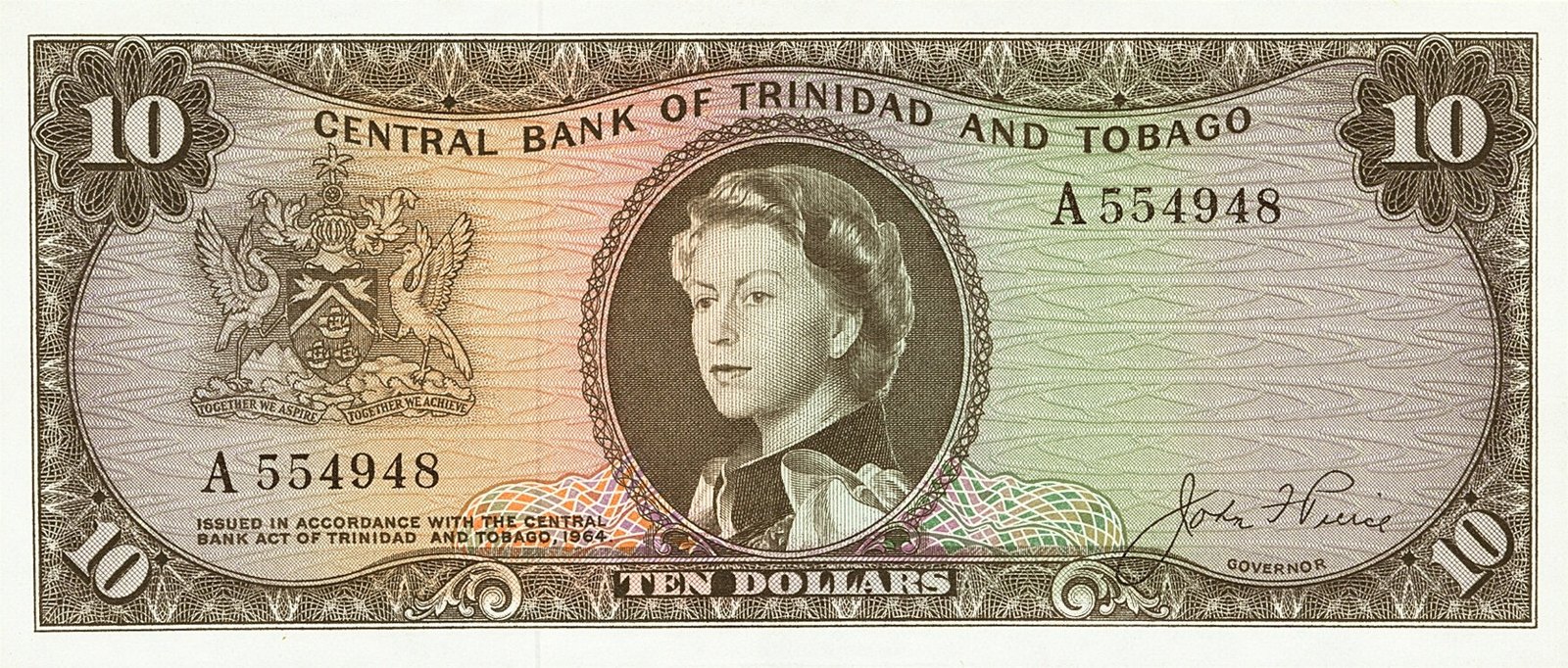
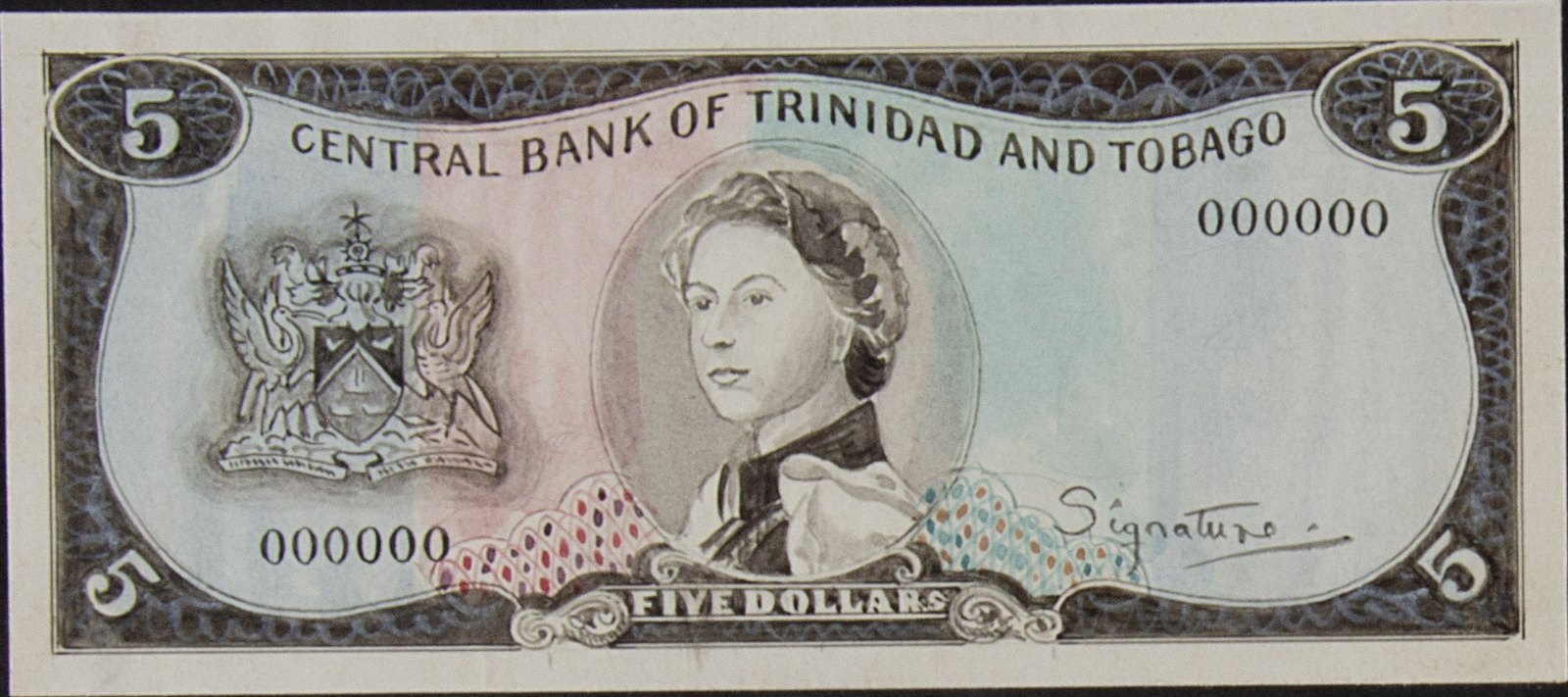
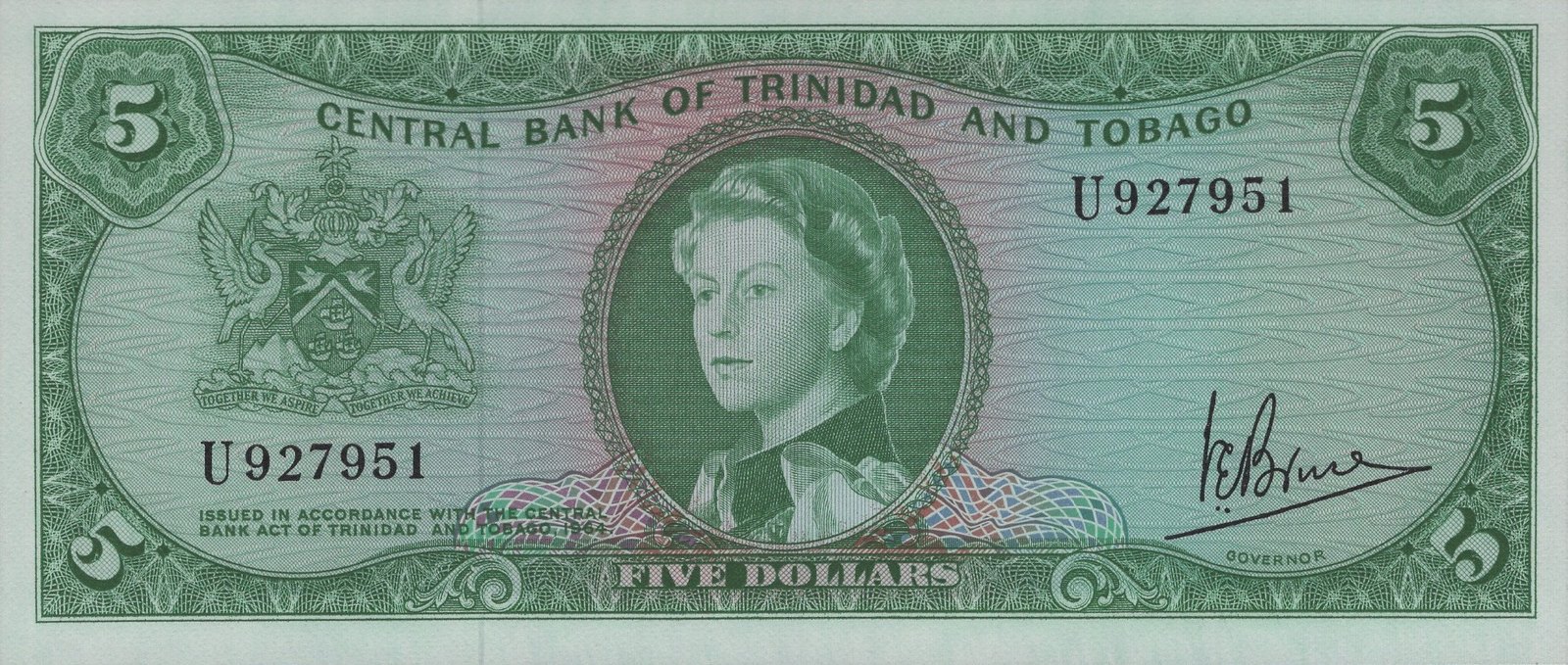
This article covers the first notes of the Central Bank of Trinidad and Tobago: the 1, 5, 10 and 20 dollars that carry the year 1964 and the portrait of Queen Elizabeth II, and a 100 dollars that stopped at the specimen. It is drawn from the catalogue's pages and the specimens and printer's file pieces recorded on them, from the Central Bank's own history pages, and from what the auction houses have written about single pieces.
Independence and the Central Bank Act
Trinidad and Tobago became independent on 31 August 1962. Its notes were then those of the British Caribbean Currency Board, which served several territories and could not give an independent country the monetary tools its economic policy needed. So the country set up a central bank of its own. The Central Bank of Trinidad and Tobago was created by the Central Bank Act of 1964.
The sources give two days for the Act. The Act itself, No. 23 of 1964, gives 11th December 1964 as the day of assent. The Central Bank's own history page says the Bank "was established by an Act of Parliament on December 12, 1964". The first notes were issued on 14 December 1964, and they replaced the British Caribbean Currency Board notes at par.
The notes were nicknamed "Robbies" after A. N. R. Robinson, the country's first Minister of Finance (1961 to 1967).
The designs, 1963 and 1964
The notes were printed by Bradbury Wilkinson. They carry the year of the Act instead of a date. Sources mention that the portrait is Bradbury Wilkinson's engraving of Pietro Annigoni's 1956 portrait of the Queen in the robes of the Order of the Garter.
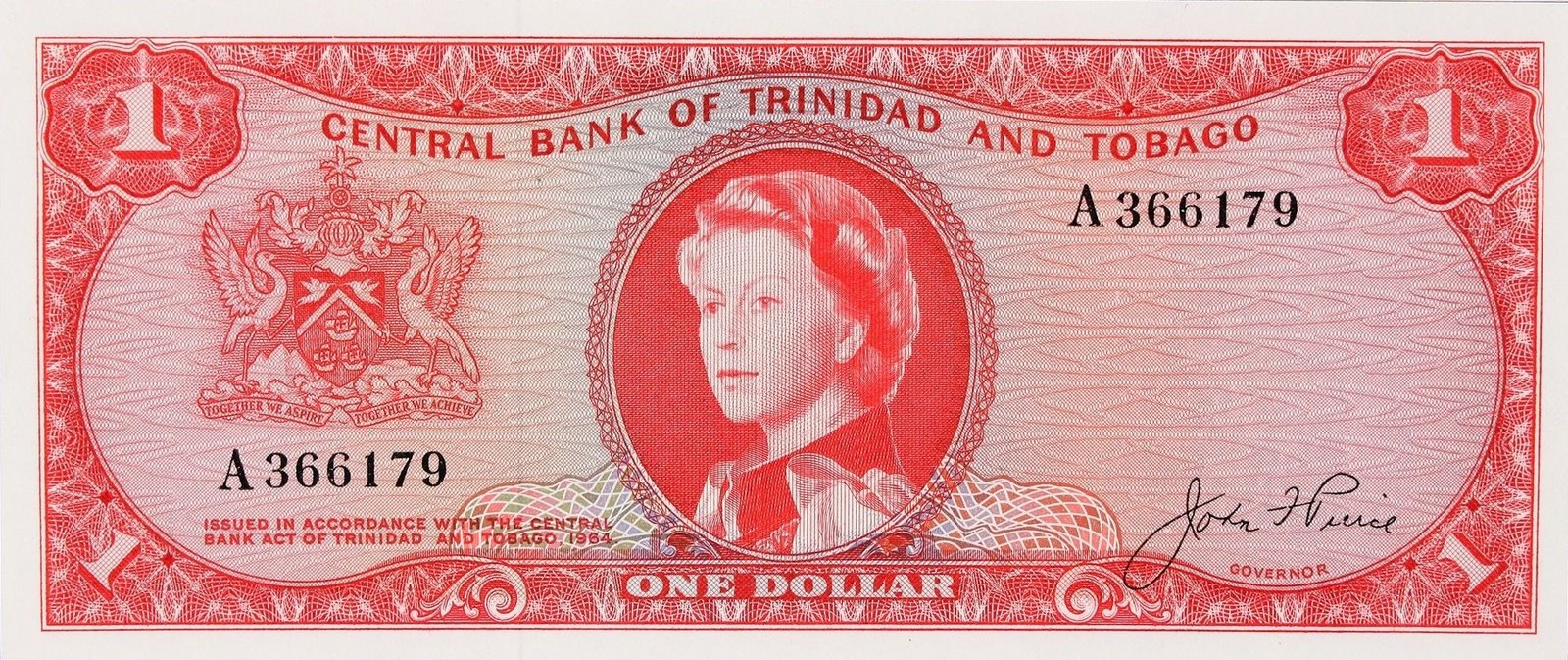
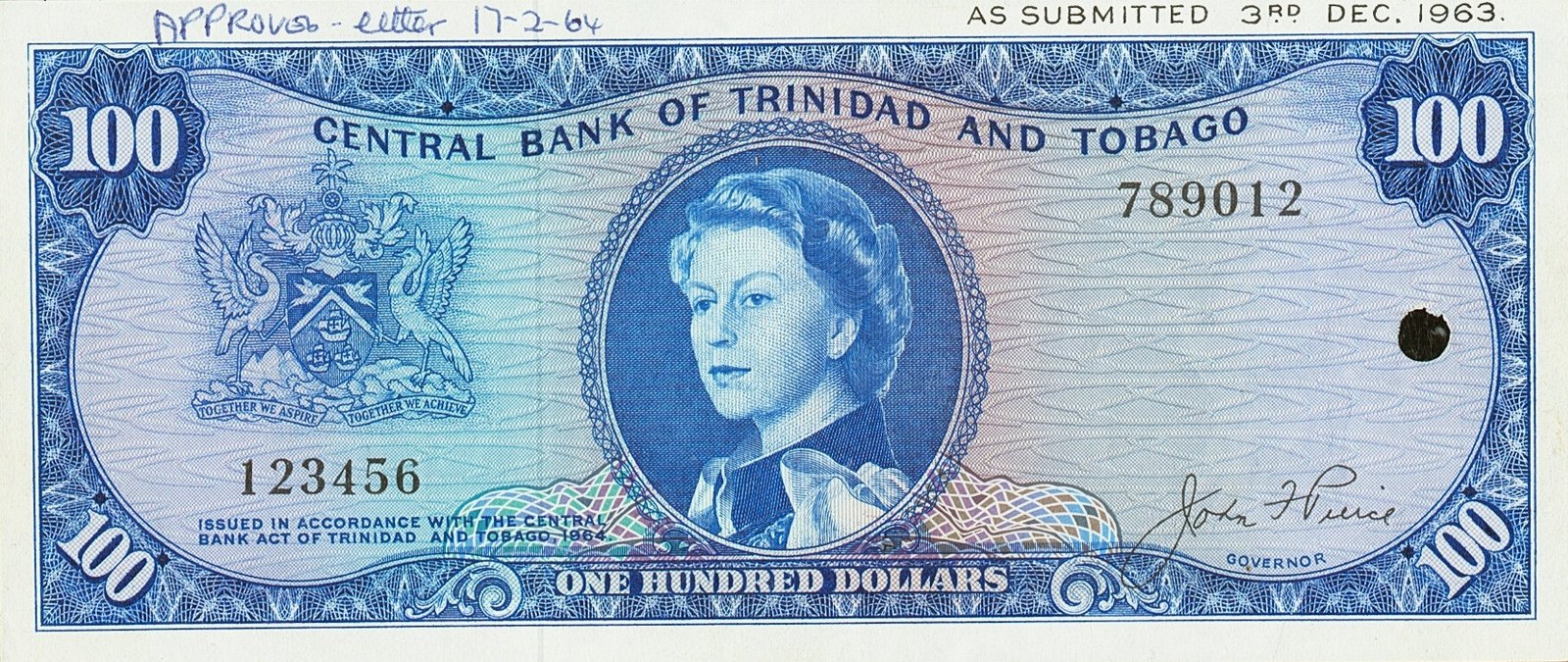
The printer's work was well ahead of the law. The adopted design of the 5 dollars survives in archival photographs, each dated 11/4/63 in pencil on the reverse. The specimen of the 100 dollars is marked AS SUBMITTED 3RD DEC. 1963 in the top margin and approved by letter of 17-2-64.
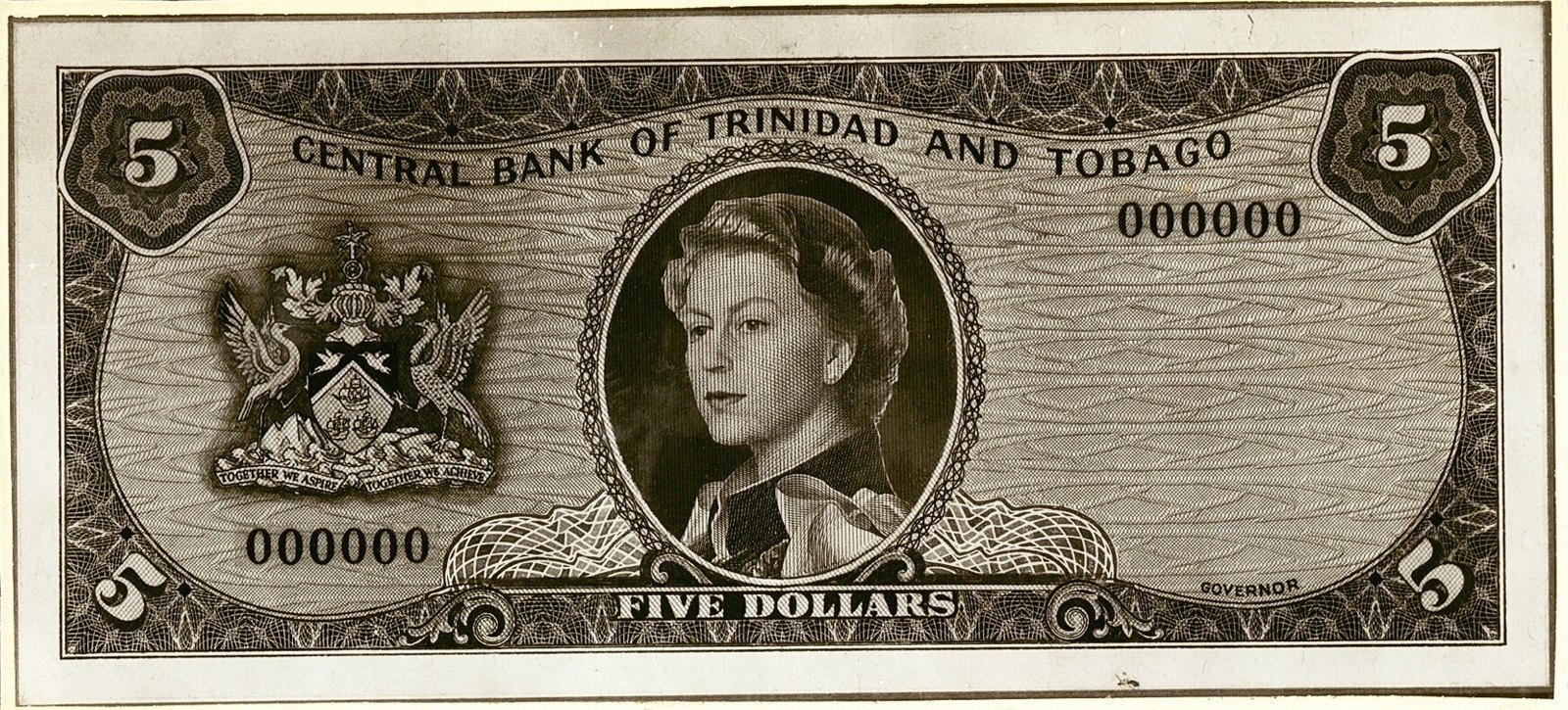
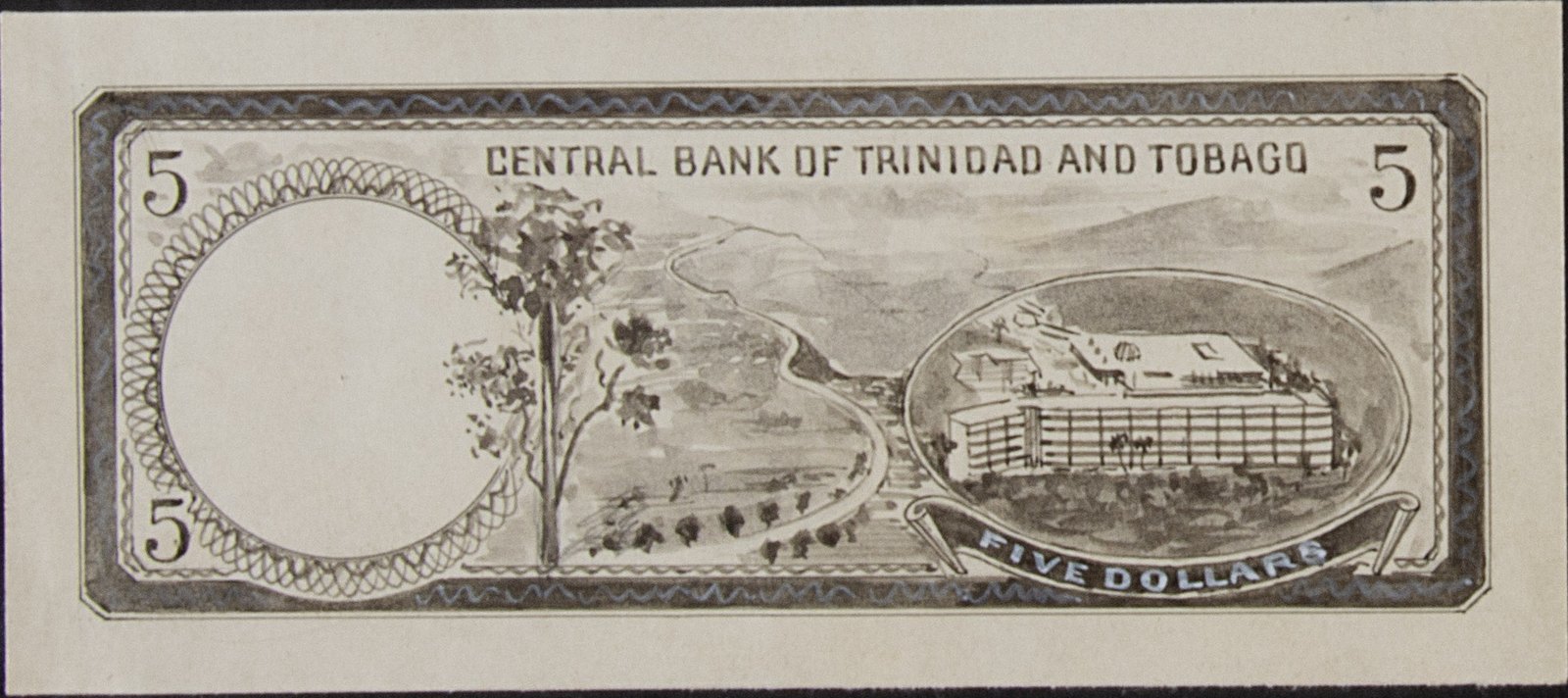
An earlier stage has been sold. Stack's Bowers, in its description of lot 30241 of 16 January 2026, offers a hand-drawn front and back for a 5 dollars, pasted on black paper, and says the front is fairly close to the issued note while the back is completely different from the one that was issued.
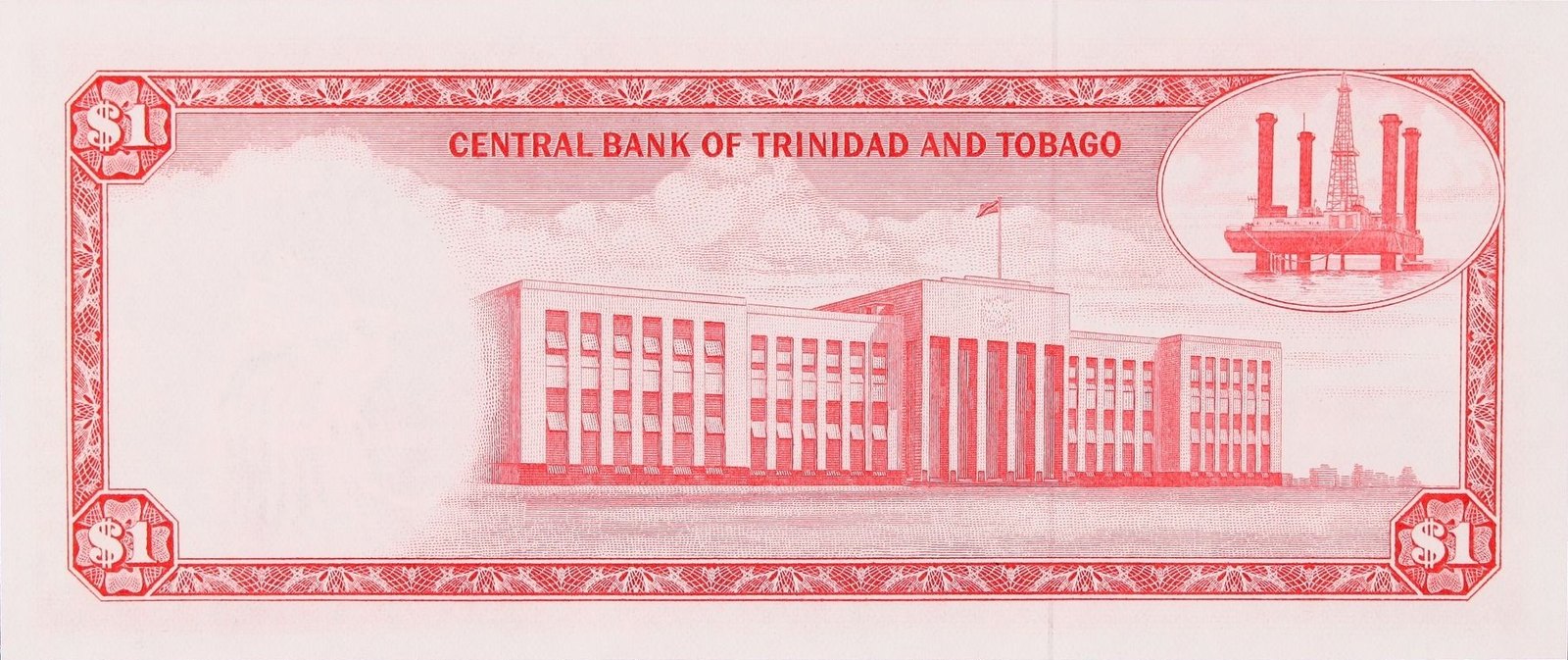
The back of the 1 dollar shows a large building at the centre, which sources mention as the Central Bank's, and an offshore oil rig in the oval at upper right. The Central Bank's history page says the Bank moved to its present home, the Central Bank Tower of the Eric Williams Financial Complex, in 1986, and heads that entry as a move from the Treasury Building; it does not say that the Treasury Building is the one on the note.
Designs of these years that were not adopted, with and without the Queen, are described in From the monarch to national figures.
Three Governors
Three Governors signed the notes: Pierce (1964 to 1966), McLeod (1966 to 1969) and Bruce (1969 to 1984). The Central Bank's page on its past Governors gives the same years. It calls John Pierce the first Governor, with a background in the operational side of central banking; it says that under Dr. Alexander McLeod the Bank became banker to the Government; and it says Victor Bruce, who took up the office in 1969, was the first local to head the Bank.
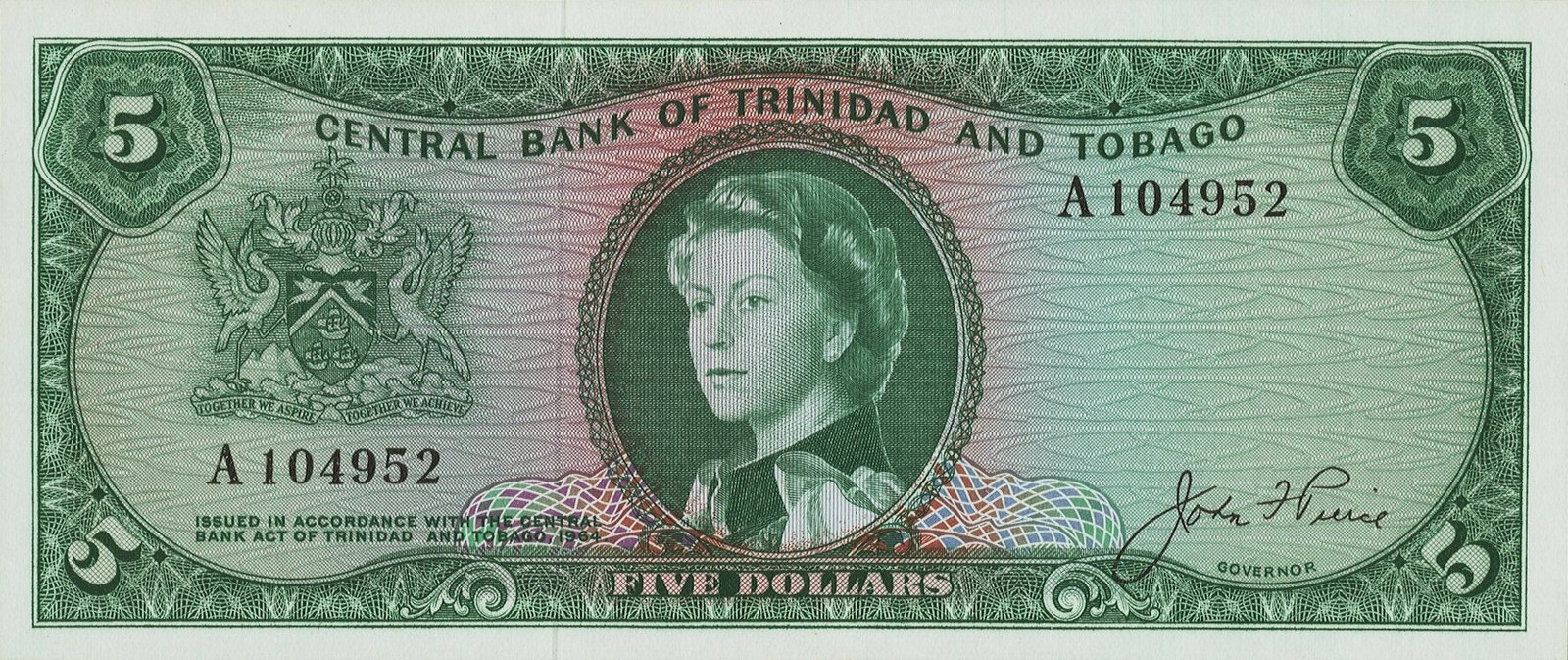
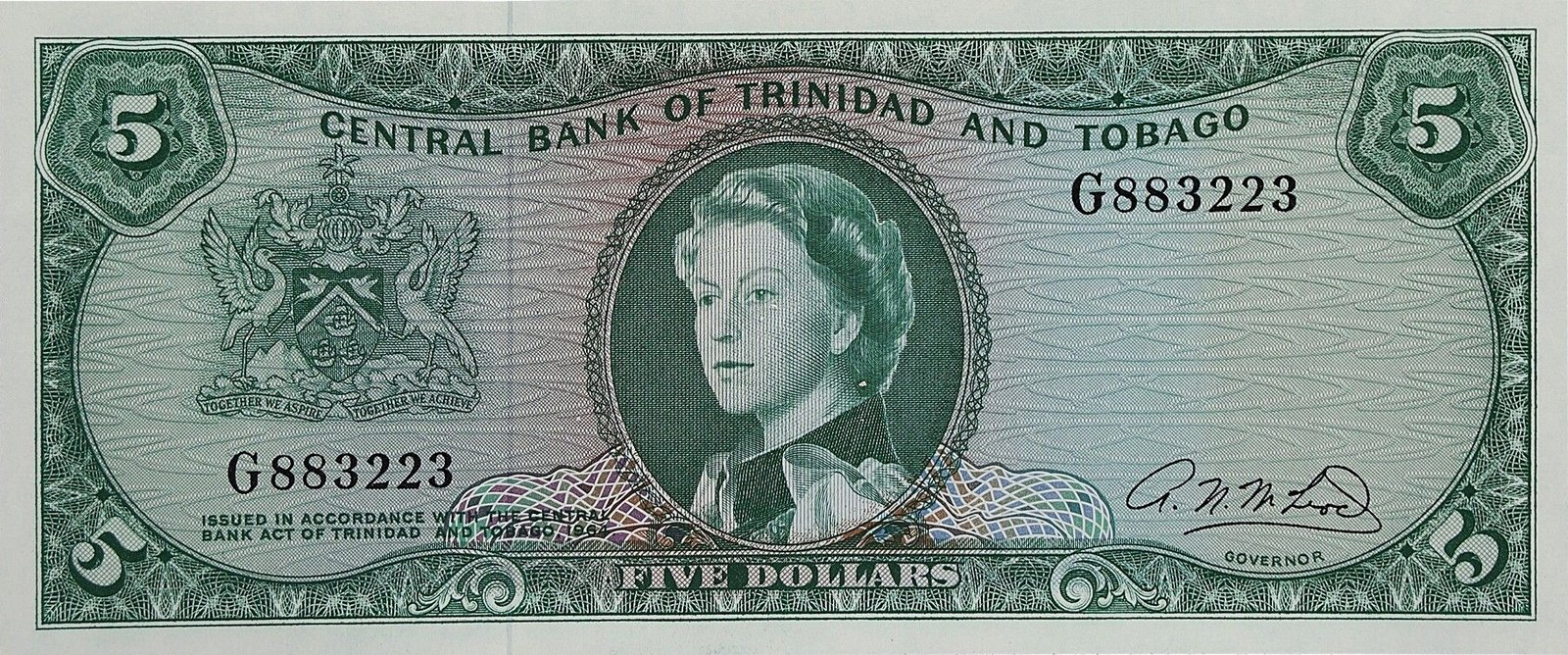
Heritage, in its description of lot 24676 of 10 November 2023, says the three signatures cover about twelve years of printing, and in lot 22424 of 8 December 2023 that the series circulated from about 1964 to 1977. Those spans are the house's; the catalogue's pages give the Governors' years only.
How the prefixes divide
The notes were numbered first with a single-letter prefix and then with a fractional one. The prefix shape and the Governor's signature tell the catalogue's rows apart. The fractional prefixes began under McLeod on the 1 dollar and under Bruce on the 5 and 20 dollars, and no fractional 10 dollars has been recorded yet.
The pages give the letters for two values:
| Value | Pierce | McLeod | Bruce |
|---|---|---|---|
| 5 dollars | A to F | G to R | S to Z, then the fractional A/1 to J/1 |
| 20 dollars | A to F | G to Q | R to Z, then the fractional A/1 to W/1 so far |
On the 10 dollars the changes are placed by two specimens that name a range of numbers. The Pierce specimen of the range B 500001 to D 100000 puts the change to McLeod inside the D prefix, after D 100000. The McLeod specimen of the range G 100001 to J 100000 puts the change to Bruce inside the J prefix, after J 100000.
On the 1 dollar the single-letter Q prefix is shared by Pierce and McLeod, and no Q note has been recorded yet. The fractional Z/1 prefix is shared by McLeod and Bruce, and the page of the 1 dollar gives the numbers at which the recorded notes of each end and begin. On the 20 dollars every fractional prefix is signed by Bruce.
The 100 dollars
The 100 dollars was prepared but never issued. It is signed by Pierce and is known only as a specimen. Heritage, which offered one on 8 December 2023 as lot 22424, describes it as a prototype with ascending ladder serial numbers, a punched hole and the printer's written and typed notes. The pages give no reason why the value was dropped. The unissued designs with the Queen's portrait from across the catalogue are gathered in Notes that never were: unissued designs with Queen Elizabeth II.
What is not known
- The number printed of any value. No source on the pages gives one.
- The day the notes ceased to be legal tender. The pages give no notice for it in their text.
- Which building the back of the 1 dollar shows, beyond what sources mention.
Sources
- The catalogue's pages for the 1, 5, 10, 20 and 100 dollars of 1964, with the specimens, archival photographs and printer's file pieces recorded on them.
- Central Bank Act, No. 23 of 1964, assented to on 11th December 1964.
- Central Bank of Trinidad and Tobago, "Our History" and "Past Governors", on the Bank's website.
- Stack's Bowers, 16 January 2026, lot 30241.
- Heritage, 10 November 2023, lot 24676, and 8 December 2023, lot 22424.


Member comments
Log in or register to post a comment.