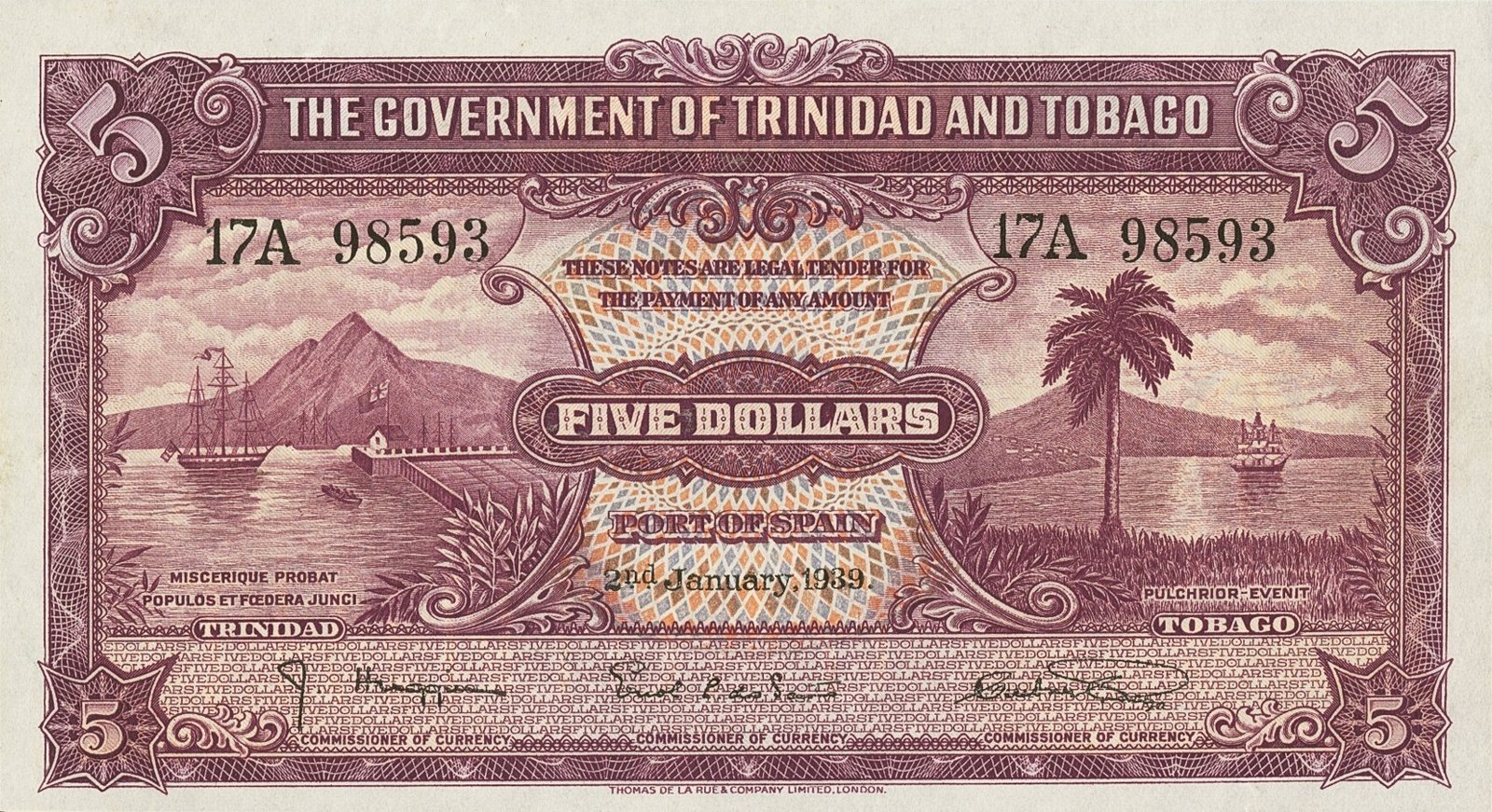
For most of the years covered by this catalogue the Government of Trinidad and Tobago issued only the small notes, and the higher values came from the commercial banks. The catalogue has no pages for the banks' notes, but the records read for it say a good deal about them: Chalmers's history of 1893, the Blue Books, the annual reports, the Year Books, the revised laws, the Port of Spain Gazette and an article in the IBNS Journal. This article gathers what they say, as the background to the Government notes. Where a figure is a bank's authorised limit rather than the notes actually out, it says so.
Before the Government notes
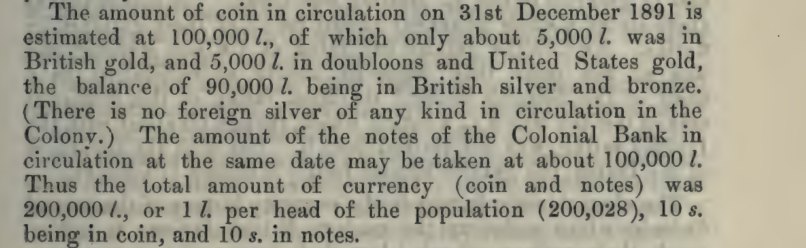
Chalmers, in A History of Currency in the British Colonies (1893), gives the notes of the Colonial Bank in circulation in Trinidad at the end of 1891 as about 100,000 pounds (p. 123, read in the machine text). For Government paper in Trinidad, Chalmers names only the Spanish "papeletas" of the years before British rule in 1797 (p. 114, machine text).
A shortage of the bank's notes and of gold is what first brought the Government into the business. In the Legislative Council debate reported in the Port of Spain Gazette of 6th June 1899 (machine text only), a member proposed Government Treasury notes because neither gold nor the bank's notes could be had. A counterfeit of a 5 dollar note dated 1890, signed by a manager and a cashier, so a bank's note, was passed in Montserrat Ward in early 1898 by a report of 3rd March 1898; the bank is not named.
The Bank Notes Ordinance, No. 243 in the revised Ordinances, was in force from 22nd February 1904, as Ordinance No. 26 of 1914 later declared when it validated every issue made under it. Under it the Union Bank of Halifax began to issue its own Trinidad notes of 5, 10, 20, 50 and 100 dollars on 3rd January 1905, by the Port of Spain Gazette of 6th January 1905 (machine text only, the values partly garbled). When the Government's notes came out on 1st February 1906, the first day's issue included 20,000 pounds of them to the Colonial Bank and 5,000 pounds to the Union Bank of Halifax (Port of Spain Gazette, 2nd February 1906). The Port of Spain Gazette of 21st June 1904 had said the new notes would be "a trifle smaller than those of the Colonial Bank".
The division of 1906 to 1951
From 1906 the Government issued the 1 and 2 dollars, with the 1,000 dollars between the banks from 1914, and the banks the 5, 20 and 100 dollars. The annual report for 1931 says it in one sentence: the three commercial banks "have their own issue of $5.00, $20.00 and $100.00 notes". The catalogue's page for the Government's own 5 dollars lists a date of 1st September 1935 but says no note of that date has been seen; its notes are seen from 2nd January 1939, as are the 10 dollars, and the 20 dollars runs from 1942. The Economic Survey for 1935 and the annual report for 1936 still name only the 1 and 2 dollars as Government notes.
A bank note was not legal tender. In a case reported in the Port of Spain Gazette of 21st September 1922 (machine text only), a magistrate at Sangre Grande held that a 5 dollar Colonial Bank note, refused by a shop for want of change, was not a legal tender, and dismissed the claim.
The banks and their limits, year by year
| Year | What the source says | Source | Read on |
|---|---|---|---|
| 1891 | Colonial Bank notes in circulation about 100,000 pounds | Chalmers (1893), p. 123 | text |
| 1913 to 1914 | the Colonial Bank issues notes of 100, 20 and 5 dollars "to the amount probably of a million dollars at times"; the Royal Bank of Canada notes of the same values to 600,000 dollars, "its authorized limit at present" | Blue Book 1913 to 1914, V 1 | image |
| from 1915 | the Royal Bank of Canada's limit 1,500,000 dollars | Blue Books 1915 to 1925 | text |
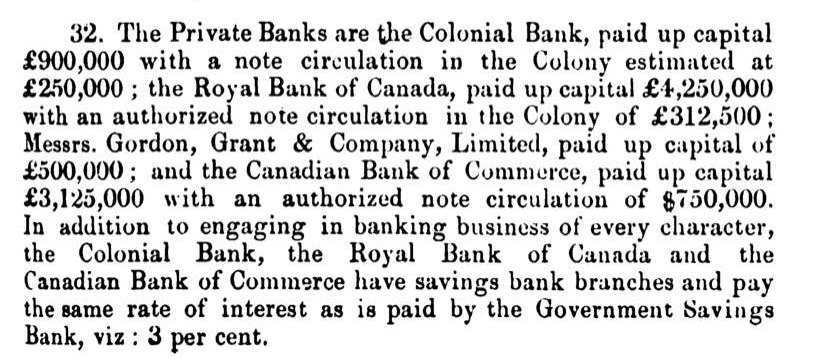
| 1922 | the Colonial Bank, note circulation in the colony estimated at 250,000 pounds; the Royal Bank of Canada, authorised note circulation in the colony 312,500 pounds; the Canadian Bank of Commerce, authorised note circulation 750,000 dollars; Gordon, Grant and Company, a private bank, no note circulation stated | annual report for 1922, No. 1166, p. 9, para. 32 | image |
| from 1922 | the Canadian Bank of Commerce issues notes of 100, 20 and 5 dollars to 750,000 dollars | Blue Books from 1922 | text |
| 1925 | Barclays Bank (Dominion, Colonial and Overseas) issues notes of 100, 20 and 5 dollars, its note circulation estimated at 750,000 pounds; the Royal Bank of Canada authorised 1,500,000 dollars | annual report for 1925, paras. 29 and 31 (image); Blue Book 1925 (text) | image |
| 1931 | the three commercial banks, Barclays, the Royal Bank of Canada and the Canadian Bank of Commerce, issue 5, 20 and 100 dollars | annual report for 1931, No. 1589 | image |
| 1936 | three joint-stock banks issue 5, 20 and 100 dollars; a fund statement shows "Note Issue of Banks" at 765,370 | annual report for 1936 | image for the first, text for the figure |
| 1944 to 1948 | bank notes of 100, 20 and 5 dollars among the notes in circulation | Year Books 1944, 1945 and 1948 | text |
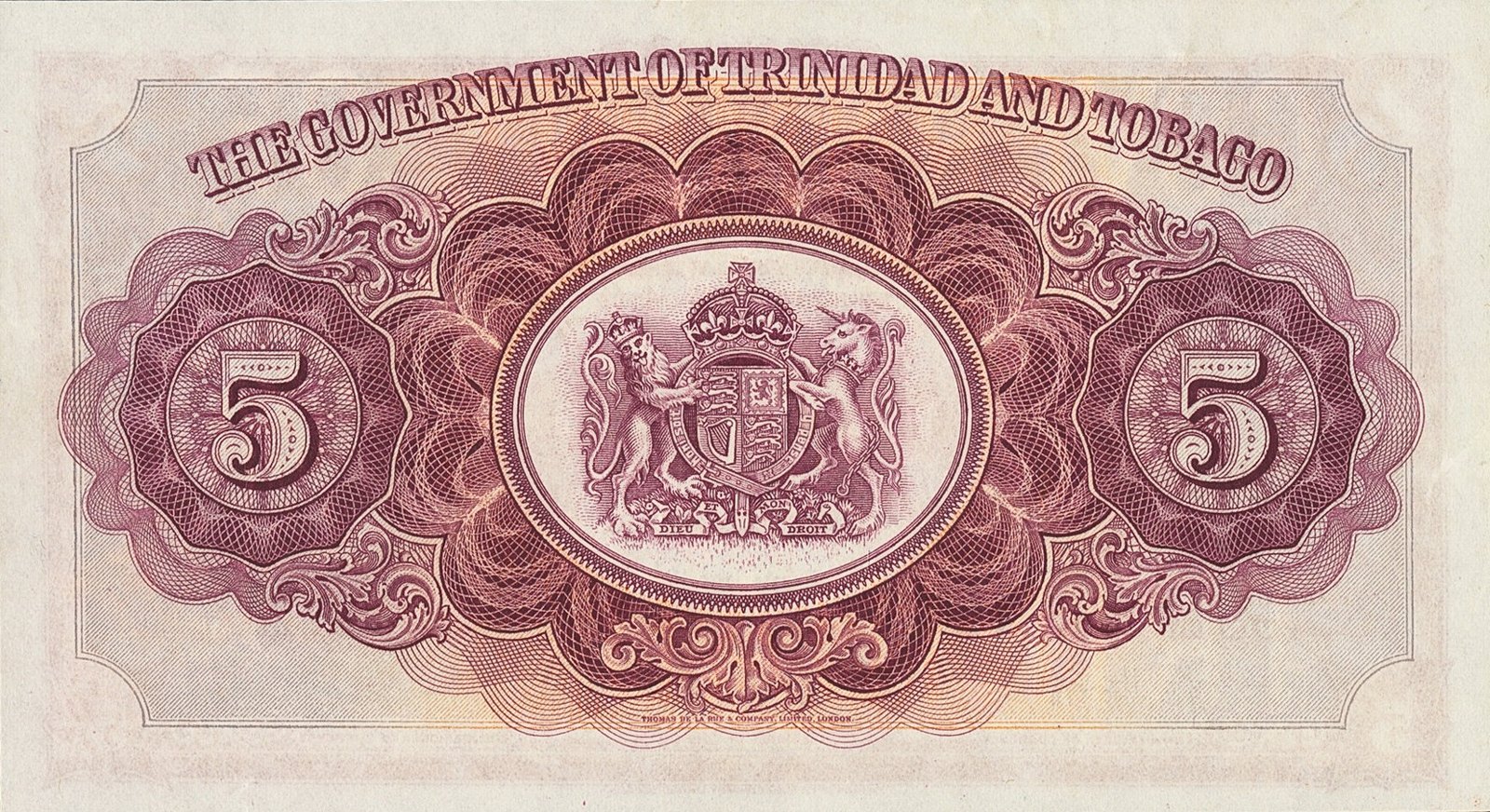
The Colonial Bank became Barclays Bank (Dominion, Colonial and Overseas) in the mid 1920s: the Blue Book of 1925 already names Barclays. The Currency Ordinance of 1950 still calls it "formerly the Colonial Bank".
Security, licence and duty
The Government held securities against the notes of the two Canadian banks. The Blue Books (machine text only) give 39,000 pounds for the Canadian Bank of Commerce and 117,000 pounds for the Royal Bank of Canada at the end of 1930 and of 1931, and 43,500 pounds and 116,484 pounds, 159,984 pounds together, at the end of 1934; in the text of 1930 the first figure reads once as 89,000 and once as 39,000. The annual report for 1946 (text only) shows 3,399,894 dollars held by the Accountant General from Barclays Bank for its note issue.
The Bankers Licences and Bank Notes Ordinance, No. 40 of 1932, licensed the banks and taxed their notes. The Year Book of 1937 gives the rates: a banker authorised to issue notes paid 250 pounds a year and a duty of 1 pound for every 100 pounds of notes issued, against 100 pounds a year for a banker not so authorised.
1944: the banks held back
In the war years the Government's own issue grew and the banks were held back. Under section 15 of the Ordinance of 1932, the Certain Bankers (Restriction of Note Issue) Order, published in the Royal Gazette of 29th June 1944 and read on the page image, capped the notes in circulation of the Royal Bank of Canada, in Trinidad and the prescribed territory together, at 1,293,000 dollars from 1st July 1944, and those of the Canadian Bank of Commerce at 271,000 dollars from 1st January 1945. An article on the Canadian banks in the West Indies in the IBNS Journal, vol. 58 no. 1 (2019), p. 34, drawn from Colonial Office files, says that in 1944 Barclays and the Canadian banks were made to cut their note circulation in the British West Indies by 30 per cent, and that a West Indies Currency Conference held in Barbados in 1946 recommended a regional currency board in place of the private issues.
1951: the end of the bank notes
The Currency Ordinance, No. 39 of 1950, in force on 1st August 1951, barred any banker from issuing new notes, and section 13 saved the note rights of Barclays. The annual report for 1951, read on the page image, says Barclays Bank "voluntarily surrendered its right under charter to issue notes" from 15th August 1951, the day the withdrawal of the Government notes began. In August 1952 the Board named the same three banks, Barclays, the Royal Bank of Canada and the Canadian Bank of Commerce, as the places where the public could change the old Government notes.
Two managers of Barclays sat on the Government's own Board as its outside member: C. C. George from 1935 to 1944 and R. L. Gwatkin in 1948 and again from 1st July 1950, as told in The Commissioners of Currency of Trinidad and Tobago.
What collectors have seen of them
The banks' notes of Trinidad turn up in the sale catalogues and the collectors' press that the records cover, though the catalogue does not list them. Each item is what the source names; none has been examined for the catalogue.
- Bank Note Reporter, July 1974, p. 15: a sale report naming two Colonial Bank of Trinidad 5 dollar proofs.
- NASCA, London Collection, second volume, 18th July 1979: lots 3827 and 3834, Royal Bank of Canada 5 dollars of 1938, and lot 3833, Barclays Bank 5 dollars of 1939.
- NASCA, Stanley Gibbons sale part III, 22nd March 1982: lots 4106 to 4112, notes of Barclays, the Colonial Bank and the Canadian Bank of Commerce.
- Bank Note Reporter, July 1991, pp. 1 and 12: a report of Christie's New York sale of 5th June 1991, from the American Bank Note Company archives, saying that the Royal Bank of Canada's "British East Caribbean Territories" designs, Trinidad among them, were offered in five lots.
- Bank Note Reporter, May 1993, p. 43: a Colonial Bank 5 dollars specimen of Trinidad.
- Bank Note Reporter, August 2001, p. 71: Ponterio's sale 115, lot 202, a 100 dollars of 1904 of the Union Bank of Halifax in Trinidad.
- Bank Note Reporter, April 2007, p. 118: Ponterio's sale 142 (Chicago, 27th to 28th April 2007), a Barclays Bank 5 dollars specimen of 1927, pictured.
- Bank Note Reporter, January 2019, p. 8: a Royal Bank of Canada 5 dollars of 1938.
What the records do not hold
- Any count of bank notes by value, or any serial number of a bank note.
- The notes of the Union Bank of Halifax after 1906, and when that bank stopped issuing in Trinidad.
- What the "Note Issue of Banks" figure of 1936 measures.
- A full text of the order of 1944 cutting the banks' circulation by 30 per cent, which the IBNS Journal cites from Colonial Office files.
Sources
- Chalmers, A History of Currency in the British Colonies (London, HMSO, 1893), pp. 114 and 123.
- Blue Books of Trinidad and Tobago, 1913 to 1914 to 1925 (Currency), 1930, 1931 and 1934 (Assets and Liabilities).
- Annual reports on Trinidad and Tobago for 1922 (No. 1166), 1925, 1931 (No. 1589), 1936, 1946 and 1951.
- Year Books of Trinidad and Tobago for 1937, 1944, 1945 and 1948.
- Ordinances: Bank Notes Ordinance, No. 243; No. 26 of 1914; Bankers Licences and Bank Notes Ordinance, No. 40 of 1932; Currency Ordinance, No. 39 of 1950; the Certain Bankers (Restriction of Note Issue) Order, Royal Gazette, 29th June 1944.
- Port of Spain Gazette: 3rd March 1898; 6th June 1899; 21st June 1904; 6th January 1905; 2nd February 1906; 21st September 1922.
- Royal Gazette, notice of 7th August 1952.
- IBNS Journal, vol. 58 no. 1 (2019), p. 34.
- Economic Survey of the Colonial Empire, 1935.
- Bank Note Reporter: July 1974, July 1991, May 1993, August 2001, April 2007, January 2019.
- NASCA sale catalogues of 18th July 1979 and 22nd March 1982.


Member comments
Log in or register to post a comment.