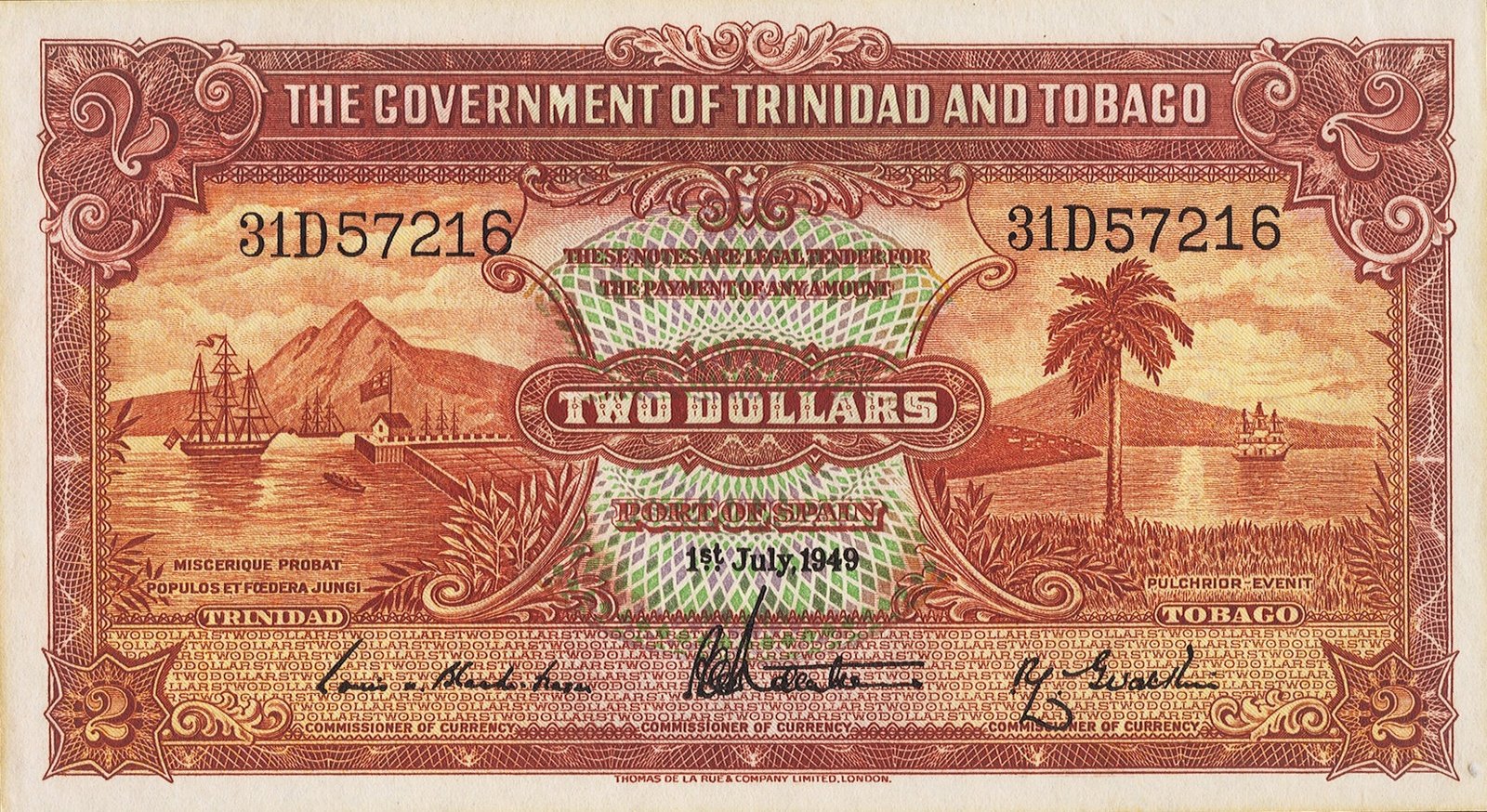
This article follows the last Government notes of Trinidad and Tobago after the British Caribbean Currency Board took them over in 1951: how they were called in, the day they were demonetised, and the notes that never came back, down to 1969. It rests on the Currency Ordinance of 1950, the colony's annual reports, the Board's monthly statements in the Royal Gazette of 1955, the Board's return printed in the West Indies Gazette of 1958, its reports for 1959 to 1962, and the Trinidad and Tobago Gazette of 1969. The Board itself and its own notes have their article in The British Caribbean Currency Board and its notes, 1950 to 1968; the outline of the redemption is in The Trinidad and Tobago Government notes of 1935 to 1949. What is new here is the count by value and the month-by-month figures.
The take-over of 1st August 1951
Trinidad and Tobago's Currency Ordinance, No. 39 of 1950, passed by the Legislature on 12th June 1950, came into force on 1st August 1951. By the text in the revised Ordinances of 1950, read on the page image for its number and commencement, from that day the Trinidad Board of Commissioners of Currency ceased to issue, no banker could issue new notes, the Government notes became liabilities of the new Board, and demonetised notes stayed payable at face by the Board (section 9). Section 13 saved the note rights of Barclays Bank (Dominion, Colonial and Overseas), formerly the Colonial Bank.
The annual report for 1951 (read on the page image) says the Government notes of Barbados, British Guiana and Trinidad were taken over on 1st August 1951, that their withdrawal began on 15th August 1951, and that Barclays Bank gave up its right to issue notes from that day. The Board's report for 1960 puts the Trinidad and Tobago notes taken over at 23,599,252 dollars; in the table of its report for 1962 the take-over figures of Grenada, St Vincent, St Lucia, Dominica, Antigua, St Kitts and Montserrat read "included in Trinidad and Tobago".
The notes came in fast. The annual reports give 6,064,852 dollars of them still out at the end of 1951 and 2,356,287 dollars at the end of 1952, against 15,875,000 and 20,300,670 dollars of the Board's own notes. A notice signed by L. Spence, Executive Commissioner, on 7th August 1952 (Royal Gazette, p. 1440; machine text only) asked holders of the Barbados, British Guiana and Trinidad and Tobago Government notes to change them for British Caribbean notes "with as little delay as possible" at Barclays Bank, the Royal Bank of Canada and the Canadian Bank of Commerce.
Demonetised from 2nd January 1955
Notice 1222, dated 29th December 1954 and printed in the Royal Gazette Extraordinary of 31st December 1954, signed by W. V. Brown as Acting Executive Commissioner, read on the page image, gave the Board's intention: all currency notes first issued by the Governments of Barbados, British Guiana and Trinidad and Tobago would cease to be legal tender from 2nd January 1955; the banks would change them until that day, and after it their value could still be claimed at the Board's headquarters in Trinidad or its Currency Centres. The auditor's report on the Board's accounts for 1954, printed in the Royal Gazette of 1955 (pp. 1487 to 1488, machine text only), says the notes were declared no longer legal tender from 2nd January 1955 by proclamation of each Governor under section 9 of the Currency Ordinance. The Trinidad proclamation itself is not among the pages read.
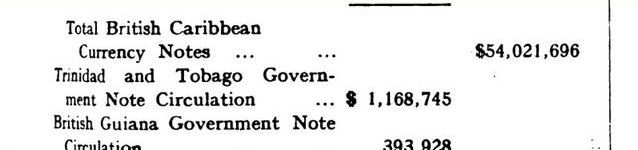
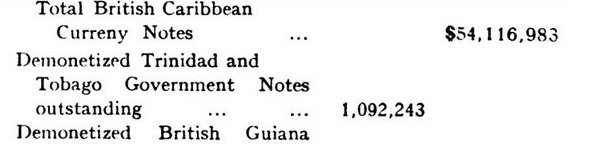
The Board's monthly statements in the Royal Gazette of 1955 then count down what was left. The figures from February were read here on the page cuts of the record; that of 1st January was read on the page image by the reader. The statement of 1st February still heads the line "Trinidad and Tobago Government Note Circulation"; from 1st March it reads "Demonetized Trinidad and Tobago Government Notes outstanding".
| Statement of | Trinidad and Tobago Government notes outstanding | Royal Gazette 1955, page of the scanned volume |
|---|---|---|
| 1st January 1955 | 1,282,489.00 dollars | 62 |
| 1st February 1955 | 1,168,745 dollars | 156 |
| 1st March 1955 | 1,092,243 dollars | 259 |
| 1st April 1955 | 1,049,082 dollars | 356 |
| 1st May 1955 | 1,014,459 dollars | 392 |
| 1st June 1955 | 979,390.00 dollars | 552 |
| 1st July 1955 | 946,161.00 dollars | 646 |
| 1st August 1955 | 933,367.00 dollars | 762 |
| 1st September 1955 | 914,753.00 dollars | 841 |
| 1st October 1955 | 894,142.00 dollars | 936 |
| 1st November 1955 | 888,014.00 dollars | 990 |
| 1st December 1955 | 871,360.00 dollars | 1058 |

In the same year Ordinance No. 34 of 1955, the Government Currency Notes (Repeal) Ordinance, repealed the Government Currency Notes Ordinance and wound up the Note Security Fund kept under it (annual report for 1955, machine text only).
The return of 31st August 1958
The Board's return of currency notes at 31st August 1958, signed by W. V. Brown at Trinidad on 25th September 1958 and printed in the West Indies Gazette of 10th October 1958 (p. 99), read on the page image, sets out the three old issues side by side.
| Government notes of | Taken over on 1st August 1951 | Withdrawn by 31st August 1958 | Still outstanding |
|---|---|---|---|
| Barbados | 3,408,040.00 dollars | 3,340,065.00 dollars | 67,975.00 dollars |
| British Guiana | 9,431,000.00 dollars | 9,177,143.50 dollars | 253,856.50 dollars |
| Trinidad | 23,599,252.00 dollars | 22,883,672.00 dollars | 715,580.00 dollars |
| Total | 36,438,292.00 dollars | 35,400,880.50 dollars | 1,037,411.50 dollars |
How many notes of each value never came back
From 1959 the Board's reports count the old notes still outstanding by number and value, in their Appendix I. These are the Board's own counts as copied from the reports, each read on the page image. A half in the British Guiana columns is a half note. For Trinidad and Tobago the 100 dollars column is empty each year, which agrees with the catalogue: no Government 100 dollars was ever issued.
| At 31st December | 1 dollar | 2 dollars | 5 dollars | 10 dollars | 20 dollars | 100 dollars | Value |
|---|---|---|---|---|---|---|---|
| 1959 | 399,956 | 40,775 | 22,930 | 4,434 | 2,750 | none | 695,496 dollars |
| 1960 | 399,286 | 40,578 | 22,445 | 4,249 | 2,621 | none | 687,577 dollars |
| 1961 | 398,187 | 40,288 | 21,779 | 4,074 | 2,446 | none | 677,318 dollars |
| 1962 | 397,559 | 40,090 | 21,441 | 3,957 | 2,309 | none | 670,694 dollars |
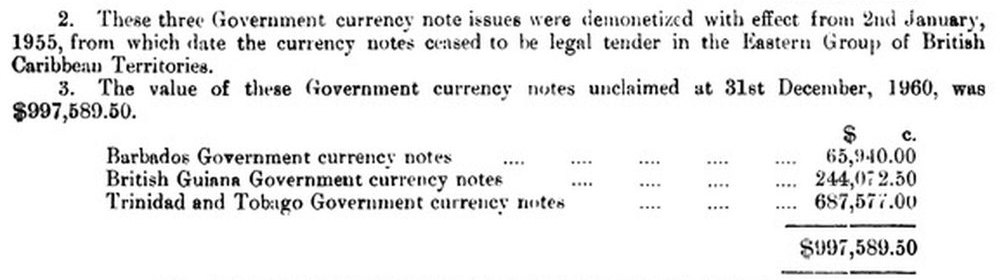
The 1959 report is printed in the Antigua, Montserrat and Virgin Islands Gazette of 27th July 1961 (p. 135), the 1960 report in the same Gazette of 23rd August 1962 (p. 181), and the reports for 1961 and 1962 are among the Parliament of Guyana papers. In the 1961 report the machine text reads 393,187 for the 1 dollar notes; the page and the column total give 398,187.
The same reports give the value withdrawn since the take-over (machine text): 22,911,675 dollars by the end of 1960, 22,921,934 dollars by the end of 1961 and 22,928,558 dollars by the end of 1962.
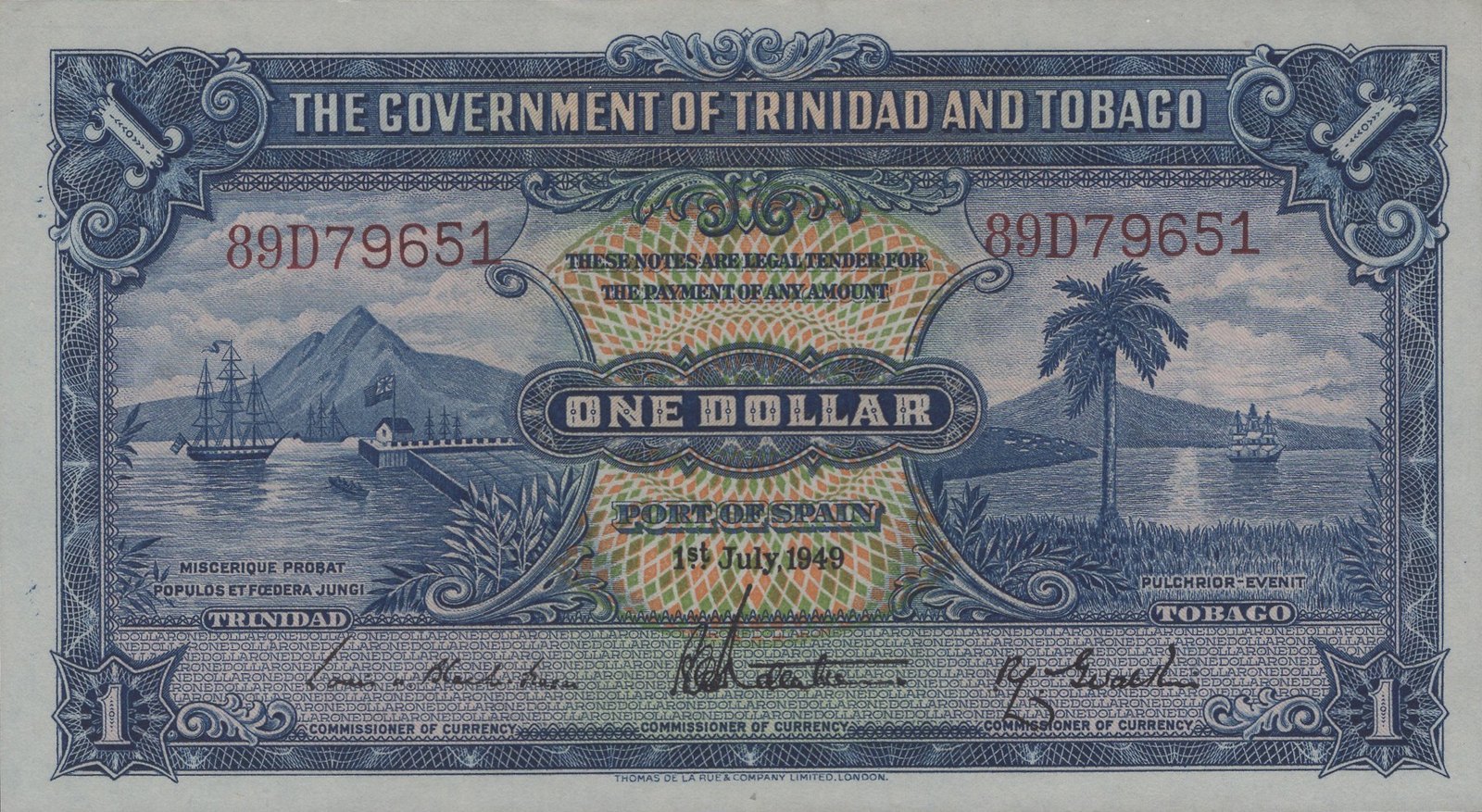
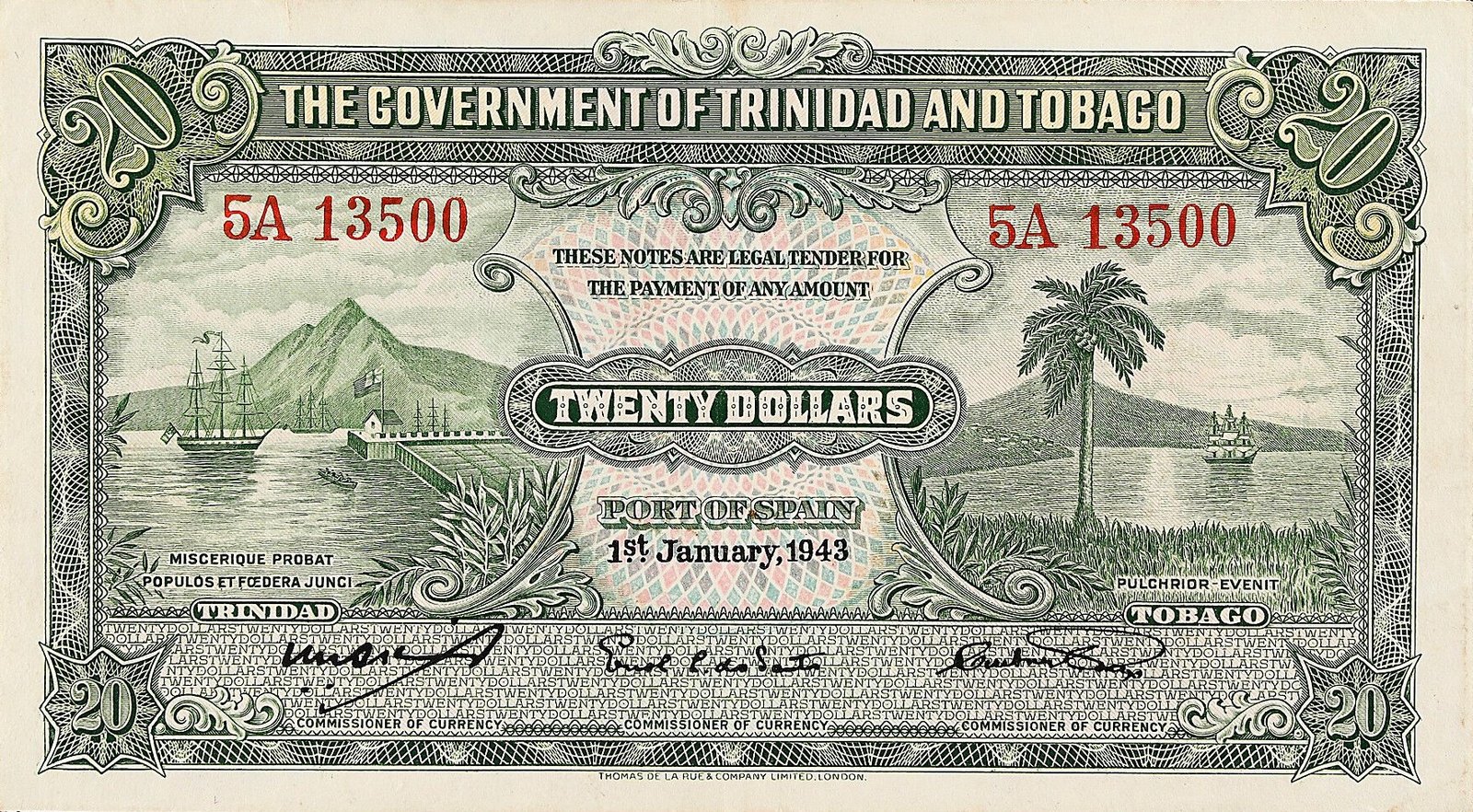
These are the notes of the five values of 1935 to 1949: the 1 dollar, the 2 dollars of 1935 to 1939 and 1942 to 1949, the 5 dollars, the 10 dollars and the 20 dollars. The 1 and 2 dollar counts may also hold notes of the older series: the Government Currency Notes Ordinance as revised in 1950 counted the notes of the former Ordinance as issued under it (section 15, added by Ordinance No. 4 of 1941), and the 1905 to 1934 notes had been redeemable at the Treasury since they lost their legal tender on 2nd January 1936. The reports do not split the counts by series or by date, so how many of the 397,559 one dollar notes of 1962 were of the 1905, 1929 or 1935 designs is not known.
The Central Bank's liability, 1964 to 1969
The Board's statement for 1st November 1963 (Grenada Gazette, 30th November 1963) still gives 666,818 dollars of Trinidad and Tobago Government notes out. Its statement for 1st February 1965, in the Saint Vincent Government Gazette of 23rd March 1965 (p. 73, read on the page image), no longer counts them: a footnote says the liability for the Trinidad and Tobago Government notes outstanding at 14th December 1964 had been assumed by the Central Bank of Trinidad and Tobago. The Dominica Herald of 24th December 1964 gives 14th December as the day the Central Bank issued its own notes. Article 12 of the British Caribbean Currency Agreement of 12th December 1964, as printed with British Guiana's Currency Ordinance, 1965 (No. 8 of 1965, among the Parliament of Guyana papers), had provided that the liability for these notes should go back to the Government of Trinidad and Tobago, with sterling equal to the notes outstanding, on the day its new currency authority began to issue.
The Central Bank carried the debt in its own accounts. Its weekly statement for 5th March 1969, in the Trinidad and Tobago Gazette of 13th March 1969 (p. 640), read on the page image, notes that its notes in circulation include its liability to redeem the demonetised Government notes still outstanding, "sterling assets for which have been received from the British Caribbean Currency Board".
| Date | Outstanding | Source | Read on |
|---|---|---|---|
| 31st December 1968 | 651,667 dollars | Auditor General's report, balance sheet note 1, Trinidad and Tobago Gazette, 17th July 1969, p. 1803 | image |
| 5th March 1969 | 651,564 dollars | weekly statement, Gazette of 13th March 1969, p. 640 | image |
| 26th March 1969 | 651,525 dollars | weekly statement, Gazette of 3rd April 1969 | text |
| 9th July 1969 | 651,254 dollars | weekly statement, Gazette of 17th July 1969 | text |
The 1968 balance sheet is signed by A. N. McLeod as Governor of the Bank, the McLeod whose signature is on the second of the three signature rows of the Central Bank's first notes.
Trinidad notes in Grenada to 1968
Trinidad notes had passed in Grenada since 1935, and the link lasted into the Central Bank years. The Grenada Government Gazette printed weekly from 22nd June to 31st August 1968 a notice that "British Caribbean Currency Board and Trinidad and Tobago Notes will shortly cease to be legal tender in Grenada", asking the public to change them for East Caribbean notes; no closing day is given. An article by Salem on Trinidad and Tobago from Currency Board to Central Bank, in the IBNS Journal, vol. 41 no. 2 (2002), p. 20, says Grenada used Trinidad and Tobago currency until it joined the East Caribbean Currency Authority in November 1968. Neither source says which Trinidad and Tobago notes were meant; by 1968 they would have been those of the Central Bank, but the notice does not say so.
What is not known
- The text of the Trinidad proclamation that ended the notes on 2nd January 1955.
- The counts by value before 1959 and after 1962: the Board's reports for 1951 to 1958 and from 1963 on have not been found.
- How many of the outstanding notes were of each series and date.
- When the Central Bank stopped carrying the old notes in its accounts, if it ever did.
Sources
- Currency Ordinance, No. 39 of 1950, in the Revised Ordinances of Trinidad and Tobago, 1950, vol. V, Chapter 35 No. 2; the Government Currency Notes Ordinance in the same volume, Chapter 35 No. 6.
- Annual reports on Trinidad and Tobago for 1951, 1952 and 1955.
- Royal Gazette: notice of 7th August 1952, p. 1440; notice 1222 in the Royal Gazette Extraordinary of 31st December 1954; the Board's monthly statements of 1955; the auditor's report on the Board's accounts for 1954, pp. 1487 to 1488.
- West Indies Gazette, 10th October 1958, p. 99: return of currency notes at 31st August 1958.
- Reports of the Executive Commissioner of the British Caribbean Currency Board for 1959 and 1960 (Antigua, Montserrat and Virgin Islands Gazette, 27th July 1961 and 23rd August 1962) and for 1961 and 1962 (papers of the Parliament of Guyana).
- Grenada Gazette, 30th November 1963; Saint Vincent Government Gazette, 23rd March 1965, p. 73 (statement for 1st February 1965); Grenada Government Gazette, 22nd June to 31st August 1968.
- Dominica Herald, 24th December 1964, p. 7.
- British Caribbean Currency Agreement, 1964, Article 12, as printed with the Currency Ordinance, 1965 (No. 8 of 1965) of British Guiana.
- Trinidad and Tobago Gazette, 13th March, 3rd April and 17th July 1969.
- Salem, on Trinidad and Tobago from Currency Board to Central Bank, IBNS Journal, vol. 41 no. 2 (2002), p. 20.


Member comments
Log in or register to post a comment.