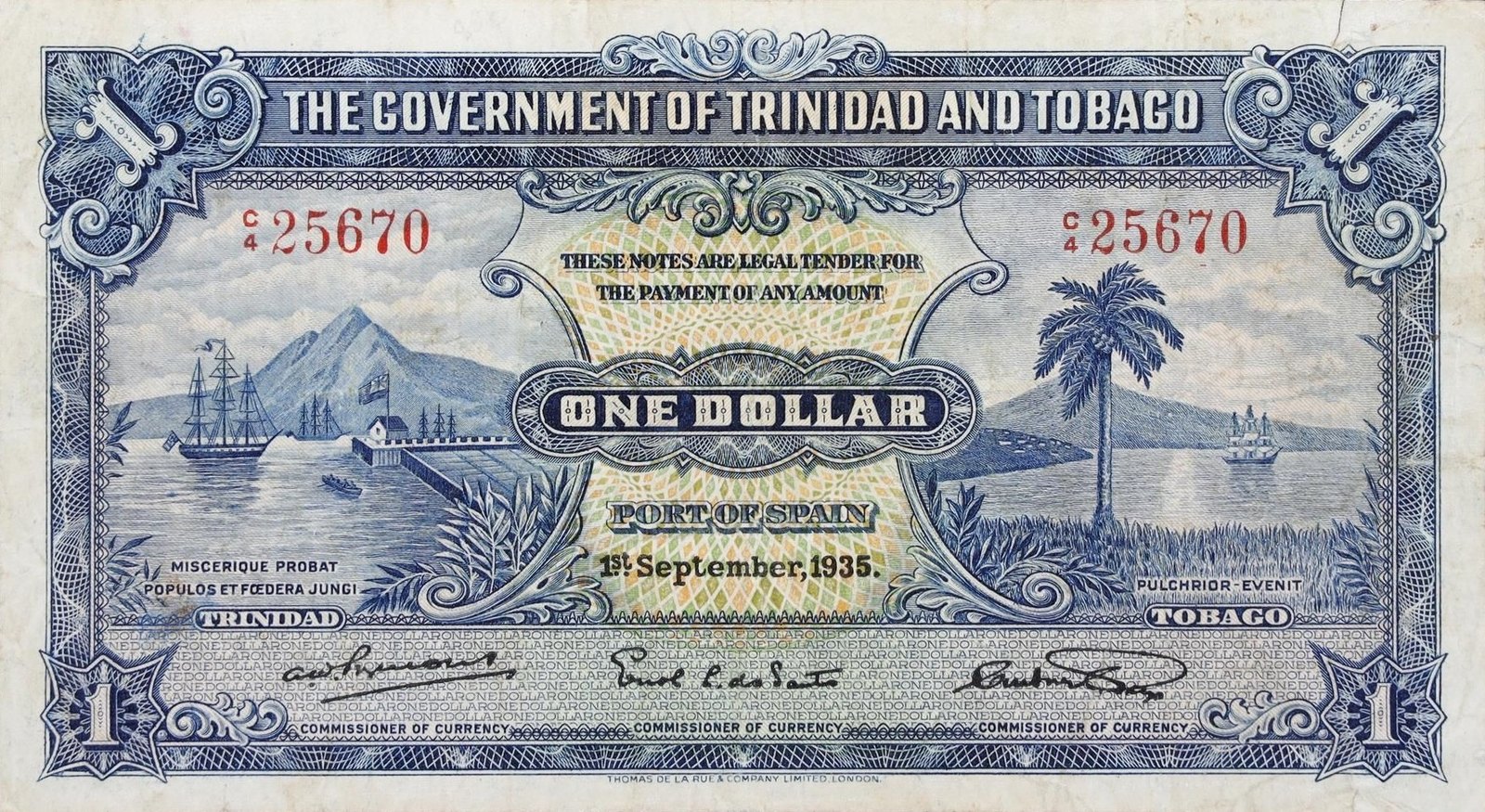
This article covers the last notes the Government of Trinidad and Tobago issued in its own name: the 1, 2, 5, 10 and 20 dollars dated from 1st September 1935 to 1st July 1949, and a 100 dollars that was approved and not issued. It is drawn from the catalogue's pages, which rest on the Ordinance of 1934, the Year Books, the annual reports of Trinidad and of the Windward Islands, the Trinidad Guardian and the reports of the British Caribbean Currency Board, with a few additions from the Royal Gazette and from auction houses. The earlier notes are in The first Government notes of Trinidad and Tobago, 1903 to 1936.
The Ordinance of 1934 and the new Board
A new Board of Commissioners of Currency took over the issue under the Government Currency Notes Ordinance, 1934 (No. 40 of 1934; Chapter 35 No. 2 in the revised laws). Its members were the Colonial Secretary, the Treasurer and one non-official member. The Ordinance was printed in the supplement to the Royal Gazette of 20th December 1934.
The Board's notes were printed by Thomas de la Rue, with the seals of Trinidad and of Tobago on the front and the arms on the back. They ran from 1st September 1935 to 1st July 1949 through five signature boards. The old 1 and 2 dollars of Series A and B ceased to be legal tender on 2nd January 1936, by Proclamation No. 75 of 1935 (the Treasurer's notice in the Royal Gazette of 12th December 1935 refers to it as printed in the Royal Gazette of 19th September 1935), and were to be exchanged for Series C.
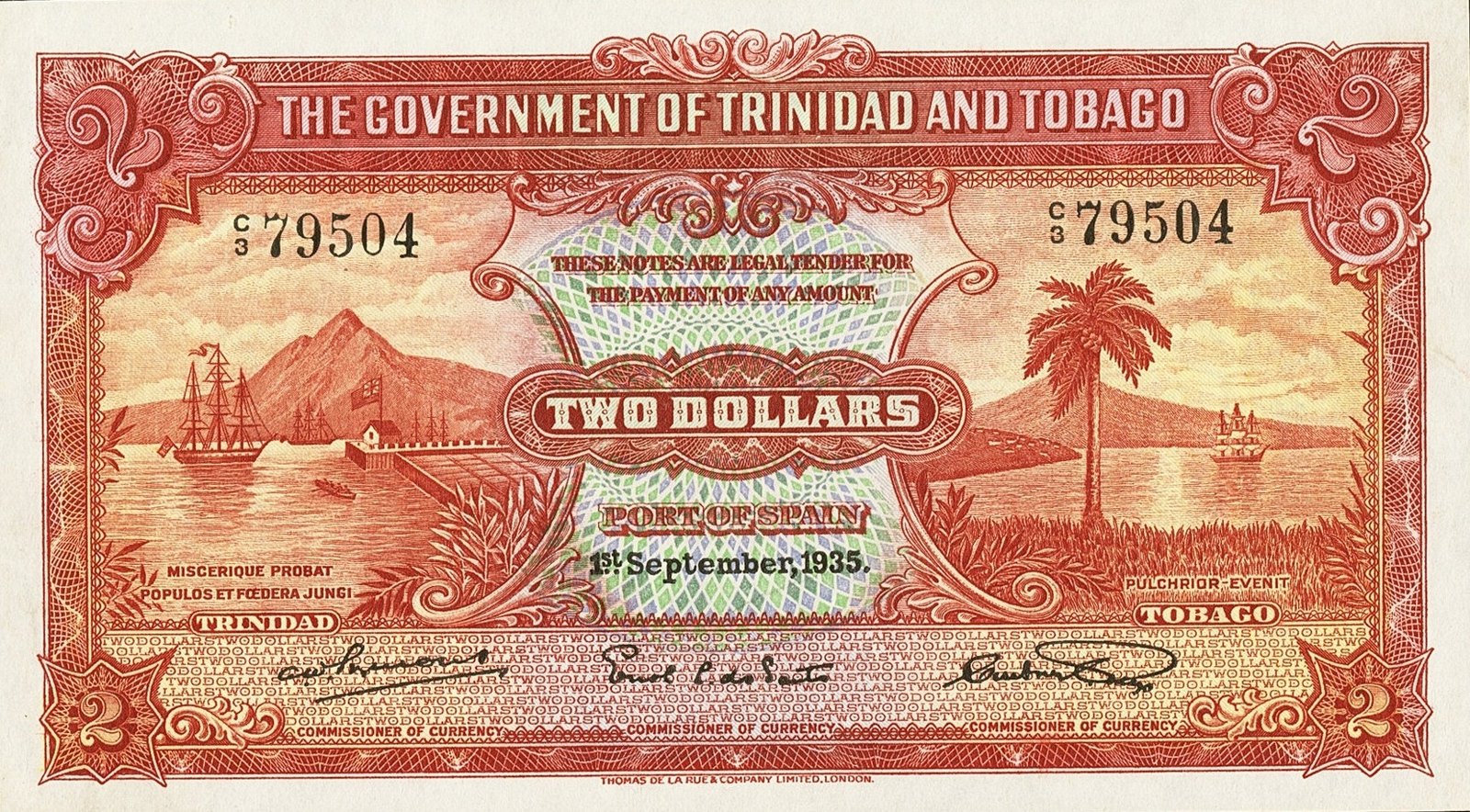
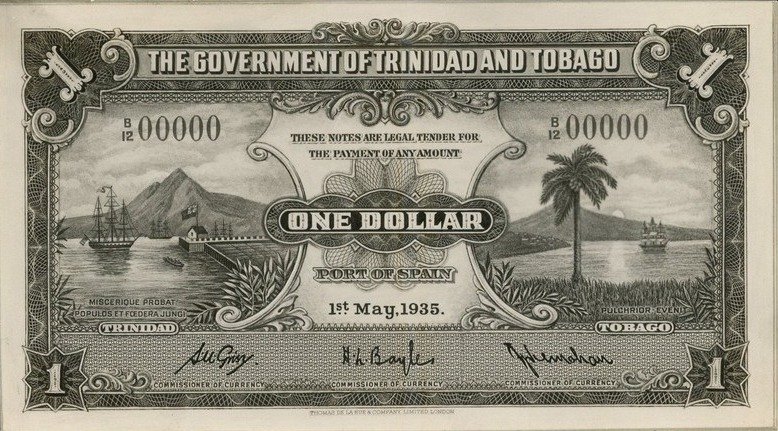
De La Rue's archival photographs of the 1 and 2 dollars carry dates that were never used for issue: 1st January 1935 and 1st May 1935. The page of the 1 dollar gives the photographs dated 1st May 1935 the signatures of Grier, Bayles and Kernahan. The page of the 2 dollars gives its photographs the signatures of the Jackson, Walcott and Kernahan board and of the Grier, dos Santos and George board. These are the boards of the 1929 designs, not the board that signed the issued notes of 1935.
Dates and signers
| Date on the note | Signed by | Values the pages record with this date |
|---|---|---|
| 1st September 1935 | Seymour, dos Santos and George | 1 dollar, 2 dollars |
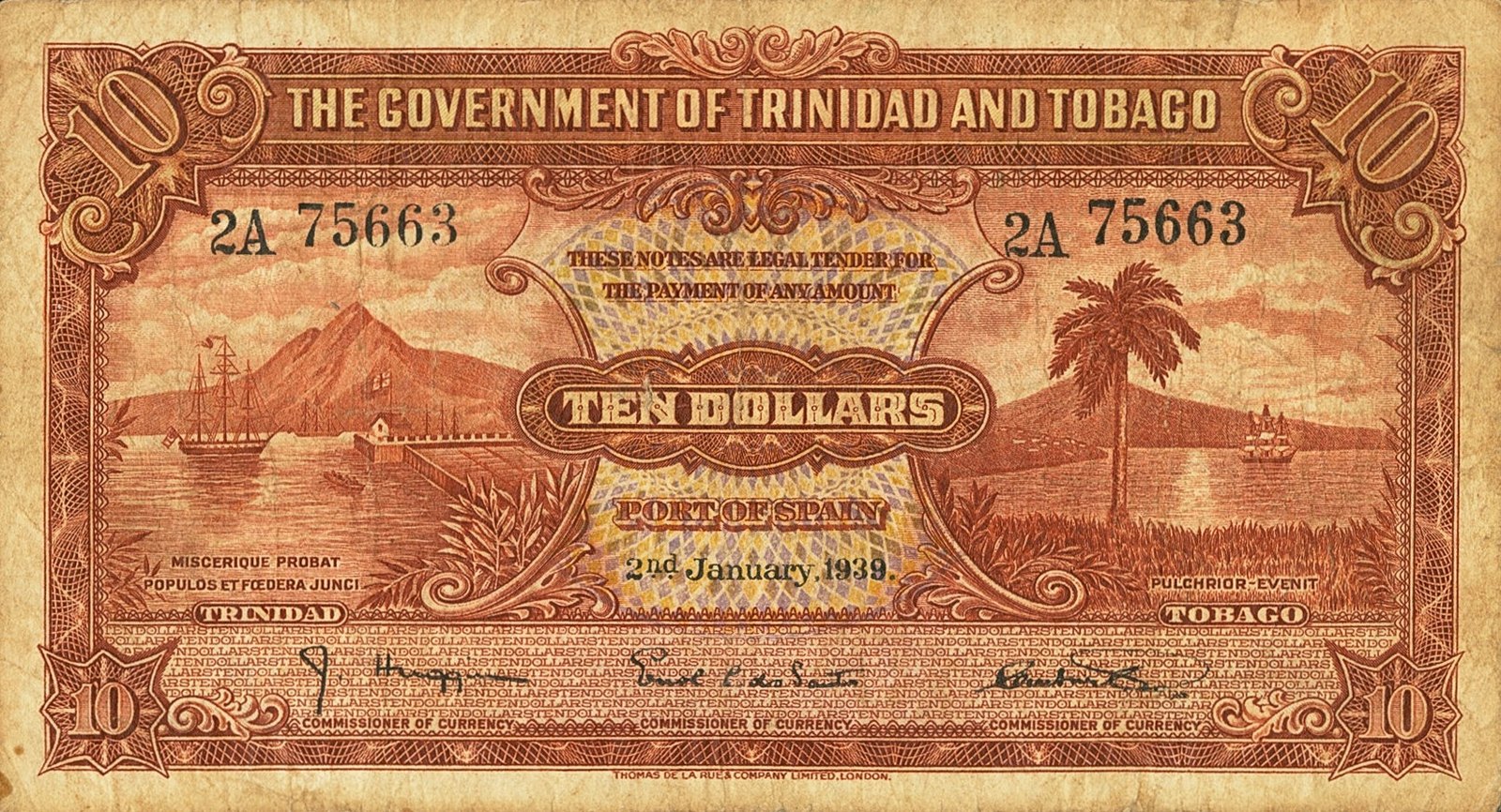
| 2nd January 1939 | Huggins, dos Santos and George | 1, 2, 5 and 10 dollars |
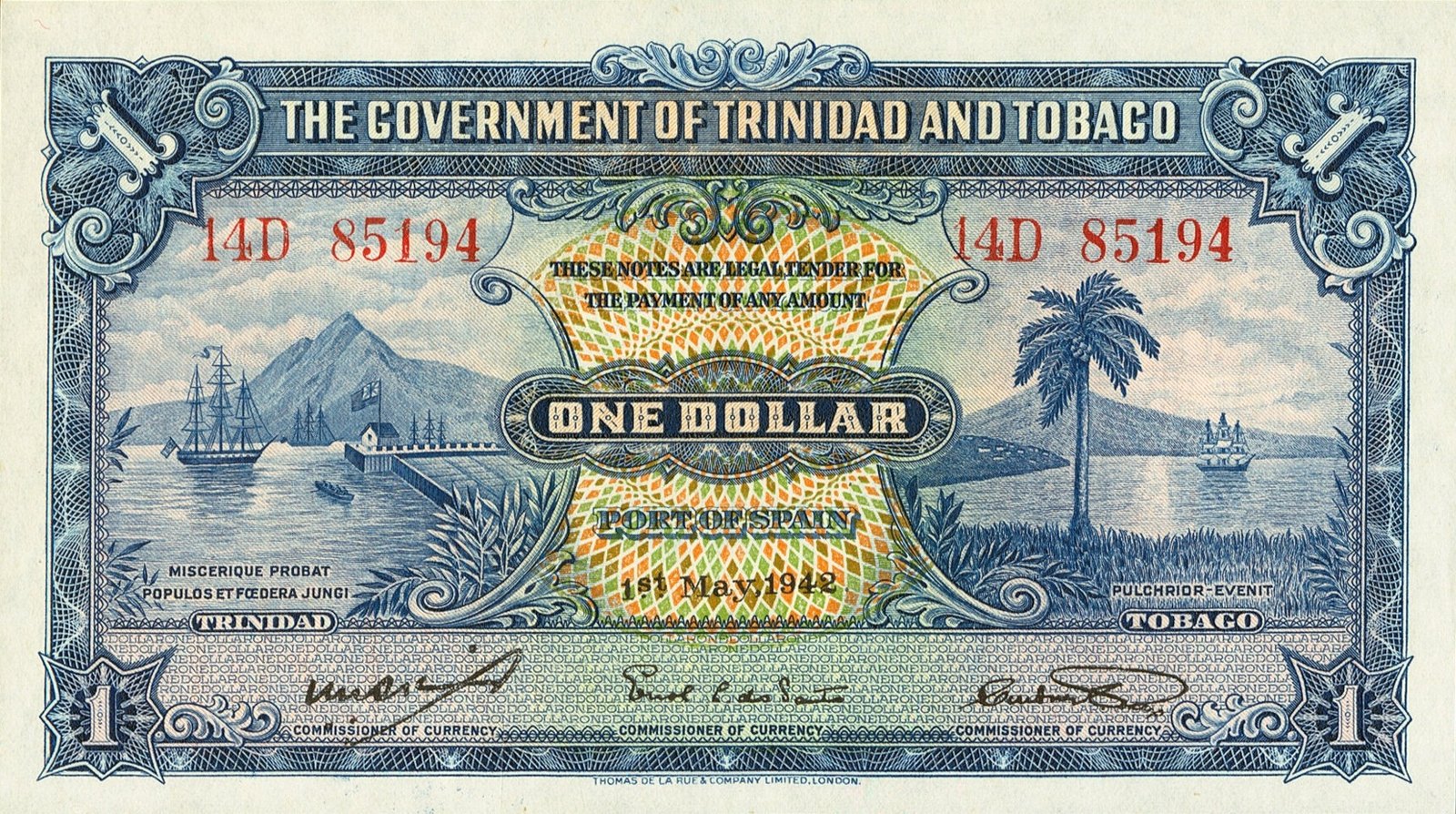
| 1st May 1942 | Wright, dos Santos and George | 1, 2, 5, 10 and 20 dollars |
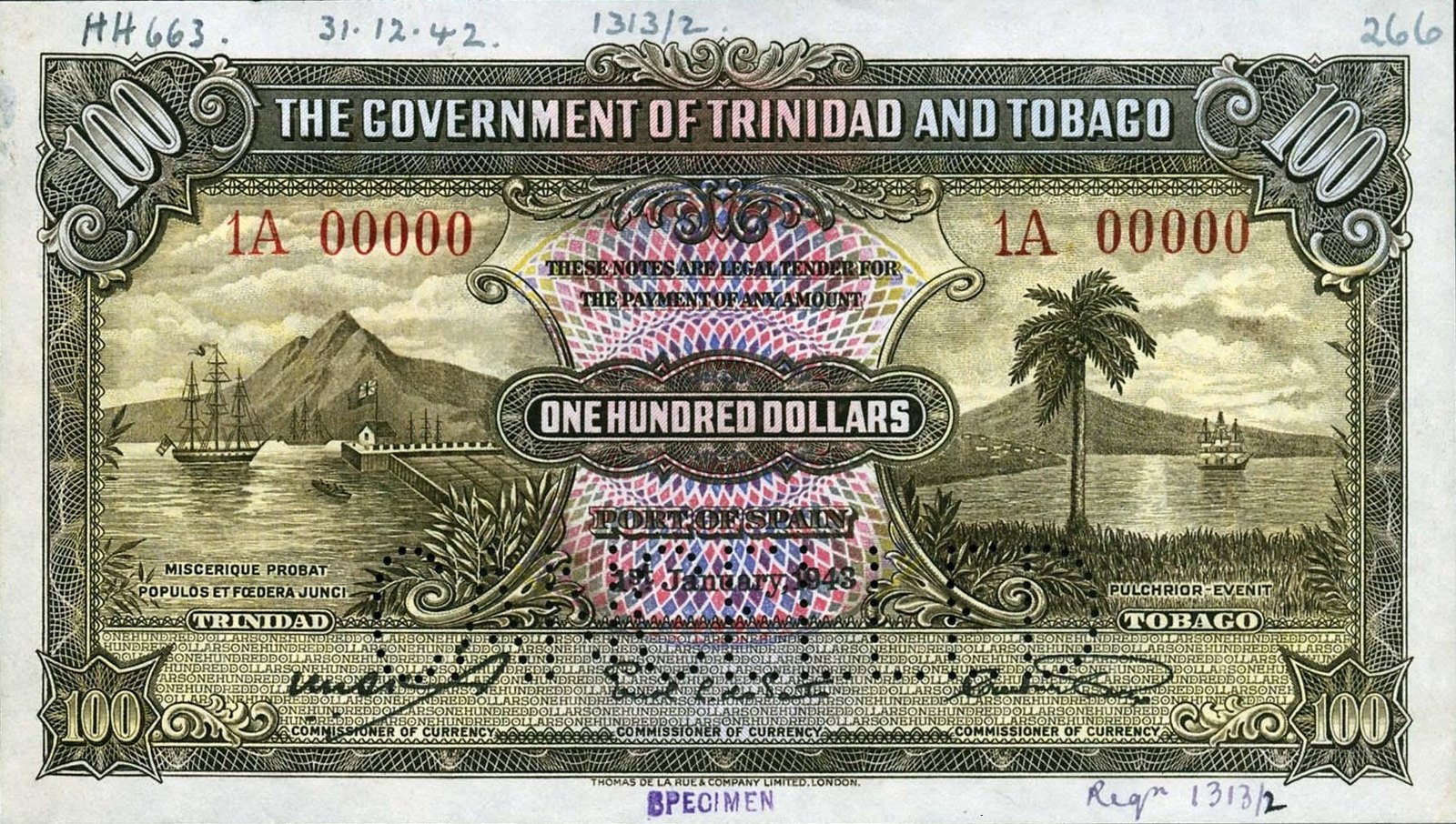
| 1st January 1943 | Wright, dos Santos and George | 1, 2, 10 (specimens only), 20 and 100 dollars (not issued) |
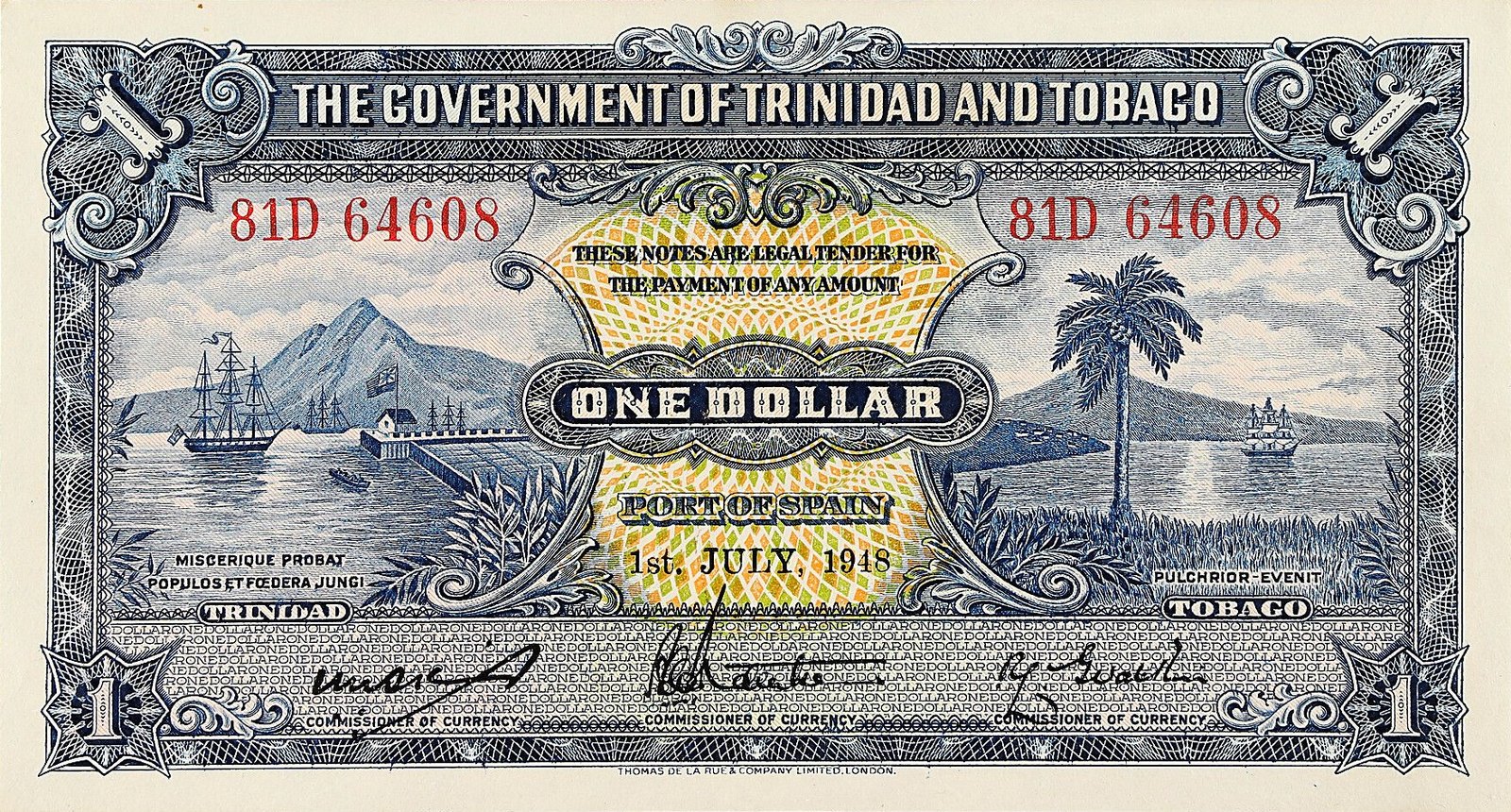
| 1st July 1948 | Wright, Robertson and Gwatkin | 1 dollar |
| 1st July 1949 | Blache-Fraser, Robertson and Gwatkin | 1 dollar, 2 dollars |
The pages name the signers on the 1, 10, 20 and 100 dollars; for the 2 and 5 dollars they give the dates only. No 5 dollars dated 1st September 1935 has been seen, and no 2 dollars dated 1st July 1948 is recorded.
From fractions to number and letter
The 1935 printings were numbered first with fractional prefixes, C/1 to C/15 on the 1 dollar and C/1 to C/5 on the 2 dollars, and then with number-letter prefixes, 16C and 6C onward. Every later printing kept the number-letter form. The 5, 10 and 20 dollars have number-letter prefixes only, each starting at 1A.
Two prefixes run across a change of date. On the 2 dollars of 1942 to 1949, which is the 1935 design in new colours, 30D was used for both the 1st January 1943 and the 1st July 1949 printings. On the 20 dollars the prefix 3A is shared by 1st May 1942 and 1st January 1943. Heritage, in its description of lot 24674 of 10 November 2023, says the date of the 20 dollars changed about halfway through 3A.
For the first 2 dollars, Heritage (21 April 2022, lot 25258) says only 300,000 notes dated 1935 were printed, across prefixes C/1 to C/3. The catalogue records the fractional prefixes of that date up to C/5, so the two do not agree, and no official figure is on the pages.
Legal tender in the Windward Islands
The notes also passed outside the colony. The annual reports of the Windward Islands colonies say Trinidad Government notes were made legal tender in Grenada from 1st November 1935, and the 1 and 2 dollars in St Lucia from 1st May 1936. St Vincent passed a Trinidad Currency Notes Ordinance the same year.
The higher values, 1939 to 1943
The annual report for 1931 says the 5, 20 and 100 dollar notes were then left to the three commercial banks. The 5 and 10 dollars are first recorded with the date of 2nd January 1939, the 20 dollars with 1st May 1942. Stack's Bowers, in its description of lot 30336 of 29 August 2025, says the Government brought in the higher values as the notes of the Canadian banks were phased out; the pages give no date for that.
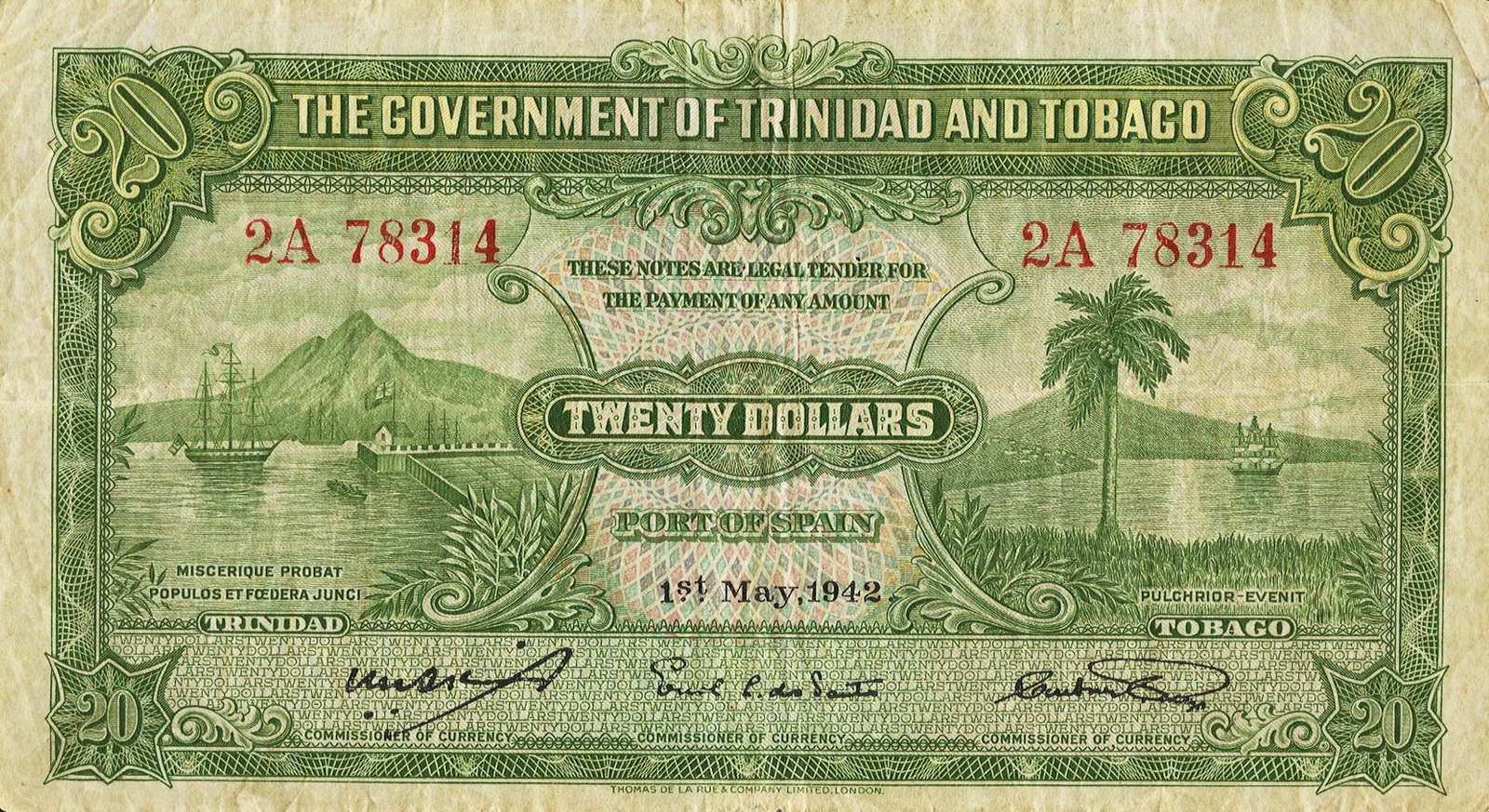
The De La Rue file proofs of the 5 dollars, a violet proof and a black front die proof, are initialled and dated October 1940. The 20 dollars has its serial numbers printed in red.
A 100 dollars dated 1st January 1943, signed by Wright, dos Santos and George, was prepared and not issued, and is known only as specimens. The De La Rue file copy, with the prefix 1A, is marked approved and dated 5/2/43 in the bottom margin. Its colour proofs were printed on the 20 dollars design and are listed in the catalogue with the colour trials of the 20 dollars. Stack's Bowers, which offered the file copy on 13 January 2024 as lot 60491, wrote that it knew of no earlier record of the value in any form.
Stolen in transit, June 1944
A police notice in the Trinidad Guardian of 28th July 1944 lists notes stolen from Government money on 1st June 1944: thirteen 10 dollars with prefixes from 2A to 6A, and six 20 dollars with prefixes 1A, 2A and 3A. The notice is signed by G. M. Drury, Assistant Detective Superintendent, ran again in the Trinidad Guardian of 29th July 1944, and says the notes were taken in transit from the Pointe-a-Pierre Post Office to Port of Spain. It shows that the 10 dollars of 1942 up to 6A were in use by then. The prefixes are on the pages of the two notes.
The Royal Gazette of 3rd June 1943 holds one more notice about notes that were not to pass. By Proclamation No. 25 of 1943, printed there, the import of unissued 1 dollar notes numbered 29D 55839 to 29D 55984 was prohibited.
The last notes issued
Sources mention the last number the Government issued of each value:
- 1 dollar: 1E 67000
- 2 dollars: 34D 44000
- 5 dollars: 38A 38000
- 10 dollars: 9A 66000
- 20 dollars: 6A 27000
The list is notice 662 in the Royal Gazette of 10th April 1952, and the article What the currency boards published gives it as well.
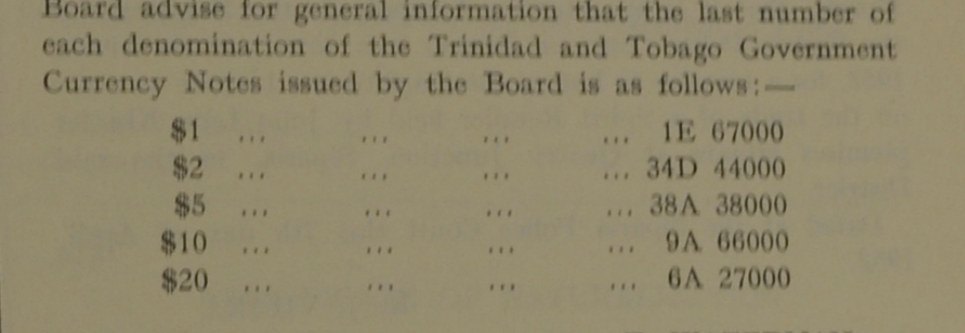
The list matters because the catalogue records prefixes above those numbers, and knows them only as specimens: the 5 dollars of 1942 up to 56A, the 2 dollars of 1949 up to 36D, the 20 dollars of 1943 up to 11A. On the 10 dollars the 1942 prefixes above 9A, up to 14A, and the 1943 prefix 16A were probably printed but not issued, and the 1943 date is so far known only from specimens. The 1 dollar specimen dated 1st July 1948 carries 85D, the first prefix of the 1949 issue.
The Currency Board takes over, 1951 to 1955
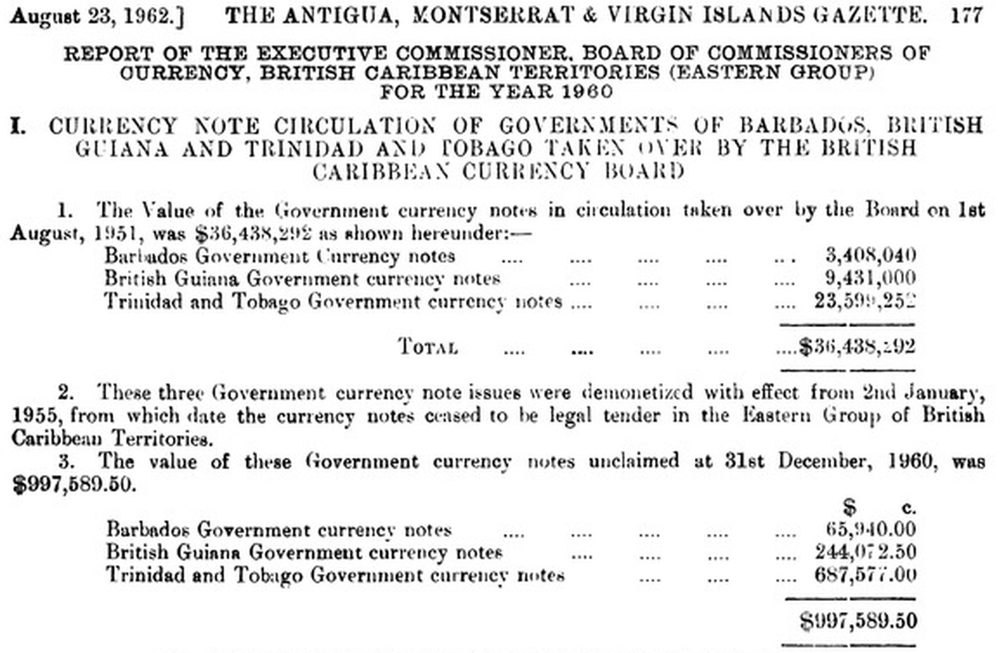
In 1951 the British Caribbean Currency Board took over the issue. Notice 2065 in the Royal Gazette of 21st December 1950 says the Board was constituted by the Secretary of State on 28th November 1950, with Robertson as the member for Trinidad. The Currency Board's report for 1960 gives 1st August 1951 as the day it took over the Government notes. The Trinidad and Tobago Government notes were demonetised with effect from 2nd January 1955, by notice 1222 in the Royal Gazette Extraordinary of 31st December 1954, and their value could still be claimed afterwards.
Heritage (8 March 2024, lot 24549) dates the currency union to 1950; the Board was constituted in 1950 and took over the Trinidad issue in 1951.
What was never handed in
The Currency Board's report for 1960 puts the Trinidad and Tobago Government notes it took over on 1st August 1951 at 23,599,252 dollars. The colony's annual reports and the Board's statements show how fast they came in, and how much stayed out.
| Date | Government notes still out | Source |
|---|---|---|
| 1st August 1951 | 23,599,252 dollars | Currency Board's report for 1960 |
| End of 1951 | 6,064,852 dollars | Annual report of the colony |
| End of 1952 | 2,356,287 dollars | Annual report of the colony |
| 1st January 1955, the day before they were demonetised | 1,282,489 dollars | The Board's statement |
| 1st June 1955 | 979,390 dollars | The Board's monthly statement, Grenada Government Gazette, 25th June 1955 |
| End of 1960 | 687,577 dollars | Currency Board's report for 1960 |
| 1st November 1963 | 666,818 dollars | The Board's statement, Grenada Gazette, 30th November 1963 |
| 31st December 1968 | 651,667 dollars | Trinidad and Tobago Gazette, 17th July 1969 |
By the last date the Central Bank of Trinidad and Tobago had taken over the duty of paying them. The Board's monthly statement for 1st February 1965, as printed in the Saint Vincent Gazette, shows nil for Trinidad and Tobago, with the liability assumed by the Central Bank at 14th December 1964. The figures are values, not numbers of notes; the pages do not give the division among the five values.
Stack's Bowers, in its description of lot 20820 of 2 October 2024, offers one reason for what survives abroad: servicemen stationed in Trinidad in the war took 1 dollar notes home, and sometimes 2 or 5 dollars, but not the 10 and 20 dollars. That is the house's reading, not a count.
Not settled: Wright or Skinner
The left-hand signature of the 1st July 1948 notes is the same as on the notes of 1942 and 1943, which the catalogue gives as Wright's. Andrew Barkworth Wright, the Colonial Secretary, had left Trinidad in 1947. By the Year Books, the Board from the early 1940s was no longer the Colonial Secretary and the Treasurer but the Financial Secretary, the Accountant General and the non-official member. The Accountant General through those years was Robert Burnell Skinner, and Blache-Fraser, who followed Skinner in that office, signs in the same place in 1949. So the signer of 1942 to 1948 may be Skinner, not Wright. The question is open on the page of the 1 dollar.
Sources
- Government Currency Notes Ordinance, 1934 (No. 40 of 1934; Chapter 35 No. 2 in the revised laws).
- Year Books of Trinidad and Tobago, as cited on the catalogue's pages.
- Annual reports of Trinidad and Tobago for 1951 and 1952, and of Grenada, St Lucia and St Vincent, as cited on the catalogue's pages.
- Trinidad Guardian, 28th and 29th July 1944, police notice.
- Report of the Executive Commissioner of the British Caribbean Currency Board for 1960; the Board's statements for 1st January 1955, 1st June 1955 (Grenada Government Gazette, 25th June 1955), 1st November 1963 (Grenada Gazette, 30th November 1963) and 1st February 1965 (Saint Vincent Gazette).
- Trinidad and Tobago Gazette, 17th July 1969, balance sheet of the Central Bank.
- Royal Gazette: the Treasurer's notice on Proclamation No. 75 of 1935 (12th December 1935); Proclamation No. 25 of 1943 (3rd June 1943); the Ordinance of 1934 in the supplement of 20th December 1934; notice 2065 of 21st December 1950 constituting the Board; notice 662 of 10th April 1952; notice 1222 in the Royal Gazette Extraordinary of 31st December 1954.
- Heritage, 21 April 2022, lot 25258; 10 November 2023, lot 24674; 8 March 2024, lot 24549.
- Stack's Bowers, 13 January 2024, lot 60491; 2 October 2024, lot 20820; 29 August 2025, lot 30336.


Member comments
Log in or register to post a comment.