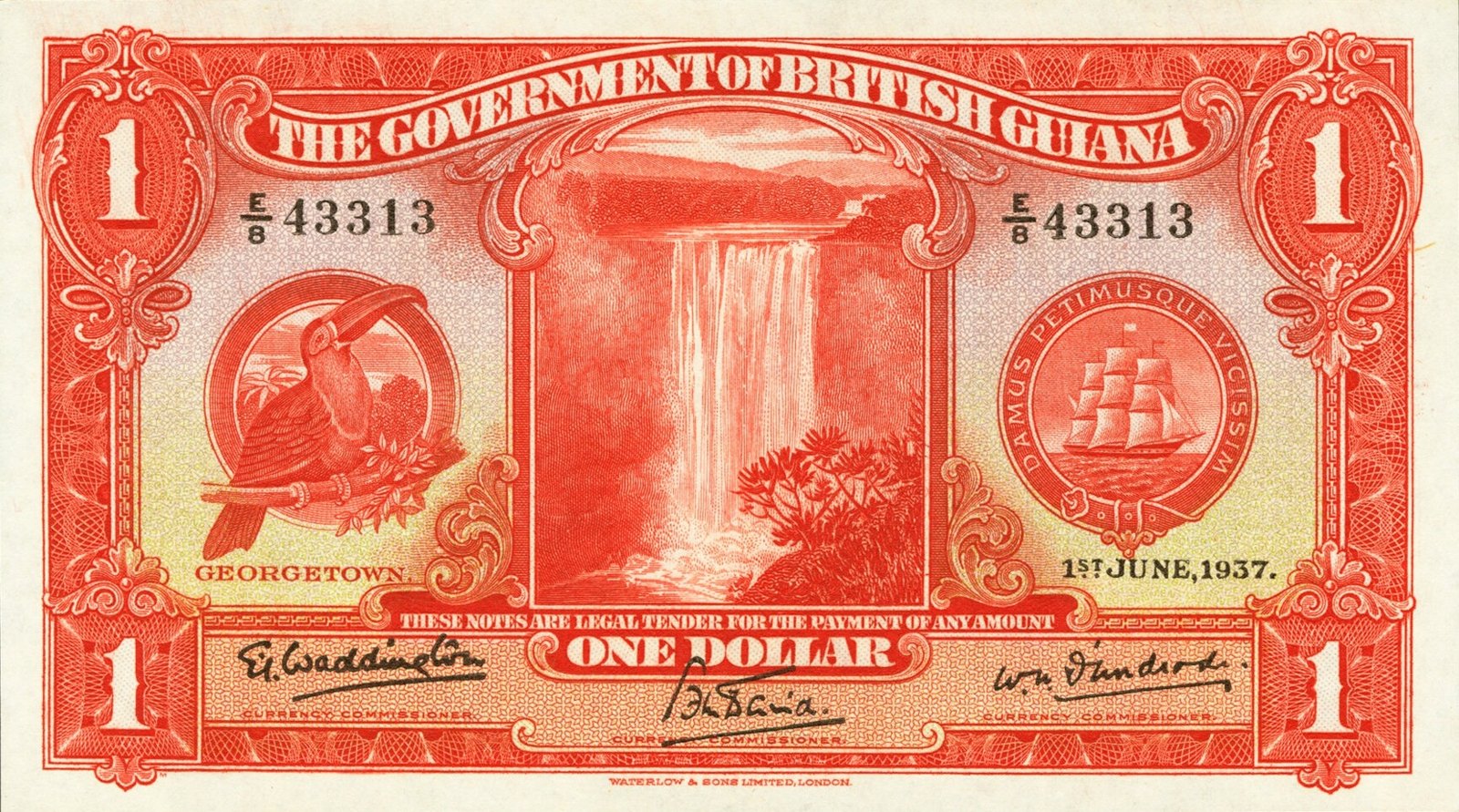
This article lists in order of time the laws of British Guiana that touched its paper money, as far as the sources read for the catalogue name them, and says what each one did. The laws of 1933 to 1965 were read in the copies kept among the papers of the Parliament of Guyana, with the minutes and order papers that show their stages; the earlier ones are known from Chalmers' History of Currency in the British Colonies (1893), the gazettes held in the Johns Hopkins currency board archive and the annual reports. The notes themselves are told in The Government notes of British Guiana, 1916 to 1955; the laws of the Currency Board as they touched all five territories are in The British Caribbean Currency Board and its notes, 1950 to 1968.
The laws at a glance
| Law | Dates | What it did for the notes |
|---|---|---|
| Ordinance No. 82 of 1836 | 1836; amended by No. 9 of 1838; continued by No. 6 of 1857 | Set up the British Guiana Bank, which issued notes of 5, 20 and 100 dollars (Chalmers) |
| Ordinance of 10th June 1839 | 10th June 1839 | Paid off the joe notes of Demerara and Essequibo by 1st January 1840, after which they were tender only at the Public Offices (Chalmers) |
| Ordinance of 27th November 1839 | 27th November 1839 | Brought the first day of paying off forward to 2nd December 1839 (Chalmers) |
| Government Currency Note Ordinance, 1915 (No. 16 of 1915) | 30th June 1915; issue approved by the Combined Court on 16th August 1915 | Created the Commissioners of Currency and the Government's 1 and 2 dollars |
| Government Currency Notes Ordinance, 1933 (No. 7 of 1933) | Passed 4th April 1933; assented to 26th April 1933 | Changed the funds behind the notes |
| Government Currency Notes Ordinance, 1937 (No. 14 of 1937) | Assent read as 30th April 1937, the copy of the law dated 1st May 1937; Official Gazette of 1st May 1937 | Put the issue on a permanent footing; the notes of 1937 to 1942 |
| Currency Ordinance, 1950 (No. 20 of 1950) | Assented to 16th June 1950; notes part in force 1st August 1951 | Joined the colony to the British Caribbean Currency Board |
| Currency (Notes) Regulations, 1951 (No. 21 of 1951) | Published 27th July 1951 | Rules for printing and paying out the Board's notes |
| Legal Tender (Jamaica Currency Notes) Ordinance, 1954 (No. 45 of 1954) | Passed 20th December 1954; assented to 23rd December 1954 | Made Jamaica's Government notes legal tender in the colony |
| Government Currency Notes (Repeal) Ordinance, 1956 (No. 20 of 1956) | Passed 17th May 1956; assented to 25th May 1956; effect from 1st August 1951 | Repealed the law of the Government's notes |
| Currency (Amendment) Ordinance, 1956 (No. 28 of 1956) | Passed 27th July 1956; assented to 4th August 1956 | Let the Board issue against the governments' securities |
| Currency Ordinance, 1959 (No. 8 of 1959) | Assented to 8th May 1959 | Enacted the second Currency Agreement |
| Exchange Control (Amendment) Ordinance, 1962 (No. 22 of 1962) | Assented to 14th November 1962 | Exchange control; nothing on the notes themselves |
| Currency Ordinance, 1965 (No. 8 of 1965) | Passed 25th May 1965; assented to 5th June 1965 | Enacted the Agreement that wound up the Board |
| Bank of Guyana Ordinance, 1965 (No. 23 of 1965) | Passed 12th October 1965; assented to 15th October 1965 | Set up the Bank of Guyana and gave it the old notes still unpaid |

The paper of Berbice and of Demerara and Essequibo, and the banks' notes, are told in Before the Government's dollar notes.
1915: the Government's first note law
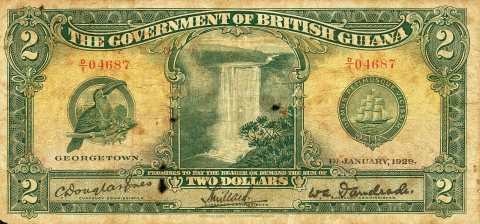
The Government Currency Note Ordinance, 1915 (No. 16 of 1915, of 30th June 1915) made the Government Secretary, the Colonial Treasurer and one other officer named by the Governor the Commissioners of Currency. The first notes under it were the 1 dollar and 2 dollars dated 1st August 1916. It allowed notes of 1 and 2 dollars, and higher values only as the Secretary of State approved. Their form, design, plate, paper and signatures, which might be facsimiles, were also for the Secretary of State to approve, and the notes were legal tender. The Ordinance was to come into force on a day proclaimed after the King had signified that it would not be disallowed. Working paper 247 (WP 247) in the Johns Hopkins currency board archive adds that each note was a promise of the Government to pay the bearer on demand. The annual report for 1922 says the Combined Court approved the issue on 16th August 1915, at 4 shillings 2 pence to the dollar.
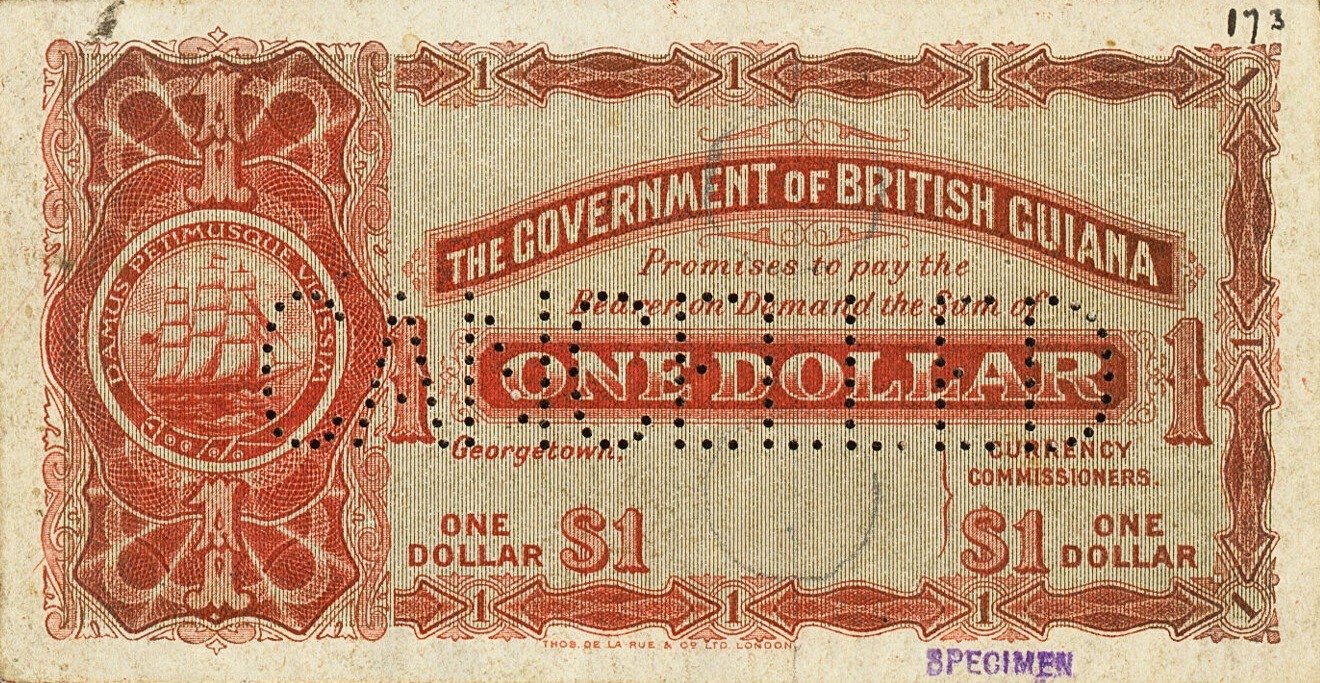
The monthly abstracts of the notes in the Official Gazette from 1923 to 1937 cite section 10 of this Ordinance as their authority; in the revision of the laws in the 1930s it became Chapter 50.
1933: the funds behind the notes
The Government Currency Notes Ordinance, 1933 (No. 7 of 1933) amended Chapter 50. It was passed by the Legislative Council on 4th April 1933, a date read from a weak text layer, and assented to by Governor Denham on a day written by hand and read as 26th April 1933. It had no section on its coming into force. It merged the depreciation fund into the note guarantee fund. When the securities of that fund came to more than 110 per cent of the notes in circulation not covered by coin, the Commissioners might sell the surplus and pay it into general revenue; later sales needed the Secretary of State's approval, and earlier payments of the kind were made lawful. It said nothing of legal tender, values, the form of the notes or the signers.

1937: the issue made permanent
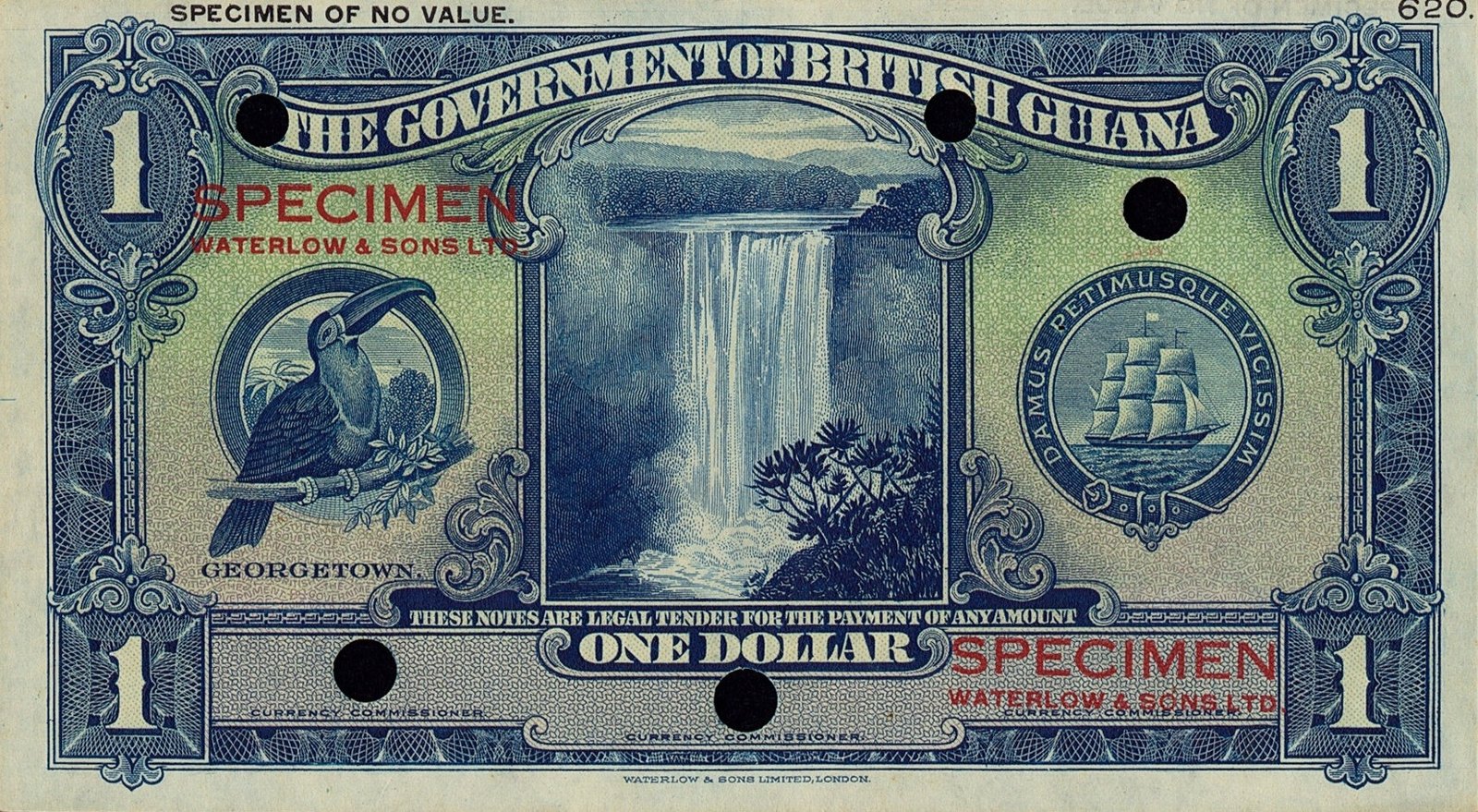
The Government Currency Notes Ordinance, 1937 (No. 14 of 1937) was printed in the Official Gazette of 1st May 1937, pages 1,603 to 1,607. Its day of assent was read as 30th April 1937 in the Gazette, while the copy of the law in the Johns Hopkins currency board archive is dated 1st May 1937; the point is not settled. It repealed Chapter 50 and the Ordinance of 1933, to put the issue of notes "on a permanent basis". The Commissioners were now the Colonial Secretary, the Colonial Treasurer and one other public officer named by the Governor. The values and design were for the Secretary of State; the notes were issued at one dollar for 4 shillings 2 pence against sterling. It set up a Note Security Fund, let the Governor demonetise notes by proclamation, the holders still being paid by the Colonial Treasurer, and counted the notes already out as issued under it. By 1956 it was cited as Chapter 284 of the revised laws. The notes issued under it are the 1 dollar and 2 dollars of 1937 to 1942 and the 5 to 100 dollars of 1938 and 1942.
The annual report on British Guiana for 1946, read in the text layer only, says the notes of Trinidad, Barbados and British Guiana were made legal tender in each other's colonies from 1941. The British Guiana law for it is not among the papers read.
1950 and 1951: the Currency Board
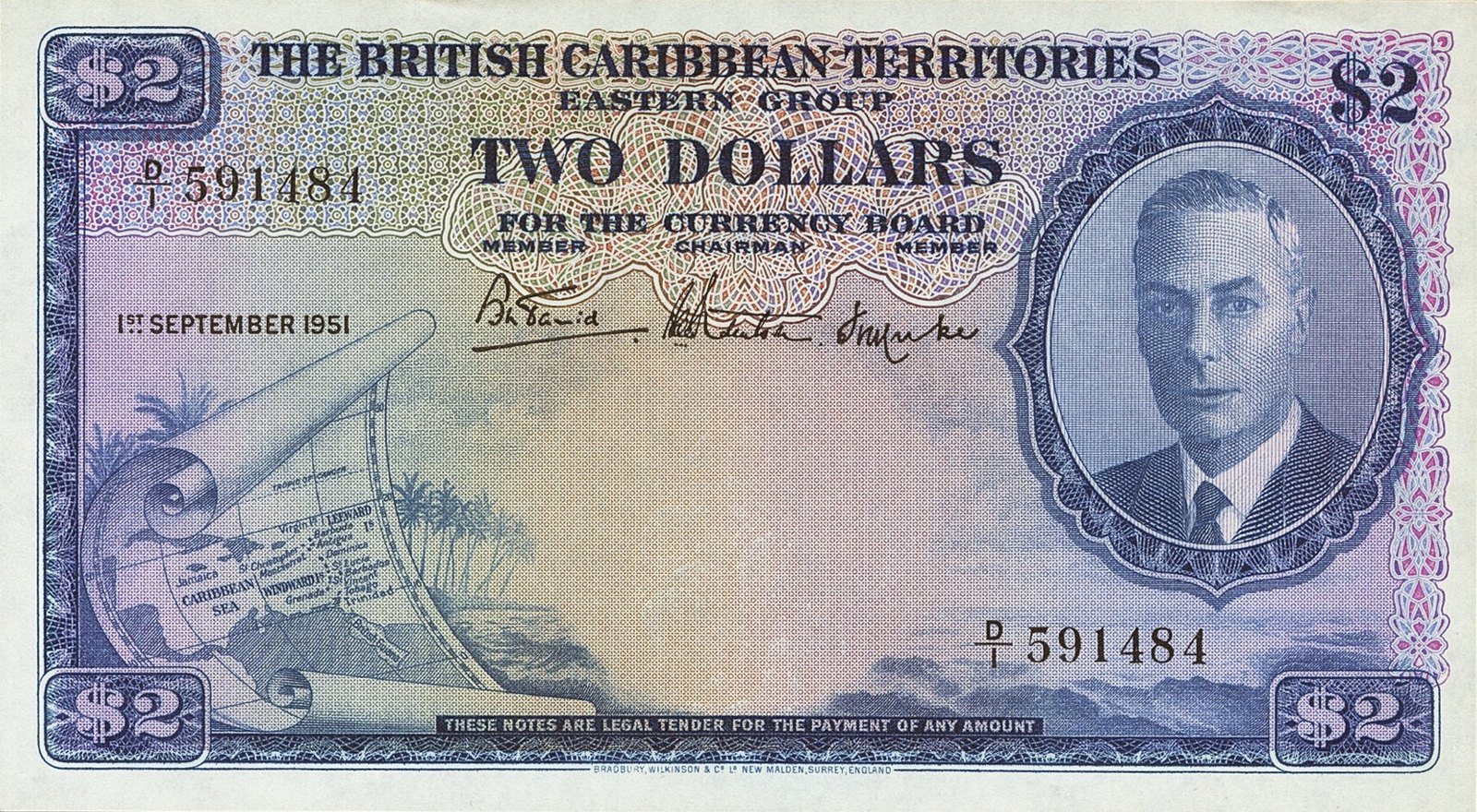
The Currency Ordinance, 1950 (No. 20 of 1950) was assented to by Governor C. C. Woolley on 16th June 1950. Its preamble names the Currency Conference held at Barbados in May 1946. It gave the force of law to the Agreement of Barbados, British Guiana, the Leeward Islands, Trinidad and Tobago and the Windward Islands, printed as its First Schedule, and left its coming into force to a proclamation, separately for notes and for coin (section 15). For British Guiana's own notes it said four things:
- From the day the part on notes came into force the Board alone might issue notes in the colony; the colony's Commissioners of Currency could issue no more, and no banker could issue bank notes (section 4(1)), saving any rights of Barclays Bank (section 13).
- The Government notes issued under the Ordinance of 1937 were deemed issued under the new law (section 4(2)) and stayed legal tender.
- The Board took over the Government's liability for those notes, and the colony handed over sterling or investments from its Note Security Fund to match (Article 2(2) of the Agreement).
- The colony was to demonetise its notes, help the Board withdraw them, and in due course repeal the Ordinance under which they were issued (Article 2(3)).
The Official Gazette of 28th July 1951 printed the proclamation that brought the part on notes into force on 1st August 1951. The same Gazette carried the Currency (Notes) Regulations, 1951 (No. 21 of 1951, pages 187 and 188), made after consulting the Board: the plates were to be made by a person chosen by the Crown Agents and kept by them, the notes printed under their supervision, used notes re-issued before new ones, and new notes issued, as far as possible, in the order of their serial numbers. The Government's notes ceased to be legal tender on 2nd January 1955 by proclamation of the Governor under section 9, as the Board's audit report says (Grenada Government Gazette, 16th July 1955, page 283); British Guiana's proclamation itself is not among the pages read.
1954: Jamaica's notes
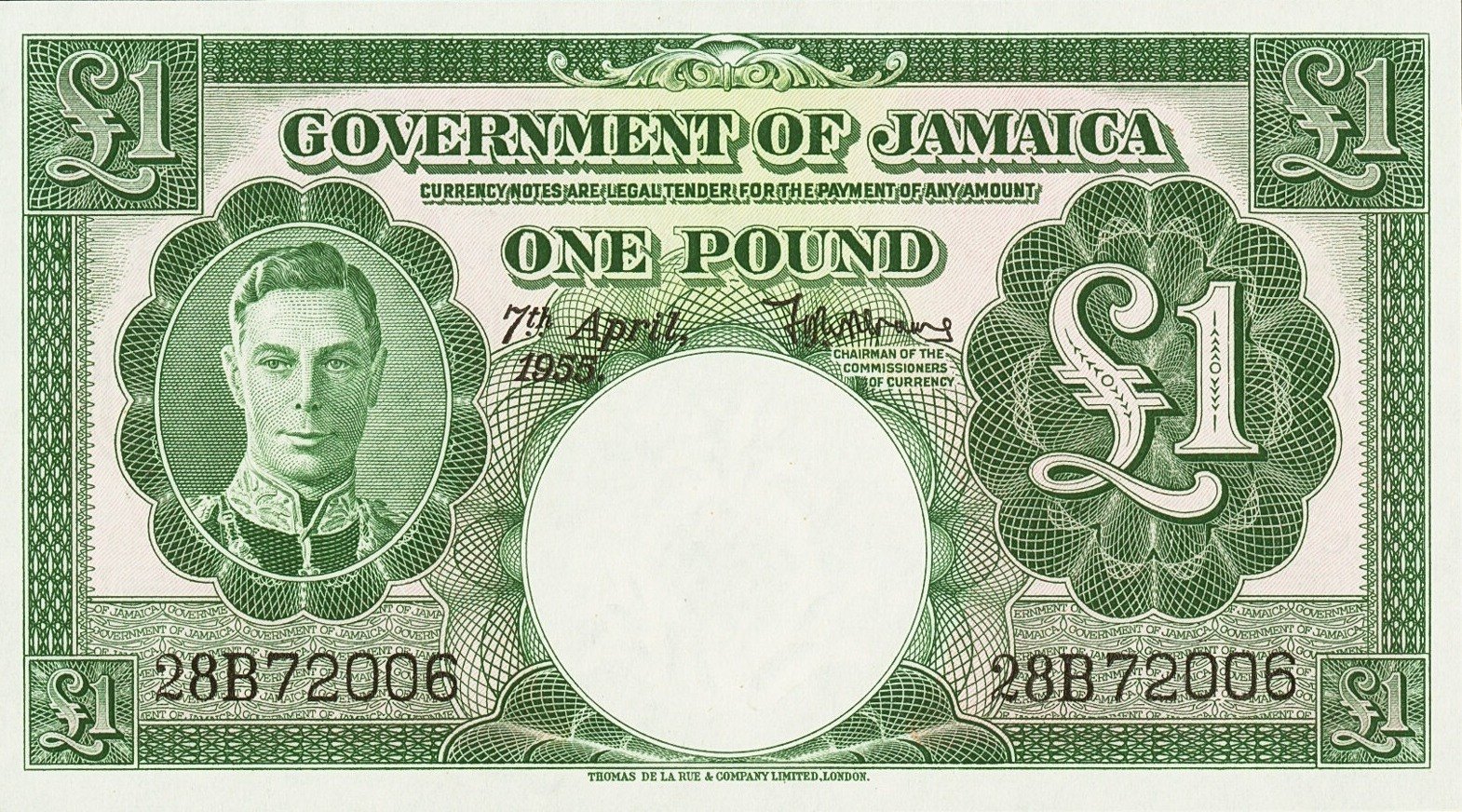
The stages of the Legal Tender (Jamaica Currency Notes) Ordinance are in the minutes of the Legislative Council. The Bill (No. 58 of 1954) was published on 11th December 1954. The Financial Secretary gave notice of it on 16th December, it was read a first time on 17th December, and on 20th December it was read a second time and passed, with an amendment adding a second subclause to clause 2: Jamaica's notes were to count at one pound for 4 dollars 80 cents. Governor Alfred Savage assented on 23rd December 1954 (Ordinance No. 45 of 1954). It made every note that was legal tender in Jamaica legal tender in British Guiana for any amount, from a day to be proclaimed. The Board's audit for 1955 says Jamaica's notes were legal tender from 1st October 1955 by proclamations made in Trinidad, British Guiana and Dominica. The minutes give no reason for the law.
1956: the old law repealed
The Bill to repeal the Government Currency Notes Ordinance and wind up the Note Security Fund (No. 24 of 1956) was published on 28th April 1956. The Financial Secretary gave notice on 3rd May 1956, and its first reading was set down for 10th May. It was passed on 17th May and assented to by Governor Renison on 25th May 1956 (Ordinance No. 20 of 1956). It repealed Chapter 284 (section 2), moved all the money of the Note Security Fund into general revenue, anything once payable from the Fund now to be paid from revenue (section 3), and was deemed to have come into force on 1st August 1951 (section 4). Its preamble cites Article 2(3) of the Agreement of 1950.
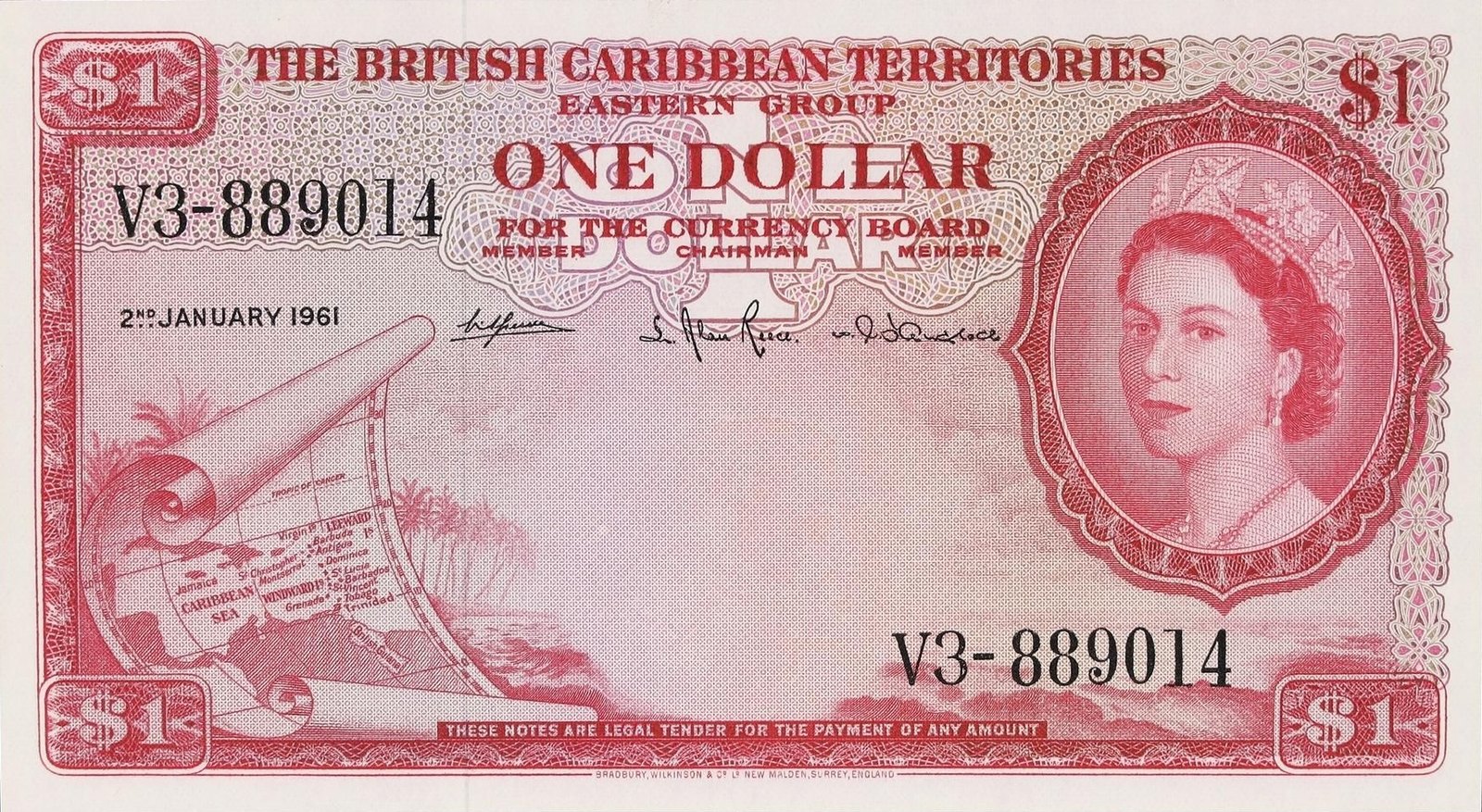
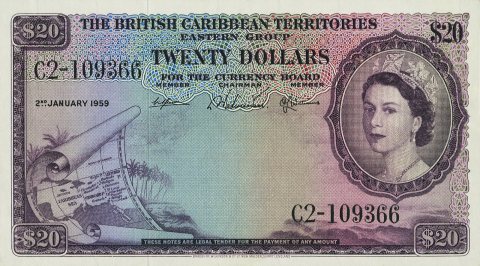
The Currency (Amendment) Ordinance, 1956 (No. 28 of 1956), passed on 27th July and assented to on 4th August 1956, let the Board issue notes against securities of the member governments, up to the dollar value of 2,500,000 pounds of its Currency Fund. It changed the backing of the notes, not the notes.
1959: the second Agreement
The Currency Bill of 1959 was published on 7th March 1959 and read on 10th and 25th March; Governor Renison assented on 8th May 1959, the printed "April" struck out and "May" typed over (Ordinance No. 8 of 1959). It enacted the Agreement of 28th January 1958, which Renison had signed for British Guiana on 16th December 1957, deemed to run from 1st July 1956, and repealed the law of 1950 (Chapter 283). It kept the six values, made the notes legal tender for any amount, wrote Jamaica's notes into the main law at 4 dollars 80 cents to the pound, and kept the Governor's power to demonetise, the holder always being able to claim face value from the Board (section 10). The colony's annual report for 1959 describes it as consolidating the law in line with the other territories.
1962: exchange control
The Exchange Control (Amendment) Ordinance, 1962 (No. 22 of 1962) passed the Legislative Assembly on 16th October and the Senate on 22nd October, and was assented to by the Acting Governor, O. A. Murphy, on 14th November 1962. It took the "scheduled territories" wording out of the Exchange Control Ordinance, 1958, as it applied to British Guiana, struck out the words "sterling or" and defined foreign currency as any currency other than that whose notes and coins were legal tender in the colony. It says nothing of the notes, but the Board's statement of 1st February 1964 blamed British Guiana's exchange control for notes carried by travellers out of the colony since 1962. The report of the inquiry into the disturbances of February 1962 says the Government had suspended the convertibility of the dollar into sterling in December 1961 without first consulting the Board.
1965: the end of the Board and the Bank of Guyana
The Currency Ordinance, 1965 (No. 8 of 1965) passed the House of Assembly on 25th May 1965 and was assented to by Governor Richard E. Luyt on 5th June 1965; the date printed under its title, 5th May 1965, is probably a misprint for the day of assent. It enacted the British Caribbean Currency Agreement made at Port of Spain on 12th December 1964. Any further notes were to be of the same form and design, from the same plates and on the same paper as those already in circulation in the colony (section 4(1)). Under Article 12 the liability for the old Government notes still outstanding in the Board's books went back to the colony on the day its own currency authority began to issue, with sterling to match. The copy read lacks printed pages 20 and 21, so sections 7 to 11 were not read.
The Bank of Guyana Ordinance, 1965 (No. 23 of 1965) passed the House of Assembly on 12th October and was assented to by Luyt on 15th October 1965. Its coming into force was left to orders of the Governor. It gave the Bank the sole right to issue notes. The Board's notes were to stay legal tender for a time fixed by the Minister and published in the Gazette, and the Bank was to change them at par for its own, during that time and after it (sections 22(5) and 25). Section 65 made the Bank liable for the Government's own notes still outstanding in the Board's books, against the sterling the Board handed back. Section 67 made lawful the Government's earlier steps, "including the printing of notes", for the notes the Bank was to issue.
What the laws do not say
- None of them names a signer, gives a serial number or a quantity, or shows a note; the design was always for the Secretary of State.
- Most give no day of coming into force and leave it to a proclamation or order; the Ordinance of 1933 has no section on it, and the repeal of 1956 is deemed in force from 1st August 1951. Of the days left to a proclamation, only 1st August 1951 for the notes part of the law of 1950 is known, from the Gazette and from the Ordinance of 1956.
- The law of 1941 that made the three Governments' notes legal tender in each other's colonies has not been read.
Sources
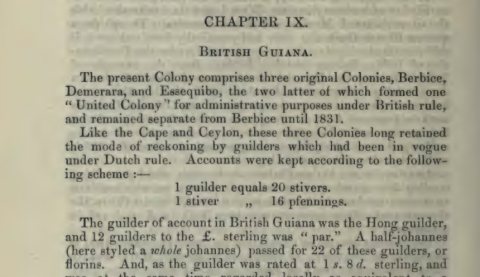
- Robert Chalmers, A History of Currency in the British Colonies (London, 1893), chapter IX, pages 133 to 138.
- Government Currency Note Ordinance, 1915 (No. 16 of 1915), as held in the Johns Hopkins currency board archive; working paper 247 (WP 247) in the same archive, page 3.
- Colonial Reports, Annual: British Guiana, reports for 1922 (No. 1174), page 9; 1946; 1959, chapter VIII.
- Official Gazette of British Guiana: the Government Currency Notes Abstracts, 1923 to 1937; 1st May 1937, pages 1,603 to 1,607; 28th July 1951.
- Ordinances of British Guiana: No. 7 of 1933; No. 14 of 1937; No. 20 of 1950; No. 45 of 1954; Nos. 20 and 28 of 1956; No. 8 of 1959; No. 22 of 1962; Nos. 8 and 23 of 1965, in the papers of the Parliament of Guyana.
- Currency (Notes) Regulations, 1951 (No. 21 of 1951).
- Minutes and order papers of the Legislative Council, 16th, 17th and 20th December 1954; 3rd and 10th May 1956; February and March 1959.
- British Caribbean Currency Board, audit report for 1954 (Grenada Government Gazette, 16th July 1955, page 283); audit report for 1955 (Grenada Government Gazette, 18th August 1956, page 324); statement of 1st February 1964 (Antigua, Montserrat and Virgin Islands Gazette, 2nd April 1964, page 85).
- Report of the Commission of Inquiry into the disturbances in British Guiana in February 1962.
Member comments
Log in or register to post a comment.