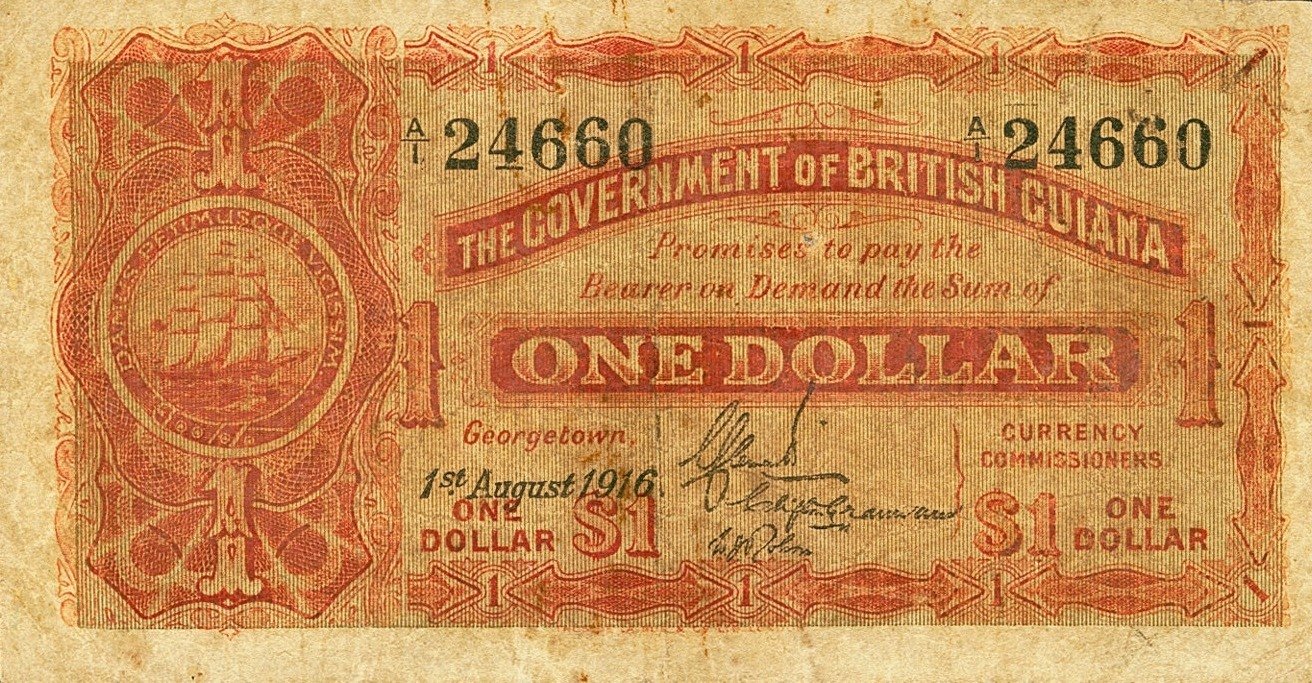
This article sets out the notes of the Government of British Guiana in order of time, from the first 1 and 2 dollars dated 1st August 1916 to the day they ceased to be legal tender, 2nd January 1955. It is drawn from the catalogue pages of the notes and from the sources those pages name: Chalmers' History of Currency in the British Colonies (1893), the annual reports on British Guiana, the colony's Ordinances and Official Gazette, the reports of the British Caribbean Currency Board, and the descriptions of the auction houses, which are given as the claims of those houses.
Before 1916: government paper, then the banks
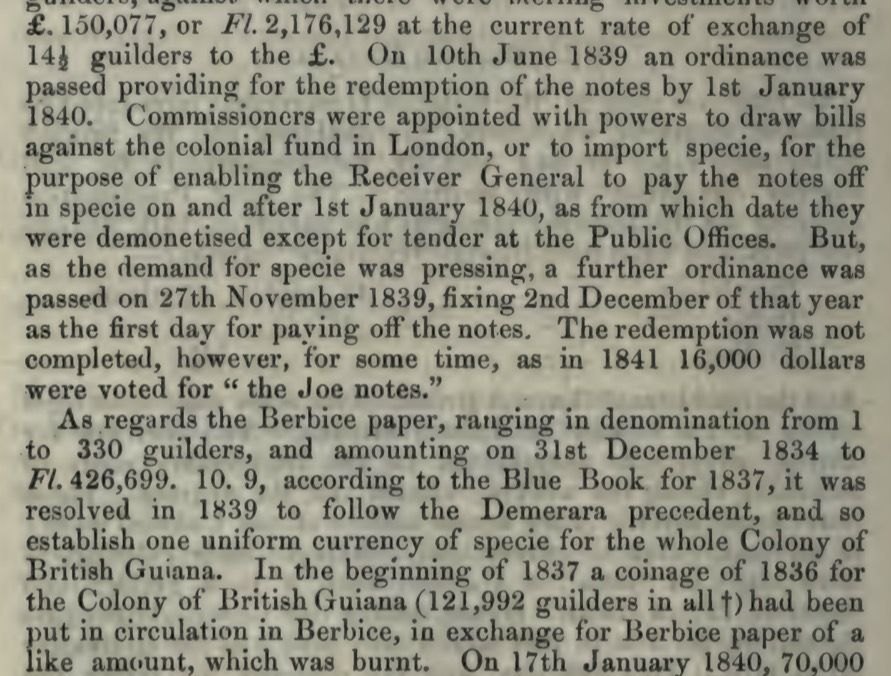
The colony had government paper money long before the dollar notes. Chalmers' History of Currency in the British Colonies (1893), chapter IX, records notes in guilders and "joes" issued by the Court of Policy of Demerara and Essequibo. Chalmers puts them at 75,807 joes, or 1,667,754 guilders, by April 1815, and at 2,199,770 guilders in all after a further issue of 24,182 joes on 22nd March 1825. The notes were of 1 to 20 joes, a joe being 22 guilders, and half-joe notes followed under Ordinances of 1830 and 1832. An Ordinance of 10th June 1839 called the notes in and demonetised them from 1st January 1840, except for payments at the Public Offices. Chalmers says paying off began on 2nd December 1839.
Berbice had paper of its own. Chalmers records a Treasury issue of 80,000 guilders ordered by the Court of Policy on 1st August 1809, in notes of 10 to 500 guilders signed by the two eldest members of the Court, and later notes of 1 to 330 guilders. The Berbice notes were redeemed between 1837 and about 1841. Chalmers prints no picture of any of these notes and names no signer.
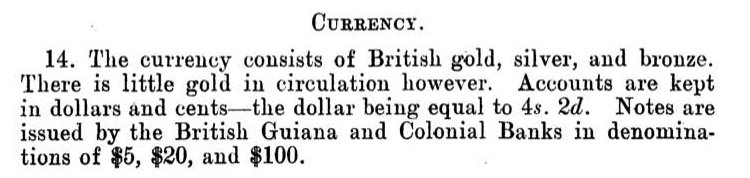
After that the colony's notes came from private banks, from the 1830s on. The pages of the first Government notes give the British Guiana Bank until 1907, the Colonial Bank until 1917 and Barclays Bank from 1926 to 1941, and say the Royal Bank of Canada issued notes in the colony as well. Chalmers says the British Guiana Bank was set up by Ordinance No. 82 of 1836 with notes of 5, 20 and 100 dollars, and gives the notes in circulation on 31st December 1891 as 77,794 pounds for the British Guiana Bank and 57,999 pounds for the Colonial Bank.
One point is not settled. The annual report on British Guiana for 1908-9 still names the British Guiana Bank beside the Colonial Bank as issuing notes, of 5, 20 and 100 dollars, which is later than the year 1907 that the pages give for the end of that bank's notes. The report's sentence may be one carried over from earlier years, and the year 1907 may be the last date printed on the bank's notes. Neither has been checked further.
1915 to 1924: the De La Rue notes of 1 and 2 dollars
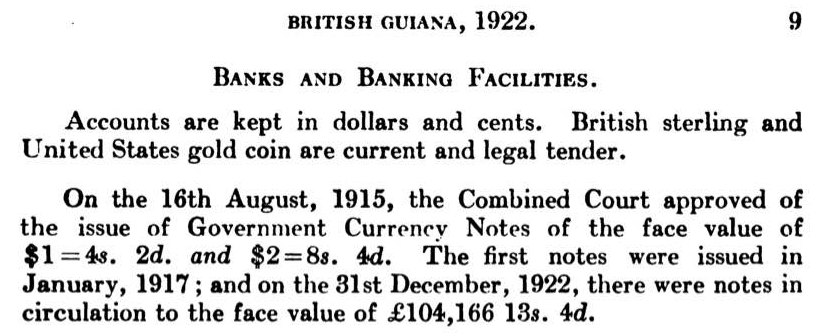
The Government's notes rest on the Government Currency Note Ordinance, 1915 (No. 16 of 1915, of 30th June 1915). The Ordinance named as Commissioners the Government Secretary, the Colonial Treasurer and one other officer chosen by the Governor. It allowed notes of 1 and 2 dollars, and higher values only with the approval of the Secretary of State. The annual report on British Guiana for 1922 says the Combined Court approved the issue of the 1 and 2 dollar notes on 16th August 1915, at 4 shillings 2 pence to the dollar.
The first notes, the 1 dollar of 1916 to 1918 and the 2 dollars of 1916 to 1918, are dated 1st August 1916. The annual report for 1922 says the first notes were issued in January 1917. The date on the notes and the month of issue differ. Thomas de la Rue printed both values. Each carries the colony's sailing-ship seal with the motto DAMUS PETIMUSQUE VICISSIM (we give and seek in return) and the signatures of the three Currency Commissioners. A second date, 2nd January 1918, followed on both values.
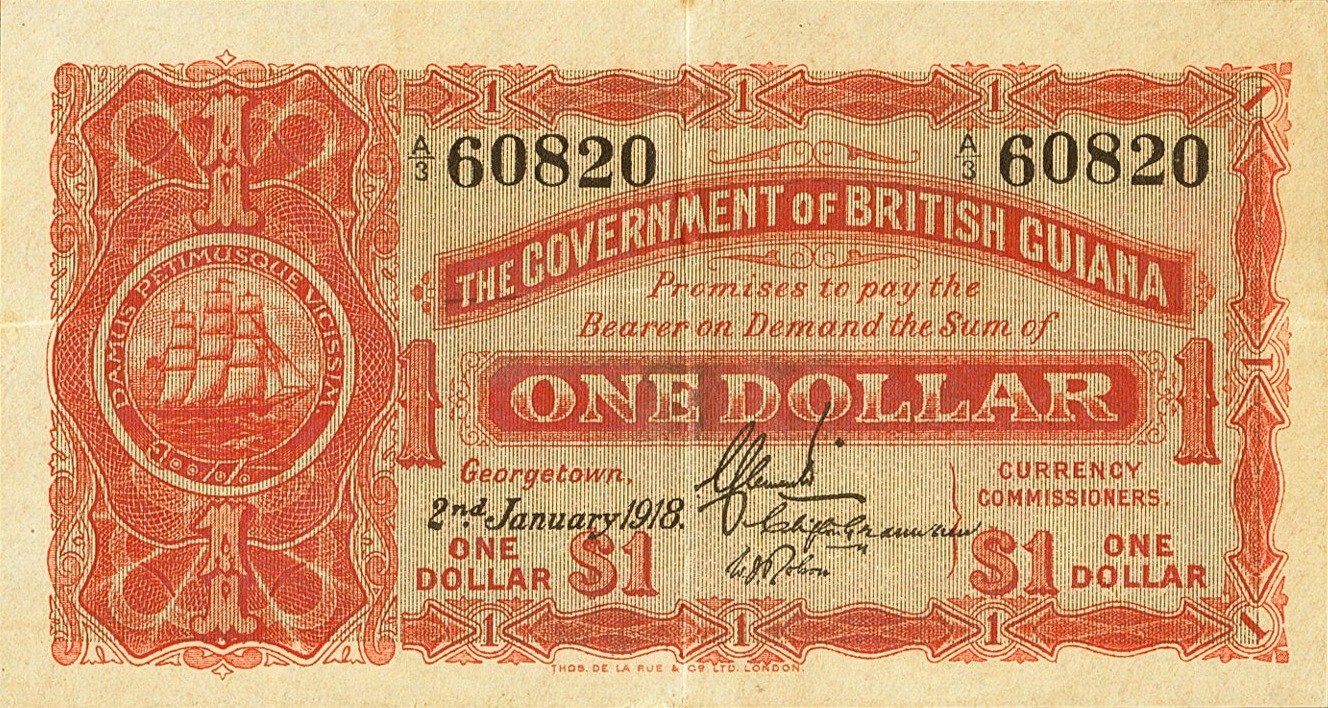
The printings of 1st January 1920 and 1st October 1924, the 1 dollar of 1920 to 1924 and the 2 dollars of 1920 to 1924, are the same designs on larger paper: 150 x 85 mm against 118 x 63 mm for the first 1 dollar and 115 x 73 mm for the first 2 dollars.
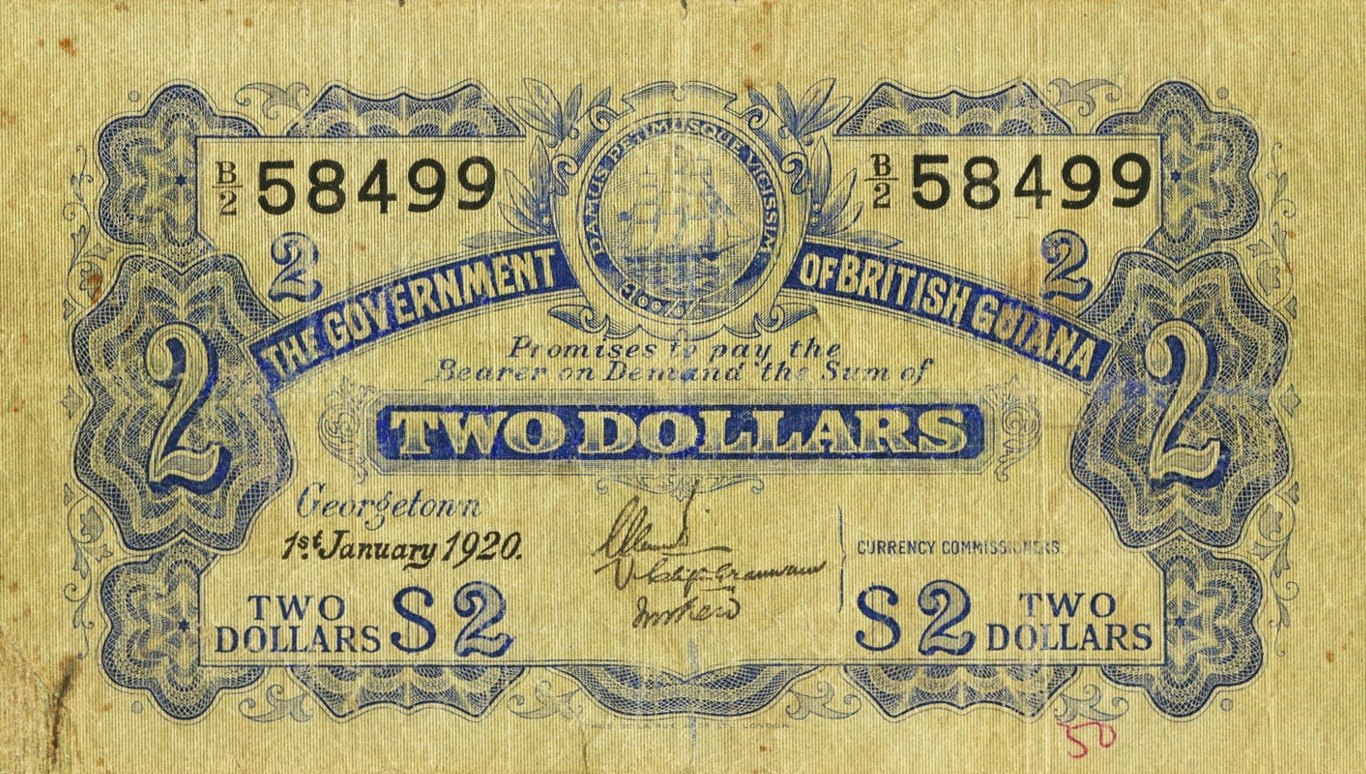
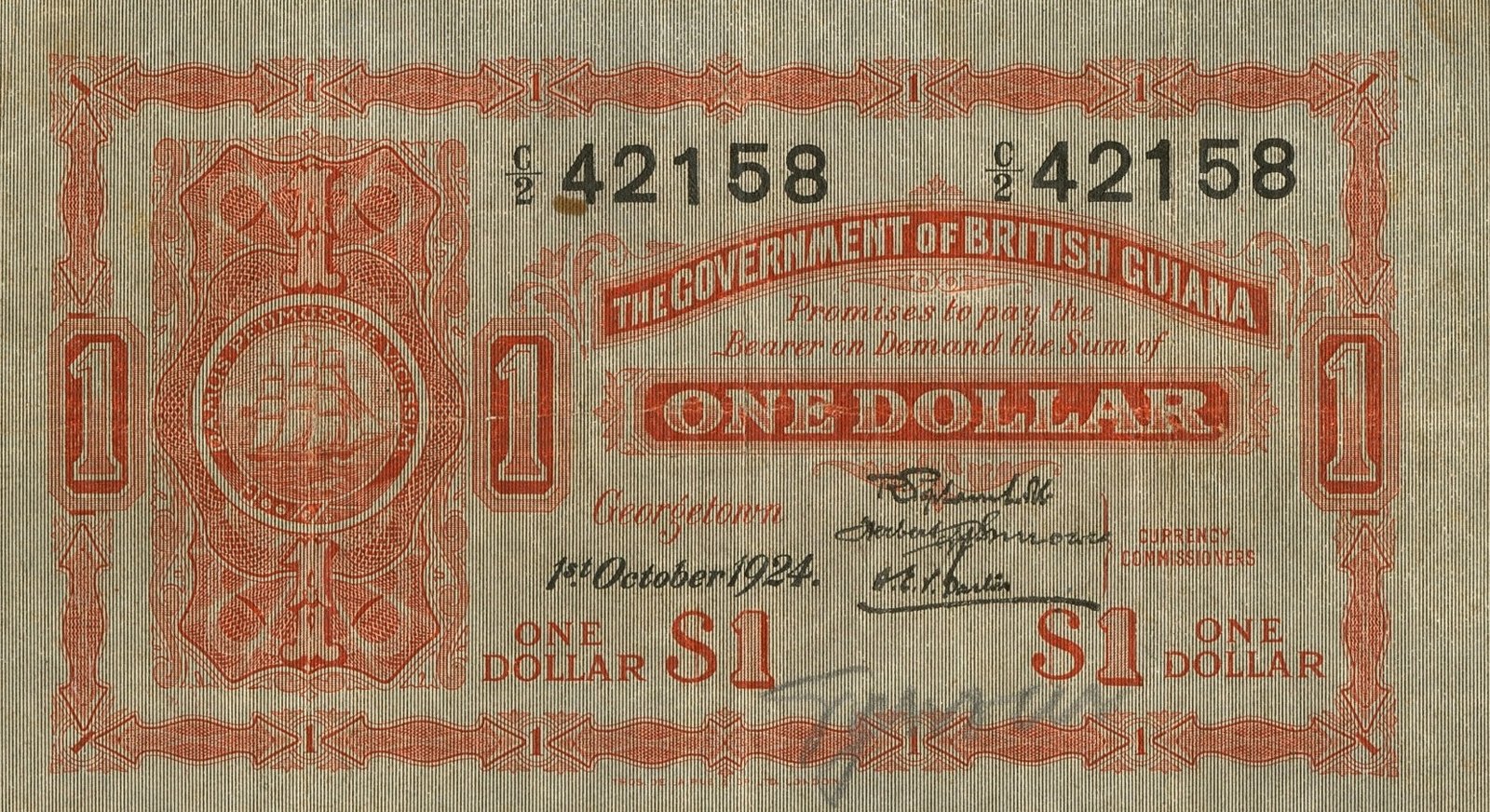
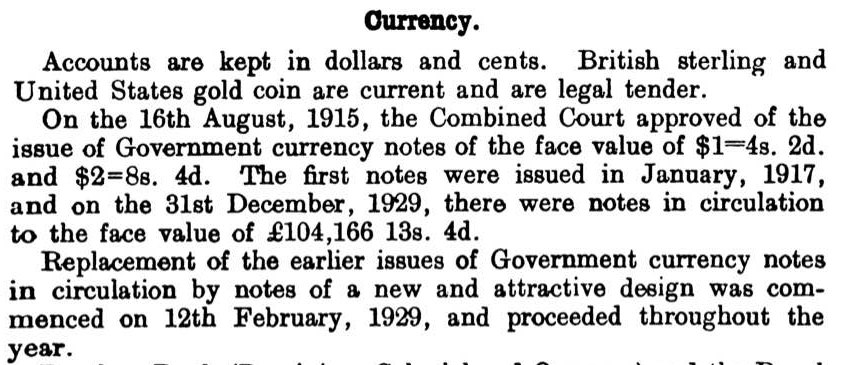
The reports give one figure for these years. The annual reports on British Guiana for 1922, 1928 and 1929 each give the notes in circulation on 31st December of the year as 104,166 pounds 13 shillings 4 pence. The same figure in the three reports is discussed in 12th February 1929: the day British Guiana's new notes came. No report read gives the number of notes printed. Heritage's description of lot 26067 in its sale of 24th April 2020, a 1 dollar of 1st January 1920, says that only 500,000 notes were printed for that date. That is the house's statement, and it names no source for it.
The proofs of 1916 and the design of 1926
Two groups of pieces sold at auction show designs that were not issued. What is said of them here is from the houses' descriptions.
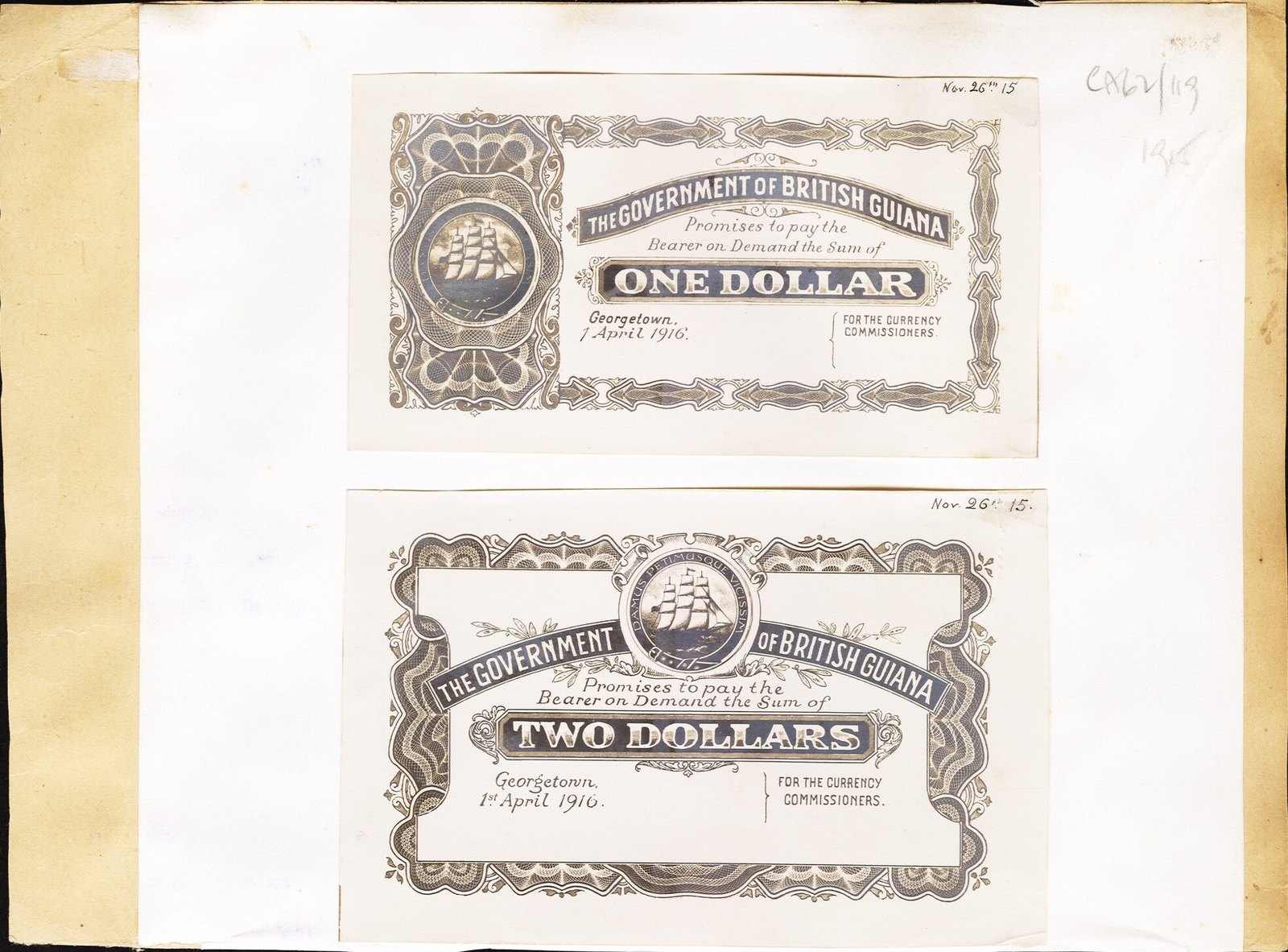
Heritage's description of lot 17145 in its sale of 6th to 10th September 2012 tells of two face proofs of a 1 dollar, each of a different design, mounted on a page from an album, with a printed date of 1st April 1916 and a date of 1915 written in pen. With them were a back proof and a piece of paper with three signatures for use on the notes. No issued note carries the date 1st April 1916.
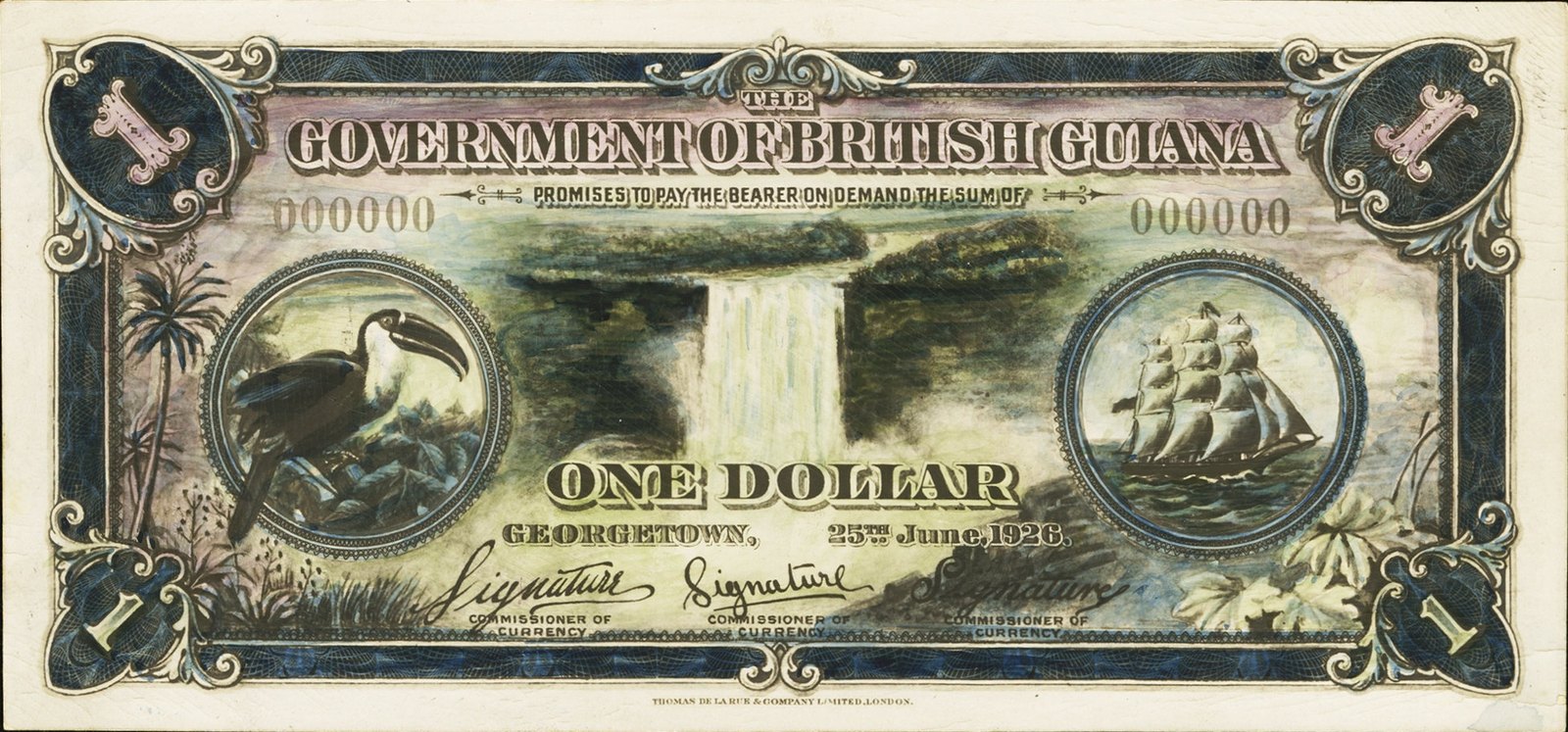
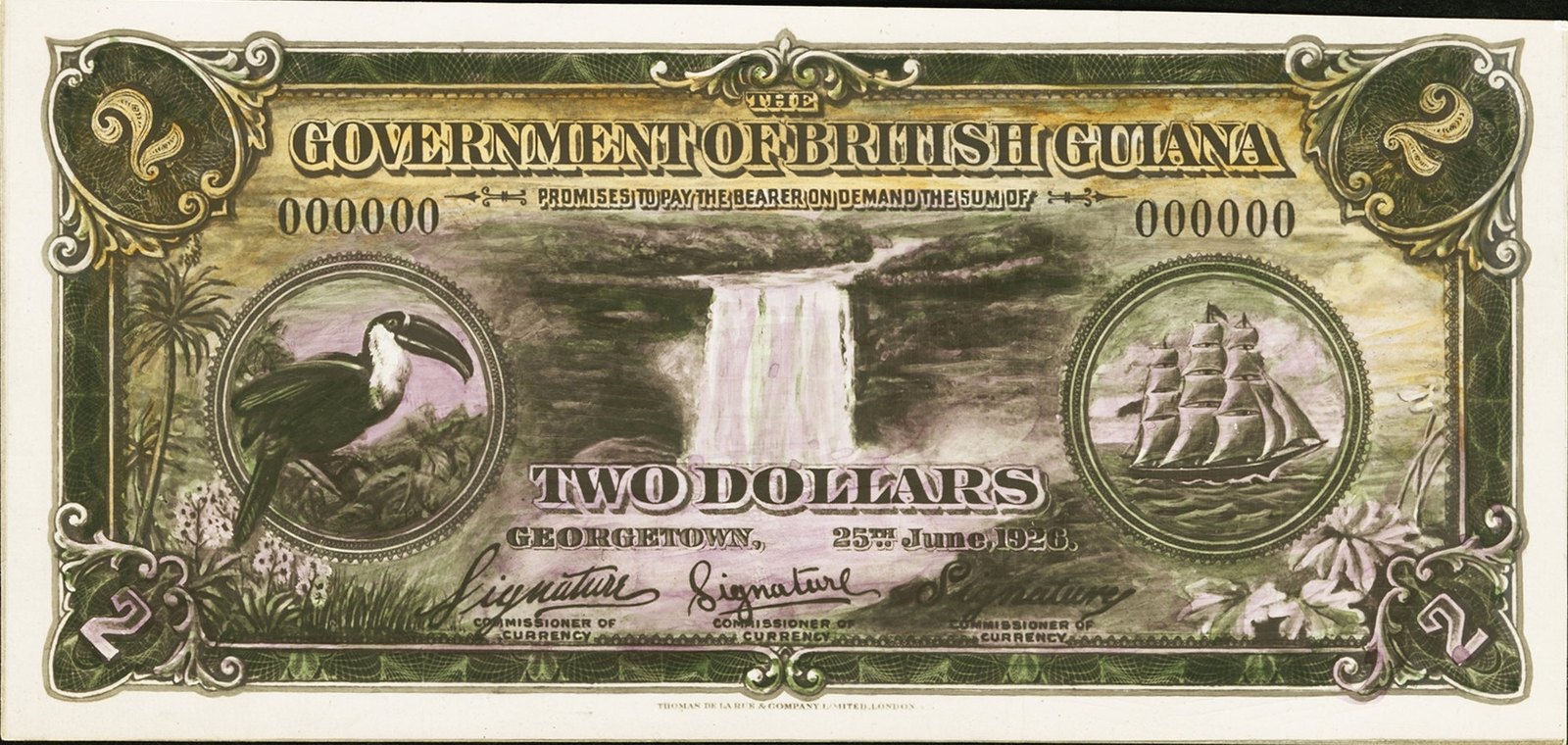
The second group carries the date 25th June 1926. Heritage (6th September 2012, lots 15164 and 15168, and 9th and 13th January 2014, lots 21037 and 21348) and Spink (4th November 2020, lots 110 and 111) describe photographs of a 1 dollar and a 2 dollars with the toucan, Kaieteur Falls and the sailing-ship seal, some left in black and white and some coloured by hand in oils. Spink's descriptions say the back shows the arms at the centre, without the portrait of King George V. Heritage says of the 2 dollars that a stylised word Signature stands where each Commissioner's signature would go. Both houses say the design is close to the notes of 1929. The annual report on British Guiana for 1928 says the change of design was decided during 1927, so the date on these pieces is earlier than the decision as the report tells it. Nothing read explains the date.
1929 to 1936: Waterlow, the toucan and Kaieteur Falls
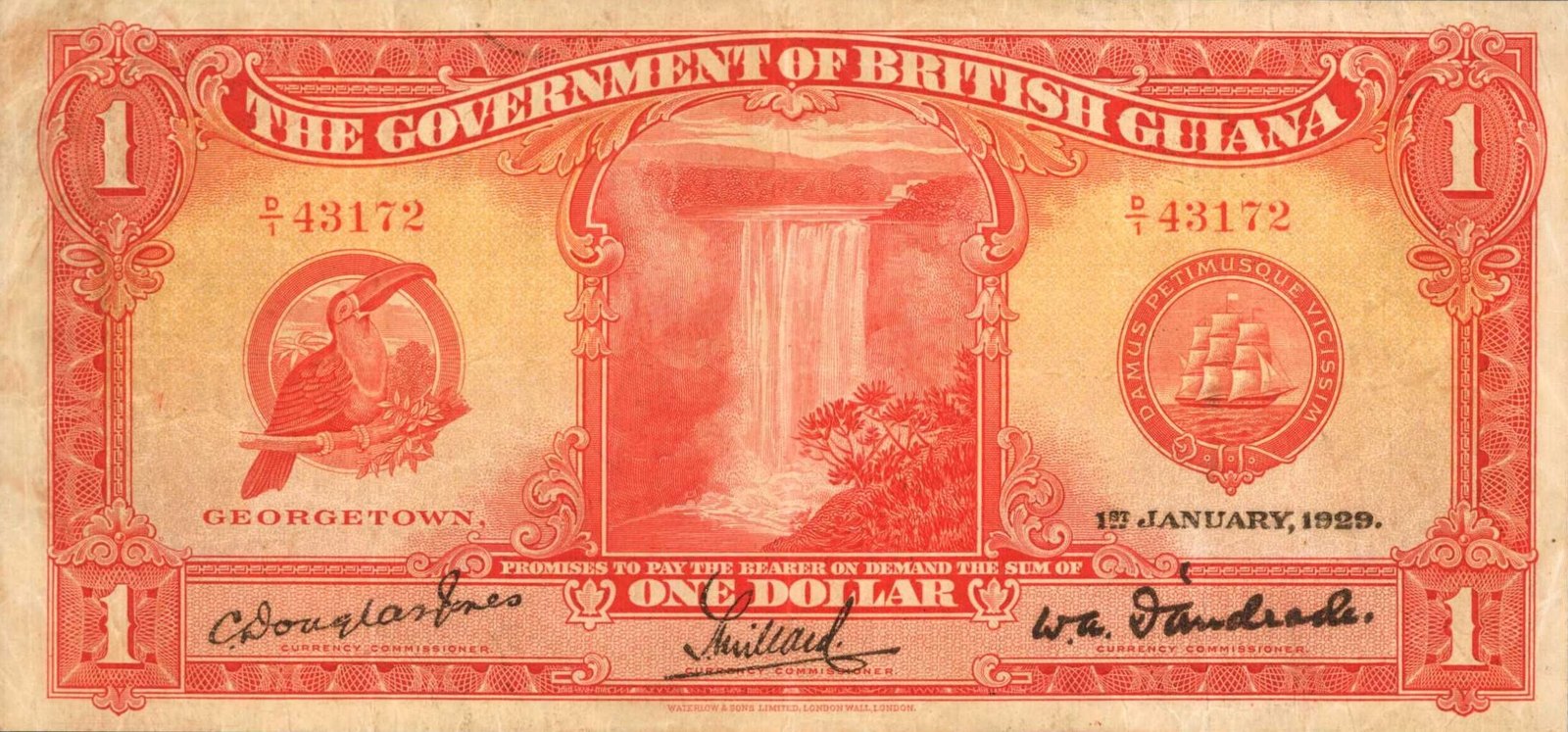
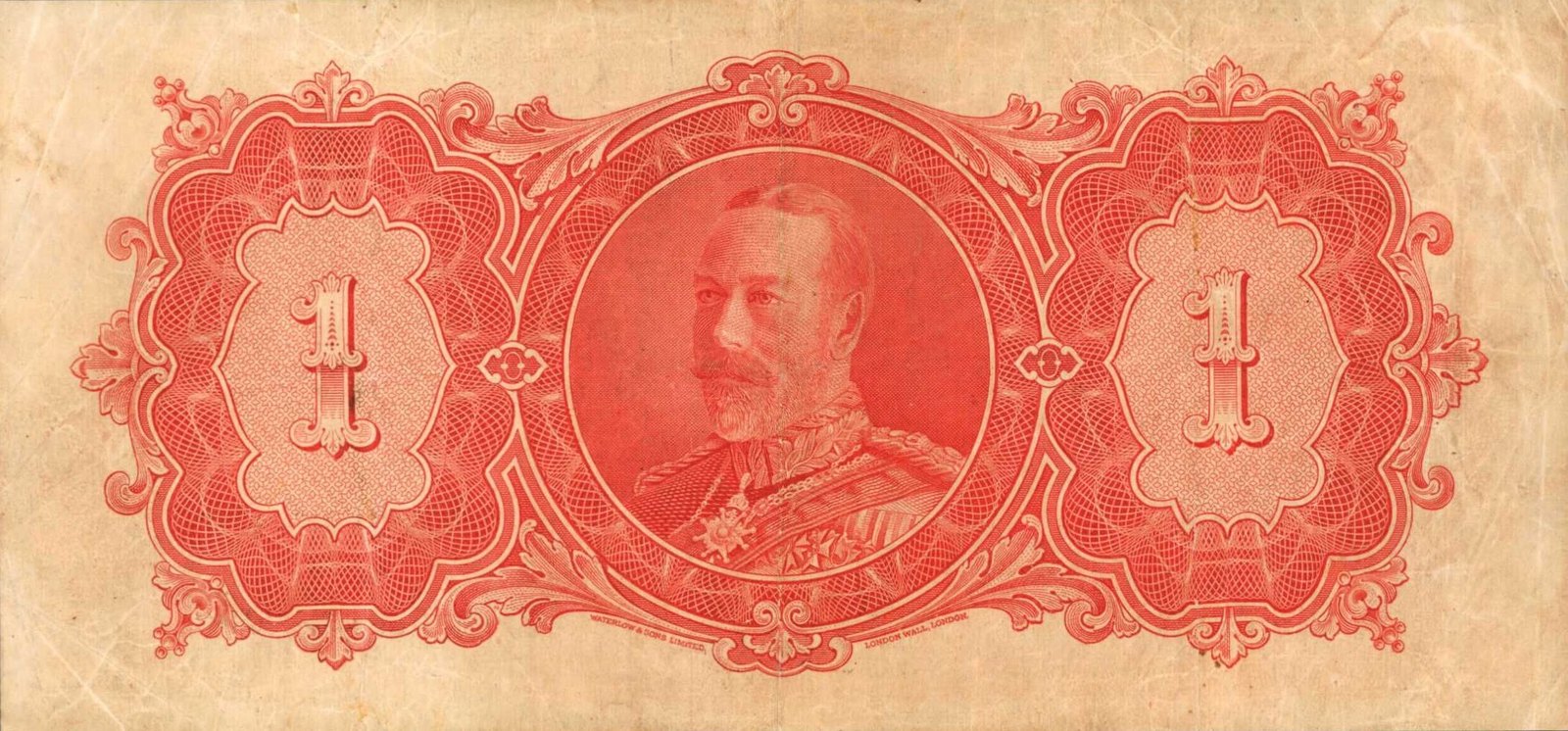
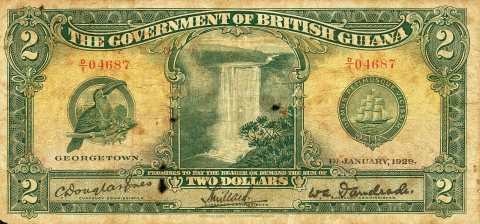
The notes of 1st January 1929, the 1 dollar of 1929 to 1936 and the 2 dollars of 1929 to 1936, were printed by Waterlow and Sons. They add a toucan at the left and Kaieteur Falls at the centre to the sailing-ship seal, and carry King George V on the back. The annual report for 1929 says the replacement of the earlier notes was begun on 12th February 1929 and went on through that year. The reports do not say that the old notes ceased to be legal tender then, and give no last day for the exchange. A second date, 1st January 1936, followed.
One law of these years changed the fund behind the notes and not the notes. The Government Currency Notes Ordinance, 1933 (No. 7 of 1933, assented to on 26th April 1933) merged the depreciation fund into the note guarantee fund and set the cover at 110 per cent of the notes not backed by coin.
1937 to 1942: King George VI and four new values
The notes of 1937 to 1942 repeat the 1929 design on smaller paper, 152 x 82 mm, with King George VI on the back after the abdication of Edward VIII on 11 December 1936. They were issued under the Government Currency Notes Ordinance, 1937 (No. 14 of 1937), printed in the Official Gazette of 1st May 1937. The Ordinance put the note issue on a permanent footing, kept a board of three (the Colonial Secretary, the Colonial Treasurer and one other officer) and made the notes exchangeable for sterling at 4 shillings 2 pence to the dollar. Its day of assent has been read both as 30th April and as 1st May 1937, and is not settled here.
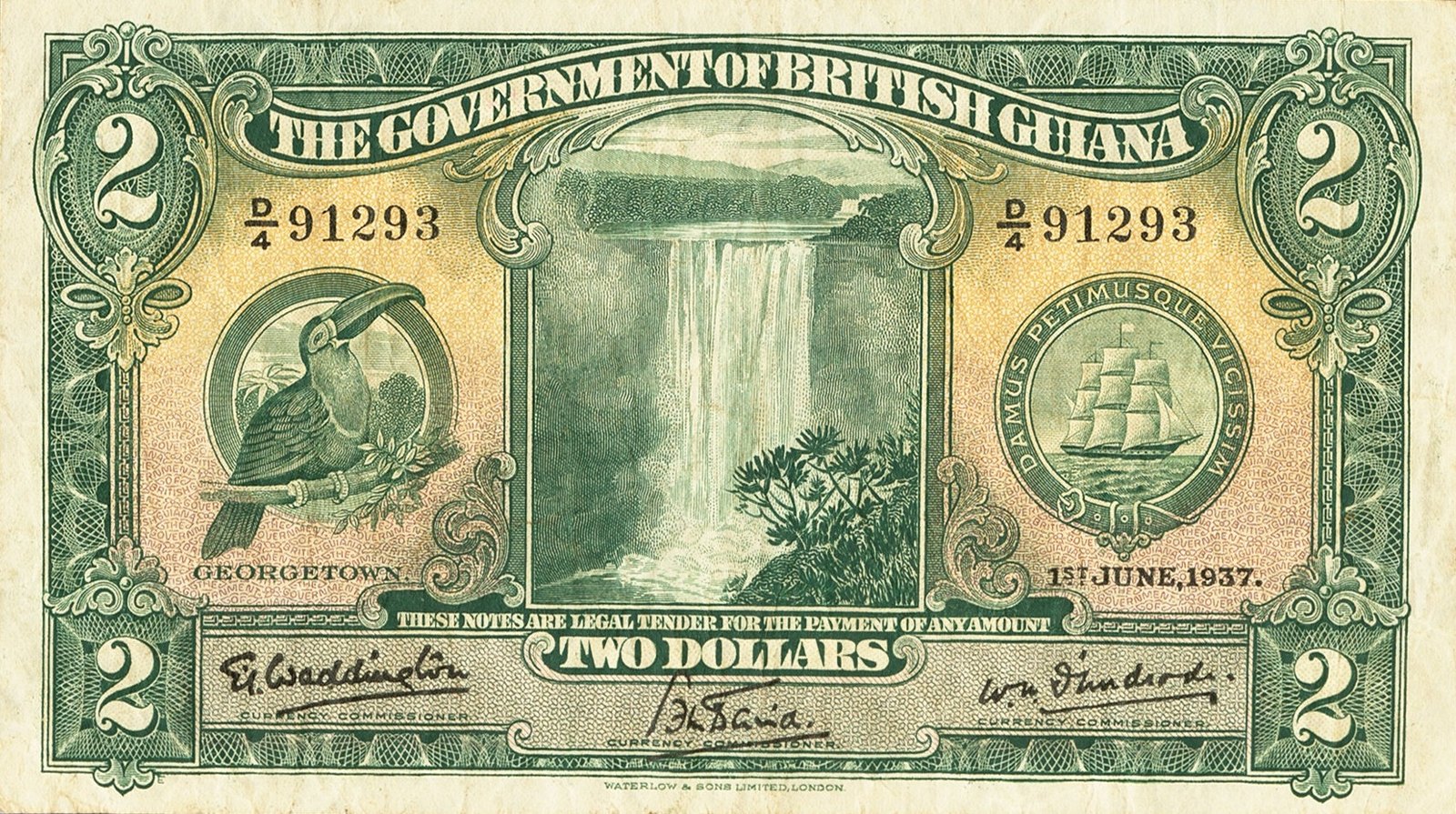
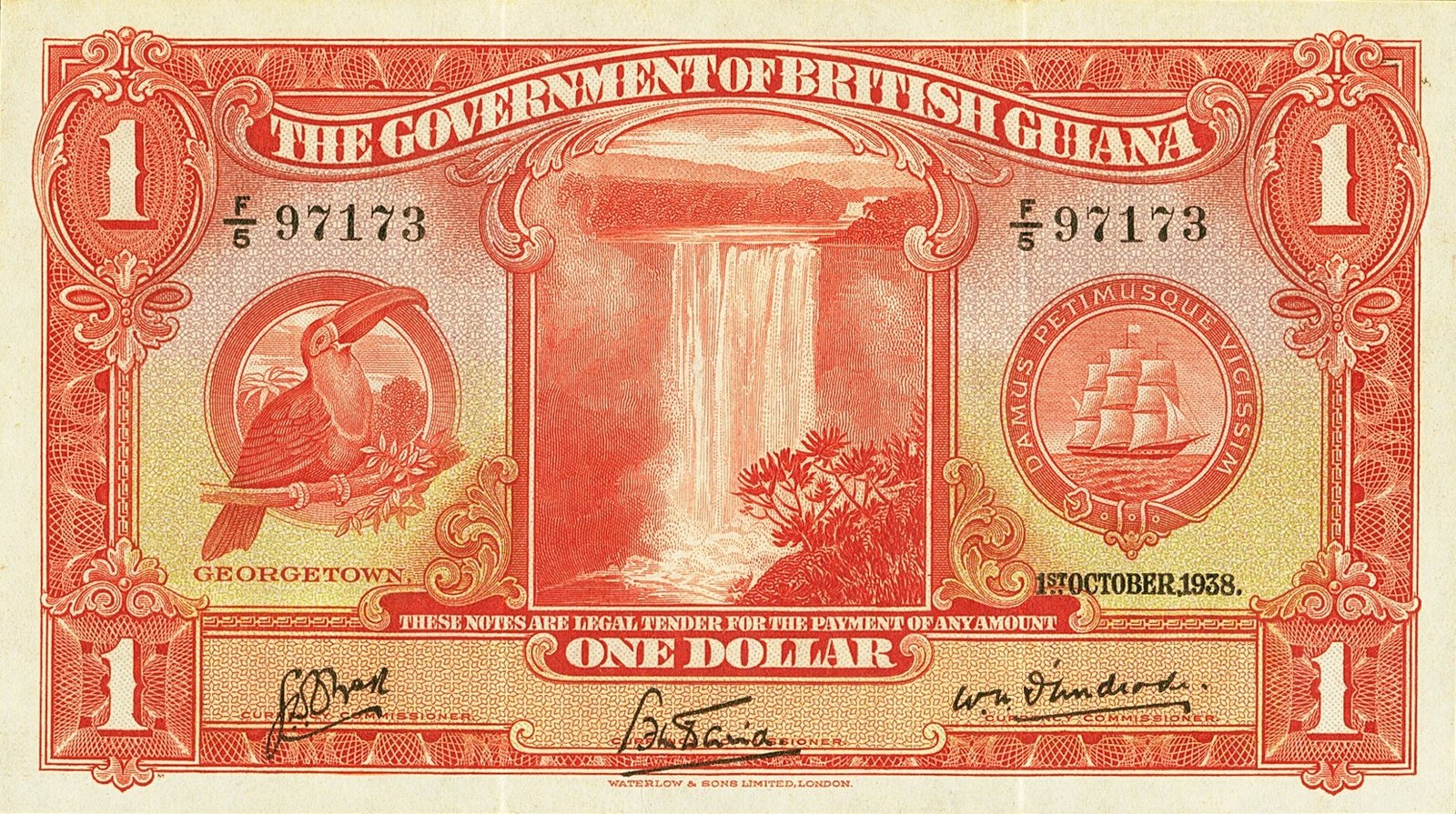
The 1 dollar of 1937 to 1942 and the 2 dollars of 1937 to 1942 each carry three dates: 1st June 1937, 1st October 1938 and 1st January 1942. The 5 dollars was added in 1938 and carries two dates, 1st October 1938 and 1st January 1942. The 10 dollars, the 20 dollars and the 100 dollars were added in 1942 and carry the one date, 1st January 1942. The high values have an article of their own: The 5 to 100 dollars of British Guiana, 1938 to 1942.
No source read says why the high values were added. In the budget debate of 11th December 1946, kept among the papers of the Parliament of Guyana, a member said that the colony's note issue had been under 2,000,000 dollars in 1939 and was then over 7,500,000. Those are one member's words in debate and not an account. The Currency Board's own count for 1st August 1951 is 9,431,000 dollars.
The page of the 1 dollar tells of one printing that did not arrive: sources mention an order for 500,000 of the 1 dollar, without date or signatures, sent to the colony on 7 December 1940 and lost at sea with the ship. The numbers of that order, and what the notes recorded since show, are on the page of the note.
The three Commissioners who signed
Every Government note carries three signatures, those of the Commissioners of Currency. The laws name them by office only: the Government Secretary, the Colonial Treasurer and one other officer in 1915, and the Colonial Secretary, the Colonial Treasurer and one other officer in 1937. The notes give no office. The annual report on British Guiana for 1922 records that Cecil Clementi had been transferred to Ceylon and that R. Popham Lobb had taken the post of Colonial Secretary; the annual reports name no Commissioner of Currency as such.
| Date on the notes | Signed by |
|---|---|
| 1st August 1916 and 2nd January 1918 | Clementi, Grannum and Robson |
| 1st January 1920 | Clementi, Grannum and Reid |
| 1st October 1924 | Lobb, Burrowes and Barton |
| 1st January 1929 | Douglas-Jones, Millard and d'Andrade |
| 1st January 1936 and 1st June 1937 | Waddington, McDavid and d'Andrade |
| 1st October 1938 and 1st January 1942 | Owen, McDavid and d'Andrade |
The quarterly statements of the Commissioners of Currency printed in the Official Gazette from 1923 on are signed by the same groups of three from Lobb, Burrowes and Barton onward, which agrees with the notes. The Trinidad Royal Gazette of 21st December 1950 (notice 2065) names McDavid as the member for British Guiana on the British Caribbean Currency Board when that Board was constituted on 28th November 1950.
1950 to 1966: the Currency Board and the end
Notes for British Guiana alone ended with the date 1st January 1942. The British West Indies dollar of the British Caribbean Currency Board replaced them. British Guiana gave the agreement between the five governments force by its Currency Ordinance, No. 20 of 1950, assented to on 16th June 1950, and the Official Gazette of 28th July 1951 carried the proclamation bringing it into force on 1st August 1951. On that day the Board took over 9,431,000 dollars of Government notes in circulation, by its own count in its report for 1960, and it first paid out its own notes on 15th August 1951.
The Government notes ceased to be legal tender on 2nd January 1955 and could still be redeemed afterwards. The Government Currency Notes Ordinance was repealed by Ordinance 20 of 1956, assented to on 25th May 1956, with effect from 1st August 1951; the same Ordinance paid what was left of the Note Security Fund into general revenue. British Guiana left the Board for a central bank of its own and the Guyana dollar at independence in 1966. Under section 65 of the Bank of Guyana Ordinance of 1965, assented to on 15th October 1965, the duty to pay the old notes still outstanding passed to the new Bank of Guyana.
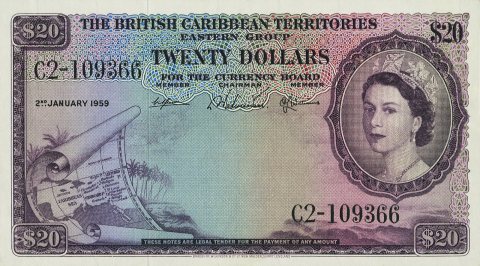
What became of the notes after 1951, and how many of each value were never handed in, is told in British Guiana's Government notes after 1st August 1951. The notes of the Board itself, dated 1950 to 1964, are on the British Caribbean Territories pages.
What the sources do not give
- The number of notes printed of any value or date. The one figure is Heritage's for the 1 dollar of 1920, given above as that house's statement.
- The day the notes of 1936, 1937, 1938 and 1942 were first paid out. Only January 1917 and 12th February 1929 are given, both by the annual reports.
- The office of each signer, beyond what the annual report for 1922 says of Clementi and Lobb.
- The notes in circulation by value before 1951. The monthly abstracts in the Official Gazette give totals only.
Sources
- Robert Chalmers, A History of Currency in the British Colonies (London, 1893), chapter IX, pages 125 to 135, and the table of bank notes in circulation on 31st December 1891.
- Colonial Reports, Annual: British Guiana, report for 1908-9 (No. 632), page 8; report for 1922 (No. 1174), pages 6 and 9; report for 1928 (No. 1441), page 5; report for 1929 (No. 1496), page 5.
- Government Currency Note Ordinance, 1915 (No. 16 of 1915, 30th June 1915); Government Currency Notes Ordinance, 1933 (No. 7 of 1933); Government Currency Notes Ordinance, 1937 (No. 14 of 1937), Official Gazette of British Guiana, 1st May 1937, pages 1,603 to 1,607; Currency Ordinance, No. 20 of 1950; Ordinance 20 of 1956; Bank of Guyana Ordinance, 1965, section 65.
- Official Gazette of British Guiana: the quarterly statements of the Commissioners of Currency, 1923 to 1950; the issue of 28th July 1951.
- Trinidad Royal Gazette, 21st December 1950, page 738, notice 2065.
- Papers of the Parliament of Guyana: the budget debate of 11th December 1946.
- British Caribbean Currency Board, report of the Executive Commissioner for 1960.
- Heritage Auctions, 24th April 2020, lot 26067; 6th to 10th September 2012, lots 15164, 15168 and 17145; 9th and 13th January 2014, lots 21037 and 21348. Spink, 4th November 2020, lots 110 and 111.
- The catalogue pages of the twelve notes, for the dates, sizes and signatures read from the notes themselves.
Member comments
Log in or register to post a comment.