This article gathers what is on record about the four high values of the Government of British Guiana: the 5 dollars of 1938 to 1942, the 10 dollars of 1942, the 20 dollars of 1942 and the 100 dollars of 1942. It draws on the catalogue pages of the four notes, the annual reports of the British Caribbean Currency Board, and the descriptions written by Stack's Bowers, Heritage, Spink and London Coins. A house's statement is given as that house's claim.
The four notes
Until 1938 the Government's notes were of 1 and 2 dollars only. The Government Currency Note Ordinance of 1915 allowed higher values with the approval of the Secretary of State. The annual report on British Guiana for 1908-9 names 5, 20 and 100 dollars as the values of the notes of the British Guiana and Colonial Banks.
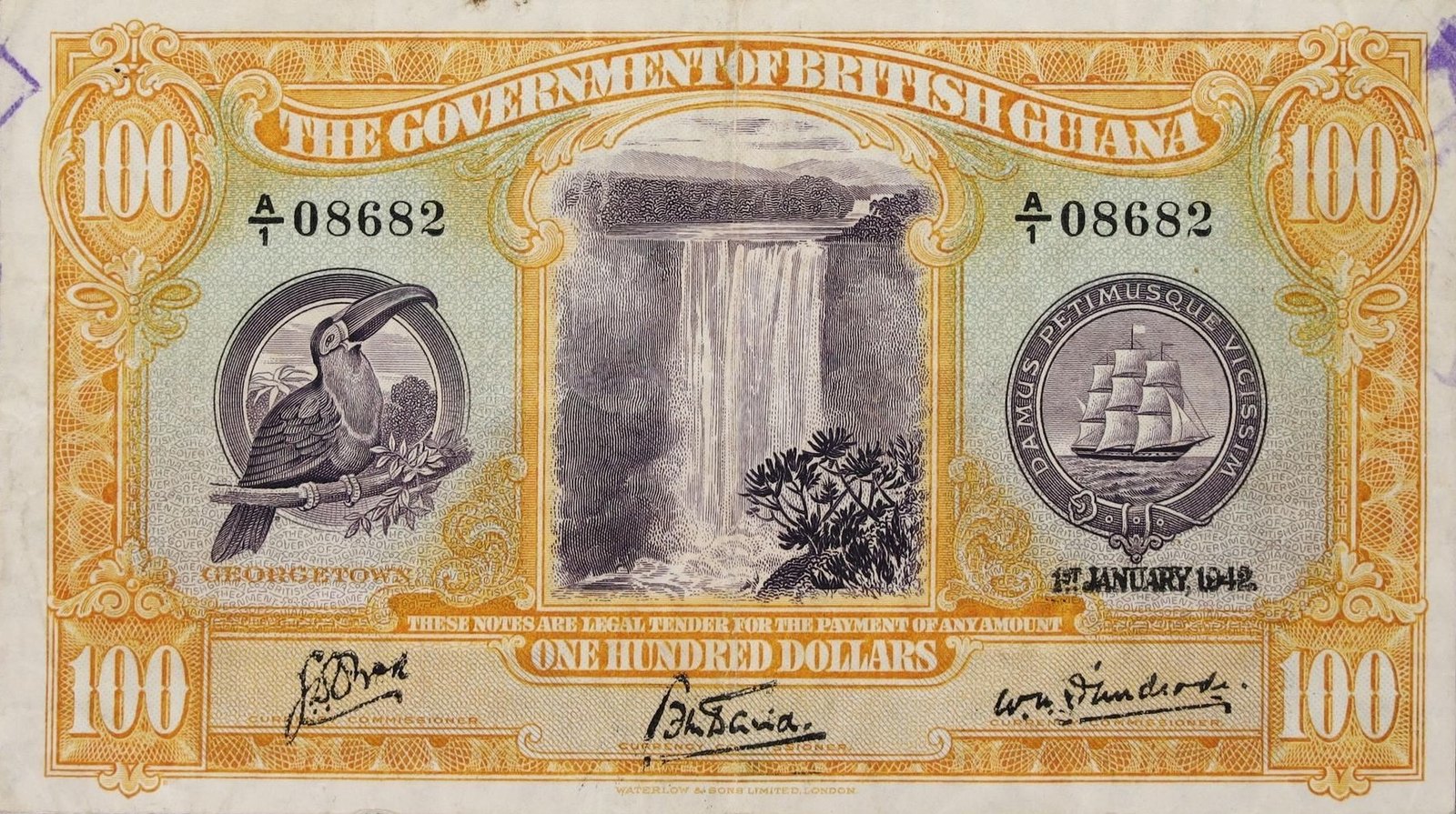
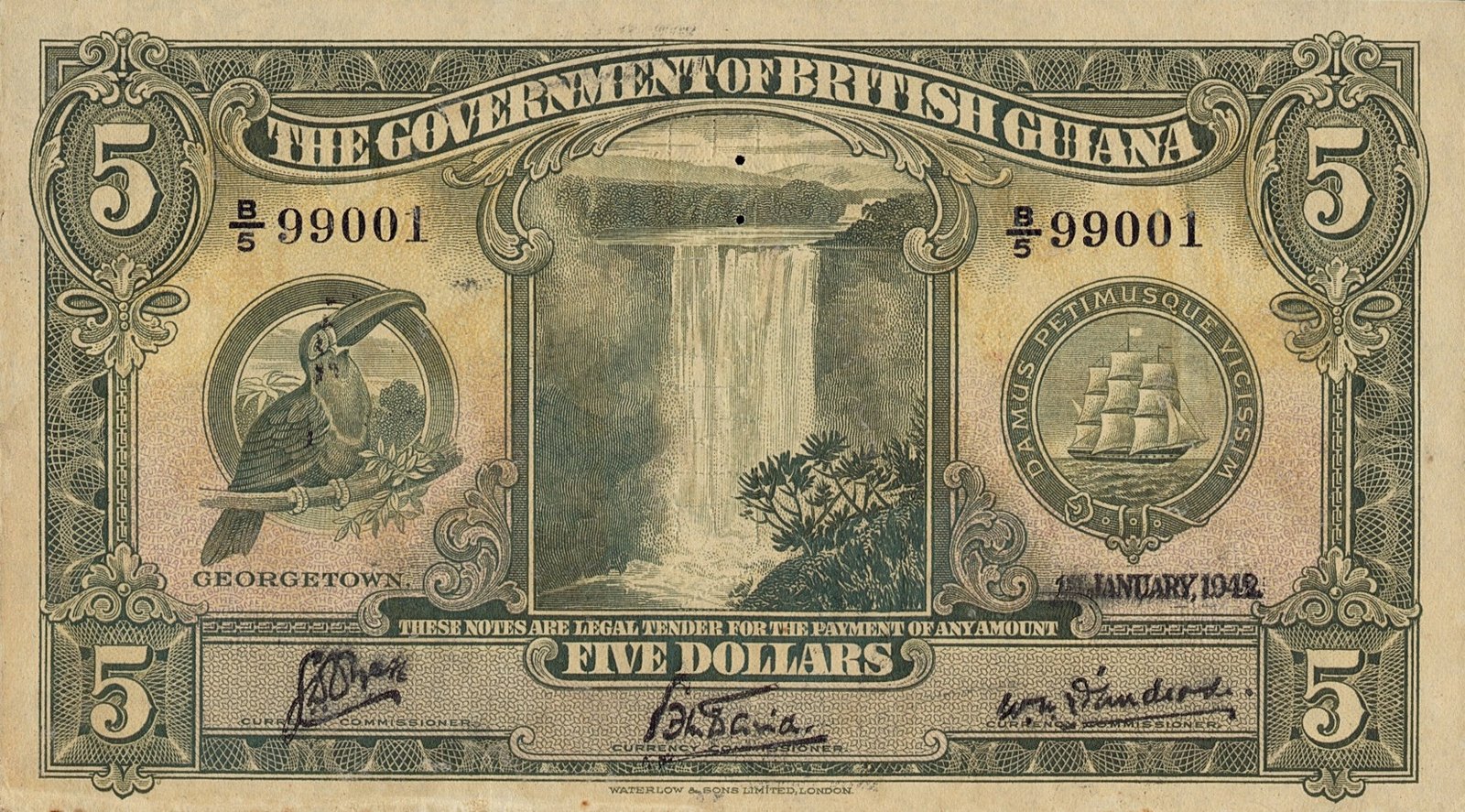
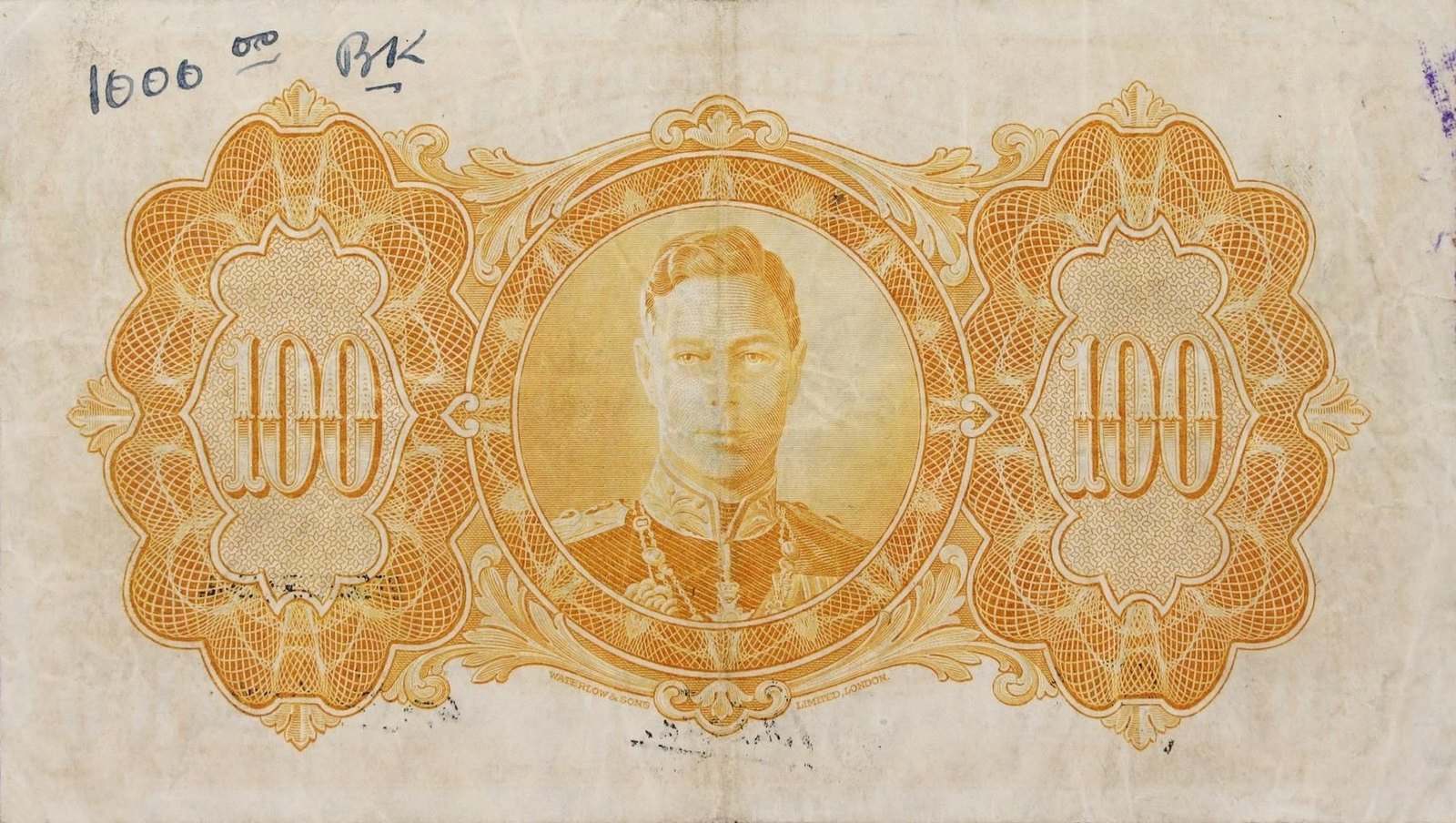
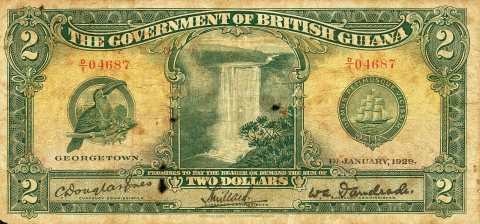
The Government's own high values came under the Government Currency Notes Ordinance, 1937 (No. 14 of 1937). The 5 dollars carries two dates, 1st October 1938 and 1st January 1942. The 10, 20 and 100 dollars carry the one date, 1st January 1942. All are signed by Owen, McDavid and d'Andrade, were printed by Waterlow and Sons, and measure 152 x 82 mm. They repeat the design of the 1 and 2 dollars: a toucan at the left, Kaieteur Falls at the centre and the sailing-ship seal, with King George VI on the back.
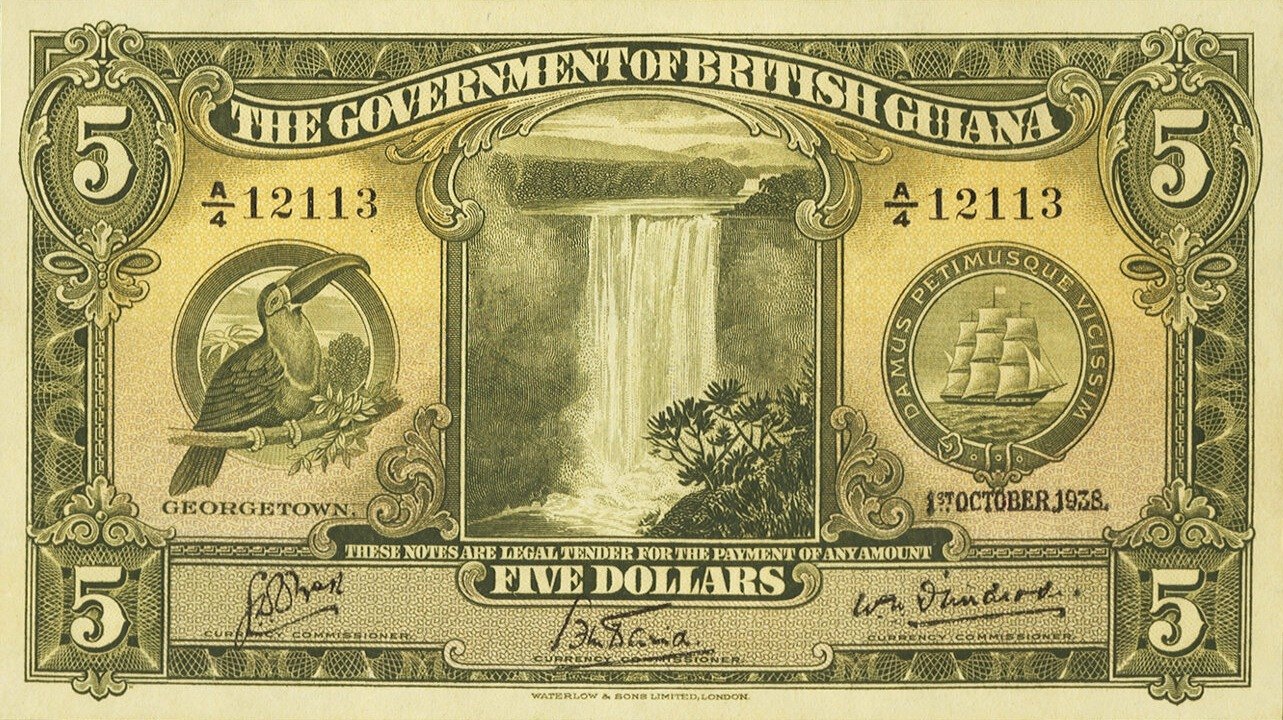
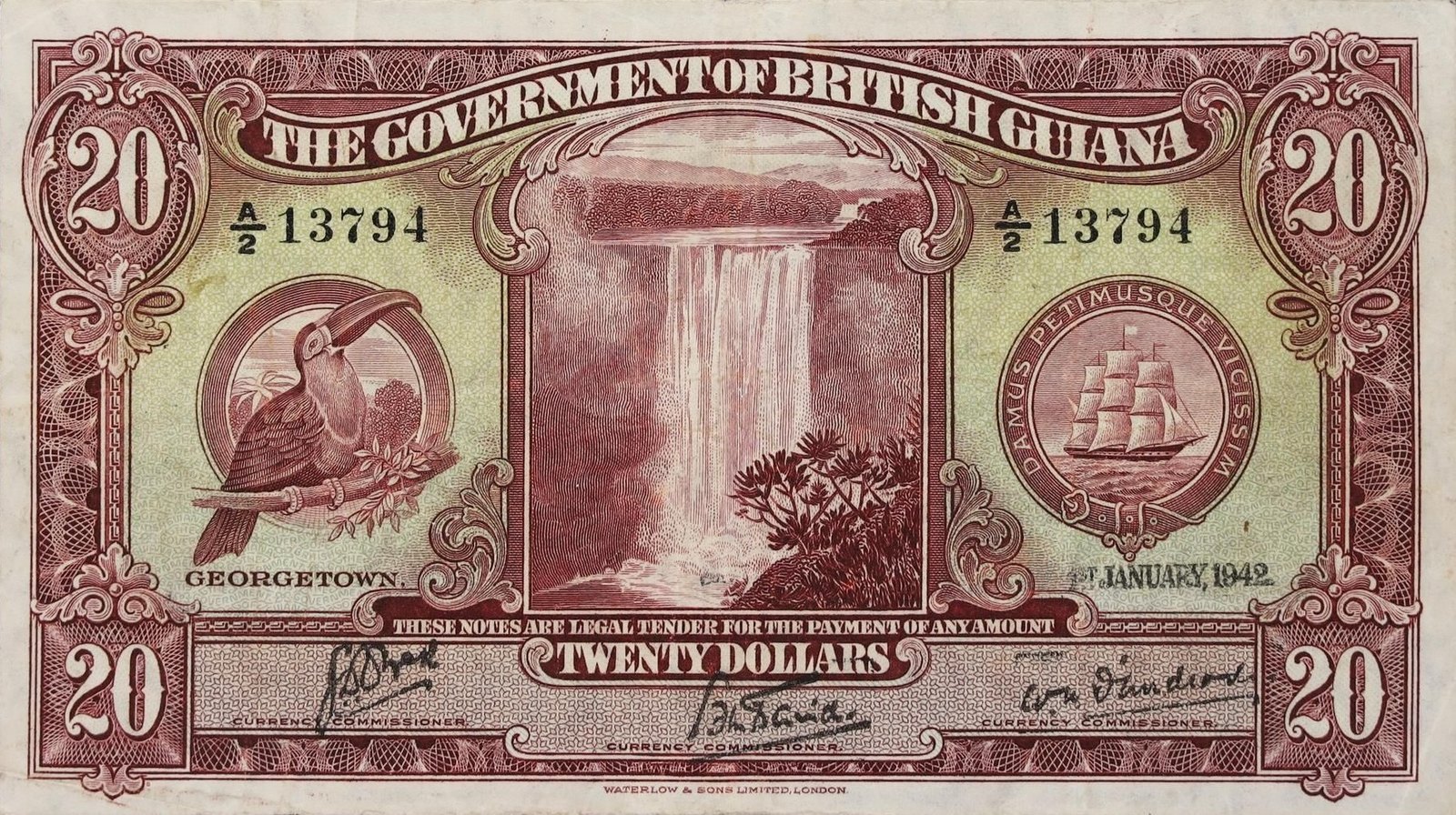
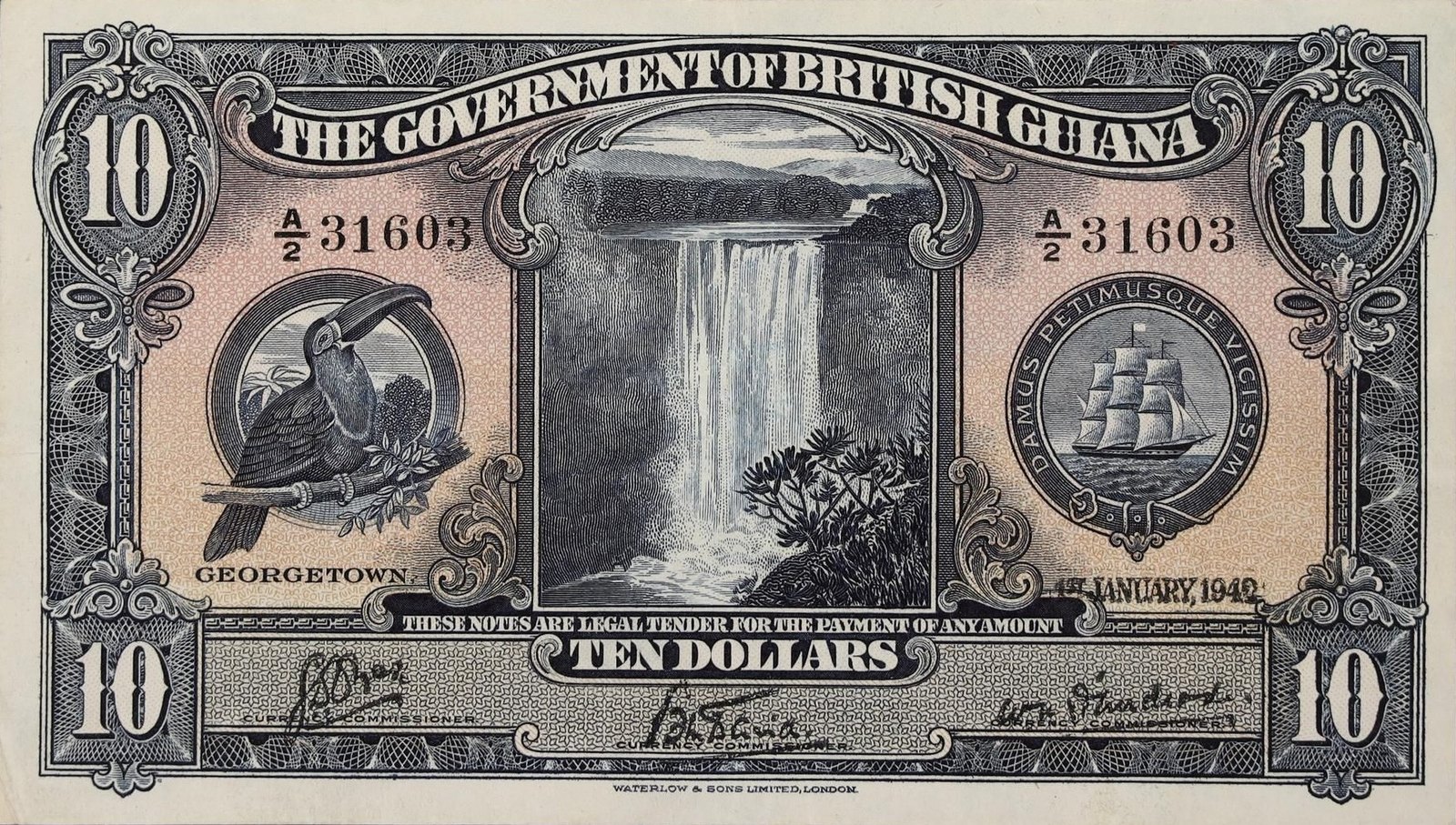
The houses' descriptions give the colours as they saw them. London Coins (2nd December 2019, lot 1450) and Spink (2nd October 2019, lot 695) call the 5 dollars olive or olive green. Spink (17th April 2019, lot 240) calls the 20 dollars burgundy, and in its sale 1023 (lots 124 and 125) calls the 20 dollars purple and green and the 100 dollars orange, pale blue and green. Stack's Bowers (12th August 2016, lot 30064) says of the 10 dollars that the portrait of the King changes on this value from three-quarter facing, as on the lower values, to full facing. That is the house's observation; the catalogue pages do not speak of it.
The printer's ink tests
The pages of the 5, 20 and 100 dollars carry one detail of the printing. Sources mention that the printer tested the inks of the 5, 20 and 100 dollars on printed notes soaked in washing soda, and that the 100 dollars used orange ink R609 and mauve ink V197. The pages do not name the source more closely, and nothing is said there of the 10 dollars.
How many were printed: not recorded
No source read gives the number printed of any of the four notes. The annual reports of the Currency Board for 1960 to 1962 say nothing of printing at all. Stack's Bowers' description of lot 30034 in its sale of 29th August 2025, the issued 100 dollars, says in so many words that the print run is not documented.
Two sources give the size of the whole note issue, of all values together. In the budget debate of 11th December 1946, kept among the papers of the Parliament of Guyana, a member said the issue had been under 2,000,000 dollars in 1939 and was then over 7,500,000; those are one member's words. The Currency Board's report for 1960 gives 9,431,000 dollars of Government notes in circulation when it took them over on 1st August 1951.
What the Currency Board counted
The Government notes ceased to be legal tender on 2nd January 1955 and could still be handed in afterwards. The Board's annual reports count, value by value, the notes that had not come in. The catalogue pages give the figures in round numbers; the reports print them like this, a half being half a note.
| 31st December | 5 dollars | 10 dollars | 20 dollars | 100 dollars |
|---|---|---|---|---|
| 1960 | 9,334½ | 1,473½ | 1,015 | 66 |
| 1961 | 9,184½ | 1,447½ | 959½ | 66 |
| 1962 | 8,769½ | 1,265½ | 861½ | 62 |
These are notes not handed in. Some will have been lost or destroyed. The count is the most that can exist of each value at that day, and it was still falling. The full account, with the 1 and 2 dollars, is in British Guiana's Government notes after 1st August 1951.
The 100 dollars, as each source puts it
Stack's Bowers sold an issued 100 dollars on 29th August 2025 (lot 30034); the number of the note is on its page. The house wrote that its search of the literature had found only specimens of the 100 dollars before this note, marked by a perforated or stamped SPECIMEN, that the note was the only one of its kind in the grading company PMG's census when the lot was written, and that it would not call the note the only one. The house supposes that the 100 dollars served mainly for settlements between banks, government accounts and export trade. It gives the colony's population at the time as about 325,000. These are the house's own reasoning and figures.
The page of the 100 dollars sets beside this the other notes recorded on the row of the issued note: one carries a SPECIMEN handstamp, one a faint SPECIMEN perforation, and one is known from a picture in the Bank of Guyana's "History of Guyana Notes". Spink's sale 1023 (lot 125) offered a 100 dollars with a normal serial number and a black SPECIMEN handstamp applied upright at the centre.
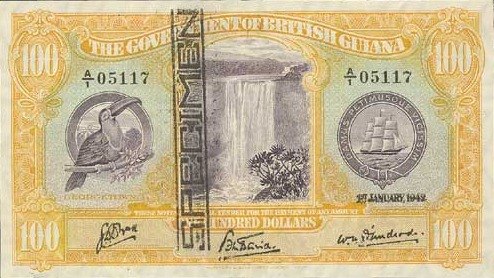
The Board's count is the one official figure: 62 of the 100 dollars had not been handed in at the end of 1962. No source says how many of those still exist.
The 20 and the 10 dollars
Stack's Bowers' description of lot 30033 in the same sale of 29th August 2025, a 20 dollars, says PMG had graded four notes of the 20 dollars in all, and that the cataloguer had seen three of them. Spink's description of lot 240 in its sale of 17th April 2019, a 20 dollars from the collection of Bruce Smart, says the 20 dollars is "usually only obtainable with specimen perforation or embossed cancellation". Spink's sale 1023 (lot 124) had such a piece: a 20 dollars with a normal serial number and a black SPECIMEN handstamp.
Of the 10 dollars, Spink (17th April 2019, lot 239, also from the Bruce Smart collection) says much the same, that the note is usually found only with a specimen cancellation. Stack's Bowers has described three: one on 12th August 2016 (lot 30064), which it then called the highest graded by PMG, one on 29th August 2025 (lot 30032), which it called the highest in the PMG census at that time, and one on 16th January 2026 (lot 30082), of which it said three were graded higher. Heritage offered one on 26th March 2026 (lot 24077). Stack's Bowers' description of 2025 says the 10 dollars had a larger issue than the two highest values; it gives no figure and no source.
The 5 dollars
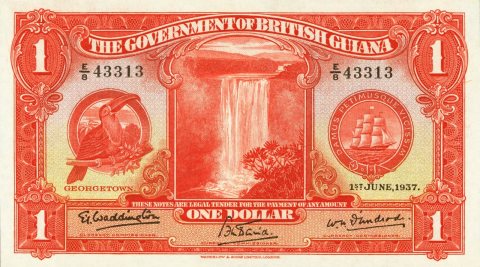
Most of the house descriptions of the 5 dollars read for this article are of notes dated 1st January 1942. Heritage's description of lot 27095 in its sale of 5th January 2017 says that note was the first 5 dollars dated 1938 the house had offered. Stack's Bowers (8th May 2025, lot 50057) counts 23 notes of the 5 dollars in the PMG census at that time.
One piece is of interest for the specimens. Heritage (23rd October 2021, lot 28057) describes a 5 dollars of 1942 with the word Specimen added by hand, upright, on front and back, and two small holes above the King's portrait. The house notes that B/5 is the last prefix of this value, that the number of the note is near the end of the run, and suggests that an issued note was made into a specimen. The house does not say who did so or when.
What is not known
- The number printed of each value, and the numbers of the first and last note.
- The day each value was first paid out.
- Why the 10, 20 and 100 dollars were added in 1942. No law or report read gives the reason.
- How many of the notes counted as outstanding in 1962 still exist.
Sources
- British Caribbean Currency Board, reports of the Executive Commissioner for 1960, 1961 and 1962, Appendix I.
- Government Currency Note Ordinance, 1915 (No. 16 of 1915); Government Currency Notes Ordinance, 1937 (No. 14 of 1937).
- Colonial Reports, Annual, No. 632: British Guiana, report for 1908-9, page 8.
- Papers of the Parliament of Guyana: the budget debate of 11th December 1946.
- Stack's Bowers, 12th August 2016, lot 30064; 8th May 2025, lot 50057; 29th August 2025, lots 30032, 30033 and 30034; 16th January 2026, lot 30082.
- Heritage Auctions, 5th January 2017, lot 27095; 23rd October 2021, lot 28057; 26th March 2026, lot 24077.
- Spink, 17th April 2019, lots 239 and 240; 2nd October 2019, lot 695; sale 1023 (World Banknotes), lots 124 and 125.
- London Coins, 2nd December 2019, lot 1450.
- The catalogue pages of the four notes.
Member comments
Log in or register to post a comment.