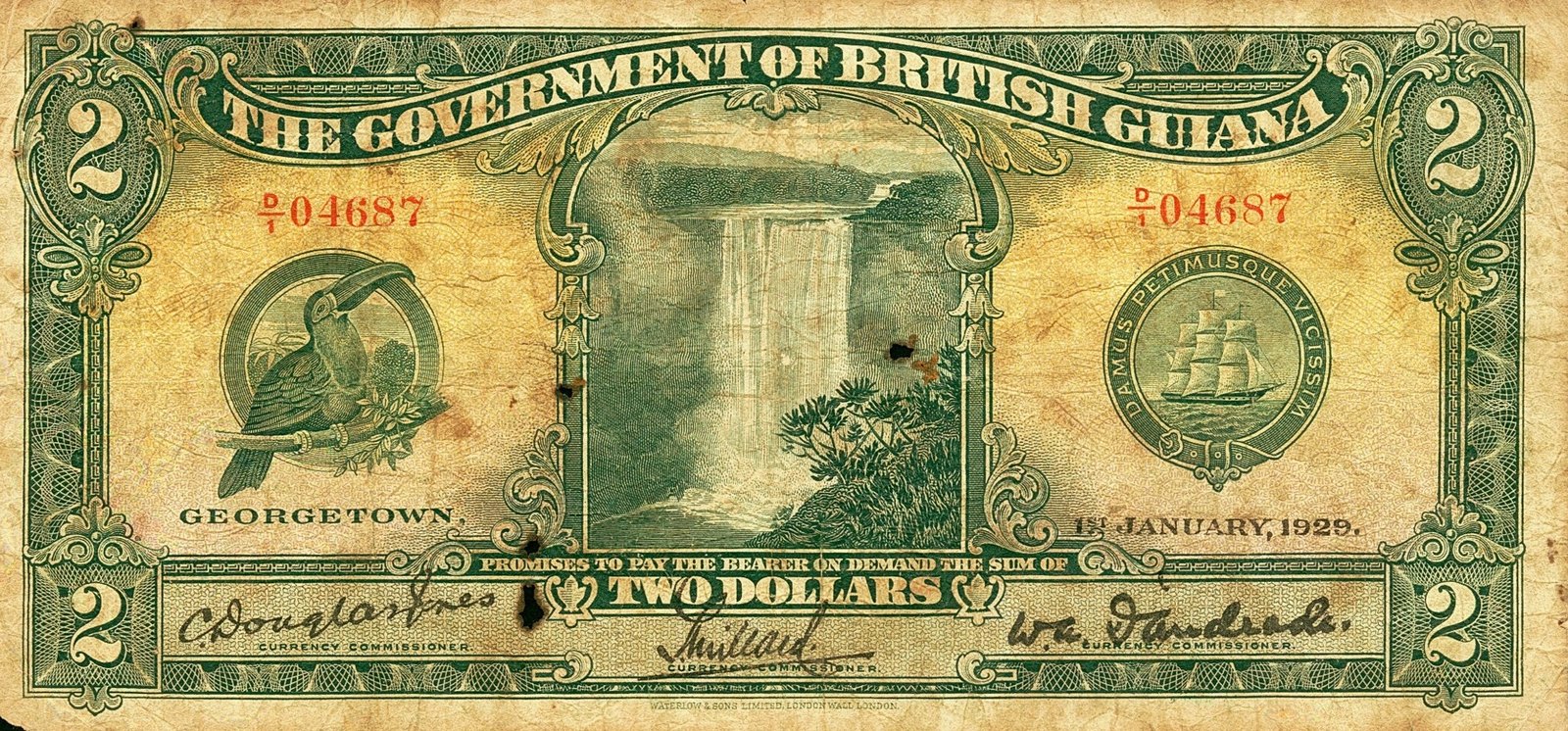
This article sets out, year by year, how much paper money the Government of British Guiana had in circulation, from the first notes of January 1917 to the take-over by the British Caribbean Currency Board on 1st August 1951, and then how much of the Board's money stood in the colony's name until 1962. The figures come from the annual reports on the colony, a debate of the Legislative Council, working paper 247 in the Johns Hopkins currency board archive, the gazettes of the Caribbean territories, and the Board's own reports. Some were read on the page image and some only in the text layer of a scan; the article says which. The notes themselves are told in The Government notes of British Guiana, 1916 to 1955, and their last years in British Guiana's Government notes after 1st August 1951.
1917 to 1919: the first notes go out
The annual reports on British Guiana for 1922, 1928 and 1929 say the Combined Court approved the issue on 16th August 1915 and that "the first notes were issued in January, 1917". Working paper 247 (WP 247) in the Johns Hopkins currency board archive cites the report for 1921, page 9, for the same month, and so does the summary of British Guiana in Krus and Schuler's Currency Board Financial Statements (2014).
How the notes reached people is told in a newspaper. The Port of Spain Gazette of 5th November 1919, reprinting the Daily Argosy of Georgetown, reports that "on the suggestion of the Hon. Clifton Grannum, one of the Commissioners of Currency", all the Government officials in Georgetown changed their salary cheques for October at the Treasury on 1st November 1919 "and received Government two and one dollar notes". Grannum signs the notes of 1916, 1918 and 1920. The same paper, on 22nd November 1919, printed the Demerara Salaries Commission's view that the Government should take the colony's paper money wholly into its own hands; that is told in Before the Government's dollar notes. Both passages were read in the text layer only.
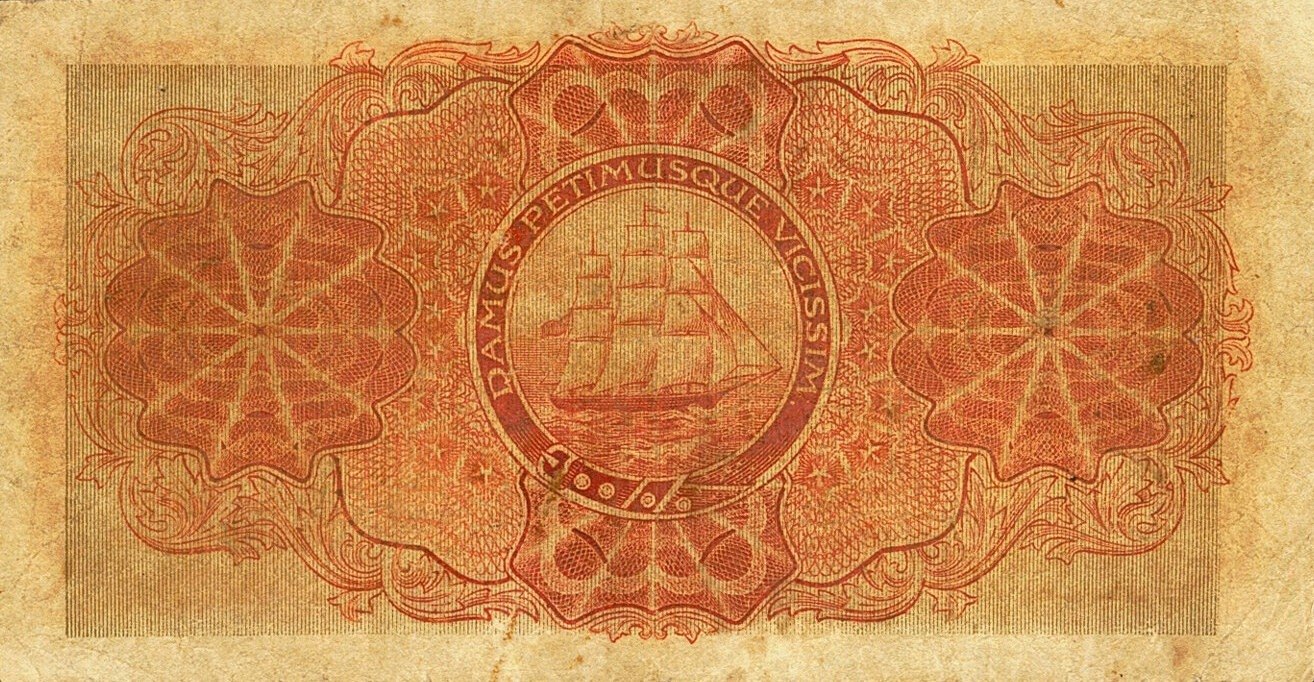
No source read gives a figure of notes out before 1922.
1922 to 1936: 500,000 dollars, and a different figure for 1935
The annual reports give the notes in circulation at the end of the year as follows.
| Year | Notes in circulation | Source | Read |
|---|---|---|---|
| 31st December 1922 | 104,166 pounds 13 shillings 4 pence | Report for 1922 (No. 1174), page 9 | page image |
| 31st December 1928 | 104,166 pounds 13 shillings 4 pence | Report for 1928 (No. 1441), page 5 | page image |
| 31st December 1929 | 104,166 pounds 13 shillings 4 pence | Report for 1929 (No. 1496), page 5 | page image |
| 1931 | 104,166 pounds 13 shillings 4 pence | Report for 1931 (No. 1598) | text layer only |
| 1932 | 104,166 pounds 13 shillings 4 pence (500,000 dollars) | Report for 1932 | text layer only |
| 1934 | 104,166 pounds 13 shillings 4 pence (500,000 dollars) | Report for 1934 | text layer only |
| 1935 | 109,375 pounds (525,000 dollars) | Report for 1935 | text layer only |
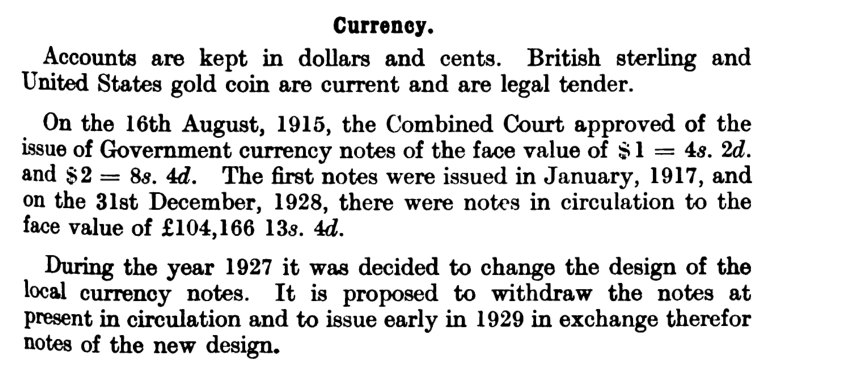
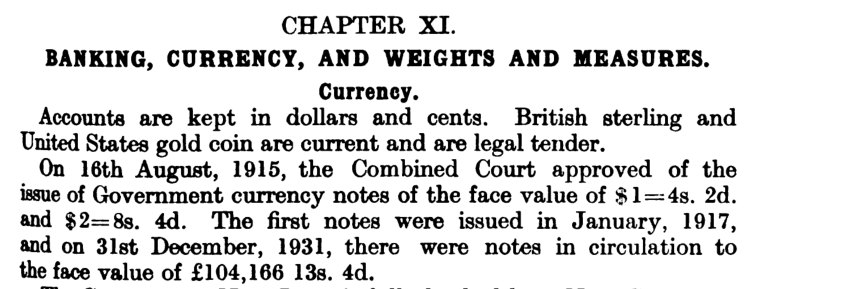
The reports for 1932 and 1934, as their text layers read, themselves put the sterling figure at 500,000 dollars. The figure, and the exchange of notes in 1929 that left it unchanged, are discussed in 12th February 1929: the day British Guiana's new notes came. Working paper 247 (pages 4 to 7) says the Commissioners held the issue at exactly 500,000 dollars from the middle of 1922 to December 1936, and that it stood at 575,000 dollars by January 1937.
The two sources do not agree on 1935. The report for 1935, as its text layer reads, gives 109,375 pounds, or 525,000 dollars; the working paper has 500,000 dollars until December 1936. The report's page has not been read on the image, and no figure of the working paper's own for 1935 was copied when it was read, so the point is open. The monthly abstracts of 1935 in the Official Gazette, described below, were not copied either.
The monthly Government Currency Notes Abstracts in the Official Gazette, from 1923 on, gave the notes in circulation each month. They cite as their authority section 10 of the Ordinance of 1915 (No. 16 of 1915), later Chapter 50 of the revised laws. They give a total only, with no split between the 1 and 2 dollars, and their figures were not copied out when the gazettes were read.
The quarterly statements of the Commissioners of Currency in the same Gazette carry the names of the Commissioners. As read in the machine text of the gazettes, with one page checked on the image, they are: Lobb, Shannon and Davis in 1923; Lobb, Burrowes and Barton from August 1924 to May 1925; Douglas-Jones, Millard and d'Andrade from 1929 to 1934, not always all three; Waddington, McDavid and d'Andrade from October 1935 to May 1937; Owen, McDavid and d'Andrade from April to June 1941; and McDavid and Fraser from 1945 to 1950. The catalogue's pages record no note signed by Shannon or Davis.
1937 to 1950: the issue grows
The Government Currency Notes Ordinance, 1937 (No. 14 of 1937) made the notes exchangeable for sterling at 4 shillings 2 pence to the dollar; working paper 247 says in both directions. The catalogue's pages have the 1 dollar and 2 dollars of 1937 joined by a 5 dollars in 1938 and a 10 dollars, 20 dollars and 100 dollars in 1942, told in The 5 to 100 dollars of British Guiana, 1938 to 1942. Working paper 247 (page 3, citing the Bank of Guyana) says instead that the 5, 10, 20 and 100 dollars began in 1929. The two are given here as they stand. The working paper gives these figures for the years that followed.
| When | Notes in circulation | Source |
|---|---|---|
| January 1937 | 575,000 dollars | Working paper 247, pages 4 to 7 |
| December 1940 | over 1,000,000 dollars | Working paper 247 |
| End of 1942 | 3,700,000 dollars | Working paper 247 |
| 31st December 1950 | 9,400,000 dollars | Working paper 247 |
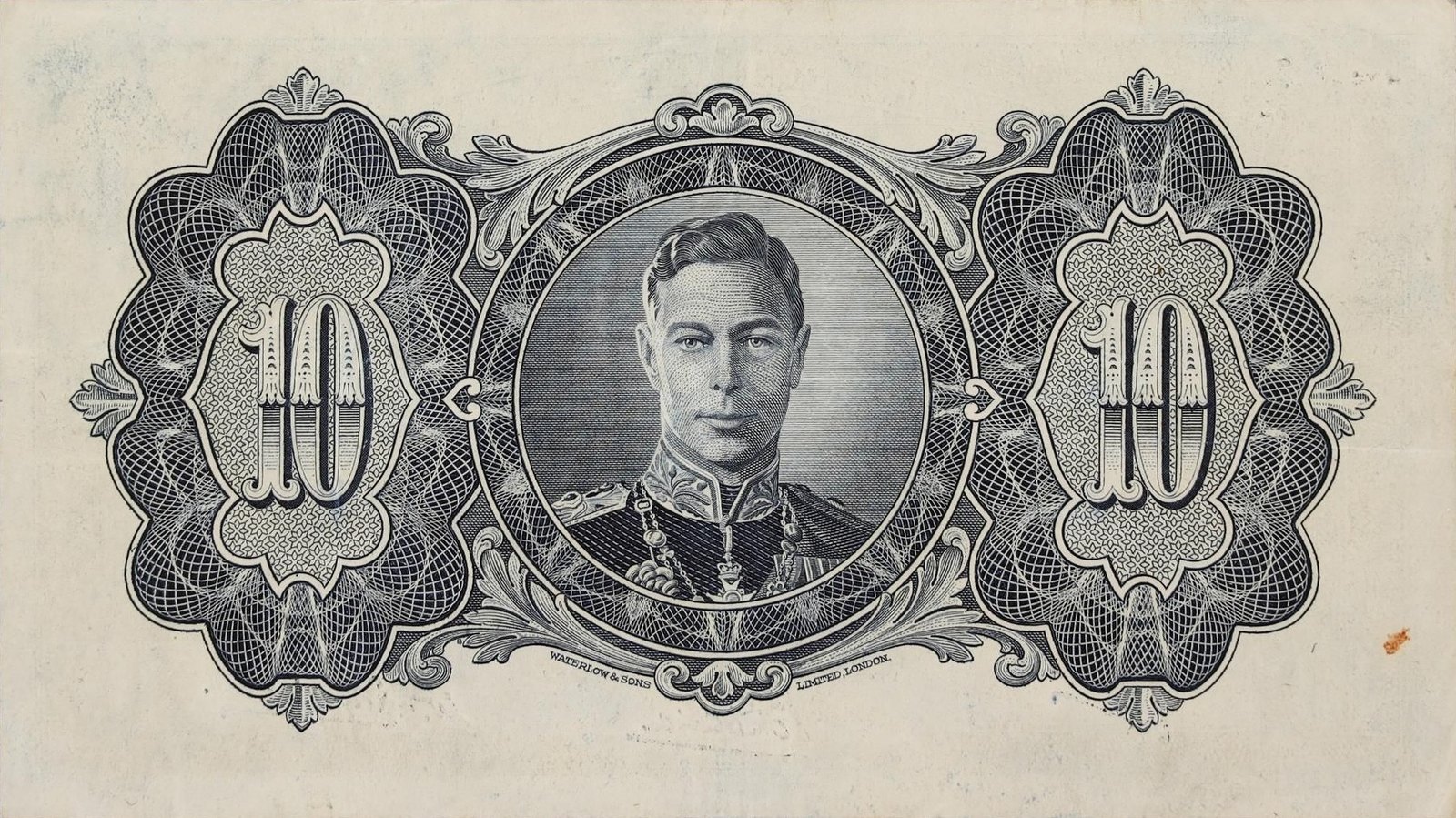
The working paper's figures for 1940 to 1950 are round figures. The Currency Board's own count of the Government notes it took over on 1st August 1951 is in the next section. A member's round figures for 1939 and 1946, spoken in the budget debate of 11th December 1946, are given in The Government notes of British Guiana, 1916 to 1955 as that member's words; they are words in debate, not an account. The report of the Commissioners of Currency for 1937 was laid before the Legislative Council on 25th May 1938, but the report itself is not among the papers read, nor are the reports of later years.
Two things in these years widened where the notes could be spent. The annual report on British Guiana for 1946, read in the text layer only, says the notes of Trinidad, Barbados and British Guiana were made legal tender in each other's colonies from 1941. The Revised Ordinances of Trinidad and Tobago, 1950 (volume V, chapter 35, number 6, section 17, read on the page image) make any Barbados or British Guiana currency note legal tender in Trinidad to the full amount on the note. The Barbados Advocate of 13th April 1950, read in the text layer only, calls the three Governments' notes "interchangeable and legal tender in these colonies".
Then came the move to one note issue. On 13th March 1945 the Colonial Treasurer, McDavid, gave notice in the Legislative Council of a motion to approve in principle a unified note issue for the British West Indies and British Guiana, in dollars with the sterling value shown at 4 shillings 2 pence to the dollar, under a joint board. The currency conference at Barbados in May 1946 recommended it, as the preamble of the Currency Ordinance, 1950 records. In April 1950 the Unified Currency Committee, with McDavid as chairman, met at Hastings House in Barbados, the Barbados Advocate reports (text layer only), to approve the draft laws and award the printing of the new notes. How the Board was then set up is told in The British Caribbean Currency Board and its notes, 1950 to 1968.
1951 to 1966: the old notes on the Board's statements
The Board took over 9,431,000 dollars of British Guiana Government notes on 1st August 1951 and printed its circulation each month in the gazettes of the territories. The table of the outstanding Government notes in British Guiana's Government notes after 1st August 1951 can be filled out with these statements, which it does not list.
| Day of the statement | British Guiana Government notes outstanding, dollars | Where printed |
|---|---|---|
| 1st October 1951 | 4,177,700 | Dominica Gazette, 19th November 1951, page 247 |
| 1st December 1951 | 2,904,100 | Dominica Gazette, 7th January 1952, page 2 (text layer only) |
| 1st January 1953 | 909,555 | Grenada Government Gazette, 24th January 1953, page 21 |
| 1st January 1954 | 606,986 | Grenada Government Gazette, 30th January 1954, page 28 |
| 1st April 1954 | 571,927 | Dominica Gazette, 13th May 1954, page 123 |
| Statement printed 24th December 1955 | 314,662.50 | Grenada Government Gazette, 24th December 1955, page 518 |
| 1st April 1964 | 231,780 | Saint Vincent Government Gazette |
| 1st February 1965 | 230,457 | Saint Vincent Government Gazette, 23rd March 1965, page 73 |
| 1st February 1966 | Nil | Saint Vincent Government Gazette |
The statements in the Official Gazette of Barbados show the British Guiana line as nil by 1st December 1965. No statement says why. What the laws provided is this: the Currency Agreement of 12th December 1964, as enacted by British Guiana's Currency Ordinance, 1965 (Article 12), handed the liability for the old notes back to the Government when its own currency authority began to issue, with sterling equal to the notes still in the Board's books, and the Bank of Guyana Ordinance of 15th October 1965 (section 65) passed it to the new Bank.
The Board's money in British Guiana, 1952 to 1962
The Board's report for 1962 (page 12, as laid before the British Guiana legislature) gives, territory by territory, the value of notes in circulation at each 31st December, its own notes with the old Government notes still outstanding. For British Guiana:
| 31st December | Dollars |
|---|---|
| 1952 | 12,062,162 |
| 1953 | 13,325,629 |
| 1954 | 15,210,739 |
| 1955 | 16,783,011 |
| 1956 | 18,539,603 |
| 1957 | 20,613,124 |
| 1958 | 22,589,733 |
| 1959 | 23,146,579 |
| 1960 | 26,943,529 |
| 1961 | 29,446,197 |
| 1962 | 35,719,853 |
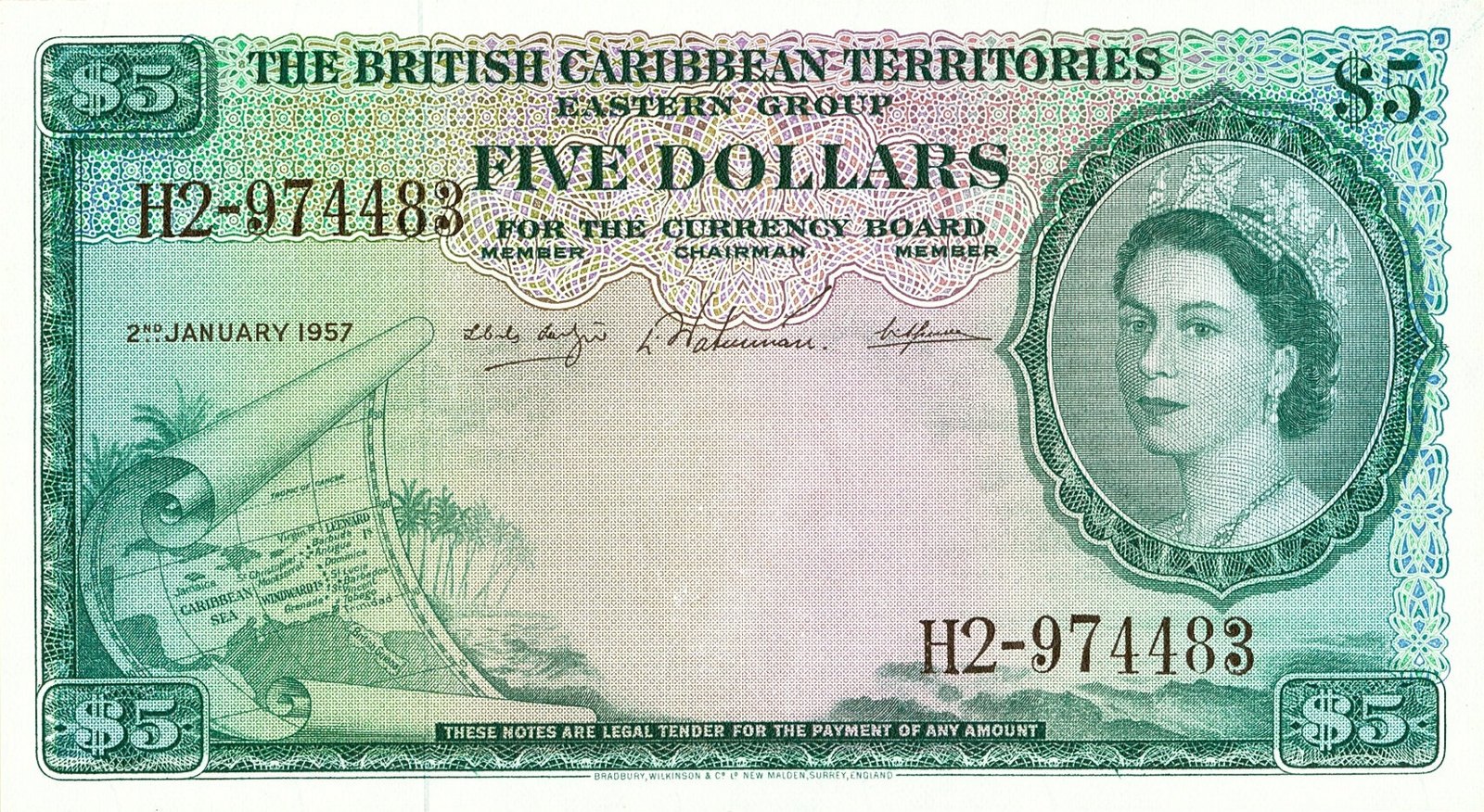
The same figures for 1952 to 1960 stand in the report for 1960 as printed in the Antigua, Montserrat and Virgin Islands Gazette of 23rd August 1962 (page 182), where the image is blurred at places in the British Guiana line. The colony's own annual report for 1961 gives the Board's notes in British Guiana at 31st December 1961 as 29,204,665 dollars, a different figure from the Board's 29,446,197, which counts the old Government notes as well.
The Board itself warned against reading too much into the figure for a territory. Each is the notes issued there less the notes taken back there. A footnote to the statement for 1st February 1964, signed W. B. Brown, Executive Commissioner (Antigua, Montserrat and Virgin Islands Gazette, 2nd April 1964, page 85), says that since British Guiana's exchange control law, travellers had carried notes out of the colony to the other territories in such numbers since 1962 that the figures by territory had become "unrealistic and in fact misleading".
Who stood for British Guiana
The laws name the Commissioners by office only, and the papers read give a few of the colony's men by name. McDavid gave notice of the motion of 1945 as Colonial Treasurer, chaired the Unified Currency Committee in 1950 and was the colony's first member of the Board when it was constituted on 28th November 1950 (Trinidad Royal Gazette, 21st December 1950, notice 2065). W. O. Fraser, Financial Secretary, took McDavid's place on the Board from 17th May 1953 (Dominica Gazette, 23rd September 1953, page 353). The minutes of the Legislative Council of 18th February 1959 say the Financial Secretary, F. W. Essex, had left the colony to attend a meeting of the Board, with W. P. D'Andrade acting as Financial Secretary. From 2nd November 1961 the colony's member was the Secretary to the Treasury, ex officio (Grenada Government Gazette, 2nd December 1961, page 370, text layer only).
What the sources do not give
- Any figure before 1922, and the notes in circulation by value at any date before 1951.
- The monthly figures of the Government Currency Notes Abstracts, 1923 to 1950, which exist in the Official Gazette but were not copied.
- Whether the issue stood at 525,000 dollars in 1935, as the report for 1935 reads, or at 500,000 dollars, as the working paper has it.
- The Commissioners' yearly reports from 1937 on.
Sources
- Colonial Reports, Annual: British Guiana, reports for 1922 (No. 1174), page 9; 1928 (No. 1441), page 5; 1929 (No. 1496), page 5; 1931 (No. 1598); 1932; 1934; 1935; 1946; 1961.
- Working paper 247 (WP 247), in the Johns Hopkins currency board archive, pages 3 to 7.
- Krus and Schuler, Currency Board Financial Statements (2014), British Guiana section.
- Port of Spain Gazette, 5th and 22nd November 1919.
- Official Gazette of British Guiana: the monthly Government Currency Notes Abstracts and the quarterly statements of the Commissioners of Currency, 1923 to 1950.
- Legislative Council of British Guiana: debates of 25th May 1938, 13th March 1945 (columns 1961 and 1962) and 11th December 1946; minutes of 18th February 1959.
- Government Currency Notes Ordinance, 1937 (No. 14 of 1937); Currency Ordinance, 1950 (No. 20 of 1950), preamble; Currency Ordinance, 1965 (No. 8 of 1965), Article 12 of the Agreement; Bank of Guyana Ordinance, 1965 (No. 23 of 1965), section 65.
- Revised Ordinances of Trinidad and Tobago, 1950, volume V, chapter 35, number 6, section 17.
- The Barbados Advocate, 13th April 1950.
- Trinidad Royal Gazette, 21st December 1950, notice 2065.
- The Currency Board's monthly statements in the Dominica Gazette, the Grenada Government Gazette, the Saint Vincent Government Gazette, the Official Gazette of Barbados and the Antigua, Montserrat and Virgin Islands Gazette, 1951 to 1966.
- British Caribbean Currency Board, reports of the Executive Commissioner for 1960 (Antigua, Montserrat and Virgin Islands Gazette, 23rd August 1962, page 182) and 1962 (page 12).
Member comments
Log in or register to post a comment.