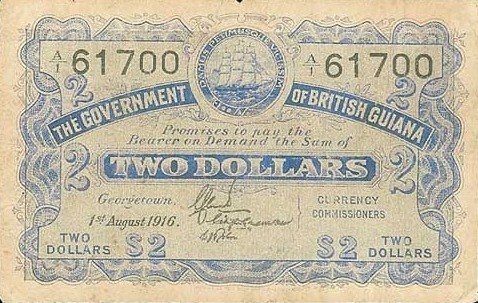
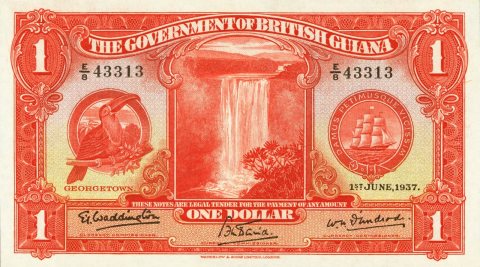
The Government of British Guiana put out its own 1 and 2 dollars only from January 1917. This article covers the paper money that came before and beside them: the notes in guilders and joes of the old Dutch colonies of Berbice and of Demerara and Essequibo, and the notes of the private banks. For the first it follows Robert Chalmers, A History of Currency in the British Colonies (1893), chapter IX, read on the page images of the book. For the banks it uses the annual reports on the colony, the colony's Ordinances, the gazettes of the Caribbean territories, the IBNS Journal and Bank Note Reporter. The Government notes of British Guiana, 1916 to 1955 gives the short version of the same years.
Three colonies and a money of account
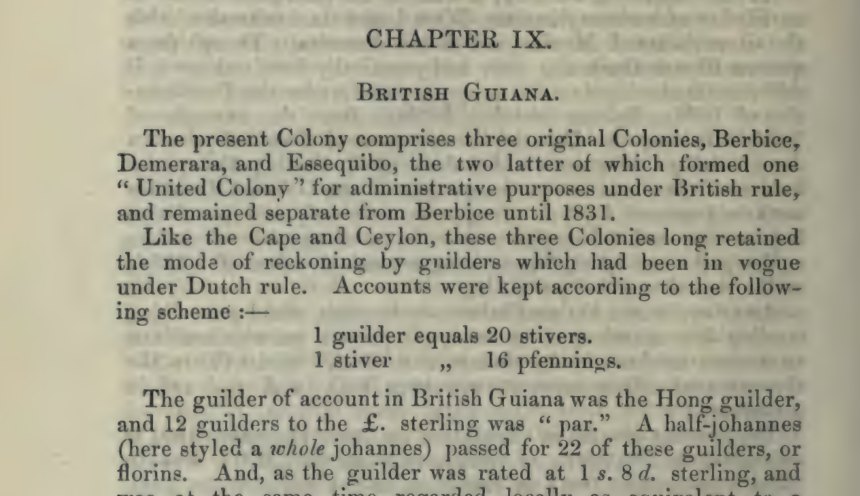
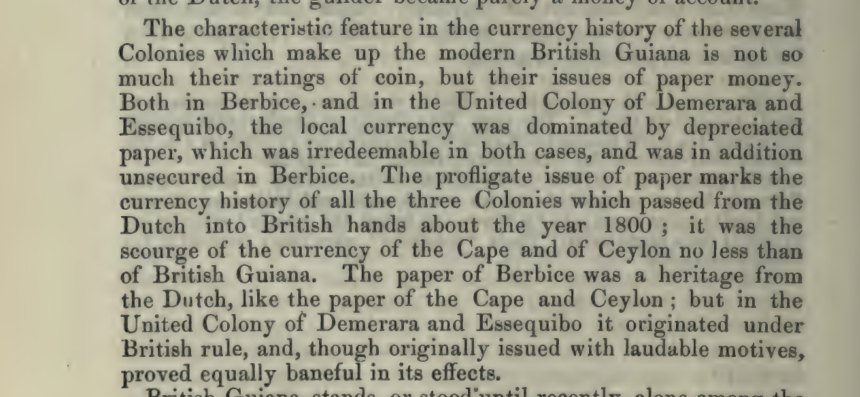
Chalmers opens the chapter by saying that the colony was made of three: Berbice, and Demerara and Essequibo, which formed one "United Colony" under British rule and stayed apart from Berbice until 1831. All three kept the Dutch reckoning in guilders of 20 stivers, the stiver being 16 pfennings, and 12 guilders to the pound sterling was "par". The half johannes, the Portuguese gold coin known as the joe, passed for 22 guilders. Chalmers calls the paper money, not the coins, "the characteristic feature" of the colonies' currency, and says it was irredeemable in both colonies and in Berbice also unsecured.
Berbice: paper from the Capitulation to 1844
The first paper of Berbice, Chalmers says, came out under Articles 5 to 7 of the Capitulation, in place of bills for salaries drawn on the Dutch Berbice Association, and "appears to have been 173,349 guilders". When the estates that stood behind it were given back to the Association in 1815, nothing was arranged for paying the paper off.
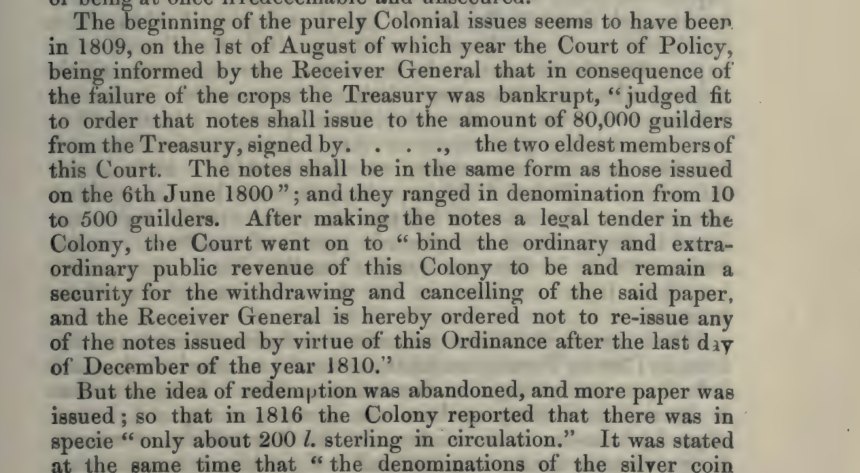
The colony's own issues began on 1st August 1809. The Court of Policy, told by the Receiver General that the Treasury was bankrupt after the crops had failed, ordered notes of 80,000 guilders from the Treasury, of 10 to 500 guilders, signed by the two eldest members of the Court, "in the same form as those issued on the 6th June 1800". The Court bound the colony's revenue as security and forbade the Receiver General to re-issue any of them after the last day of December 1810. Chalmers adds that the idea of paying them off was dropped and more paper issued, so that in 1816 the colony reported "only about 200 l. sterling" of coin in circulation. The book does not name the two members who signed.
By 1829, Chalmers says, the paper of Berbice came to 365,416 guilders: the 173,349 of the Capitulation, 97,160 left from issues before 1815, and 94,907 issued in 1826. Private promissory notes passed beside it, and on 20th November 1833 the Governor ordered the public offices in Berbice to refuse them.
The end came in stages. On 31st December 1834 the Berbice paper, in notes of 1 to 330 guilders, stood at 426,699 guilders 10 stivers 9 pennings, by the Blue Book for 1837. Early in 1837 a coinage of 1836 worth 121,992 guilders was paid out in Berbice for paper of the same amount, which was burnt. On 17th January 1840 a further 70,000 guilders of paper was cancelled. The Local Guide noted for 1841 that "the remainder of the Berbice paper money" was redeemed, but Chalmers points out that 2,000 dollars was voted for the "redemption of Berbice paper money" in 1844, and appears in 1845 as a balance in hand.
Demerara and Essequibo: "goods" and joe notes, 1806 to 1841
In the United Colony the paper began, Chalmers says, under British rule and "with laudable motives". In 1806, for want of silver, the Court of Policy issued "goods" of 73,000 florins, in notes of 1 to 100 guilders, secured on the revenue and made legal tender, while the Berbice paper was "decried" in the United Colony.
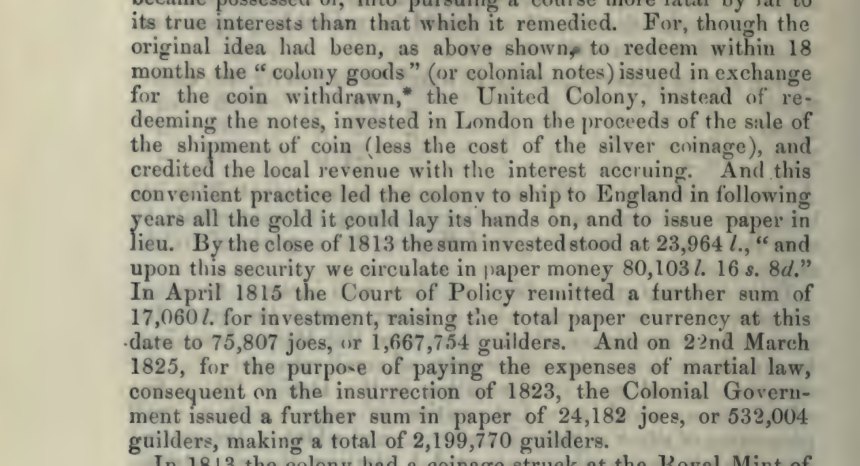
The larger issue came from the plugged joes. A memorial of the Court of Policy sent home by the Governor on 31st December 1808 tells of joes plugged with copper or brass "slightly gilt over" in general circulation. The Court called in every plugged joe, coin worth "nearly 50,000 l. sterling", and paid out in its place "Colony goods, redeemable in specie in 18 months or sooner". The gold went to England for sale. Chalmers says the colony then invested the proceeds in London instead of paying off the notes, and went on sending gold home and issuing paper in its place. Chalmers' figures for the paper are these:
| Date | Paper of Demerara and Essequibo | Chalmers, page |
|---|---|---|
| "The original issue of paper", the notes given for the plugged joes (no date given) | 615,340 guilders | 130, footnote |
| Close of 1813 | 80,103 pounds 16 shillings 8 pence, against 23,964 pounds invested | 130 |
| April 1815 | 75,807 joes, or 1,667,754 guilders, after a further 17,060 pounds was sent for investment | 130 |
| 22nd March 1825 | 24,182 joes, or 532,004 guilders, issued to pay for martial law after the rising of 1823, making 2,199,770 guilders | 130 |
| End of 1829 | 2,199,758 guilders, in notes of 1 to 20 joes, against 184,800 pounds of Consols | 133 |
| 1839 | 2,199,770 guilders, against investments of 150,077 pounds | 134 |
The book gives the total once as 2,199,770 and once, for the end of 1829, as 2,199,758 guilders. Both are printed so.
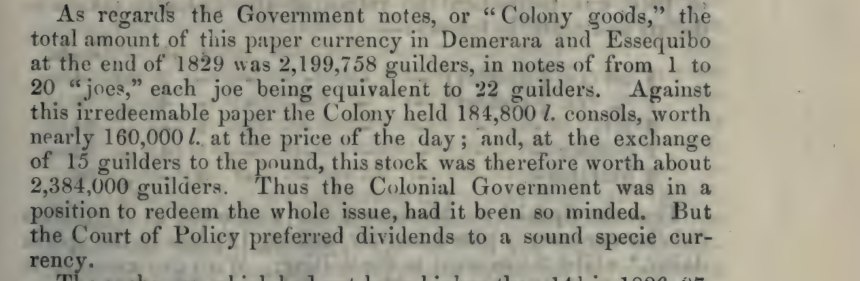
Chalmers says the Consols held in 1829 would have paid off the whole issue, "had it been so minded. But the Court of Policy preferred dividends to a sound specie currency." By Ordinances of 1830 and 1832 the Court changed the form and values of some notes: half-joe notes of 11 guilders were put out in place of 2,500 notes of 1 joe.
On 10th June 1839 an Ordinance provided for paying the notes off by 1st January 1840, from which day they were no longer legal tender except at the Public Offices. Because the demand for coin was pressing, an Ordinance of 27th November 1839 brought the first day of payment forward to 2nd December 1839. In 1841, Chalmers says, 16,000 dollars were still voted for "the Joe notes".
Chalmers describes no note of either colony and gives no picture; the book has no plates. None of these notes has a page in the catalogue.
The joe notes in the old sales
Notes of Demerara and Essequibo turn up in a few of the old auction catalogues read for the catalogue. The National Auction and Sales Company of America (NASCA) offered joe notes in its sale of the London collection on 18th July 1979 (lots 2900 and 2901) and in its sale of the Montreal collection on 5th December 1979 (lots 19 to 22, lot 22 a note of 10 joes). Harmer-Rooke's sale of the Albert I. Donn collection on 5th December 1974 had a "Demerary and Essequebo colonial security" (lot 100). NASCA's sale of part II of the Stanley Gibbons collection on 7th December 1981 had notes of Demerary of the early nineteenth century with Colonial Bank notes (lots 233 to 236), and Herbert I. Melnick's sale of part V of the same collection on 20th December 1982 a Demerary note of 22 guilders (lot 2086), the value of one joe. The catalogues give no numbers that can be set against Chalmers' figures.
The British Guiana Bank and the Colonial Bank
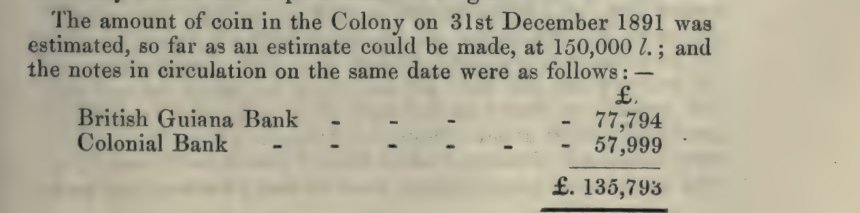
Chalmers says the British Guiana Bank was set up by Ordinance No. 82 of 1836, amended by Ordinance No. 9 of 1838 and continued by Ordinance No. 6 of 1857, and that British Guiana was the only colony in the West Indies where the Colonial Bank met a rival. Both banks issued notes of 5, 20 and 100 dollars. On 31st December 1891, Chalmers says, their notes in circulation were:
| Bank | Notes in circulation, 31st December 1891 |
|---|---|
| British Guiana Bank | 77,794 pounds |
| Colonial Bank | 57,999 pounds |
| Together, as Chalmers prints it | 135,793 pounds |
Chalmers puts the coin in the colony at about 150,000 pounds, and, at a population of about 290,000, gives 10 shillings 4 pence of coin and 9 shillings 4 pence of notes a head. In 1893 the colony's money was, in Chalmers' words, British silver and bronze, the notes of the two banks, "together with a dwindling stock of the old guilder tokens".

The annual report on British Guiana for 1908-9 (No. 632, page 8, paragraph 14) still reads: "Notes are issued by the British Guiana and Colonial Banks in denominations of $5, $20, and $100." The catalogue's pages give 1907 as the end of the British Guiana Bank's notes. What that year rests on has not been traced, and the report's sentence may be one carried on from earlier years. The point is open.
1919: a call for the Government to take the notes over
The Port of Spain Gazette of 22nd November 1919 printed the report of the Demerara Salaries Commission on "currency notes and coinage". The Commission wrote that the Government's notes were "confined at present to denominations of $2 and $1", that the colony's paper money should "as soon as possible, be brought under the sole control of the Government", and that until then the Government should get leave to issue notes of 20 and 100 dollars. It also proposed that the banks pay 1 per cent a year on their notes in circulation. This was read in the newspaper's text layer only, the page image being too small to read. The catalogue's pages date the Government's own higher values to 1938 (the 5 dollars) and 1942 (the 10, 20 and 100 dollars); working paper 247 in the Johns Hopkins currency board archive (page 3, citing the Bank of Guyana) gives 1929 for the 5, 10, 20 and 100 dollars. The two are given here as they stand.
Barclays and the Royal Bank of Canada
The annual report for 1922 (No. 1174, page 9) names the Colonial Bank and the Royal Bank of Canada as having "establishments at Georgetown". The reports for 1928 and 1929 (Nos. 1441 and 1496, page 5) name Barclays Bank (Dominion, Colonial and Overseas) and the Royal Bank of Canada. None of the three says anything of the banks' notes or gives their amount. The catalogue's pages give the Colonial Bank's notes until 1917 and Barclays' from 1926 to 1941, and say the Royal Bank of Canada issued notes in the colony too.

An article in the IBNS Journal (volume 58, number 1, page 34), drawn from Colonial Office files, says that in 1944 Barclays and the Canadian banks were made to cut their note circulation in the British West Indies by 30 per cent, and that the currency conference held in Barbados in 1946 recommended a regional currency board in place of private note issues.
The Currency Ordinance, 1950 (No. 20 of 1950, section 4(1)) forbade any banker to issue or re-issue bank notes in the colony once its part on notes came into force, on 1st August 1951. Section 13 saved "any rights" of Barclays Bank (Dominion, Colonial and Overseas), and the Bank of Guyana Ordinance of 1965 (sections 22(6) and 27(7)) did so again. The Board's memorandum on the Director of Audit's report on its accounts for 1959, as printed in the Antigua, Montserrat and Virgin Islands Gazette of 27th July 1961 (page 143), shows what that right came to. Barclays had given up of its own accord its right under its Charter to issue notes; 59,285 dollars of its notes were still out in August 1958; and on 26th September 1959 the Board paid the bank 75 dollars, the commission on 20,000 dollars, to settle its promise to replace the bank's notes free of commission. The report does not say in which territories those notes were.
The banks' notes in the collectors' papers
Few of the banks' notes appear in the papers read. Bank Note Reporter for February 2000 pictures a Royal Bank of Canada 20 dollars of British Guiana dated 1938 in an article by Slabaugh on sugar and cacao. A list of stolen notes in Bank Note Reporter for November 1988 includes a British Guiana 5 dollars of 1939, a bank's note, without a number. Henry Christensen's mail sale of 20th December 1991 offered a Barclays 5 dollars of 1926 (lot 85), and Melnick's sale of 20th December 1982 notes of the Colonial Bank and Barclays in British Guiana and Jamaica (lots 2087 to 2089, 2091 and 2092). The catalogue has no pages for the banks' notes.
What the sources do not give
- No picture or description of any note of Berbice or of Demerara and Essequibo, and no signer's name.
- The amount of each value of the old paper, at any date.
- The last year of issue of the British Guiana Bank's notes, and of the Colonial Bank's.
- The amount of the banks' notes in circulation after 1891.
Sources
- Robert Chalmers, A History of Currency in the British Colonies (London, 1893), chapter IX, pages 124 to 138, read on the page images.
- Colonial Reports, Annual: British Guiana, report for 1908-9 (No. 632), page 8; for 1922 (No. 1174), page 9; for 1928 (No. 1441), page 5; for 1929 (No. 1496), page 5.
- Port of Spain Gazette, 22nd November 1919: the report of the Demerara Salaries Commission (text layer only).
- IBNS Journal, volume 58, number 1, page 34.
- British Guiana, Currency Ordinance, 1950 (No. 20 of 1950), sections 4 and 13; Bank of Guyana Ordinance, 1965 (No. 23 of 1965), sections 22 and 27.
- British Caribbean Currency Board, memorandum on the Director of Audit's report on the accounts for 1959, Antigua, Montserrat and Virgin Islands Gazette, 27th July 1961, page 143.
- Working paper 247 (WP 247), in the Johns Hopkins currency board archive, page 3.
- Bank Note Reporter, November 1988 and February 2000.
- Auction catalogues: Harmer-Rooke, 5th December 1974; NASCA, 18th July 1979 and 5th December 1979; NASCA, 7th December 1981; Herbert I. Melnick, 20th December 1982; Henry Christensen, 20th December 1991.
Member comments
Log in or register to post a comment.