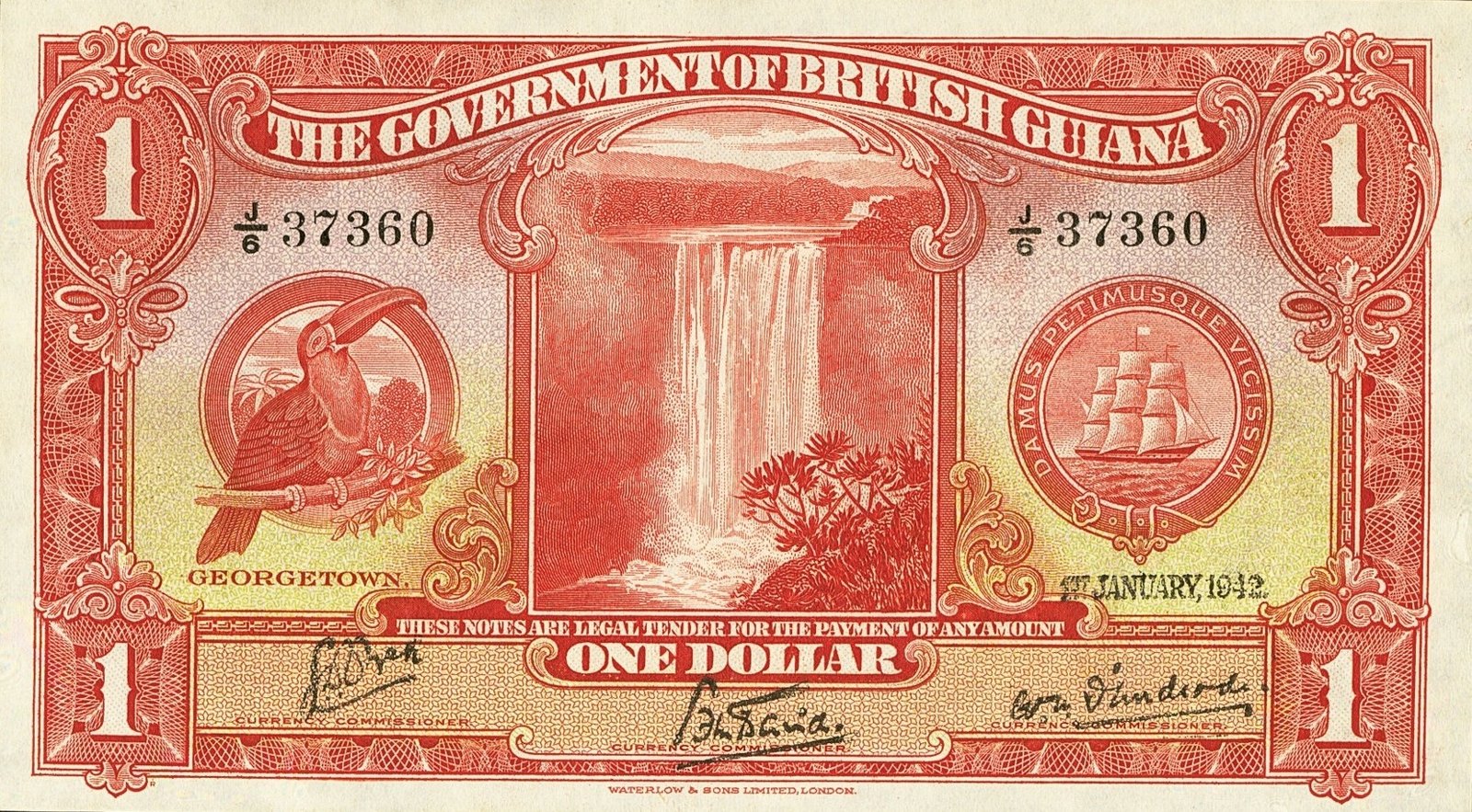
This article follows the notes of the Government of British Guiana after the British Caribbean Currency Board took them over on 1st August 1951: how much was out on that day, how the amount fell, when the notes ceased to be legal tender, and how many of each value had still not been handed in by 1962. Every figure is from the Board's annual reports, from the statements of circulation printed in the official gazettes of the territories, or from the colony's Ordinances.
The take-over of 1st August 1951
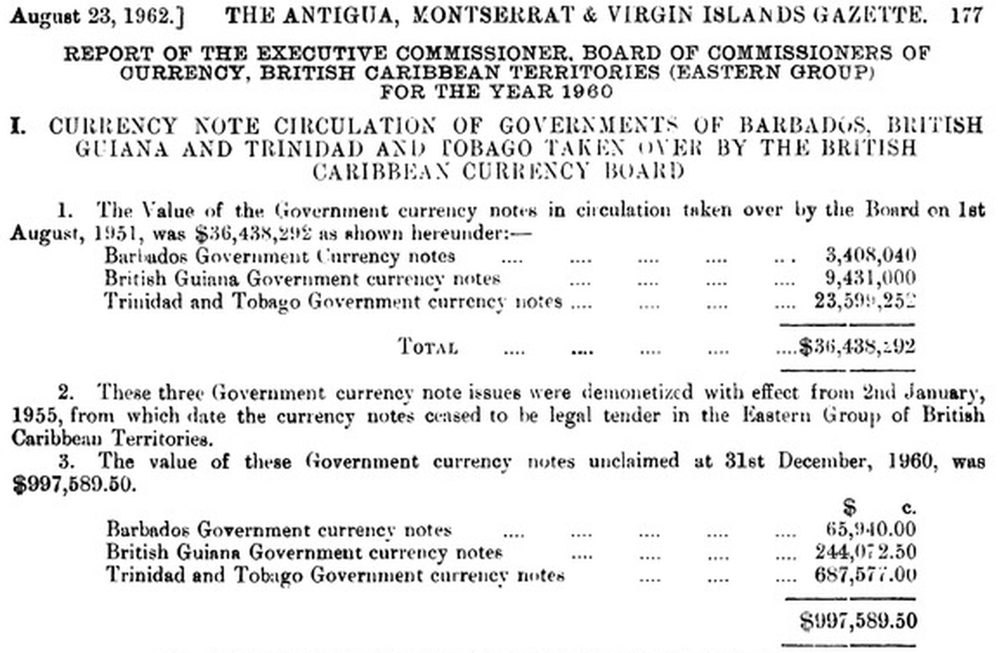
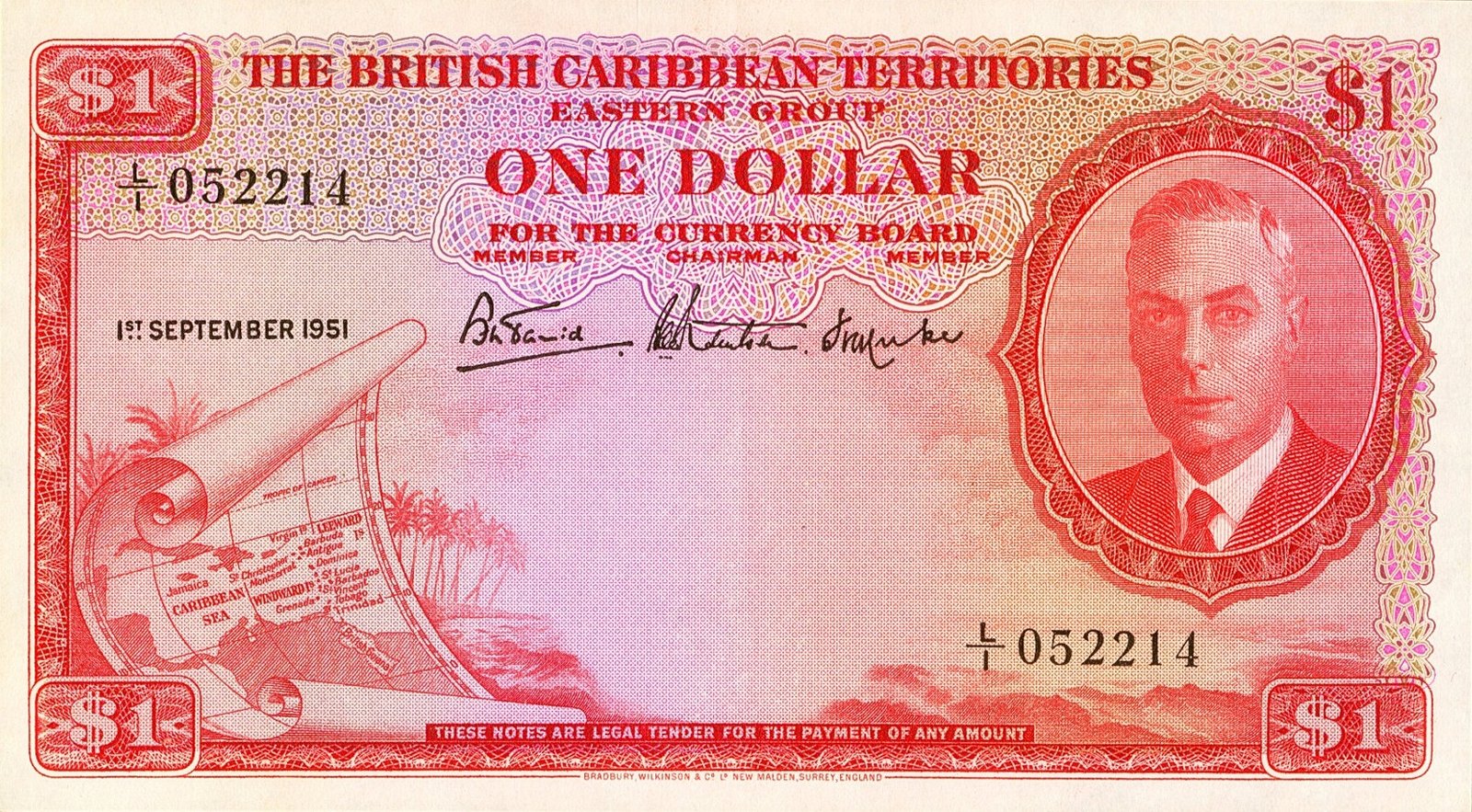
British Guiana joined the Board by its Currency Ordinance, No. 20 of 1950, assented to on 16th June 1950. The part on notes came into force on 1st August 1951, by a proclamation printed in the Official Gazette of British Guiana of 28th July 1951. The Board's report for 1960 puts the British Guiana Government notes it took over on that day at 9,431,000 dollars. In the same report the Government notes of Trinidad and Tobago come to 23,599,252 dollars and those of Barbados to 3,408,040 dollars, 36,438,292 dollars for the three.
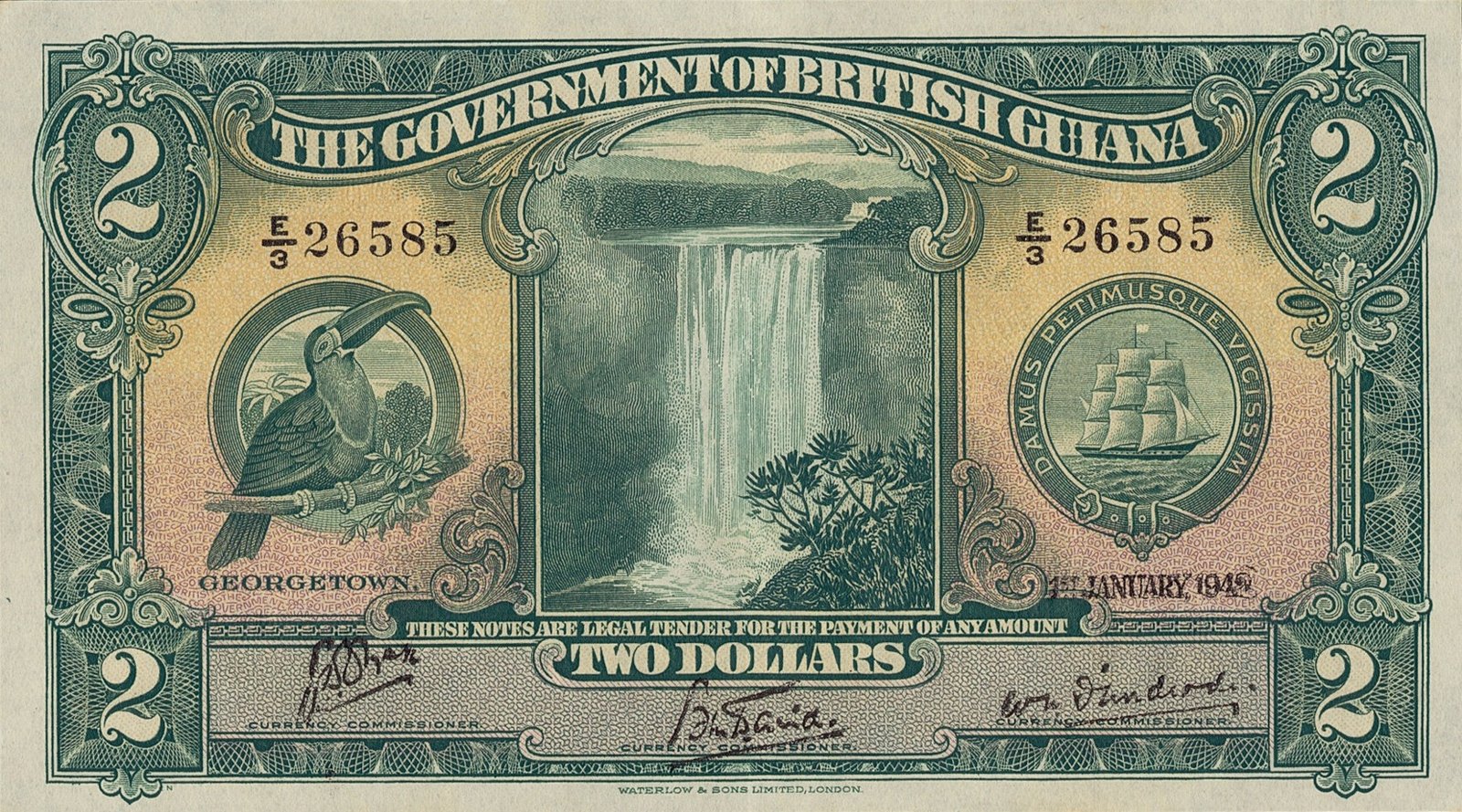
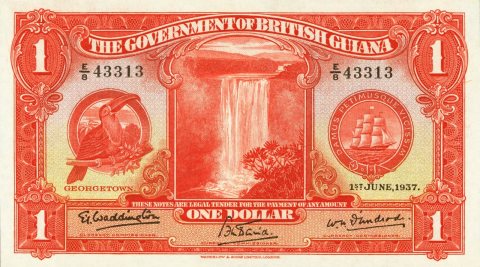
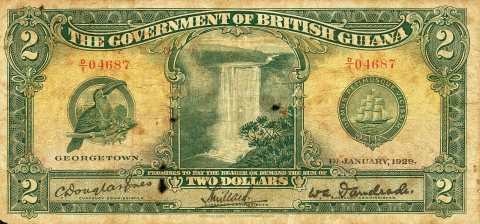
The Board first paid out its own notes on 15th August 1951. The old notes were of six values: the 1 dollar and 2 dollars, of which the latest issue is that of 1937 to 1942, the 5 dollars of 1938 to 1942, and the 10 dollars, 20 dollars and 100 dollars of 1942.
How fast the notes came in
The currency notices in the Official Gazette of British Guiana and the Board's later statements give the Government notes still out on a run of days. The figures are in dollars, as the sources print them.
| Day | British Guiana Government notes outstanding | Source |
|---|---|---|
| 1st August 1951 | 9,431,000 | The Board's report for 1960 |
| 1st November 1951 | 3,307,900 | Official Gazette of British Guiana, 24th November 1951, page 956, Currency Notice No. 2,006 |
| 1st January 1952 | 2,665,600 | Official Gazette of British Guiana, 8th March 1952, page 524 |
| 1st October 1952 | 1,090,329 | Official Gazette of British Guiana, November 1952, page 1,055 |
| 1st June 1955 | 348,208.50 | The Board's statement in the Grenada Government Gazette, 25th June 1955 |
| 1st June 1956 | 297,541 | The Board's statement in the Antigua, Montserrat and Virgin Islands Gazette, 26th July 1956 |
| 1st December 1956 | 281,162 | The Board's statement in the Official Gazette, Barbados |
| 31st August 1958 | 253,856.50 | Return of Currency Notes, West Indies Gazette, 10th October 1958, page 99 |
| 31st December 1959 | 244,670.50 | The Board's report for 1959 |
| 31st December 1960 | 244,072.50 | The Board's report for 1960 |
| 31st December 1961 | 241,532 | The Board's report for 1961 |
| 31st December 1962 | 234,978 | The Board's report for 1962 |
| 1st November 1963 | 234,796 | The Board's statement, 1st November 1963 |
| 1st October 1965 | 230,356 | The Board's statement in the Official Gazette, Barbados |
The Return of 31st August 1958 also gives the other side of the account: 9,177,143 dollars 50 cents of the 9,431,000 dollars had by then been withdrawn.
2nd January 1955
The Government notes of British Guiana, Trinidad and Tobago and Barbados ceased to be legal tender on 2nd January 1955. The Trinidad Royal Gazette Extraordinary of 31st December 1954 (notice 1222) gave the day and said that the value of the notes could still be claimed from the Board. The Board's report for 1960 says the same: the three issues "were demonetized with effect from 2nd January, 1955". The proclamation of British Guiana itself is not among the gazette pages read.
After that day the notes could still be handed in for payment. The Board's statements from 1955 on carry them on a line of their own as demonetised Government notes outstanding. On 1st June 1955, 348,208 dollars 50 cents of British Guiana notes were out. At the end of 1960 it was 244,072 dollars 50 cents.
What was still out, value by value
The Board's reports for 1959 to 1962 count the old notes by value, in an appendix that gives the number of notes of each kind in circulation at the end of the year. A half in the table is half a note.
| 31st December | 1 dollar | 2 dollars | 5 dollars | 10 dollars | 20 dollars | 100 dollars |
|---|---|---|---|---|---|---|
| 1959 | 122,981 | 16,468½ | 9,373½ | 1,482½ | 1,023 | 66 |
| 1960 | 122,880 | 16,442½ | 9,334½ | 1,473½ | 1,015 | 66 |
| 1961 | 122,641½ | 16,351½ | 9,184½ | 1,447½ | 959½ | 66 |
| 1962 | 122,418½ | 16,313½ | 8,769½ | 1,265½ | 861½ | 62 |
Three things should be kept in mind when reading the table.
- The count is by value only and does not say to which issue or date a note belongs. The Government's 1 and 2 dollars go back to 1916. The 5, 10, 20 and 100 dollars each belong to one issue only.
- A note that was not handed in is not a note that survives. The line holds every note lost, burnt or worn to nothing since it was paid out, as well as every note put away. The figures are an upper limit and nothing more.
- The reports for 1959 and 1960 were read as printed in the Antigua, Montserrat and Virgin Islands Gazette (27th July 1961, page 135, and 23rd August 1962, page 181). The reports for 1961 and 1962 were read in the copies kept among the papers of the Parliament of Guyana. The Board's reports for 1951 to 1958 and from 1963 on have not been found, so the count by value before 1959 is not known.
The law repealed and the duty passed on
Ordinance 20 of 1956, assented to on 25th May 1956, repealed the Government Currency Notes Ordinance with effect from 1st August 1951 and paid what was left of the Note Security Fund into general revenue. The notes could still be claimed from the Board, as the notice of 31st December 1954 had said.
The British Caribbean Currency Agreement was made at Port of Spain on 12th December 1964. Under the Agreement the duty to pay the old Government notes went back to British Guiana when its own bank started, and section 65 of the Bank of Guyana Ordinance of 1965, assented to on 15th October 1965, passed that duty to the new Bank of Guyana. British Guiana left the Board for its own central bank and the Guyana dollar at independence in 1966.
The Board's statement of 1st October 1965 still shows 230,356 dollars of British Guiana Government notes outstanding. What the Bank of Guyana paid out on old notes after that has not been found in any source read.
Sources
- British Caribbean Currency Board, reports of the Executive Commissioner for 1959, 1960, 1961 and 1962, with Appendix I (number of notes in circulation by value).
- Official Gazette of British Guiana, 28th July 1951; 24th November 1951, page 956 (Currency Notice No. 2,006); 8th March 1952, page 524; November 1952, page 1,055.
- The Board's monthly Statements of Currency Note Circulation as printed in the Grenada Government Gazette (25th June 1955), the Antigua, Montserrat and Virgin Islands Gazette (26th July 1956), the Official Gazette of Barbados (statements of 1st December 1956 and 1st October 1965) and the statement of 1st November 1963; the Return of Currency Notes at 31st August 1958, West Indies Gazette, 10th October 1958, page 99.
- Trinidad Royal Gazette Extraordinary, 31st December 1954, notice 1222.
- Currency Ordinance, No. 20 of 1950; Ordinance 20 of 1956; the British Caribbean Currency Agreement of 12th December 1964; Bank of Guyana Ordinance, 1965, section 65.
Member comments
Log in or register to post a comment.