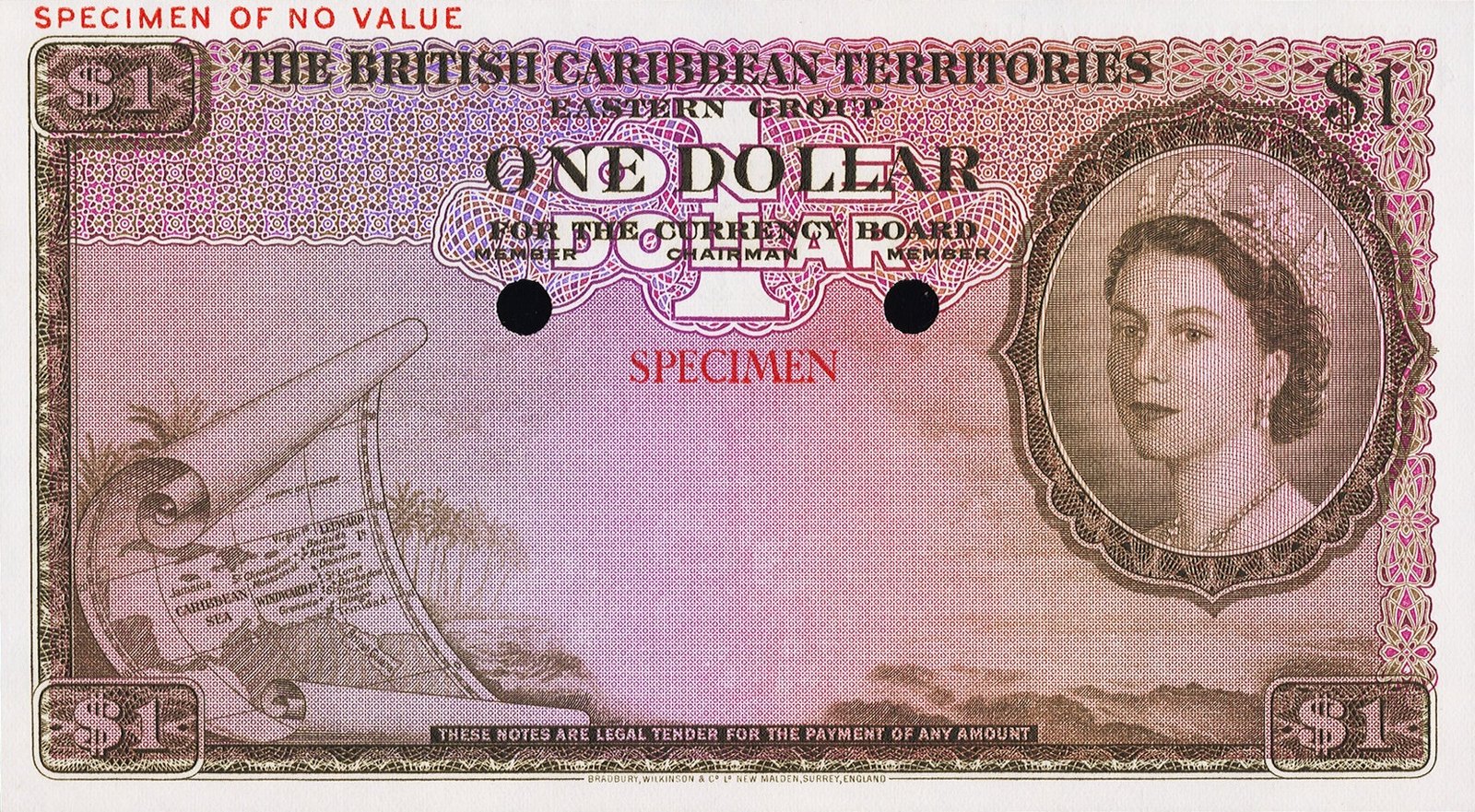
This article gathers what the auction houses wrote about the designs, specimens and colour trials of the British Caribbean Territories, and the counts of graded notes they quoted for the issued notes. Every statement below is the claim of the house named, on the day of its sale. Where the catalogue's note pages say something on the same point, that is set beside it. The story of the Board and its issues is in The British Caribbean Currency Board and its notes, 1950 to 1968.
A drawing of 14th July 1948
Stack's Bowers offered a hand drawn design for the front of a 1 dollar note as lot 50053 on 8 May 2025. The house's description gives its date as 14.7.1948. The note pages have the Board constituted on 28th November 1950. The heading reads "British Caribbean Colonies", which the house takes to be the name considered before "British Caribbean Territories".
The description says the drawing has parts that came through to the issued note and many that did not. The portrait of King George VI differs from the one used. At the right is a portrait the house believes to be Admiral Horatio Nelson, with a scene the house reads as the Battle of Cape St. Vincent. The colours are mainly yellow, blue and green. The piece is uniface, and PMG put it in a holder without a grade. The house calls it unique to the best of its knowledge, and names neither the artist nor the printer.
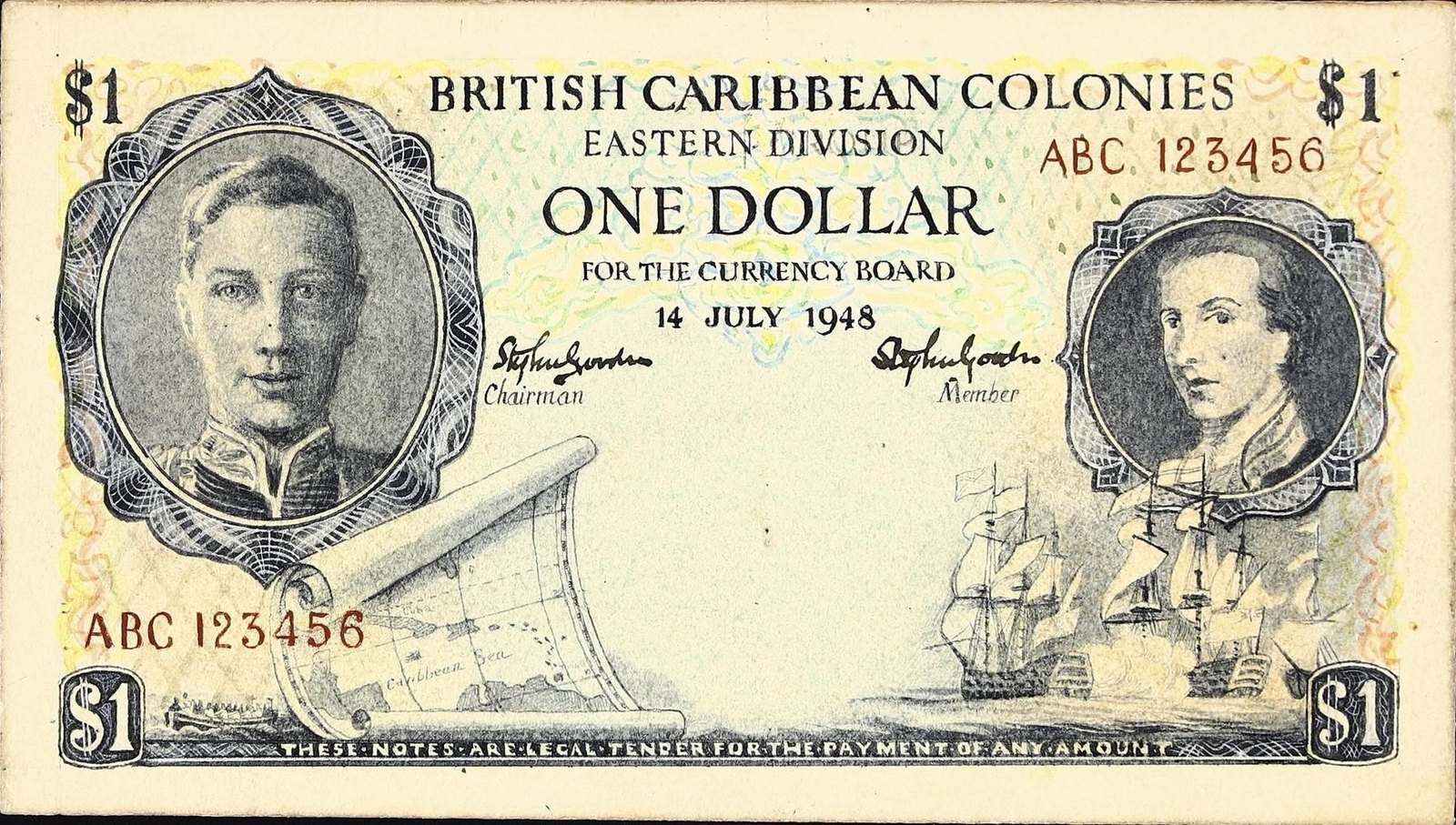
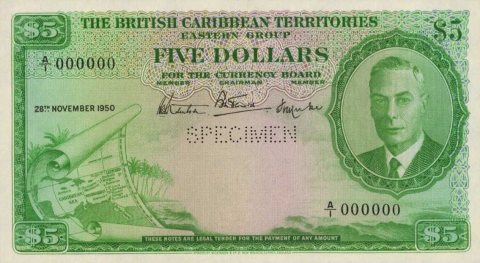
The note pages add the other end of the story. Specimens of the six notes were shown to the public in each territory on 27th April 1951, and the Barbados Advocate reported next day that Bradbury Wilkinson's designs had been chosen in preference to those of De La Rue and Waterlow.
The Queen's portrait, August 1952
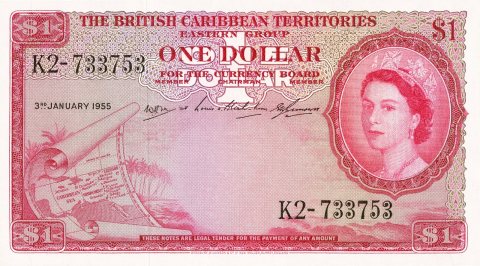
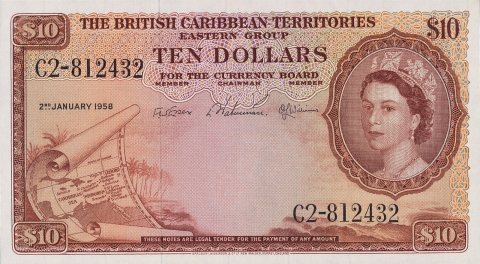
The note pages say only that the portrait follows a 1952 photograph by Dorothy Wilding, engraved by Bradbury Wilkinson, and name no source. Spink's description of lot 320 in its sale of 2 October 2019 gives days. The lot, as Spink describes it, was two black and white pulls of the portrait, engraved by Bradbury Wilkinson on paper and fixed to card, the first marked in ink "As submitted 12. 8. 52" and the second with a signed approval in red ink dated 29/8/52.
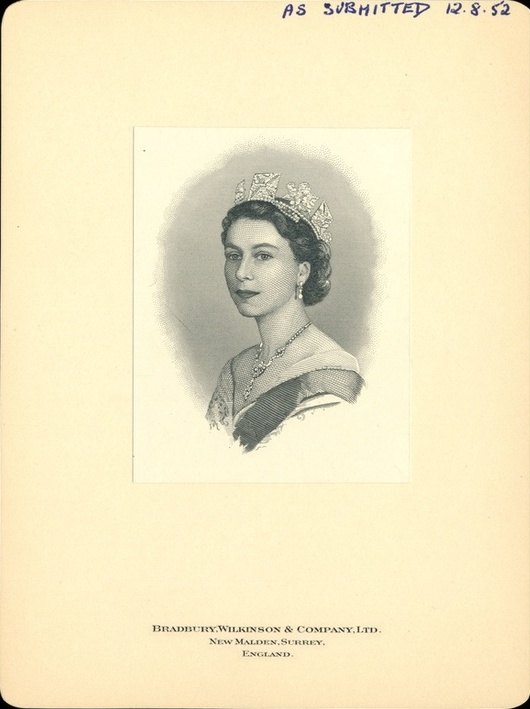
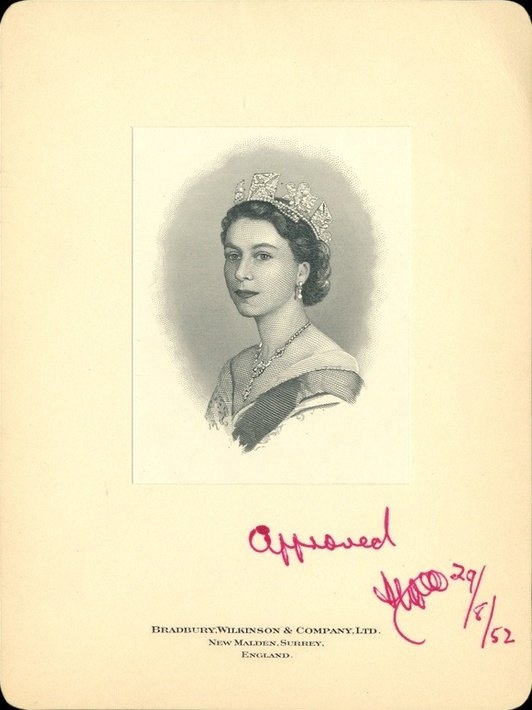
Spink says the photograph was taken at a single sitting shortly after the accession, that the Queen wears the George IV State Diadem and a necklace of diamond flowers and leaves given as a wedding present by the Nizam of Hyderabad and Berar, and that this is Portrait 4a in Peter Symes's article "The Portraits of Queen Elizabeth II". The house lists the issuers that used it: Belize, Bermuda, the British Caribbean Territories, British Honduras, Cyprus, Fiji, Hong Kong, Mauritius, and Rhodesia and Nyasaland.
The first notes with the portrait are dated 5th January 1953.
A 1951 note with the Queen's portrait
One piece shows the change being tried on the old note. The 20 dollars of 1953 to 1964 page files a specimen of the 1st September 1951 King George VI 20 dollars struck with the Queen's portrait in place of the King's, as a design for the new issue. Heritage offered it as lot 22092 on 8 December 2023. The house's description says the date, the signatures and the prefix are all those of the King George VI series, and that the issued Queen Elizabeth II notes changed these.
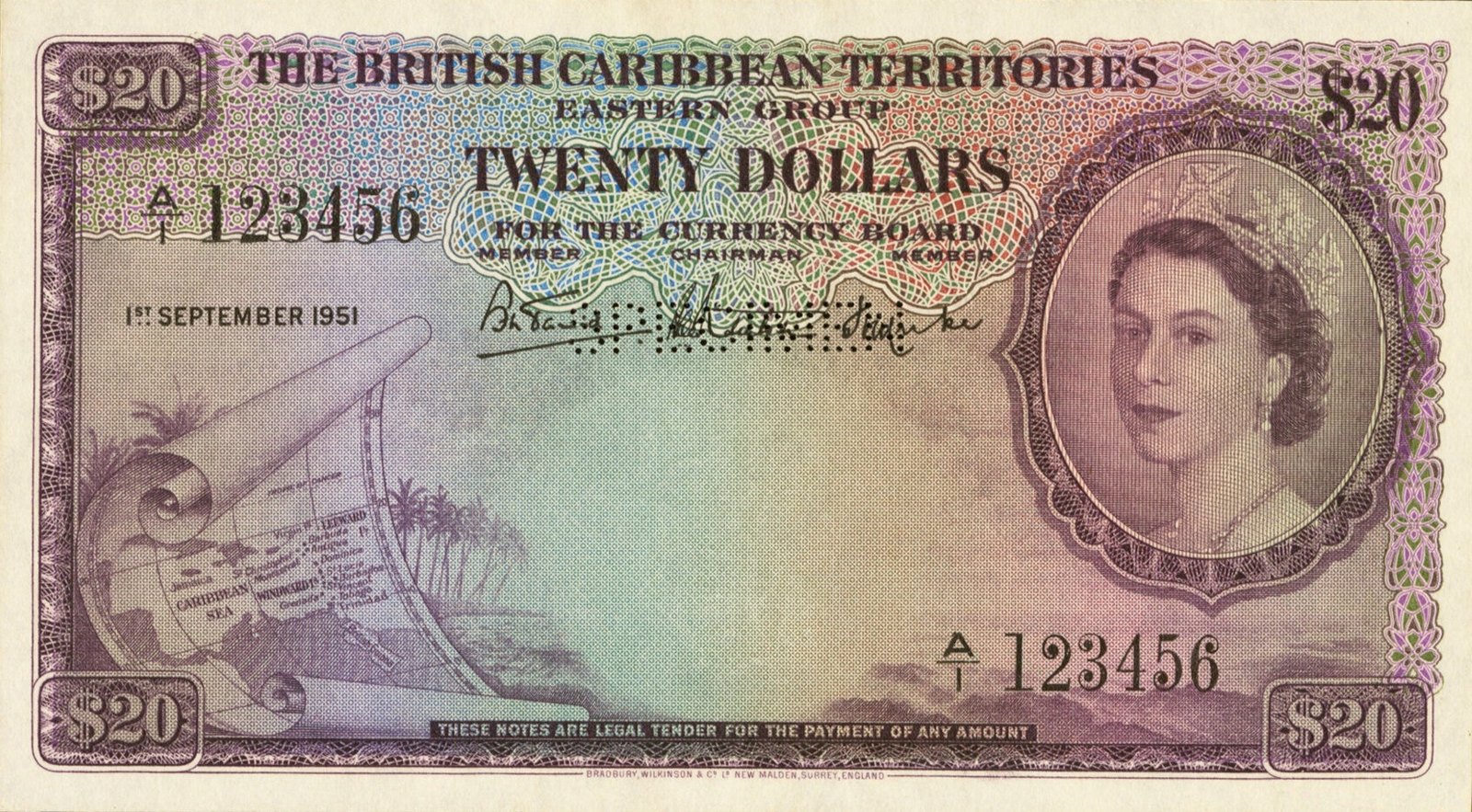
Specimens with a range of numbers
Some specimens of the Board's notes do not carry a single number. They print the first and the last number of a printing. The note pages call these range specimens and use them to fix where each date begins and ends.
Two of Heritage's descriptions of 8 December 2023 read a quantity out of such a range for the 100 dollars of 1953 to 1963. Lot 22095, dated 2nd January 1957, is said to show a range of 100,000 notes, which the house thinks could be the number printed for that date. Lot 22097, dated 2nd January 1963, is said to show that 25,000 pieces were to be printed for that date. These are the house's readings. The note page gives the whole run of the four dates as A2 000,001 to A2 235,000 and states no number printed.
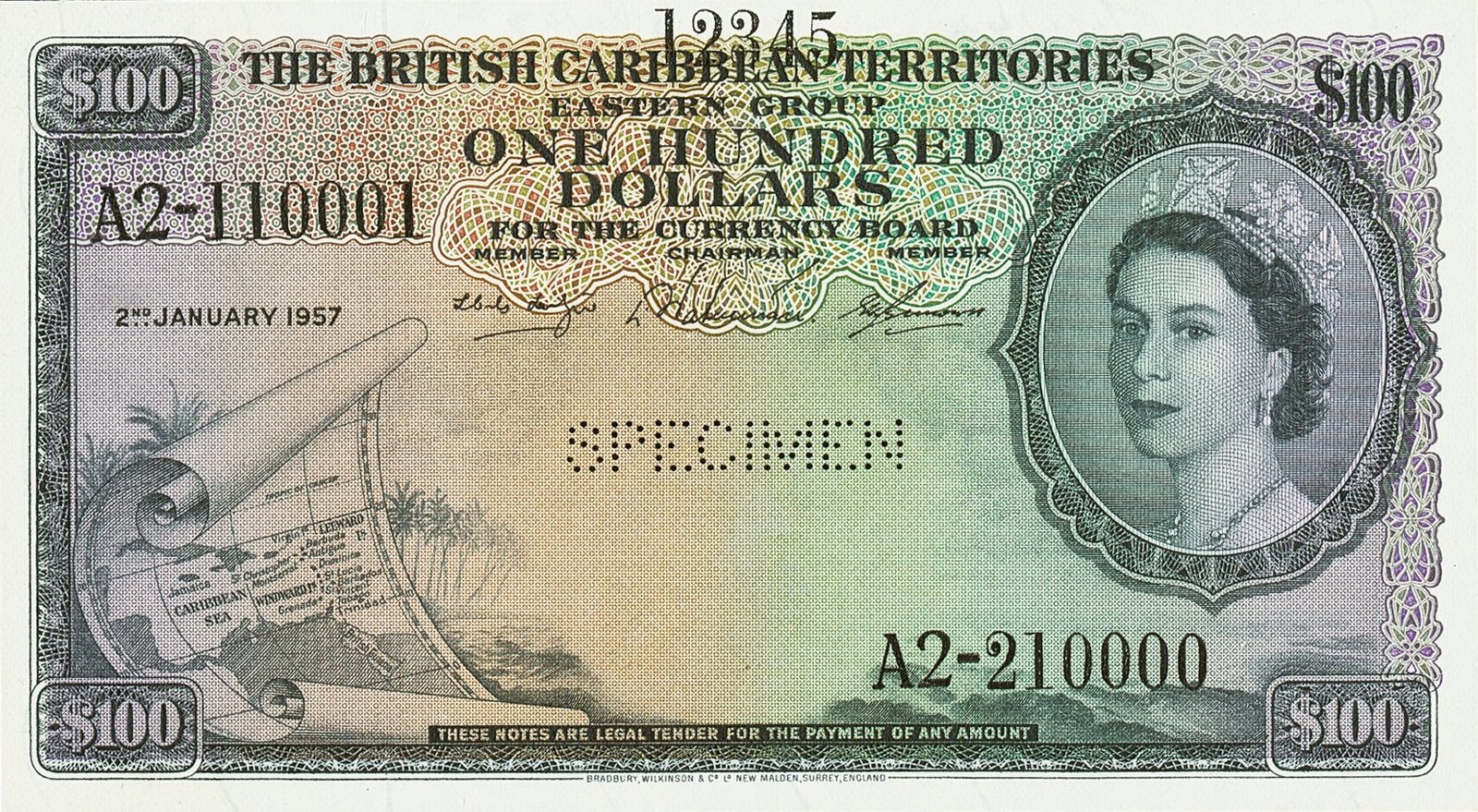
Other descriptions tell of the marks the printer left on specimens:
- Stack's Bowers, 4 May 2023, lot 50154: a 100 dollars specimen of 1957 with a black 12345 at the top of the front and a date of 8/1/57 in pen on the back.
- Stack's Bowers, 22 April 2009, lot 451: a 2 dollars specimen of 2nd January 1964 with a "12345" ladder on the top edge and small notes written there.
- Stack's Bowers, 16 January 2026, lot 30068: a 20 dollars specimen dated 2nd January 1962 on the note and November 1961 in the margin. The house takes this to show the specimen was made before the notes of the new date were issued.
- Stack's Bowers, 16 January 2026, lots 30066, 30068 and 30071, from the Jerry and Diane Fishman Collection: PMG notes printer's annotations and that the pieces were once mounted.
A second kind of specimen has a serial number of noughts and a single perforated cancellation. Heritage describes such pieces of the 5 dollars of 3rd January 1956 (8 December 2023, lot 22076), the 20 dollars of 2nd January 1957 (21 April 2022, lot 25319) and the 100 dollars of 2nd January 1957 (21 April 2022, lot 25320).
Colour trials
The note pages list a colour trial specimen for the King George VI 5 dollars and for each of the six Queen Elizabeth II values. The houses describe five of them:
| Value | Colour as the house gives it | House, sale and lot |
|---|---|---|
| 5 dollars, King George VI | Red specimen overprint, three punch holes, "Specimen No. 35" (catalogued here as the blue-green trial; the house's title calls it P-3s) | Stack's Bowers, 4 May 2023, lot 50137 |
| 1 dollar, Queen Elizabeth II | Not named by the house (purple on the note page) | Heritage, 23 March 2023, lot 24108 |
| 5 dollars, Queen Elizabeth II | Orange and blue in place of the green of the issued note (orange and green on the note page) | Heritage, 8 December 2023, lot 22077 |
| 20 dollars, Queen Elizabeth II | Green, where the issued note is purple; undated, without signatures or numbers | Heritage, 8 December 2023, lot 22091, and 17 August 2018, lot 28010 |
| 100 dollars, Queen Elizabeth II | Blue, where the issued note is black | Stack's Bowers, 2 October 2024, lot 20084; Heritage, 8 December 2023, lot 22096, and 17 August 2018, lot 28012 |
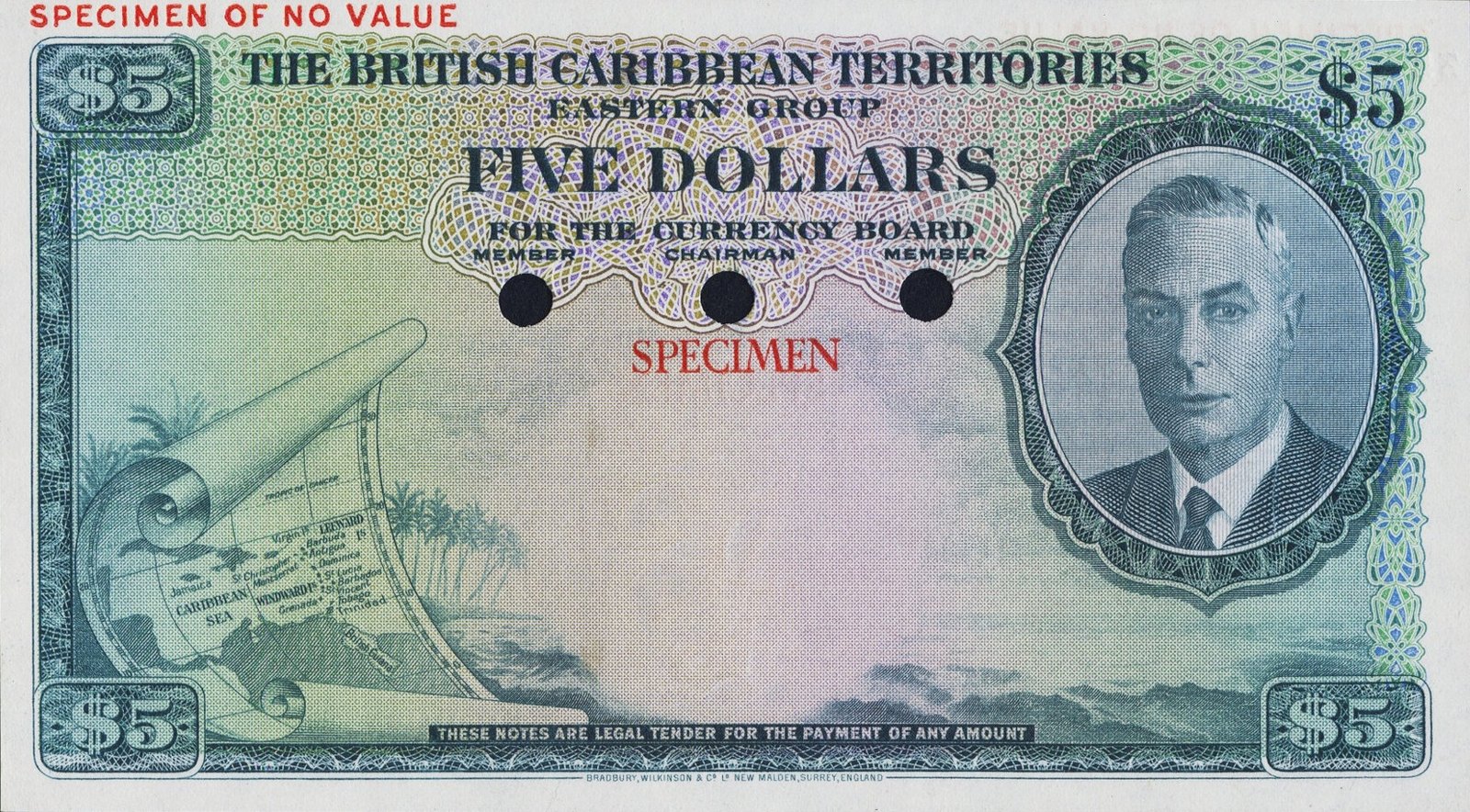
Heritage's description of lot 28012 warns that the blue 100 dollars trial can be taken for a 2 dollars note at a glance. The house says the blue is deeper and the underprint pattern different. Of the green 20 dollars the house says, in its description of lot 28010, that the colour is that of the issued 5 dollars.
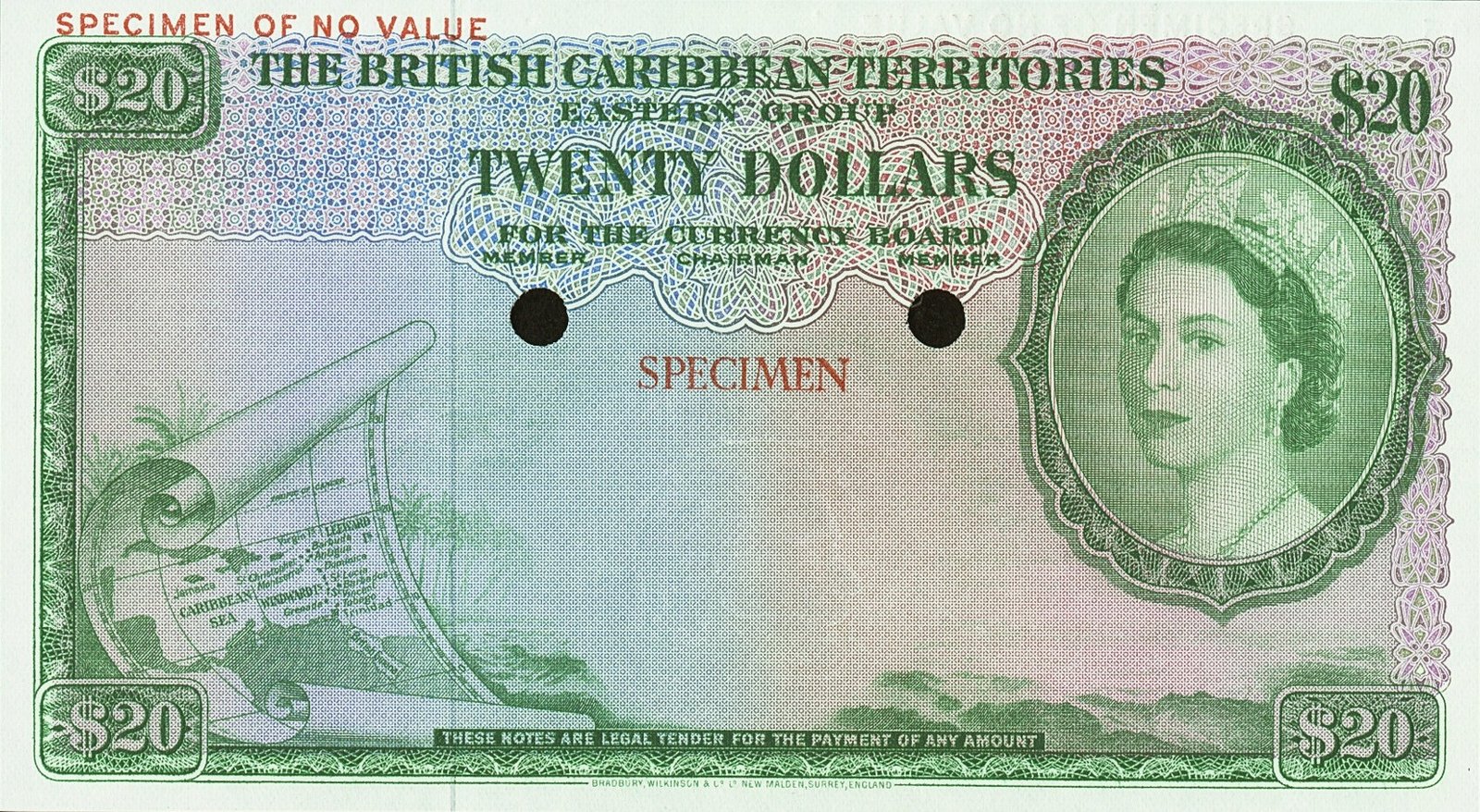
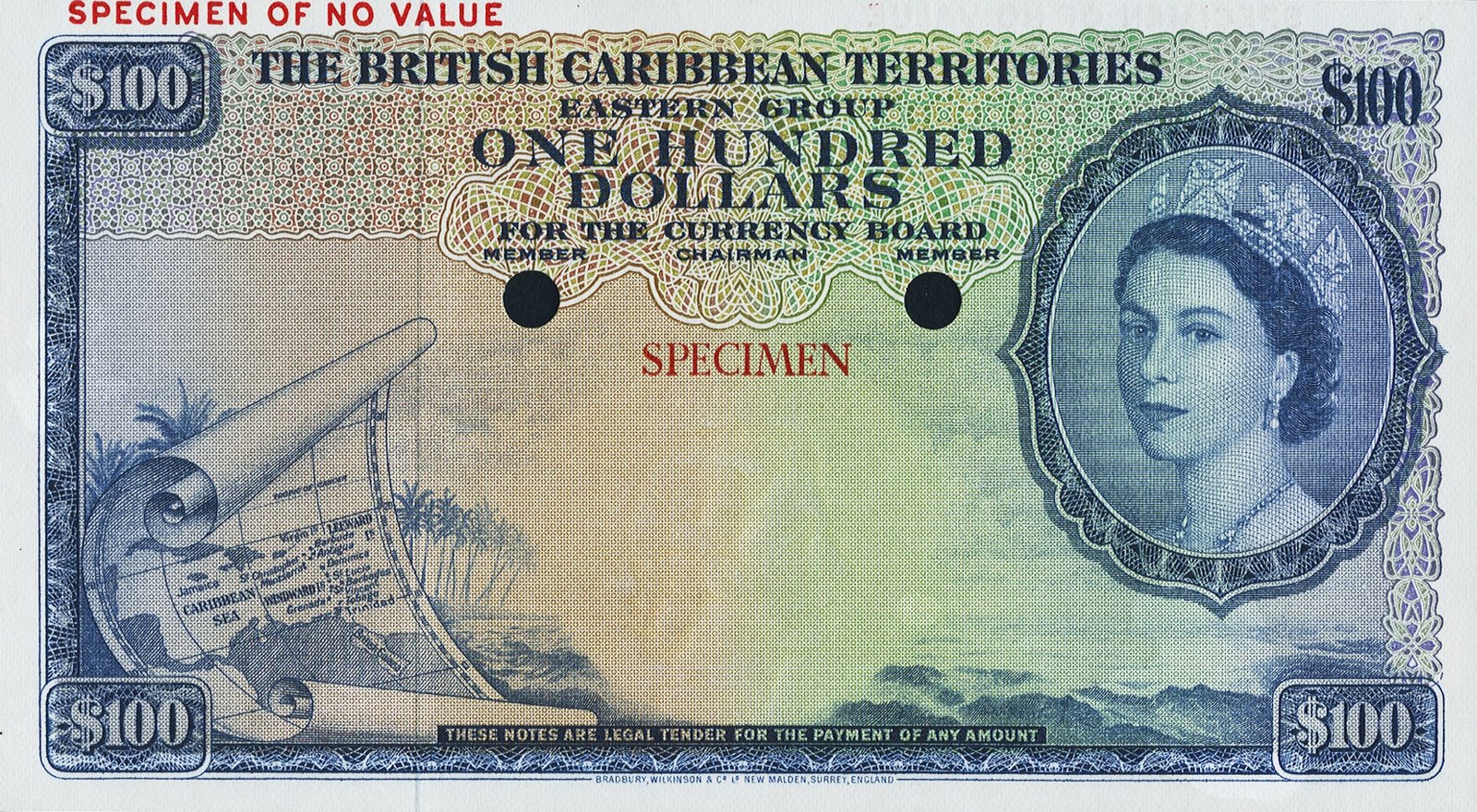
Heritage's description of lot 24108 gives the house's view of why such trials exist: the printer made several colourings of each note so that officials could choose, and also used trials to show its work to other customers. The note pages do not say which officials saw the trials of this issue, or when.
The pages also list proofs, progressive proofs and a reverse proof of the Queen Elizabeth II values, and an error note of the 10 dollars of 3rd January 1956. The house descriptions in hand say nothing of these.
The issued 100 dollars: what each house counted
The figures below are PMG's counts of notes it had graded, as each house quoted them on the day. They are not counts of the notes that survive.
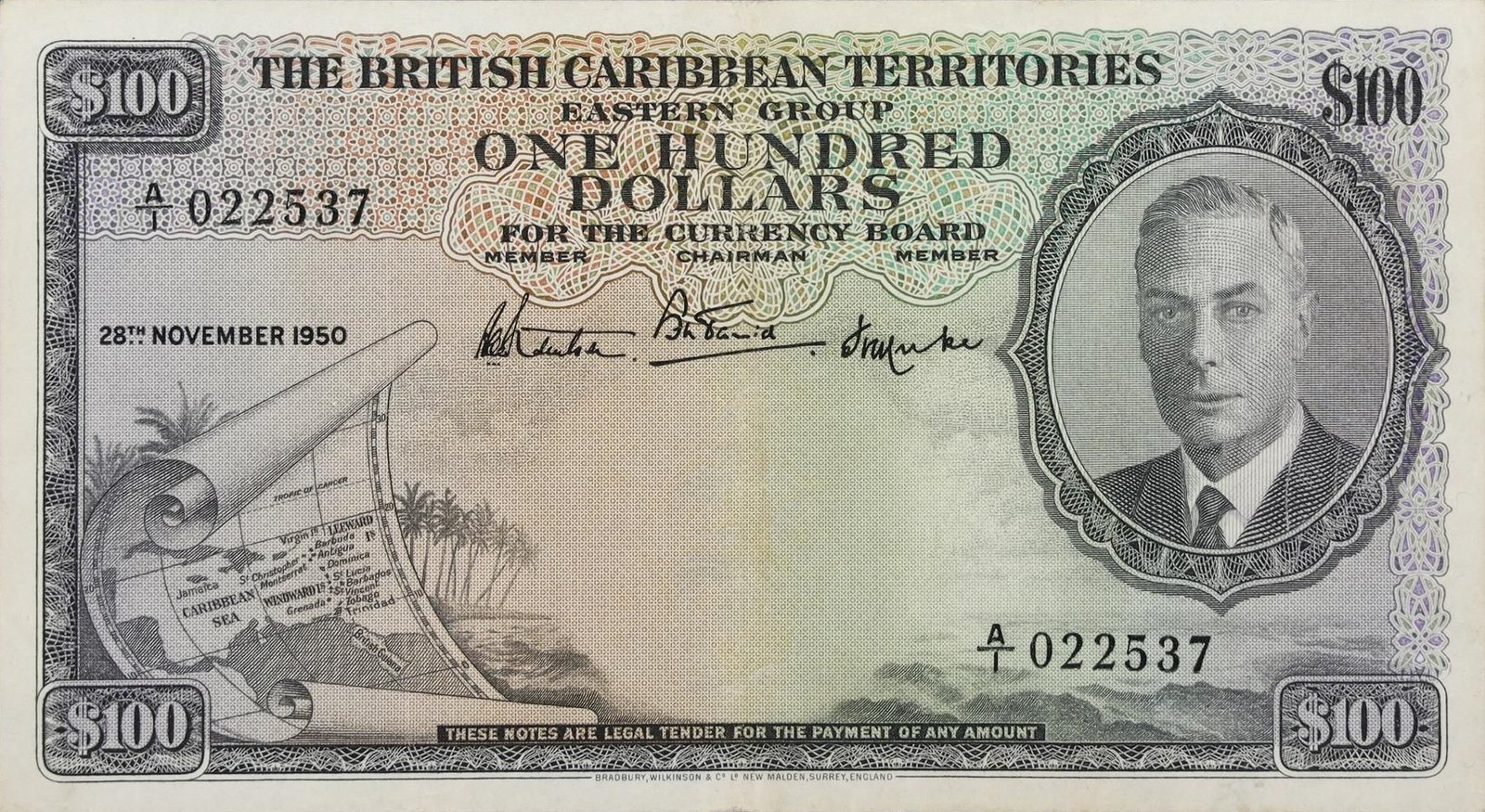
King George VI, 100 dollars of 1950 and 1951. Stack's Bowers, 17 January 2025, lot 20058, a note of 28th November 1950: three notes graded in all, this one at Choice Very Fine 35 and the other two at Very Fine 25. The house says it had never before offered the type as an issued note, and heads the lot as the first public offering since 2009.
Queen Elizabeth II, 100 dollars of 1953 to 1963. Heritage, 8 December 2023, lot 22093, a note of 5th January 1953: two examples of that date graded. Heritage, the same sale, lot 22094, a note of 2nd January 1957: one of three notes graded. Stack's Bowers, 16 January 2026, lot 30070, a note of 5th January 1953: two graded of that date, both Very Fine 20, and seven notes graded of all dates together, the best a single Very Fine 35.
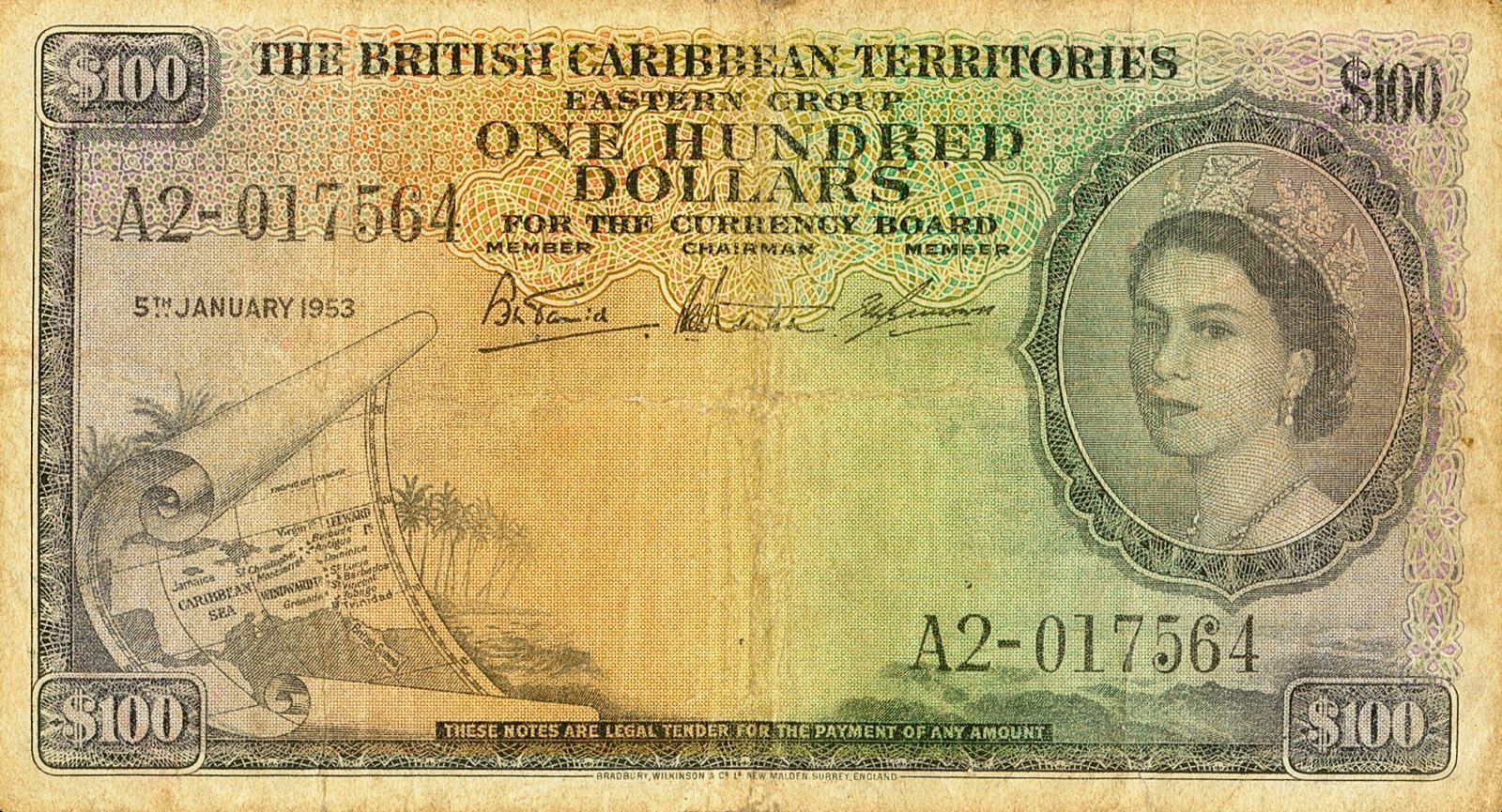
Heritage's descriptions of lots 22093 and 22094 point out that every date from 1953 to 1963 uses the prefix A2, and that of lot 22094 takes this as a sign of how few were issued. The note page agrees on the prefix. The Board's report for 1962 counts 117,045 of its 100 dollar notes, both portraits together, in circulation at the end of that year.
Other counts the houses quoted
| Note | What the house said | House, sale and lot |
|---|---|---|
| 5, 10, 20 and 100 dollars specimens, 1950 and 1951 | Four or five of each specimen graded; two of the 100 dollars | Stack's Bowers, 5 August 2020, lot 30063 |
| 100 dollars specimen, 28th November 1950 | Three graded, one of them higher than the lot | Spink, 12 January 2024, lot 43 |
| 5 dollars of 1950 and 1951, a specimen in the house's title, filed here as the colour trial | One of five graded of that variety | Stack's Bowers, 4 May 2023, lot 50137 |
| 10 dollars, 1st September 1951 | The only one graded uncirculated; one About Uncirculated and one Extremely Fine; the rest Very Fine or lower | Stack's Bowers, 16 January 2026, lot 30063 |
| 20 dollars, 1st September 1951 | The highest graded, at About Uncirculated 50 | Heritage, 9 May 2023, lot 28058 |
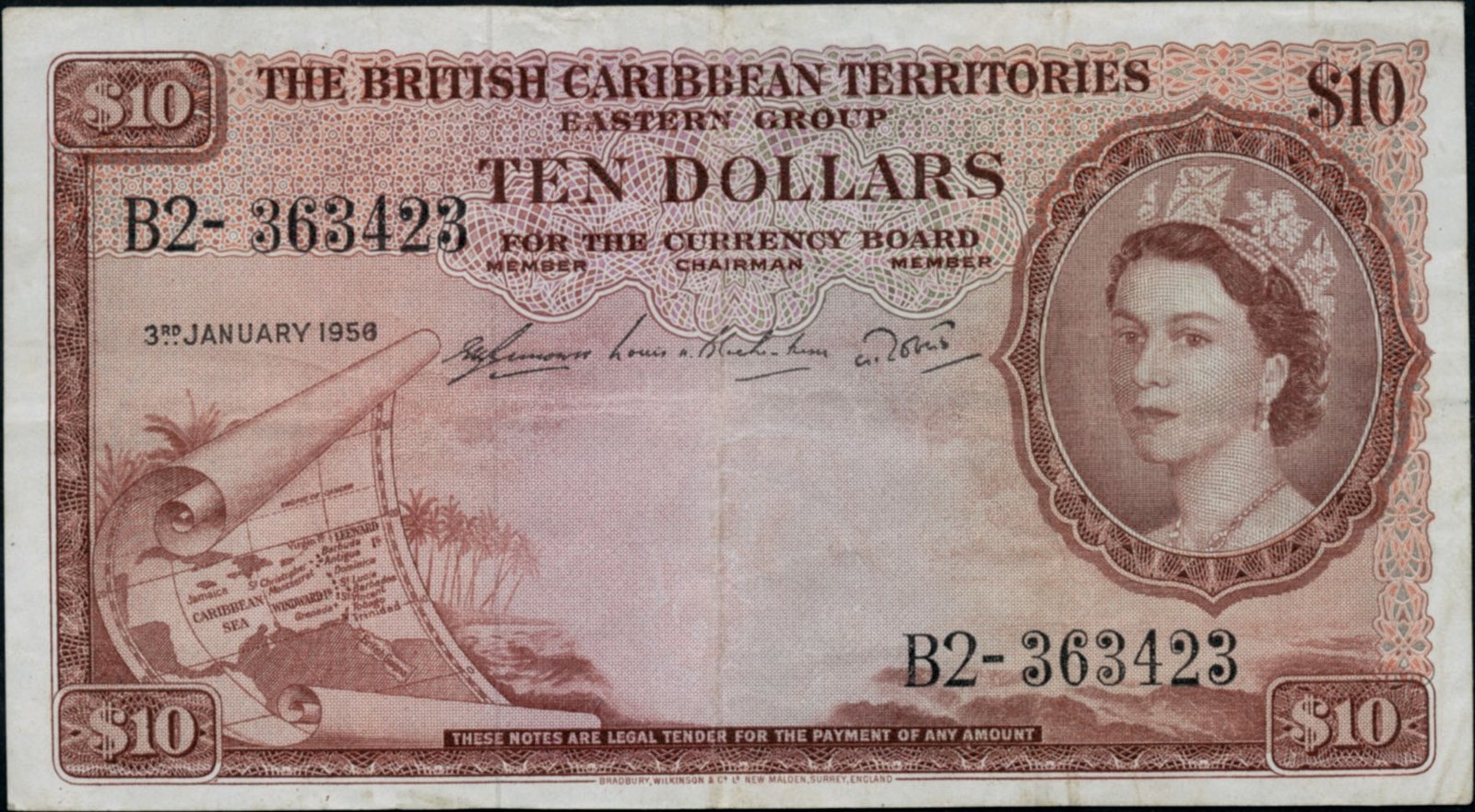
| 10 dollars, 5th January 1953 | The highest graded of that date, at Extremely Fine 40 | Heritage, 9 November 2023, lot 24097 |
| 5 dollars, dates of 1955 to 1959 | Eight graded uncirculated for all those dates | Heritage, 21 April 2022, lot 25054 |
| 20 dollars specimen, 2nd January 1957 | Eleven graded | Heritage, 21 April 2022, lot 25319, and 20 October 2022, lot 25037 |
| 100 dollars specimen, 2nd January 1957 | Four graded | Stack's Bowers, 4 May 2023, lot 50154 |
Stack's Bowers adds a detail about the 10 dollars of 1951 in lot 30063 of 16 January 2026: PMG notes pinholes, and the house supposes the note was once stapled to a paper, perhaps a receipt, and was kept for that reason.
Collections named in the sales
The house descriptions name these collections as the source of British Caribbean notes: the Jerry and Diane Fishman Collection and the Prosperity Collection (Stack's Bowers); the Nordjysk Collection (Stack's Bowers, 29 October 2026); the Queen Elizabeth II Collection, the Ibrahim Salem Collection, the Thomas Collup Collection, the Bruce Smart Collection, the Minot Collection, the Feeling Good Collection and the Balmoral Collection of Queen Elizabeth II (Heritage). Spink offered the portrait pulls in the second part of the Ibrahim Salem Collection of British Commonwealth.
Where the houses and the note pages differ
- Spink, 12 January 2024, lot 43, names Barbados, British Guiana, British Honduras and the British Virgin Islands as the territories of the Board, and puts its dissolution in 1965. The note pages give Trinidad and Tobago, British Guiana, Barbados, the Leeward Islands and the Windward Islands, and 30th June 1967 as the day set for the dissolution.
- Spink, 19 January 2024, lot 56, says the Eastern Group existed from 1955 to 1964 and was governed by an Eastern Caribbean Currency Authority. On the note pages the issuer is the Board from 1950, and the East Caribbean Currency Authority took over in March 1965.
- Stack's Bowers, 17 January 2025, lot 20058, and 16 January 2026, lot 30070, say the Board's currency was introduced in 1951. The note pages have the first notes dated 28th November 1950 and put into circulation on 15 August 1951.
- Several holders and titles use a shorter row lettering than the note pages, which give each date its own row. Stack's Bowers's lot 17003 of 29 October 2026, a 10 dollars of 2nd January 1958, is titled P-10b and stands here on P-10e.
Sources
- Stack's Bowers: 22 April 2009, lot 451; 5 August 2020, lot 30063; 4 May 2023, lots 50137 and 50154; 2 October 2024, lot 20084; 17 January 2025, lot 20058; 8 May 2025, lot 50053; 16 January 2026, lots 30063, 30066, 30068, 30070 and 30071; 29 October 2026, lot 17003.
- Heritage Auctions: 17 August 2018, lots 28010 and 28012; 21 April 2022, lots 25054, 25319 and 25320; 20 October 2022, lot 25037; 23 March 2023, lot 24108; 9 May 2023, lot 28058; 9 November 2023, lot 24097; 8 December 2023, lots 22076, 22077, 22091, 22092, 22093, 22094, 22095, 22096 and 22097.
- Spink: 2 October 2019, lot 320; 12 January 2024, lot 43; 19 January 2024, lot 56.
- The catalogue's note pages for the British Caribbean Territories, and through them the Barbados Advocate of 28th April 1951 and the Board's report for 1962.
Member comments
Log in or register to post a comment.