Most of what the catalogue's pages say about the notes of the Government of Cyprus with the words "sources mention" goes back to a few articles in two collectors' journals. This article names them, says what each one added, and sets the writers beside one another where they differ. It rests on the articles themselves, in the IBNS Journal and in Bank Note Reporter, as they were read for the catalogue. One book stands behind several of them and was not read: Major F. Pridmore, Modern Coins and Notes of Cyprus, published by the Central Bank of Cyprus in Nicosia in 1974. It is known here only through the writers who cite it.
The writers
| Year | Writer | Where | Subject |
|---|---|---|---|
| 1969 | Major F. Pridmore | IBNS Journal 9:1, Autumn 1969, pp. 13 to 16 | the Turkish Treasury notes that were current in Cyprus in 1878 and 1879 |
| 1974 | Robert Obojski | Bank Note Reporter, March 1974, p. 18 | a short account of the island and its notes, with a specimen 5 pounds of 1st June 1955 pictured |
| 1974 | Roger V. McNeice | Bank Note Reporter, April 1974, p. 19 | a survey and list of all the issues |
| 1983 | Fred Schwan | Bank Note Reporter, February 1983, pp. 6 and 16 | the notes of the Second World War, from Pridmore's book |
| 1983 | Michael L. Santamas | IBNS Journal 22:4, pp. 108 to 112 | the unusual issues, and a list of every date with the number printed |
| 1993, 2010, 2015 | Neil Shafer | Bank Note Reporter, August 1993, from p. 32; October 2010, pp. 118 to 120; September 2015, p. 64 | cut notes, among them the 3 piastres of 1943 |
| 2005 | Peter Symes | IBNS Journal 44:2, pp. 8 to 20 | the portraits of Queen Elizabeth II on bank notes |
| 2016 | Jamie Sanz | IBNS Journal 55:4, pp. 19 to 23 | designs for Cyprus notes that were not used, from printers' photographs |
| 2017 | Alexis Galatariotis | IBNS Journal 56:3, pp. 21 to 25 | the notes of 1952 to 1960 |
Pridmore's article of 1969 is about paper money older than the Government's notes and has its own article: The Turkish kaime in Cyprus, 1876 to 1879.
1974: two surveys in Bank Note Reporter
The two pieces of 1974 are the earliest general accounts found. Neither names a source, and several of their statements do not agree with the notes.
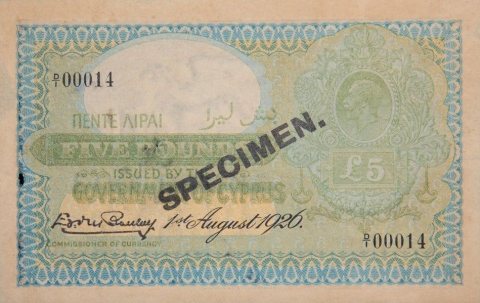
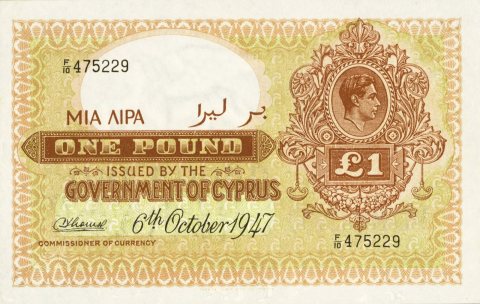
McNeice's survey says the bust of George V did not appear on the notes until 1920. The catalogue's pages show the King in profile on the 10 shillings, 1 pound and 10 pounds of 30th June 1917. The list under the survey gives a 1 shilling and a 2 shillings of 1918, where the notes are dated 12th November 1919 and 1st March 1920, and a 5 pounds of 1917, where the 5 pounds of that design is dated 1926 and 1927. It says that the Queen's issue had notes of 1, 2 and 5 shillings and that the 250 and 500 mils were introduced in 1957, and it dates the first 250 mils 1 March 1955. The catalogue has one note in shillings with the Queen, the 5 shillings of 1st September 1952, and the mils notes are dated from 1st June 1955.
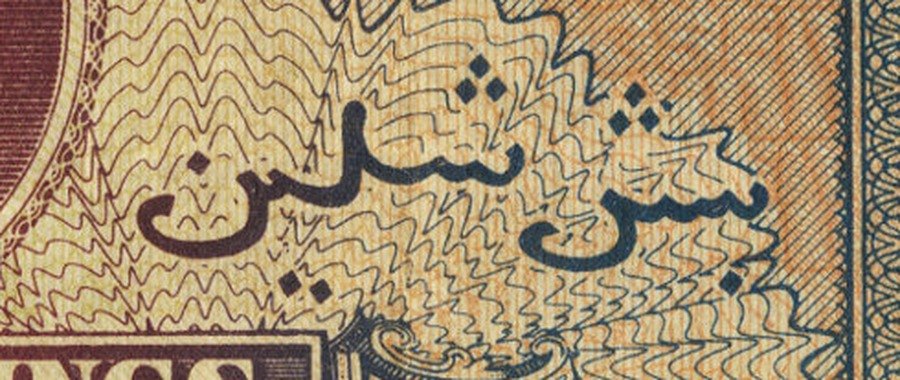
Obojski's piece says that the notes before those of the Republic were printed in Greek and English only. The pages record Turkish on the notes as well, in Arabic letters until 1951 and in Latin letters from the 5 shillings of 1952.

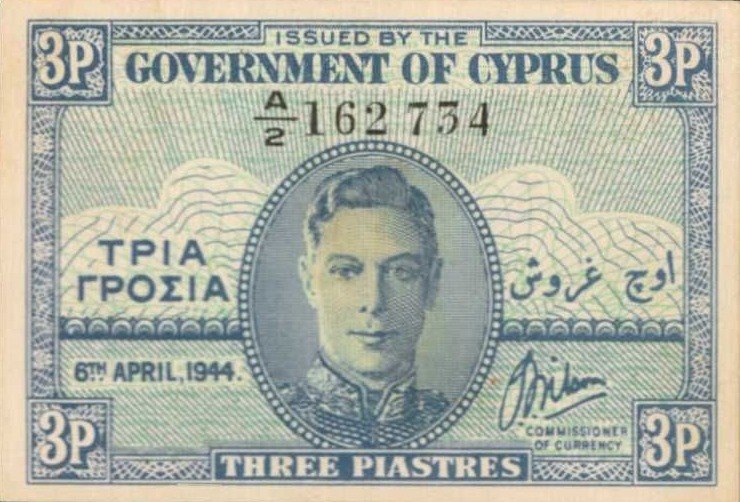
What the survey of April 1974 did add is a picture: a 3 piastres dated 6th April 1944, which is on the catalogue's register as a published record.
1983: Santamas and the files of the Central Bank
The article by Michael L. Santamas is the source of the numbers printed. Its last two pages are a list of the dates of every value, each with a quantity, from 1914 through the Government's notes to those of the Republic and the Central Bank up to 1982. The catalogue's pages took their "sources mention" figures for the notes of 1914 to 1954 from that list, and its figures for 1955 to 1960 are the same as those the pages give as printed. They are set out in Cyprus notes printed, held back and destroyed, 1914 to 1960, which could not name where they stood.
Santamas gives four sources at the end: Pridmore's book; the Numismatic Report of the Cyprus Numismatic Society; Cyprus Gazettes of the time, from the library of the District Officer at Larnaca; and files of the time in the archives of the Central Bank of Cyprus. The article does not say which figure comes from which.
The text before the list tells the story of the unusual issues. These are the points in it that the catalogue's pages now carry as "sources mention":
- For the notes printed in Nicosia in 1914: a proclamation of 5 September 1914 forbade the export of gold sovereigns without leave, and the proclamation of 7 September 1914 authorised notes of 5 pounds and 1 pound. Because of the urgency they were printed on the island while a set was ordered from England: 3,400 of the 5 pounds and 18,000 of the 1 pound. They were demonetised on 17 December 1914.
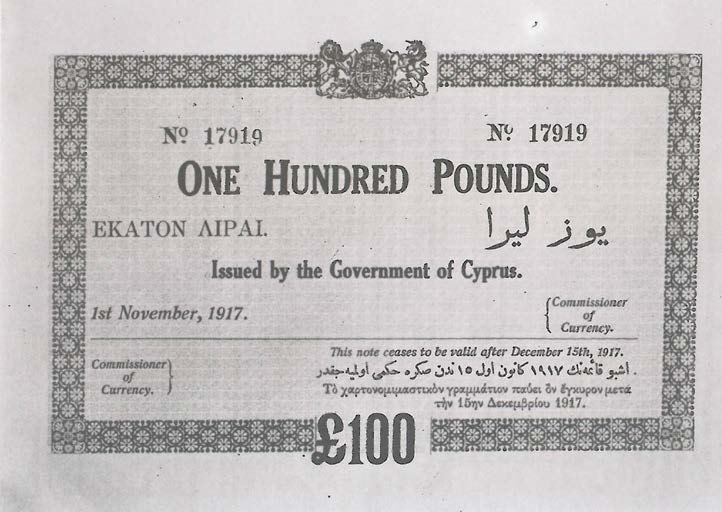
- For the 100 pounds dated 1st November 1917: one specimen is in the archives of the Central Bank of Cyprus, and no record was traced to show that the note circulated. Santamas concludes that it was prepared and never given legal sanction.
- For the shillings of 1919: two consignments of silver shillings reached the island in 1919, in January and in April, of 200,000 pieces each. By October silver coin was so short that the Government decided to print notes of 2 shillings and 1 shilling on the island. Printer's proofs show the 2 shillings meant for red ink and the 1 shilling for black. Only the 1 shilling was printed, in green, 60,000 of them, made legal tender by a proclamation of 12 November 1919 and demonetised on 30 April 1922.
On one detail of the 1919 note the article and the catalogue differ. Santamas says it was printed on the backs of 5 shillings notes of 1917. The catalogue's page says the notes used were dated 1918. The date cannot be seen on the pieces, since each is a third of a note with its front overprinted.
The list tested against the notes
The catalogue did not take the list on trust. When it was read, each quantity was set against the prefixes and the highest numbers recorded for that date. Nearly all fit: the prefixes recorded for a date agree with its quantity, and no recorded number goes past its figure.
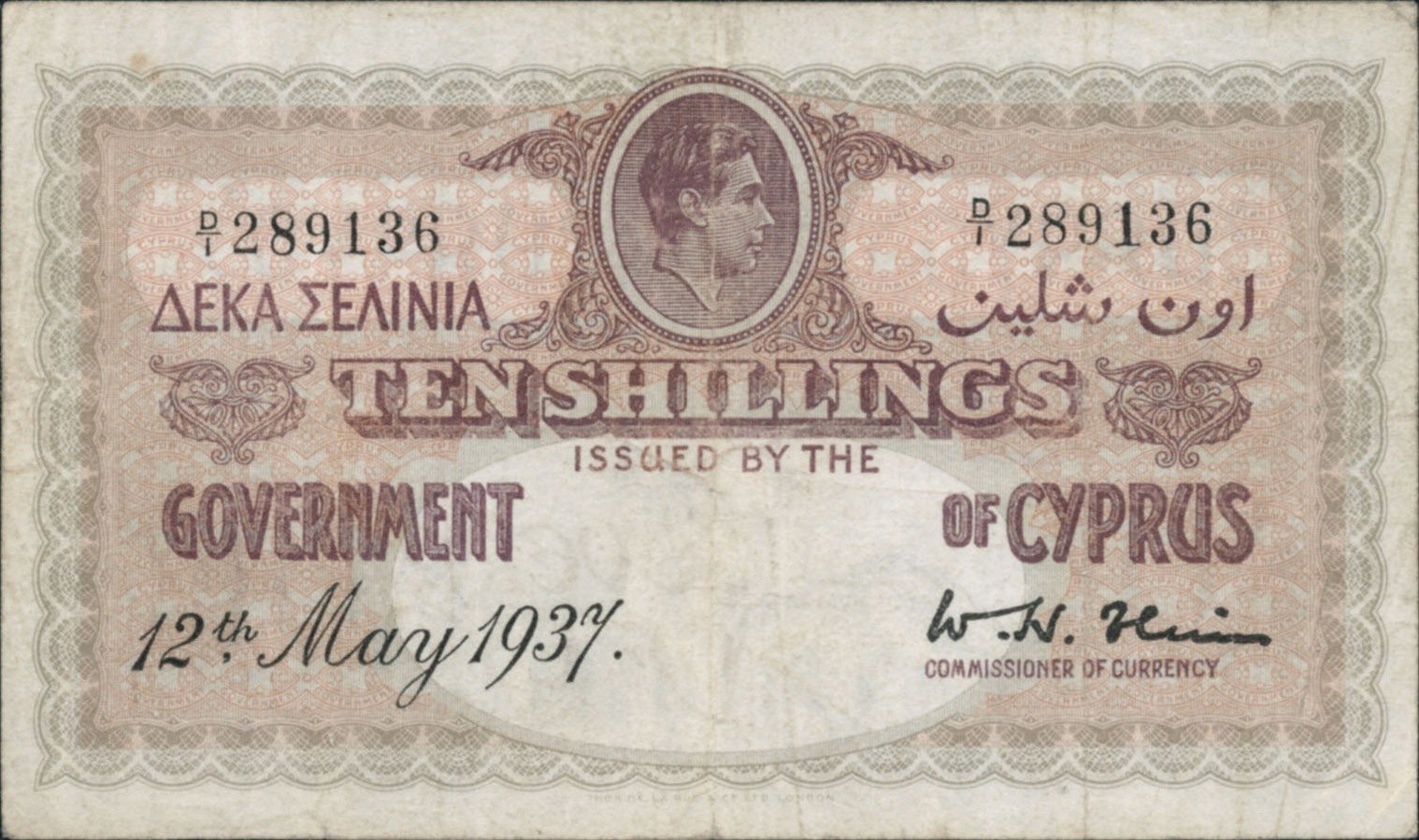
Two figures for the 10 shillings do not fit. The list gives 200,000 for 12th May 1937, and the catalogue pictures a 10 shillings of that date numbered D/1 289136. It gives 100,000 for 1st September 1953, and notes of that date are on record with numbers well above 100,000. The pages therefore give no quantity for those two dates.
Some other points of the list:
- The 1 shilling line for 30th August 1941 is printed twice.
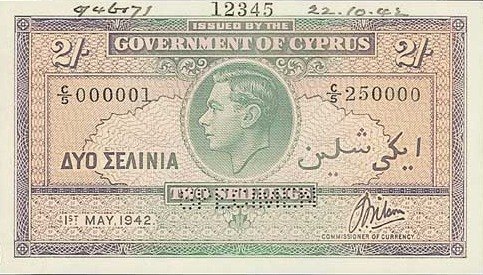
- It gives 765,000 of the 2 shillings dated 1st May 1942. The range specimens of that date show three prefixes, C/4, C/5 and C/6, of 250,000 each.
- It gives 1,025,000 of the 1 pound dated 1st November 1950.
- It has no 1 shilling dated 8th August 1947, no 5 pounds dated 25th October 1945 and no 5 pounds dated 31st July 1954. Each of those dates is an open question on the catalogue's pages, and the list does not settle any of them, since a date may simply have been left out.
- It lists the Palestine notes among the Cyprus issues: 20,000 of the 5 pounds and 150,000 of the 1 pound, dated 20th April 1939 and released on 5th May 1942.
1983: Schwan, from Pridmore
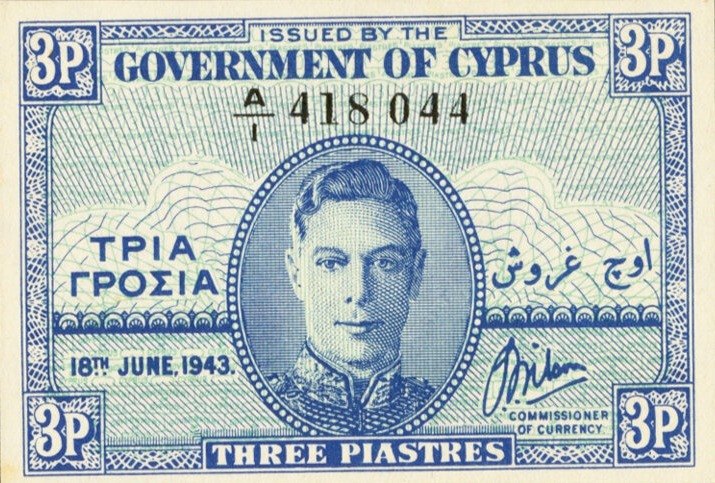
In the same year Fred Schwan gave the wartime story in Bank Note Reporter, and says at the end that much of the detail came from Pridmore's book, which Schwan describes as 323 pages with the full text of official proclamations, announcements and laws in its appendices. Schwan adds things that Santamas does not have: that the shipment of bronze half-piastre coins lost to enemy action was sent in October 1942; that the Treasurer, G. F. Wilson, first proposed an emergency note of 4 1/2 piastres and changed it to 3 piastres at the wish of the banks and the military; that restrictions were placed on the amount of cash a person could hold; and that the printed 3 piastres dated 18th June 1943 did not reach Cyprus until March 1944.
Schwan also says that one million of the 1 shilling notes that were overprinted had been printed, and that the number of each of the two overprints had not been reported. Santamas's list gives 1,000,000 for the 1 shilling dated 30th August 1941, the date on the overprinted notes, and no figure for the overprints.
The two articles of 1983 draw on the same book and still differ.
| Point | Santamas | Schwan | The catalogue's pages |
|---|---|---|---|
| When the Cyprus notes ordered from England arrived in 1942 | 25 May 1942 | September, more than four million pounds | not stated on the Cyprus pages |
| When the Palestine notes ceased to be legal tender | 17 November 1942 | a proclamation of 10 September, after 17 September | withdrawn under a proclamation of 10 September 1942; sources mention 18 November 1942 |
| The second consignment from Palestine, 11 April 1942 | 150,000 pounds: 20,000 notes of 5 pounds and 50,000 of 1 pound | 150,000 pounds in notes of 1 and 5 pounds; in all 150,000 notes of 1 pound and 20,000 of 5 pounds | 150,000 pounds in 1 and 5 pound notes |
| The first 3 piastres overprint | released on 16 February, the year printed as 1942 in the text and as 1943 in the list; in use nine days | authorised on 16 February 1943; repealed nine days after release | introduced on 16 February 1943 |
| The cut overprint | all dated 1 March 1943 and released in that month | released when the first was repealed | introduced on 25 February 1943; the note is dated 1st March 1943 |
| The last printing of the printed 3 piastres | 25th September 1944 | 25th November 1944 | not yet settled |
| The last two printings | never released | ordered destroyed, by Pridmore's account; no note of either seen | never issued |
The story of the Palestine notes, with the days given for its end, is told in Palestine pounds in Cyprus, 1942: the notes that were never overprinted. Santamas has two details that are not there: the Government asked the Secretary of State on 3 February 1942 for leave to obtain the notes, and what forced their use was a requisition by the British Army Cashier on the Ottoman Bank for 60,000 pounds.
On the last printing of the 3 piastres, Santamas's list gives 25th November 1944 for the 1, 2 and 5 shillings and 25th September 1944 for the 3 piastres, so the two dates were kept apart in the list and are not one slip. The catalogue's page records no note of that printing, only a range specimen dated 25th November 1944, pictured in The Banknote Book.
1993 to 2015: Shafer's cut notes
Neil Shafer came back three times to notes that were cut to make small change. The column of August 1993 pictured a cut 3 piastres dated 1st March 1943, and the same piece was shown again, face and back, in October 2010 and in September 2015. The column of October 2010 also pictured an overprint on the whole 1 shilling with two of the corner figures 3 rubbed out on the back, which Shafer thought had been done to pass it as a 1 shilling again. The pictures in these columns and in Schwan's article are on the register as published records.
2005 and 2016: the portraits and the designs that were not used
Peter Symes's study of the Queen's portraits gives the 5 shillings of 1952 its Portrait 2, the profile from a photograph by Dorothy Wilding of 1952, and the notes of 1955 to 1960 its Portrait 4a, from another Wilding photograph of 1952, in an engraving by Bradbury Wilkinson.
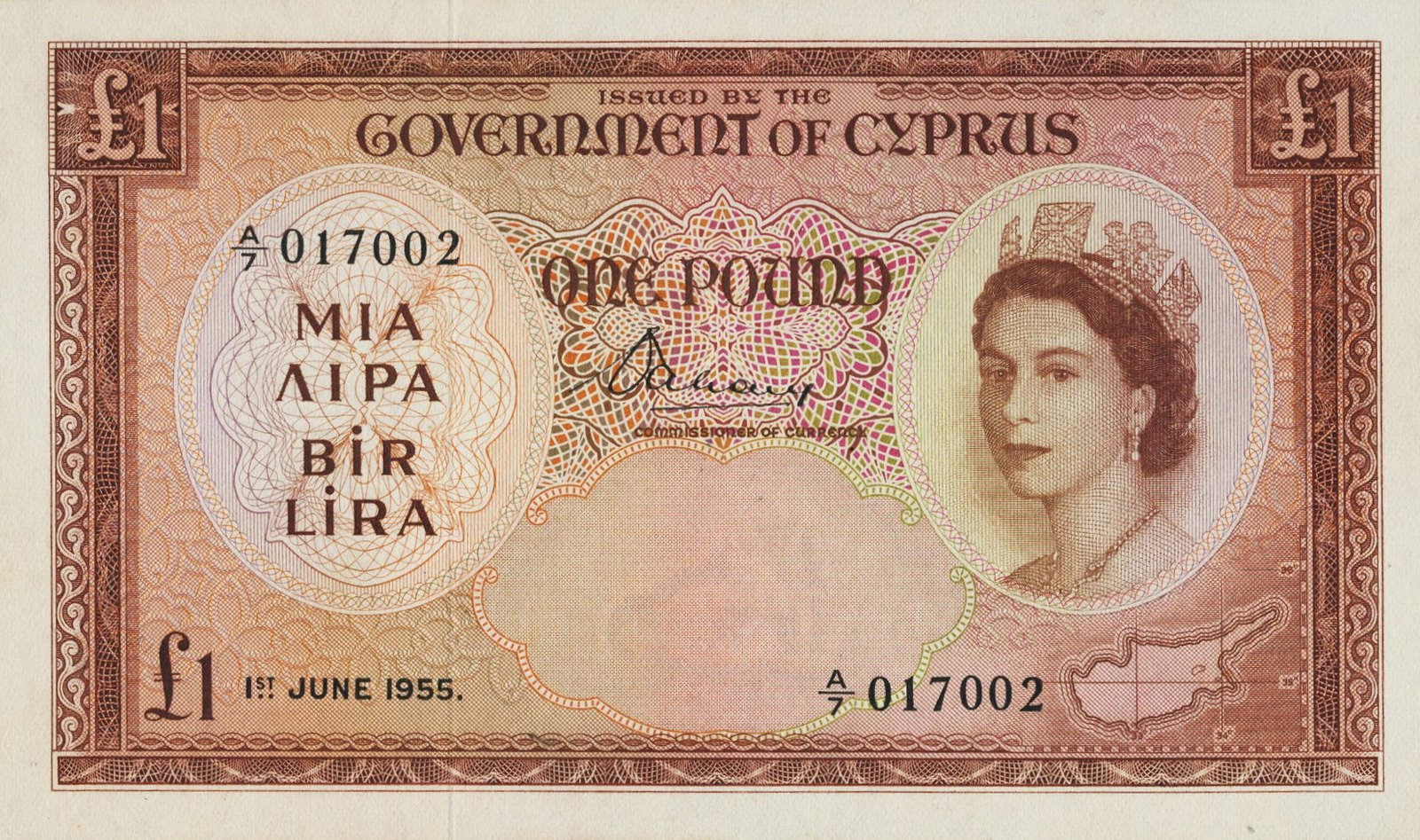
Jamie Sanz wrote in 2016 from photographs out of the archives of Bradbury Wilkinson and Thomas de la Rue, of the years 1950 to 1980, which the article says were saved from destruction and came to light through the auction house Spink. Most of the article is about the Republic. Two things in it touch the Government's notes. Designs dated February 1959 exist as front and back proofs for the 250 mils, 500 mils, 1 pound and 5 pounds: they keep the layout of 1955, with a bust of the philosopher Zeno of Citium in place of the Queen and a bunch of grapes in place of the two lions. And a back with a Byzantine church, which the writer could not identify, was considered in 1953 for the back of a small note with the Queen; the article does not name the value.
The same article says in passing that the first George V notes were issued in October 1914 and the last 250 mils and 5 pounds in March 1960. The catalogue's pages give 2 December 1914 for the issue of the first Thomas de la Rue notes.
2017: Galatariotis on 1952 to 1960
The article by Alexis Galatariotis is the source of what the pages say about the split order of the 5 shillings of 1952, the notes of 1957 and 1958 that were held back, and the notes of 1st March 1960. It cites Pridmore's book, Symes's study, the catalogue of the Pridmore sale of 1981 and an interview in June 2016 with C. C. Stephani, then 92 years old, who signed the notes of 1960, and calls itself the product of years of research. The article announces a book to follow. Much of it is already on the catalogue's pages and in Cyprus notes printed, held back and destroyed, 1914 to 1960; these points are not.
- On 13 December 1951 the Commissioner of Currency, S. M. Rich, asked the Crown Agents to prepare new specimens of the 5 shillings, 10 shillings, 1 pound and 5 pounds for the approval of the Secretary of State. Galatariotis cites Pridmore's appendix 72 for this. The change of the order for the 5 shillings after the King's death was agreed in an exchange of telegrams with the Crown Agents.
- The article pictures a 5 shillings with the Queen numbered G/1 000414, which it says was paid to a Cypriot as part of a salary in 1952 and kept in an envelope from then on.
- Stephani's appointment as Commissioner of Currency is said to have been agreed by both community leaders, Archbishop Makarios III and Dr. Fazıl Küçük. Stephani recalled that the order for the 1960 notes was decided quickly, under the pressure of events. The article says that the Treasury ordered the 5 pounds destroyed ten to twelve weeks after it reached Cyprus.
- Why the 5 pounds of 1960 has the prefix B/1, when the notes before it ran from A/1 to A/7, is not known. Galatariotis supposes an error made in the hurry.
- All the colonial issues ceased to be legal tender from 31 March 1965, by an Order of the Governor of the Central Bank of Cyprus of 25 September 1964, made under section 25 of the Central Bank law of 1963. The catalogue's pages give 31 August 1958 for the notes older than those of 1955, and the pages of the mils notes carry 1 April 1965 in their withdrawal field.
Three small things do not match the catalogue or the official lists. The article spells the signer Stephanie and calls the office Account Manager; the Colonial Office Lists print C. C. Stephani, Assistant Accountant-General from 1958. For the 500 mils of 1st March 1957 the article says both that prefixes A/1 to A/9 were all released, the whole of A/8 and A/9 among them, and that the numbers known for prefix A/10 show only 250,000 notes of that date went out; the catalogue's page records no note with prefix A/10. And the article says that every 5 pounds of 1960 known but one lies in one short run of numbers. The catalogue of the R. J. Ford collection, sold in 1975, lists a note of that date with a number in neither place; see Cyprus in the old sale catalogues, 1974 to 1994.
What has not been read
Pridmore's book of 1974 was not read for the catalogue, and nothing in this article is taken from it directly. Schwan, Santamas, Sanz and Galatariotis all cite it, and Schwan says its appendices print the proclamations and laws in full. Reading it would show which of the two accounts of 1983 follows it on the Palestine notes and on the 3 piastres, and whether the printing figures stand in it or come from the Central Bank's files. Until then the figures are Santamas's, and the pages say "sources mention".
Sources
- Major F. Pridmore, "Cyprus Currency. Turkish Treasury Notes 1878-79", IBNS Journal 9:1, Autumn 1969, pp. 13 to 16.
- Robert Obojski, "The Bank Notes Of Cyprus", Bank Note Reporter, March 1974, p. 18.
- Roger V. McNeice, "A Survey of Cyprus' Bank Notes", Bank Note Reporter, April 1974, p. 19.
- Fred Schwan, "Cyprus Military Currency Studied", Bank Note Reporter, February 1983, pp. 6 and 16.
- Michael L. Santamas, "Cyprus: Some Interesting Currency Notes", IBNS Journal 22:4, 1983, pp. 108 to 112.
- Neil Shafer, "Cutting notes created quick small change", Bank Note Reporter, August 1993, from p. 32; "More on cut notes and their use", Bank Note Reporter, October 2010, pp. 118 to 120; "Cut notes present real challenge", Bank Note Reporter, September 2015, p. 64.
- Peter Symes, "The Portraits of Queen Elizabeth II on World Bank Notes", IBNS Journal 44:2, 2005, pp. 8 to 20.
- Jamie Sanz, "Printers' Proofs Show Efforts to Define a National Identity in Post-Independence Cyprus", IBNS Journal 55:4, 2016, pp. 19 to 23.
- Alexis Galatariotis, "The Currency Notes of Cyprus during the Reign of Queen Elizabeth II, 1952-1960", IBNS Journal 56:3, 2017, pp. 21 to 25.
- Major F. Pridmore, Modern Coins and Notes of Cyprus, Central Bank of Cyprus, Nicosia, 1974: not read; cited by Schwan, Santamas, Sanz and Galatariotis.
Member comments
Log in or register to post a comment.