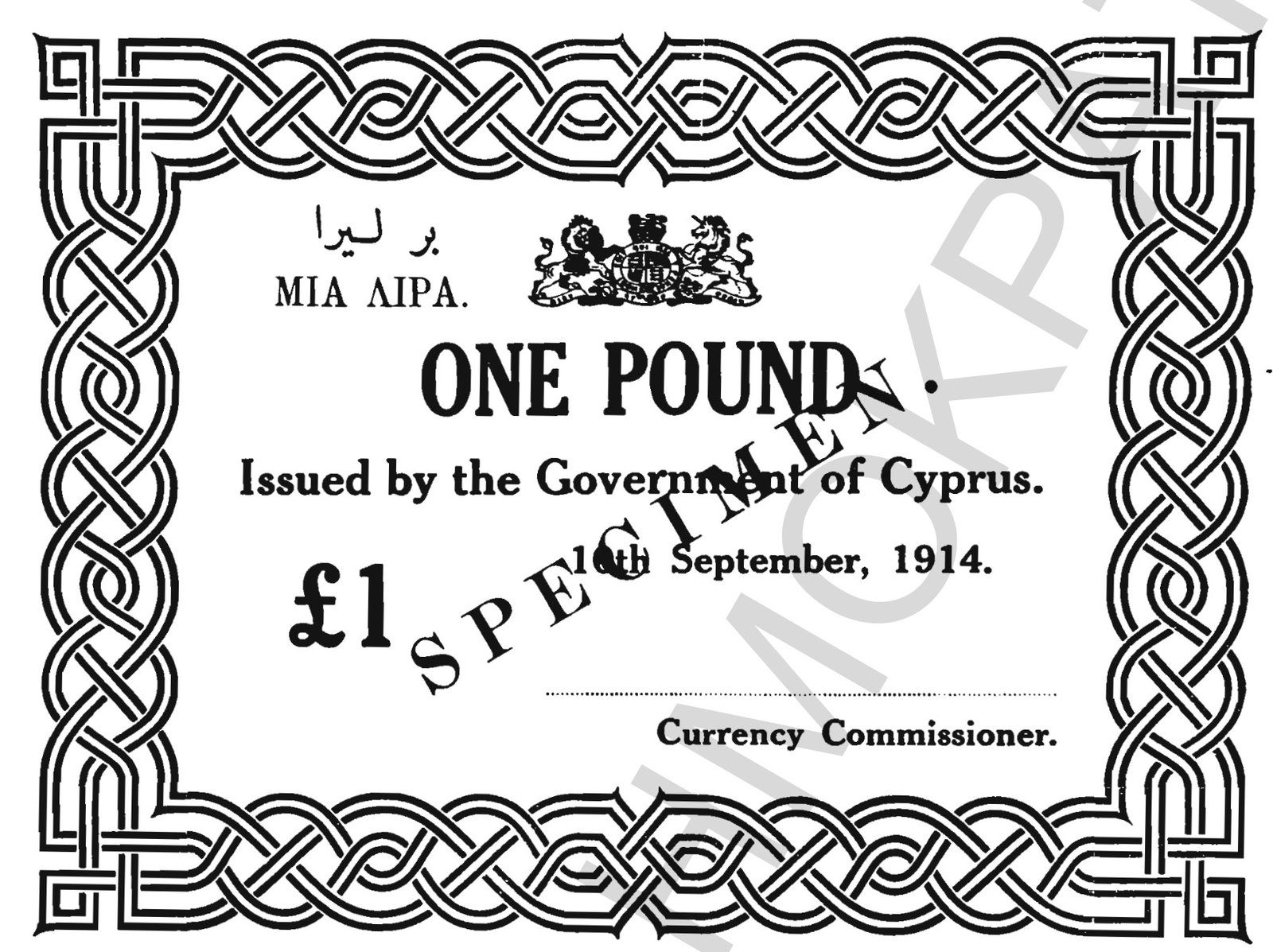
The catalogue's pages for Cyprus begin in September 1914, with the 1 pound and 5 pounds printed in Nicosia. Paper money had been current on the island once before, when the British took over its administration in 1878: the Ottoman Treasury notes called kaime, or caime. They are not notes of the Government of Cyprus and have no page in the catalogue. This article puts together what the sources read for the catalogue say of them: Robert Chalmers's A History of Currency in the British Colonies of 1893, an article by Major F. Pridmore in the IBNS Journal in 1969, and three later mentions.
The sources
| Year | Source | What it is |
|---|---|---|
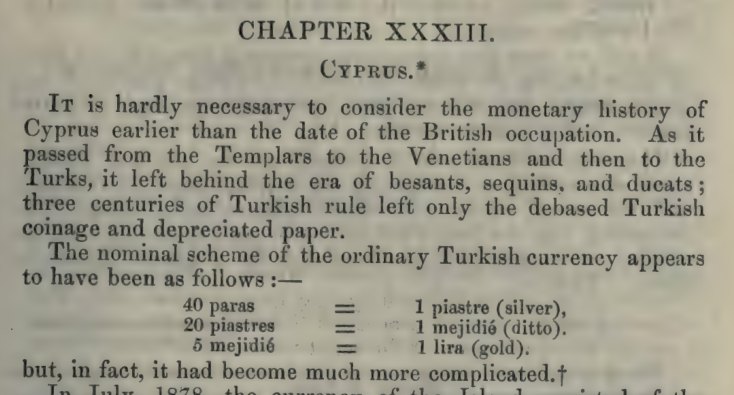
| 1893 | Robert Chalmers, A History of Currency in the British Colonies, chapter XXXIII, Cyprus, pp. 325 to 329 and 334 | a history of the currency of each colony, without plates; its Cyprus chapter was read in the machine-made text only |
| 1969 | Major F. Pridmore, "Cyprus Currency. Turkish Treasury Notes 1878-79", IBNS Journal 9:1, pp. 13 to 16 | a collector's description of the notes, with a note pictured front and back |
| 1974 | Roger V. McNeice, Bank Note Reporter, April 1974, p. 19 | a line in a list of Cyprus issues |
| 1975 | Glendining, the R. J. Ford collection, 9 June 1975, lot 129 | two notes in a sale |
| 1983 | Michael L. Santamas, IBNS Journal 22:4, p. 108 | a short account, with a note of 100 piastres of 1877 pictured |
Pridmore says that no official Turkish record could be found, and that the article rests on reports of the first British administrators and on a note of 100 piastres dated 1877 that came to hand by chance. Its inscription, once translated, showed it to be the paper money those reports complained of.
What the notes were
Pridmore gives the Turkish currency of 1878 as the coinage brought in by Sultan Abdul Mejid in 1844: 40 paras to the piastre, 20 piastres to the silver mejid and 5 mejids to the gold lira. Silver of two older and baser standards was still about, and reckoning was not simple.
In July 1876 the Turkish Treasury added an inconvertible paper money to this. Pridmore's account of it is as follows.
- The notes bore no interest. They were to be taken by the Treasuries at their face value, and so were good for paying taxes. Customs houses and post and telegraph offices did not take them: those took only gold and silver.
- They could not be exchanged for coin at a Treasury or a bank.
- They were put into use by paying the salaries of Ottoman officials wholly in them, so that merchants and shopkeepers had to take them in turn.
- The values are believed to have been 1, 5, 10, 20, 50 and 100 piastres. The Ministry of Finance ordered the printing, and before issue the notes went to the Imperial Ottoman Bank at Constantinople to be registered and numbered. Over six million lira was issued.
- The printing seems to have been from wood blocks on white paper in two colours, a grey ground under a design and wording in pink, the pink running from a dark purple pink to a pale orange pink. A correspondent told Pridmore of two types, one with the printing horizontal, which Pridmore had not seen, and one with it vertical, as on the note pictured.
Chalmers, in 1893, calls the paper practically the same thing as Treasury notes and gives its face values as 1 to 100 piastres. Santamas adds that the back carried the round seal of the Minister of Finance, with the Minister's name and the date of issue, and a stamp of the Imperial Ottoman Bank with the year.
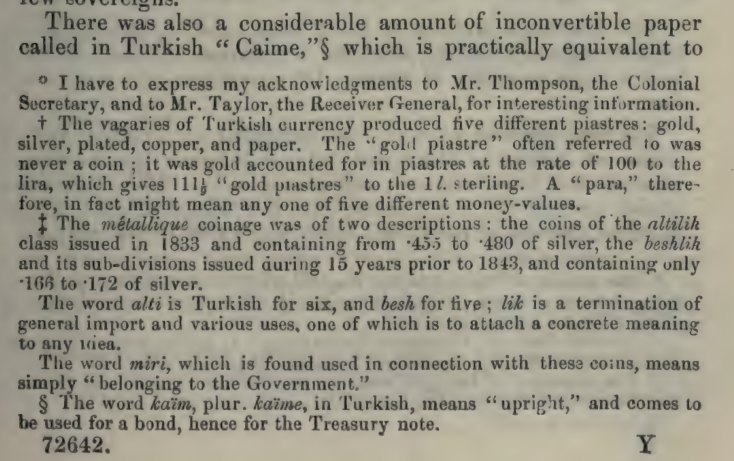
McNeice's list of 1974 puts the six values under the heading of the Imperial Ottoman Bank. Pridmore and Santamas both make the notes an issue of the Treasury, with the Bank only registering and numbering them.
How fast they lost their value
Because the holder could not turn the paper into coin, it fell quickly. Pridmore says it stood at par in July 1876 and that by 1878 a gold lira in Cyprus cost between 315 and 325 paper piastres, and sometimes more.
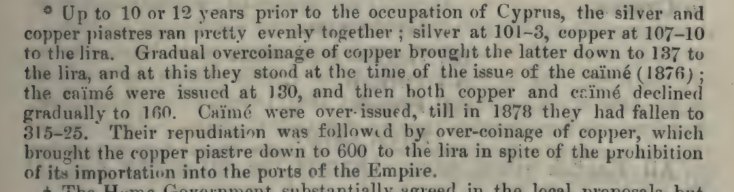
When the British administration began in July 1878, ordinary dealings on the island were made partly in kaime and partly in depreciated Turkish copper or metallic piastres, and taxes were paid almost wholly in kaime.

1878 and 1879: out of use within months
With the change of administration the merchants of the island refused the paper. Pridmore tells what followed. The people petitioned the British High Commissioner to be freed from having to take it. Cyprus was still Ottoman territory in law, and the High Commissioner answered that the general standing of the paper money was not a matter to interfere in. Two things were promised: the salaries of public servants would be paid in coin, and for the rest of that year the British administration would take kaime for taxes as the Turkish government had done. Within a few days of this the notes were gone from ordinary use and lay in the hands of merchants, who sold them on to taxpayers at rates to their own advantage.
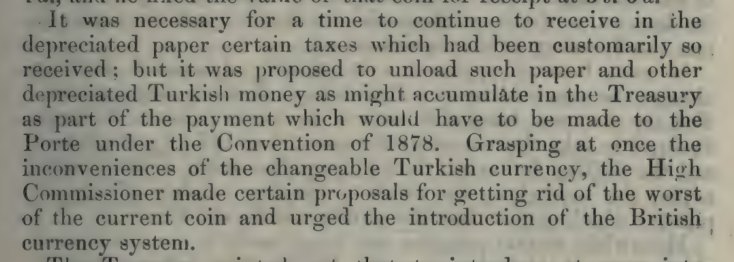
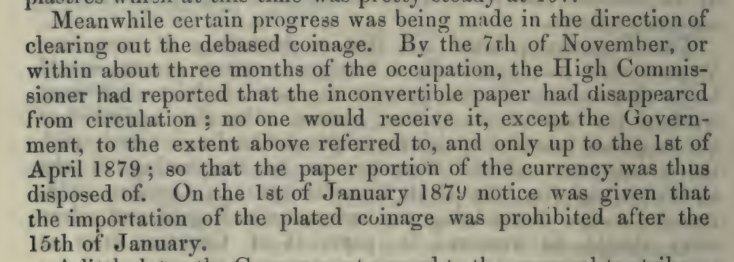
Chalmers gives a day for this. By 7th November 1878, about three months after the occupation, the High Commissioner had reported that the inconvertible paper had disappeared from circulation: nobody would take it but the Government, and the Government only for certain taxes and only until 1st April 1879.
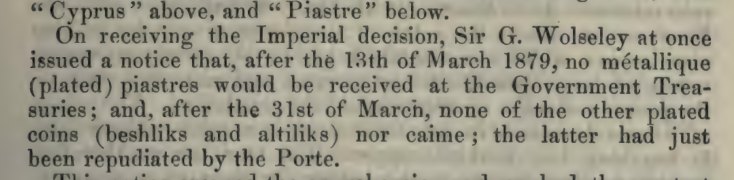
Pridmore gives the notice that ended it. The kaime was demonetised in Cyprus on 31st March 1879, by Notice No. 2 in the Cyprus Gazette of 13th March 1879. Santamas has the same day and adds that the Porte itself repudiated the paper in 1879.
Pridmore and McNeice both say the notes were current under the British for nine months.
After 1879
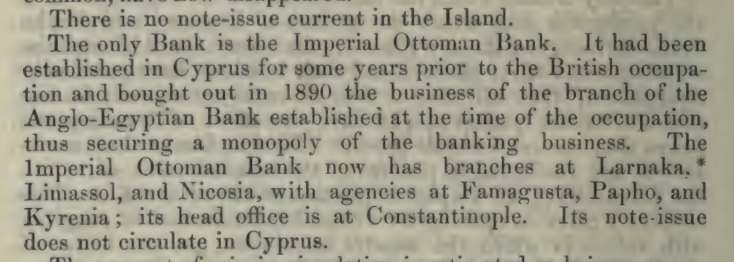
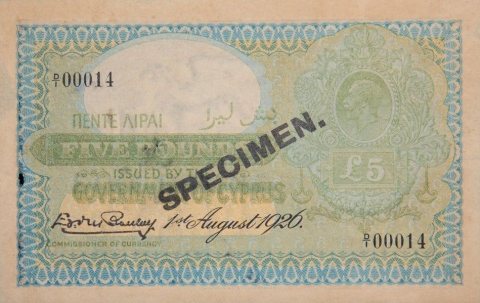
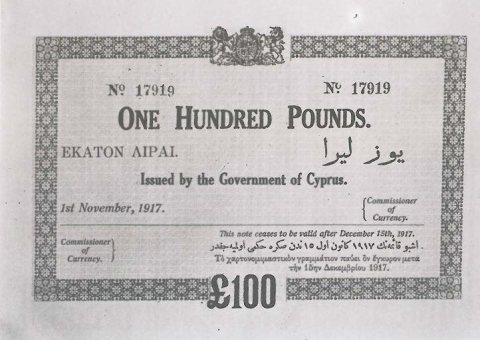
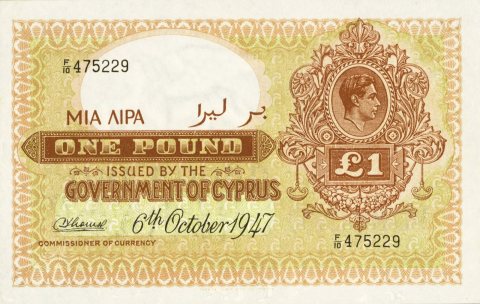
Chalmers records that in 1892 there was no note issue of any kind in Cyprus, and that the notes of the Imperial Ottoman Bank did not circulate there. The next paper money on the island was the Government's own, authorised by the proclamation of 7 September 1914. That story begins in The currency notes of the Government of Cyprus, 1914 to 1960.
Notes that have been seen
Only one value is described in the sources read, the 100 piastres, and every piece is dated 1877: the note Pridmore pictured in 1969, the one Santamas pictured in 1983 and described as Turkish 100 piastres of 1877, and the two in lot 129 of the R. J. Ford sale at Glendining on 9 June 1975. Whether Pridmore's note and Santamas's are one piece is not said. The Ford catalogue calls its two notes 100 ghurush, brown, and says they were found in an old chair in Cyprus. That is the cataloguer's statement, and nothing else is recorded of where they came from. The Ford sale is described in Cyprus in the old sale catalogues, 1974 to 1994.
No note of the lower values is described in any of these sources, and Pridmore gives the list of values only as what was believed.
What is not known
- The Turkish decree of July 1876 was not read by any of the writers, and Pridmore found no official Turkish record.
- How much kaime was in Cyprus in 1878: Chalmers (p. 326) gives an estimate of the day, "the total amount of coin was estimated at 30,000 l., and of caime at 1,000 l." No other source read here gives a figure for the island. The figure of over six million lira is for the whole issue.
- The text of Notice No. 2 of 13th March 1879 was not read for the catalogue. It is known here only through Pridmore.
Sources
- Robert Chalmers, A History of Currency in the British Colonies, London, 1893, chapter XXXIII, pp. 325 to 329 and 334.
- Major F. Pridmore, "Cyprus Currency. Turkish Treasury Notes 1878-79", IBNS Journal 9:1, Autumn 1969, pp. 13 to 16.
- Roger V. McNeice, "A Survey of Cyprus' Bank Notes", Bank Note Reporter, April 1974, p. 19.
- Glendining, The R. J. Ford Collection, London, 9 June 1975, lot 129.
- Michael L. Santamas, "Cyprus: Some Interesting Currency Notes", IBNS Journal 22:4, 1983, p. 108.
Member comments
Log in or register to post a comment.