This article sets out the paper money of the Government of Cyprus in order of time, from September 1914 to March 1960. It is put together from the catalogue's own pages, which rest on the Cyprus Gazette, the Blue Books, the annual reports on Cyprus and the Colonial Office Lists, and from what auction houses have written in their lot descriptions, which is given as each house's own statement. Two companion articles cover the officers who signed the notes and the numbers printed and the printings that were destroyed.
September 1914: notes printed in Nicosia
Cyprus came under British administration in 1878. The government introduced locally printed currency notes, from the Government Printing Office, in September 1914. The 1 pound and 5 pounds were authorised by a proclamation of 7 September 1914, published in the Cyprus Gazette the next day. The proclamation made the Treasurer, Bowring, and the Chief Assistant Secretary, Fenn, the first Currency Commissioners, had the 5 pounds printed in red ink and the 1 pound in black, and printed a specimen form of each. Four commissioners signed these notes by hand. Sources mention that both values were demonetised on 17 December 1914.
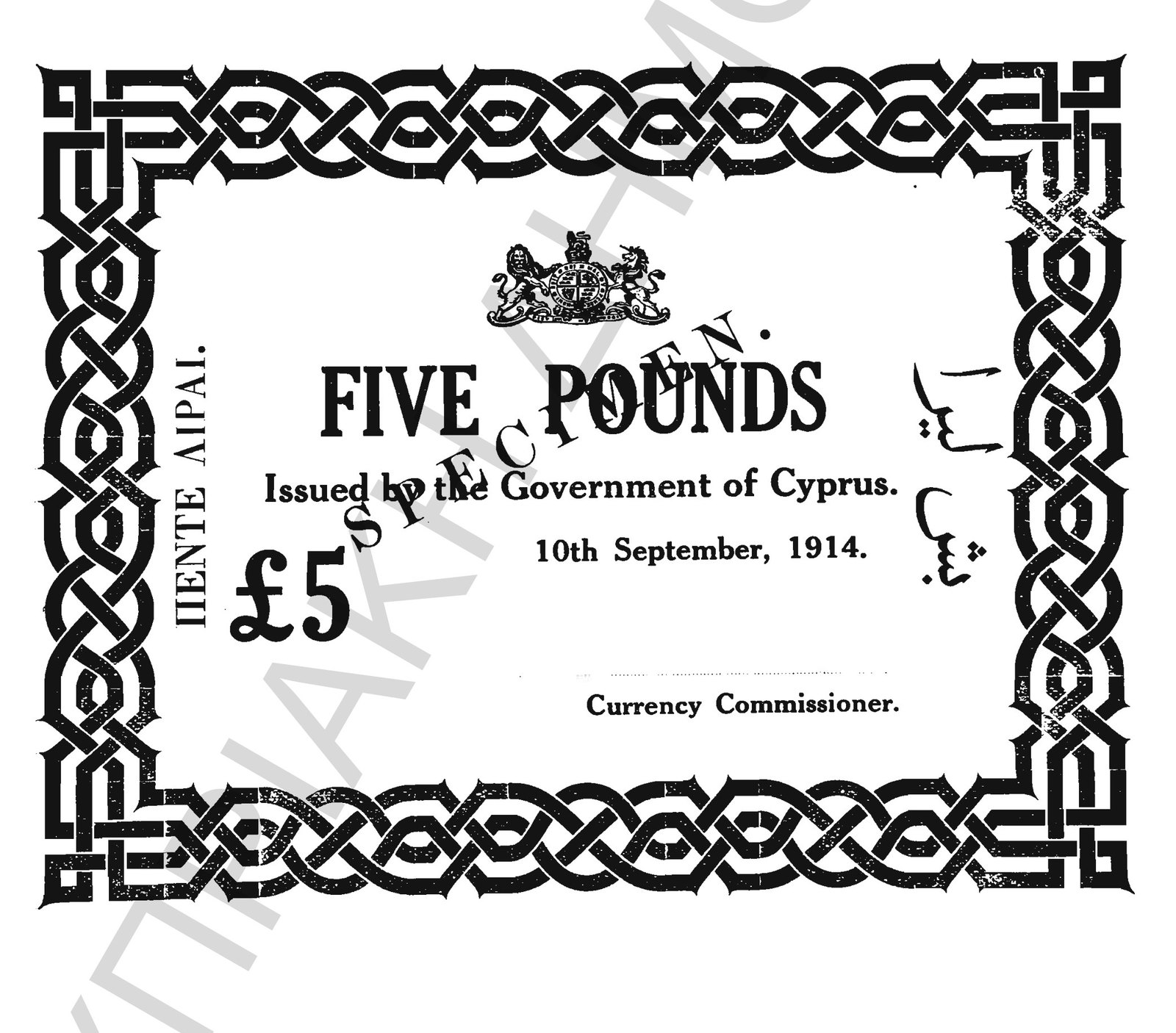
The Gazette's own description of these two notes is told in What the currency boards published: Gazettes, laws and reports, 1847-1969.
December 1914 to 1916: the first notes from Thomas de la Rue
Notes printed in England by Thomas de la Rue took their place: 5 shillings, 10 shillings, 1 pound and 5 pounds, dated 30th October and 6th November 1914. The pages give 2 December 1914 as the day of issue. Once these notes had arrived, the island's Treasurer became the sole currency commissioner.
The notes were then withdrawn; the pages give 30 June 1915 as the date. Afterwards there was too little currency on the island, and every denomination except the 1 pound was put back into circulation. The 5 pounds was printed again with the date 1st September 1916.
Heritage, describing a 10 shillings specimen (9 May 2023, lot 28085), says that the 5 and 10 shillings share one design, that the English text is joined by Greek and Turkish, and that the notes have no back design because the series was designed and printed in haste. That last point is Heritage's statement; the pages give no reason.
1917 to 1928: the King George V issue
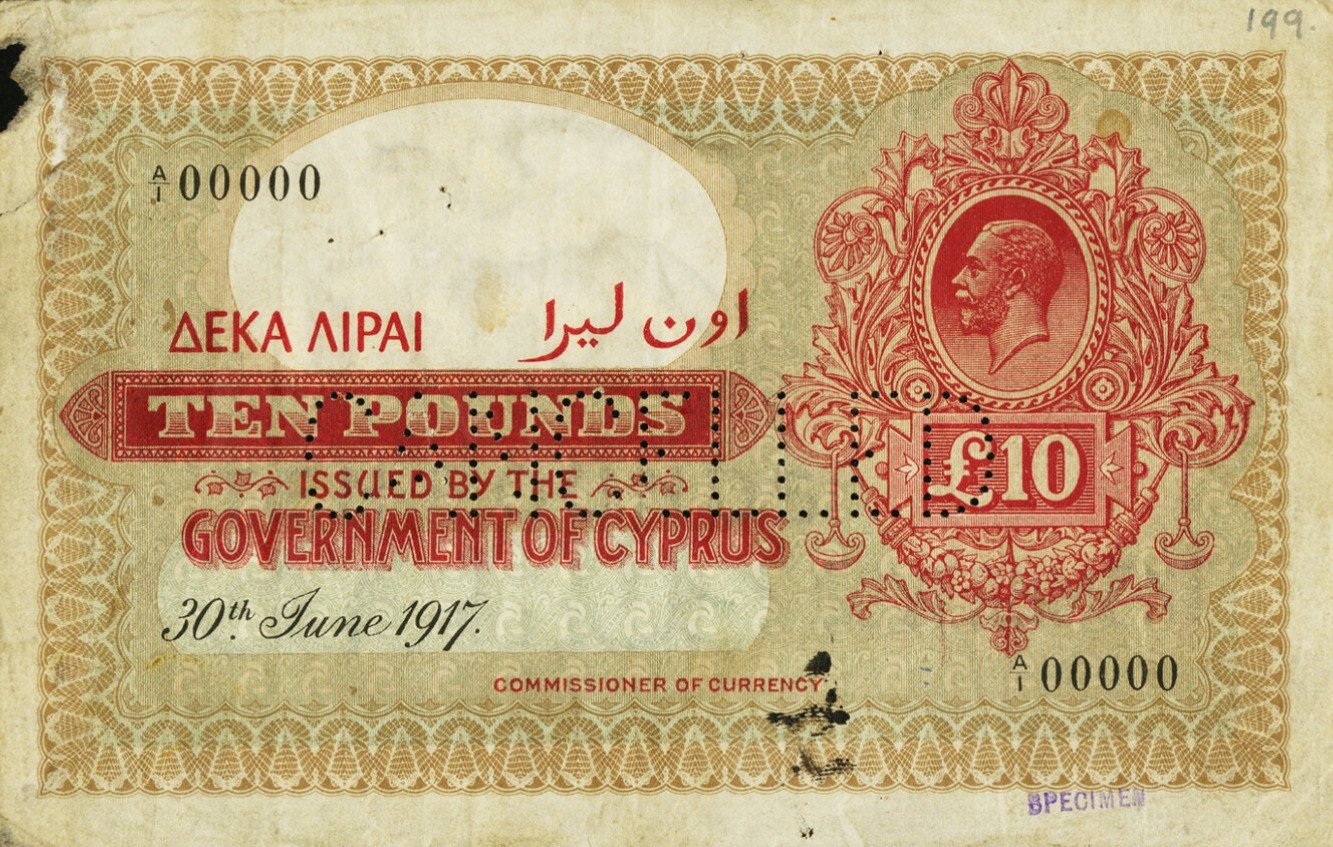
A new issue from Thomas de la Rue followed, uniface, with the King in profile facing left: 5 shillings, 10 shillings, 1 pound and 10 pounds. The first date of the 1 pound and the 10 pounds is 30th June 1917. For the 10 shillings some sources mention 3rd June 1917; the catalogue follows 30th June 1917, the date printed on the face-plate proofs. The 5 shillings is dated 1st December 1917 and 1st March 1918. Heritage (8 September 2017, lot 29007) says that the 5 shillings was released in the spring of 1918.
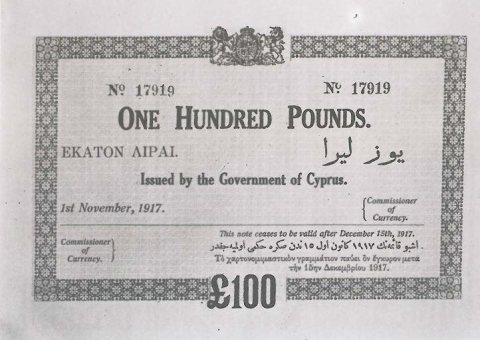
A 100 pounds dated 1st November 1917 was prepared at the Government Printing Office and never issued. Sources mention that the piece is held in the archives of the Central Bank of Cyprus, that no record shows the note in circulation, and that it seems never to have been given legal sanction.
The authority for the 1917 notes
The Blue Books give the authority for the 1917 notes as a proclamation under martial law of 5th September 1917. It was kept in force under the Provisional Powers Laws by Orders in Council:
- No. 849 of 21st November 1921;
- No. 919 of 31st January 1923;
- No. 1021 of 9th August 1924, under which the 10 pounds, 1 pound and 10 shillings were to stay legal tender from 1st September 1924 to 31st August 1926;
- No. 1132 of 30th August 1926, under which the 1 pound and 10 shillings were to stay legal tender to 31st August 1928;
- No. 1161 of 28th December 1926;
- Nos. 1249 and 1250 of 3rd September 1928.
The annual report for 1930 says that once the Cyprus Currency Notes Order in Council, 1928, came into force on 16th January 1930, the notes no longer rested on the Provisional Powers Laws.
In circulation in 1922
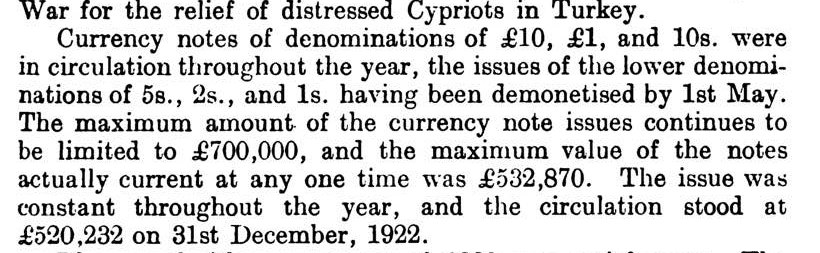
The annual report for 1922 says notes of 10 pounds, 1 pound and 10 shillings were in circulation throughout that year, with the issue limited to 700,000 pounds. The most out at one time was 532,870 pounds, and 520,232 pounds were in circulation on 31st December 1922. The same report says the issues of 5, 2 and 1 shillings had been demonetised by 1st May 1922.
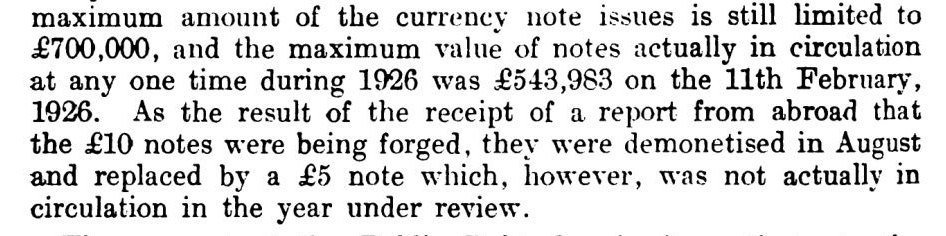
The 10 pounds and the forgery report of 1926
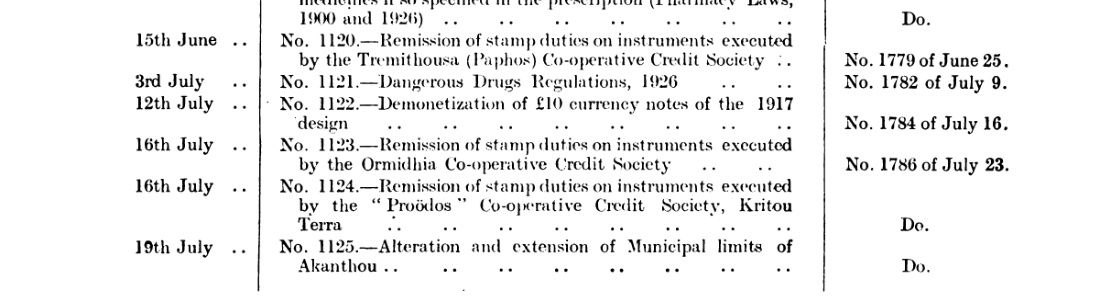
The 10 pounds was withdrawn shortly after a counterfeit was found in circulation. The annual report for 1926 says that it was demonetised in August 1926, after a report from abroad that the notes were being forged. The Blue Book for 1926 lists the Order in Council for the demonetisation of the 10 pounds of the 1917 design, No. 1122 of 12th July 1926, published in the Cyprus Gazette of 16th July.
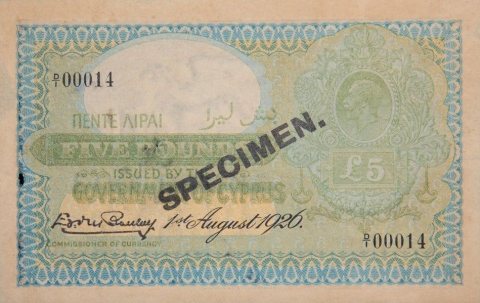
A 5 pounds of the same design took its place, dated 1st August 1926 and 1st November 1927. Its issue was authorised by Order in Council No. 1161 of 28 December 1926 (Blue Books for 1926 and 1927), and the annual report for 1926 says it was not actually in circulation in that year.
1919 and 1920: shillings on paper
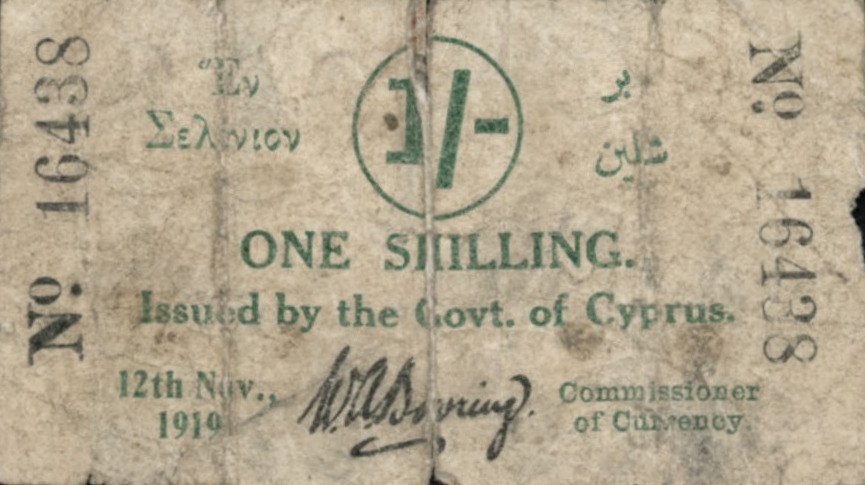
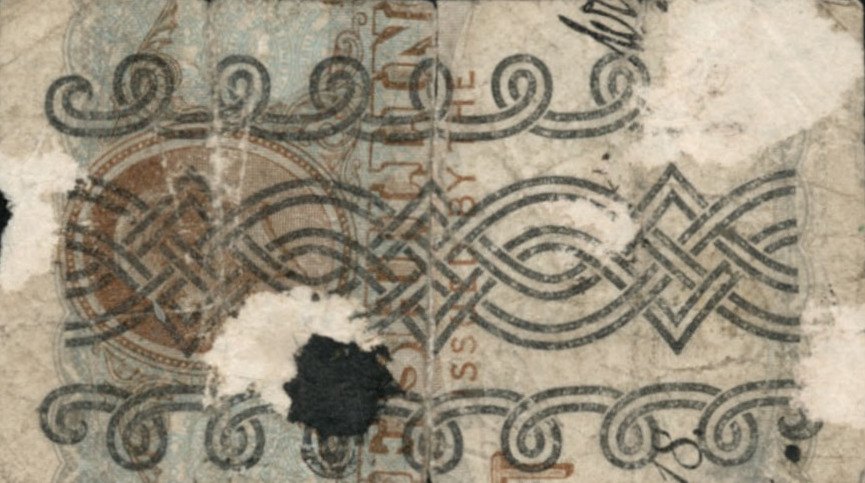
To ease a shortage of coin, the government printers in Nicosia took unused 5 shillings notes dated 1918, cancelled the front with an overprinted design, printed new text on the blank back and cut each into three 1 shilling notes. Sources mention that these were made legal tender by a proclamation of 12 November 1919 and demonetised on 30 April 1922. Sources also mention that a 2 shillings was planned in red ink and the 1 shilling in black, and that in the end only the 1 shilling was printed, in green. The 2 shillings is known from an unsigned proof dated 1st November 1919 and from a typeset lettering proof printed on one sheet with the 1 shilling; the Blue Books for 1919 and 1920, listing the notes that were legal tender, name only the 1 shilling.
Thomas de la Rue then printed a 1 shilling and a 2 shillings dated 1st March 1920, which circulated alongside the emergency shillings. Stack's Bowers (2 October 2025, lot 50094) says the two went into circulation in late April 1920 and were withdrawn in April 1922, and puts the shortage of silver coin down to hoarding and to the rise in the price of silver. Heritage (8 September 2017, lot 29009) says that by 1922 the island had received large shipments of bronze and silver coin and then withdrew the small notes. Small change made from older notes is one of the subjects of Wartime and occupation: what the design archive keeps from 1914 to 1945.
1930 to 1936: the Order in Council of 1928 and notes with a back
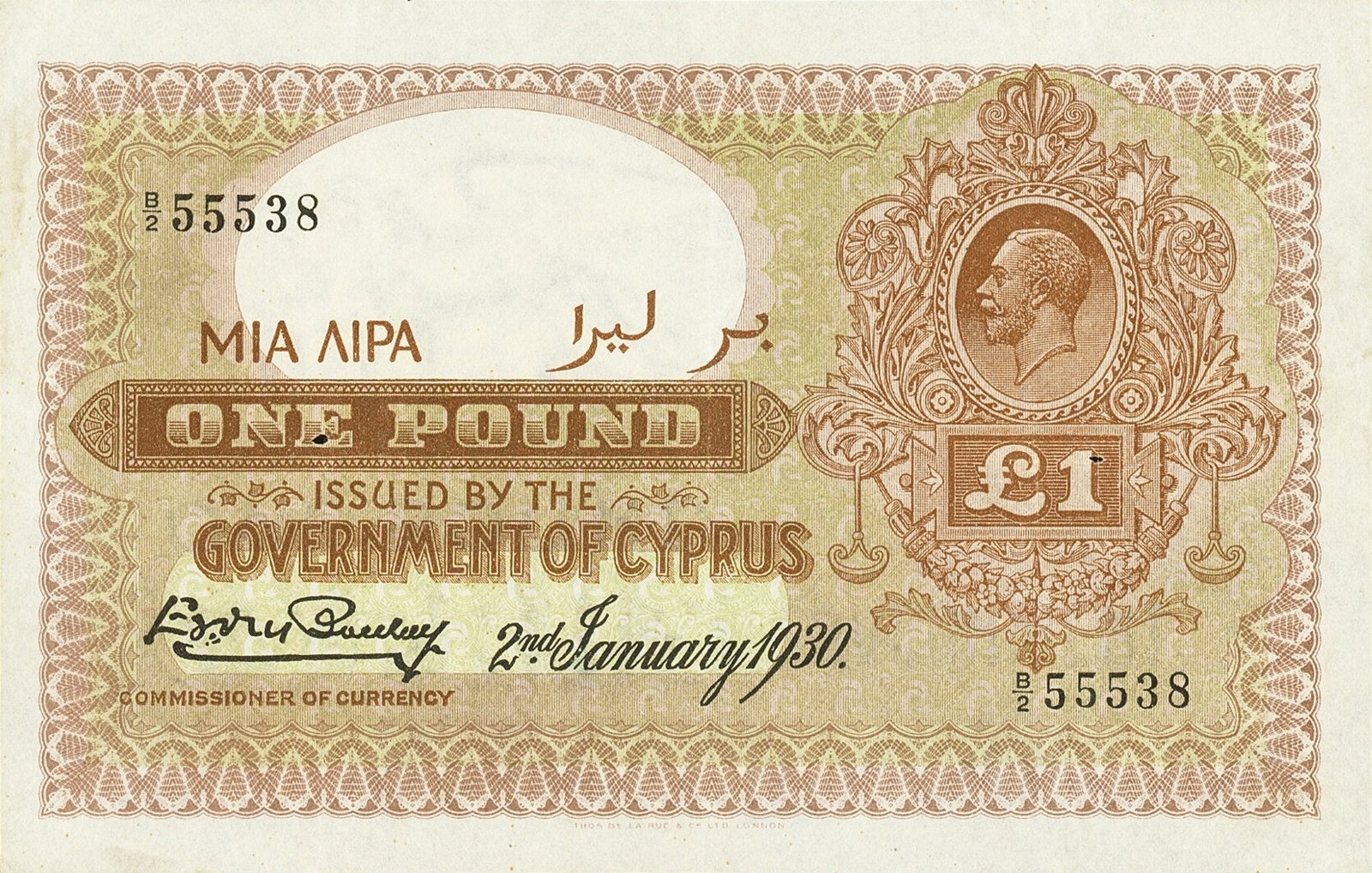
The next notes were like those before them, but with a back: two lions passant on a white field and GOVERNMENT OF CYPRUS. They were issued under the Cyprus Currency Notes Order in Council, 1928, with the Treasurer as sole Commissioner of Currency. The Order in Council is dated 1st November 1928; it was published in the Cyprus Gazette of 16th January 1930 and came into force that day (Blue Book and annual report for 1930). From 15th February 1930 the banks stopped paying out the older notes.
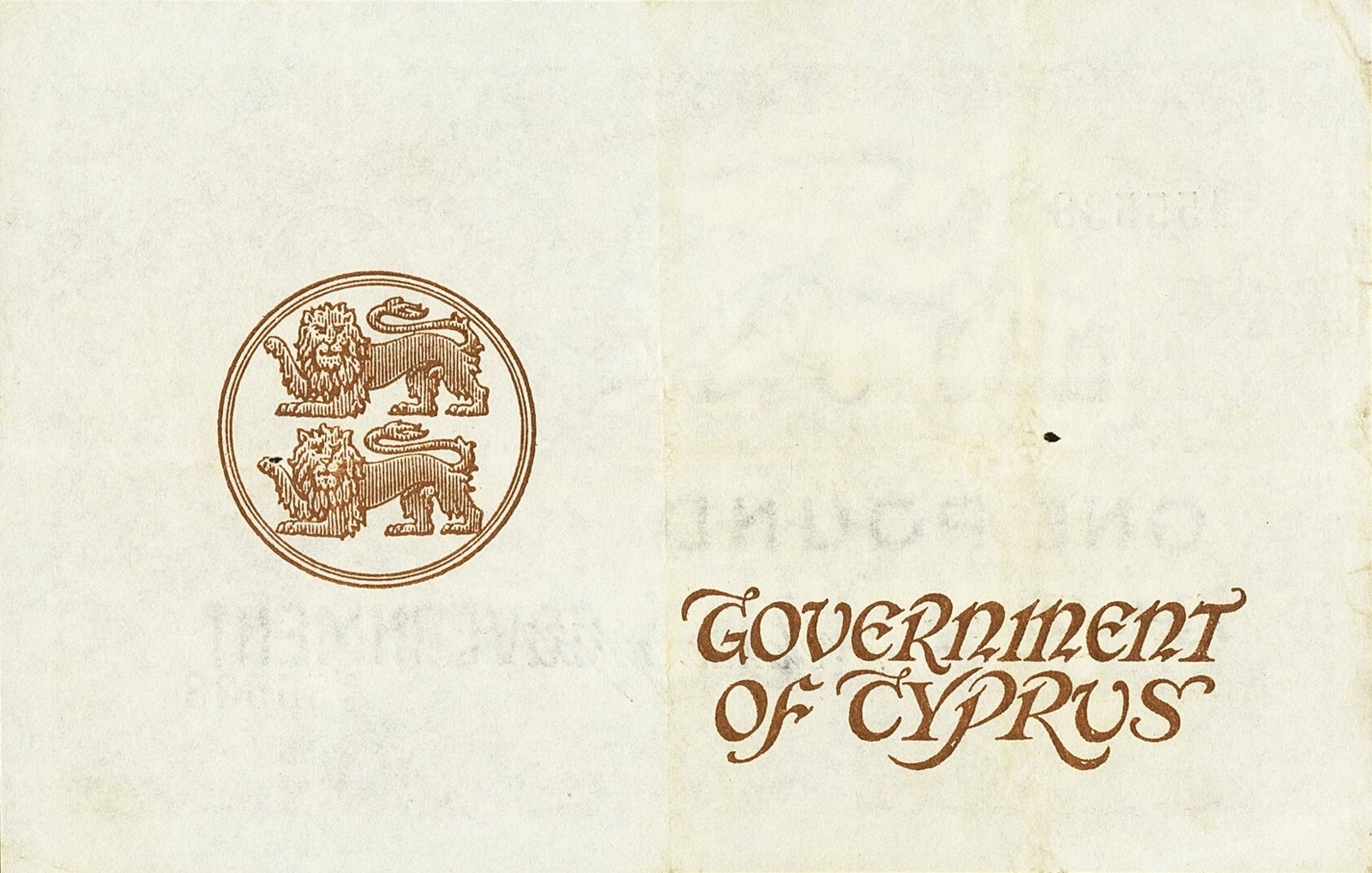
The 1 pound and the 5 pounds are dated from 2nd January 1930. The 10 shillings was held back at first and came only with the date of 1933; the annual report for 1933 says the 10 shillings of the 1930 design was put into circulation in November 1933.
How the 1917 notes came back
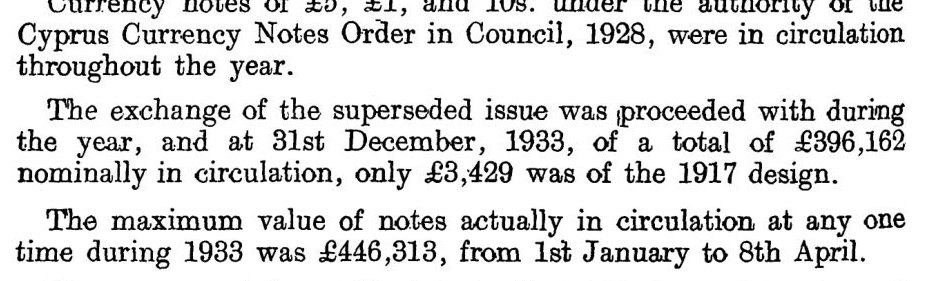
The annual reports show the notes of the 1917 design coming back slowly after the banks stopped paying them out in 1930. The reports give what was still of the 1917 design among the notes nominally in circulation:
| Day | Notes of the 1917 design still out |
|---|---|
| 31st December 1930 | 12,160 pounds 10 shillings |
| 31st December 1931 | 6,092 pounds |
| 31st December 1932 | 4,094 pounds |
| 31st December 1933 | 3,429 pounds |
The report for 1931 says the 10 shillings of this design were being gradually withdrawn. How such figures should be read is the subject of What an annual report can tell you about a banknote, and what it cannot.
1937 to 1951: King George VI
George V died on 20 January 1936, Edward VIII abdicated on 11 December 1936 and George VI became King. The first 10 shillings and 1 pound with the new King carry the coronation date, 12th May 1937, although they were not issued until 1938. The 5 pounds begins with 1st September 1938. All three were printed by Thomas de la Rue and ran with many dates to 1950 and 1951. On the 10 shillings and the 5 pounds the Turkish value is written in Arabic letters.
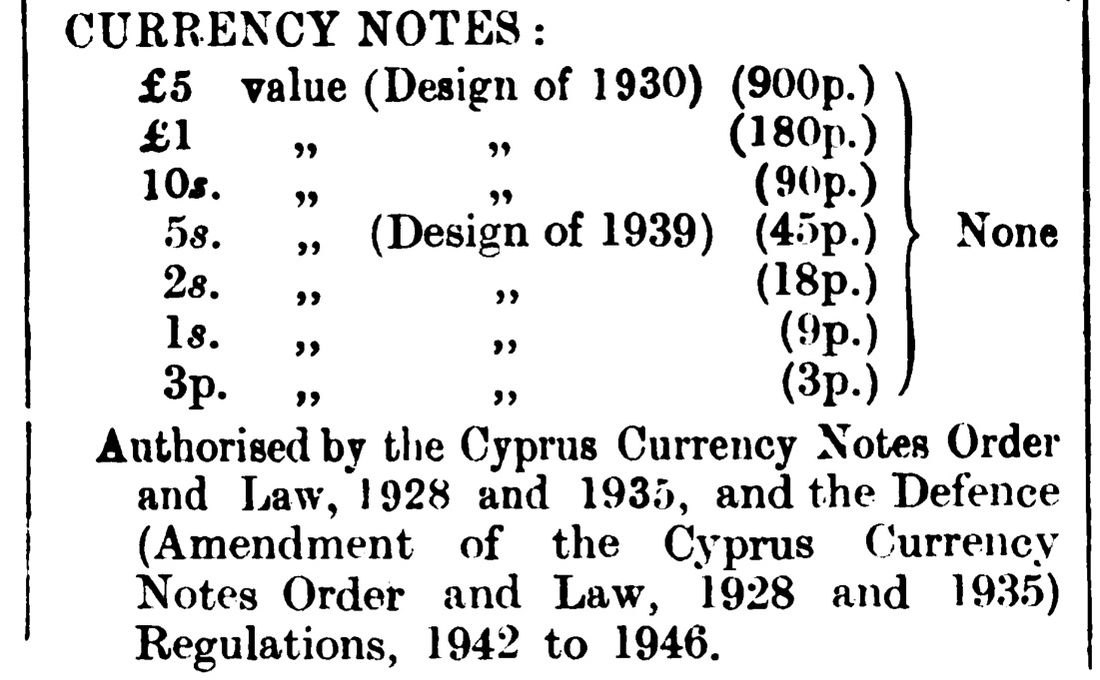
The Blue Book for 1946 lists the Cyprus notes as two designs. The 10 shillings, 1 pound and 5 pounds are the 'Design of 1930', the name it gives the George V notes of 1930 to 1936 too. The 5, 2 and 1 shillings and the 3 piastres are the 'Design of 1939', issued under Defence Regulations of 1942 to 1946 that amended the Cyprus Currency Notes Order and Law of 1928 and 1935.
1939 to 1944: shillings, Palestine pounds and 3 piastres
The shilling notes of 1939
The 1 shilling, 2 shillings and 5 shillings, printed by Bradbury Wilkinson, were prepared in 1938 against the shortage of currency that a war would bring. Six days after war was declared on 3 September 1939, the notes held in reserve were made legal tender with effect from 1 January 1939, because the first of them are dated 3rd January 1939.
Palestine notes, 1942
In 1942 Cyprus ran so short of currency that Palestine notes were brought in: 100,000 1 pound notes on 24 February and a further 150,000 pounds in 1 and 5 pound notes on 11 April. They were made legal tender on 5 May 1942 without any overprint, used mainly within the army camps, and withdrawn under a Proclamation made on 10 September 1942 and printed in the Cyprus Gazette of 17 September. They ceased to be legal tender after 17 November 1942, and the Proclamation of 5 May was revoked from 18 November. The full account is in Palestine pounds in Cyprus, 1942: the notes that were never overprinted.
The 3 piastres of 1943 and 1944
Silver rose in value during the war and coin ran short. Fred Schwan, writing in Bank Note Reporter in February 1983 from Major Fred Pridmore's work, says that the first shipment of bronze half-piastre coins, sent in October 1942, was lost to enemy action, and that the Treasurer first proposed a 4 1/2 piastres note, changed to 3 piastres at the wish of the banks and the military.
The Government Printing Office in Nicosia overprinted 1 shilling notes THREE PIASTRES (1 shilling was 9 piastres). The first form, the overprint on the whole note, was introduced on 16 February 1943. Cheats found that the overprint came off with benzine, which tripled the value of the note, and sources mention that this form circulated for only nine days. Neil Shafer, writing in Bank Note Reporter in October 2010, pictures one of these notes with two of the corner figures 3 erased from the back, which Shafer thought was done so that it could pass as a 1 shilling note.
In the second form, introduced on 25 February 1943, the 1 shilling notes were cut in two: the smaller piece, with the signature of the Commissioner of Currency, was overprinted, and the larger piece with the King's portrait was destroyed. A properly printed 3 piastres replaced both provisionals; it was introduced on 8 March 1944.
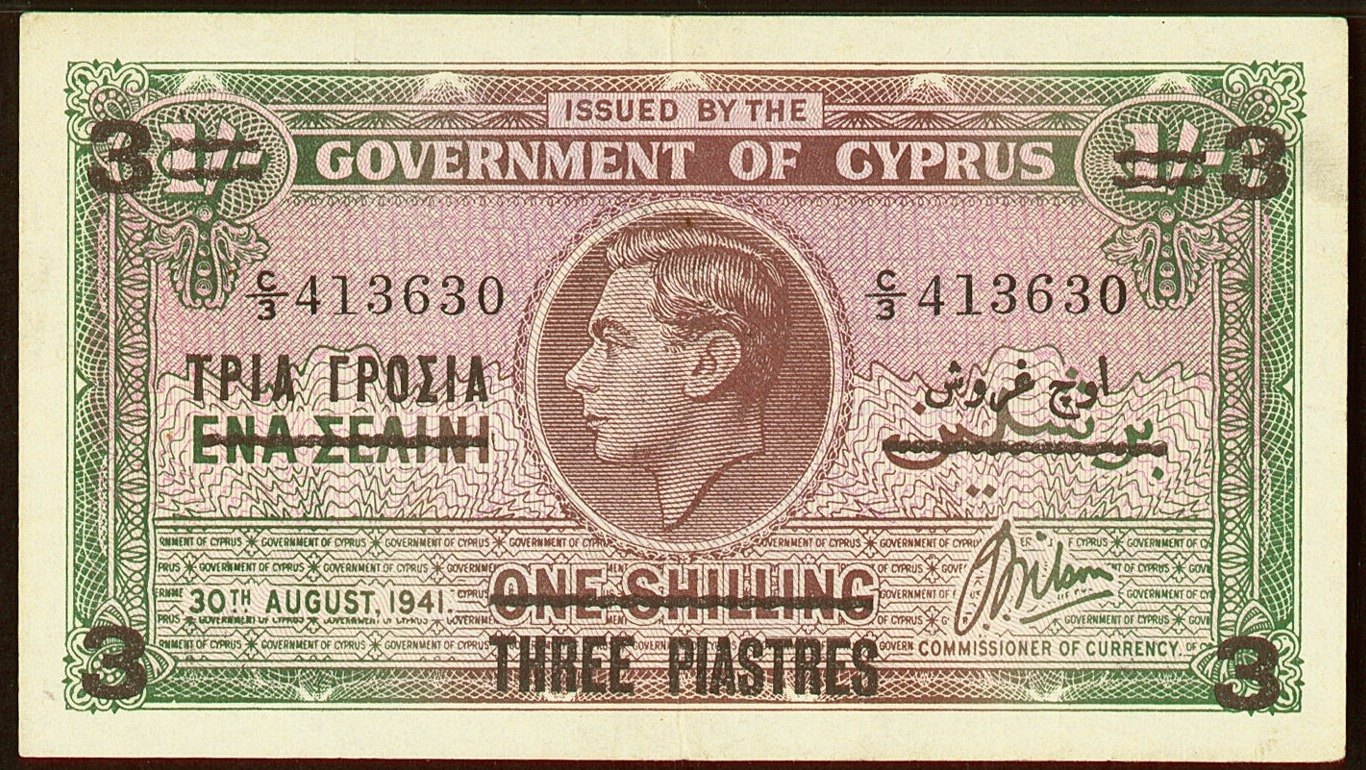
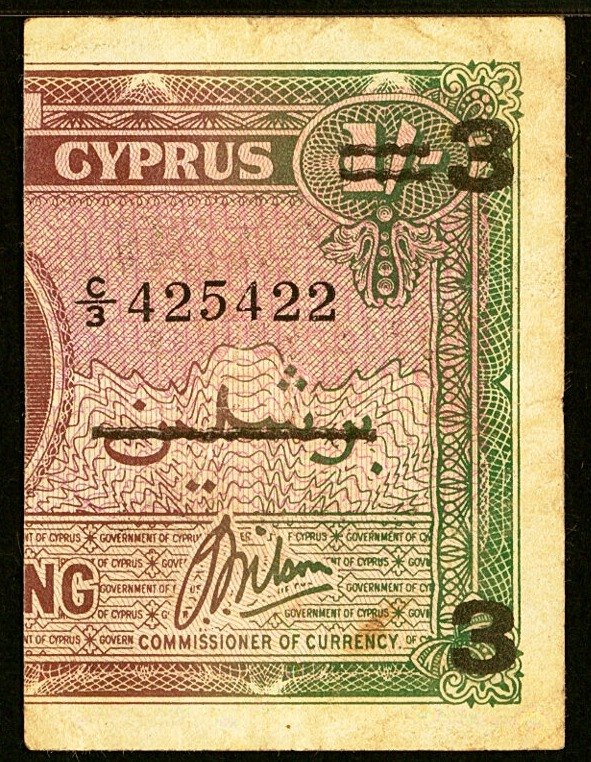
Heritage (24 April 2020, lot 26084) says of the first overprint that Thomas de la Rue had been badly damaged in the air raids on London and had not yet taken up banknote printing again. The pages name Bradbury Wilkinson, not Thomas de la Rue, as the printer of the 1 shilling and of the 3 piastres of 1943 and 1944, and they do not give this reason.
1952 to 1954: Turkish in Latin letters, and two portraits
The 5 shillings of 1952 are the first Cyprus notes with Turkish in the modern Latin letters that Turkey adopted in 1928; this had been approved on 1 December 1951. The notes were ordered before King George VI died on 6 February 1952. Bradbury Wilkinson delivered half the order with the King's portrait and a date in the King's reign, and half with the Queen's portrait and a date in the Queen's reign. The 10 shillings and 5 pounds of 1953 and 1954 went on using the King's portrait, because more notes were needed at once, changing the portrait would have been slow and costly, and the law required the date on a note to be current.
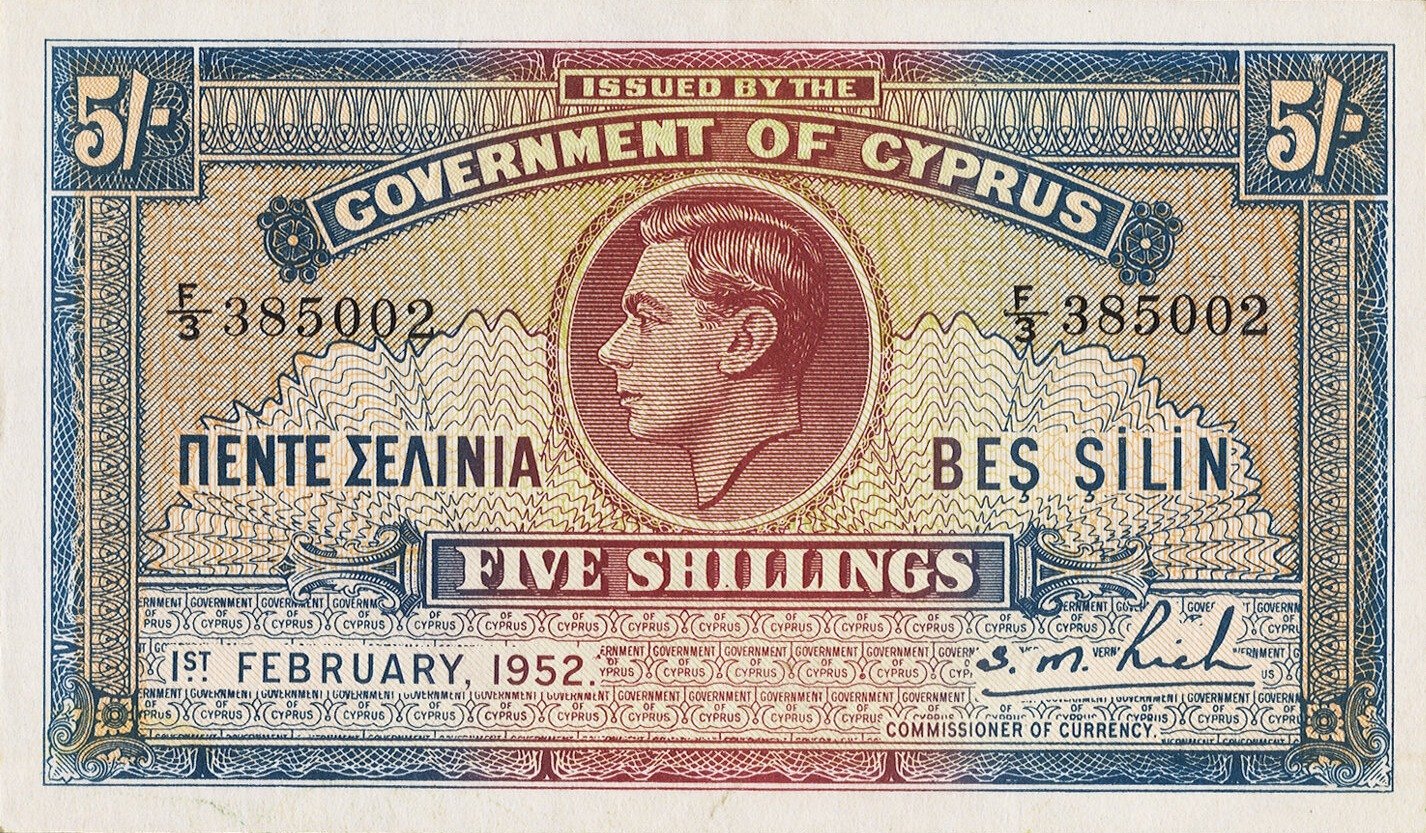
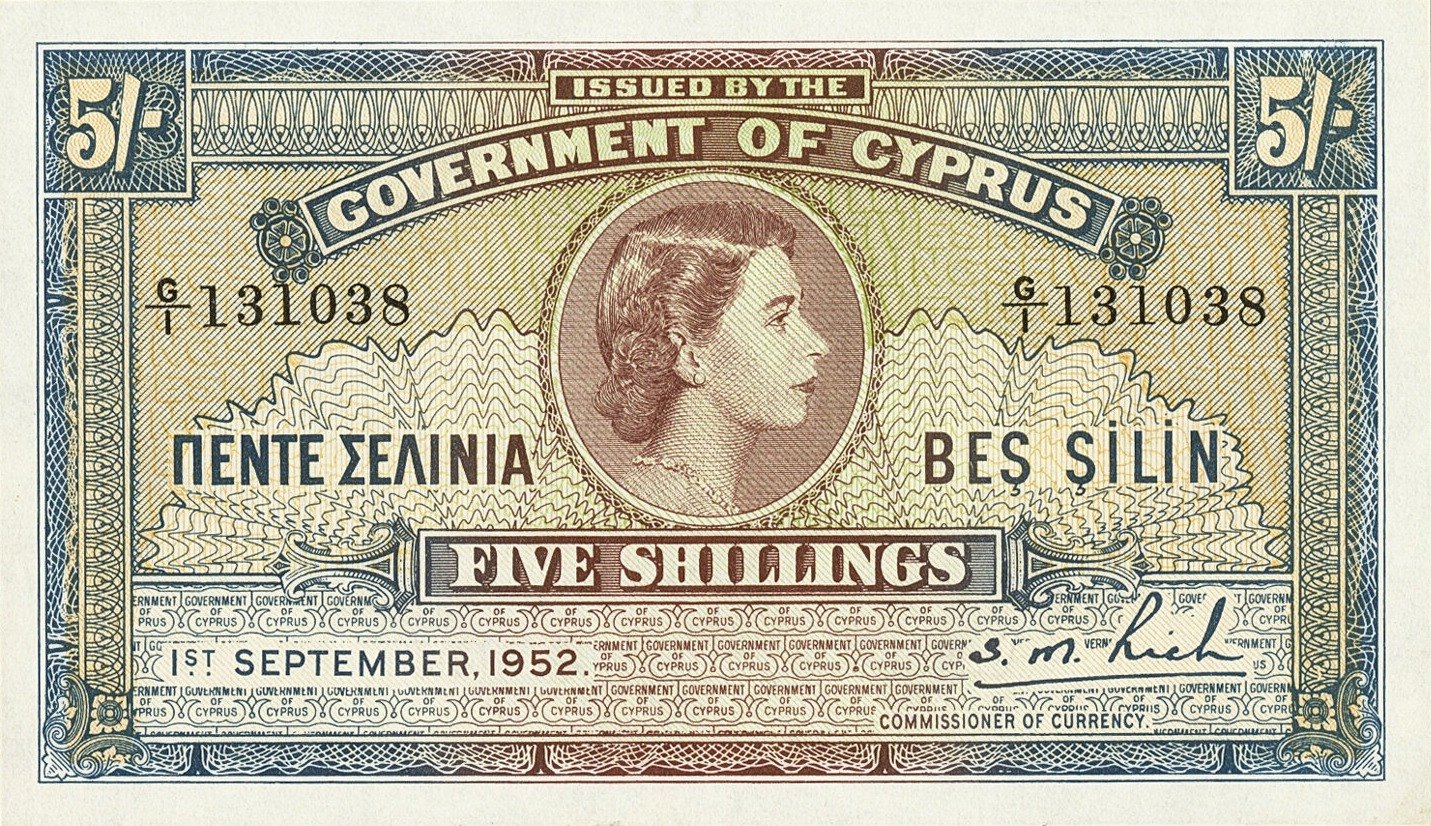
Sources mention that the Queen's profile on the 5 shillings follows a 1952 photograph by Dorothy Wilding. Spink (12 April 2016, lot 691) sold Bradbury Wilkinson's engraved portrait on card, which Spink's description says was used on the notes of Bermuda and on this Cyprus 5 shillings.
1955 to 1960: mils
The pound had been divided into 180 piastres since 1879. A committee approved decimal currency in August 1953, and the pound of 1,000 mils entered circulation on 1 August 1955. Bradbury Wilkinson printed four new notes with Queen Elizabeth II above a map of Cyprus: 250 mils, 500 mils, 1 pound and 5 pounds. The eagle's head of the watermark comes from the reverse of a silver stater of Paphos of the 5th century BC. Sources mention that the portrait follows a 1952 photograph by Dorothy Wilding, engraved by Bradbury Wilkinson. Spink (2 October 2019, lot 320) sold two copies of a Bradbury Wilkinson engraving after a Dorothy Wilding photograph, one marked as submitted on 12 August 1952 and one with a signed approval dated 29 August 1952. Spink's description names Cyprus among the countries whose notes used it, without saying which notes.
The older notes ceased to be legal tender on 31 August 1958 and could be redeemed until 28 February 1967. Spink (17 April 2019, lot 388) likewise says the George VI 5 pounds was demonetised in 1958.
Sources mention designs of February 1959 for the 250 and 500 mils and the 1 and 5 pounds that kept the layout of 1955, with a bust of Zeno in place of the Queen and a bunch of grapes in place of the lions on the back. They were not used.
The last notes of the Government of Cyprus are the 250 mils and 5 pounds dated 1st March 1960. Sources mention the 1960 notes being ordered quickly because the 250 mils was running short, and the Republic's first notes, dated 1961, did not circulate until August 1962. Sources mention the 1st March 1960 notes as the first signed by a Cypriot commissioner of currency, Stephani, who signed in Latin letters and later used Greek on the Republic's notes. The colour trials of this issue have their own article: Two £5 colour trials, not one: a closer look at the Cyprus 1955 colour trials.
What the pages do not say
The pages give no circulation figures after 1933. They do not name the law that made the 1914 Thomas de la Rue notes legal tender, or the notice under which those notes were put back into circulation after 1915. For the 5 and 10 shillings of 1914 the pages give 31 January 1922 as the day of the final withdrawal and for the 5 pounds 30 April 1922, without naming a source for either day. Where a page says only "sources mention", this article keeps those words.
Sources
- Proclamation of 7 September 1914, Cyprus Gazette of 8 September 1914, as given on the catalogue's pages.
- The Cyprus Blue Books for 1919, 1920, 1926, 1927, 1930 and 1946, as given on the catalogue's pages.
- The annual reports on Cyprus for 1922, 1926, 1930, 1931, 1932, 1933, as given on the catalogue's pages.
- Fred Schwan, Bank Note Reporter, February 1983, from the work of Major Fred Pridmore.
- Neil Shafer, Bank Note Reporter, October 2010.
- Heritage Auctions, 8 September 2017, lots 29007 and 29009; 24 April 2020, lot 26084; 9 May 2023, lot 28085.
- Stack's Bowers, 2 October 2025, lot 50094.
- Spink, 12 April 2016, lot 691; 17 April 2019, lot 388; 2 October 2019, lot 320.
Member comments
Log in or register to post a comment.