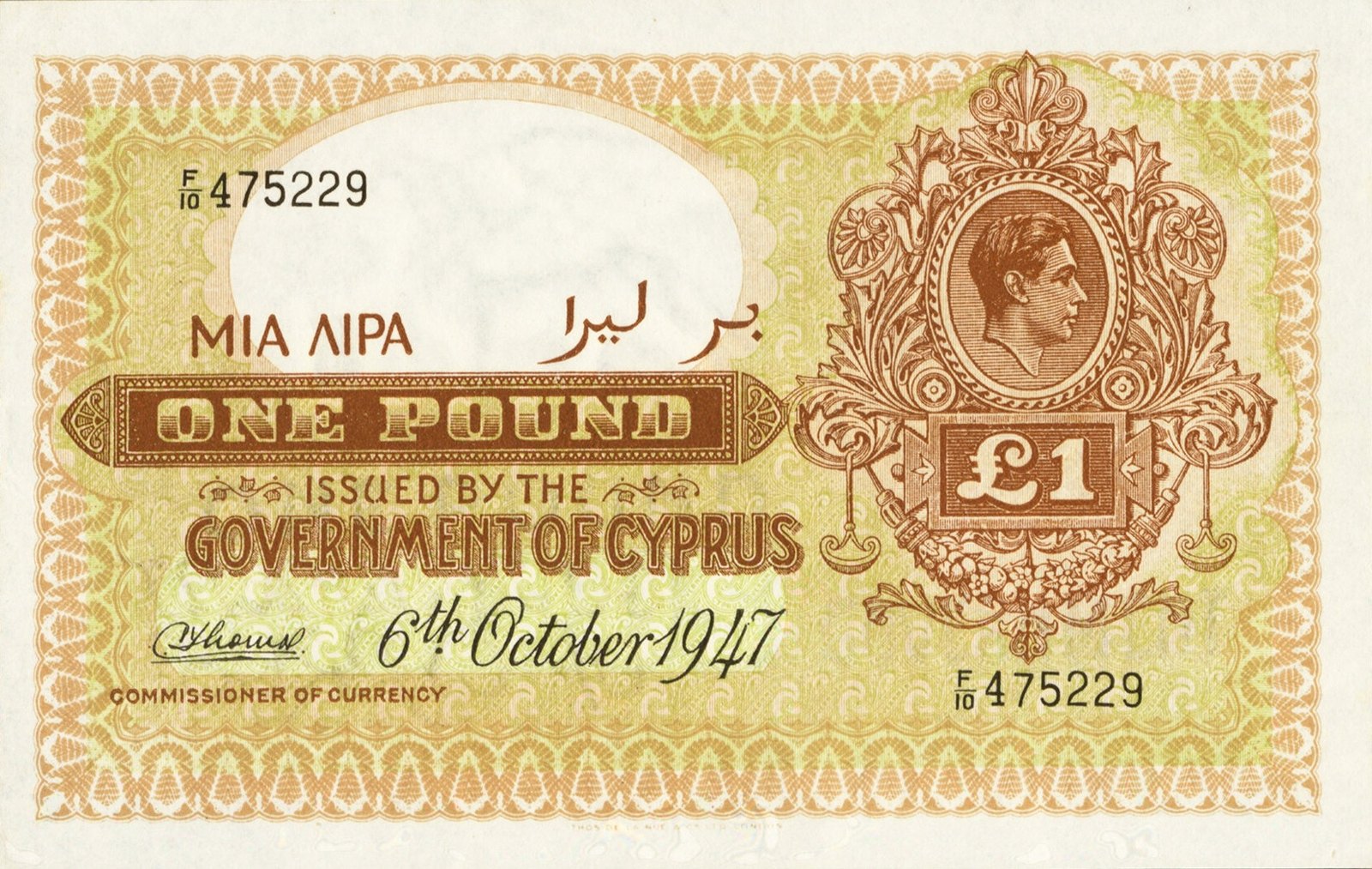
The catalogue's pages for the Government of Cyprus carry circulation figures for 1922 and for the notes of the 1917 design still out from 1930 to 1933, and nothing else. The volumes behind those sentences hold much more. Thirty-five volumes on Cyprus, published from 1918 to 1961, were read for the catalogue, chiefly the Cyprus Blue Books from 1917-18 to 1938 and for 1946 and the annual reports on Cyprus; the Colonial Office Lists, the bound volumes of Colonial Reports and two editions of An Economic Survey of the Colonial Empire add more. This article sets out what they count.
One caution runs through all of it. Only the Blue Books for 1923, 1924, 1926, 1928 and 1946 and a few annual reports were read on an image of the printed page; a few more lines were read on page images when the catalogue's pages were checked on 12 November 2026. The rest were read in machine-made text, where a digit can be lost or misread. Each table says which is which. The issues themselves are told in The currency notes of the Government of Cyprus, 1914 to 1960.
The limit of the issue and the most out in a year
For some years the annual report gives three things: the values in circulation, the highest amount out at any one time, and the amount out on the last day. The reports for 1920, 1922, 1924 and 1929 also give the limit of the issue, 700,000 pounds.
| Report | Values named as in circulation | Most out at one time | Out at the end | Read on |
|---|---|---|---|---|
| 1920, p. 7 | 10 pounds, 5 pounds, 1 pound, 10s., 5s., 2s., 1s. | 632,169 pounds | 526,539 pounds on 31st March 1921 | text only |
| 1922, No. 1159, p. 15 | 10 pounds, 1 pound, 10s. | 532,870 pounds | 520,232 pounds on 31st December 1922 | page image |
| 1924, p. 20 | 10 pounds, 1 pound, 10s. | 525,125 pounds, on 31st December | 525,125 pounds | page image |
| 1929 | 5 pounds, 1 pound, 10s. | 478,999 pounds, 12th to 17th October | not given in the passage read | text only |
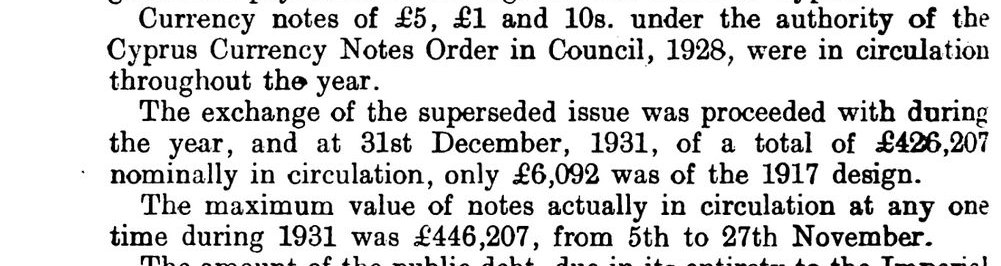
| 1931, No. 1574 | 5 pounds, 1 pound, 10s. | 446,207 pounds, 5th to 27th November | 426,207 pounds, nominally | page image |
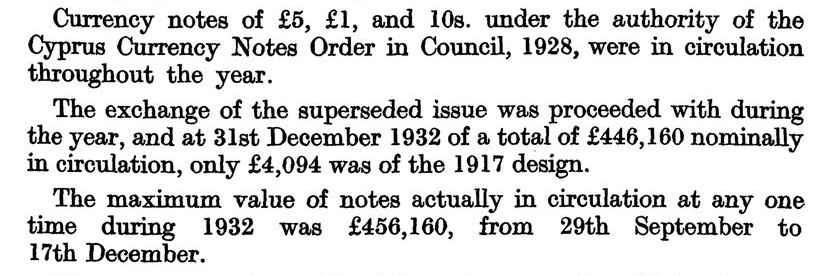
| 1932, No. 1618 | 5 pounds, 1 pound, 10s. | 456,160 pounds, 29th September to 17th December | 446,160 pounds, nominally | page image |
| 1933, No. 1663 | 5 pounds, 1 pound, 10s. | 446,313 pounds, 1st January to 8th April | 396,162 pounds, nominally | page image |
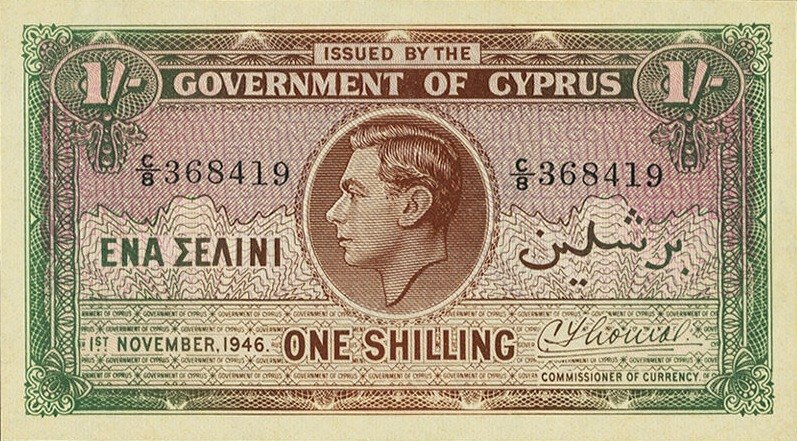
The report for 1920 adds that the emergency issue of 1 shilling notes made in 1919-20, to the value of 1,949 pounds, was withdrawn. That is the 1 shilling printed in Nicosia on the backs of cut 5 shillings notes. The catalogue's page gives 60,000 as the number made and 30 April 1922 as the day the note was demonetised; the report speaks of a withdrawal, which is not the same thing, and it does not say how many notes its 1,949 pounds stood for.
The report for 1924 says that all values other than the 10 pounds, 1 pound and 10 shillings had by then been demonetised. The reports for 1930 to 1933 use the word "nominally" because the total still counted notes of the 1917 design that were being handed in; those figures are in the first article, linked above.
The total at the end of each year, 1923 to 1959
From 1923 the Blue Book has one line a year, the estimated amount of paper money in circulation at the end of the year. No Blue Book for 1932 or for 1939 to 1945 was held. From 1946 the figure comes from the annual report.
| End of | Notes in circulation | Source | Read on |
|---|---|---|---|
| 1923 | 410,170 pounds | Blue Book for 1923 | page image |
| 1924 | 525,125 pounds | Blue Book for 1924 | page image |
| 1925 | figure lost in the machine-made text | Blue Book for 1925 | text only |
| 1926 | 461,069 pounds 10s. | Blue Book for 1926 | page image |
| 1927 | 474,025 pounds | Blue Book for 1927 | text only |
| 1928 | 411,999 pounds | Blue Book for 1928 | page image |
| 1929 | 396,999 pounds | Blue Book for 1929 | text only |
| 1930 | 411,206 pounds in the Blue Book; 411,206 pounds 10s. in the annual report | Blue Book and annual report for 1930 | Blue Book text only; report on the page image |
| 1931 | 426,207 pounds | Blue Book for 1931, text only; annual report for 1931 | report on the page image |
| 1932 | 446,160 pounds | annual report for 1932; An Economic Survey of the Colonial Empire (1932), p. 224 | page image |
| 1933 | 396,165 pounds 10s. in the Blue Book; 396,162 pounds in the annual report | Blue Book and annual report for 1933 | Blue Book text only; report on the page image |
| 1934 | 428,575 pounds | Blue Book for 1934 | text only |
| 1935 | 462,023 pounds, the shillings doubtful | Blue Book for 1935 | text only |
| 1936 | 522,653 pounds | Blue Book for 1936 | text only |
| 1937 | 609,761 pounds, the shillings doubtful | Blue Book for 1937 | text only |
| 1938 | 628,267 pounds, the shillings doubtful | Blue Book for 1938 | text only |
| 1939 to 1945 | no volume held | ||
| 1946 | 5,855,543 pounds | annual report for 1946 | text only |
| 1947 | 5,366,163 pounds 5s. 6p. | Blue Book for 1946, p. 238, and annual report for 1947 | page image |
| 1948 | 4,708,015 pounds 5s. 6d. | annual report for 1948 | text only |
| 1949 | the first digit lost; the rest reads 789,804 pounds 16s. 3p. | annual report for 1949 | text only |
| 1950 | 4,754,032 pounds 4s. | annual report for 1950 | text only |
| 1951 | 4,771,107 pounds 4s. 6p. | annual report for 1951 | text only |
| 1952 | 5,492,915 pounds | annual report for 1952 | text only |
| 1953 | 6,009,697 pounds 12s. 3p. | annual report for 1953 | text only |
| 1954 | 6,803,186 pounds 17s. 3p. | annual report for 1954 | text only |
| 1955 | 7,460,836 pounds, old and new notes together | annual report for 1955 | text only |
| 1956 | 9,306,237 pounds | annual report for 1956 | text only |
| 1957 | 9,827,972 pounds 467 mils | annual report for 1957 | text only |
| 1958 | 9,178,062 pounds 250 mils | annual report for 1958 | text only |
| 1959 | 8,818,966 pounds 750 mils | annual report for 1959 | text only |
The 1933 line shows the Blue Book and the annual report differing by 3 pounds 10 shillings. The 1933 edition of An Economic Survey of the Colonial Empire prints 396,166 pounds for the currency notes, under a heading that still reads 31st December 1932, the date of the edition before, which gave 446,160 pounds.
The 1947 figure stands in the volume called the Blue Book for 1946, in a section headed as at 31st December 1947.
None of these volumes divides the total by value after 1919. The Blue Books for 1917-18 and 1919 do have a table of notes by value, with the notes of the 1914 design beside those of 1917, but in the machine-made text its columns are scrambled and the figures cannot be tied to their rows. They are not given here.
The Note Security Fund
The notes were backed by a Note Security Fund, shown each year in the statement of assets and liabilities in the Blue Book. These figures were read in the text only.
| Day | Note Security Fund | Volume |
|---|---|---|
| 31st March 1921 and 31st December 1921 | 160,000 pounds, investments at cost | Blue Books for 1920 and 1921 |
| 31st December 1922 | 520,232 pounds | Blue Book for 1922 |
| 31st December 1923 | 410,170 pounds | Blue Book for 1923 |
| 31st December 1924 | 525,125 pounds | Blue Book for 1924 |
| 31st December 1926 | 461,069 pounds 10s. | Blue Book for 1926 |
| 31st December 1928 | 411,999 pounds | Blue Book for 1928 |
| 31st December 1929 | 369,074 pounds 15s. 2cp., investments at cost | Blue Book for 1929 |
| 31st December 1930 | 337,483 pounds 16s. 7cp., investments at cost | Blue Book for 1930 |
| 31st December 1931 | 431,867 pounds 9s. 6cp. | Blue Book for 1931 |
| 31st December 1933 | 488,241 pounds 2s. 8cp. | Blue Book for 1933 |
In 1923, 1924, 1926 and 1928 the Fund is the same figure as the notes in circulation, and the Fund of 1922 is the figure the annual report gives for the notes out at the end of that year. The annual report for 1931 says that the Government stopped paying into the Fund a subvention out of the interest on Government moneys. An Economic Survey of the Colonial Empire (1933) gives 559,909 pounds as the invested reserves for the note and silver issues together in 1933. The annual report for 1958 says the notes were still backed in full in sterling.
Which notes each Blue Book lists as legal tender
The currency section of the Blue Book lists the notes that were legal tender. Read year by year, the lists run as follows.
| Blue Book | Notes listed |
|---|---|
| 1917-18 | design of 1914: 5 pounds, 10s., 5s.; design of 1917: 10 pounds, 1 pound, 10s. |
| 1919 | the same, with the 5s. of the 1917 design and the 1s. called Emergency Issue 1919 |
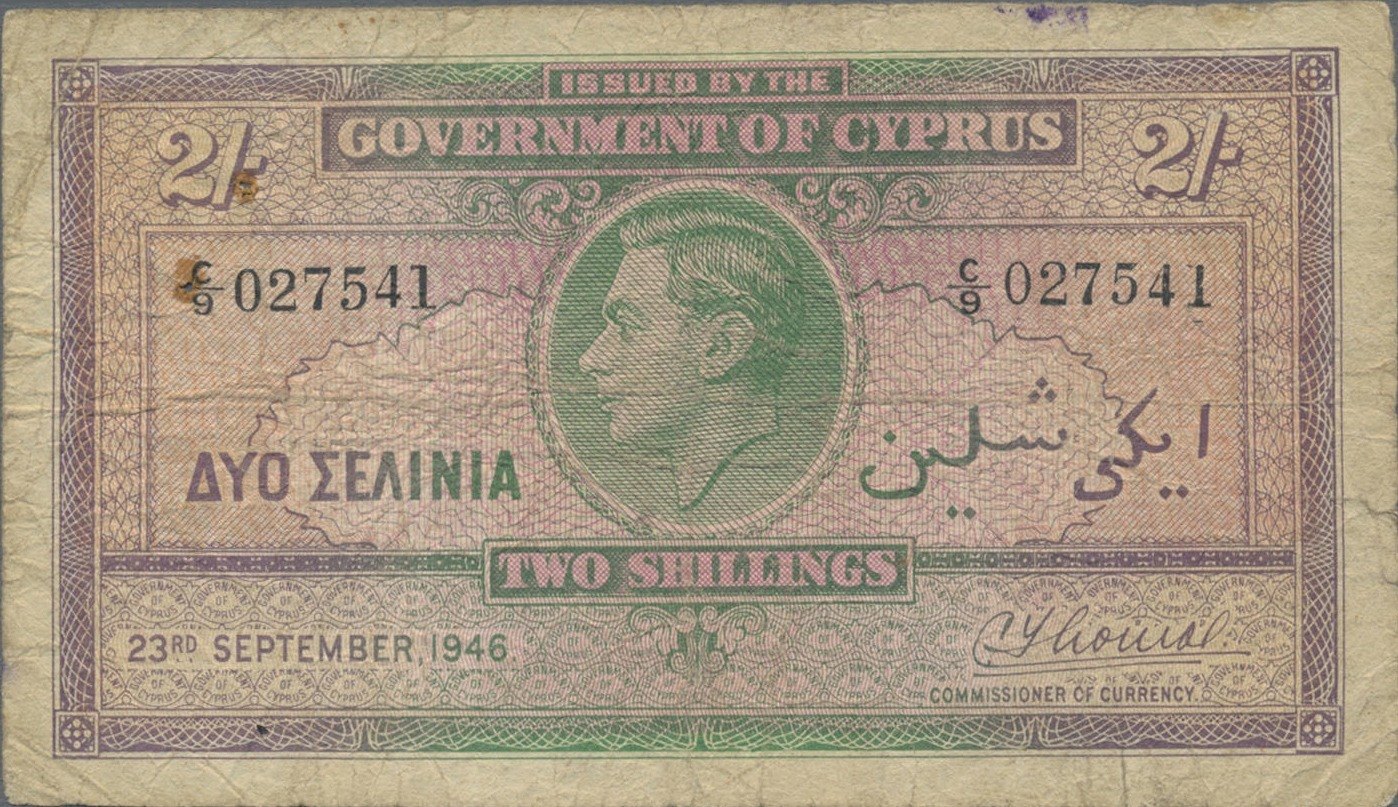
| 1920 | the same, with the 2s. and 1s. of the design of 1920 |
| 1922 | only the 10 pounds, 1 pound and 10s. of the design of 1917 |
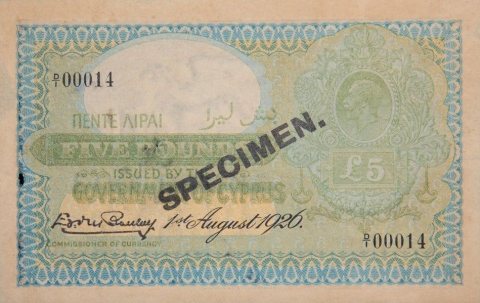
| 1926 | 1 pound, 10s. and a new 5 pounds, all three called design of 1917 |
| 1930 and 1931 | only the 1 pound and 5 pounds of the design of 1930 |
| 1933 | the 10s. of the design of 1930 appears |
| 1946 | 5 pounds, 1 pound and 10s., design of 1930; 5s., 2s., 1s. and 3 piastres, design of 1939 |
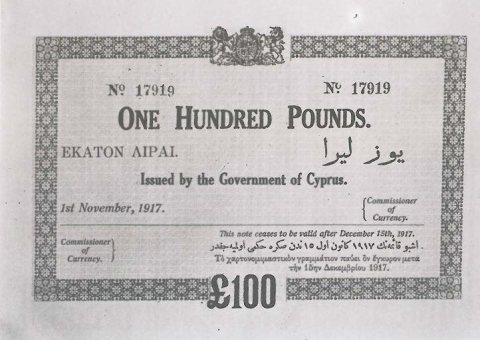
The 1 pound of the design of 1914 is in none of these lists; the catalogue's pages say that it alone was not put back into circulation after 1915. The Blue Book for 1921 no longer lists the emergency 1 shilling of 1919. No list names a 2 shillings of 1919 or the 100 pounds of 1917.
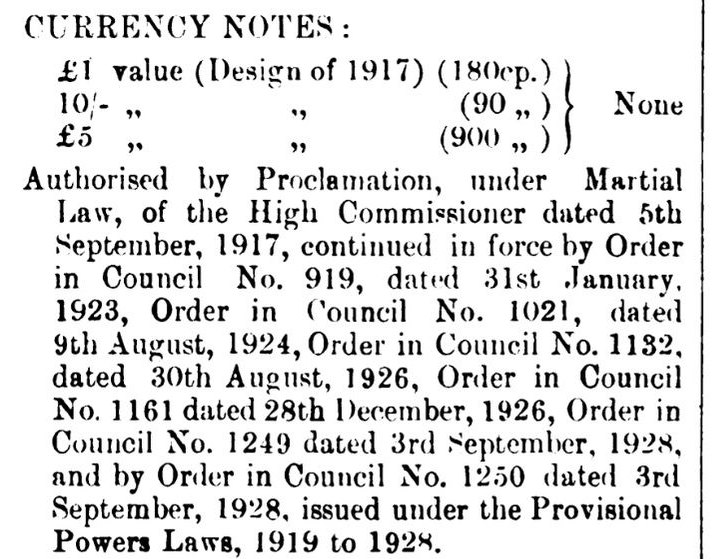
The Blue Book for 1919 gives four proclamations under martial law as the authority for these notes: one of 2nd September (the machine-made text prints the year as 1915; the notes it covers are those of the 1914 design), one of 5th September 1917, one of 10th April 1918 and one of 12th November 1919. By their order in the list the third belongs to the 5 shillings of the 1917 design and the fourth to the emergency 1 shilling, but the text is too broken to be sure of the pairing.
The annual reports from 1946 say that the notes of 5, 2 and 1 shillings and of 3 piastres took the place of the silver coin that disappeared during the war. Cupro-nickel coins of 18 and 9 piastres, 89,000 pounds of them, were out by the end of 1948, yet the 2 shillings, 1 shilling and 3 piastres notes are still listed every year to 1954. The report for 1955 says the notes in mils came in on 1 August 1955 and that by the end of the year all the old currency except notes had ceased to be legal tender.
Orders, laws and rules the volumes name
The chain of Orders in Council that kept the 1917 notes legal tender from 1921 to 1928 is in the first article. The legislation lists of the Blue Books name these as well. Where the day could not be matched to its line in the text, the table says so.
| Year | Instrument | What the Blue Book calls it |
|---|---|---|
| 1917-18 | Orders in Council Nos. 709 and 721 | raising the note issue, and fixing a maximum issue of notes; days not matched |
| 1918 | proclamations under martial law | making acts concerning currency notes offences |
| 1918 | an Order by the Officer Administering the Government | on currency notes, in Gazette No. 1354 of November 1918 |
| 1919 | a proclamation | Issue of one shilling Currency Notes |
| 1919 | Order in Council No. 779 | Note Currency issue, increase of |
| 1922 | Order in Council No. 861 | Demonitization of 1914 issue of Currency Notes; day not matched |
| 1922 | Order in Council No. 869 | Demonitization of Currency Notes; day not matched |
| 1935 | Law No. 9 of 1935 | amending the Cyprus Currency Notes Order in Council, 1928 |
| 1936 | Law No. 28 of 1936, of 17th August, Gazette of 18th September | penalties for counterfeit notes under the Geneva Convention of 1929 |
| 1946 | Cyprus Currency Notes (Amendment) Rules, 1946, of 30th August | published in Supplement No. 3 to the Gazette of 5th September 1946; content not given |
The spelling of the two Orders of 1922 is the Blue Book's. After them only the 10 pounds, 1 pound and 10 shillings of the 1917 design were legal tender. The catalogue's pages give 31 January 1922 for the end of the 5 and 10 shillings of 1914 and 30 April 1922 for the 5 pounds of 1914 and the small notes; which Order goes with which day cannot be told from the Blue Book, and the text of the Orders was not read.
From the Blue Book for 1937 the authority for the notes is given as the Cyprus Currency Notes Order and Laws, 1928 to 1936. The Blue Books for 1937, 1938 and 1946 record that the import and export of forged, counterfeited or altered currency notes was prohibited. No forgery of a Cyprus note is reported in any of the volumes, beyond the report from abroad that led to the end of the 10 pounds in 1926.
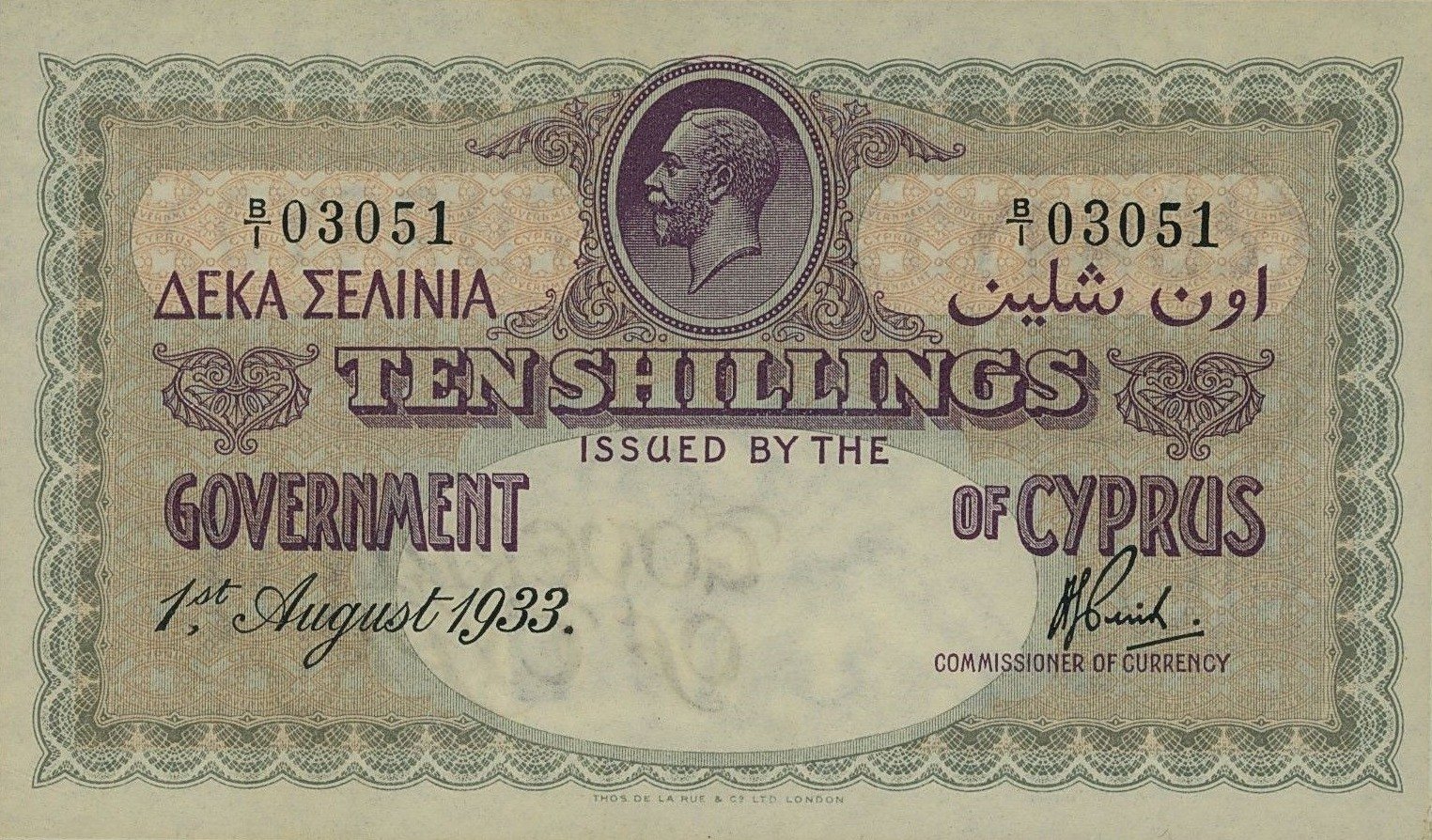
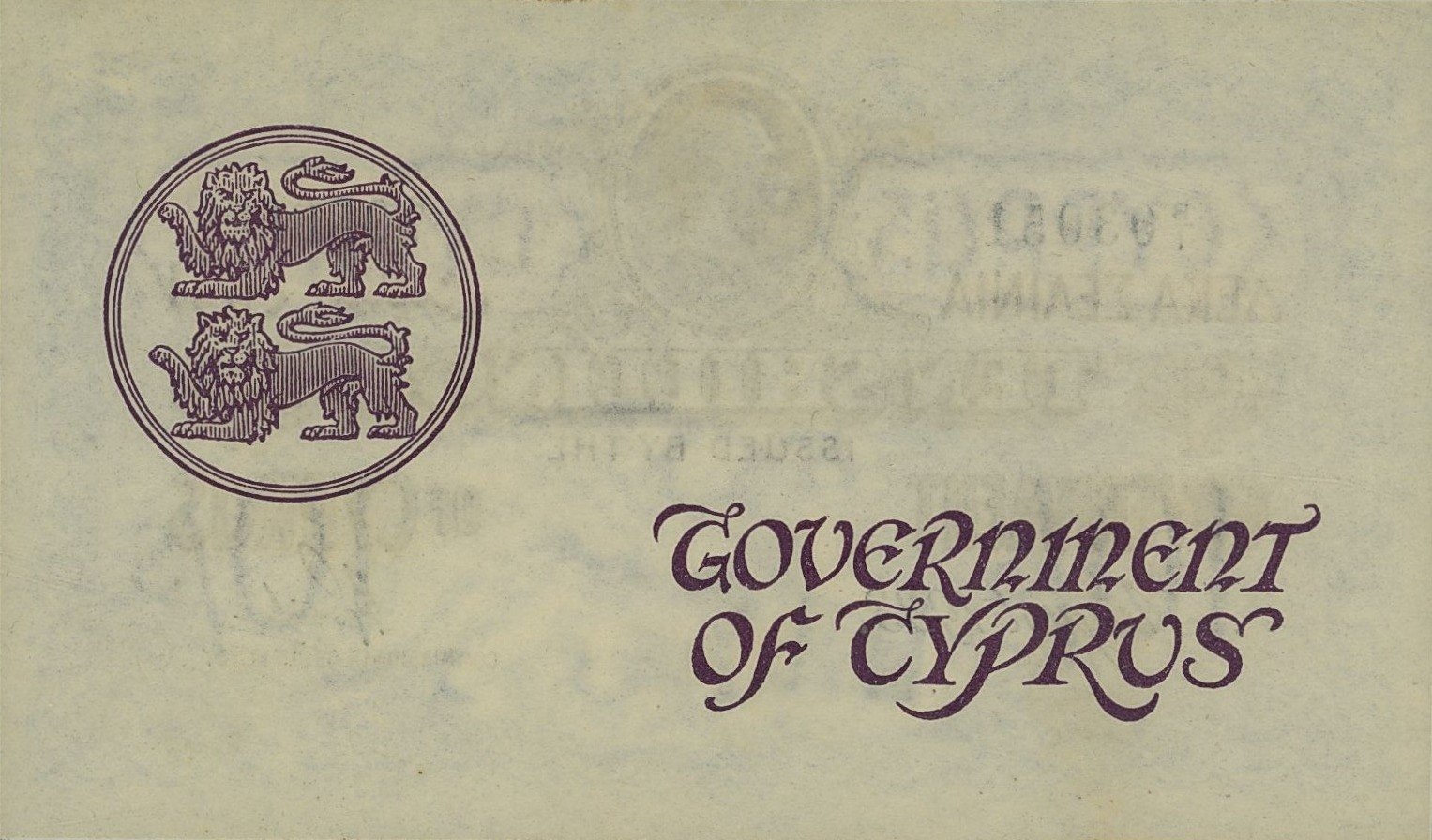
The Cyprus Gazette (Extraordinary) No. 2028 of 16th January 1930, which printed the Order in Council of 1928, carried two more things. The Currency Notes Rules, 1930, told the banks to stop paying out the old notes from 15th February 1930. Notice No. 63 said that the 10 shillings would not be issued for the present. The Rules describe the two beasts on the back of the new notes as the leopards of the Governor's badge; the catalogue's pages call them lions passant.
Officers of the currency in the same volumes
The signers and their terms are set out in Who signed the Cyprus notes, 1914 to 1960. The same volumes name officers whose names are on no note, and give careers for some who signed.
| Officer | What the volume says | Volume |
|---|---|---|
| Clive Watts | Accountant from 16.4.20, Deputy Treasurer from 1928; acted as Treasurer 22nd to 31st December 1930, 1st to 4th January and 21st to 28th December 1931, and 28th and 29th March 1934 | Blue Books for 1930, 1931 and 1934 |
| A. M. H. Kevorkian | a Chief Clerk of the Treasury, paid 50 pounds a year as Currency Officer from 1935 | Blue Books for 1935 to 1938 |
| H. C. Ley | Chief Accountant of the Treasury from September 1930, after the Falkland Islands Treasury, 1924 to 1930; Deputy Treasurer from 3.12.34; acted as Treasurer 30th May to 4th November 1936 as well as in 1938 | Colonial Office List for 1932; Blue Books for 1934, 1936 and 1938 |
| G. F. Wilson | Comptroller of Customs and Inland Revenue from 7.7.24, first appointed 1.5.08; acted as Treasurer from 4th November 1934 to 13th March 1935; Treasurer in the staff lists of 1940 and 1946 | Blue Books for 1933 to 1935; Colonial Office Lists for 1940 and 1946 |
| P. Parker | Deputy Treasurer, with an allowance of 60 pounds as Currency Officer | Colonial Office List for 1946 |
| C. J. Thomas | accountant, Ceylon, 1930; assistant accountant, Cyprus, 1935; in the income tax and inland revenue offices from 1941; Treasurer 1946; Financial Secretary 1948; Sarawak 1952 | Colonial Office List for 1957 |
| S. M. Rich | Accountant-General, Mauritius, 1943; Assistant Treasurer, Cyprus, 1948; Accountant-General 1948; Director of Organization 1954 | Colonial Office List for 1957 |
| D. J. Mahony | accountant, Cyprus, 1946; chief accountant 1953; Accountant-General 1954; Tanganyika 1957 | Colonial Office List for 1958 |
| T. S. C. McIlwain | income tax, Nigeria, 1944 to 1951; chief accountant of the electricity authority, Cyprus, 1951 to 1957; Accountant-General 1957 to 1960 | Colonial Office List for 1960 |
| C. C. Stephani | accountant, Cyprus, 1952; Assistant Accountant-General 1958; Accountant-General in the Commonwealth Relations Office Lists of 1962 to 1966 | Colonial Office List for 1960; Commonwealth Relations Office List for 1962 |
Two things here bear on the notes. The record of service of Rich gives 1948 for the appointment as Accountant-General, where the catalogue's pages quote the Lists for 1950; the first date Rich signed is 1st January 1949. The Lists for 1958 and 1959 still print Mahony as Accountant-General after the move to Tanganyika in 1957, so a staff list alone is not proof of who held the office in a given year.
The Blue Book for 1946 marks the Treasurer's post as also that of Commissioner of Currency, and shows a Chief Currency Clerk and Currency Clerks in the Treasury. Whether an acting Treasurer was Commissioner of Currency for the weeks of acting is not stated in any volume.
What these volumes do not hold
- The Colonial Office Lists for 1941 to 1945 were not held, and the term of G. F. Wilson as Treasurer was not read. Why Ley signed the notes dated 2nd February 1942, in the middle of the dates Wilson signed, is therefore not answered.
- There is no Blue Book for 1939 to 1945 among them, so nothing dated on the Defence Regulations of 1942 to 1946, on the 3 piastres of 1943 or on the Palestine notes of 1942.
- The text of the Cyprus Gazette notices is not in them. The day on which Order in Council No. 1122 of 12th July 1926 took effect for the 10 pounds is not proved, and neither is any day on which the notes of the 1917 design ceased to be legal tender. The Blue Books stop listing those notes from 1930.
- No volume pictures a note or prints a serial number.
Sources
- The Cyprus Blue Books for 1917-18, 1918-19, 1919, 1920, 1921, 1922, 1923, 1924, 1925, 1926, 1927, 1928, 1929, 1930, 1931, 1933, 1934, 1935, 1936, 1937, 1938 and 1946.
- Colonial Reports, Annual: the reports on Cyprus for 1920 (p. 7), 1922 (No. 1159, p. 15), 1924 (p. 20), 1929, 1930, 1931 (No. 1574), 1932 (No. 1618) and 1933 (No. 1663).
- The annual reports on Cyprus for 1946 to 1959.
- An Economic Survey of the Colonial Empire (1932), Colonial No. 95, 1934, p. 224, and the edition for 1933, Colonial No. 109, 1935.
- The Colonial Office Lists for 1932, 1934, 1940, 1946, 1957, 1958, 1959 and 1960; the Commonwealth Relations Office List for 1962.
- The Cyprus Gazette (Extraordinary) No. 2028 of 16th January 1930: the Cyprus Currency Notes Order in Council, 1928, the Currency Notes Rules, 1930, and Notice No. 63.
Member comments
Log in or register to post a comment.