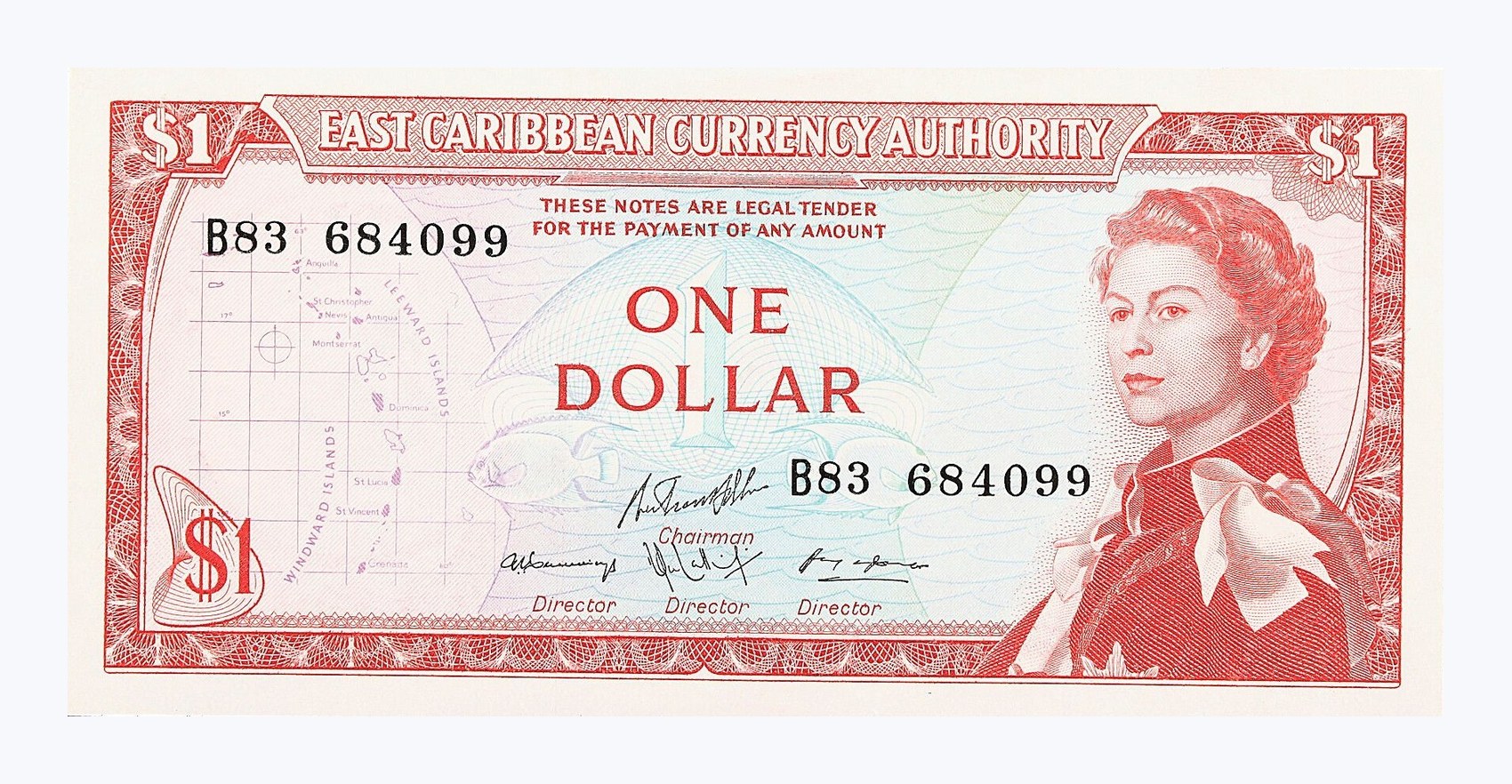
The notes of the East Caribbean Currency Authority have no date on them. One design, printed by Thomas de la Rue, was first issued in September 1965 and stayed in use until 1983. In those eighteen years twelve boards signed it, the list of territories on the back changed twice, and the prefix of the number moved on from board to board.
So a note can still be dated. This guide shows how, for the 1, 5, 20 and 100 dollars. It was checked against all 1,662 issued notes of this issue on the catalogue's serial register, as recorded on 16 November 2026. Every one of them has a prefix that its catalogue row gives.
Where to look
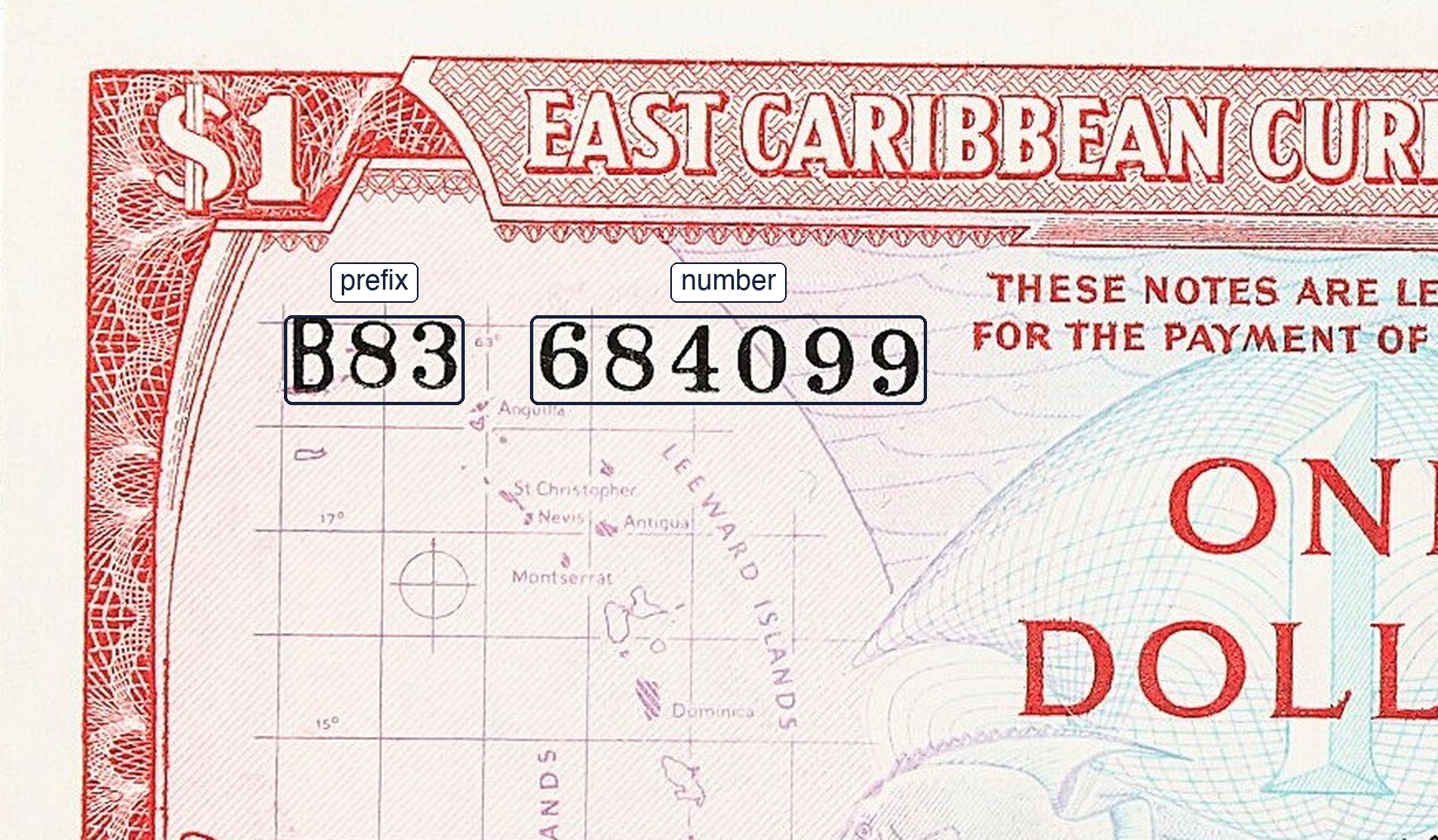
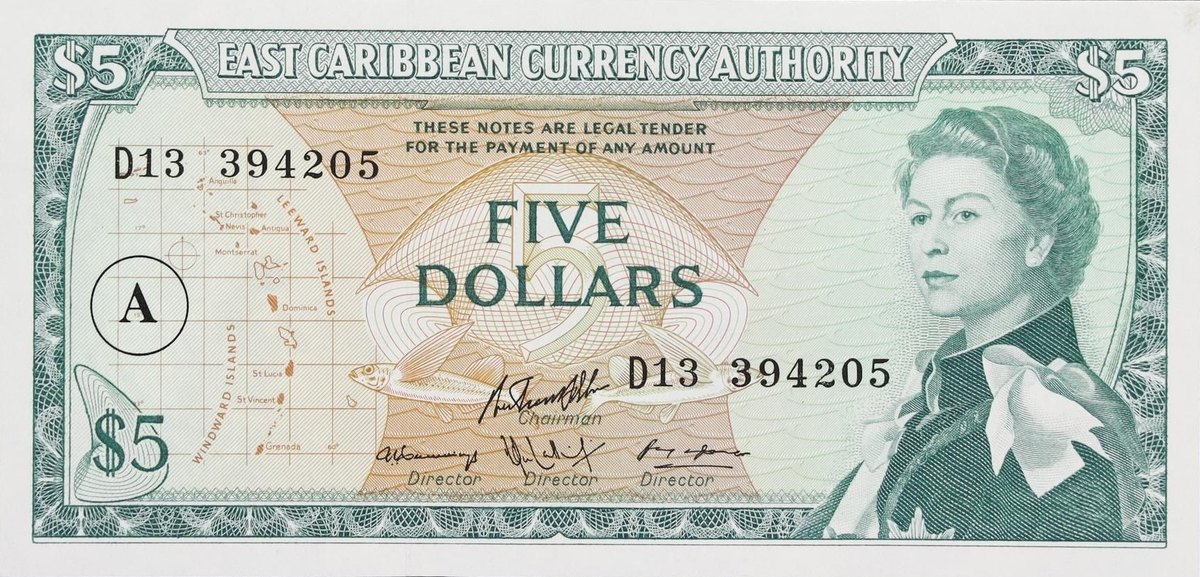
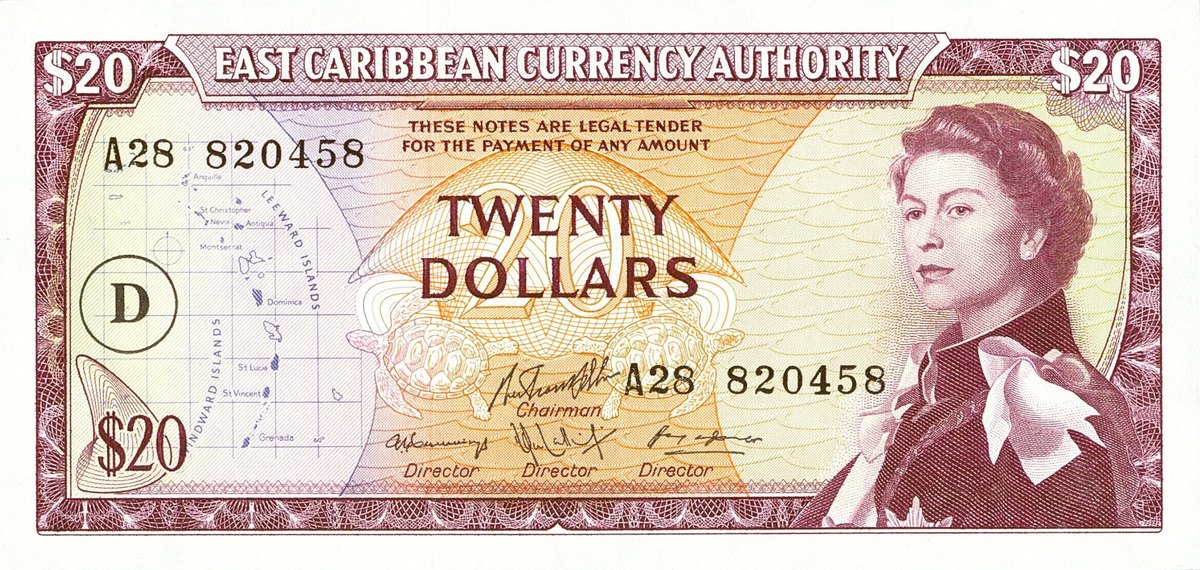
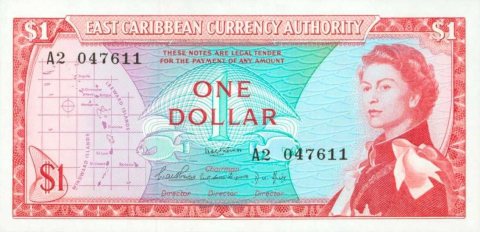
The prefix. The number is printed twice on the front: at the upper left, over the map, and at the lower right, beside the signatures. The prefix is the letter and figures before the gap. On the note below it is B83.
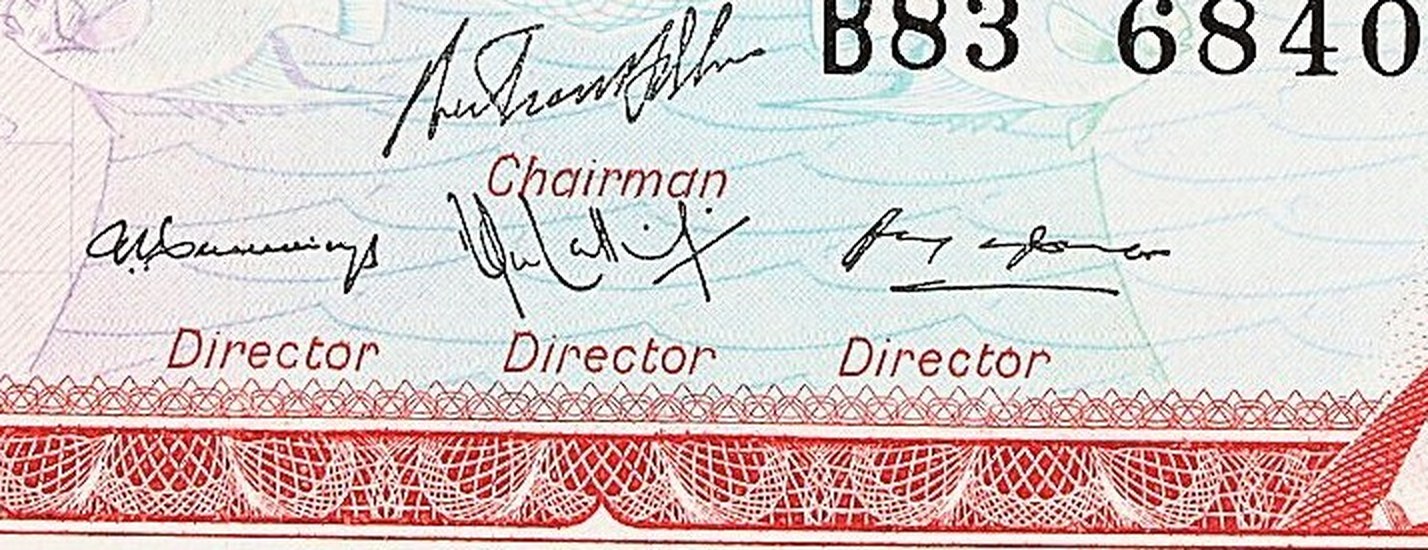
The signatures. There are four: the Chairman in the middle, and three Directors in a row beneath.
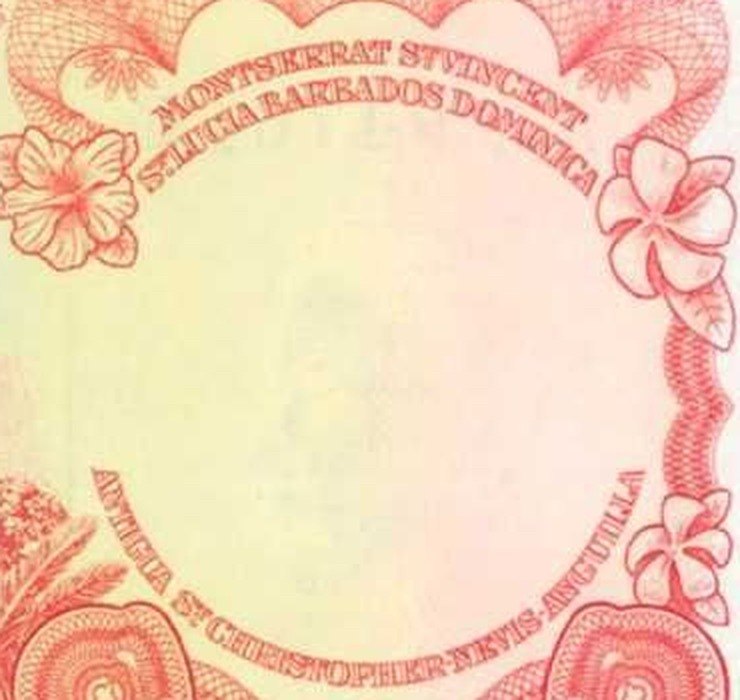
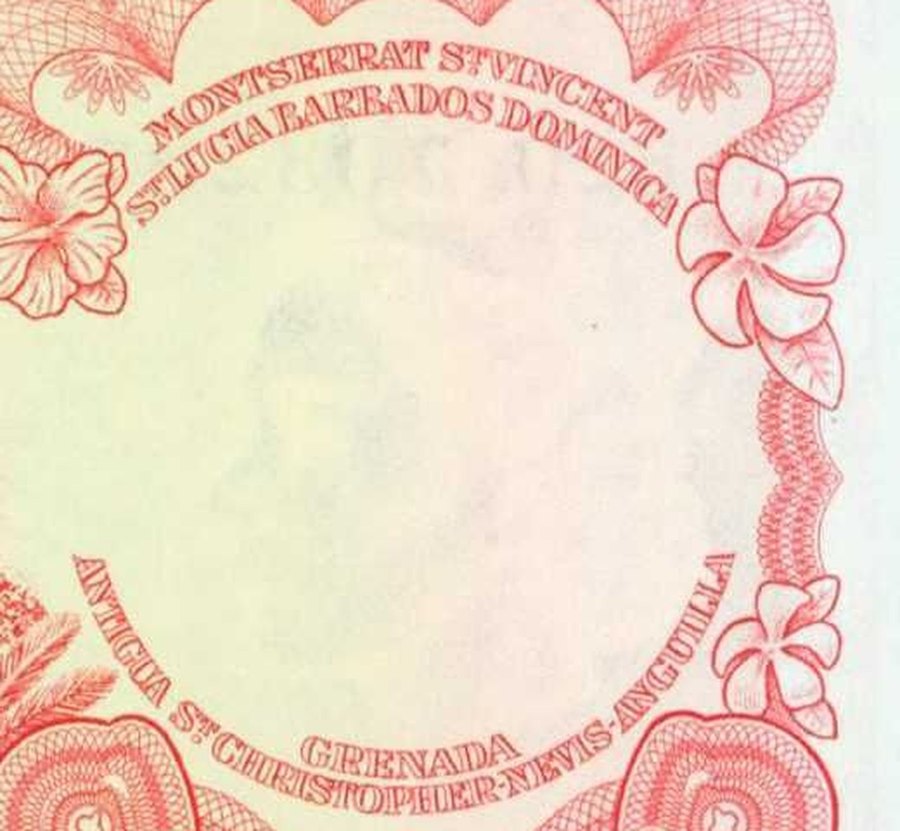
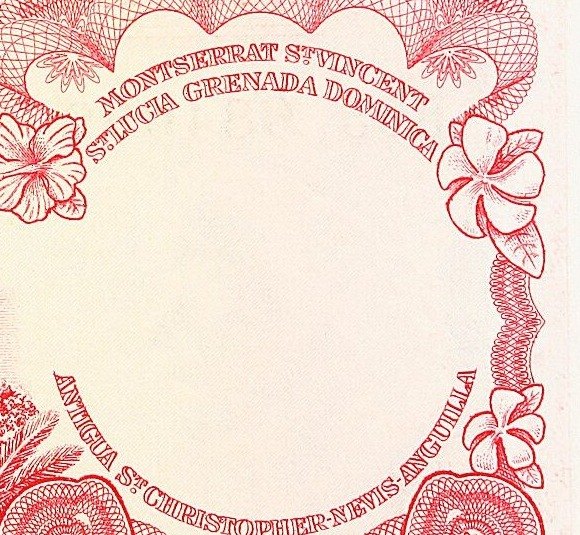
The back. At the right of the back, round the blank space of the watermark, is a list of the territories that used the notes.
First, the back gives the period
The list of territories comes in three forms, and each belongs to a stretch of years.
| Back | Barbados | Grenada | Period |
|---|---|---|---|
| A | named | not named | 1965 to 1968 |
| B | named | named | 1968 to 1974 |
| C | not named | named | 1974 to 1983 |
Barbados left the currency union in 1973, which is why its name goes from the last back.
Then the prefix gives the board
Each board was a Chairman and three Directors. The prefixes run in the order of the boards, so the prefix tells which board signed the note. The tables give the prefixes that each catalogue row states, the four names, the back, and how many notes of that row are on the serial register.
1 dollar
Ten boards signed the 1 dollar, which is red.
| Prefixes | Signatures, the Chairman first | Back | On the register | Catalogue row |
|---|---|---|---|---|
| A1 to A9, B1 | Thomas, Kelsick, Salles-Miquelle, Spiers | A | 56 | P-13a1 |
| B1 to B12 | Thomas, Kelsick, Salles-Miquelle, Lambert | A | 36 | P-13a2 |
| B13 to B17 | Kelsick, Gittens, Armour, Hughes | B | 18 | P-13b |
| B18 to B22 | Kelsick, Gittens, Armour, Smith | B | 26 | P-13c |
| B23 to B32 | Gittens, Mendes, Armour, Smith | B | 30 | P-13d1 |
| B33 to B43 | Gittens, Mendes, Williams, Smith | B | 17 | P-13d2 |
| B43 to B48 | Gittens, Osborne, Williams, Jacobs | B | 13 | P-13d3 |
| B48 to B59 | Salles-Miquelle, Squires, Gregoire, Jacobs | C | 43 | P-13e |
| B60 to B70 | Walling, Squires, Gregoire, Jacobs | C | 50 | P-13f |
| B70 to B92 | LeBlanc, Cummings, Walling, Jacobs | C | 140 | P-13g |
Four prefixes were used by two boards: B1, B43, B48 and B70. On those the signatures decide.
5 dollars
The 5 dollars is green. Its prefixes move faster through the letters, from A to D.
| Prefixes | Signatures, the Chairman first | Back | On the register | Catalogue row |
|---|---|---|---|---|
| A1 to A8 | Thomas, Kelsick, Salles-Miquelle, Spiers | A | 34 | P-14a |
| A8 to B1 | Thomas, Kelsick, Salles-Miquelle, Lambert | A | 6 | P-14b |
| not recorded | Kelsick, Gittens, Armour, Hughes | B | none, unconfirmed | P-14c |
| B1 to B3 | Kelsick, Gittens, Armour, Smith | B | 16 | P-14d |
| B4 to B8 | Gittens, Mendes, Armour, Smith | B | 12 | P-14e1 |
| B9 to C4 | Gittens, Mendes, Williams, Smith | B | 28 | P-14e2 |
| C5 | Gittens, Osborne, Williams, Jacobs | B | 3 | P-14f |
| C6 to D1 | Salles-Miquelle, Squires, Gregoire, Jacobs | C | 30 | P-14g |
| D1 to D5 | Walling, Squires, Gregoire, Jacobs | C | 23 | P-14h1 |
| D5 to D17 | LeBlanc, Cummings, Walling, Jacobs | C | 106 | P-14h2 |
Four prefixes were used by two boards: A8, B1, D1 and D5. No 5 dollars of the board of Kelsick, Gittens, Armour and Hughes has been recorded, and the catalogue marks that row unconfirmed.
20 dollars
The 20 dollars is purple. It used far fewer prefixes, and most of them were shared by two boards: A1, A3, A4, A5, A7, A8, A9 and A12. On the 20 dollars the prefix narrows the choice to two boards, and the signatures do the rest. The board of Kelsick, Gittens, Armour and Hughes is unconfirmed on this value too.
| Prefixes | Signatures, the Chairman first | Back | On the register | Catalogue row |
|---|---|---|---|---|
| A1 | Thomas, Kelsick, Salles-Miquelle, Spiers | A | 7 | P-15a |
| A1 to A3 | Thomas, Kelsick, Salles-Miquelle, Lambert | A | 18 | P-15b |
| not recorded | Kelsick, Gittens, Armour, Hughes | B | none, unconfirmed | P-15c |
| A3, A4 | Kelsick, Gittens, Armour, Smith | B | 7 | P-15d |
| A4, A5 | Gittens, Mendes, Armour, Smith | B | 14 | P-15e1 |
| A5 to A7 | Gittens, Mendes, Williams, Smith | B | 14 | P-15e2 |
| A7, A8 | Gittens, Osborne, Williams, Jacobs | B | 8 | P-15e3 |
| A8, A9 | Salles-Miquelle, Squires, Gregoire, Jacobs | C | 9 | P-15f |
| A9 to A12 | Walling, Squires, Gregoire, Jacobs | C | 50 | P-15g1 |
| A12 to A19 | LeBlanc, Cummings, Walling, Jacobs | C | 31 | P-15g2 |
100 dollars
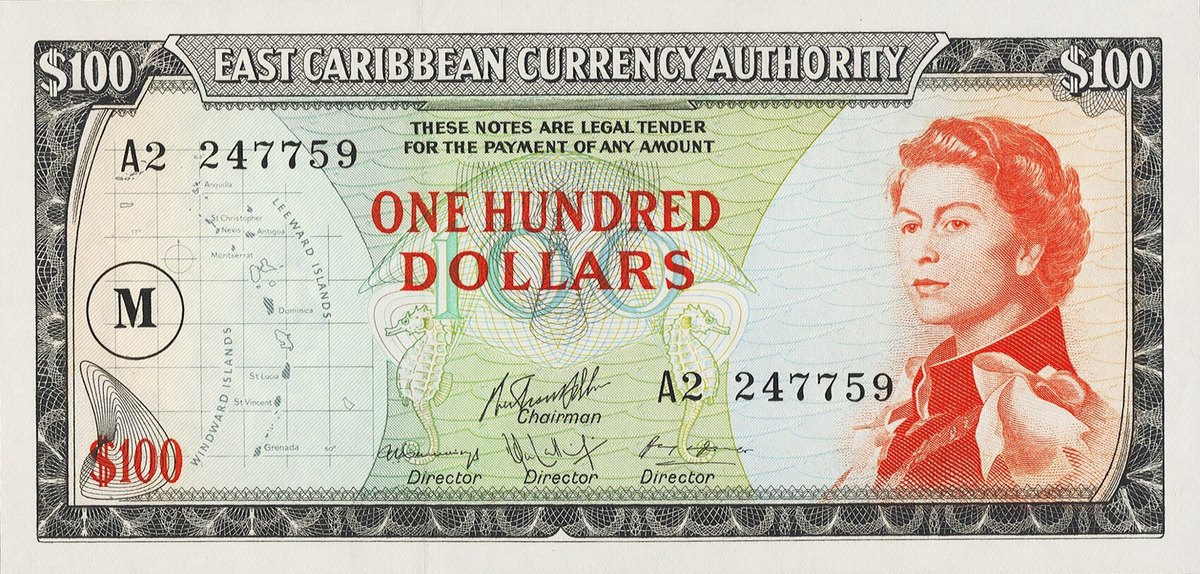
On the 100 dollars, which is black, the prefix does not help. Every board used A1, and only the last ran on into A2. The signatures and the back place the note. All twelve boards are catalogued for this value. Six of them have no note on the register, and the catalogue marks five of those unconfirmed.
| Prefixes | Signatures, the Chairman first | Back | On the register | Catalogue row |
|---|---|---|---|---|
| A1 | Thomas, Kelsick, Salles-Miquelle, Spiers | A | 2 | P-16a |
| A1 | Thomas, Kelsick, Salles-Miquelle, Lambert | A | 3 | P-16b |
| A1 | Thomas, Kelsick, Salles-Miquelle, Hughes | A | none, unconfirmed | P-16 |
| A1 | Thomas, Kelsick, Armour, Hughes | A | 1 | P-16 |
| A1 | Kelsick, Gittens, Armour, Hughes | A | none, unconfirmed | P-16d1 |
| A1 | Kelsick, Gittens, Armour, Smith | A | none, unconfirmed | P-16d2 |
| A1 | Gittens, Mendes, Armour, Smith | B | 1 | P-16c |
| A1 | Gittens, Mendes, Williams, Smith | B | none, unconfirmed | P-16d3 |
| A1 | Gittens, Osborne, Williams, Jacobs | B | none, unconfirmed | P-16d4 |
| A1 | Salles-Miquelle, Squires, Gregoire, Jacobs | C | none | P-16e |
| A1 | Walling, Squires, Gregoire, Jacobs | C | 24 | P-16f1 |
| A1, A2 | LeBlanc, Cummings, Walling, Jacobs | C | 9 | P-16f2 |
1983: a letter in a circle
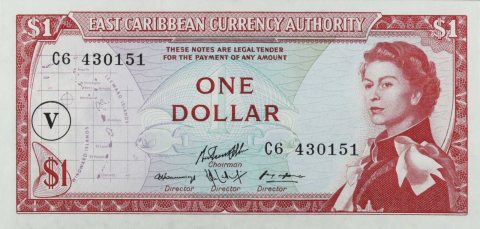
From 1983 the notes of the last board, LeBlanc, Cummings, Walling and Jacobs, were overprinted with a letter in a circle for the territory where they were issued. The letter is in black at the left of the front, over the map and below the number.
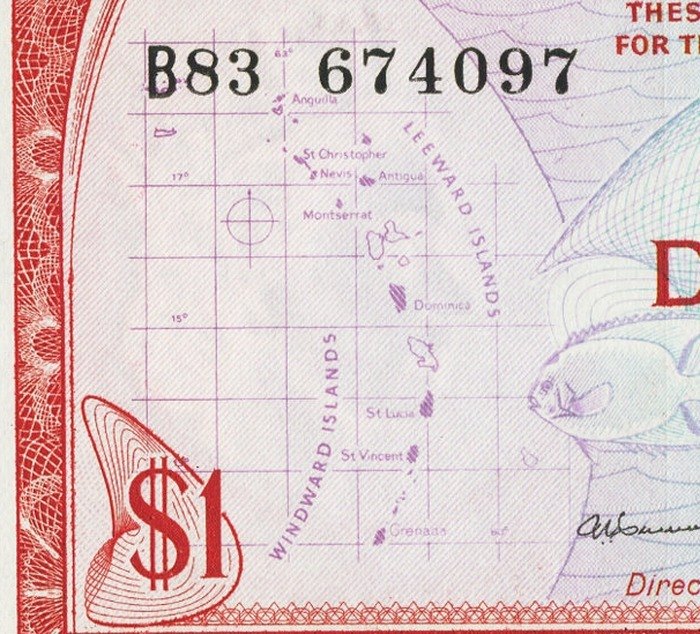
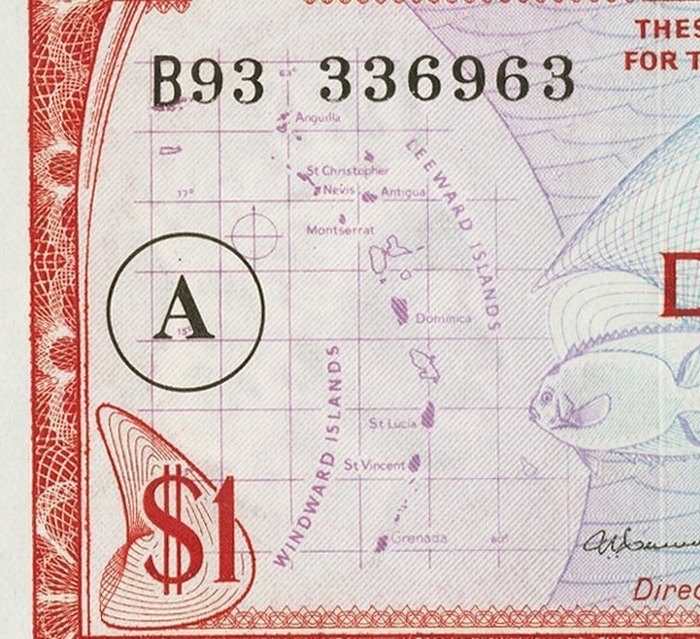
A note with a letter in a circle is a note of the 1983 overprint, whatever its prefix. The same prefix can carry several letters: B90 of the 1 dollar is recorded with G, K and M. The table gives the prefixes that the catalogue rows state for each letter.
| Letter | Territory | 1 dollar | 5 dollars | 20 dollars | 100 dollars |
|---|---|---|---|---|---|
| A | Antigua | B87, B88, B93, B98, B99, C7 | D12, D13, D17, D18 | A13 to A14, A16, A19, A25 | A1, A2 |
| D | Dominica | B88, B89, C2 | D13, D18 | A17, A19, A20, A28 | A1, A2 |
| G | Grenada | B90, B94, B95, C3, C4, C8, C9 | D14, D18, D19 | A20, A21, A26 | A1, A2 |
| K | St. Kitts | B90, B91, B95, B96, C1, C4, C8 | D14, D15, D20 | A22, A26, A27 | A1, A2 |
| L | St. Lucia | B96, B97, C1, C5, C8, C9, C10 | D16, D17, D20, D21 | A22, A23, A24, A27 | A1, A2 |
| M | Montserrat | B90, B95, C4 | D14, D19, D20 | A21, A22, A26 | A1, A2 |
| U | Anguilla | B92 | D17 | A19 | not recorded |
| V | St. Vincent | B92, B98, C6, C9, C10 | D17, D22 | A24, A25, A29, A30 | A1, A2 |
The notes without a territory letter ceased to be legal currency on 1st January 1988, and banks changed them until 31st March 1988.
Prefix Z1: a replacement
A note with the prefix Z1 is a replacement note, printed to take the place of a spoiled one. Z1 was used under several boards, so here the prefix gives nothing and the signatures give the board. The catalogue records replacements from back B onwards, with and without the letter of 1983.
Three notes, worked through
- A 1 dollar with the prefix B21. B18 to B22 is the board of Kelsick, Gittens, Armour and Smith. The back should be B, with both Barbados and Grenada, and the note belongs to 1968 to 1974.
- A 5 dollars with the prefix D1. D1 was used by two boards. If the Chairman is Salles-Miquelle, it is the earlier one; if he is Walling, the later. Both have back C, so either way the note belongs to 1974 to 1983.
- A 20 dollars with the prefix A19. With no letter on the map, it is the last board before the overprints. With a letter in a circle, it is a note of 1983: A19 is recorded with A, D and U.
What this guide cannot give
The catalogue has the years of each back, not the day each board took office. So a prefix places a note with a board and within a stretch of years, not in a single year. Where two or more boards signed under one back, their order is known and their dates are not.
Nine rows of the issue have no note behind them yet. If you have a note whose prefix is not in these tables, or a note of a board marked "none", please send us a photograph.
After 1983
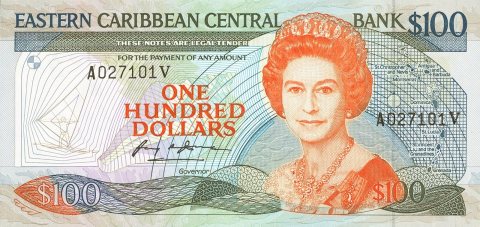
The Eastern Caribbean Central Bank took the place of the Currency Authority, and its notes are dated in another way. On its notes before the issue of 2008 the letter that names the territory is printed after the number: A, D, G, K, L, M, U or V, as in the table above. Every issue is set out on the catalogue page of the East Caribbean States.
The serial register of each row is there for NumiCrown Pro members.
Member comments
Log in or register to post a comment.