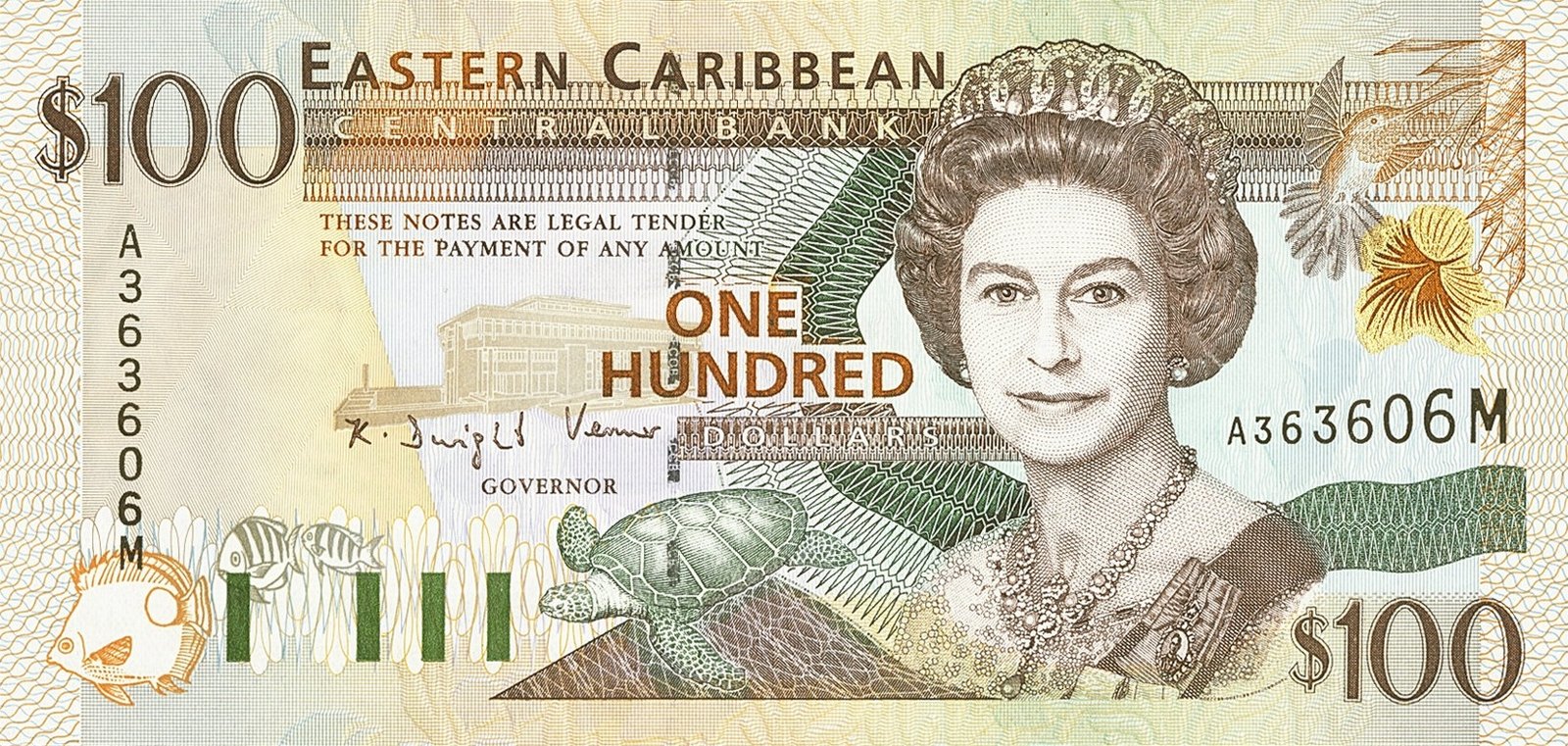
The paper notes of the Eastern Caribbean Central Bank carry no date, and nine printings look much alike. This article brings together, from the catalogue's note pages for the East Caribbean States, the marks that separate one printing from the next, the points where the Governor's signature changes, and the notes whose grading holders name a printing the note itself does not bear out. The notes of the Currency Authority before 1984 are dated from their prefixes in another article.
The five marks, in order of time
| Printing | Catalogue numbers | The mark |
|---|---|---|
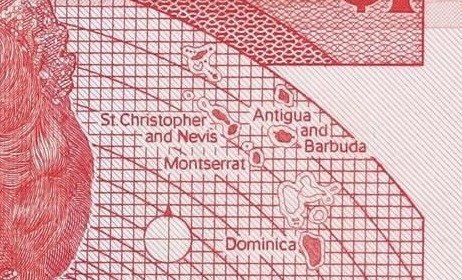
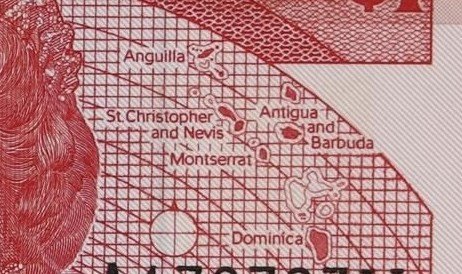
| 1984 to 1988 | P-17 to P-20 | Map at right; the northernmost island has no name |
| 1988 to 1993, and the 10 dollars from 1984 | P-21 to P-25 | Map at right; the word Anguilla beside that island |
| 1993 | P-26 to P-30 | No map; the value at upper left on a dark ornamental square |
| 1994 | P-31 to P-35 | No square, no foil; the building has a long low wing at the left |
| 1998, 100 dollars only | P-36 | Gold foil flower; the building still has the wing |
| 2001 | P-37 to P-41 | Gold foil; the building without the wing |
| 2003 | P-42 to P-46 | Silver foil; the building without the wing |
| 2008 | P-47 to P-51 | Two-letter prefix, no island letter; no raised marks |
| 2012 and 2015 | P-52 to P-55 | Two-letter prefix; raised marks for the blind |
The map: is Anguilla named?
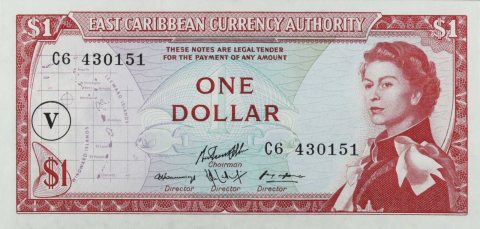
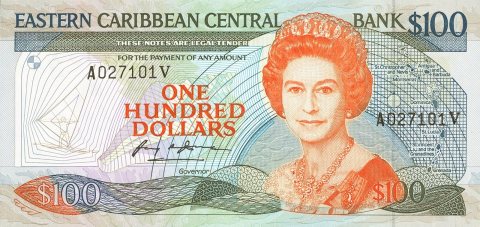
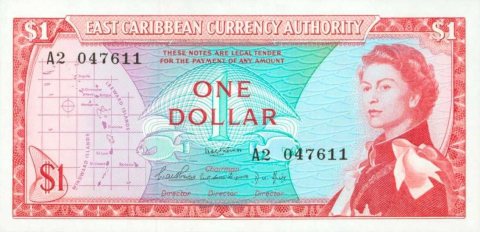
On the first printing of the 1 dollar, 5 dollars, 20 dollars and 100 dollars, the northernmost island, at the top of the map above St. Christopher and Nevis, carries no name. On the second printing, the 1 dollar, 5 dollars, 20 dollars and 100 dollars, the word Anguilla is printed beside it. The 10 dollars names Anguilla from its first notes of 1984, and there is no 10 dollars without the name.
The Anguilla notes differ in the same way. On the first printing the serial number ends in V, as on a St. Vincent note, and a black U in a circle is overprinted at the left of the front, beside the serial number. On the second printing the U is the printed last letter of the serial number and there is no circle.
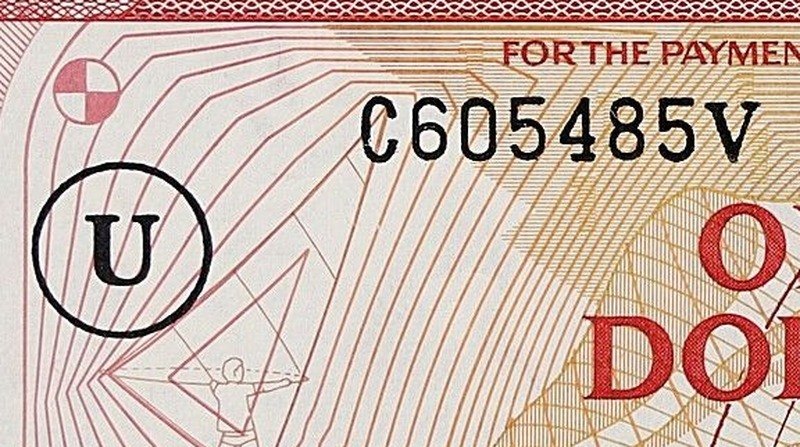
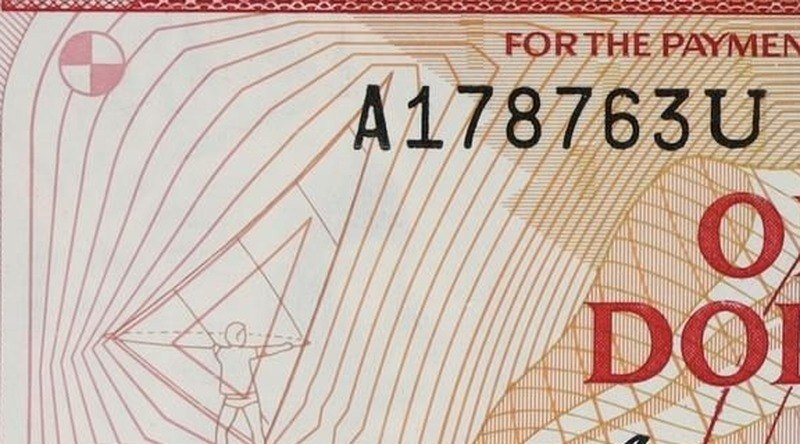
The pages say that grading-company holders get the two printings wrong in both directions, so a note is placed by the map and never by the label. Three notes moved for that reason:
- 5 dollars A 688378 K, holdered as P-22k1, has no Anguilla on its map and sits 1,661 numbers from A 686717 K. It is of the first printing.
- 20 dollars A 174552 A, holdered as P-24a1, has no Anguilla on its map and comes from the same pack as A 174577 A and A 174579 A. It is of the first printing.
- 100 dollars A 121914 V with the circled U is of the first printing, not the second.
Jacobs and Venner
The second printing and the 10 dollars come with two signatures: Jacobs, a scrawl with an underline, and Venner, written out legibly. Each is a row of its own, and the catalogue dates the Venner rows ND (1989). The notes recorded so far put the change between these numbers:
| Value | Island | Last Jacobs note recorded | First Venner note recorded |
|---|---|---|---|
| 5 dollars | Antigua | B 705930 A | B 834242 A |
| 5 dollars | St. Lucia | C 647653 L | D 023584 L |
| 10 dollars | Antigua | B 156413 A | B 265010 A |
| 10 dollars | Grenada | B 278638 G | B 317075 G |
| 10 dollars | St. Lucia | B 795668 L | B 808405 L |
| 20 dollars | Antigua | B 636589 A | B 662388 A |
| 20 dollars | Dominica | B 704830 D | C 428728 D |
| 20 dollars | Grenada | C 355344 G | C 406869 G |
| 20 dollars | St. Lucia | E 381974 L | F 170336 L |
| 20 dollars | Montserrat | A 472149 M | A 507785 M |
| 100 dollars | Antigua | A 697491 A | A 727098 A |
| 100 dollars | Dominica | A 316529 D | A 407897 D |
| 100 dollars | Grenada | A 382993 G | A 468317 G |
| 100 dollars | St. Kitts | A 475907 K | A 513651 K |
| 100 dollars | St. Lucia | A 891573 L | A 933490 L |
These are the nearest recorded numbers on each side, not the true last and first. The pages give no change point for the islands that are missing from the table.
The dark square: 1993 or 1994
The new design of 1993 has no map. On the 1993 notes (5, 10, 20, 50 and 100 dollars) the value at the upper left sits on a dark ornamental square. The reprint of 1994 (5, 10, 20, 50 and 100 dollars) drops the square and the value stands on the plain underprint. Neither has foil at the upper right, and the 1994 notes have a thin plain security thread.
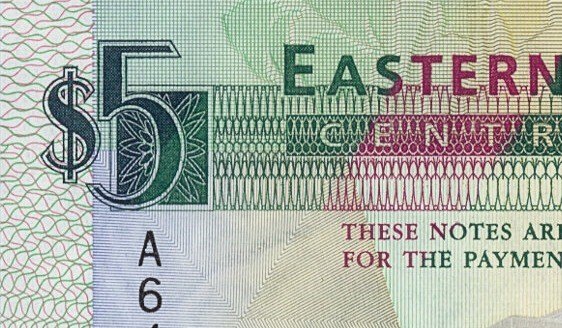
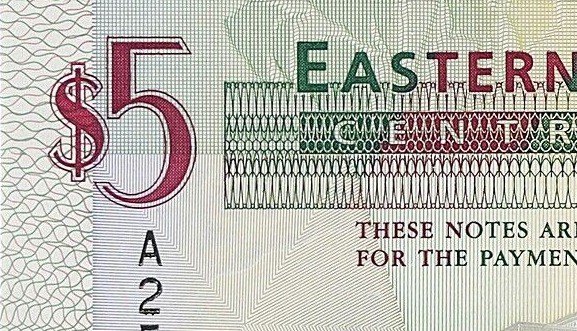
On the 50 dollars the colour is enough. The 1993 note is printed in purple and olive. The 1994 note is orange-brown with the value in green.
The serial numbers started again in 1993, so a number alone can belong to the map notes or to the later design.
The wing of the building: 1998 or 2001
Behind the Governor's signature stands the Bank's building. On every note of 1993 to 1998 it has a long low wing running left from the main block, past the start of the signature. On the notes of 2001 and 2003 the building was redrawn without the wing, and only a short stub remains to the left of the main block.
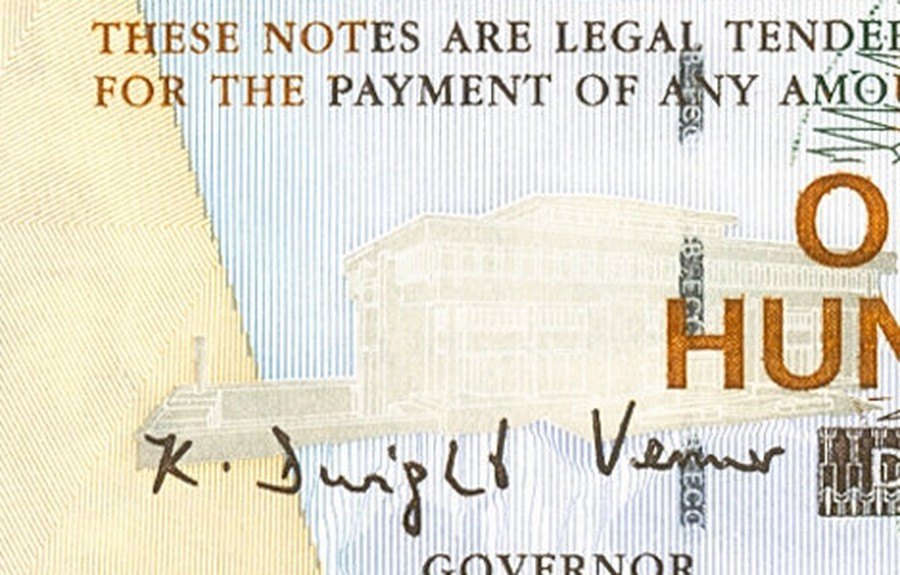
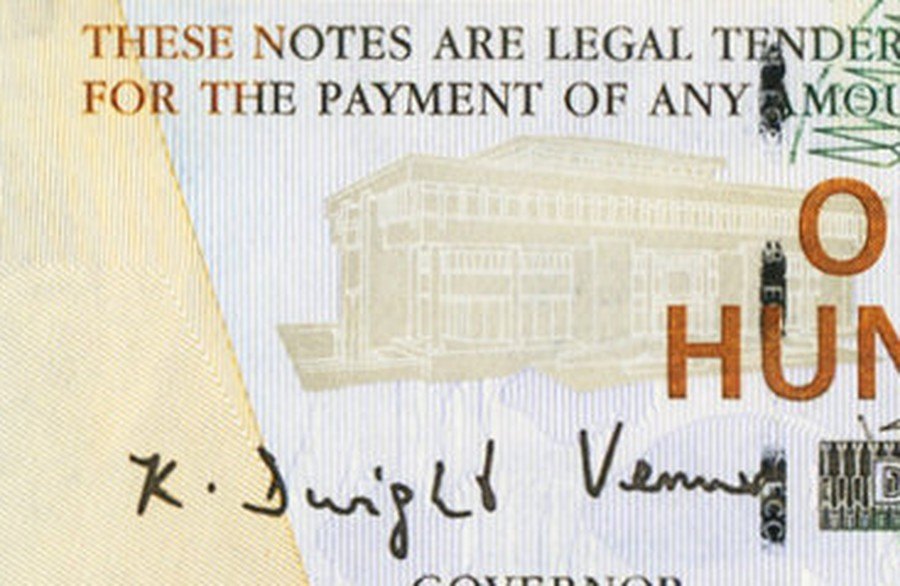
The wing matters most on the 100 dollars. The 100 dollars of 1998 and the 100 dollars of 2001 carry the same gold foil flower, so the foil cannot decide. The pages say holders of both grading companies have been wrong in both directions, and every gold-flower 100 dollars is placed by the wing.
Runs the catalogue has proved to be of 1998, by the wing:
- B 550008 A to B 550637 A
- A 800022 D to A 800042 D
- B 115002 G to B 115045 G
Runs proved to be of 2001, by the missing wing:
- B 481589 D to B 531039 D, and C 224942 D to C 329576 D
- B 920025 G to B 920042 G, and C 350602 G to C 521222 G
- C 027010 K to C 027033 K
- C 863504 L to C 863538 L
- A 601761 M to A 613431 M, and A 684889 M to A 684900 M
- A 364419 U to A 521589 U
Single notes moved: B 550608 A, holdered as P-41a, has the wing and is of 1998. C 329501 D, C 863538 L and A 613431 M are of 2001 despite their holders. A 432503 U, A 432506 U, C 103002 D and C 329501 D, holdered or titled as P-30u, P-35d or P-35u, are of 2001 as well.
On the Dominica 100 dollars the two printings meet. The 1994 run ends by A 799632 D and the 1998 printing begins at A 800000 D, with A 800022 D onward seen. Notes 400 numbers apart are on different pages of the catalogue.
Gold or silver foil: 2001 or 2003
The series of 2001 has a gold foil device at the upper right and a segmented security thread: a fish on the 5 dollars and 10 dollars, a butterfly on the 20 dollars, a device the page does not name on the 50 dollars, and a flower on the 100 dollars. Stack's Bowers, in its description of lot 41099 in its sale of 15 August 2023, calls the device on the 50 dollars a gold foil flower. The series of 2003 has the same shapes in silver and a wider segmented thread: a fish on the 5 dollars and 10 dollars, a butterfly on the 20 dollars, a flower on the 50 dollars and 100 dollars. Foil colour decides between 2001 and 2003. The wing decides between 1994 to 1998 and 2001 to 2003.
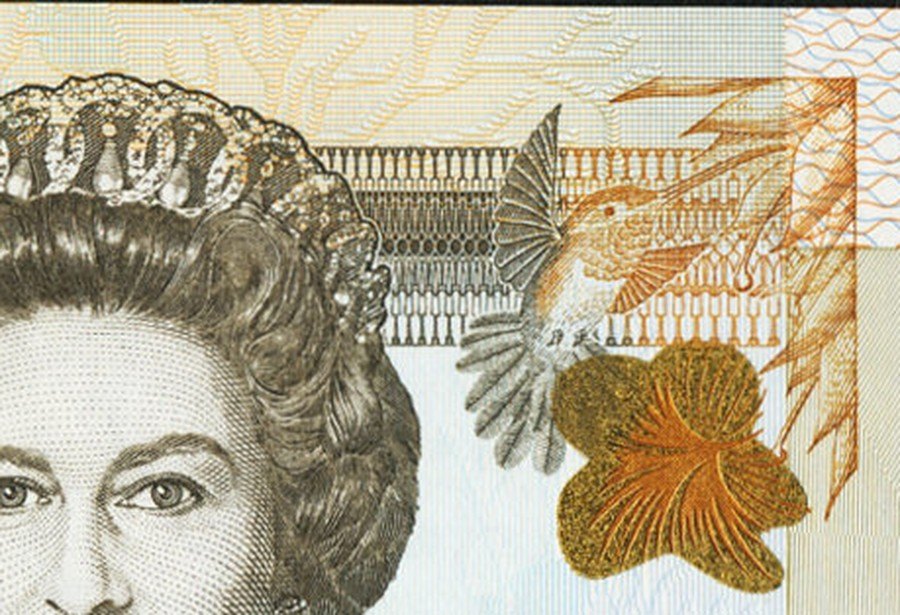
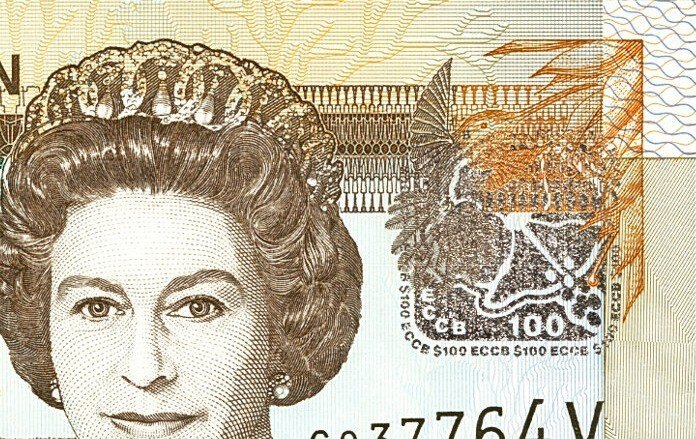
Notes moved by the foil:
- 50 dollars A 512508 M and A 512518 M carry the gold device and are of 2001, whatever the holder says.
- 50 dollars A 696041 M, holdered as P-34m, carries the silver flower. The whole A 555xxx M, A 661xxx M and A 696xxx M runs and A 646182 M are of 2003.
- 100 dollars C 937767 V, holdered as P-36v, carries the silver flower and sits between C 937764 V and C 937845 V. It is of 2003.
On the 5 dollars of 2003 the eye of the fish in the foil exists in two versions, brown and green. Both are genuine. The colour shows only when the foil is tilted to the light, so an auction photograph does not show it. PMG words its holders "With Brown Fish Eye" (Pick 42a) or "With Green Fish Eye" (Pick 42Aa). The catalogue keeps one page for both.
Two letters and the raised marks: 2008, 2012 or 2015
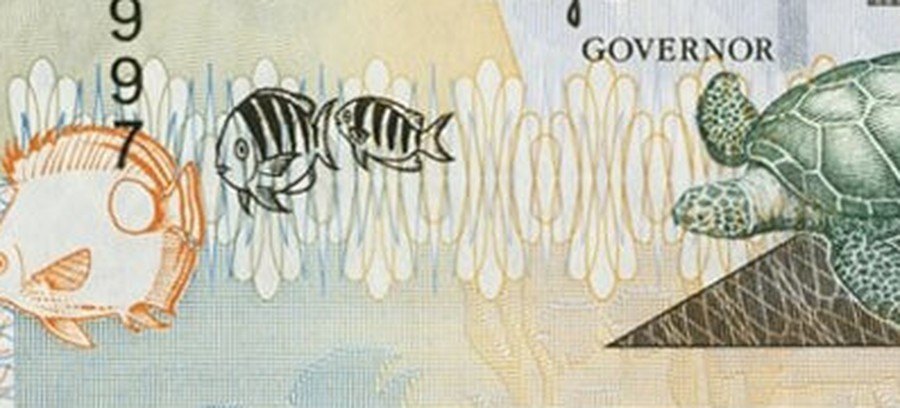
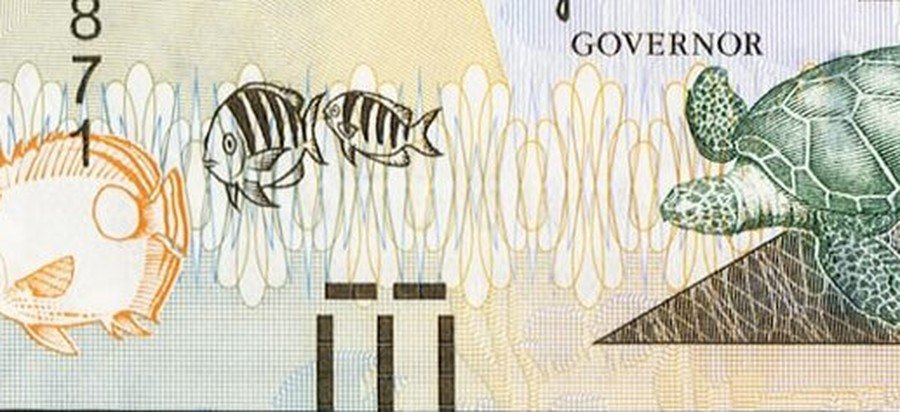
From 2008 the island letter is gone and the serial number has a two-letter prefix. The reprints of 2012 and 2015 add raised marks for the blind at the lower left of the front, between the fish and the turtle, a different mark on each value; on the 100 dollars it is three short raised bars. The two reprints are told apart by the thread: narrow and segmented in 2012, wide, dark and segmented in 2015, reading ECCB and the value.
| Value | 2008, no marks | 2012, narrow thread | 2015, wide thread |
|---|---|---|---|
| 5 dollars | AA to CN | none | none |
| 10 dollars (2008, reprints) | FA to FM | FN to FZ | GA to GQ |
| 20 dollars (2008, reprints) | LA to LZ and MB | MC to MY | NA to PE |
| 50 dollars (2008, reprints) | SA to SH | SH to SM | SN to SW |
| 100 dollars (2008, reprints) | VA to VK | VL to VR | VS to WD |
SH is the last prefix of the 2008 50 dollars and the first of the 2012 reprint, so on an SH note the raised marks decide. There is no 5 dollars among the reprints: the next 5 dollars is the polymer note.
What the pages do not settle
The pages give the change from Jacobs to Venner for some islands only. The page of the 50 dollars of 2001 does not name its foil device. A sale without a holder label may be either version of the fish eye.
Sources
- The catalogue's note pages for the East Caribbean States, P-17 to P-55, and the notes pictured and recorded on them.
- The labels of the PMG holders quoted on the page of the 5 dollars of 2003.
- Stack's Bowers, 15 August 2023, lot 41099.
Member comments
Log in or register to post a comment.