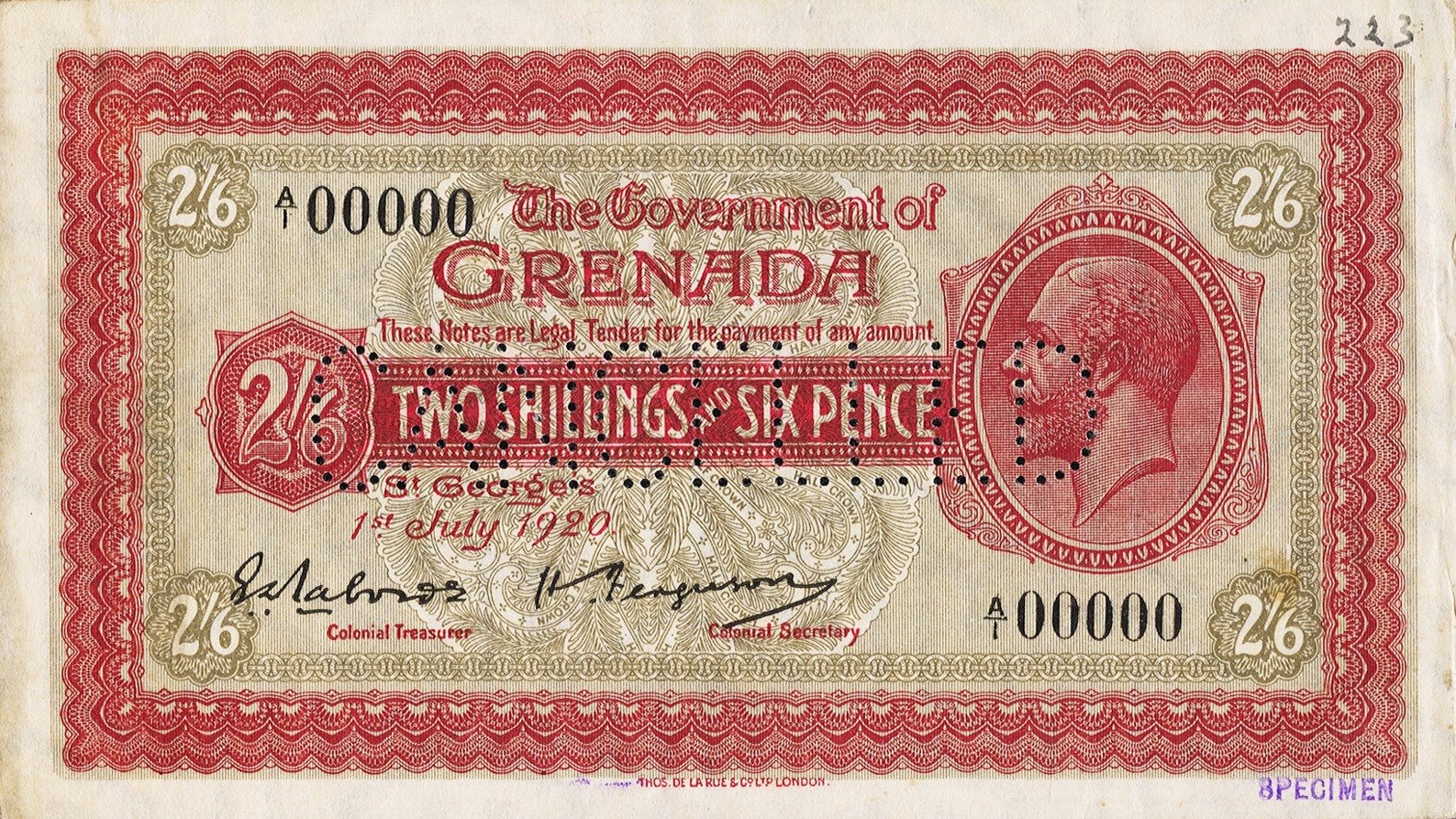
The Government of Grenada issued notes of its own once, in three values dated 1st July 1920. This article sets out the law behind them, the two officers who signed, the trial pieces the printer made, and the little that the official books say of the notes afterwards. It is drawn from the catalogue's three note pages and their rows, the annual reports and Blue Books of Grenada, the Colonial Office Lists, and the descriptions the auction houses wrote. The report for 1922, with the withdrawal of the lowest value and the banks' notes beside the Government's, is told in Half a crown withdrawn: the small islands' notes of 1920 and what became of them and is only summed up here.
The Paper Currency Ordinance, No. 7 of 1920
The annual report on Grenada for 1920 lists the law among the Ordinances of the year: "No. 7. The Paper Currency Ordinance, providing for the issue of Government Currency Notes of the denominations of 2s. 6d., 5s, and 10s."
The same report, in its chapter on finance, says that notes of the three values were issued during the year to the amount of 12,500 pounds. It adds what the issue meant to the Treasury. Redemption of the notes was postponed by law until two years from the date of issue, so that the issue "had an effect equivalent to a loan of the same amount without interest for two years". After the two years the Government was to provide a reserve fund in coin of 25 per cent of the issue.

The reports and Blue Books read for the catalogue give no first day of issue and do not divide the 12,500 pounds between the three values.
Three values dated 1st July 1920
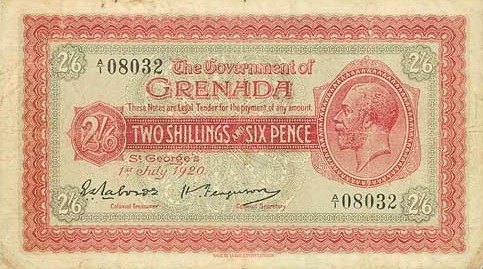
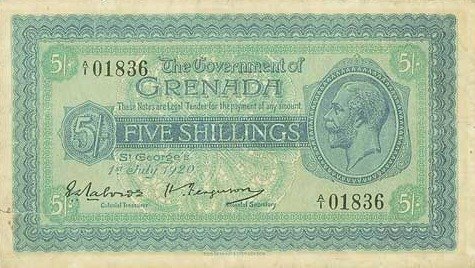
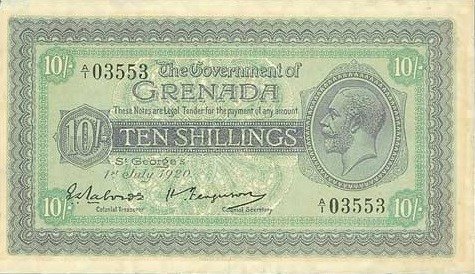
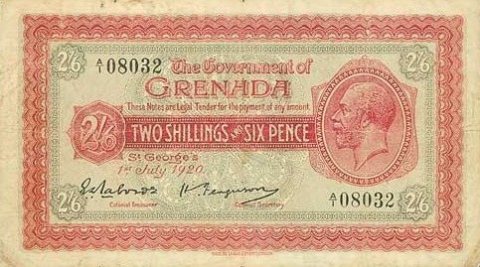
The notes are the 2 shillings 6 pence, the 5 shillings and the 10 shillings. All are dated St. George's, 1st July 1920, printed by Thomas de la Rue, and recorded with the prefix A/1. The note pages call them the island's only government paper money before the notes of the British Caribbean Territories.
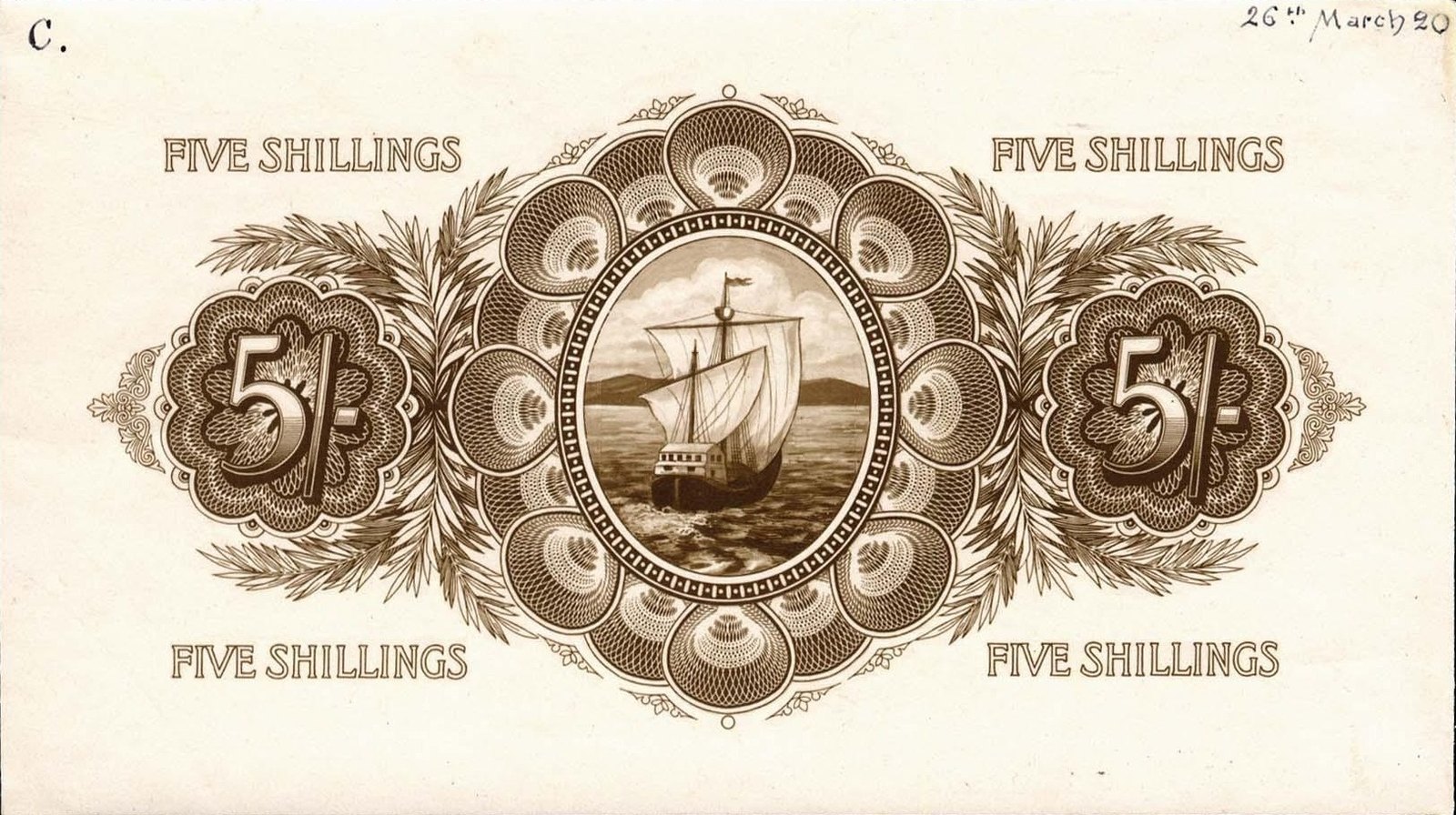
Spink sold one issued note of each value on 29 September 2009 (lots 959, 960 and 961), and its descriptions give the design: the head of George V at the right, the value in a tablet at the centre and in each corner, and on the back a sailing ship, which Spink calls a galleon, between the value at left and right. As Spink describes the colours in its sales of 2009, 2015 and 2016, the 2 shillings 6 pence is red on an olive green underprint with an olive green back, the 5 shillings dark blue on green with a brown back, and the 10 shillings green and blue-grey with a blue and white back.
Laborde and Ferguson
The notes are signed by the Colonial Treasurer and the Colonial Secretary. The Colonial Office List for 1921 names them in the staff of Grenada: "Colonial Secretary and Registrar-General, Herbert Ferguson" and "Treasurer, Edward Daniel Laborde, I.S.O."
The Records of Services in the Colonial Office List for 1929 give Laborde as Treasurer of St Lucia in 1912 and Colonial Treasurer of Grenada from 1915. Laborde acted as Colonial Secretary at various times from 1915 to 1920 and administered the government in September and October 1915 and again in September and October 1920.
The List for 1925 gives Ferguson as Colonial Treasurer of Grenada from November 1909 and Colonial Secretary from July 1915. These entries were read in the text of the scans only. The annual report for 1909 says that Ferguson arrived that year as Treasurer and Supervisor of Inland Revenue, and Ferguson signs the reports for 1922 and 1928 as Colonial Secretary.
By these entries the two offices on the note changed hands in the same year, 1915: Ferguson went from the Treasury to the Secretariat and Laborde came from St Lucia to the Treasury. Laborde's successor in St Lucia, George Douglas Mackie, signed Saint Lucia's notes of 1920.
The wording changed before issue
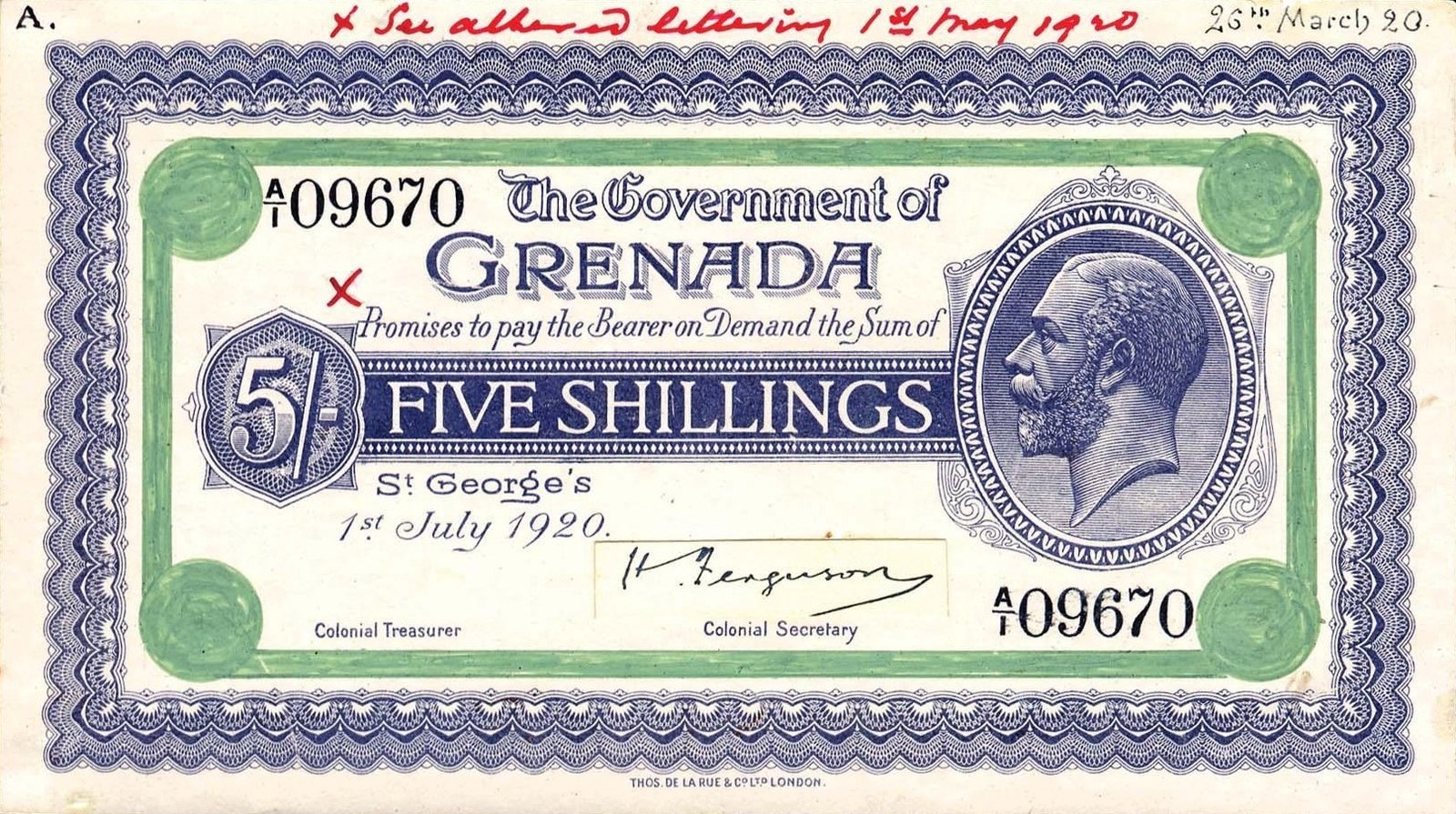
The page of the 5 shillings holds the pieces on which the note was worked out. They show the wording changing.
The first is a composite essay in three pieces on card, lettered A, B and C: a front in blue with a green underprint, a yellow underprint for the front on a hand-painted green ground, and the brown back with the ship. The front reads "Promises to pay the Bearer on Demand the Sum of". Ferguson's signature is on a pasted panel over the title Colonial Secretary, and the space for the Colonial Treasurer is unsigned. The catalogue's line for Spink's sale of 29 September 2010 (lot 656) says that each piece is dated 26th March 20 and annotated in red "See altered lettering 1st May 1920".
The second is a front printer's model, printed in black and grey with a hand-painted gold frame and corner roundels. A pasted panel carries the new words: "These Notes are Legal Tender for the payment of any amount". That is the wording of the issued note.
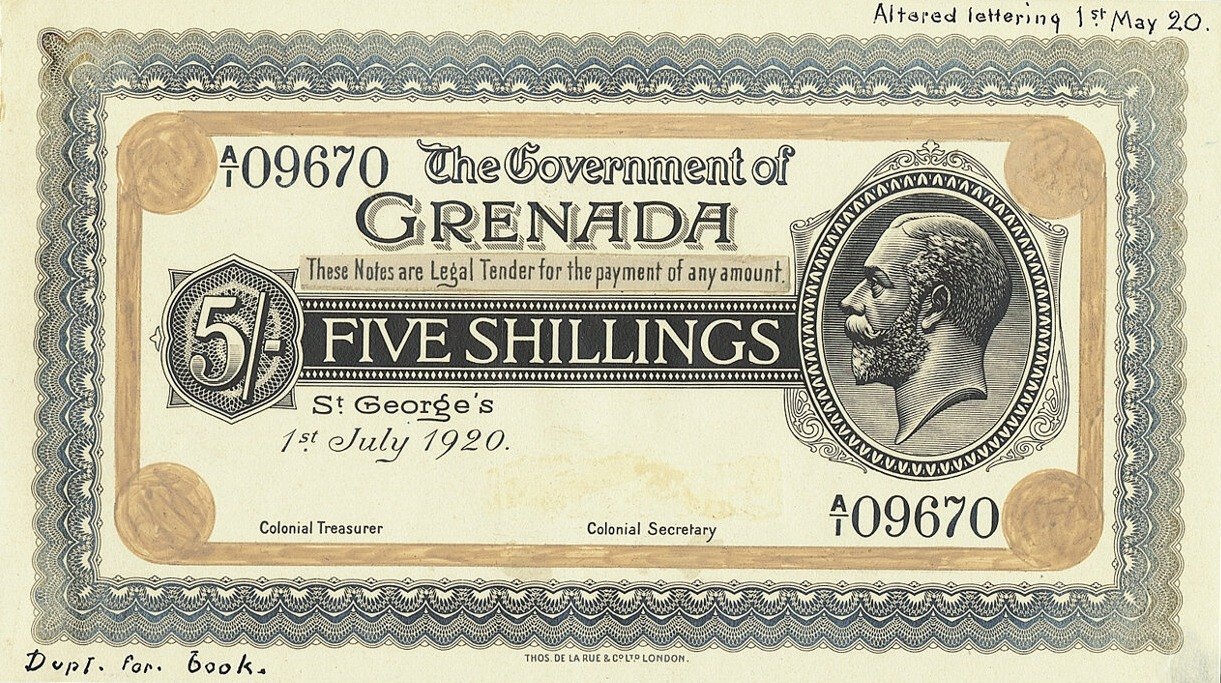
The promise to pay on demand went out and a statement of legal tender came in between 26th March and 1st May 1920. The annual report for 1920 says that the law postponed redemption for two years. No source read says that the one was the reason for the other.
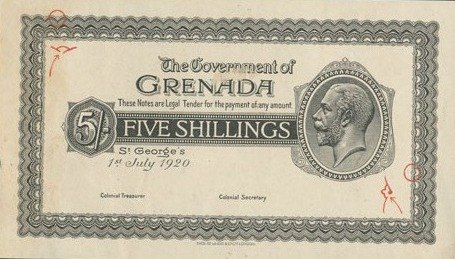
The page also records a pair of black proofs of the front and the back without signatures. The catalogue's lines for the two offers of the pair (Spink, 29 September 2010, lot 655; Noonans, 27 November 2024, lot 305) note that the secret marks are ringed and arrowed in red.
The number A/1 09670
Both the essay and the model carry the number A/1 09670. The catalogue records the same number on seven trial pieces that De La Rue made between 1919 and 1920 for six colonies: Cyprus, East Africa, Grenada, Fiji, the Leeward Islands and Saint Lucia. It reads the number as one the printer put on its own trial and proof work, not as a serial of any of these notes.
One of the seven is a hand-tinted essay for the Leeward Islands 5 shillings, dated Antigua, 1st October 1920. It carries the signatures of Laborde and Ferguson under the headings Colonial Treasurer and Colonial Secretary, though neither served in the Leeward Islands. The printer appears to have worked it up from the Grenada design.
In circulation, 1920 to 1938
| At 31st December | Grenada Government notes | Source |
|---|---|---|
| 1920 | 12,500 pounds issued during the year | Annual report for 1920 |
| 1922 | 10,254 pounds in circulation | Annual report for 1922 |
| 1933 | about 47 pounds 15 shillings outstanding | Blue Book for 1933 |
| 1936 | about 46 pounds 10 shillings outstanding | Blue Book for 1936 |
| 1938 | about 45 pounds 12 shillings 6 pence outstanding | Blue Book for 1938 |
The annual report for 1922 says that the 2 shillings 6 pence notes had been withdrawn by the end of that year and that some worn notes of 5 and 10 shillings had been destroyed. The Blue Books of 1933 to 1938 carry the remainder as a deposit of the "Commissioners of Currency" among the liabilities. They were read in the machine text of the scans only, and the figures are partly garbled, which is why the note pages say no more than that less than 50 pounds was outstanding by 1933.

The annual report for 1935 says that Trinidad Government currency notes were made legal tender in the colony from 1st November 1935, under the Currency Notes (Trinidad) Ordinance, 1935, No. 22.
What the houses say survives
The houses do not agree with each other, or with the catalogue.
Lyn Knight, describing the composite essay on 7 March 2013 (lot 206), wrote that of the three values issued for Grenada in 1920 only one note of each is known in collections. Heritage Auctions, describing the 2 shillings 6 pence specimen from the Ibrahim Salem Collection on 9 May 2023 (lot 28248), wrote that two small values are confirmed for Grenada and that a 10 shillings is unconfirmed. Spink had sold an issued 10 shillings on 29 September 2009 (lot 961). A dealer's advertisement in Bank Note Reporter of May 2006, repeated in September and October 2009, pictures an issued 5 shillings that is not the note Spink sold.
Heritage also wrote, of the 2 shillings 6 pence specimen and of the 5 shillings specimen in the same sale (lot 28249), that each was the only one of its kind in the PMG population report at the time. Spink (29 September 2015, lot 394, and 2 October 2019, lot 3) said of the 2 shillings 6 pence specimen that only a few examples are believed to exist.
Heritage offered the front printer's model twice, on 17 August 2018 (lot 28100) and on 23 April 2020 (lot 28411). Its description says that the currency in circulation at the time was mostly the Spanish or Mexican dollar, and that the note may be a relic of an attempt to bring in sterling that failed in Grenada. That is the house's reading. The annual reports say otherwise on one point: the notes were issued, 12,500 pounds of them in 1920, and 10,254 pounds were still in circulation at the end of 1922.
What the sources do not say
- The text of the Paper Currency Ordinance, and whether the reserve in coin was set up in 1922.
- The first day of issue, the number of notes printed, and any figure by value.
- A day, a notice or a law for the withdrawal of the 2 shillings 6 pence.
- Any amount in circulation between 1922 and 1933.
- Any Proclamation calling the notes in. None was found in the Grenada gazette pages read, and the statements of 1955 that list the Government notes then demonetised name those of Trinidad and Tobago, Barbados and British Guiana, not Grenada's.
Sources
- The catalogue's note pages for the Grenada 2 shillings 6 pence, 5 shillings and 10 shillings, with their rows and sale records.
- Annual reports on Grenada for 1909, 1920, 1922, 1928 and 1935.
- Grenada Blue Books, 1933 to 1938.
- Colonial Office List, 1921, 1925 and 1929.
- Spink, 29 September 2009, lots 959 to 961; 29 September 2010, lots 655 and 656; 29 September 2015, lot 394; 28 September 2016, lot 731; 2 October 2019, lots 3 and 4.
- Lyn Knight, 7 March 2013, lot 206.
- Heritage Auctions, 17 August 2018, lot 28100; 23 April 2020, lot 28411; 9 May 2023, lots 28248 and 28249.
- Noonans, 27 November 2024, lot 305.
- Bank Note Reporter, May 2006, September 2009 and October 2009.
Member comments
Log in or register to post a comment.