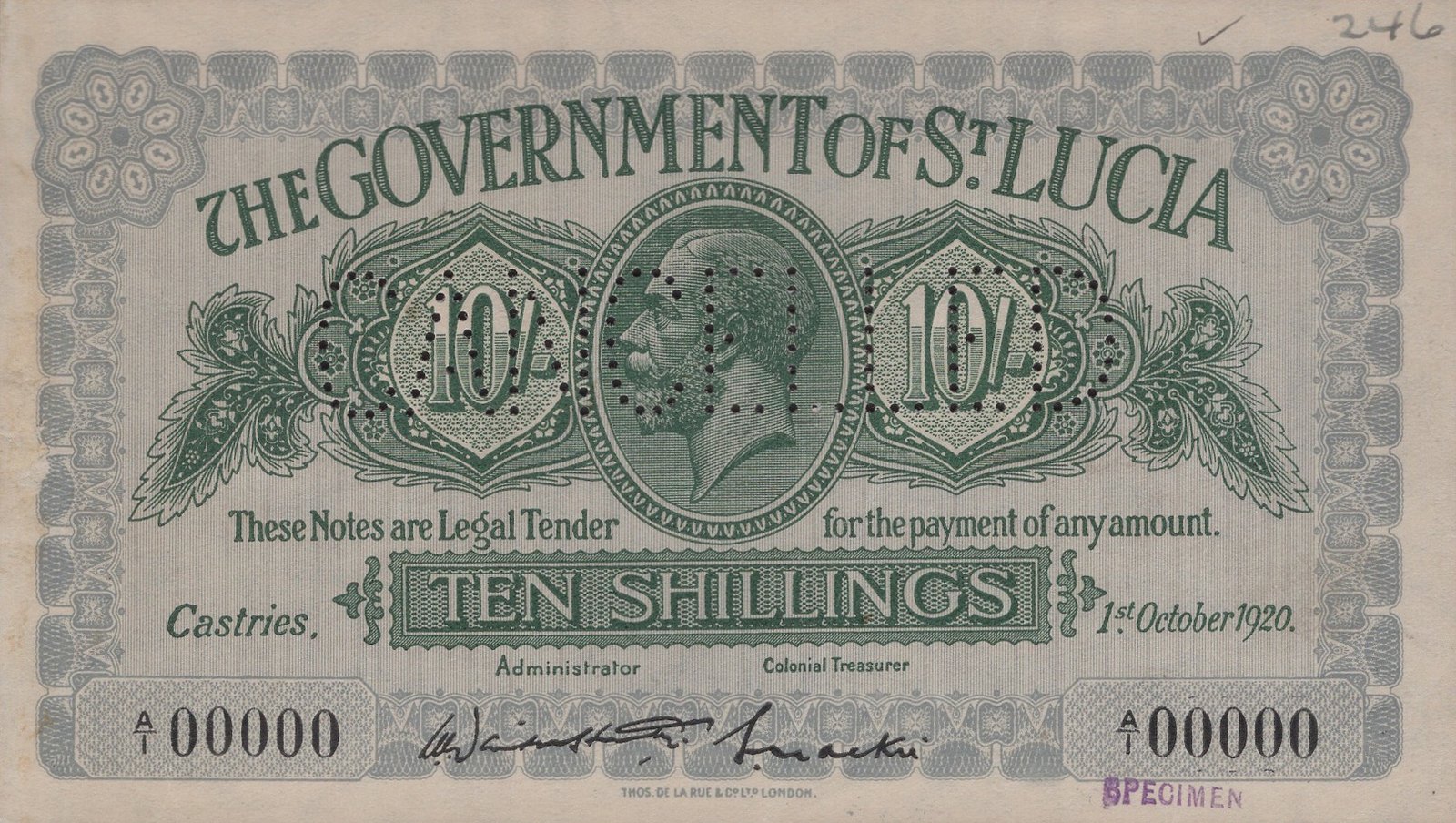
The Government of Saint Lucia made two notes of its own, a 5 shillings and a 10 shillings dated 1st October 1920. This article follows them from the Ordinance that allowed them to the year in which the Blue Book shows none left. It is drawn from the catalogue's two note pages, from the Saint Lucia Blue Books and annual reports, the Colonial Office Lists, the newspaper Voice of St Lucia, and the catalogues of the houses that have sold the few pieces known. The five annual reports that name a 10 shillings in circulation are set out in Half a crown withdrawn: the small islands' notes of 1920 and what became of them and are only touched on here.
The Ordinance of 13th July 1920
The Blue Book for 1920 lists the law under Legislation, on 13th July, as No. 15, an Ordinance "to authorise the issue of certain Currency Notes in the Colony". The Blue Book for 1922 gives it a short title, the Paper Currency Ordinance, 1920. The annual report for 1924 describes it as an Ordinance "providing for the issue of Government currency notes of the value of five shillings and ten shillings".
Stack's Bowers, describing a 10 shillings specimen on 5 September 2026 (lot 30333), gives a reason for the issue: shortages and hoarding of silver coin by 1920. That is the house's statement. The Blue Books and reports read for the catalogue give no reason.
A separate law, the Bank Notes Ordinance, No. 24 of 1920, in force from 22nd July 1922, concerned the notes of the banks and not the Government issue.
The two notes
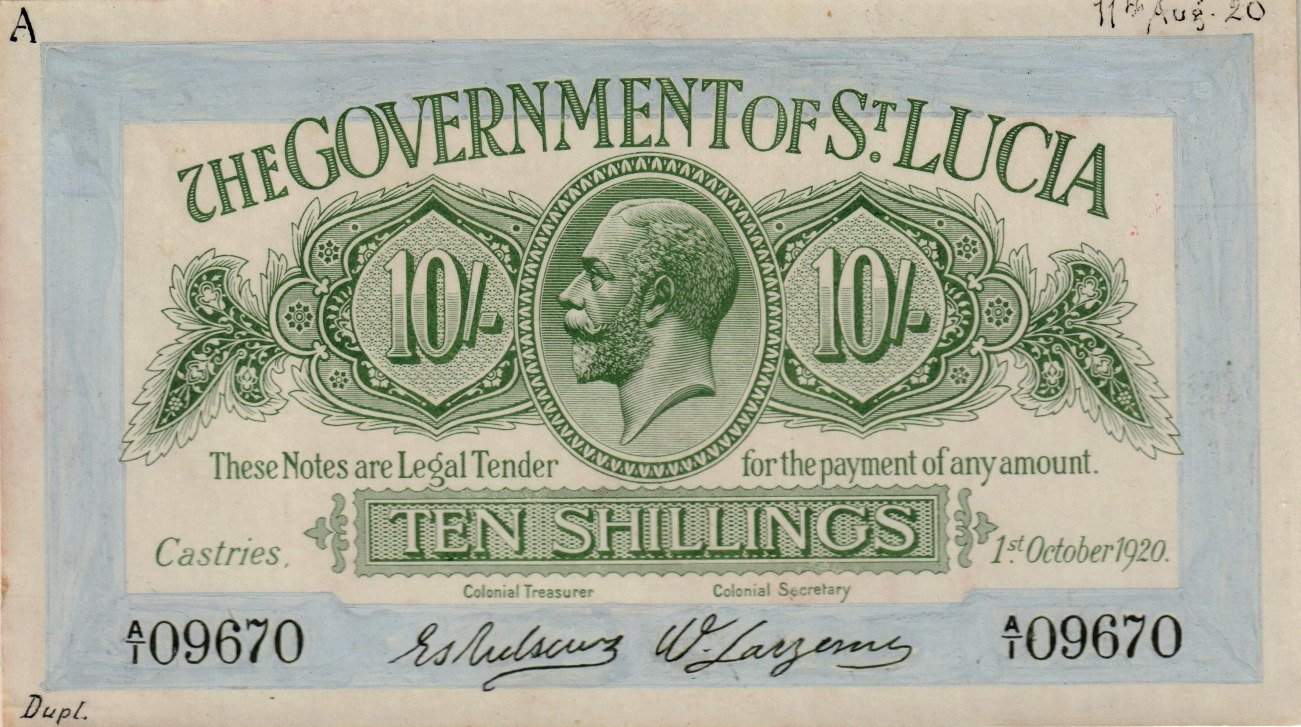
The 5 shillings and the 10 shillings are dated Castries, 1st October 1920. They show King George V on the front. The back has the arms of the island with the motto STATIO HAUD MALEFIDA CARINIS, a safe harbour for ships. The printer was Thomas de la Rue. The Leeward Islands notes of 1921 have the same portrait in a different layout.
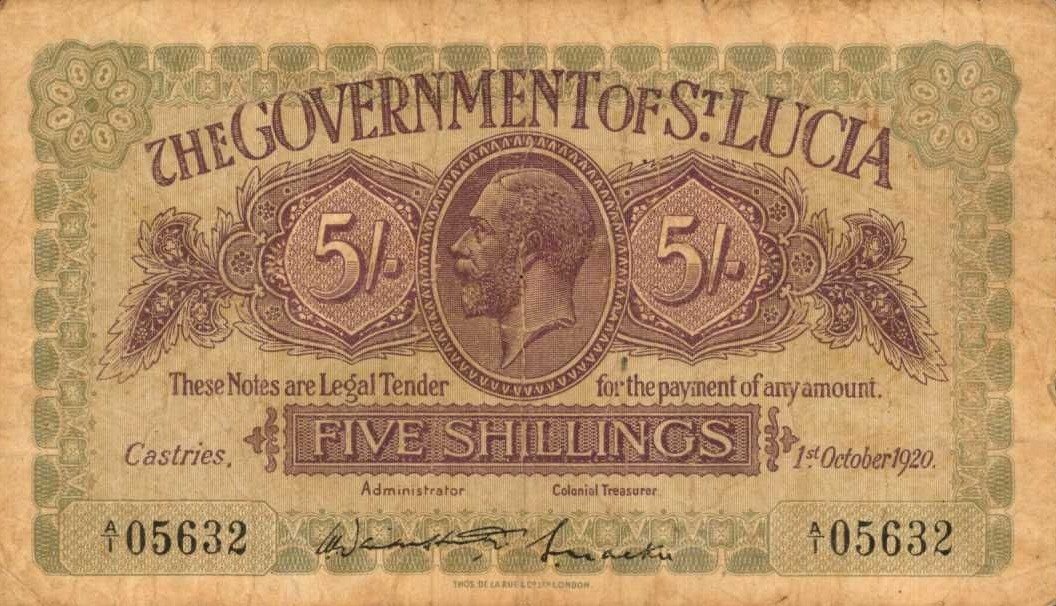
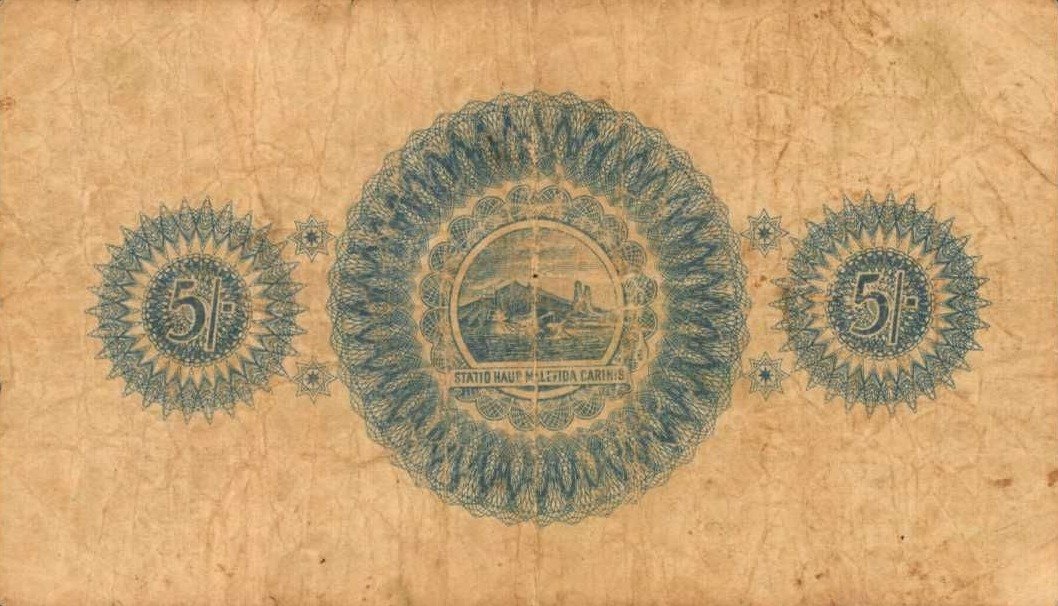
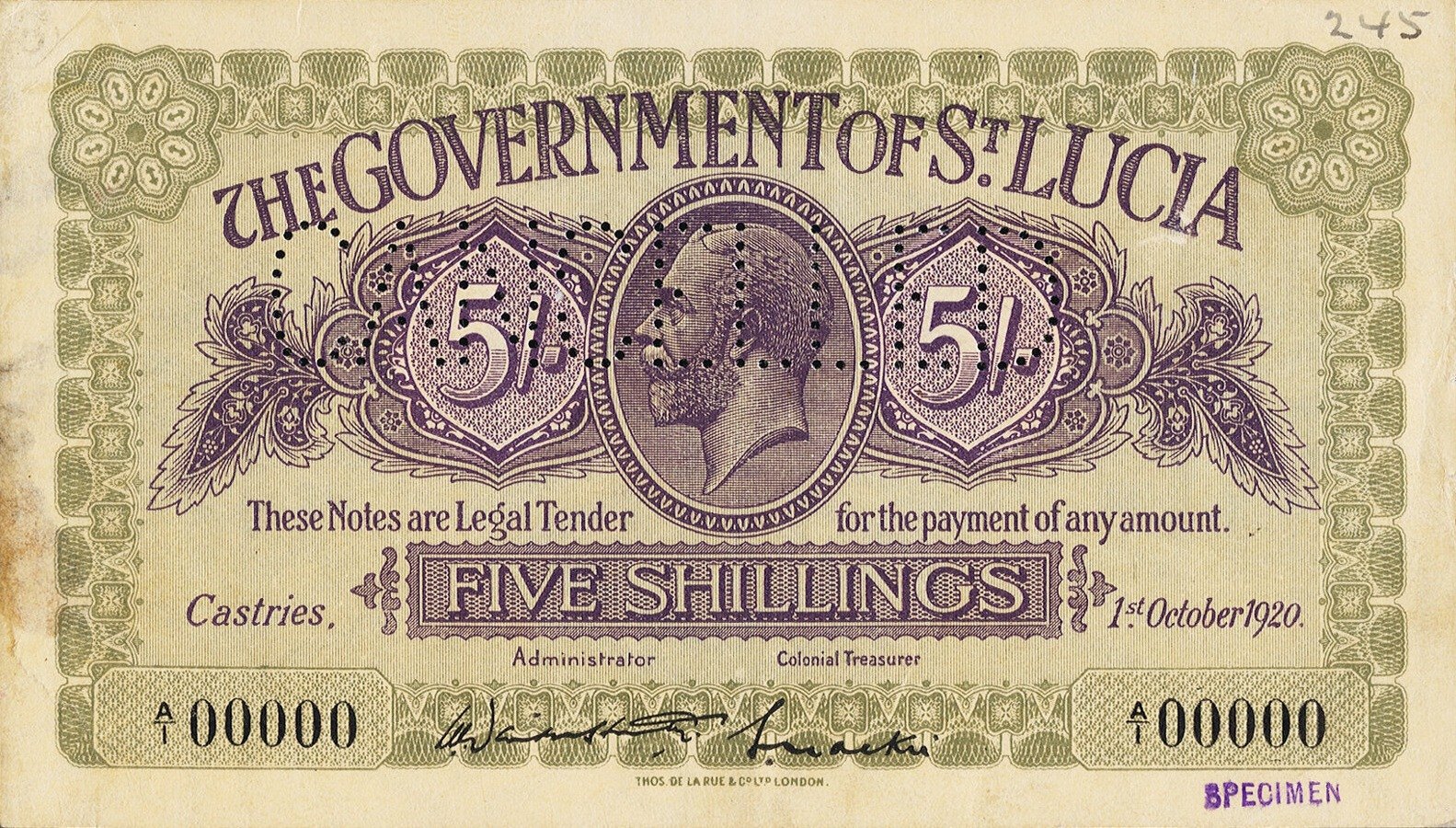
Spink (2 October 2019, lot 6) describes the 5 shillings as violet on green with a blue back. Noonans (25 February 2026, lot 526) describes the 10 shillings as green on blue-grey with a light brown back; Spink (26 April 2017, lot 2147) calls the same back mauve.
Issued notes of the 5 shillings carry the prefix A/1 with five-digit numbers. The stamped specimen of the 10 shillings carries the same prefix.
The Administrator and the Treasurer
The notes are signed by the Administrator, Wilfred Bennett Davidson-Houston, and the Colonial Treasurer, George Douglas Mackie.
The Colonial Office List gives Davidson-Houston as Administrator and Colonial Secretary of Saint Lucia from 21st December 1918. The Records of Services in the List for 1929 add that Davidson-Houston had been Commissioner of Montserrat from April 1906 and had war service from 1915 to 1918. The List's table of Administrators gives the term as 1918 to 1928, with C. W. Doorly following. The annual report for 1922 says that the Administrator, Lieutenant-Colonel W. B. Davidson-Houston, C.M.G., returned from leave and resumed duty on 31st August 1922.
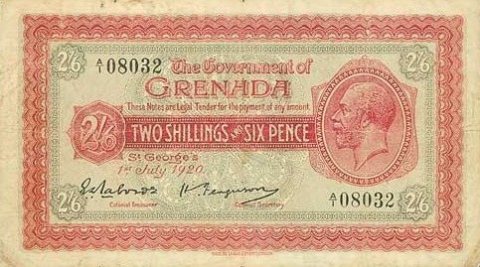
The same List gives Mackie as chief clerk of the Treasury of Grenada in 1903, Treasurer of Saint Lucia from November 1915, and acting Colonial Secretary from 1923 to 1925. The Treasurer of Saint Lucia before Mackie, from 1912, was Edward Daniel Laborde, who went to Grenada in 1915 and signed Grenada's notes of 1920.
Redemption put off, 1921 to 1923
Three steps kept the notes in use.
- The Blue Book for 1921 lists a Proclamation of 28th September 1921, No. 11: "Currency Notes Redemption (time extension)."
- The Blue Book for 1922 lists a Proclamation of 23rd September 1922, No. 9: under the Paper Currency Ordinance, 1920, the currency notes were not redeemable before 1st October 1923. The Voice of St Lucia of 27th September 1922 reported it: by Proclamation of the Governor in Chief of the Windward Islands, Sir G. B. Haddon Smith, the life of the notes "has been extended to October 1923".
- The Voice of St Lucia of 27th September 1923 reported that Mackie, introducing a Bill for an Ordinance on the issue of Government currency notes, explained that its object was to let the Government go on using the notes that had been in circulation for the past three years and would soon have to be redeemed. The Bill went through all its stages at one sitting. It became the Government Currency Notes Ordinance, 1923. On 28th November 1923 the same newspaper reported that the Hon. H. deMinvielle had been appointed a Commissioner of Currency under that Ordinance.
The note pages say that the notes were to be redeemed after two years. The Blue Book for 1921, as shown above, lists a Proclamation extending the time for redemption on 28th September 1921, before two years from the date on the notes had passed. The term first set by the Ordinance of 1920 is not in the sources read, and the point is left open here. The Voice of St Lucia of 27th September 1922 speaks of notes "issued in September 1921 and redeemable in October 1922". The notes are dated 1st October 1920, and Mackie's "past three years" in September 1923 fits 1920. The year in the newspaper's paragraph is faint on the page image and may be a slip.
For 1921 the Blue Book and the annual report, read together, also give a liability of 7,252 pounds "payable on redemption of temporary currency notes". No source read explains the difference from the 7,500 pounds issued.
The amounts, year by year
| At 31st December | Government notes | Source |
|---|---|---|
| 1920 | Issued: 7,500 pounds | Blue Book for 1920 |
| 1921 | Issued: 7,500 pounds | Blue Book for 1921 |
| 1922 | 7,480 pounds 5 shillings | Blue Book for 1922 |
| 1924 | 6,549 pounds in circulation | Annual report for 1924 |
| 1937 | Nil | Blue Book for 1937 |
The same Blue Books give the paper money of the private banks in the island: 152,900 dollars at the end of 1920, 96,320 dollars at the end of 1921 and 94,275 dollars at the end of 1922.
No source read divides the 7,500 pounds between the two values, and none gives the number of notes printed.
The 10 shillings
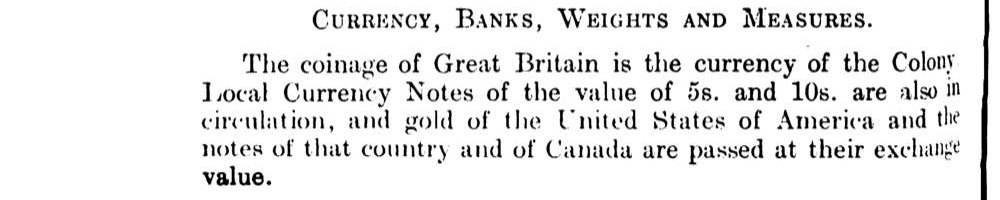
No issued 10 shillings has been traced. The page of the 10 shillings keeps the question open under "Not yet settled". The annual reports for 1921, 1922, 1926, 1928 and 1929 name notes of 10 shillings as well as 5 shillings in circulation. The report for 1921 has: "Local Treasury notes of the value of 10s. and 5s. are also in circulation." The report for 1930 still names them. So the Government's own reports say the value was issued, and no note has been seen.
Stack's Bowers (5 September 2026, lot 30333) says that its specimen is the only fully printed 10 shillings in the population report of PMG, with no issued note and no other specimen graded, and that Pick lists the value as needing confirmation.
Winding up, 1935 to 1937
The annual report for 1935 names the Colonial Currency Note (Winding-up) Ordinance, 1935, "providing for the winding up of the Government note issue circulating in the Colony". The Blue Book for 1937 lists the Colonial Currency Note (Winding Up) Proclamation among the Proclamations of that year. Its day cannot be read in the copy held. The same Blue Book shows no Colonial Government paper money at 31st December 1937.
By then another Government's notes were in use. The annual report for 1936 says that notes of the Government of Trinidad and Tobago of one and two dollars became legal tender under Ordinance No. 4 of 1936 from 1st May 1936. The Colonial Office reports on Saint Lucia for 1948 and 1949-50 give the notes in circulation then: 504,140 dollars of Trinidad Government notes and 145,870 dollars of Barclays Bank notes in 1948, and 457,140 and 128,280 dollars in 1949. The notes of the British Caribbean Currency Board followed: see The British Caribbean Currency Board and its notes, 1950 to 1968.
The 5 shillings found in 1992
For years no note of the issue was known to collectors. R. M. Smythe's catalogue of its sale at Baltimore on 20th and 21st March 1992 (lot 2903) says that the 5 and 10 shillings had once been listed in the Standard Catalog as S101 and S102 and were taken out when no note of the issue turned up. Bank Note Reporter announced the note, A/1 00172, in February 1992 with photographs of both sides, and it was shown at the New York International show before the sale. Smythe headed the lot "Another Discovery Note". Bank Note Reporter reported the sale on the front page of its issue of April 1992.
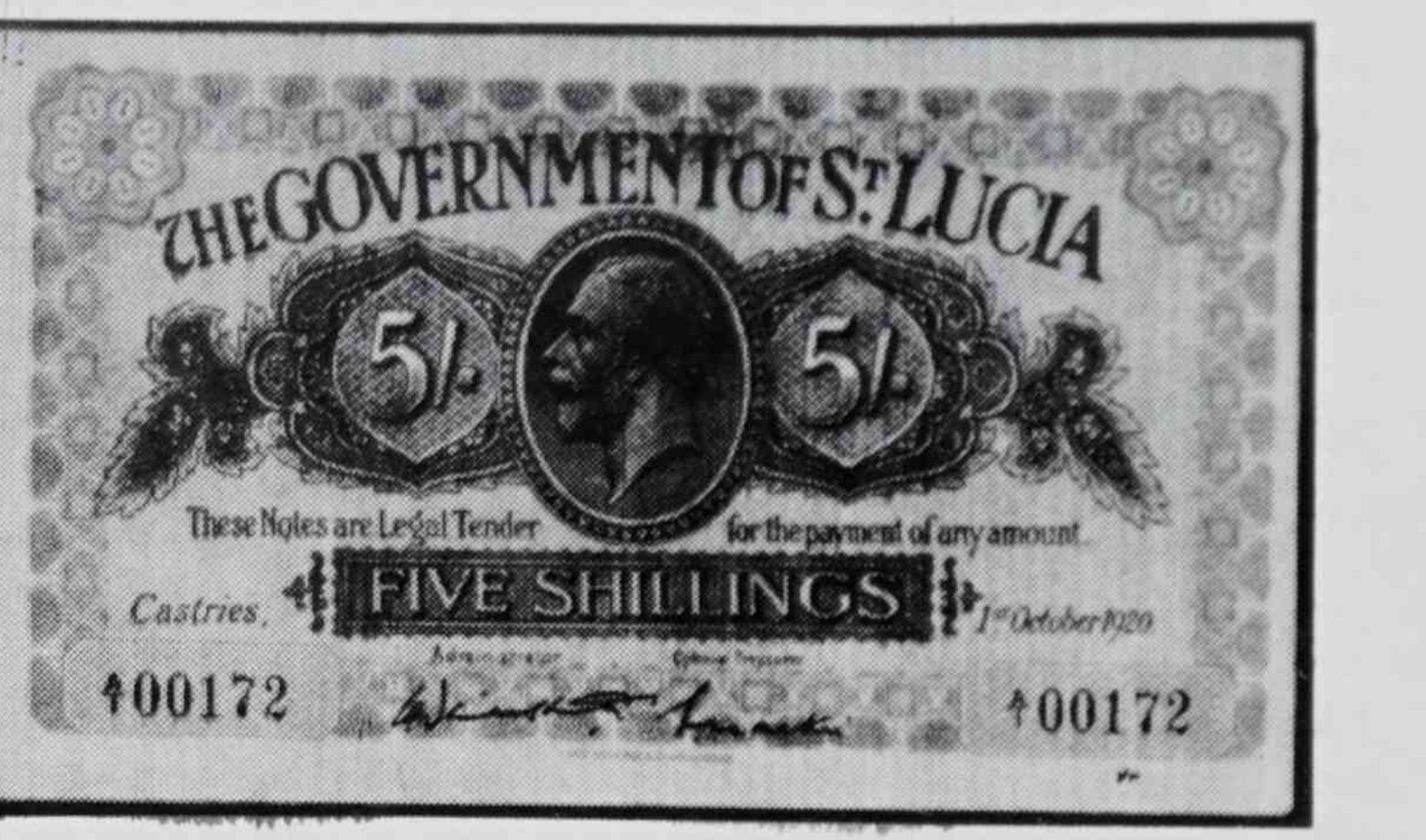
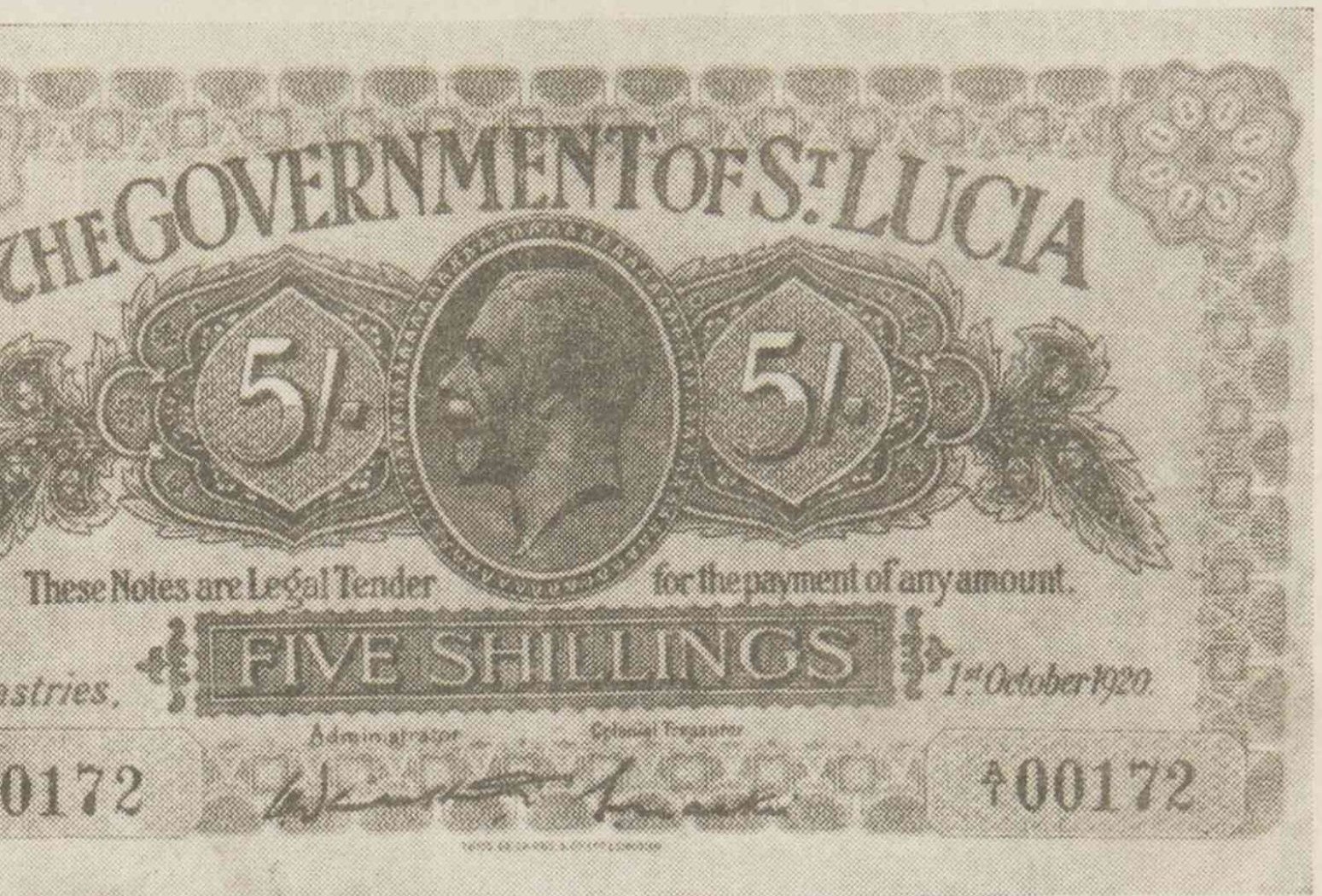
The same note was sold again by Spink on 29 September 2009 (lot 1612), where Spink called it the plate note of the Pick catalogue. A second issued 5 shillings was sold by Stack's Bowers on 5 August 2020 (lot 30329).
Specimens, proofs and a design that was not used
One stamped specimen of each value is recorded, each perforated CANCELLED, with a small purple SPECIMEN stamp and the number A/1 00000. The 5 shillings specimen was offered by Spink on 12 April 2016 (lot 1837) and on 2 October 2019 (lot 6), and by Heritage Auctions on 9 May 2023 (lot 28324), the last two from the Ibrahim Salem Collection. The 10 shillings specimen was offered by Spink on 26 April 2017 (lot 2147), by Noonans on 27 November 2025 (lot 932) and 25 February 2026 (lot 526), and by Stack's Bowers on 5 September 2026 (lot 30333). Spink calls both specimens the plate notes of the Banknote Book, and Stack's Bowers says the same of the 10 shillings. The catalogue also records two prints of the 10 shillings with the CANCELLED perforation and no SPECIMEN stamp or serial number.
Heritage Auctions (23 October 2021, lot 28454) sold a pair of proofs of the 10 shillings: a front printed in one colour before the underprint and border were added, and a complete back. Heritage said that the pair was the only set for Saint Lucia in the PMG population report when the lot was catalogued. For the 5 shillings the catalogue records a partial proof of the front, with the green underprint and frame only, sold by Spink on 2 October 2012 (lot 1193).
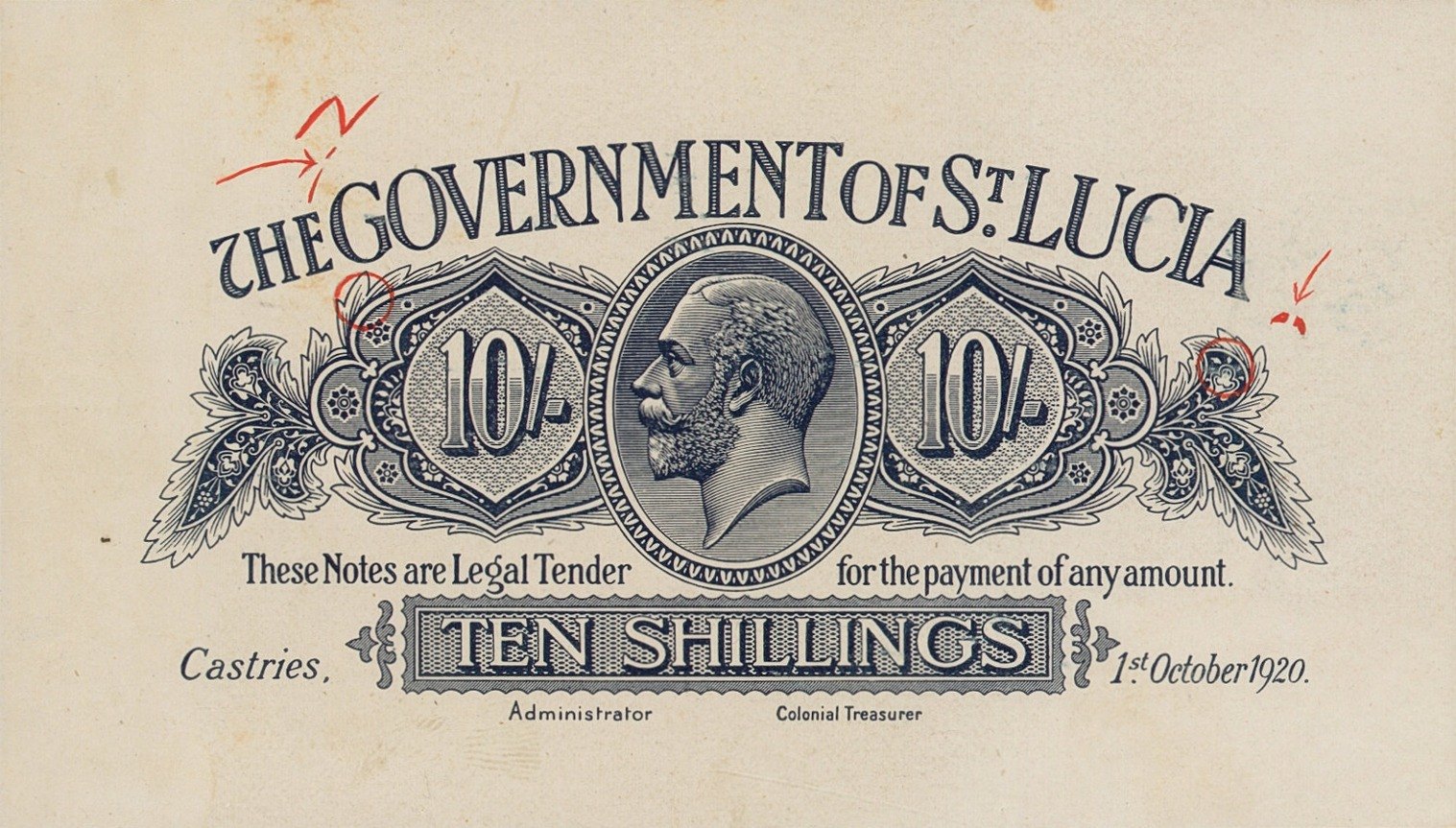
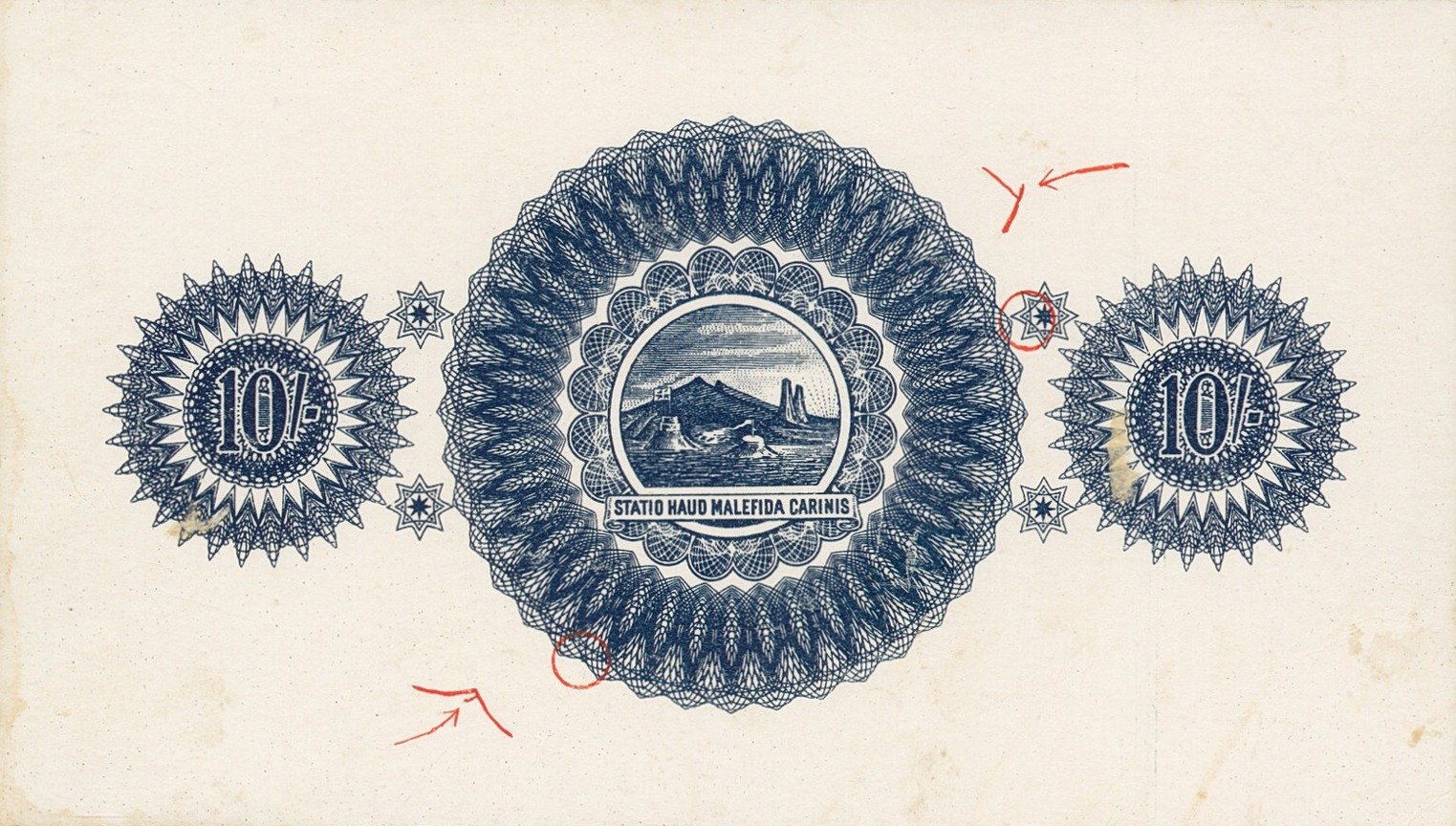
The catalogue records front and back printer's models of the 10 shillings on card, dated Castries, 1st October 1920, with the signature titles Colonial Treasurer and Colonial Secretary and signatures that are not those of the issued note. The models carry the number A/1 09670, which the catalogue records on seven De La Rue trial pieces for six colonies and reads as the printer's own trial number. They were sold by St James's Auctions on 5 October 2021 (lot 1327).
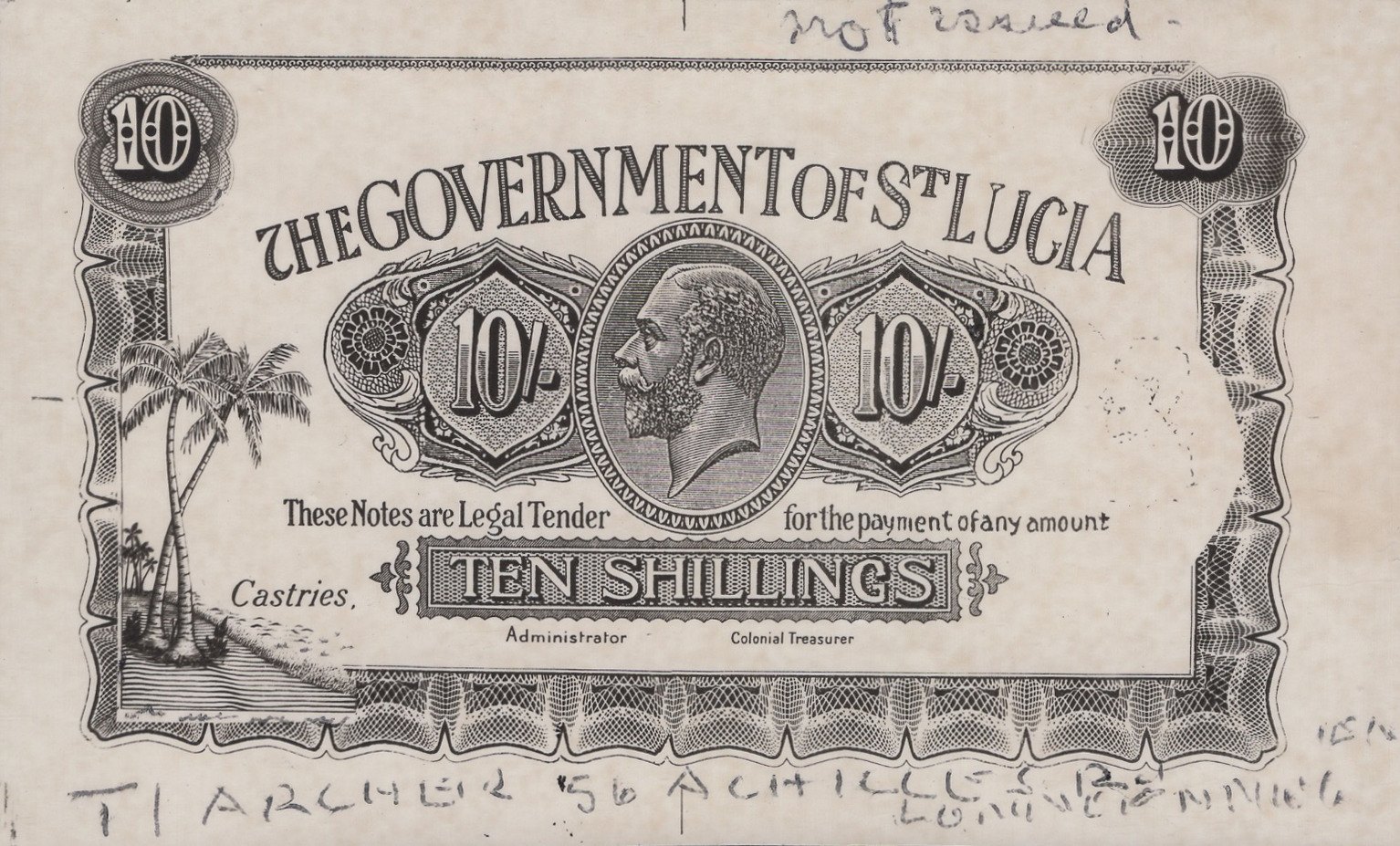
Noonans (27 August 2025, lot 952) sold a black and white archival photograph of a front design for a 10 shillings that was not adopted. It has palm trees on a shoreline at the left, George V at the centre, and the signature headings Administrator and Colonial Treasurer. The catalogue's row for it records pencil notes in the margins, among them "not issued".
What the sources do not say
- The term of redemption first set in 1920, and the text of the Ordinances of 1920, 1923 and 1935.
- How the 7,500 pounds was divided between the 5 shillings and the 10 shillings, and how many notes were printed.
- The first day of issue.
- The day of the Proclamation of 1937, and any amount in circulation between 1924 and 1937.
- Whether an issued 10 shillings survives.
Sources
- The catalogue's note pages for the Saint Lucia 5 shillings and 10 shillings, with their rows and sale records.
- Saint Lucia Blue Books for 1920, 1921, 1922 and 1937.
- Annual reports on Saint Lucia for 1921, 1922, 1924, 1926, 1928, 1929, 1930, 1935 and 1936; Colonial Office reports on Saint Lucia for 1948 and 1949-50.
- Colonial Office List, 1929.
- Voice of St Lucia, 27th September 1922, 27th September 1923 and 28th November 1923.
- R. M. Smythe, Baltimore, 20th and 21st March 1992, lot 2903.
- Bank Note Reporter, February 1992 and April 1992.
- Spink, 29 September 2009, lot 1612; 2 October 2012, lot 1193; 12 April 2016, lot 1837; 26 April 2017, lot 2147; 2 October 2019, lot 6.
- Stack's Bowers, 5 August 2020, lot 30329; 5 September 2026, lot 30333.
- Heritage Auctions, 23 October 2021, lot 28454; 9 May 2023, lot 28324.
- St James's Auctions, 5 October 2021, lot 1327.
- Noonans, 27 August 2025, lot 952; 27 November 2025, lot 932; 25 February 2026, lot 526.
Member comments
Log in or register to post a comment.