In 1920 and 1921 three small Governments of the eastern Caribbean put out small notes of their own, in shillings: Grenada, St. Lucia and the Leeward Islands. The catalogue's pages on them rest on local laws, Blue Books and gazettes. We have now read the yearly Colonial Reports of the 1920s for these islands and their neighbours. They add a figure and a withdrawal for Grenada, two more years of evidence for a St. Lucia note nobody has seen, and a good deal of silence.
The source
The "Colonial Reports - Annual" are the printed reports that each colony sent every year to the Secretary of State. They were sold by H.M. Stationery Office, and each has a number. We read six bound volumes of them, 1908 to 1931, against the catalogue. For this article the reports used are: Grenada for 1922 (No. 1168) and 1928 (No. 1443); St. Lucia for 1922 (No. 1169), 1928 (No. 1433) and 1929 (No. 1495); the Leeward Islands for 1921-22 (No. 1170); St. Vincent for 1922 (No. 1177), 1928 and 1929; and Barbados for 1909-10 (No. 660), 1922-23 (No. 1175) and 1929-30 (No. 1499).
Three issues in shillings
| Government | Values | Date on the notes | Amount, as the catalogue's pages give it |
|---|---|---|---|
| Grenada | 2 shillings 6 pence, 5 shillings, 10 shillings | 1st July 1920 | 12,500 pounds issued in 1920 (annual report for 1920) |
| St. Lucia | 5 shillings, 10 shillings | 1st October 1920 | 7,500 pounds issued in 1920 and 1921 (Blue Books) |
| Leeward Islands | 2 shillings 6 pence, 5 shillings, 10 shillings | 1st January 1921 | 2,000 pounds in Antigua, 3,500 in Dominica, 2,000 in Montserrat, 6,000 in St Kitts-Nevis (Leeward Islands Gazette) |
All three series carry the portrait of King George V. Grenada's notes were authorised by the Paper Currency Ordinance, No. 7 of 1920, and St. Lucia's by Ordinance No. 15 of 13th July 1920. The Leeward Islands notes were issued under the Government Currency Notes Act, 1921, which came into operation on 1st July 1921.
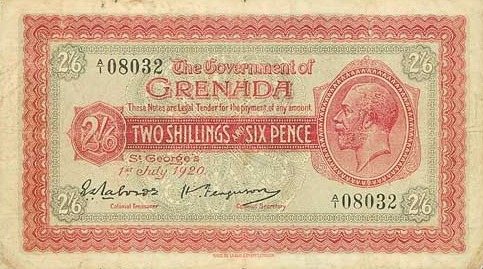
Grenada: the half crown goes first
Until now the pages of the 2 shillings 6 pence, the 5 shillings and the 10 shillings of Grenada had nothing between the issue of 1920 and the Blue Books' figure for 1933, when less than 50 pounds of the notes was still outstanding. The report for 1922 fills part of that gap. In its chapter on Government finance, on page 5, it says:
"Of the issue of Government Currency Notes of the denominations of 2s. 6d., 5s. and 10s., made in 1920 to the amount of £12,500, only £10,254 remained in circulation at 31st December, the 2s. 6d. notes having been withdrawn, and some dilapidated notes of the higher denominations destroyed as being unserviceable."
So by 31st December 1922 the lowest value was out of circulation. The 12,500 pounds agrees with the report for 1920. The difference, 2,246 pounds, is our subtraction: the report does not divide it between the withdrawn notes of 2 shillings 6 pence and the destroyed notes of the two higher values.
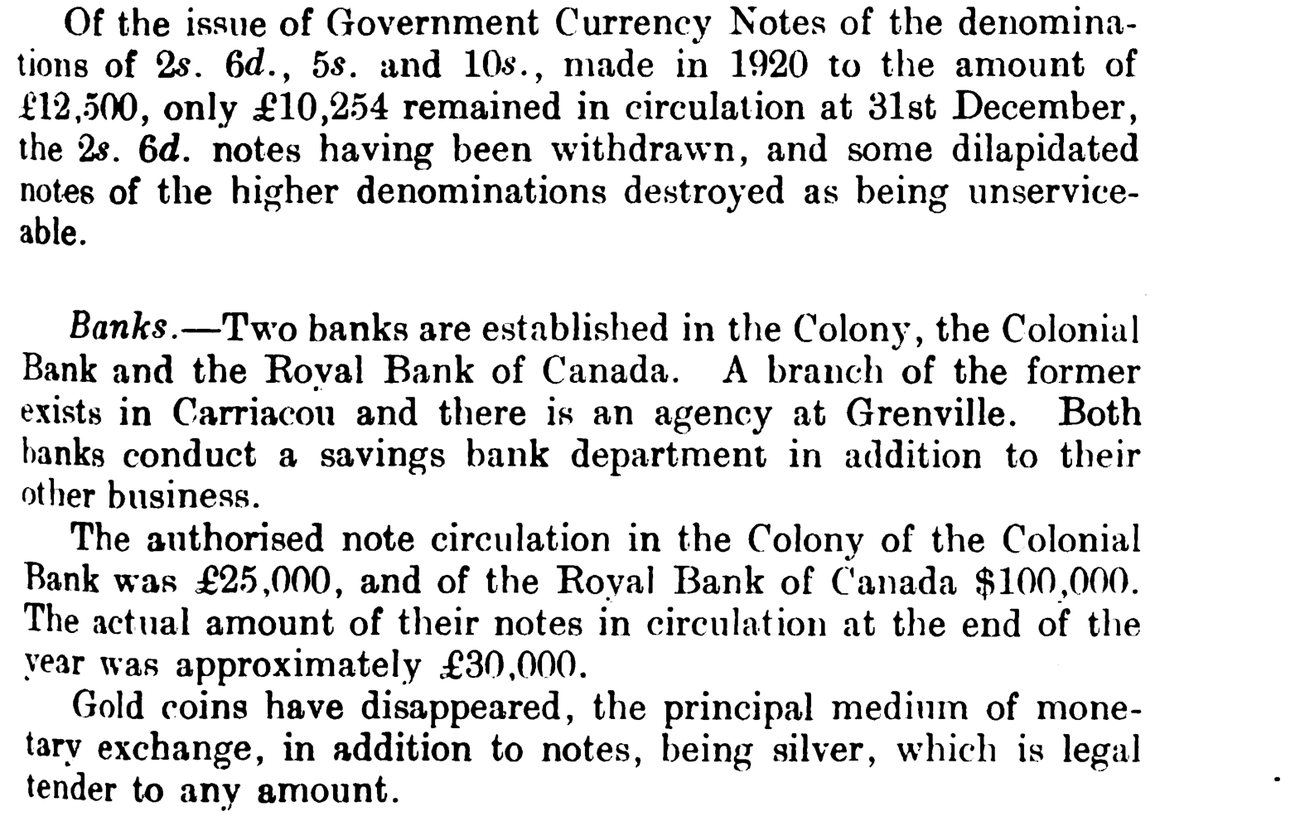
The report gives no day, no notice and no law for the withdrawal. The catalogue's withdrawal field for the 2 shillings 6 pence therefore now reads "Withdrawn by 31.12.1922" and no more. The report speaks of notes taken out of circulation; it does not say that they had ceased to be legal tender.
The banks' notes beside them
The same page sets the Government issue beside the paper of the two banks in the island. "The authorised note circulation in the Colony of the Colonial Bank was £25,000, and of the Royal Bank of Canada $100,000", and their notes actually in circulation at the end of 1922 came to "approximately £30,000". That is about three times the Government notes (our comparison).
Six years later the report for 1928 describes the currency of Grenada without naming a Government note at all. Beside British coin it speaks only of "bank notes of Barclays Bank and the Royal Bank of Canada of five dollars denomination". This is silence only: the report does not say that the Government notes had been called in.
St. Lucia: a 10 shillings named in five reports
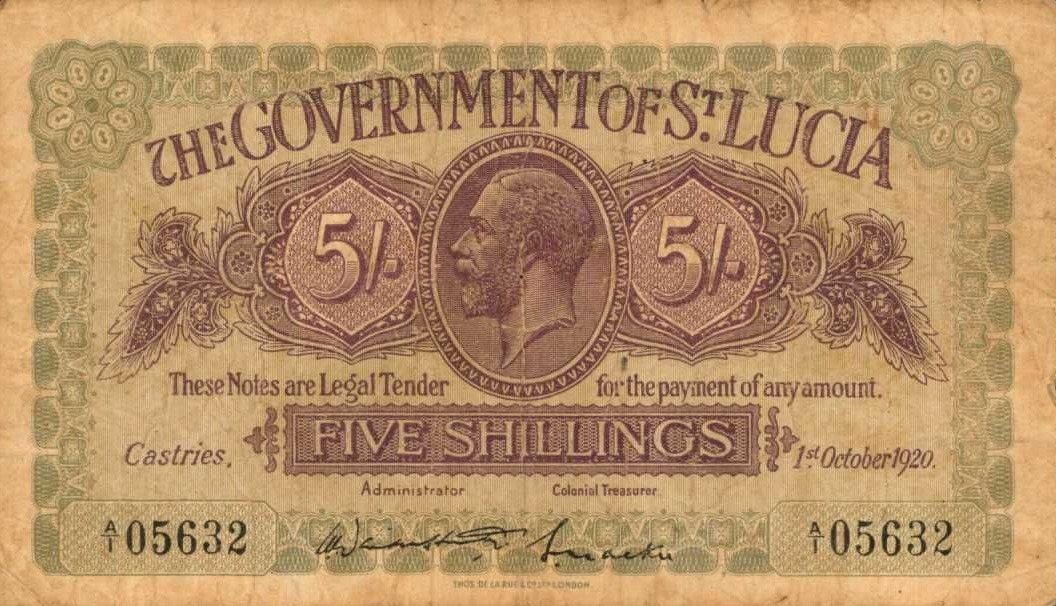
The 5 shillings of St. Lucia is known as an issued note. The 10 shillings is another matter. Its page says that sources mention an issued 10 shillings while others record only specimens, and that no issued example has been traced.
The reports speak plainly. The page already named the annual reports for 1921, 1926 and 1929. To these we can add the report for 1922, "Local Currency Notes of the value of 5s. and 10s. are also in circulation", and the report for 1928, "local Government currency notes of the value of 10s. and 5s. are in circulation, as well as the notes of Barclays Bank and the Royal Bank of Canada". The report for 1929 repeats the sentence of 1928. The page now names all five reports and concludes: "so the 10 shillings was issued, though no issued note has been seen".
None of the three reports read here gives an amount. The figures on the pages come from elsewhere: the Blue Books give 7,480 pounds 5 shillings out at the end of 1922, and the annual report for 1924 counts 6,549 pounds at the end of that year. The issue was wound up under an Ordinance of 1935.
The Leeward Islands: a report that says nothing
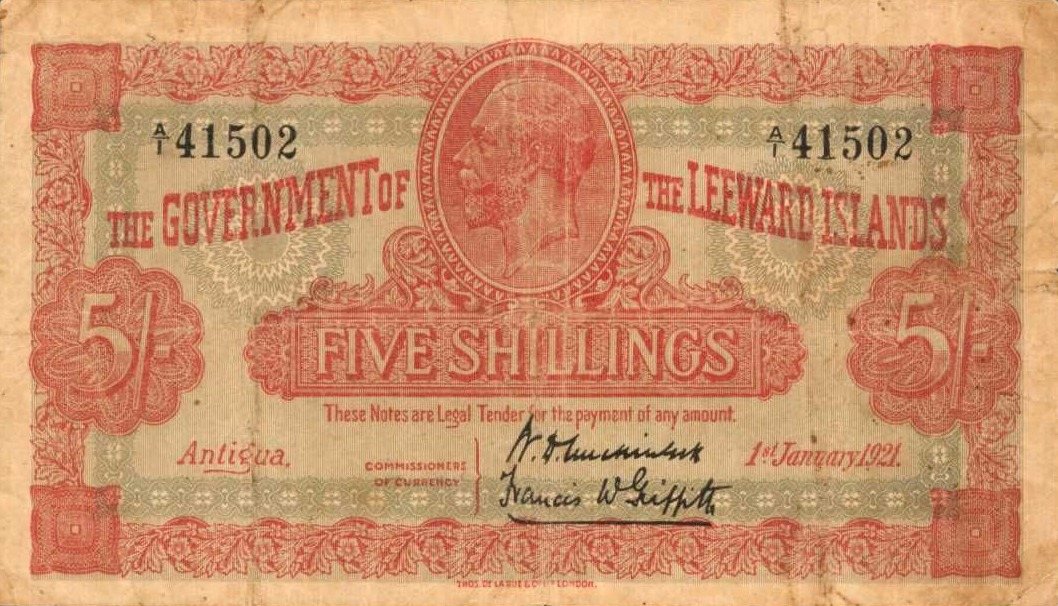
The Leeward Islands notes, the 5 shillings, the 10 shillings and a 2 shillings 6 pence of which no issued note is recorded, were introduced in July 1921. That falls inside the year of the report for 1921-22. We looked for them there and found nothing. The Legislation section says that "Twenty-one Federal Acts and seventy Presidential Ordinances were passed during the year 1921" and names two, neither on currency. No section gives an amount of notes. The dates and amounts on the pages rest on the Leeward Islands Gazette; the report neither supports nor disturbs them.
St. Vincent and Barbados: no Government note named
St. Vincent had no Government paper in these years. Its report for 1922 lists the whole currency: "British and American gold, five dollar notes of the Colonial Bank, and British silver and bronze coins". The reports for 1928 and 1929 say the same, with Barclays Bank in place of the Colonial Bank.
Barbados is harder. Catalogues list a 1 pound note of the Government of Barbados, issued between 1915 and 1917, with 28,000 printed, but give no photograph, colour, size or signer, and no example is known to have survived. The page calls it not yet settled whether this note existed: the Colonial Office List of 1918 gives the island's paper money as the five dollar notes of the Colonial Bank and American notes, and Bermuda had a Government 1 pound note in the same years, of which 28,000 pounds were outstanding from 1918 to 1924, so the figures may belong to Bermuda. The report on Barbados for 1929-30 adds one line to this. Its paragraph on currency names, beside British coin, only "a dollar paper currency issued by the banks". The reports for 1909-10 and 1922-23 have no paragraph on currency at all. None of this settles the question, because the Barbados reports for 1915-16 to 1918-19, the years of the supposed note, are in none of the volumes read.
What the reports do not say
- Grenada, 1921. The report for 1921 is not in these volumes. It might show when the 2 shillings 6 pence notes were called in.
- The withdrawal itself. No report gives the notice or the law under which Grenada's lowest value was withdrawn, a day, or the number of notes of each value. A notice or an ordinance of 1921 or 1922 would settle it.
- St. Lucia by value. No report read here gives an amount, and no source yet tells how much of the 7,500 pounds was in notes of 10 shillings. A photograph of an issued 10 shillings would show what the five reports only state.
- The Leeward Islands. The one report for the year of issue is silent; any figure in a later report remains to be found.
- Barbados. The reports for 1915-16 to 1918-19 are the ones to read.
Member comments
Log in or register to post a comment.