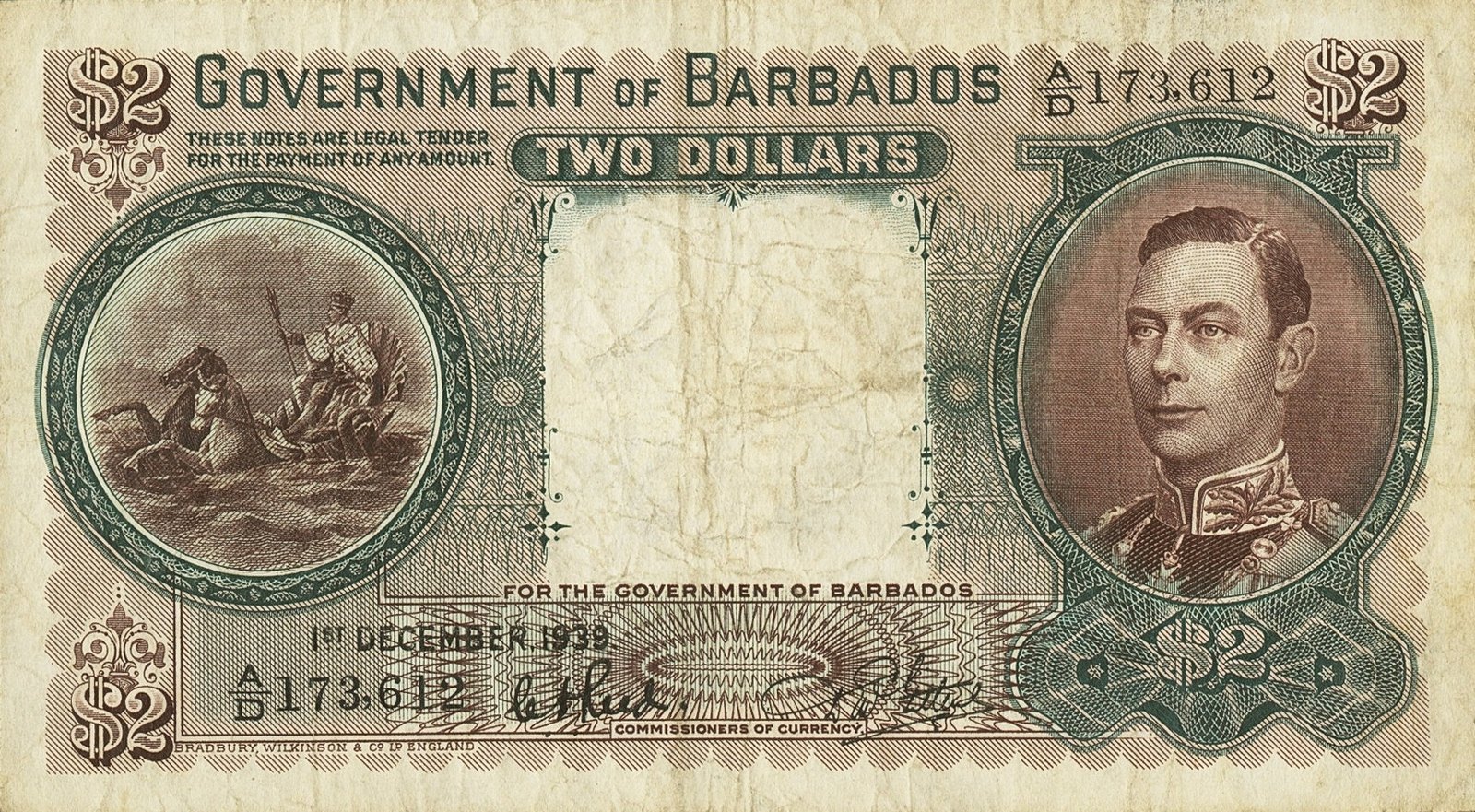
Before the Government notes of 1938, the official descriptions of the money of Barbados read so far name the notes of private banks as its paper money, and those notes went on beside the Government's until the Currency Act, 1950 took effect. The catalogue has no page for them. This article sets out what the official descriptions of the island's money, an article on the Canadian banks in the IBNS Journal, the Barbados Advocate and a few other sources say about them. The same story for the neighbouring colony is in The banks' notes beside the Government's in Trinidad, 1891 to 1951.
The West India Bank and the Colonial Bank
When the Barbados Advocate could not get leave to print a picture of the new Currency Board notes in April 1951, it printed instead a 5 dollars of the West India Bank of Bridgetown, held at the Barbados Museum (Barbados Advocate, 28th April 1951, page 5, read on the photograph of the page). With it the paper quoted E. M. Shilstone, in the Journal of the Barbados Museum and Historical Society, volume VIII, pages 5 and 6: the bank opened in March 1840 with an authorised capital of two million dollars, lasted six or seven years and was then wound up. The number and date on the note cannot be read in the newspaper's picture.
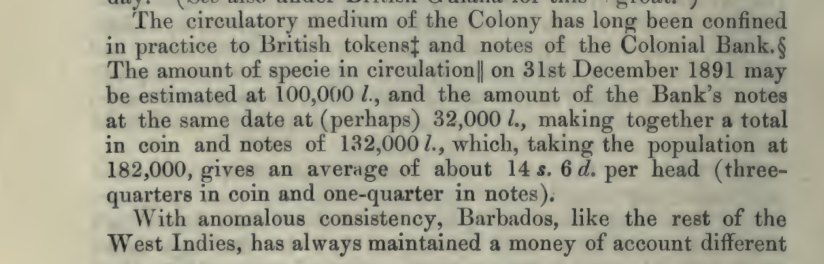
The Colonial Bank was founded in 1836 and from 1925 was part of Barclays Bank; its notes, as Michael H. Ryan writes in the IBNS Journal (volume 58, number 1), circulated throughout the British West Indies. Robert Chalmers, in A History of Currency in the British Colonies (1893, page 58), says the circulation of Barbados had long been confined in practice to British tokens and the notes of the Colonial Bank, and estimates the bank's notes there at perhaps 32,000 pounds on 31st December 1891.
What the official descriptions said, 1891 to 1937
| Year | Source | What it says of paper money in Barbados | Read on |
|---|---|---|---|
| 1891 | Chalmers, 1893, page 58 | Colonial Bank notes, perhaps 32,000 pounds | page photograph |
| 1909-10 | annual report, No. 660 | nothing on notes; no currency paragraph beyond the Savings Bank | text |
| 1912-13 | annual report, No. 779 | nothing on notes or currency | word search of the scan |
| 1913 | Handbook of Barbados | no Government notes; bank notes of about 50,000 pounds, and American notes | text |
| 1914-15 | annual report | no word of notes | text |
| 1918 and 1920 | Colonial Office List, Currency and Banking (1918, page 269; 1920, page 286) | British coin legal tender; the note circulation is the Colonial Bank's five dollar notes, about 50,000 pounds in Barbados; the Royal Bank of Canada named among the banks; an appreciable amount of American gold and notes | text |
| 1919-20 | annual report | only the Colonial Bank's five dollar notes | page photograph |
| 1922-23 | annual report, No. 1175 | no currency paragraph; the Colonial Bank named only as lender to the Government | text |
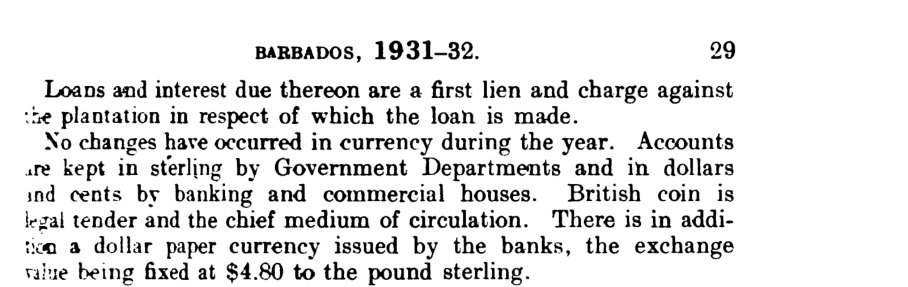
| 1929-30 | annual report, No. 1499, page 11, paragraph 34 | British coin the chief medium of circulation, with a dollar paper currency issued by the banks at 4 dollars 80 to the pound | page photograph |
| 1930-31 | annual report | dollar notes of the banks, at 4 dollars 80 to the pound | text |
| 1931-32 | annual report | bank dollar notes | text |
| 31st December 1932 | Economic Survey of the Colonial Empire, 1932 | no Government notes; Barclays 243,235 dollars, Royal Bank of Canada 156,635 dollars, Canadian Bank of Commerce 55,545 dollars | page photograph |
| 31st December 1933 | Economic Survey of the Colonial Empire, 1933 | Barclays 255,080 dollars, Royal Bank of Canada 123,000 dollars, Canadian Bank of Commerce 66,280 dollars | page photograph |
| 31st December 1935 | Economic Survey of the Colonial Empire, 1935 | Barclays 255,830 dollars, Royal Bank of Canada 111,570 dollars, Canadian Bank of Commerce 70,075 dollars | text |
| 1935-36 | annual report | a Government note issue under consideration | page photograph |
| 1936 | annual report | Government currency notes to be issued in the near future | text |
| 1936 | Economic Survey of the Colonial Empire, 1936 | Barclays 278,450 dollars, Royal Bank of Canada 114,985 dollars, Canadian Bank of Commerce 65,315 dollars | text |
| 1937 | Economic Survey of the Colonial Empire, 1937 | Barclays 295,580 dollars, Royal Bank of Canada 108,770 dollars, Canadian Bank of Commerce 79,060 dollars | text |
The Colonial Office List of 1918 names only the Colonial Bank as an issuer of notes in Barbados, although, by Ryan's account below, the Royal Bank of Canada had leave to issue there from 1911. The two are set side by side here and not reconciled. Whether a Government note was issued in 1915 to 1917 is an open question set out on the page of the 1 pound.
The Royal Bank of Canada, from 1911
Ryan's article, Canadian Banknotes for the British West Indies, 1900-1950 (IBNS Journal 58:1), is drawn from the papers of the Colonial Office, the Treasury and the Crown Agents at the National Archives, Kew, among other sources. It was read here in its machine text only, and its tables of authorised issues came out of that text in a jumble, so only the figures that stand in Ryan's own sentences are used below.
The Royal Bank of Canada took over the Union Bank of Halifax in 1910, and with it a presence in Trinidad. It opened in Barbados in 1911 and at once asked leave to issue five and twenty dollar notes there; it was allowed notes to a value of 200,000 dollars in Barbados, a limit later raised. The first notes were the bank's Canadian notes of 1909, overprinted for the island.
The bank's series dated 2nd January 1920 was the first designed for the West Indies and the first to give the value in both dollars and pounds: 5 dollars or 1 pound 0 shillings 10 pence, with a steamship; 20 dollars or 4 pounds 3 shillings 4 pence, with a sugar cane harvest; and 100 dollars or 20 pounds 16 shillings 8 pence, with a draped female figure before a tropical island. Ryan says the 20 and 100 dollars of this series were issued only in Barbados, British Guiana and Trinidad.
A smaller series dated 1938 followed, about 6 by 3¼ inches against the 7¼ by 3½ inches of the series of 1920. In Barbados it took the 5 dollars and the 20 dollars; no 100 dollars was issued in this series. Ryan's estimate, from the range of the serial numbers of the notes that survive, is that perhaps 20,000 of the 20 dollars entered circulation in Barbados, British Guiana and Trinidad, and 20,000 to 30,000 of the 5 dollars in each place other than British Guiana and Trinidad, Barbados among them. Ryan adds that the evidence is too thin for firm conclusions; the figures are Ryan's reckoning, not a count from the bank.
The Canadian Bank of Commerce, from 1921
The Canadian Bank of Commerce opened branches in Kingston, Bridgetown and Port of Spain in 1921 and asked leave to issue 300,000 dollars of notes in Barbados. By Ryan's account the Colonial Office held back, unsure that each colony needed a further issuing bank, and the Colonial Secretary, Winston Churchill, waited for the views of the officials in Barbados and Trinidad. In Barbados the Governor pressed strongly for approval on account of local financial conditions, and the applications for both colonies were approved in December 1921. The Barbados notes were of 5, 20 and 100 dollars, dated 2nd January 1922.
Ryan writes that the timing of the bank's entry as a note issuer was not to its advantage, and gives 66,280 dollars of its notes in circulation in Barbados at the end of 1933, the figure the Economic Survey for 1933 also gives (table above). A new issue for Barbados in 1940 was of 5 dollars only.
One account of a single value comes from Harold Don Allen, writing in the IBNS Journal (volume 38, number 1, in the article Fifty-Year Reflection). A bank manager in the Caribbean sent Allen a worn Canadian Bank of Commerce 100 dollars dated 1922, and Allen asked the head office how many of the Barbados hundreds were still outstanding. The reply, as Allen tells it: 400 were printed, then another 400; all were issued; one circulated note had been kept, and 798 had been destroyed. The article was read in its machine text only.
Beside the Government notes, 1938 to 1951
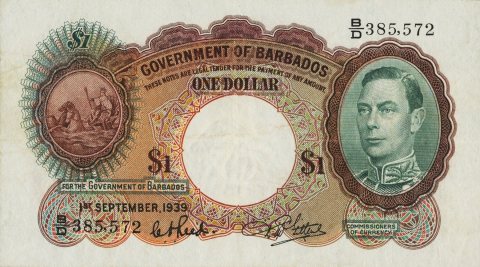
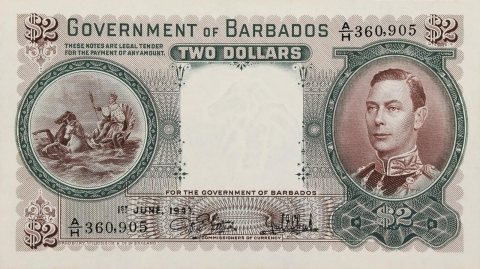
From 8th April 1938 the Government issued the 1 and 2 dollars, and the banks went on issuing the higher values: the Royal Bank's 5 and 20 dollars of 1938, the Commerce's 5 dollars of 1940, and the notes of Barclays, which the Economic Survey already counts in 1932. The Government's own 5 dollars, dated 1939, went into circulation only in 1941 or 1942, and none of its 20 or 100 dollars was out on 30th September 1942; the figures are in Barbados Government notes in figures.
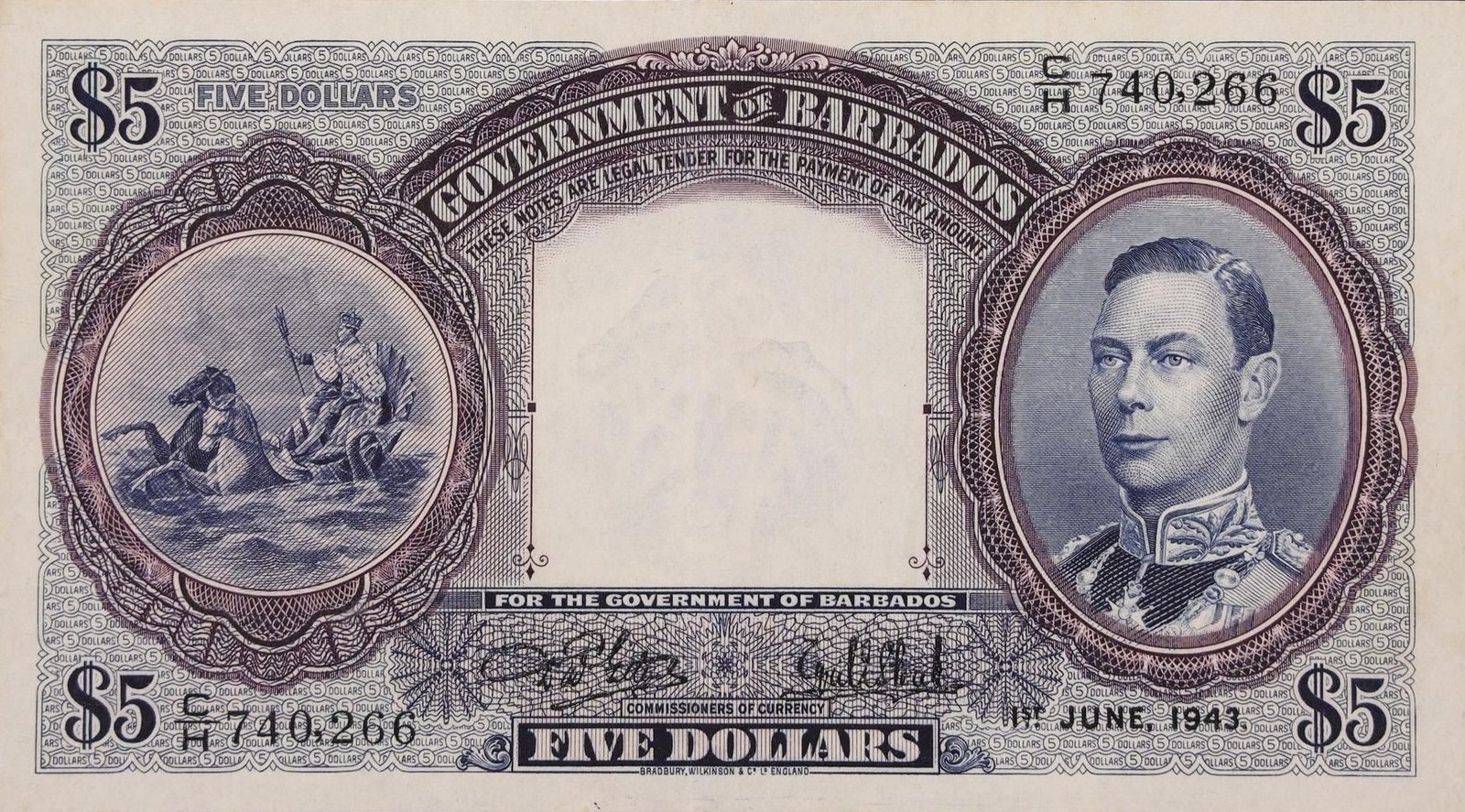
The Government notes also passed through the banks. On 5th April 1945 Barclays handed in 3,000 old Government notes of 1 dollar, 1,000 of 2 dollars and 5,000 of 5 dollars and took 1 dollar notes in exchange, and in January 1951 the Advocate reported notes for cancellation coming in from the banks at an average of 40,000 dollars every two weeks; both reports are in The Barbados Government notes in the Barbados Advocate, 1944 to 1952.
Ryan gives, on page 34, two measures of 1944 that held the banks back: the Canadian banks had to bring their notes in the West Indies down to no more than 10 per cent of their unimpaired capital, and Barclays and the Canadian banks had to cut their circulation in the West Indies by 30 per cent to make room for the Government issues. The West Indies Currency Conference that met in Barbados in 1946, which Farid Salem in the IBNS Journal (volume 41, number 2, read in the text only) places in May 1946, recommended a regional currency board and the end of the banks' note issue. As Ryan quotes it, the conference held that the power to issue notes was "the sovereign prerogative of the Governments concerned".
The end of the bank notes
The Currency Act, 1950 of Barbados (1950-31) provided, by section 2, that from its commencement the private banks could no longer issue notes in the island; the copy read is rough on that page. The note part of the Act came into force on 1st August 1951. The Board's notice of 12th August 1952 named Barclays Bank (Dominion, Colonial and Overseas), the Royal Bank of Canada and the Canadian Bank of Commerce as the places where the old Government notes could be changed, and from 1955 the annual reports on Barbados name Barclays as the Board's agent for paying them.
The Canadian notes ended by Canadian law. Ryan writes that from 1950 the Government of Canada withdrew the banks' permission to issue notes at home or abroad, and that in 1950 the liability for all their notes passed to the Bank of Canada. How Barclays kept a right to issue under its charter after the laws of 1950, and gave it up in 1959, is told in The laws, agreements and regulations of the British Caribbean currency, 1944 to 1966. Whether the Barbados Act of 1950 made that exception for Barclays the rough copy read does not show: as read, its section 2 says only that the private banks could no longer issue in the island.
The banks' notes in old sales and archives
The old sale catalogues read for the catalogue offered Barbados bank notes beside the Government notes, and left them out of the catalogue because it has no page for them:
- Harmer-Rooke, 5th December 1974 (the Albert I. Donn Collection), lot 28: Royal Bank of Canada, Barbados.
- Henry Christensen, 6th December 1975 (the Pennell and Wait collections): notes of the banks in Barbados.
- NASCA, 7th December 1981 (the Stanley Gibbons Collection, part II), lots 30 and 31 and 140 to 146: notes of Barclays, the Colonial Bank, the Canadian Bank of Commerce and the Royal Bank of Canada for Barbados and Antigua.
- Herbert I. Melnick, 20th December 1982 (the Stanley Gibbons Collection, part V), lots 2054 to 2057 and 2742 and 2743: commercial bank notes of Barbados and Jamaica.
Joel Shafer's report in the Bank Note Reporter of July 1991, pages 1 and 12, says that the third sale of the American Bank Note Company's archives, at Christie's, New York, on 5th June 1991, included Royal Bank of Canada designs for the eastern Caribbean, Barbados among them, in five lots; it gives no lot by lot detail. A Ponterio advertisement in the IBNS Journal (volume 47, number 3, page 50) pictures a Barclays Bank (Dominion, Colonial and Overseas) 100 dollars of Bridgetown.
What the records do not hold
- The limits and the figures of circulation of each bank in Barbados year by year. Ryan's tables were not readable in the copy held, and no Barbados Blue Book has been read.
- The amounts of each bank's notes in Barbados before 1932 and after 1937.
- Any notice of the 1944 measures in the Official Gazette of Barbados.
- The day the Canadian Bank of Commerce's last notes were withdrawn in Barbados.
- Eric Armstrong's A History of Money and Banking in Barbados, 1627 to 1973 (University of the West Indies Press, 2010), which Ryan cites, has not been read.
Sources
- Michael H. Ryan, Canadian Banknotes for the British West Indies, 1900-1950, IBNS Journal, volume 58, number 1 (machine text; the passages on 1944 and 1946 on page 34).
- Harold Don Allen, Fifty-Year Reflection: A "Good Time" is Now, IBNS Journal, volume 38, number 1 (machine text).
- Farid Salem, Trinidad and Tobago from the Currency Board to the Central Bank, IBNS Journal, volume 41, number 2 (machine text).
- Robert Chalmers, A History of Currency in the British Colonies, London, 1893, page 58.
- Colonial Reports, Annual: Barbados, 1909-10 (No. 660), 1912-13 (No. 779), 1914-15, 1919-20, 1922-23 (No. 1175), 1929-30 (No. 1499), 1930-31, 1931-32, 1935-36, 1936, and from 1955.
- Handbook of Barbados, 1913.
- Colonial Office List, 1918, page 269, and 1920, page 286.
- An Economic Survey of the Colonial Empire, editions for 1932 (page 260), 1933, 1935, 1936 and 1937.
- Currency Act, 1950 (Barbados, 1950-31), section 2.
- The Barbados Advocate, 28th April 1951, page 5; the Sunday Advocate, 17th August 1952, page 15.
- Joel Shafer, report of the Christie's sale of 5th June 1991, Bank Note Reporter, July 1991, pages 1 and 12.
- IBNS Journal, volume 47, number 3, page 50 (Ponterio advertisement).
- Sale catalogues: Harmer-Rooke, 5th December 1974; Henry Christensen, 6th December 1975; NASCA, 7th December 1981; Herbert I. Melnick, 20th December 1982.
Member comments
Log in or register to post a comment.