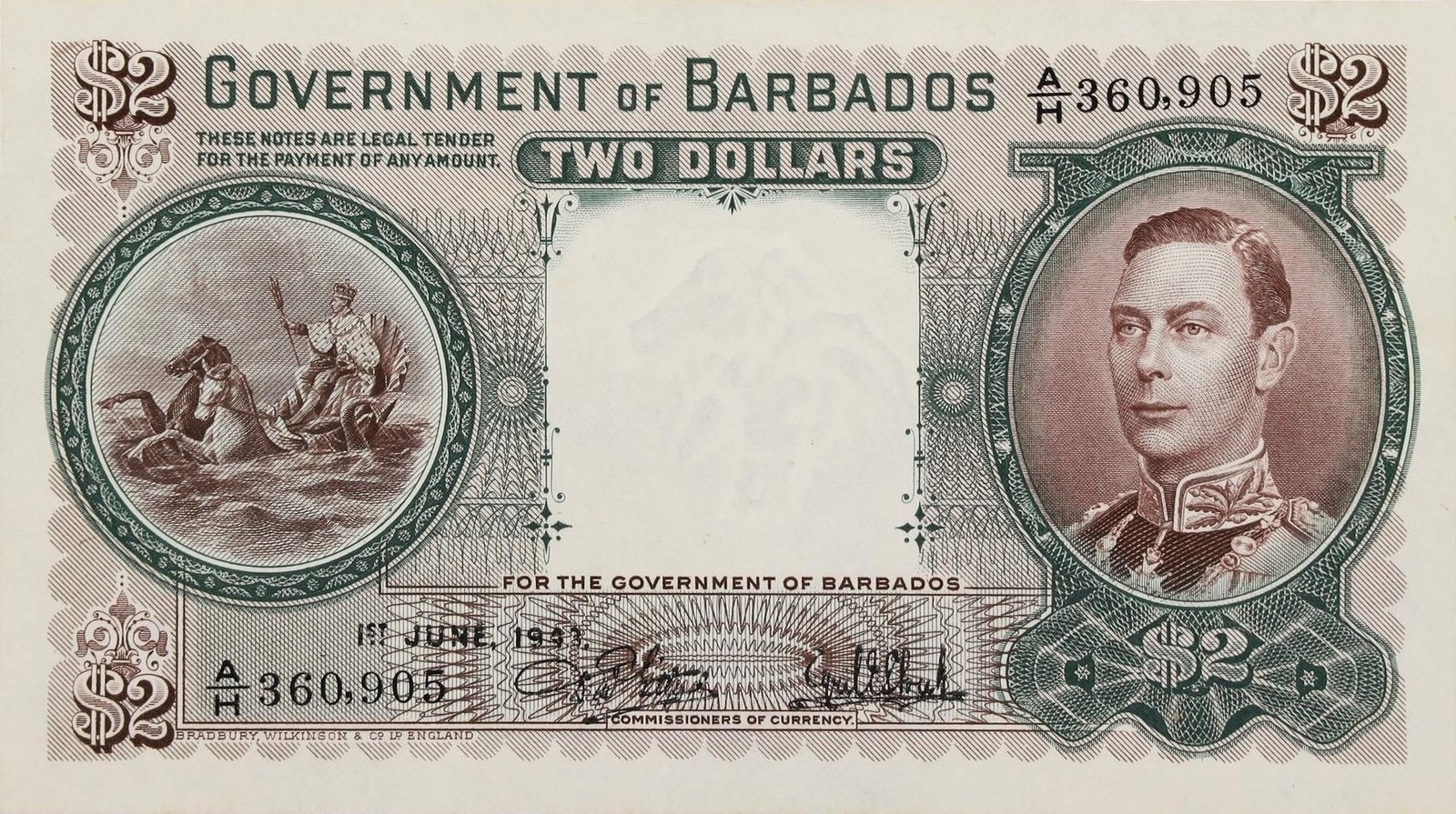
The Barbados Advocate printed what the Government's own reports leave out: how the notes of the Government of Barbados were handled in Bridgetown, how many were burnt, and how the change to the notes of the British Caribbean Currency Board was planned and put off. This article goes through the pages of the Advocate and the Sunday Advocate of 1950 to 1952 that have been read, together with the evidence given at a trial in March 1952 about the years 1944 and 1945. The story of the issue as a whole is in The Government of Barbados dollar notes, 1938 to 1955.
The pages read
The pages are single photographs of newspaper pages, each about 600 by 1,000 pixels, with the machine text made from them. Some passages below were read on the photograph of the page; others only in the machine text, and the article says so each time. The pages held are only a part of the paper's run. There are none for 1953 to 1956, so nothing the Advocate may have printed on the end of the Government notes on 2nd January 1955 has been read.
Signed in Bridgetown
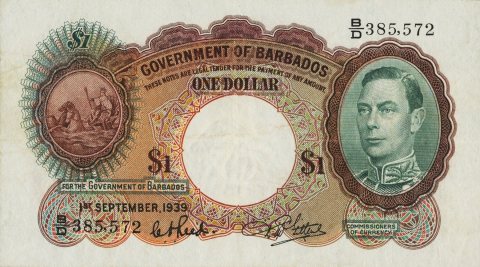
The Barbados Advocate of 18th March 1952, page 5, reported the trial of a civil servant on a charge of larceny. Among the witnesses was C. E. Stoute. Stoute told the court that during the war the notes used to come signed, and that it was then decided to bring them down from the United Kingdom unsigned. Unsigned notes were taken to the vault of the Currency Department and then sent, in the custody of two clerks, to the Advocate "to have the signatures affixed", after which they went back to the Currency Department and were locked up. One batch came back from the Advocate with its signatures on 20th November 1944. This passage was read on the photograph of the page.
The same report says that in 1945 D. E. W. Gittens was Colonial Treasurer and Commissioner of Currency and Stoute was then Manager of the Savings Bank. Gittens and Stoute are the pair on the notes dated 1st June 1943, among them the 1 dollar of that date.
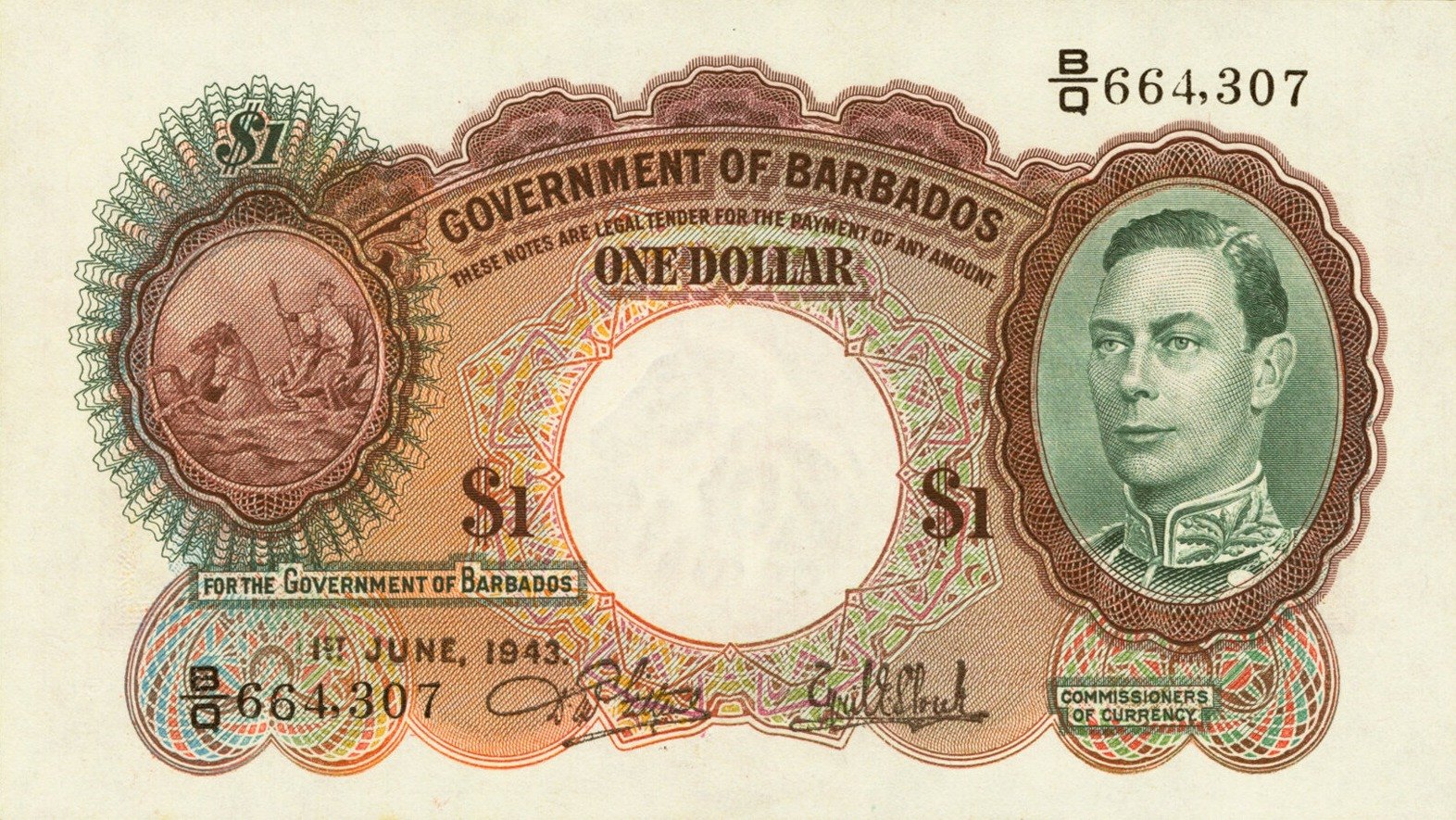
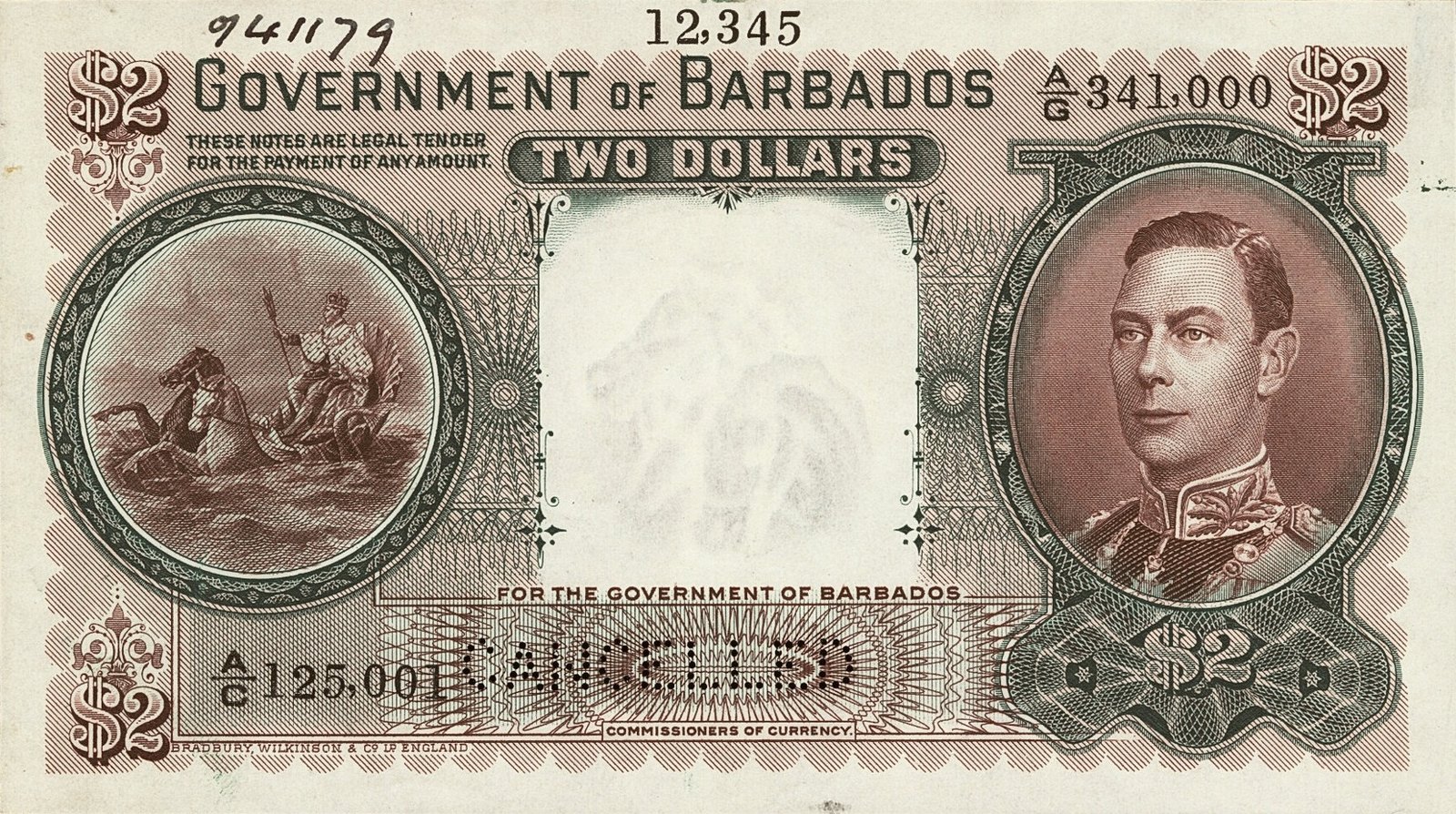
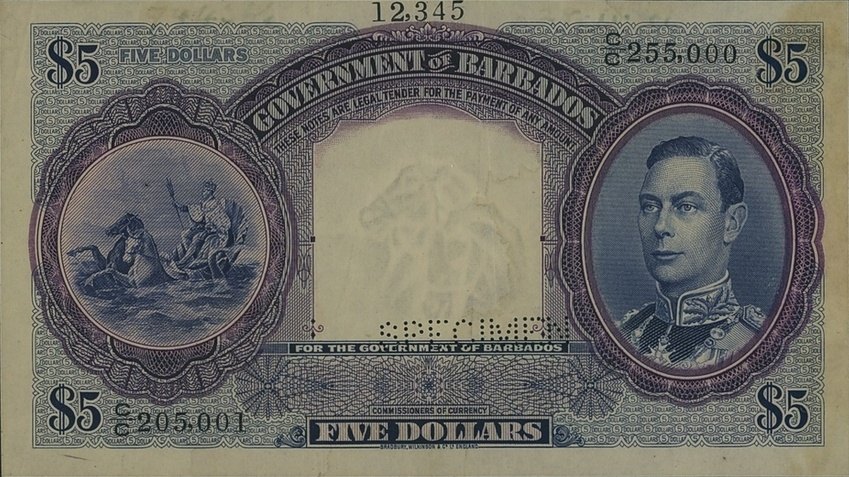
The evidence does not say from which printing the notes came unsigned, nor whether the practice went on after the war. The Pick pages record several specimens of the 2 dollars and the 5 dollars from these years that carry the range of a printing but no date and no signatures. Whether those specimens stand for printings that were sent out unsigned is not settled by anything read here.
Old notes for new: April 1945
The report of the trial gives one exchange of notes in detail. On 5th April 1945 Barclays Bank handed in 3,000 notes of 1 dollar, 1,000 of 2 dollars and 5,000 of 5 dollars as old notes, and 30,000 dollars in 1 dollar notes was issued in exchange. The same evidence has 1,000 notes of 2 dollars going to the Royal Bank of Canada. These figures were read in the machine text and on a photograph of the whole page only.
The paper of 1950
The Advocate of 2nd August 1950 reported the second reading in the Legislative Council of the Bill for a uniform currency in the Eastern Group, moved by H. A. Cuke the day before. The Council's attention was drawn to the poor quality of the paper on which the Barbados notes were then being printed, and added that the Trinidad and British Guiana notes in circulation in Barbados were just as bad. The Council heard that a firm in England had contracted to supply the new notes, and that the existing notes and coins were not expected to be recalled before 31st March 1951. This report was read in the machine text only.
Notes that passed between three colonies
A leading article in the Advocate of 13th April 1950, read in the machine text only, said that Trinidad, Barbados and British Guiana then issued currency notes that were interchangeable and legal tender in all three colonies, while the Trinidad notes were legal tender in the Leeward Islands as well. A reader's letter in the Advocate of 13th September 1951, also read in the machine text only, complained that Barbados notes taken to the Leeward or Windward Islands were changed at a commission, while Trinidad notes could have been taken there free of cost.
The law that made the three issues interchangeable has not been read. The annual report on British Guiana for 1946, read in its text only, is noted as speaking of reciprocal laws of 1941 with Barbados; the passage has not been checked, and the day from which Barbados notes passed in Trinidad and British Guiana is not known.
Worn notes destroyed, 1949 and 1950
The Advocate of 17th January 1951, page 5, read on the photograph of the page, found the staff of the Currency Department sorting into series and counting large quantities of cancelled Barbados Government notes before their disposal. They had to be got out of the way to make room for the new currency, which the paper then expected in April 1951. The report gives:
| Year | Value of notes destroyed, as the Advocate gives it |
|---|---|
| 1949 | about 420,000 dollars |
| 1950 | about 490,000 dollars |
The value of the notes in circulation was then over two million dollars, and notes for cancellation came in from the banks at an average of 40,000 dollars every two weeks. The same page reports a vote of 2,434 dollars under the head of the Commissioners of Currency for destroying worn notes. The annual report on Barbados for 1949, read in the text only, counts 2,158,040 dollars of Government notes out at the end of that year; the figures by value are in Barbados Government notes in figures. The rules for cancelling and destroying notes are in The currency law of Barbados and its Commissioners of Currency, 1937 to 1966.
The Treasury packages of July 1951
The Advocate of 13th July 1951, page 4, read in the machine text only, reported that 14,000 dollars was missing from the Public Treasury. Three sealed packages that should each have held 5 dollar notes to a value of 5,000 dollars were found to hold notes of 2 dollars. A further package, described as one that should have held 1,500 dollar notes, held only blank sheets of paper cut to the size of a note.
At the trial of March 1952, Walter D. Charlton, Accountant General, told the court of taking up the appointment on 14th May 1951, and said that about June a new currency was about to be introduced, and that the date fixed was in August, though the intention had first been to introduce it on 10th July. This evidence was read on the photograph of the page. The report of the trial goes on to page 8, which is not among the pages held, so its outcome is not known.
The date of the new currency, 1950 to 1951
The Advocate's reports show the day of the change moving later and later:
| Report | What it gave for the new notes | Read on |
|---|---|---|
| 16th April 1950 | the Crown Agents to arrange supplies for circulation early in 1951 | machine text |
| 2nd August 1950 | the old notes not to be recalled before 31st March 1951 | machine text |
| 17th January 1951 | the new notes may go into circulation in April 1951 | page photograph |
| 18th March 1952 (evidence of Charlton) | first intended for 10th July 1951, then fixed for August | page photograph |
| 2nd August 1951 | the Currency Act, 1950 brought into effect for notes on 1st August 1951; circulation from 15th August 1951 | page photograph |
The report of 2nd August 1951, page 5, adds that the notes of the Governments of Barbados, British Guiana and Trinidad would stay legal tender until the Governors demonetised them by proclamation, which would not be done until a few years had passed, and that even after that a holder could claim the face value from the Currency Board. The Board's laws are set out in The laws, agreements and regulations of the British Caribbean currency, 1944 to 1966.
The two Commissioners at Seawell, 27th July 1951
The Advocate of 28th July 1951, page 1, read on the photograph of the page, reported that 26 sealed wooden cases of the new currency had arrived from Trinidad the afternoon before by a special B.W.I.A. charter flight. At Seawell to meet the aeroplane were the two Currency Commissioners, W. D. Charlton, Accountant General, and J. A. Roberts, Manager of the Government Savings Bank. Two more cases came on 10th October 1951, when the Trinidad officers took back cancelled Trinidad and Tobago notes; that report was read in the machine text only.
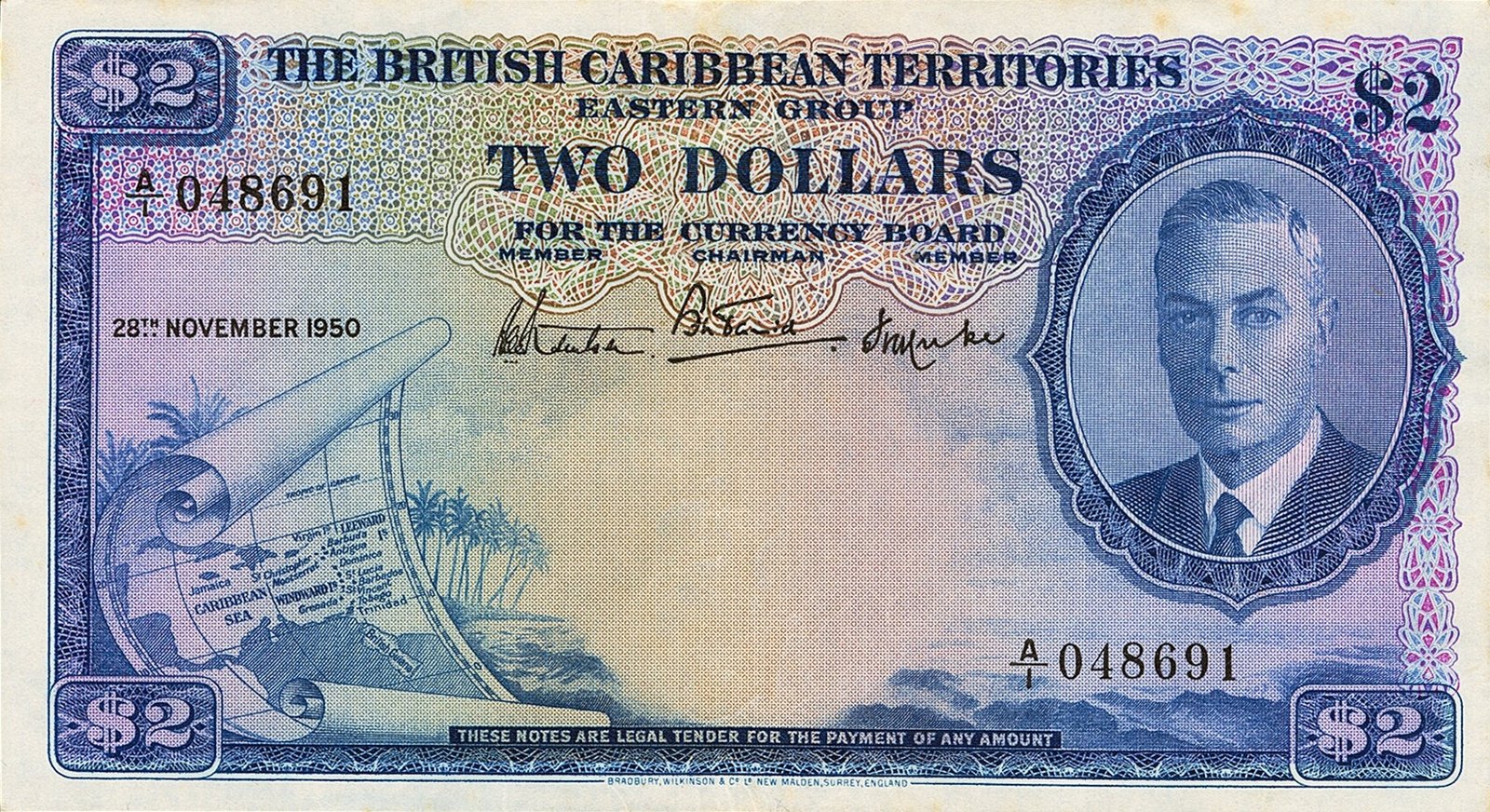
Roberts is one of the two signers of the last Barbados notes, dated 1st January 1949. No note carries the name of Charlton. The Colonial Office List of 1951 names the Commissioners as V. H. A. Chenery and J. A. Roberts, and the Advocate of 28th April 1951 names V. H. Chenery as Acting Colonial Treasurer. The list of Commissioners with their dates is in the article on the law and the Commissioners linked above.
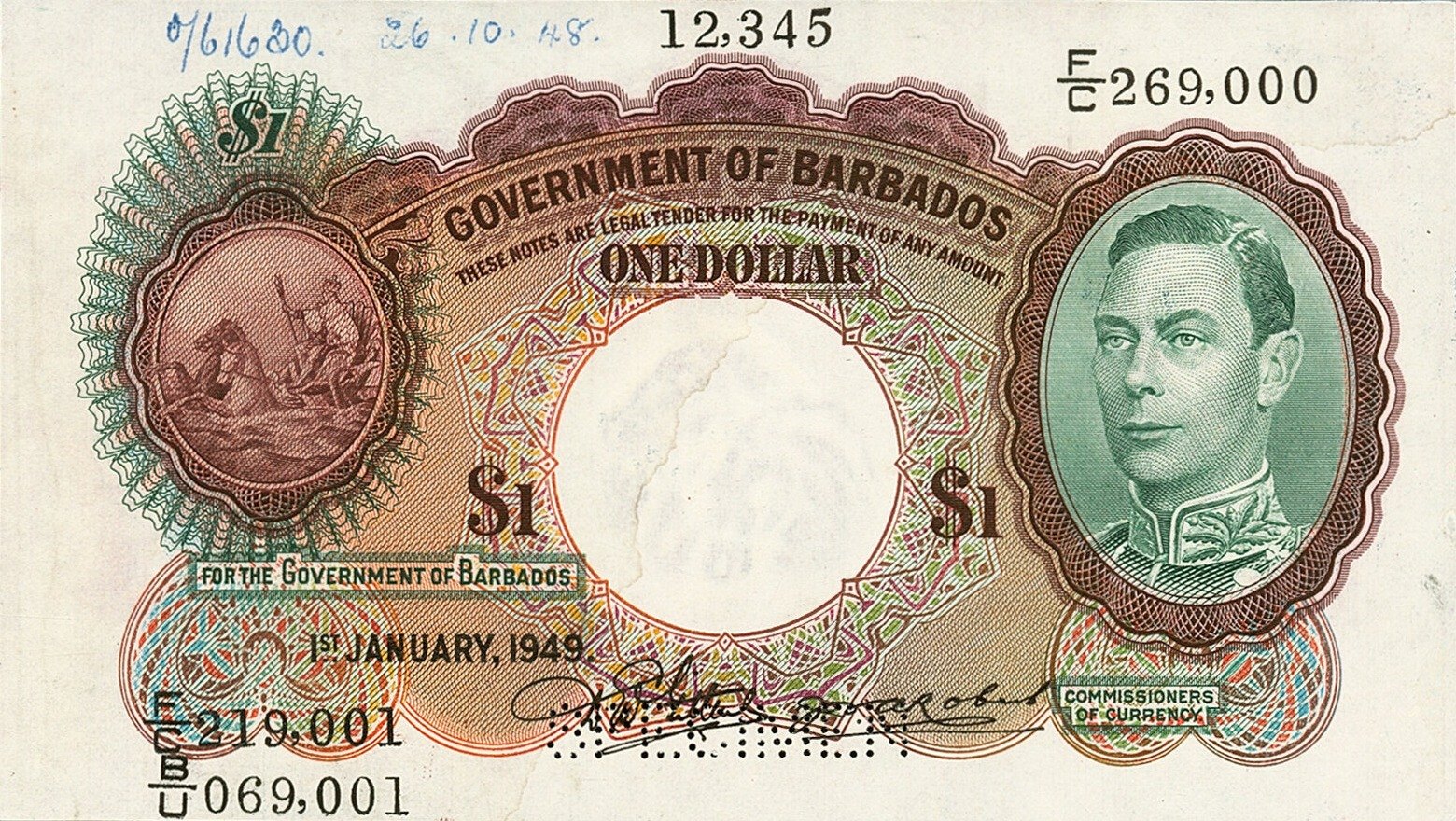
A year later the old notes were being called in. The Board's notice signed by H. N. Armstrong, Senior Currency Officer at the Barbados Centre, on 12th August 1952 and printed in the Sunday Advocate of 17th August 1952, asked holders of Barbados, British Guiana and Trinidad and Tobago Government notes to change them for the Board's notes with as little delay as possible, at Barclays Bank, the Royal Bank of Canada or the Canadian Bank of Commerce.
What the pages leave open
- Which printings came from the United Kingdom unsigned, and from when to when.
- Whether the Advocate's works signed the notes of all values, and how the signatures were applied.
- The charge and the outcome of the trial of March 1952, and whether the loss of July 1951 was made good.
- The value of notes destroyed in the years before 1949 and after 1950.
- The law under which the notes of Barbados, Trinidad and British Guiana passed in each other's colonies.
- The Barbados proclamation of 1954 or 1955 that ended the notes: no page of the Advocate or of the Official Gazette of Barbados for 1953 to 1956 is among those held.
Sources
- The Barbados Advocate: 13th April 1950 (leading article); 16th April 1950, page 7; 2nd August 1950 (Legislative Council report); 17th January 1951, page 5; 28th April 1951, page 5; 13th July 1951, page 4; 28th July 1951, page 1; 2nd August 1951, page 5; 13th September 1951, page 4 (letter); a report of October 1951 on the cases of 10th October; 18th March 1952, page 5 (report of a trial on a larceny charge).
- The Sunday Advocate, 17th August 1952, page 15 (notice of the British Caribbean Currency Board, 12th August 1952).
- Colonial Office List, 1951 (staff list of Barbados).
- Colonial Office report on Barbados for 1949, page 19 (table of currency notes in circulation; text only).
- Annual report on British Guiana for 1946 (text only; the passage on the laws of 1941 not checked).
Member comments
Log in or register to post a comment.