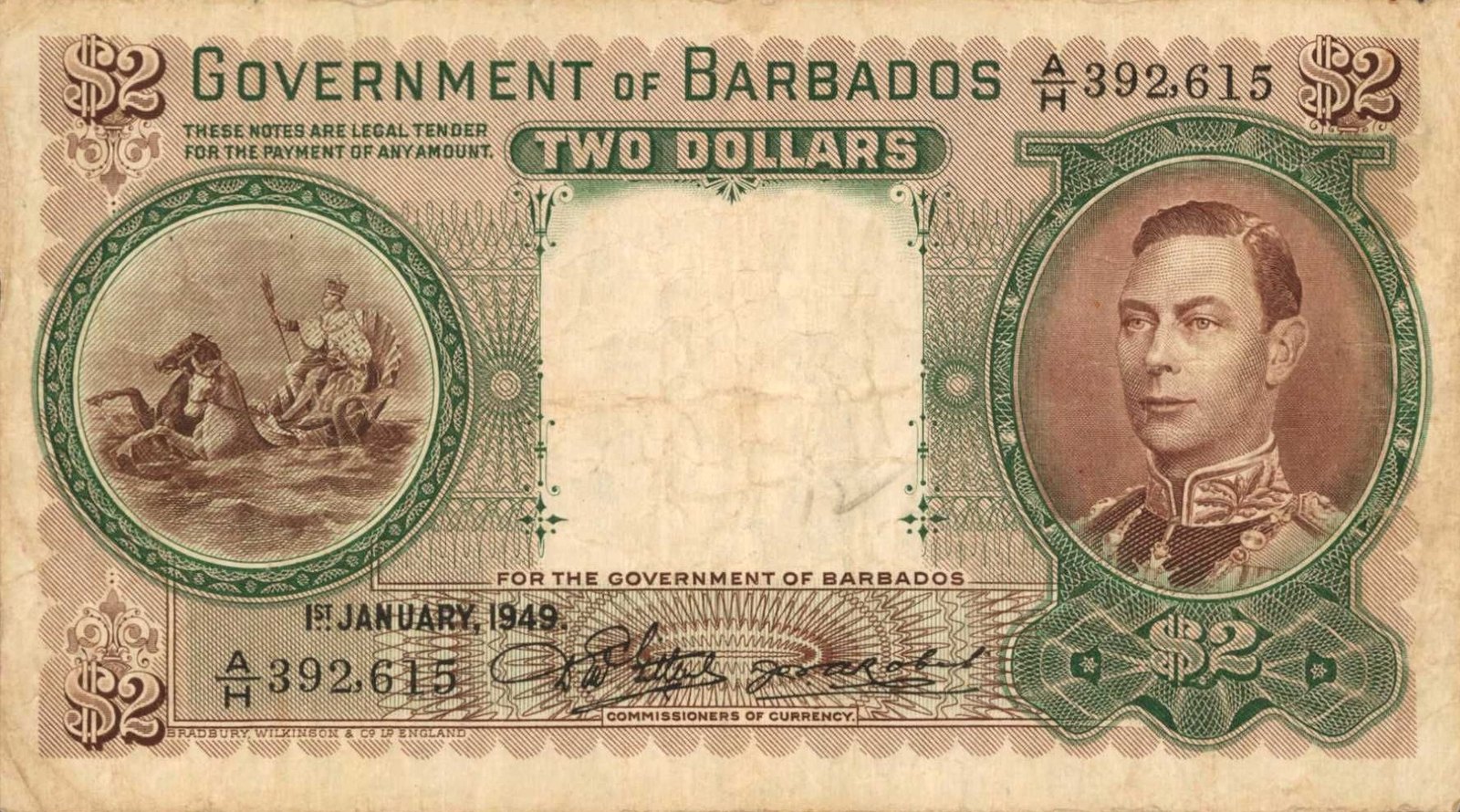
The Commissioners of Currency of Barbados printed abstracts of their note issue in the Official Gazette, the annual reports on the colony printed a table of notes by value, and after 1951 the British Caribbean Currency Board counted the old notes that had not yet come back. This article puts those figures together for the five notes of 1938 to 1949 and sets beside them what the specimens and the auction houses say of the printings and of the notes that survive. The story of the issue itself is in The Government of Barbados dollar notes, 1938 to 1955.
What was printed: the ranges on the specimens
No official count of the notes printed has been read. The guide is the range of numbers that Bradbury Wilkinson printed on the specimen of each printing, as the Pick pages record them.
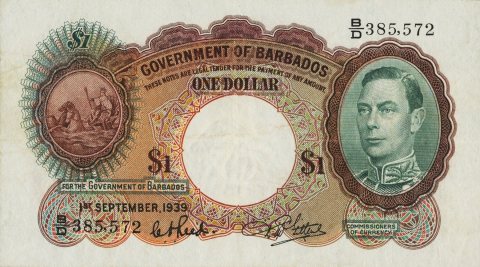
On the 1 dollar the number runs on through the prefixes, 100,000 to a prefix (B/A 000001 to 100000, B/B 100001 to 200000), and starts again at B/K, B/U and F/A. The date 1st June 1943 begins inside B/I, and 1st January 1949 begins at B/U 069001 and runs through B/Z into the F prefixes. Sources mention prefixes to F/H.
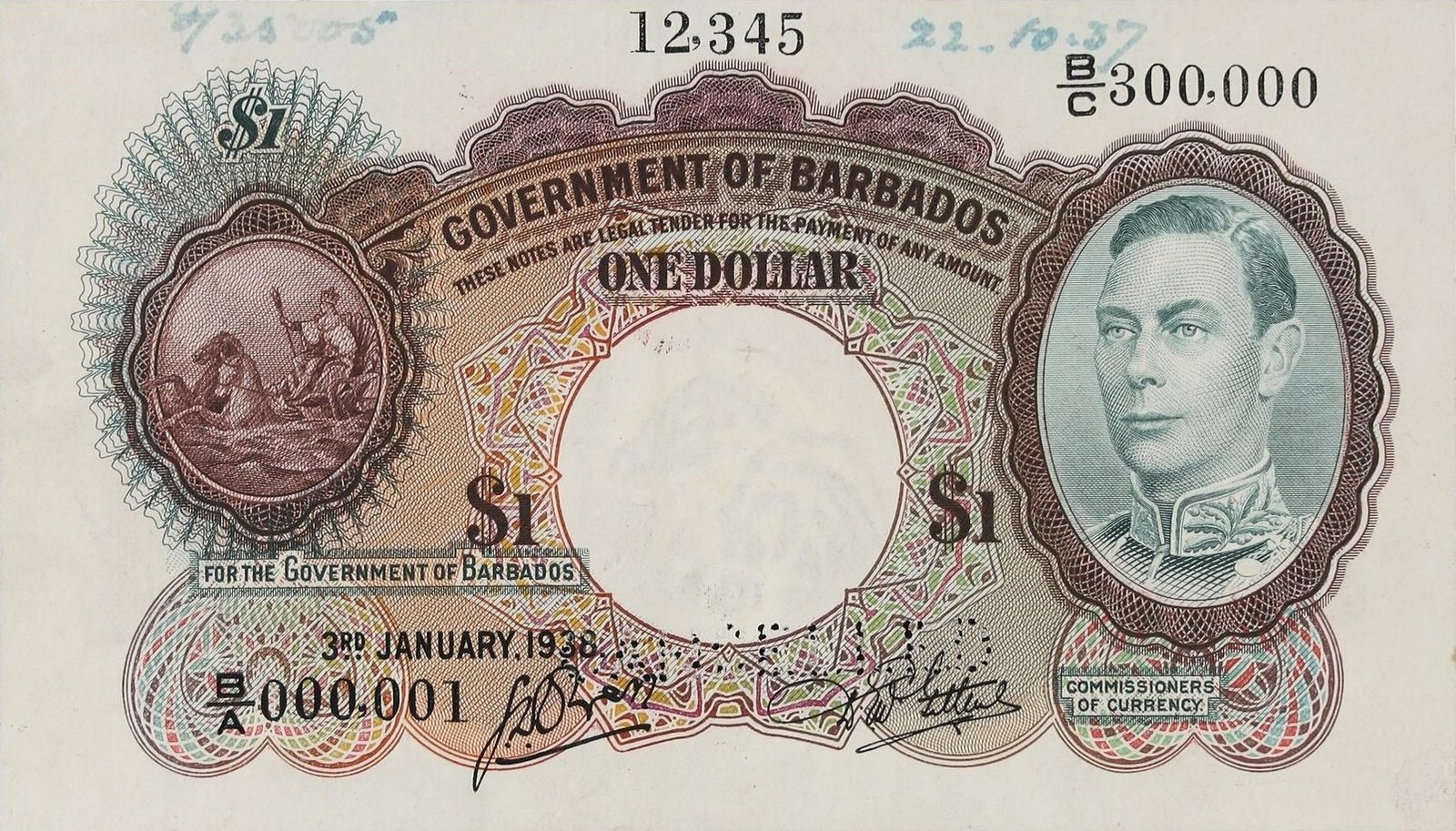
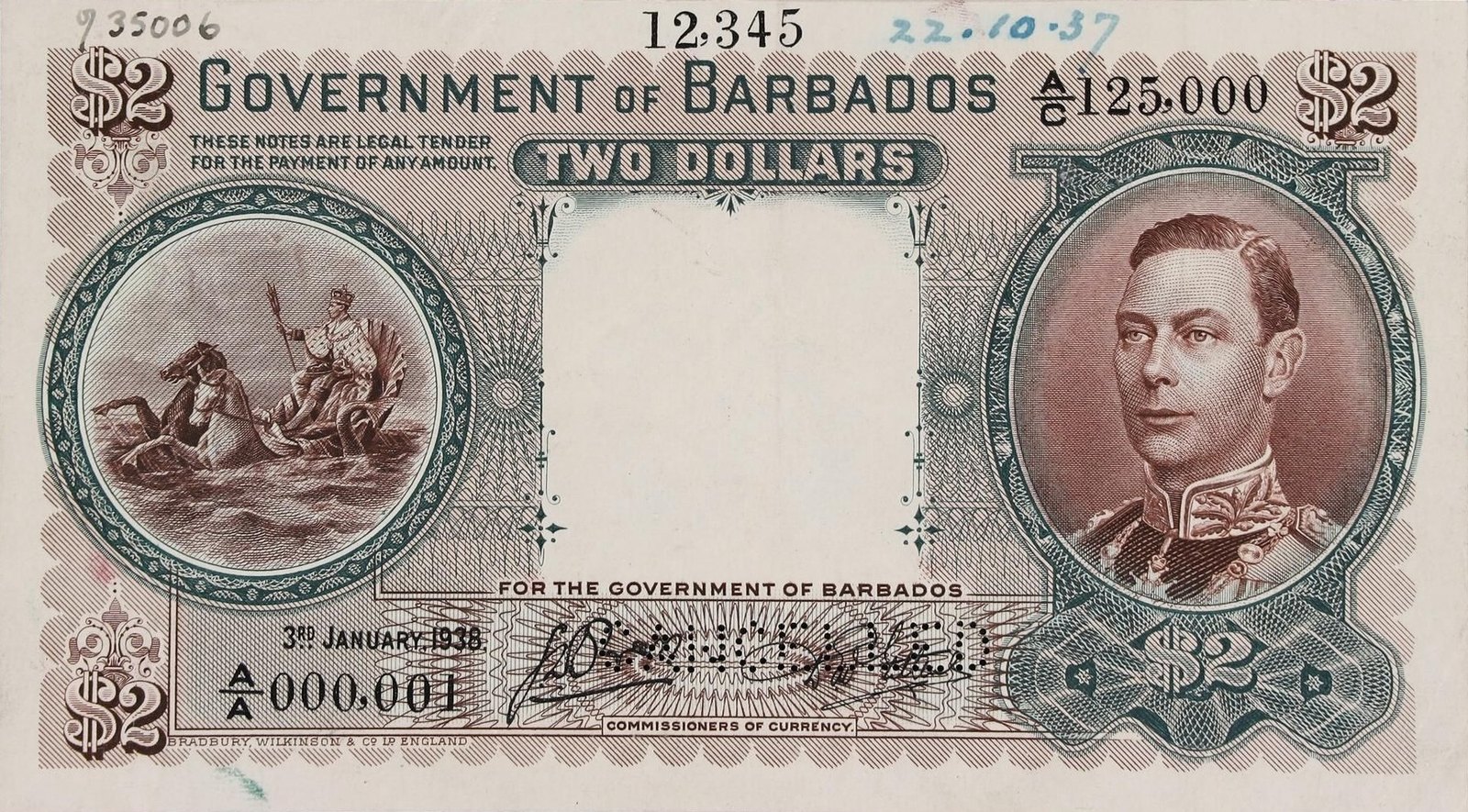
On the 2 dollars the numbers run unbroken, 50,000 notes to each lower letter, from A/A 000001 to A/N 700000. The specimens give four printings: A/A 000001 to A/C 125000, dated 3rd January 1938; A/C 125001 to A/G 341000 (a second specimen reads A/C 125001 to A/G 325000), undated and unsigned, which took the notes dated 1st December 1939 and the first notes of 1st June 1943; A/G 341001 to A/H 391000, undated and unsigned, the later notes of 1st June 1943; and A/H 391001 to A/N 700000, dated 1st January 1949.
On the 5 dollars the specimens carry the ranges C/A 000001 to C/B 200000, C/A 000001 to C/C 205000, C/C 205001 to C/C 255000, C/C 255001 to C/F 555000, C/F 555001 to C/G 665000 and C/G 665001 to C/K 065000. None of them is dated or signed.
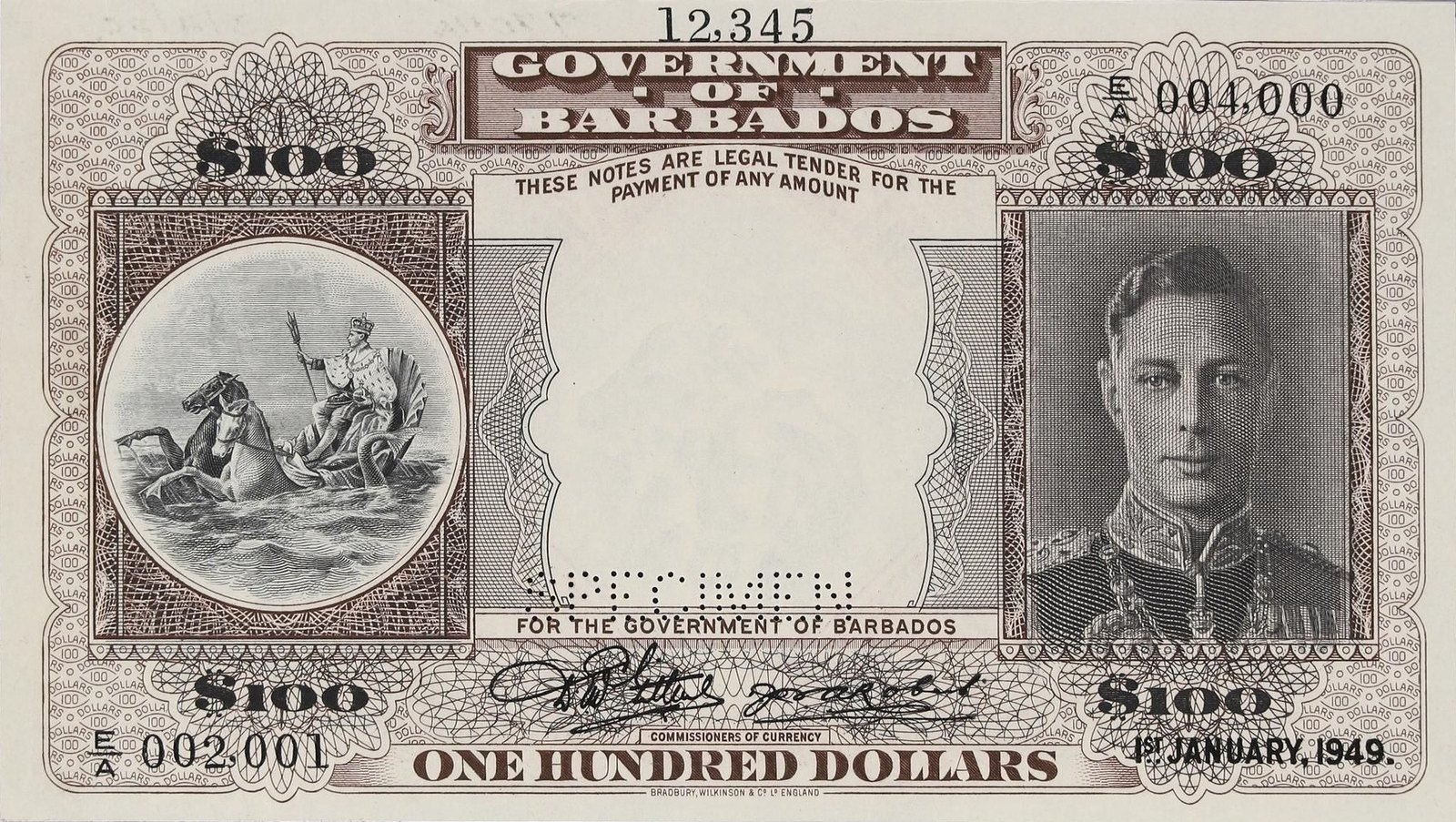
On the 20 dollars the ranges are D/A 000001 to D/A 010000 and, with the date 1st January 1949, D/B 010001 to D/B 020000: 10,000 notes of each. On the 100 dollars they are E/A 000001 to E/A 002000 and, with the date of 1949, E/A 002001 to E/A 004000: 2,000 notes of each.
The first printing of the 2 dollars ends at the number 125000, the same figure as the limit that the regulations of March 1938 set for the stock of unissued 2 dollar notes. The limit for the 1 dollar was 500,000.
Two houses give figures of their own. Heritage Auctions, describing lot 24036 of its sale of 27th March 2025, says printer records indicate that as few as 20,000 of the 20 dollars and only 2,000 of the 100 dollars were printed. Stack's Bowers, describing a 100 dollars specimen of 1949 (16th January 2026, lot 30033), reckons a total of 4,000 notes of that value from the range on the specimen, split evenly between the dates of 1943 and 1949. The two statements about the 100 dollars do not agree, and neither house says which record it used. Stack's Bowers also says, of the 1 dollar dated 1st June 1943 (8th May 2025, lot 50025), that no new order for that value was placed until 1949.
In circulation, 1938 to 1948: the Gazette abstracts
The abstracts give the number of notes in circulation by value on the last day of a half year. These are the figures read so far; the file of the Official Gazette of Barbados for 1938 to 1950 that was read is not complete, and it holds further abstracts that are not set out here.
| Day | 1 dollar | 2 dollars | 5 dollars | 20 dollars | 100 dollars |
|---|---|---|---|---|---|
| 30th September 1938 | 80,000 | 20,000 | none | none | none |
| 31st March 1939 | 129,500 | 31,250 | not noted | not noted | not noted |
| 30th September 1941 | 499,500 | 86,250 | none | none | none |
| 30th September 1942 | 505,515 | 78,250 | 102,997 | none | none |
| 31st March 1946 | not noted | not noted | not noted | 6,750 | 750 |
| 31st March 1948 | not noted | not noted | not noted | 9,899 | 1,929 |
The abstract for 30th September 1941 gives the value of the two notes then out as 672,000 dollars, and the abstract for 30th September 1942 gives 1,177,000 dollars for the three. The abstract for 30th September 1939 also lists only the 1 and 2 dollars.
In circulation, 1949 to 1961: the annual reports
The annual reports on Barbados print the number of Government notes out at the end of the year.
| 31st December | 1 dollar | 2 dollars | 5 dollars | 20 dollars | 100 dollars | Value in dollars |
|---|---|---|---|---|---|---|
| 1949 | 629,263 | 30,291 | 217,663 | 9,599 | 1,879 | 2,158,040 |
| 1951 | 132,963 | 19,791 | 83,363 | 6,099 | 1,425 | 853,840 |
| 1953 | 52,253 | 4,882 | 16,794 | 866 | 196 | 182,907 |
| 1955 | 42,277 | 3,214 | 4,987 | 172 | 44 | 81,480 |
| 1957 | 40,109 | 3,020 | 3,884 | 102 | 27 | 70,309 |
| 1959 | 39,375 | 2,917 | 3,569 | 77 | 19 | 66,494 |
| 1961 | 39,069 | 2,870 | 3,369 | 71 | 17 | 64,774 |
The report for 1963 gives only the value, 62,901 dollars. The reports for 1947 and 1948 print a "total issue" by value with no day named; the two give the same total in sterling against different numbers of notes, so they are left out of the table.
Beside the old notes the same reports show the notes of the British Caribbean Currency Board in Barbados: 3,949,000 dollars at the end of 1951 and 7,629,225 dollars at the end of 1959.
The take-over and the demonetised notes
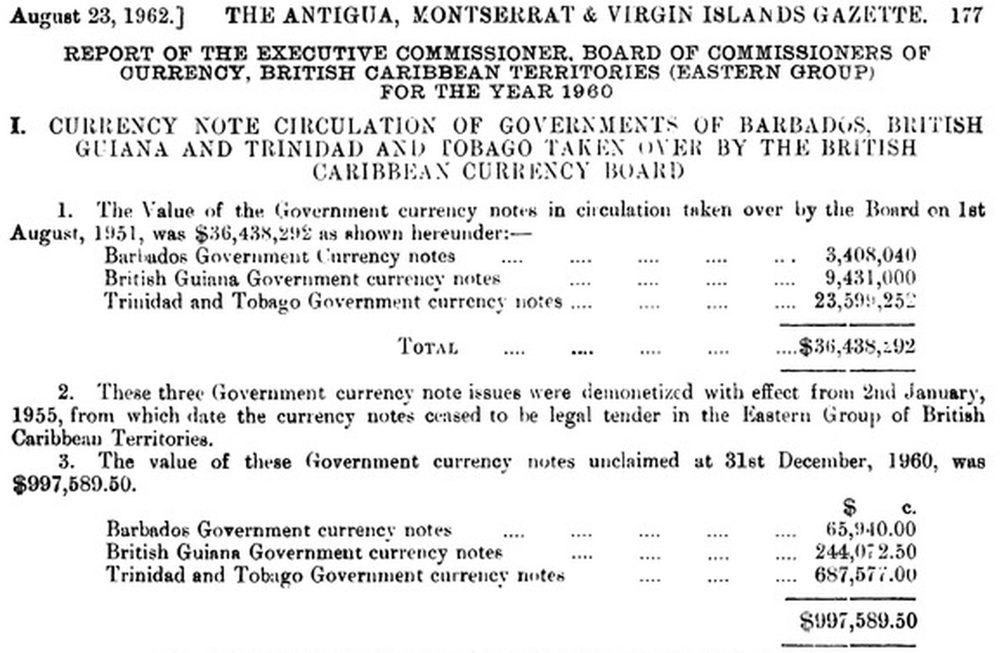
The report of the Executive Commissioner of the Currency Board for 1960 puts the Government notes in circulation that the Board took over on 1st August 1951 at 36,438,292 dollars: Barbados 3,408,040, British Guiana 9,431,000, Trinidad and Tobago 23,599,252. The three issues were demonetised with effect from 2nd January 1955, and the report gives the value of them unclaimed on 31st December 1960 as 997,589 dollars 50 cents, of which Barbados 65,940 dollars.
The Board's monthly statements follow the Barbados notes down:
| Statement of | Barbados Government notes outstanding, in dollars |
|---|---|
| 1st June 1955 | 94,942 |
| 1st December 1956 | 73,540 |
| 1st January 1957 | 73,540 |
| 1st December 1959 | 66,494 |
| 31st December 1960 (annual report) | 65,940 |
| 1st November 1963 | 62,901 |
| 1st October 1965 | 62,188 |
| 1st November 1965 | nil |
The statement of 1st June 1955 was printed in the Grenada Government Gazette of 25th June 1955 and that of 1st November 1963 in the Grenada Government Gazette of 30th November 1963; those of 1956, 1957, 1959 and 1965 in the Official Gazette of Barbados. From 1st November 1965 the statements show nil for Barbados without saying why; the figure a month earlier was 62,188 dollars. What became of the duty to pay them is not said in the pages read.
Note by note, 1960 to 1962
The Currency Board's annual reports for 1960, 1961 and 1962 count the Barbados notes still not handed in for payment, value by value:
| End of | 1 dollar | 2 dollars | 5 dollars | 20 dollars | 100 dollars |
|---|---|---|---|---|---|
| 1960 | 39,318 | 2,916 | 3,498 | 75 | 18 |
| 1961 | 39,069 | 2,870 | 3,369 | 71 | 17 |
| 1962 | 38,890 | 2,833 | 3,231 | 62 | 12 |
The figures for 1961 are the same as those in the annual report on Barbados for that year. A note not handed in is not the same as a note that survives.
The 20 and 100 dollars dated 1949
The date 1st January 1949 is recorded on the 20 and the 100 dollars as a specimen only. The figures bear on whether any were paid out, without settling it. On 31st March 1948 there were 9,899 of the 20 dollars and 1,929 of the 100 dollars in circulation, nearly the whole first printing of 10,000 and of 2,000. At the end of 1949 the annual report counts 9,599 and 1,879, still within the first printing. After that the figures only fall.
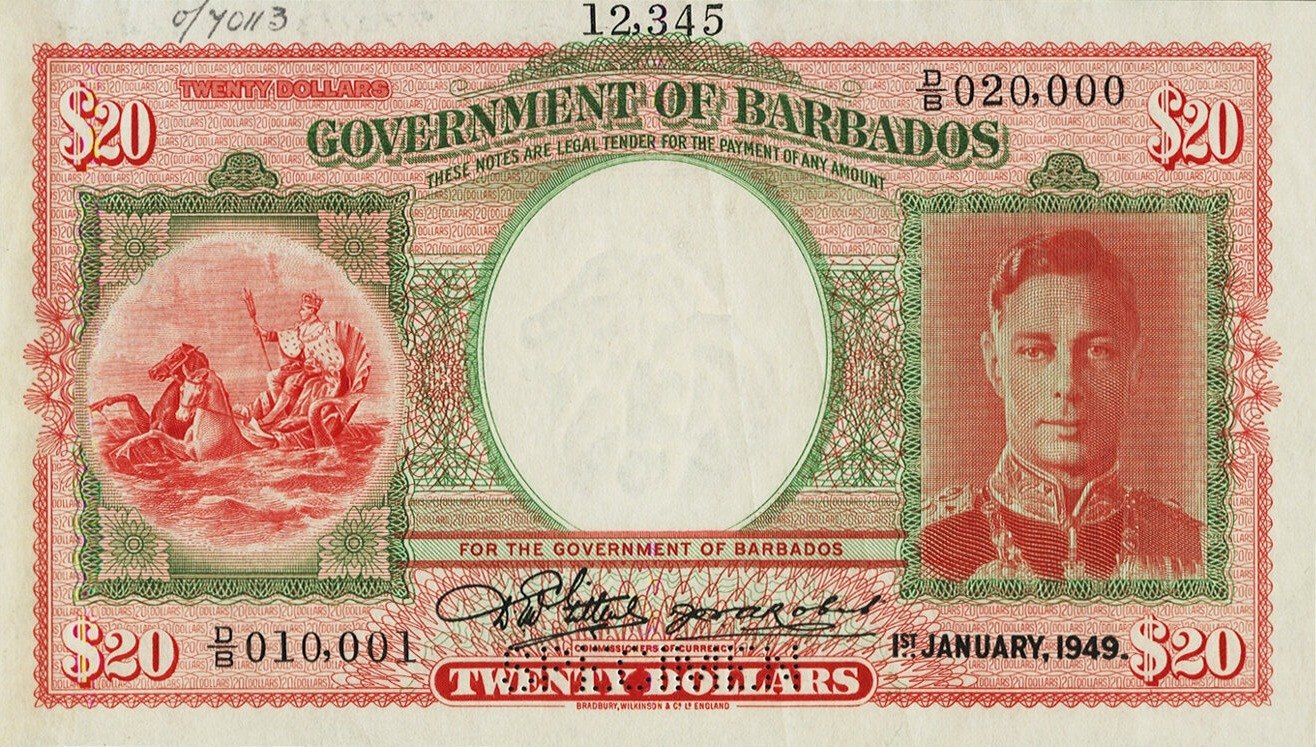
Stack's Bowers, describing a 20 dollars of 1943 (16th January 2026, lot 30032), says no issued note with the date of 1949 has appeared on the market and suspects that the notes of 1949 were never issued. The same house calls the 100 dollars of 1949 "a date that may not have been issued at all" (lot 30033 of the same sale) and adds that the Banknote Book did not list the date for the 100 dollars at the time.
What the houses say of survivors
The issued notes of the 20 dollars recorded on its Pick page are all dated 1st June 1943 and all fall in the first range of numbers. The page of the 100 dollars names one issued note, E/A 001465, dated 1st June 1943.
Spink sold that 100 dollars on 29th September 2009 as lot 135 and described it as the note pictured in the Pick catalogue and possibly the only issued example. Stack's Bowers wrote in August 2024 (lot 30040 of the sale of 12th August 2024, a colour trial of the 100 dollars) that perhaps a single issued example is known.
Of the 20 dollars, Stack's Bowers said in January 2026 (lot 30032) that the grading firm PMG had graded issued notes on two occasions only, and that a note in the grade Very Fine from the Christensen Collection had been sold in 2009; the house supposed that note to be the other one in the PMG count.
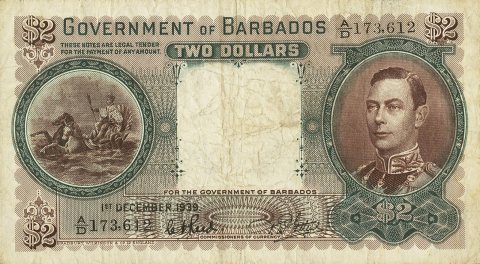
Of the lower values the houses say most about the 2 dollars. Stack's Bowers (16th January 2026, lot 30030) holds that the 2 dollars is the one of the three lower values least often met, although its print run looks much like that of the 5 dollars, and that nearly all examples seen are in worn grades. Heritage Auctions wrote of a 2 dollars dated 1st December 1939 (9th January 2020, lot 28015) that it was the first 2 dollars the house had offered and that PMG then listed five notes under the catalogue letter b. Stack's Bowers sold a 2 dollars of 1st January 1949 in January 2022 (lot 20013, from the Don Allen Collection) and again on 12th August 2024 (lot 30034), and said both times that it was the only note of that date in the PMG count.
For the 1 dollar, Heritage Auctions (14th October 2026, lot 24014), describing a note dated 1st June 1943, speaks of nearly 120 examples in the PMG count. For the 5 dollars of that date, Stack's Bowers (15th January 2022, lot 20014) says six had been graded by PMG.
These are counts of notes sent to one grading firm on the day the house wrote, not counts of notes that exist.
What the figures leave out
- The number of notes printed, from any official source.
- Abstracts by value for every half year: only the days in the first table have been set out.
- A count by value after 1962.
- The reason the Board's statements show nil for Barbados from 1st November 1965.
Sources
- Abstracts of the Commissioners of Currency in the Official Gazette of Barbados: 8th December 1938; 16th February 1942, page 234; 22nd February 1943, page 136; 14th November 1946, page 950; 21st April 1949, page 438.
- Regulations under section 14 of the Government Currency Notes (Barbados) Act, 1937, Official Gazette of Barbados, March 1938.
- Colonial Office annual reports on Barbados for 1947 to 1963 (tables of currency in circulation).
- Report of the Executive Commissioner of the British Caribbean Currency Board for 1960 (Antigua, Montserrat and Virgin Islands Gazette, 23rd August 1962, page 177).
- Annual reports of the British Caribbean Currency Board for 1960, 1961 and 1962.
- Monthly statements of the British Caribbean Currency Board: Grenada Government Gazette, 25th June 1955 and 30th November 1963; Official Gazette of Barbados, 1956 to 1966.
- The specimens and issued notes recorded on the Pick pages of this catalogue.
- Spink, 29th September 2009, lot 135.
- Stack's Bowers: 15th January 2022, lots 20013 and 20014; 12th August 2024, lots 30034 and 30040; 8th May 2025, lot 50025; 16th January 2026, lots 30030, 30032 and 30033.
- Heritage Auctions: 9th January 2020, lot 28015; 27th March 2025, lot 24036; 14th October 2026, lot 24014.
Member comments
Log in or register to post a comment.