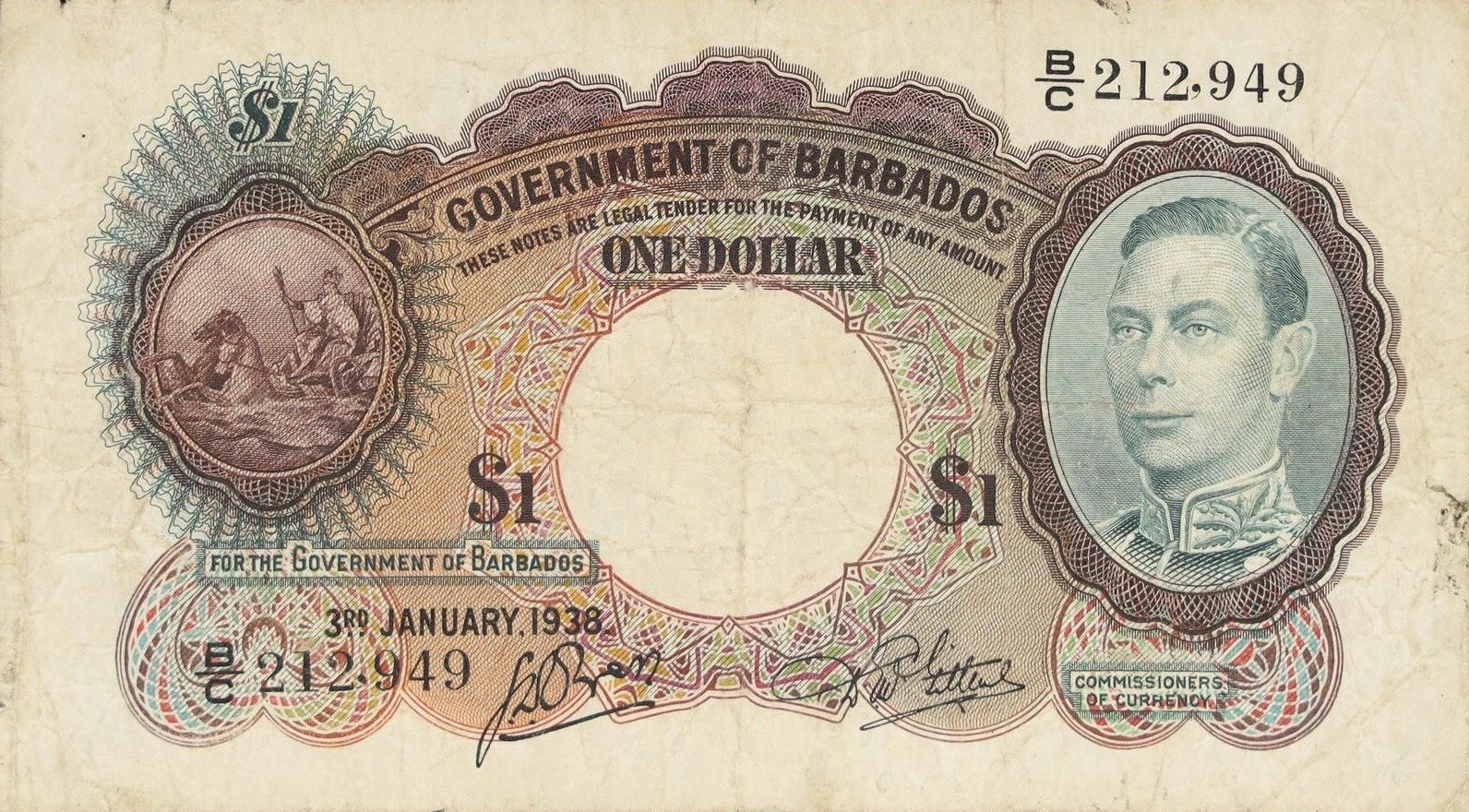
The Government of Barbados put out paper money of its own from 1938: five values in dollars, dated from 1938 to 1949, all printed by Bradbury Wilkinson and Company and all signed by two Commissioners of Currency. This article sets the issue out in order of time, from the Act of 1937 to the day the notes ceased to be legal tender in 1955. It draws on the Act and its regulations, the abstracts printed in the Official Gazette of Barbados, the annual reports on the colony, the Colonial Office Lists and the notes themselves.
Paper money in Barbados before 1938
The oldest Government paper of the island is far older than the notes of this catalogue. Robert Chalmers, in A History of Currency in the British Colonies (London, 1893, pages 51 and 52), tells of paper bills of credit for 7,000 pounds made out in 1705 for a tax, and of an Act of 18th June 1706 that let the Treasurer lend bills of credit. The Act was disallowed by Order in Council on 21st October 1706 and, as Chalmers tells it, no further paper was issued.
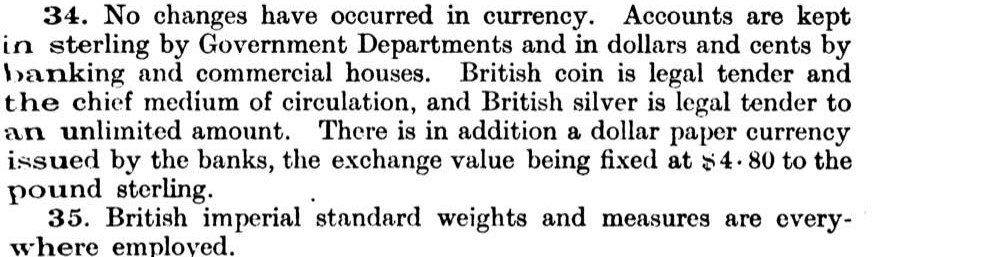
Two official descriptions of the island's money in the twentieth century, read so far, name bank notes only. The Colonial Office List of 1918 gives the paper money as the five dollar notes of the Colonial Bank and American notes. The annual report on Barbados for 1929-30 says that British coin is legal tender and the chief medium of circulation and adds only "a dollar paper currency issued by the banks", at 4 dollars 80 to the pound sterling. The Pick pages name the private banks whose notes circulated beside the Government notes after 1938: Barclays, the Royal Bank of Canada and the Canadian Bank of Commerce.
Catalogues list a 1 pound note of the Government of Barbados, issued between 1915 and 1917, with 28,000 printed. They give no photograph, colour, size or signer, and no example is known to have survived. Whether this note existed is not yet settled. The official sources read so far name no Barbados Government note before 1938. In the same years Bermuda had a Government 1 pound note, put out between 1915 and 1917, of which 28,000 pounds were outstanding from 1918 to 1924, so the figures given for this note may belong to Bermuda. An existing article, Half a crown withdrawn: the small islands' notes of 1920 and what became of them, has a section on St. Vincent and Barbados.
The annual report on Barbados for 1936 says that "it is proposed to issue Government currency notes in the near future".
The Act of 1937 and the Commissioners
The notes were issued under the Government Currency Notes (Barbados) Act, 1937, dated 23rd April 1937 and printed in a supplement to the Official Gazette of 10th June 1937. The Act set up a Board of three: the Colonial Secretary, the Colonial Treasurer and one member named by the Governor. Any two of them could act, and every note carries two signatures. The Act reckoned the dollar at 4 shillings 2 pence.
Regulations made under section 14 of the Act were printed in the Official Gazette in March 1938. By them the plates were kept by the Crown Agents, the stock of unissued notes was not to pass 500,000 of the 1 dollar and 125,000 of the 2 dollars, and worn notes were cancelled by stamping or perforating before two Currency Officers.
A working paper of the Johns Hopkins currency board archive (Krus and Schuler, Currency Board Financial Statements, 2014), citing page 36 of the Barbados annual report for 1938-39, says the Act came into force on 1st April 1938.
One design for five values
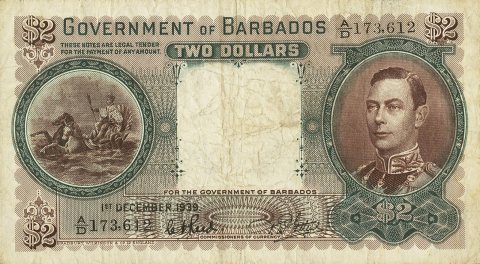
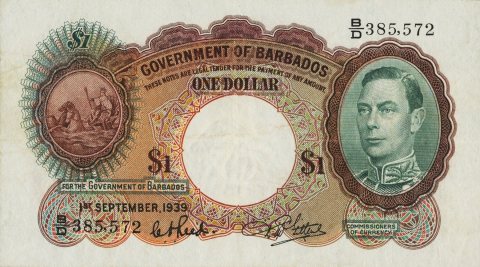
All five denominations share one design: Neptune in a shell cart drawn by seahorses at the left and King George VI at the right, with two horse heads as the watermark. The upper letter of the fractional prefix stands for the denomination: B for the 1 dollar, A for the 2 dollars, C for the 5 dollars, D for the 20 dollars and E for the 100 dollars. There was no 10 dollars.
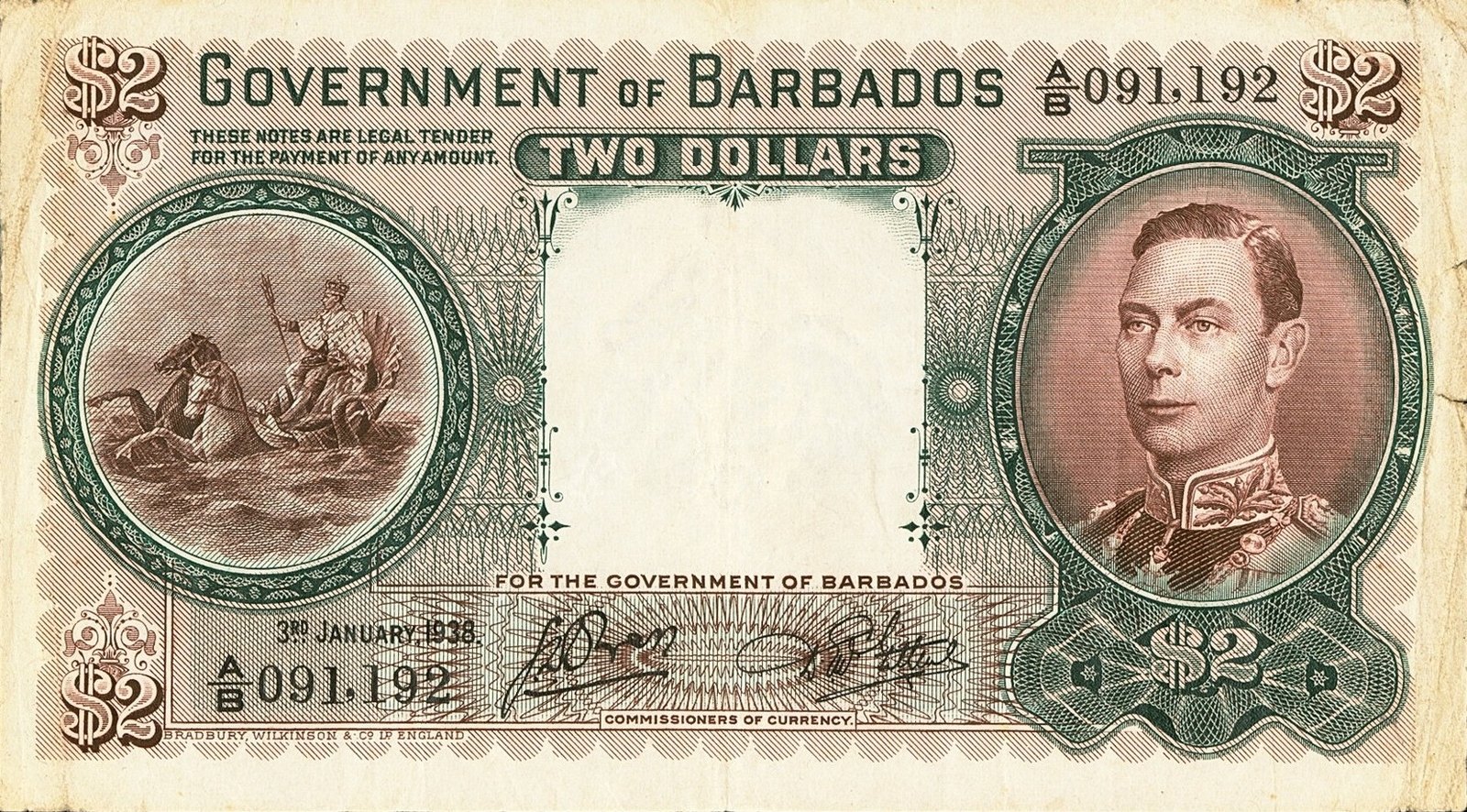
The lower letter of the prefix advances through the alphabet, and the number runs on from one letter to the next. Each lower letter covers 100,000 notes on the 1 and 5 dollars, 50,000 on the 2 dollars and 10,000 on the 20 dollars. The 100 dollars never left E/A. On the 1 dollar the run passes from B/Z to F/A in 1949.
An earlier design did not reach the press. Heritage Auctions sold, on 23rd March 2023 as lot 24051, front and back archival photographs of a 2 dollars dated 1st January 1936 with the portrait of King George V. Heritage's description points out that the date is 20 days before the death of the King and suggests that this may be why the design went no further. The existing article Notes that never were: unissued designs with George V and George VI covers designs of this kind.
The first notes: 8th April 1938
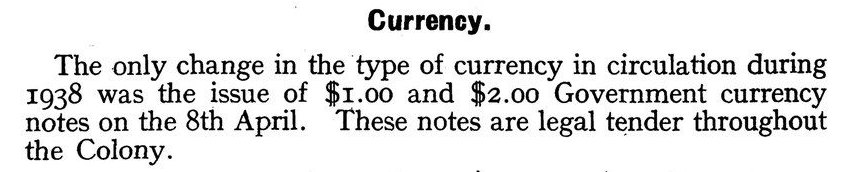
The annual report on Barbados for 1938 says: "The only change in the type of currency in circulation during 1938 was the issue of $1.00 and $2.00 Government currency notes on the 8th April. These notes are legal tender throughout the Colony." The notes themselves are dated 3rd January 1938.
The Commissioners' abstracts in the Official Gazette show how the issue grew. On 30th September 1938 there were 80,000 of the 1 dollar and 20,000 of the 2 dollars in circulation; on 31st March 1939 there were 129,500 and 31,250. The abstract for 30th September 1939 still lists only these two values.
The 5 dollars: dated 1939, in use from 1941 or 1942
The 5 dollars is dated 1st December 1939 and 1st June 1943. The date on the first notes is well ahead of their use. The abstract for 30th September 1941, printed in the Official Gazette of 16th February 1942 (page 234), lists 499,500 of the 1 dollar and 86,250 of the 2 dollars, 672,000 dollars in all, and no 5 dollars. A year later, on 30th September 1942, the abstract printed in the Official Gazette of 22nd February 1943 (page 136) lists 505,515 of the 1 dollar, 78,250 of the 2 dollars and 102,997 of the 5 dollars, 1,177,000 dollars in all. So the notes dated 1st December 1939 were first paid out late in 1941 or in 1942.
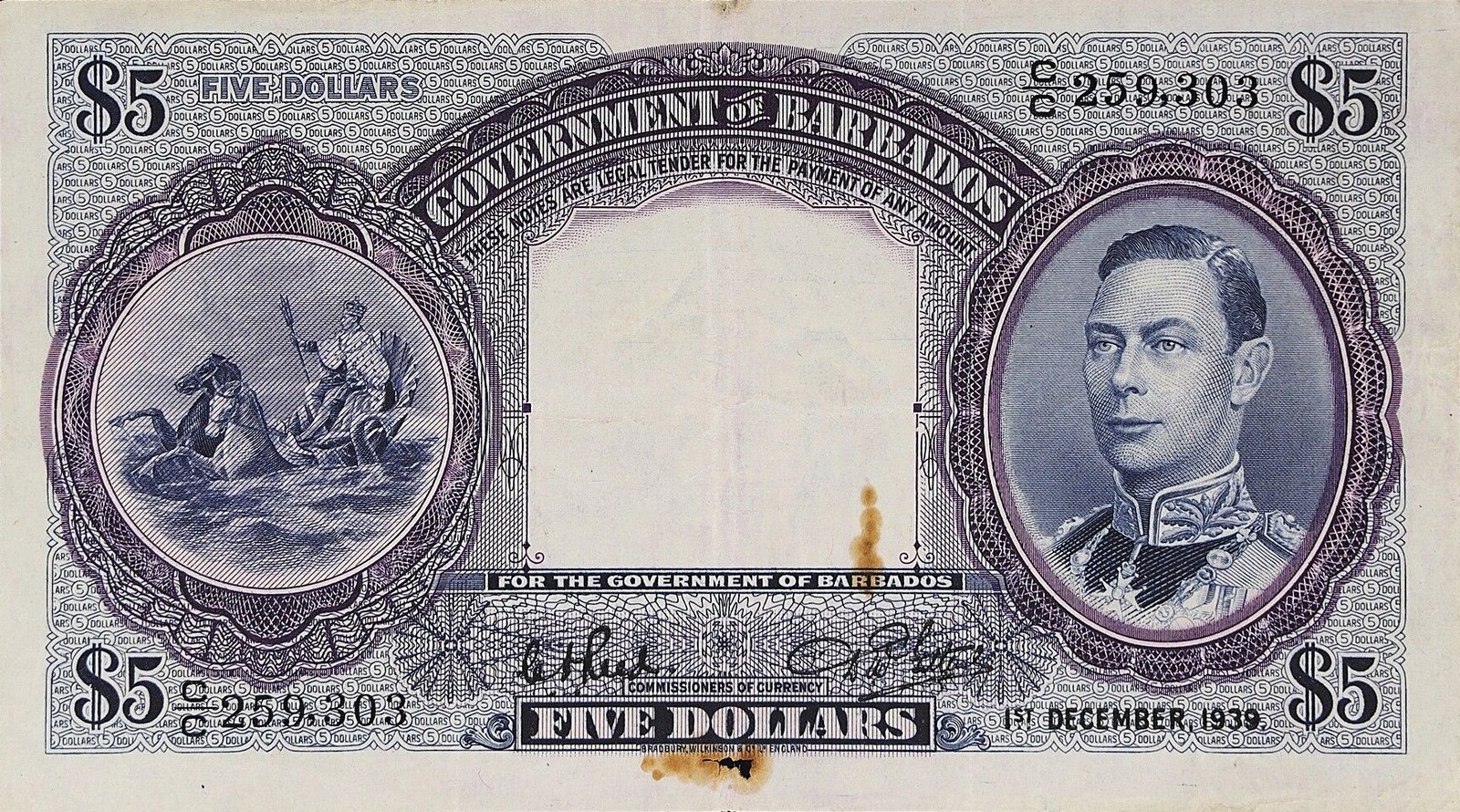
The colours fit this. Spink sold on 29th April 2015, as lot 1497, front and back proofs of the 2 dollars printed in the colours of the 5 dollars, with an ink note that the colours were approved for the front of the new 5 dollar notes and the date 14.8.40 in the margin. The colours of the front of the 5 dollars were therefore approved in August 1940, after the date printed on the first notes.
Sources mention an earlier date for the 5 dollars, 1st September 1939, with prefix C/A. It is not confirmed and no example is recorded. Stack's Bowers, describing lot 30037 of its sale of 12th August 2024, says a note with the September 1939 date was prepared but appears not to have been issued.
The 20 and 100 dollars: 1943
The two high values are dated 1st June 1943 and 1st January 1949. The abstracts in the Official Gazette show none of either in circulation on 30th September 1942, 6,750 of the 20 dollars and 750 of the 100 dollars on 31st March 1946, and 9,899 and 1,929 on 31st March 1948.
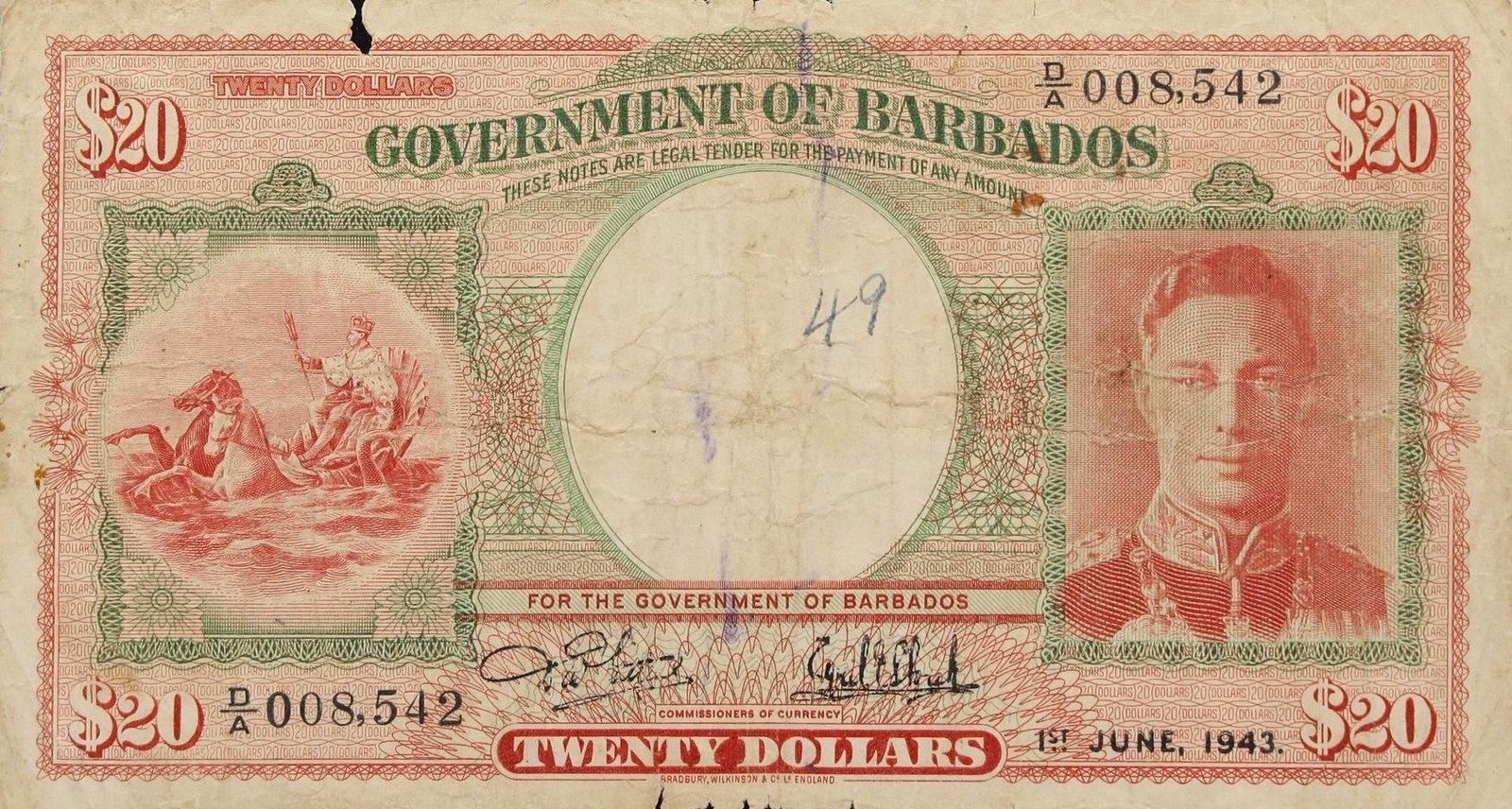
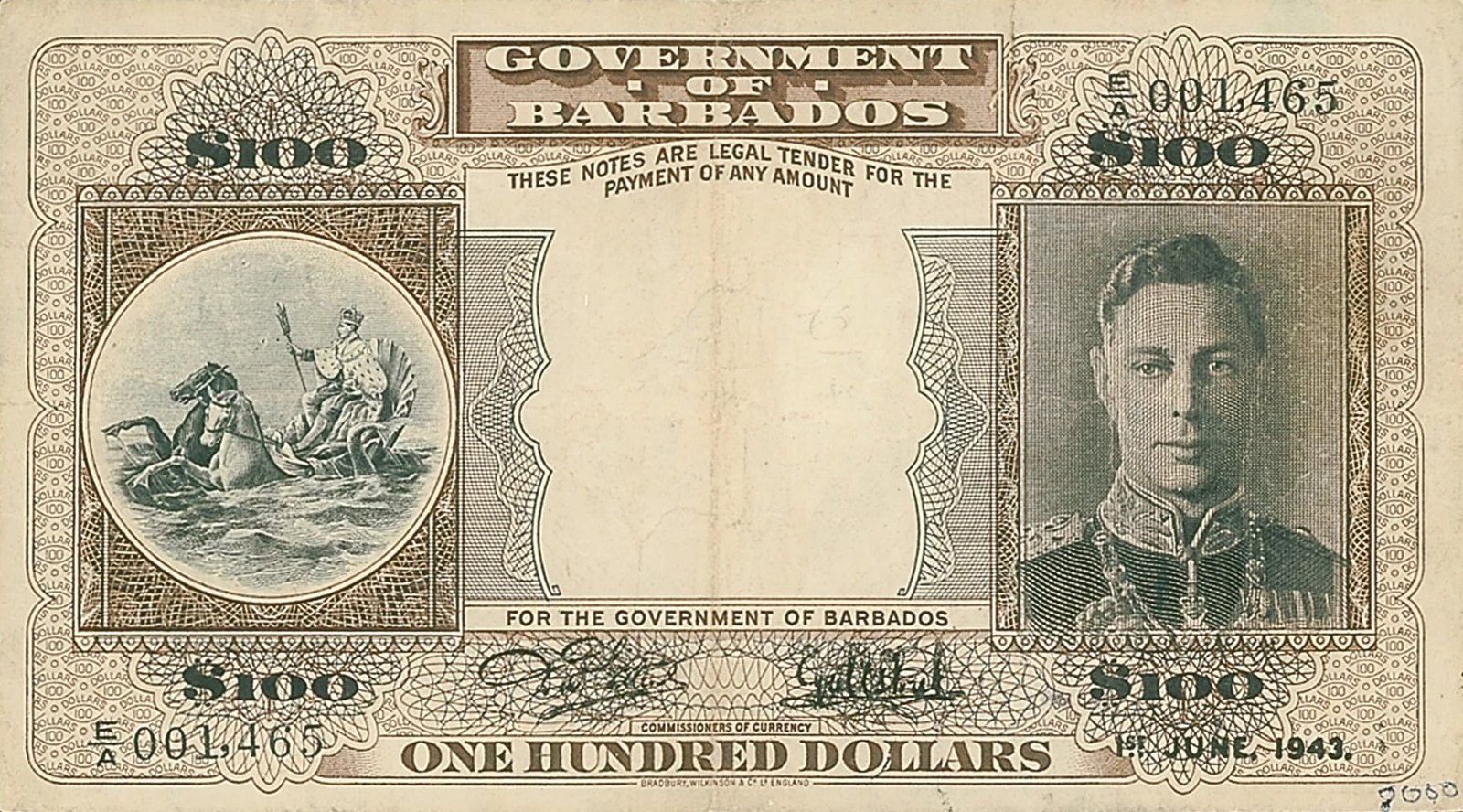
The specimens carry the printed ranges: D/A 000001 to D/A 010000 for the 20 dollars of 1943 and D/B 010001 to D/B 020000 for the date of 1949; E/A 000001 to E/A 002000 for the 100 dollars of 1943 and E/A 002001 to E/A 004000 for the date of 1949. The date of 1949 is recorded on both values as a specimen only. Whether the notes of 1949 were ever paid out is taken up in Barbados Government notes in figures: circulation, withdrawal and what was never handed in, 1938 to 1965.
The signers and their offices
Four pairs signed the notes:
| Date on the note | Signatures | Values |
|---|---|---|
| 3rd January 1938 | Owen and Gittens | 1 and 2 dollars |
| 1st September 1939, 1st December 1939 | Reed and Gittens | 1, 2 and 5 dollars (the 5 dollars confirmed only with the December date) |
| 1st June 1943 | Gittens and Stoute | all five |
| 1st January 1949 | Gittens and Roberts | 1, 2, 20 and 100 dollars (the 20 and 100 dollars recorded as specimens only) |
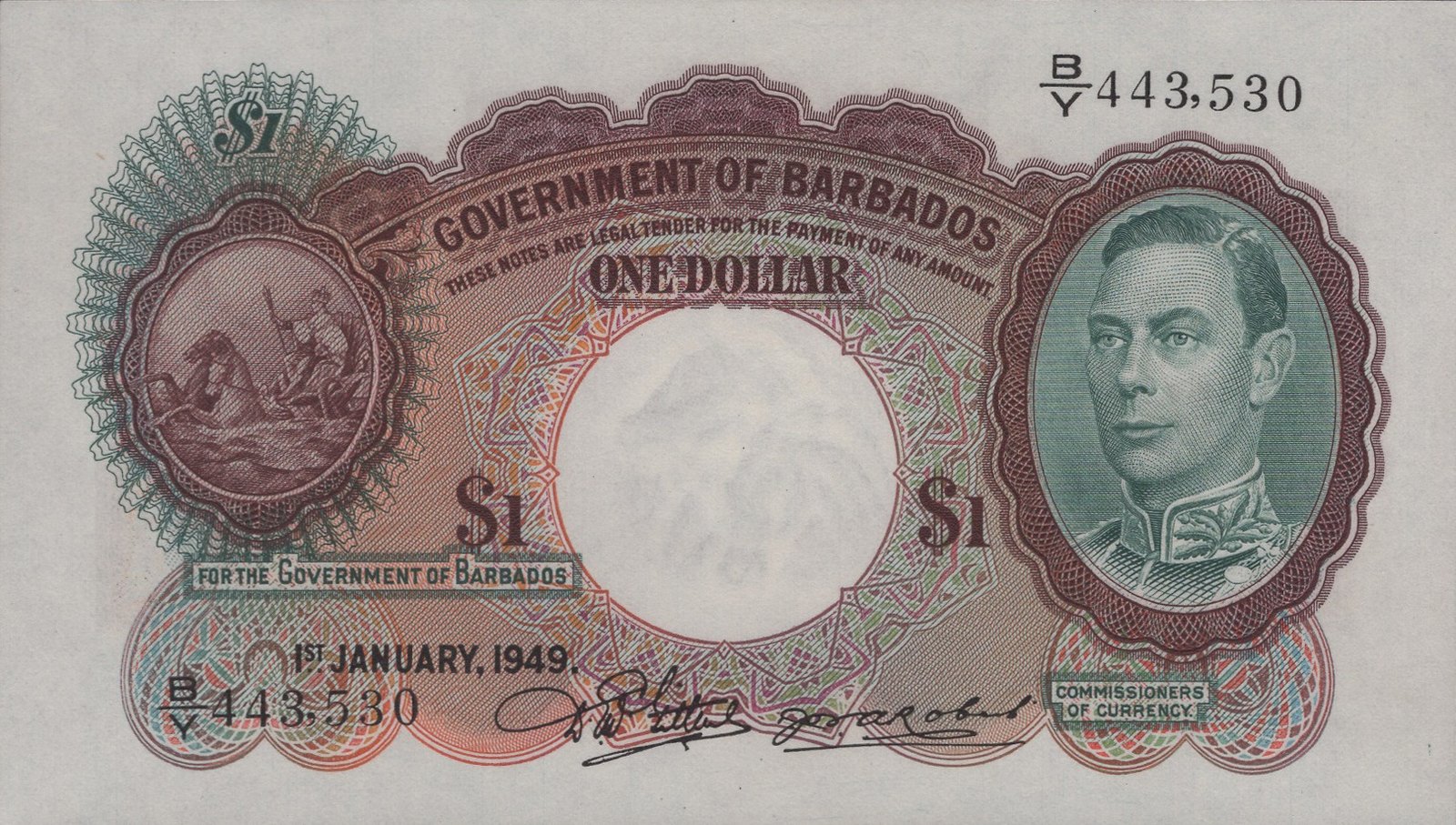
Sources put the three dates of 1st September 1939, 1st December 1939 and 1st June 1943 under one catalogue letter, b. This catalogue keeps the letter and numbers the three dates b1, b2 and b3 on the 1 and 2 dollars.
The Colonial Office List of 1939, in its Records of Services, gives George Douglas Owen as Colonial Secretary of Barbados from September 1931 and Colonial Secretary of British Guiana in 1938; Darnley Erroll Wyndham Gittens as Colonial Treasurer from 1935; and Clinton Austin Reed as Comptroller of Customs from 1932 and acting Colonial Secretary at various times from 1934 to 1936. The Dominions Office and Colonial Office List of 1935 gives Cyril Eustace Stoute as Manager of the Government Savings Bank from 1932 and J. A. Roberts as 1st Grade Clerk of the Savings Bank. The Lists print only the initials of Roberts.
The staff lists of Barbados in the Colonial Office Lists name the Commissioners of Currency as Gittens and Stoute in 1946, Gittens and Roberts in 1948, 1949 and 1950, and V. H. A. Chenery and J. A. Roberts in 1951. The last notes are dated 1949, and the Pick pages list no note signed by Chenery.
The abstracts in the Official Gazette add two points. The abstract for 30th September 1938 (Official Gazette, 8th December 1938, page 2335) is signed by Gittens and A. P. G. Austin; the Pick pages list no note with the signature of Austin. And the abstract signed on 9th December 1939 (Official Gazette, 25th December 1939, page 2385) carries the names of Gittens and Stoute, so Stoute was a Commissioner well before the first notes with the signature of Stoute, which are dated 1st June 1943.
Sharing the island with the banks
Sources mention that in 1944 the private banks were made to cut their note circulation in the British West Indies by 30% to make room for the government notes, and that a currency conference held in Barbados in 1946 recommended a regional currency board in place of private note issues. The Pick pages do not name the source of either statement, and neither has been checked against a document here.
The British Caribbean Currency Board takes over
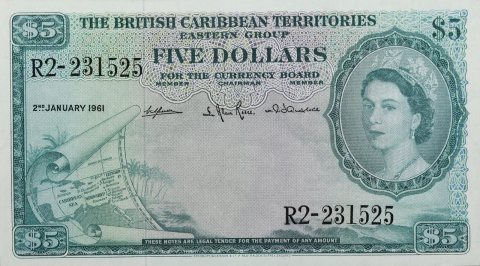
In 1950 the British Caribbean Currency Board was set up in Trinidad for Trinidad and Tobago, British Guiana, Barbados and the Leeward and Windward Islands. In Barbados the Currency Act, 1950 (1950-31), of 16th August 1950, gave effect to the agreement between the governments, which is printed in its First Schedule. By section 2 the Government notes of Barbados counted as notes issued by the new Board and stayed legal tender until they were demonetised.
The Royal Gazette of Trinidad of 21st December 1950 (page 738, notice 2065) says the Board was constituted by the Secretary of State on 28th November 1950 and names Cuke as the member for Barbados. The Royal Gazette of 27th March 1952 says Burrowes took the place of Cuke from 19th February 1952.
The Barbados Advocate of 28th April 1951 reported that specimens of the Board's six notes had been shown the day before in the Legislative Council Chamber, in a picture frame, and that the designs of Bradbury Wilkinson had been chosen in preference to those of De La Rue and Waterlow and Sons. The newspaper could not get leave to print a picture of them. Reports in the Barbados Advocate give 27th July 1951 for the arrival of the first shipment for Barbados, 26 cases, and 15th August 1951 for the day the notes went into circulation.
The annual reports on Barbados from 1955 to 1963 put it in these words: "The British Caribbean currency notes were first issued on the 1st August 1951 and from that date Barbados Government Currency notes were gradually withdrawn and were finally demonetized on the 2nd January 1955." The Board's own report for 1960 also gives 1st August 1951 as the day it took over the Government notes in circulation. No source read here says how the two days of August 1951 fit together.
2nd January 1955
The Royal Gazette Extraordinary of Trinidad of 31st December 1954 (notice 1222) gave notice that the Government notes of Barbados, British Guiana and Trinidad were demonetised from 2nd January 1955 and that their value could still be claimed from the Board. The annual reports on Barbados from 1955 say that "arrangements have been made for the encashment of Barbados Government currency notes through Barclays Bank D.C.O. as agents for the British Caribbean Currency Board", that is, Barclays Bank (Dominion, Colonial and Overseas).
The proclamation of Barbados itself has not been found: the pages of the Official Gazette of Barbados read so far have none from 1953 to 1956.
What is not known
- How many notes of each value were printed. No official count has been read; the ranges on the specimens are the only guide.
- The day the 5 dollars was first paid out, and the day the 20 and 100 dollars were first paid out. The abstracts only bracket them.
- Whether a 5 dollars dated 1st September 1939 exists.
- Whether any 20 or 100 dollars dated 1st January 1949 was issued.
- The source of the statements about 1944 and 1946.
Sources
- Government Currency Notes (Barbados) Act, 1937, 23rd April 1937, supplement to the Official Gazette of Barbados, 10th June 1937.
- Regulations under section 14 of the Act of 1937, Official Gazette of Barbados, March 1938.
- Abstracts of the Commissioners of Currency in the Official Gazette of Barbados: 8th December 1938, page 2335; 31st August 1939, page 1640; 25th December 1939, page 2385; 16th February 1942, page 234; 22nd February 1943, page 136; 14th November 1946, page 950; 21st April 1949, page 438.
- Currency Act, 1950 (Barbados, 1950-31), 16th August 1950.
- Royal Gazette of Trinidad and Tobago, 21st December 1950, page 738, notice 2065; 27th March 1952; Royal Gazette Extraordinary, 31st December 1954, notice 1222.
- Colonial Reports, Annual: Barbados, 1929-30 (No. 1499), 1936, 1938, and 1955 to 1963.
- Colonial Office List, 1918 and 1939; Dominions Office and Colonial Office List, 1935; Colonial Office Lists of 1946 and 1948 to 1951 (staff lists of Barbados).
- Krus and Schuler, Currency Board Financial Statements, 2014, working paper 22 of the Johns Hopkins currency board archive, Barbados section.
- Robert Chalmers, A History of Currency in the British Colonies, London, 1893, pages 51 and 52.
- Barbados Advocate, 28th April 1951 and later reports of 1951.
- Report of the Executive Commissioner of the British Caribbean Currency Board for 1960 (Antigua, Montserrat and Virgin Islands Gazette, 23rd August 1962, page 177).
- Spink, 29th April 2015, lot 1497; Heritage Auctions, 23rd March 2023, lot 24051; Stack's Bowers, 12th August 2024, lot 30037.
Member comments
Log in or register to post a comment.