The catalogue's pages for Jersey hold only the notes of the States. Before the States issued notes for everyday use in 1941, the island's paper money came from banks, parishes, vingtaines, firms and societies. None of these notes has a page in the catalogue. This article sets out what Yasha Beresiner's article of 1970 says of them, and what the sale catalogues read for the catalogue offered: chiefly the A. L. T. McCammon Collection, sold by Baldwin's on 11 October 1999, and four lots in Spink's sale of 9 November 1989. The wider story of the States notes is in The notes of the States of Jersey, 1840 to 2012.
Beresiner's "Early Period"
Yasha L. Beresiner ("An Excursion to Jersey", IBNS Journal, volume 10, number 2, 1970; the early period takes pages 81 to 85) wrote the article after a holiday in the island, with the help of the Jersey Library, the Societe Jersiaise and local collectors, among them I. Monins, E. Huelin and V. Dougan. The figures below were read in the text layer of the scan of that issue, not on the page images.
Beresiner dates the "Early Period" from the first bank in the Channel Islands, founded in Jersey in 1797 by a wine merchant named Hugh Godfrey and later known as the Old Bank. The period reached its climax, in Beresiner's words, with the beginning of the Jersey bank failures in 1873, and then slowly grew less confused up to the first half of the twentieth century. Through the whole of it, Beresiner writes, hundreds of note-issuing sources existed in Jersey: private banks, parishes and local authorities, single persons, firms and innumerable societies. The notes ran from 1 shilling to 1 pound and circulated freely. The States did not issue notes of their own, although the authorities had discussed forming a States bank. The year of those discussions cannot be read in the text layer.
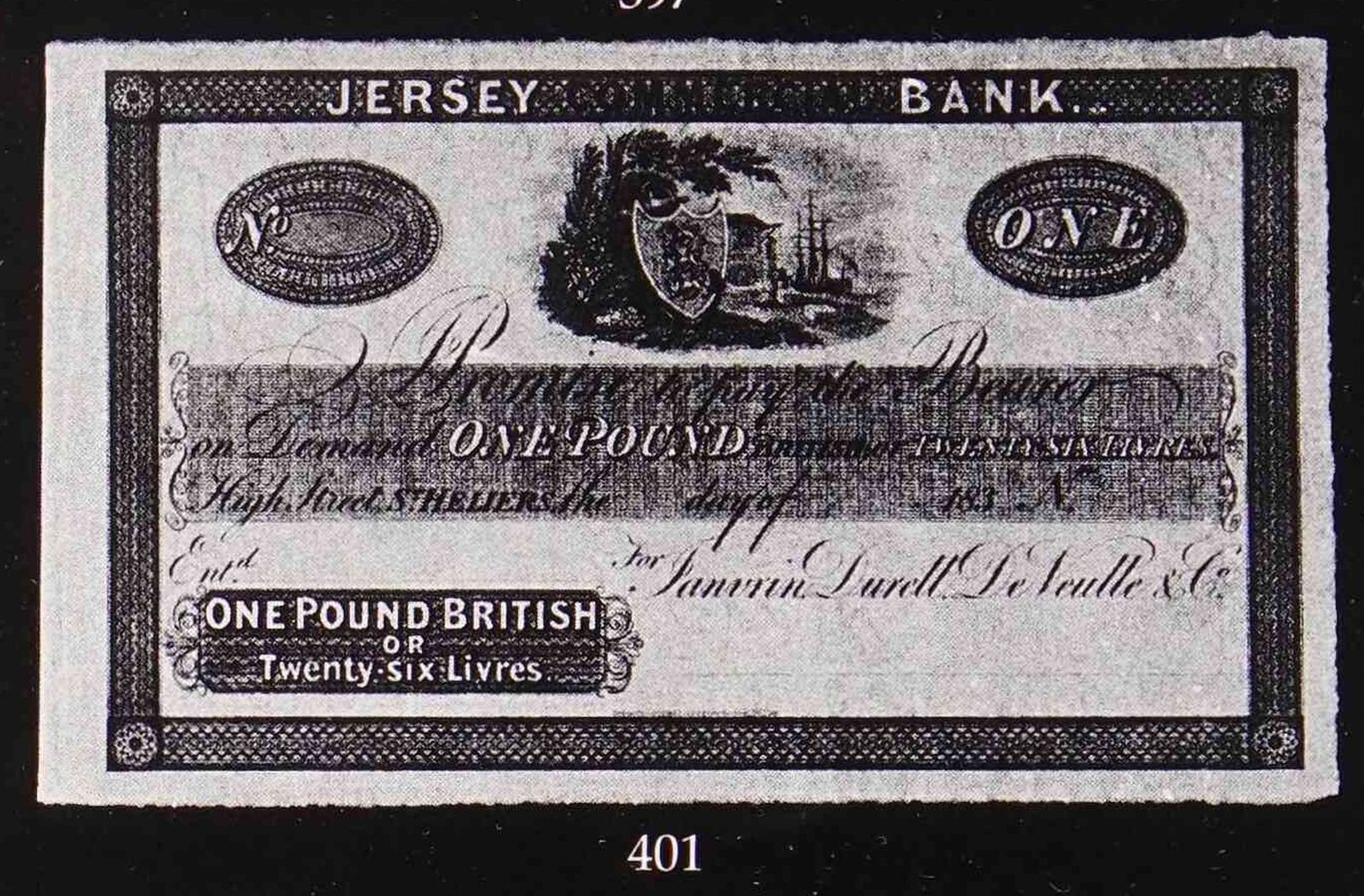
French money also circulated. Beresiner notes that it had not been legal tender since the withdrawal of the livre tournois in 1834. Some notes carry both currencies: the Jersey Commercial Bank's unissued note in the McCammon sale, dated 183- with the year left unfinished, reads ONE POUND BRITISH OR TWENTY-SIX LIVRES, and the reprint of 1982 of the St John's Bank note, printed from the original copper plate, reads 1 pound or 26 livres.
The law of 1813
The issues got out of hand, and a law was enacted in 1813 to control them. Beresiner calls it the "Law (1813) relating to Bills of exchange and promissory notes" and says there is no official translation of the French original. Its preamble describes notes of all values issued without regard to solvency, to the loss "of the poor, uneducated inhabitants and the soldiers of the Garrison". The law was passed on 8 May 1813 but is known as the law of 10 June, the day the Privy Council confirmed it. Its first four clauses require notes to be paid on the date shown, with three days' grace. The fifth forbids notes payable to bearer of less than 1 pound, on pain of a fine of twice the value issued and the seizure of the notes, and tells holders of such notes to claim their value from the issuers at once. Beresiner adds that the Currency Notes (Jersey) Law 1959, clause 7 (ii), changed the 1 pound of that clause to 5 pounds.
A pamphlet of that day was in the McCammon Collection: lot 371 of the Baldwin's sale, eight pages in French and English headed AT THE COURT AT CARLTON HOUSE, dated 10 June 1813, concerning a report of the Lords of the Committee of Council for the affairs of Jersey and Guernsey. The lot text does not say what the report was about.
Further laws, Beresiner writes, required issuers to be present at named premises for set hours to redeem their notes. By 1831, with a few exceptions such as the local authorities, an issuer needed the Court's permission and two guarantors of solvency, and had to keep an office open for up to six hours a day. Many small "bankers" failed. Beresiner adds that a great shortage of silver (a bracket here reads "including" more than 10,000 pounds' worth of Royal Mint silver tokens of 3 shillings and 1 shilling 6 pence) led some issuers back to notes of less than 1 pound. Two pieces Beresiner came across show how far this went: a round card "token" of 1812 signed by Thomas Le Hardy, promising a pound bank note for 4 of the tokens, and a 2 shillings 6 pence of 8 February 1813 signed by Michael Baudains and headed JERSEY, promising one Bank of England note for eight such notes.
Parishes, vingtaines and societies
Almost every parish, in Beresiner's account, issued notes guaranteed by an act of its parish assembly, the first being St Ouen's in 1814. The issue of St Ouen's of 1860 and that of St Brelade's were refused by the bankers. Some notes bore a parish title but were guaranteed by private persons, such as the Grouville Parish Bank note of 1869, whose signer the text layer gives as "Amice Bertramin". Several issues paid for a named work: the Vingtaine of Mont des Pretres issued notes for paving the Rue du Val in 1834 and for roads in 1862 and 1873, and the Parish of St Helier for paving the Belmont Road in 1834 and for other roads in 1862. Some were payable at the homes of their signers, some of whom had died by the time the notes circulated. Among the private issues of 1862 Beresiner names the St Peter's Windmill Association, the Gorey English Wesleyan Methodist Chapel, the Family Association Bank, agricultural associations, farmers' banks and temperance societies. Vingtaine notes were sometimes payable in Jersey currency rather than sterling. Beresiner also writes that the local bank notes were withdrawn from circulation in 1833, a date read in the text layer.
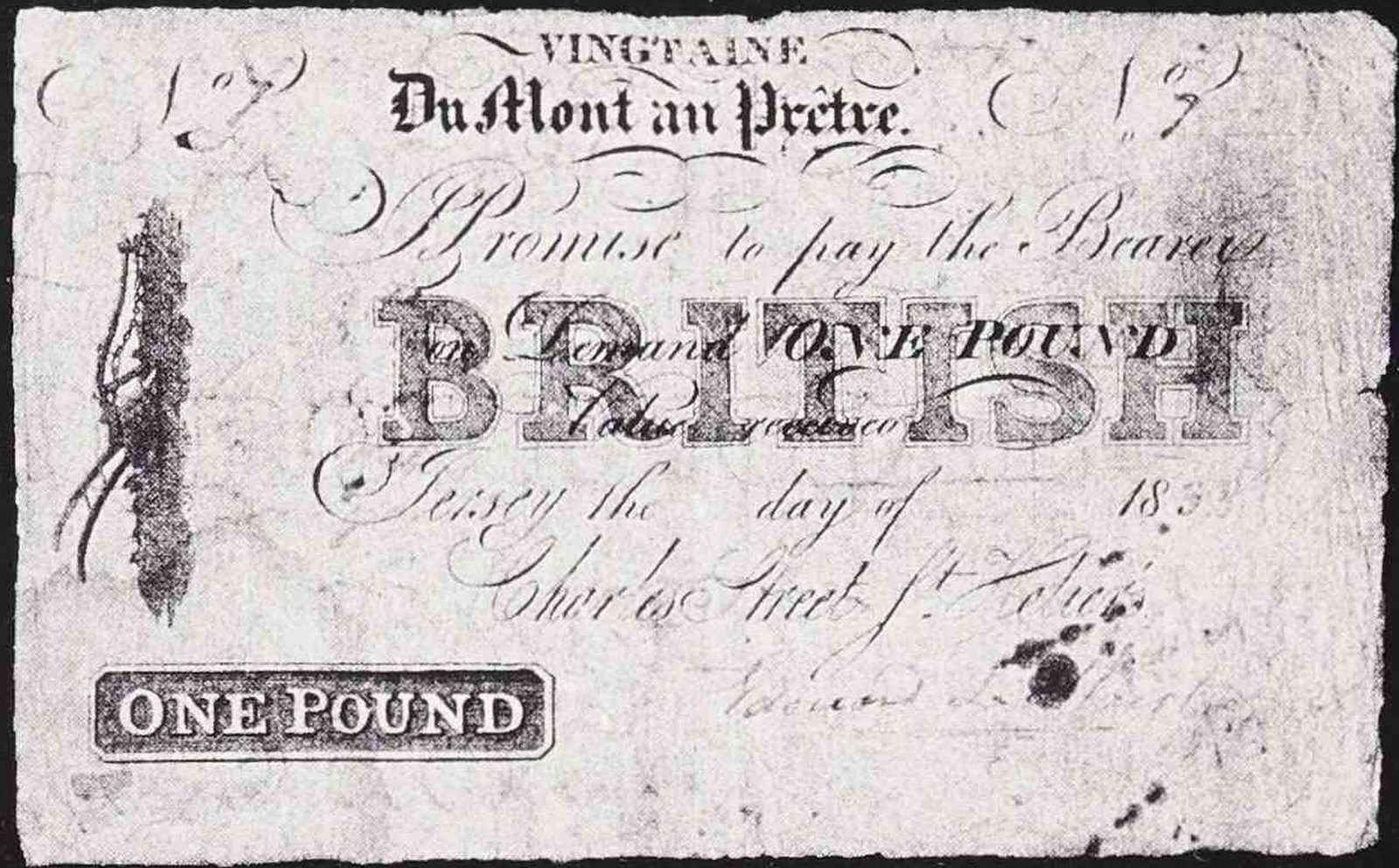
The McCammon sale held notes of this kind. Its lot 427 is a 1 pound of the "Vingtaine du Mont an Prêtre, Rue de Val St Helier", as Baldwin's prints it, dated 1 May 1834; Beresiner's paving issue of the vingtaine for the Rue du Val is of the same year. Lot 382 is a 1 pound of the Esplanade, 19 February 1830, signed by J. Hamptonne, which Baldwin's says was issued for building a line of quays from the North Pier to Patriotic Place under the guarantee of the States.
The banks
Beresiner says that today's banks came to Jersey early and that most issued notes of their own, of which only 1 pound notes are recorded. The Midland Bank took over the Channel Islands Bank in 1898, after that bank had joined the Old Bank in 1891. Parr's Bank, later the Westminster, absorbed Robin Brothers in 1908; Robin Brothers had taken over the Jersey Commercial Bank after it failed in 1879. Lloyds Bank came to Jersey in 1919, Barclays in 1922 and the National Provincial in 1927. A letter of 5 May 1948 from the Treasurer of the States, H. F. Ereaut, stated that all notes of the town banks and the parishes had been recalled and redeemed.
The issuers in the McCammon sale (Baldwin's, 11 October 1999, lots 371 to 428) are listed below as Baldwin's names them, with the number each has in Antony McCammon's own catalogue, Currencies of the Anglo-Norman Isles (Spink, 1984 and 1993).
| Issuer, as Baldwin's prints it | What the lots hold | McCammon number | Lots |
|---|---|---|---|
| Bible Christian Church; Bible Christian Society | unissued 1 pound; numbered 5 pounds, undated | JN23 | 375 to 377 |
| Channel Islands Bank, Horman, Anthoine, Ahier, Le Gros and Co. | unissued 1 pound notes; a proof with "To this March 19th/61" in pencil; a specimen | JN96 | 378 to 380 |
| English and Jersey Union Bank, Le Neveu, Sorel and Co. | specimen 1 pound, "7th June 1862" in pencil | JN148 | 381 |
| Esplanade | 1 pound, 19 February 1830 | JN66 | 382 |
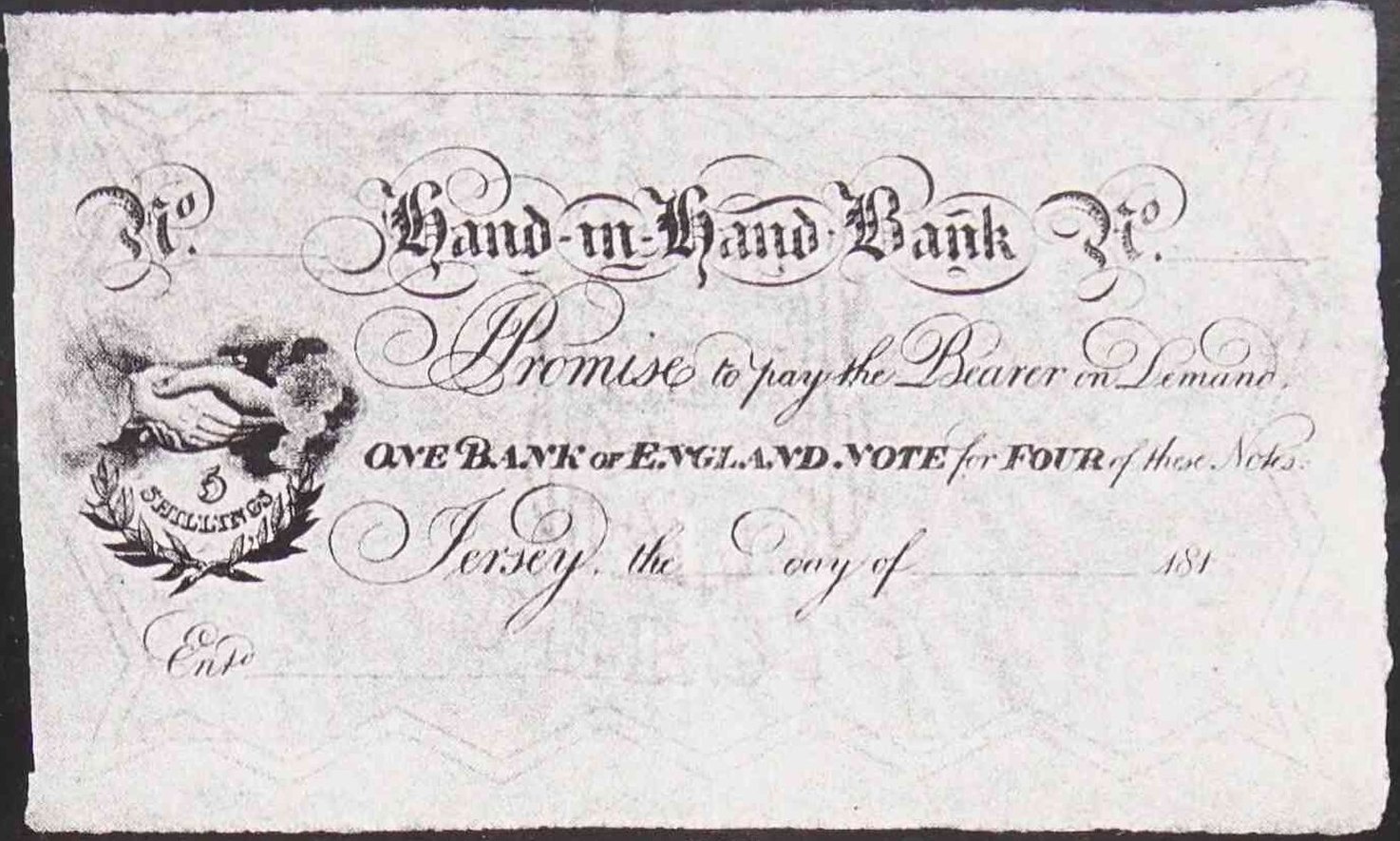
| Hand-in-Hand Bank | unissued 5 shillings, 181- | JN93 | 383 |
| International Bank, St Heliers | two 1 pound notes, 9 November 1865 | JN99 | 384 |
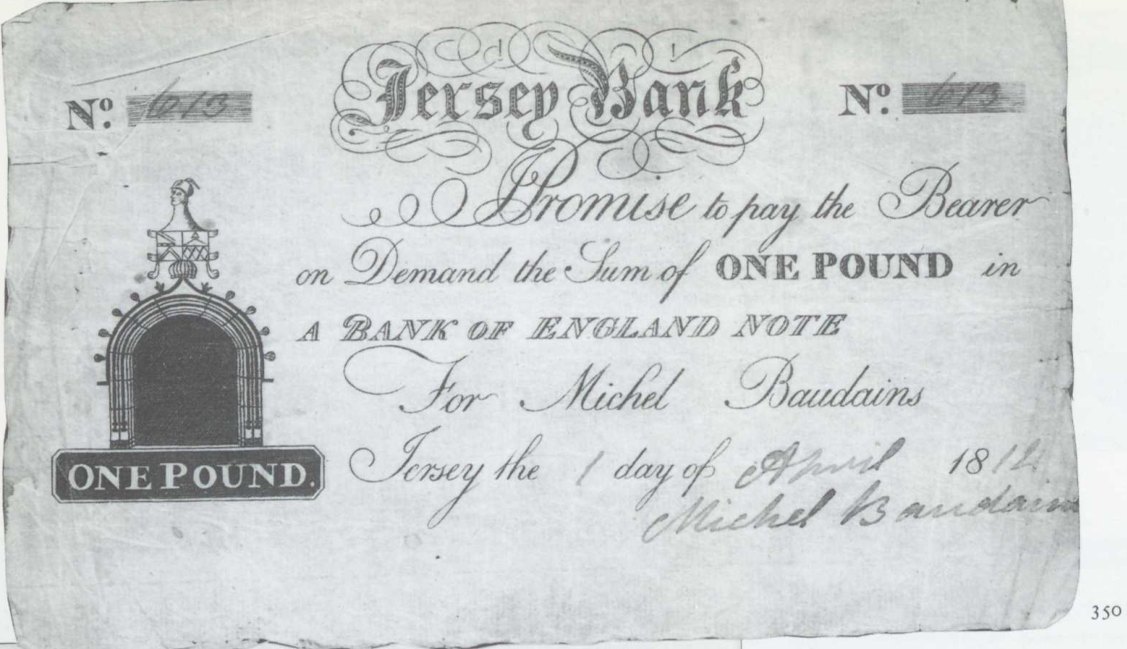
| Jersey Bank, Michel Baudains | 1 pound, 7 April 1813 and 1 April 1814 | JN22 | 385, 386 |
| Jersey Bank, David Gaudin | 1 pound, 19 January 1815 | JN76 | 387 |
| Jersey Bank, Ph. Hamon | 1 pound, 1 September 1813 and 1 January 1814 | JN91 | 388, 389 |
| Jersey Bank, signed G. Syvret | 1 pound, 4 April 1815 | JN229 | 390 |
| Jersey Banking Company, A.D. 1828, Gosset, de Gruchy and Co. | proofs of 9 April 1863 and 1 January 1864 | JN48 | 391, 392 |
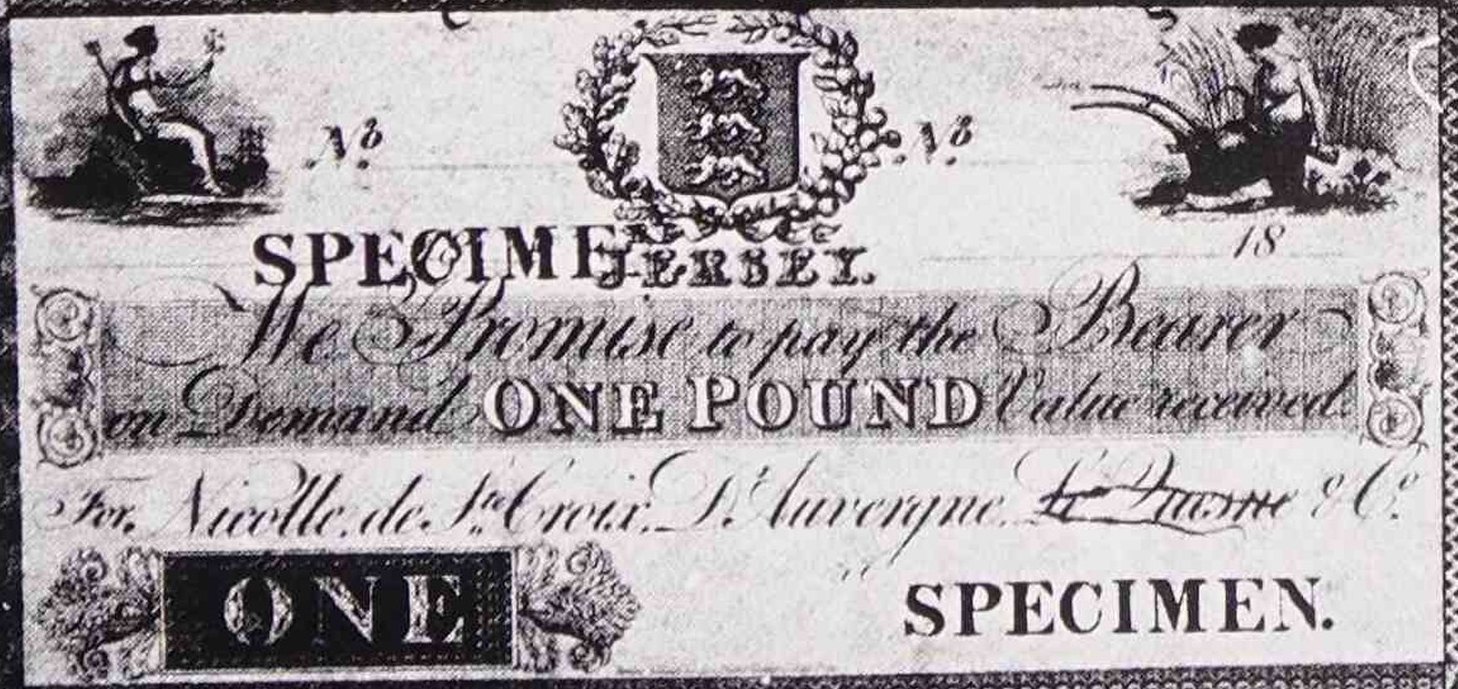
| Jersey Banking Company, Nicolle, de Ste Croix and partners | specimens of 1 pound with three different lists of partners; proof 1 pound and specimen 5 pounds, 1 January 1857; share receipts of 1828 and 1835 | JN178 (receipts: none) | 393 to 398 |
| Jersey Caledonian Bank, Le Cornu, Le Gresley and Co. | unissued 1 pound | JN131 | 399 |
| Jersey Commercial Bank, St Heliers, Janvrin, Durell and Co.; Janvrin, Durell, De Veulle and Co. | specimen 1 pound, "Engraved April 13th/53" in pencil; unissued 1 pound or 26 livres, dated 183- with the year left unfinished | JN100 | 400, 401 |
| Jersey Deposit Bank, 14 Broad Street, G. and H. Challis Bros. and Co. | 1 pound, 1 December 1866 | JN105 | 402 |
| Jersey Joint Stock Bank | two proofs, one with "To this March 28th 1867" in pencil; 1 pound of Jean Ahier, 1 June 1869 | JN12 | 403 to 405 |
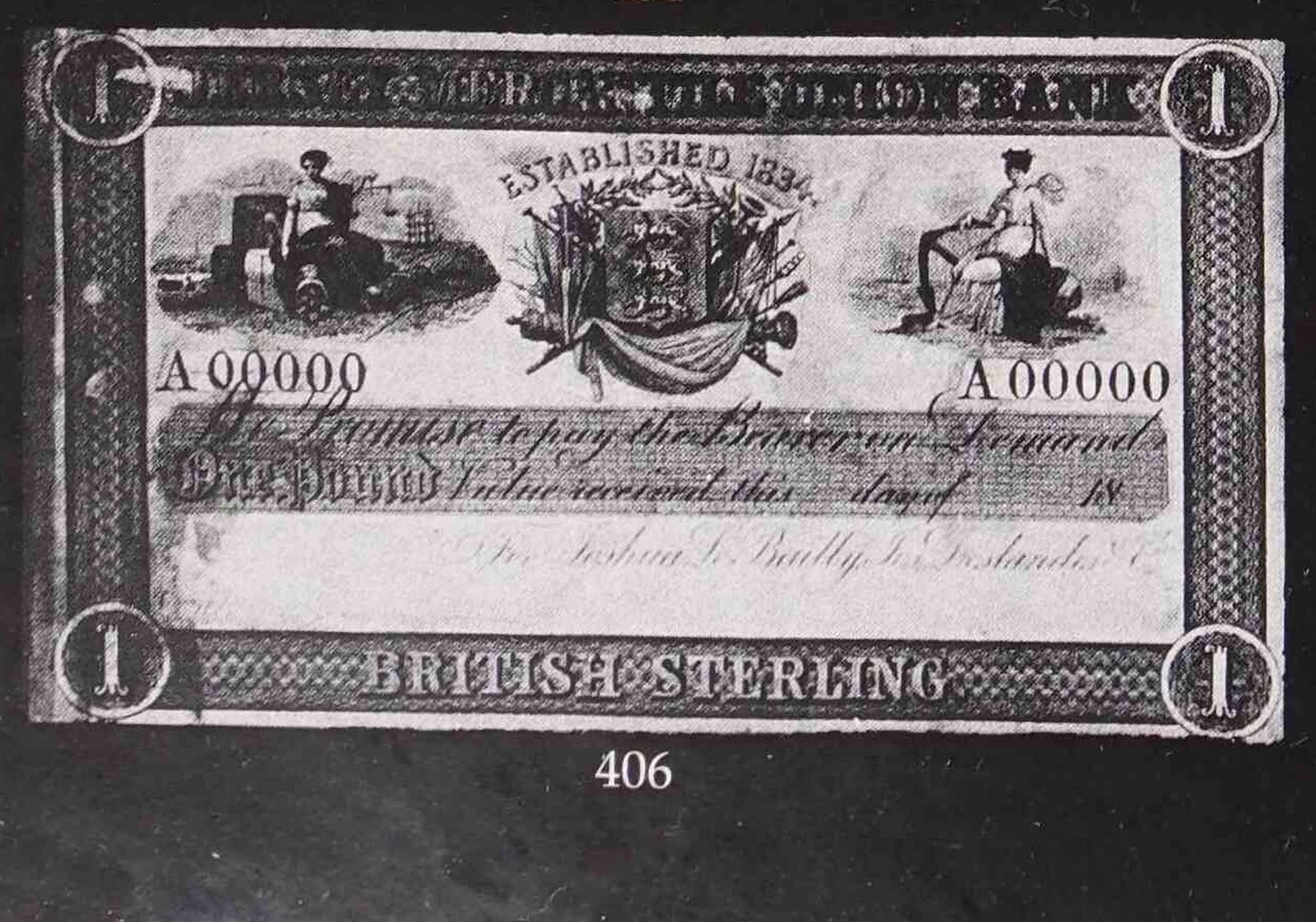
| Jersey Mercantile Union Bank | stage proof, partly hand drawn, for Joshua Le Bailly, Jos Delandes and Co.; specimen perforated C. SKIPPER and EAST; a cheque book of Matthews, de Carteret and Co., 1847 | JN116, JN169 (cheque book: none) | 406 to 408 |
| Jas. Le Couteur, St Helier | 1 pound, 2 July 1814 and 20 June 1817 | JN132 | 409 |
| Jersey Union Bank, Noel and Co. | 1 pound, 6 November 1858 | JN181 | 410 |
| St Brelade's Parish Bank, Dolbel, Le Montais and Co. | 1 pound, 7 October 1859, payable at No. 1 Cross Street | JN146 | 411 |
| St John's Bank; St John's, Jersey | 1 pound or 26 livres, reprint of 1982; unsigned 1 pound dated 183- | JN187, JN133 | 412, 413 |
| St Lawrence's Marsh or Common | 1 pound, 12 March 1835, signed by five members of the committee | JN218 | 414 |
| St Martin's Parish Bank | proof 1 pound | JN189 | 415 |
| St Mary's Parochial Bank | proofs of 1 pound | JN190 | 416, 417 |
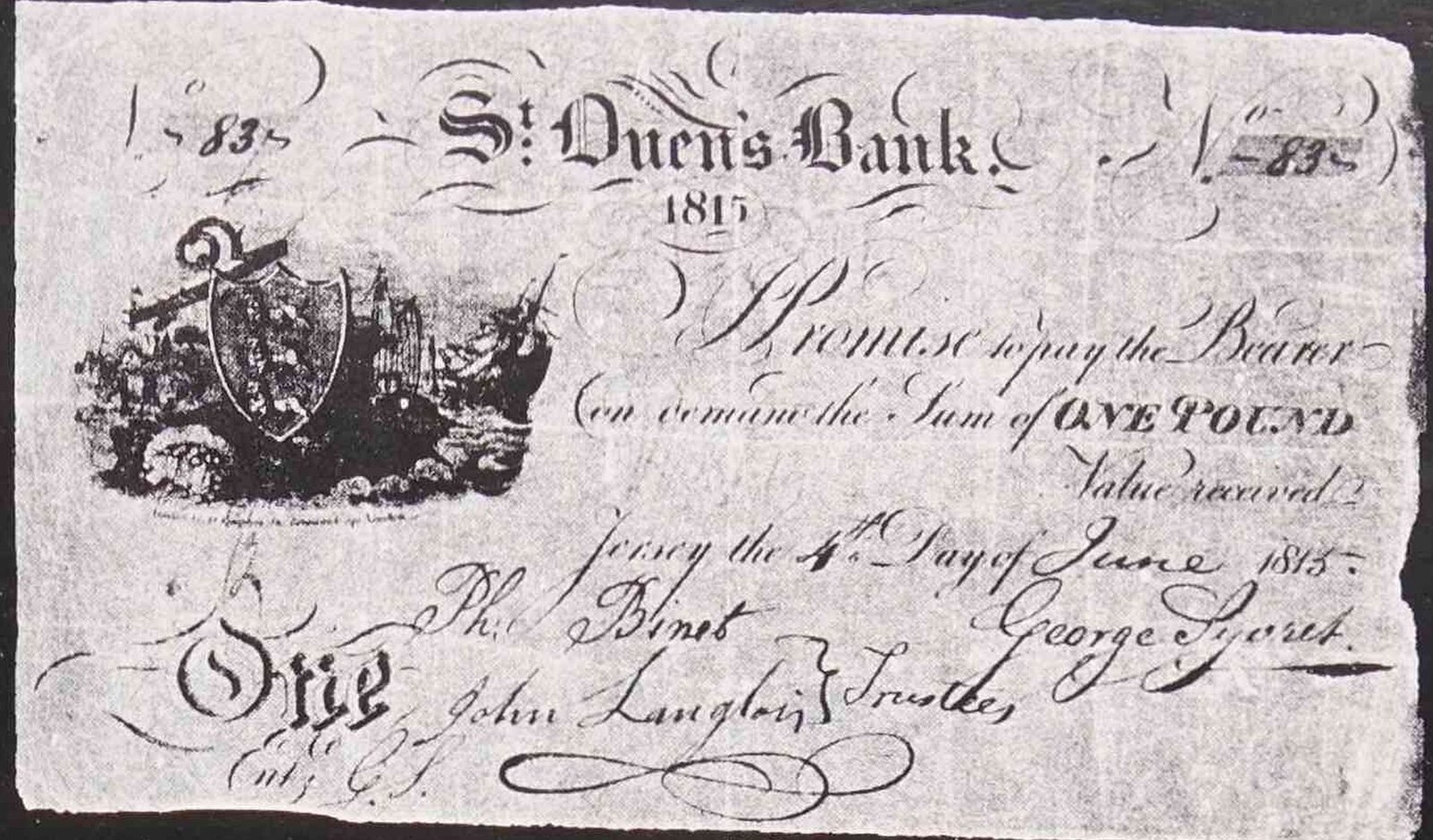
| St Ouen's Bank, signed G. Syvret | 1 pound, 4 June 1815 | JN229 | 418 |
| St Saviour's Bank, Jean Ahier | 1 pound, 17 October 1837 | JN1 | 419 |
| St Saviour's Bank (Parish) | 1 pound, 1 May 1832 and 12 May 1832 | JN193 | 420 to 422 |
| Town Vingtaine of St Helier | cut proofs with "To this 20th March/77" and "To this 12th Novr 1878" in pencil; a back trial with "21st December1858" in pencil; unissued 1 pound with RENEWED NOTE on the back | JN233 | 424 to 426 |
| Vingtaine du Mont an Prêtre | 1 pound, 1 May 1834; 1 pound "undated 1838" | JN240 | 427, 428 |
Baldwin's gives the same McCammon number, JN229, to the Jersey Bank note and the St Ouen's Bank note signed by G. Syvret. The third name on the picture of lot 418 was read for the catalogue as George Syvret, or perhaps Sycret. The Jersey Banking Company's specimens show the firm's partners changing: one has "Le Quesne" crossed through twice.
Printers, plates and reprints
Four of the Jersey pieces came, as Baldwin's says, from the Perkins Bacon archive sold by Spink: the specimen of the Jersey Commercial Bank (Spink lot 470), the stage proof of the Jersey Mercantile Union Bank (lot 471), the specimen of the English and Jersey Union Bank (lot 472) and the specimen of the States Committee for Harbours (lot 473). Baldwin's dates that Spink sale 1 April 1996 under three of the lots and 1 April 1995 under lot 400.
Three printing plates were in the sale. Lot 372 is an engraved copper plate with no value, a pound sign and scrollwork, with the engraver's line "W Adams sc. Bath St". The catalogue names W. Adams as the printer of the States 5 pounds of 1840; Baldwin's does not tie the plate to that note. Lot 373 is a steel plate for a 1 pound of the Old Bank, with ROYAL SQUARE at the left of the picture, "Lake Tokenhouse Yard London" below, and the name of G. Harris and Co. struck on the back. Lot 374 is a modern copper plate of St Peter's for a reprint of the 1 pound, with "Bon pour un Louis" below and "Edition 250 taken 1982". Baldwin's says the 250 reprints were made to help fund the St Peter's Parish Recreation Centre. Lot 412 is one of the 250 reprints of St John's Bank, printed for the St John's Fair in 1982 from the original copper plate. Beresiner had written in 1970 that original plates were in the hands of people in Jersey, and that watermarked paper was to be had with the arms and the words "The States of Jersey".
The same issuers in other sales
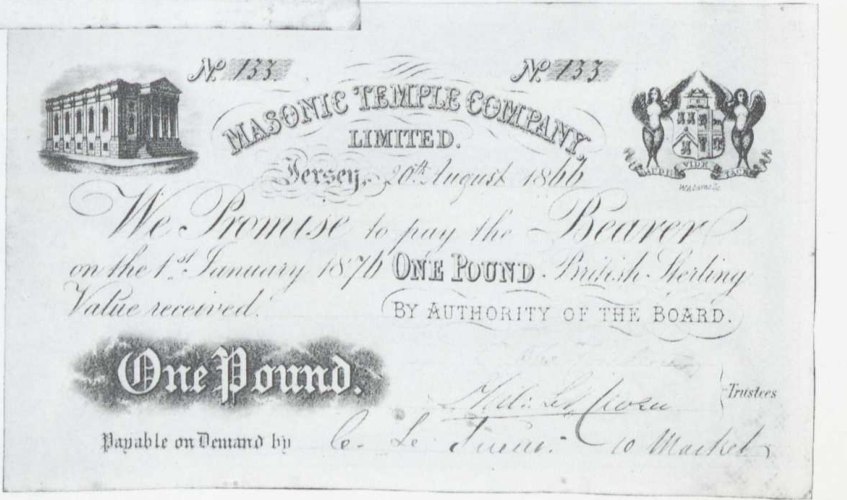
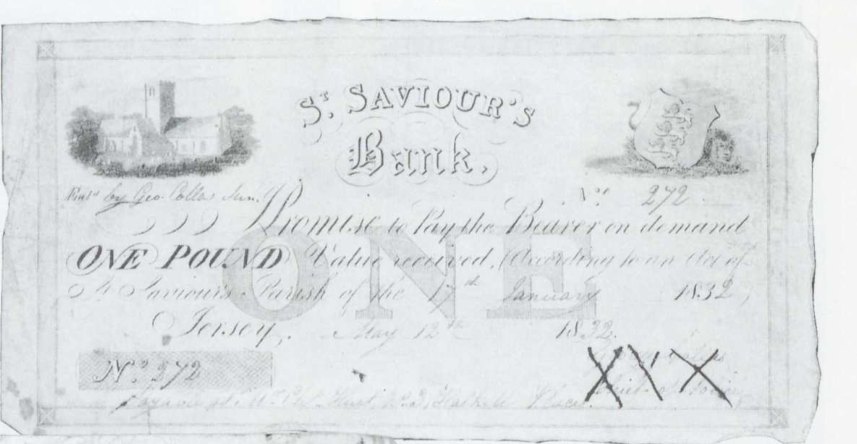
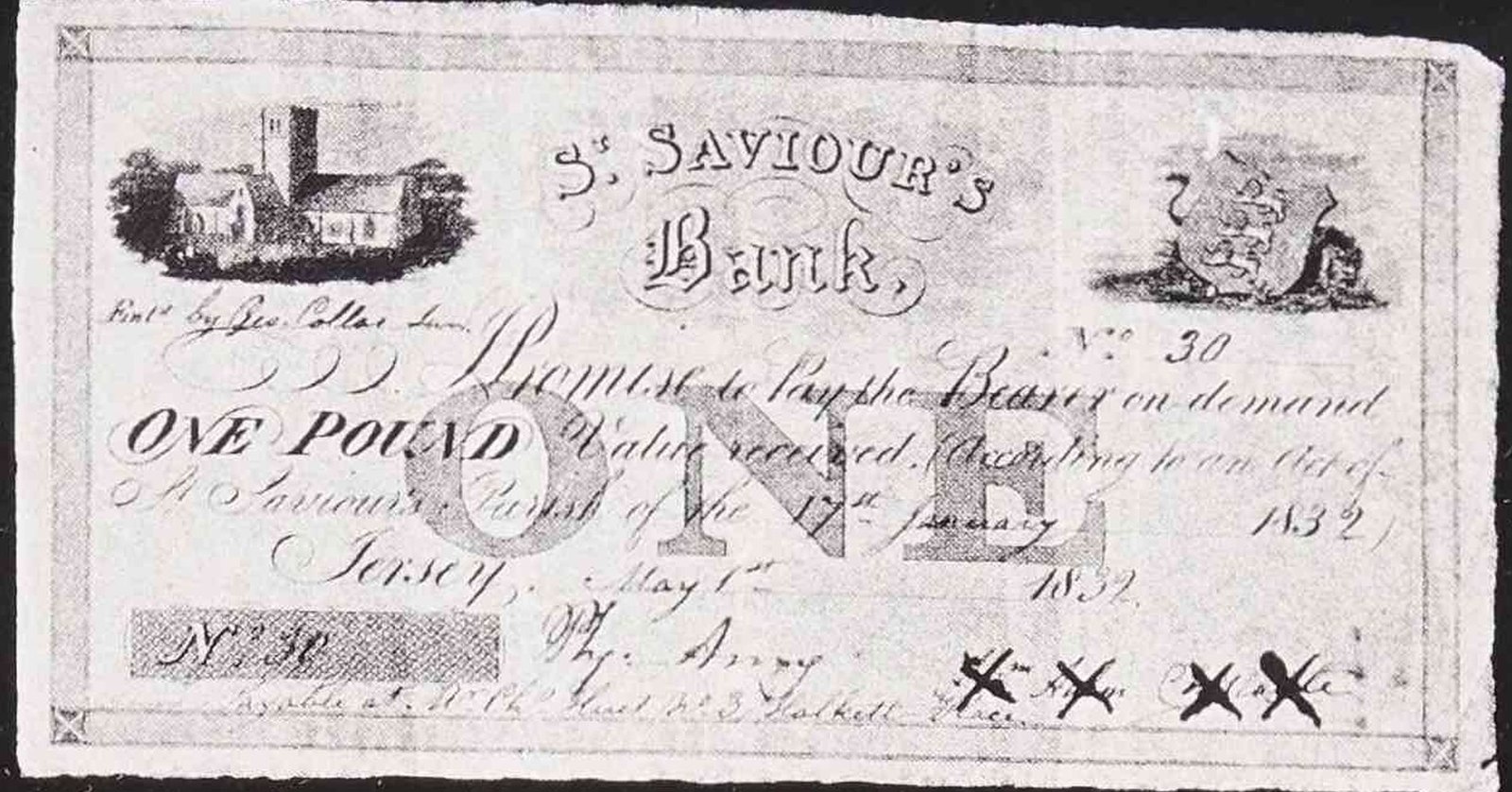
Spink's sale of 9 November 1989, under the heading Jersey and before the occupation notes, offered four lots of these issuers (lots 350 to 353, read on the page itself): a Jersey Bank 1 pound of 1 April 1814 issued for and signed by Michel Baudains (McCammon JN 22, P. S171); a St Saviours Bank 1 pound of 1832 with a church at top left and arms at right (P. S281, JN 40); the note in Spink's plate is dated at Jersey on 12 May 1832, "according to an Act of St Saviour's Parish of the 17th January 1832", with an International Bank 1 pound of 9 November 1865 (P. S161, JN 99); a Jersey Deposit Bank 1 pound of 3 December 1866 (P. S196, JN 105); and a 1 pound of the Masonic Temple Company Ltd. of 20 August 1866, with the temple at top left (P. S226, JN 168).
Two points do not match the McCammon lots. Spink numbers the St Saviours note of 1832 JN 40, while Baldwin's gives a St Saviour's parish note of May 1832, described with a church at upper left and arms and lion to the right, the number JN193 and P S346. The two pictures below show the same design. Neither catalogue explains the difference in numbers. And Spink lot 350 and Baldwin's lot 386 are both Baudains notes of 1 April 1814; Spink's text gives no number, but its plate 12 shows the note's handwritten number at both places, which reads 613 (with a stroke before it that may be a 1); Baldwin's gives lot 386 as no. 619. The plate does not settle whether they are one note.
Henry Christensen's mail auction of 20 December 1991 (lots 165 to 171) offered notes of the Bible Christian Church, the International Bank, the Town Vingtaine, St Mary's, St Saviour's, the Channel Islands Bank and the Jersey Bank. Herbert I. Melnick's sale of 20 December 1982 had a Town Vingtaine note as lot 2760, and lot 3937 included six unissued 1 pound remainders listed under the old number P-A2; the lot names no issuer, and the catalogue has no such number.
The harbour notes of 1874
Beresiner writes that it had been "recorded" that the only notes the States issued in the early period were 1 pound notes of the States Committee of Harbours dated 2 May 1874, signed by the Treasurer (whose name the text layer gives as Ph. Cosset) and called in between 1882 and 1884. Bank Note Reporter of June 1984 (page 52, World Paper Money Update) lists the note as a 1 pound dated 1 June 1874 under an Act of 2 May 1874, uniface, printed by Perkins, Bacon and Co. The McCammon sale had a specimen (lot 423): dated 1 June 1874, stamped SPECIMEN, with "May 1874" in pencil below, from the Perkins Bacon archive. Bank Note Reporter gives 2 May 1874 as the date of the Act and 1 June 1874, the date on the McCammon specimen, for the note; Beresiner gives 2 May 1874 for the notes. The catalogue has no page for them.
What the sources leave open
- The year in which the authorities discussed a States bank, which the text layer of Beresiner's article does not show.
- How many issuers there were. Beresiner writes of hundreds and of more than 200 notes in the Societe Jersiaise collection in 1970, but gives no list.
- Whether the plate engraved by W. Adams belongs to the States note of 1840.
- Whether the harbour notes were dated 2 May or 1 June 1874.
Sources
- Yasha L. Beresiner, "An Excursion to Jersey", IBNS Journal, volume 10, number 2, 1970, pages 81 to 85 for the early period (read in the text layer of the scan).
- Baldwin's, Auction 20, the A. L. T. McCammon Collection, London, 11 October 1999, lots 371 to 428 (lot texts as printed, with the numbers read on the plates).
- Spink, Coin Auction 73, the Amon Carter Collection and other properties, 9 November 1989, page 11, lots 350 to 353.
- Henry Christensen, mail auction 98, 20 December 1991, lots 165 to 171.
- Herbert I. Melnick, sale of the Stanley Gibbons Collection, part V, 20 December 1982, lots 2760 and 3937.
- Bank Note Reporter, June 1984, page 52, World Paper Money Update.


Member comments
Log in or register to post a comment.